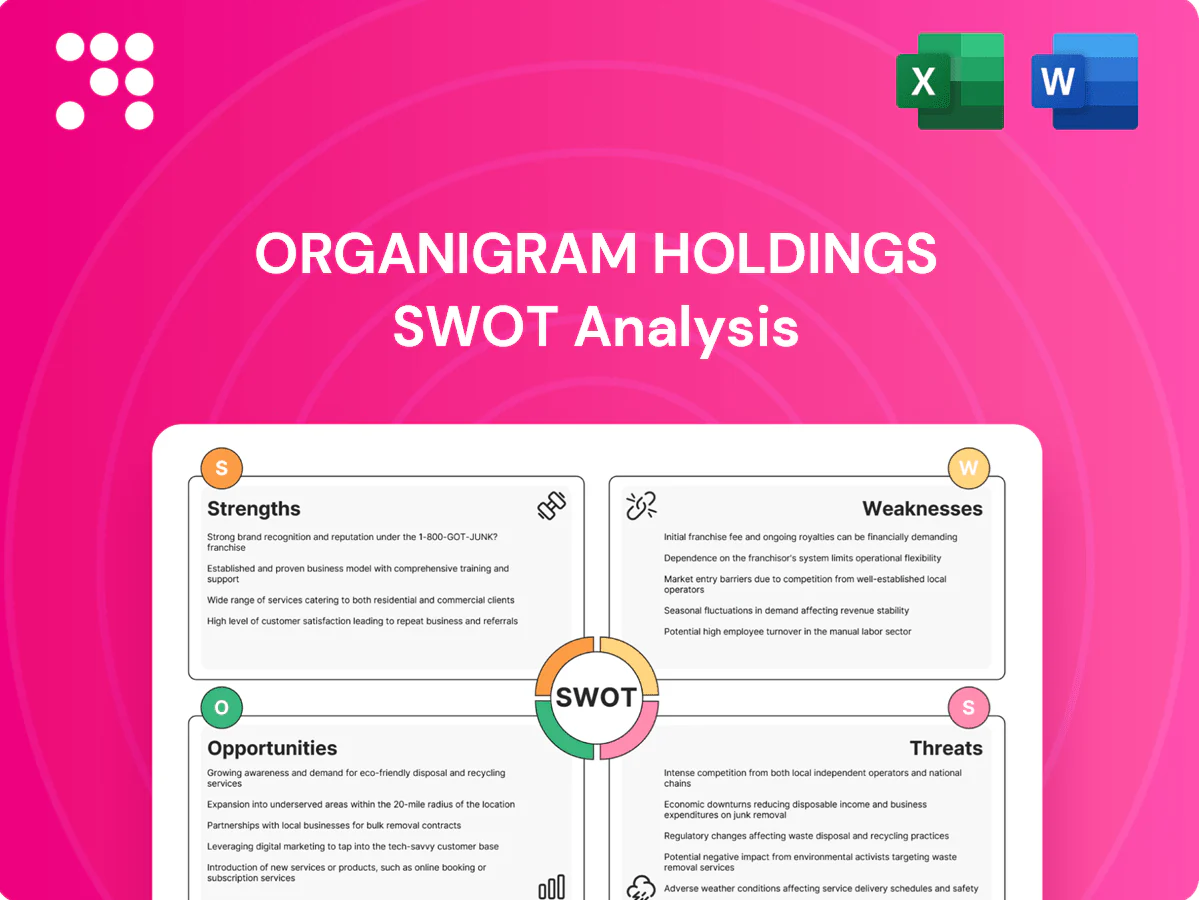
Organigram Holdings SWOT Analysis

Go Beyond the Preview—Access the Full Strategic Report
Organigram Holdings’ SWOT analysis highlights strengths like established production scale and product diversification, alongside weaknesses such as regulatory exposure and margin pressure; it also examines opportunities in CBD markets and export expansion and threats from competition and pricing volatility.
Want the full picture? Purchase the complete SWOT for a research-backed, editable Word report plus an Excel matrix to support investment, strategy, or pitch-ready planning.
Strengths

Indoor cultivation control
Organigram’s indoor grow enables precise environmental control, delivering consistent cannabinoid profiles and quality that support predictable yields and year-round production planning. Consistency underpins brand trust across medical and adult-use channels and accelerates rapid phenotype testing. This control shortens SKU refresh cycles, enabling faster product updates to market.
Diverse product portfolio
Organigram offers dried flower, pre-rolls, vapes, edibles and concentrates across value and premium tiers, supporting a lineup of over 250 SKUs to reach multiple consumer segments and price points. This breadth reduces reliance on any single category amid shifting preferences and helped drive retail penetration into hundreds of Canadian and international outlets. It also enables cross-promotion and basket-size expansion with retail partners.

Strong Canadian distribution
Organigram’s national access via provincial boards plus direct-to-consumer channels gives it scale across Canada’s legal market, which exceeded C$3 billion in retail sales in 2023 (Statistics Canada). Established listings and service levels support shelf stability and velocity, shortening time-to-market for innovations from pilot to province-wide rollouts. That footprint also strengthens negotiating leverage during category resets with major provincial buyers.

Innovation and brand building
Organigram leverages focused R&D and rapid SKU iteration to build defensible brands, supporting recognizable value and premium banners that drive loyalty and trade-down retention while offsetting price compression through differentiated formats and potencies; company trades publicly as OGI on TSX and NASDAQ.
- R&D-driven SKU rotation
- Value + premium banners
- Format/potency differentiation
- White-label/co-dev readiness
Strategic partnerships and optionality
Organigram’s alliances with global CPG and international channels accelerate commercialization and compliance readiness, supporting scaled launches and faster shelf entry; partnerships helped the company target export growth after 2023 regulatory relaxations. External capital and operational know-how bolster formulation, device and IP development, improving R&D velocity and margin expansion. Such ties unlock export lanes as markets open and enhance credibility with regulators and institutional investors, aiding fundraising and M&A optionality.
- Partnerships: enable faster commercial rollouts
- Capital/know-how: improves formulation & device IP
- Export optionality: access to new markets
- Credibility: stronger regulator & investor trust
Indoor cannabis platform: 250+ SKUs, R&D consistency and national distribution
Organigram’s indoor grow and R&D enable consistent, year‑round cannabinoid profiles, rapid SKU iteration and scalable product launches. A 250+ SKU portfolio across value and premium tiers drives retail penetration and trade-up/down resilience. National distribution via provincial boards plus DTC supports shelf stability; company trades as OGI on TSX and NASDAQ.
| Metric | Value |
|---|---|
| SKUs | >250 |
| Canada retail (2023) | C$3.0B (Statistics Canada) |
| Listings | TSX, NASDAQ |
What is included in the product
 Detailed Word Document
Provides a concise SWOT analysis of Organigram Holdings, highlighting internal strengths and weaknesses and external opportunities and threats. Assesses competitive position, growth drivers, operational gaps, and market risks shaping the company’s strategic outlook.

 Customizable Excel Spreadsheet
Provides a concise SWOT matrix for Organigram Holdings to quickly pinpoint strengths, weaknesses, opportunities, and threats, enabling fast strategic alignment and stakeholder-ready summaries.
Weaknesses

Exposure to Canada
Organigram remains heavily Canada-focused, with over 80% of net revenue derived domestically, tying results to a saturated, price-compressed market where retail margins have compressed industry-wide. Provincial purchasing swings (notably Ontario, Quebec and Alberta) can cause quarter-to-quarter revenue volatility and disrupt forecasts. U.S. federal illegality continues to restrict near-term cross‑border expansion and export opportunities. Dependence on one core geography elevates overall business volatility.
Indoor cost structure
Indoor cultivation drives significantly higher energy and labor costs versus greenhouse peers, squeezing Organigram’s per-gram economics. Rising utility prices and higher carbon intensity amplify margin pressure and increase operating expense volatility. Cost spikes risk eroding premium-SKU price benefits and compressing gross margins. Higher emissions intensity complicates ESG metrics that major retailers and institutional buyers increasingly track.

Pricing pressure and mix
Industry oversupply and normalized discounting have pushed competitive pricing in Canada — the legal retail market was roughly CAD 3.4 billion in 2023 — enabling value-tier dominance and frequent promotions. Trade-down behavior can boost volumes but dilute gross margin, challenging Organigram’s ability to grow profitable sales. Maintaining mix toward premium and derivative products is difficult amid promotional cycles that risk eroding brand equity.

Regulatory complexity
Regulatory complexity limits product differentiation: edibles and extracts remain capped at 10 mg THC per package, packaging and strict marketing rules restrict branding, and Health Canada label approvals often take months, slowing innovation. Federal excise duty (greater of $1/g or 10% of price) compresses unit economics, particularly on lower-priced SKUs, while compliance workloads add measurable fixed costs and execution risk.
- 10 mg THC per package cap
- Excise duty: greater of $1/g or 10% of price
- Label approvals often take months
- Compliance adds fixed costs and execution risk
Scale versus largest peers
Relative to the largest LPs, Organigram has smaller bargaining power and less balance-sheet flexibility, which can constrain M&A, capex, and sustained promotional spend; retail consolidation tends to favor larger suppliers for planogram access and shelf share; this scale gap also limits ability to fund in-house device or biosynthesis projects and rapid SKU expansion.
- Smaller bargaining power
- Limited balance-sheet flexibility
- Vulnerable to retail consolidation
- Constrained R&D/device investment
Canada-heavy exposure to CAD 3.4B market; indoor costs and 10 mg THC caps squeeze margins
Organigram is >80% Canada‑dependent, exposing results to a CAD 3.4B (2023) saturated retail market and provincial purchasing swings; indoor cultivation drives higher energy/labour cost and compresses per‑gram margins; regulatory caps (10 mg THC/package) and excise duty (greater of $1/g or 10%) slow innovation and squeeze unit economics.
| Weakness | Metric | 2023–2024 |
|---|---|---|
| Geographic concentration | % domestic revenue | >80% |
| Market size | Canada legal retail | CAD 3.4B (2023) |
| Regulatory | THC cap / excise | 10 mg pkg / $1/g or 10% |
Preview Before You Purchase
Organigram Holdings SWOT Analysis
This is the actual Organigram Holdings SWOT analysis document you’ll receive upon purchase—no surprises, just professional quality. The preview below is taken directly from the full report you'll get. Once purchased, the complete, editable version is unlocked and ready for use.

Go Beyond the Preview—Access the Full Strategic Report
Organigram Holdings’ SWOT analysis highlights strengths like established production scale and product diversification, alongside weaknesses such as regulatory exposure and margin pressure; it also examines opportunities in CBD markets and export expansion and threats from competition and pricing volatility.
Want the full picture? Purchase the complete SWOT for a research-backed, editable Word report plus an Excel matrix to support investment, strategy, or pitch-ready planning.
Strengths
Indoor cultivation control
Organigram’s indoor grow enables precise environmental control, delivering consistent cannabinoid profiles and quality that support predictable yields and year-round production planning. Consistency underpins brand trust across medical and adult-use channels and accelerates rapid phenotype testing. This control shortens SKU refresh cycles, enabling faster product updates to market.
Diverse product portfolio
Organigram offers dried flower, pre-rolls, vapes, edibles and concentrates across value and premium tiers, supporting a lineup of over 250 SKUs to reach multiple consumer segments and price points. This breadth reduces reliance on any single category amid shifting preferences and helped drive retail penetration into hundreds of Canadian and international outlets. It also enables cross-promotion and basket-size expansion with retail partners.
Strong Canadian distribution
Organigram’s national access via provincial boards plus direct-to-consumer channels gives it scale across Canada’s legal market, which exceeded C$3 billion in retail sales in 2023 (Statistics Canada). Established listings and service levels support shelf stability and velocity, shortening time-to-market for innovations from pilot to province-wide rollouts. That footprint also strengthens negotiating leverage during category resets with major provincial buyers.
Innovation and brand building
Organigram leverages focused R&D and rapid SKU iteration to build defensible brands, supporting recognizable value and premium banners that drive loyalty and trade-down retention while offsetting price compression through differentiated formats and potencies; company trades publicly as OGI on TSX and NASDAQ.
- R&D-driven SKU rotation
- Value + premium banners
- Format/potency differentiation
- White-label/co-dev readiness
Strategic partnerships and optionality
Organigram’s alliances with global CPG and international channels accelerate commercialization and compliance readiness, supporting scaled launches and faster shelf entry; partnerships helped the company target export growth after 2023 regulatory relaxations. External capital and operational know-how bolster formulation, device and IP development, improving R&D velocity and margin expansion. Such ties unlock export lanes as markets open and enhance credibility with regulators and institutional investors, aiding fundraising and M&A optionality.
- Partnerships: enable faster commercial rollouts
- Capital/know-how: improves formulation & device IP
- Export optionality: access to new markets
- Credibility: stronger regulator & investor trust
Indoor cannabis platform: 250+ SKUs, R&D consistency and national distribution
Organigram’s indoor grow and R&D enable consistent, year‑round cannabinoid profiles, rapid SKU iteration and scalable product launches. A 250+ SKU portfolio across value and premium tiers drives retail penetration and trade-up/down resilience. National distribution via provincial boards plus DTC supports shelf stability; company trades as OGI on TSX and NASDAQ.
| Metric | Value |
|---|---|
| SKUs | >250 |
| Canada retail (2023) | C$3.0B (Statistics Canada) |
| Listings | TSX, NASDAQ |
What is included in the product
Detailed Word Document
Provides a concise SWOT analysis of Organigram Holdings, highlighting internal strengths and weaknesses and external opportunities and threats. Assesses competitive position, growth drivers, operational gaps, and market risks shaping the company’s strategic outlook.
Customizable Excel Spreadsheet
Provides a concise SWOT matrix for Organigram Holdings to quickly pinpoint strengths, weaknesses, opportunities, and threats, enabling fast strategic alignment and stakeholder-ready summaries.
Weaknesses
Exposure to Canada
Organigram remains heavily Canada-focused, with over 80% of net revenue derived domestically, tying results to a saturated, price-compressed market where retail margins have compressed industry-wide. Provincial purchasing swings (notably Ontario, Quebec and Alberta) can cause quarter-to-quarter revenue volatility and disrupt forecasts. U.S. federal illegality continues to restrict near-term cross‑border expansion and export opportunities. Dependence on one core geography elevates overall business volatility.
Indoor cost structure
Indoor cultivation drives significantly higher energy and labor costs versus greenhouse peers, squeezing Organigram’s per-gram economics. Rising utility prices and higher carbon intensity amplify margin pressure and increase operating expense volatility. Cost spikes risk eroding premium-SKU price benefits and compressing gross margins. Higher emissions intensity complicates ESG metrics that major retailers and institutional buyers increasingly track.
Pricing pressure and mix
Industry oversupply and normalized discounting have pushed competitive pricing in Canada — the legal retail market was roughly CAD 3.4 billion in 2023 — enabling value-tier dominance and frequent promotions. Trade-down behavior can boost volumes but dilute gross margin, challenging Organigram’s ability to grow profitable sales. Maintaining mix toward premium and derivative products is difficult amid promotional cycles that risk eroding brand equity.
Regulatory complexity
Regulatory complexity limits product differentiation: edibles and extracts remain capped at 10 mg THC per package, packaging and strict marketing rules restrict branding, and Health Canada label approvals often take months, slowing innovation. Federal excise duty (greater of $1/g or 10% of price) compresses unit economics, particularly on lower-priced SKUs, while compliance workloads add measurable fixed costs and execution risk.
- 10 mg THC per package cap
- Excise duty: greater of $1/g or 10% of price
- Label approvals often take months
- Compliance adds fixed costs and execution risk
Scale versus largest peers
Relative to the largest LPs, Organigram has smaller bargaining power and less balance-sheet flexibility, which can constrain M&A, capex, and sustained promotional spend; retail consolidation tends to favor larger suppliers for planogram access and shelf share; this scale gap also limits ability to fund in-house device or biosynthesis projects and rapid SKU expansion.
- Smaller bargaining power
- Limited balance-sheet flexibility
- Vulnerable to retail consolidation
- Constrained R&D/device investment
Canada-heavy exposure to CAD 3.4B market; indoor costs and 10 mg THC caps squeeze margins
Organigram is >80% Canada‑dependent, exposing results to a CAD 3.4B (2023) saturated retail market and provincial purchasing swings; indoor cultivation drives higher energy/labour cost and compresses per‑gram margins; regulatory caps (10 mg THC/package) and excise duty (greater of $1/g or 10%) slow innovation and squeeze unit economics.
| Weakness | Metric | 2023–2024 |
|---|---|---|
| Geographic concentration | % domestic revenue | >80% |
| Market size | Canada legal retail | CAD 3.4B (2023) |
| Regulatory | THC cap / excise | 10 mg pkg / $1/g or 10% |
Preview Before You Purchase
Organigram Holdings SWOT Analysis
This is the actual Organigram Holdings SWOT analysis document you’ll receive upon purchase—no surprises, just professional quality. The preview below is taken directly from the full report you'll get. Once purchased, the complete, editable version is unlocked and ready for use.
Original: $10.00
-65%$10.00
$3.50Description
Go Beyond the Preview—Access the Full Strategic Report
Organigram Holdings’ SWOT analysis highlights strengths like established production scale and product diversification, alongside weaknesses such as regulatory exposure and margin pressure; it also examines opportunities in CBD markets and export expansion and threats from competition and pricing volatility.
Want the full picture? Purchase the complete SWOT for a research-backed, editable Word report plus an Excel matrix to support investment, strategy, or pitch-ready planning.
Strengths
Indoor cultivation control
Organigram’s indoor grow enables precise environmental control, delivering consistent cannabinoid profiles and quality that support predictable yields and year-round production planning. Consistency underpins brand trust across medical and adult-use channels and accelerates rapid phenotype testing. This control shortens SKU refresh cycles, enabling faster product updates to market.
Diverse product portfolio
Organigram offers dried flower, pre-rolls, vapes, edibles and concentrates across value and premium tiers, supporting a lineup of over 250 SKUs to reach multiple consumer segments and price points. This breadth reduces reliance on any single category amid shifting preferences and helped drive retail penetration into hundreds of Canadian and international outlets. It also enables cross-promotion and basket-size expansion with retail partners.
Strong Canadian distribution
Organigram’s national access via provincial boards plus direct-to-consumer channels gives it scale across Canada’s legal market, which exceeded C$3 billion in retail sales in 2023 (Statistics Canada). Established listings and service levels support shelf stability and velocity, shortening time-to-market for innovations from pilot to province-wide rollouts. That footprint also strengthens negotiating leverage during category resets with major provincial buyers.
Innovation and brand building
Organigram leverages focused R&D and rapid SKU iteration to build defensible brands, supporting recognizable value and premium banners that drive loyalty and trade-down retention while offsetting price compression through differentiated formats and potencies; company trades publicly as OGI on TSX and NASDAQ.
- R&D-driven SKU rotation
- Value + premium banners
- Format/potency differentiation
- White-label/co-dev readiness
Strategic partnerships and optionality
Organigram’s alliances with global CPG and international channels accelerate commercialization and compliance readiness, supporting scaled launches and faster shelf entry; partnerships helped the company target export growth after 2023 regulatory relaxations. External capital and operational know-how bolster formulation, device and IP development, improving R&D velocity and margin expansion. Such ties unlock export lanes as markets open and enhance credibility with regulators and institutional investors, aiding fundraising and M&A optionality.
- Partnerships: enable faster commercial rollouts
- Capital/know-how: improves formulation & device IP
- Export optionality: access to new markets
- Credibility: stronger regulator & investor trust
Indoor cannabis platform: 250+ SKUs, R&D consistency and national distribution
Organigram’s indoor grow and R&D enable consistent, year‑round cannabinoid profiles, rapid SKU iteration and scalable product launches. A 250+ SKU portfolio across value and premium tiers drives retail penetration and trade-up/down resilience. National distribution via provincial boards plus DTC supports shelf stability; company trades as OGI on TSX and NASDAQ.
| Metric | Value |
|---|---|
| SKUs | >250 |
| Canada retail (2023) | C$3.0B (Statistics Canada) |
| Listings | TSX, NASDAQ |
What is included in the product
Detailed Word Document
Provides a concise SWOT analysis of Organigram Holdings, highlighting internal strengths and weaknesses and external opportunities and threats. Assesses competitive position, growth drivers, operational gaps, and market risks shaping the company’s strategic outlook.
Customizable Excel Spreadsheet
Provides a concise SWOT matrix for Organigram Holdings to quickly pinpoint strengths, weaknesses, opportunities, and threats, enabling fast strategic alignment and stakeholder-ready summaries.
Weaknesses
Exposure to Canada
Organigram remains heavily Canada-focused, with over 80% of net revenue derived domestically, tying results to a saturated, price-compressed market where retail margins have compressed industry-wide. Provincial purchasing swings (notably Ontario, Quebec and Alberta) can cause quarter-to-quarter revenue volatility and disrupt forecasts. U.S. federal illegality continues to restrict near-term cross‑border expansion and export opportunities. Dependence on one core geography elevates overall business volatility.
Indoor cost structure
Indoor cultivation drives significantly higher energy and labor costs versus greenhouse peers, squeezing Organigram’s per-gram economics. Rising utility prices and higher carbon intensity amplify margin pressure and increase operating expense volatility. Cost spikes risk eroding premium-SKU price benefits and compressing gross margins. Higher emissions intensity complicates ESG metrics that major retailers and institutional buyers increasingly track.
Pricing pressure and mix
Industry oversupply and normalized discounting have pushed competitive pricing in Canada — the legal retail market was roughly CAD 3.4 billion in 2023 — enabling value-tier dominance and frequent promotions. Trade-down behavior can boost volumes but dilute gross margin, challenging Organigram’s ability to grow profitable sales. Maintaining mix toward premium and derivative products is difficult amid promotional cycles that risk eroding brand equity.
Regulatory complexity
Regulatory complexity limits product differentiation: edibles and extracts remain capped at 10 mg THC per package, packaging and strict marketing rules restrict branding, and Health Canada label approvals often take months, slowing innovation. Federal excise duty (greater of $1/g or 10% of price) compresses unit economics, particularly on lower-priced SKUs, while compliance workloads add measurable fixed costs and execution risk.
- 10 mg THC per package cap
- Excise duty: greater of $1/g or 10% of price
- Label approvals often take months
- Compliance adds fixed costs and execution risk
Scale versus largest peers
Relative to the largest LPs, Organigram has smaller bargaining power and less balance-sheet flexibility, which can constrain M&A, capex, and sustained promotional spend; retail consolidation tends to favor larger suppliers for planogram access and shelf share; this scale gap also limits ability to fund in-house device or biosynthesis projects and rapid SKU expansion.
- Smaller bargaining power
- Limited balance-sheet flexibility
- Vulnerable to retail consolidation
- Constrained R&D/device investment
Canada-heavy exposure to CAD 3.4B market; indoor costs and 10 mg THC caps squeeze margins
Organigram is >80% Canada‑dependent, exposing results to a CAD 3.4B (2023) saturated retail market and provincial purchasing swings; indoor cultivation drives higher energy/labour cost and compresses per‑gram margins; regulatory caps (10 mg THC/package) and excise duty (greater of $1/g or 10%) slow innovation and squeeze unit economics.
| Weakness | Metric | 2023–2024 |
|---|---|---|
| Geographic concentration | % domestic revenue | >80% |
| Market size | Canada legal retail | CAD 3.4B (2023) |
| Regulatory | THC cap / excise | 10 mg pkg / $1/g or 10% |
Preview Before You Purchase
Organigram Holdings SWOT Analysis
This is the actual Organigram Holdings SWOT analysis document you’ll receive upon purchase—no surprises, just professional quality. The preview below is taken directly from the full report you'll get. Once purchased, the complete, editable version is unlocked and ready for use.











