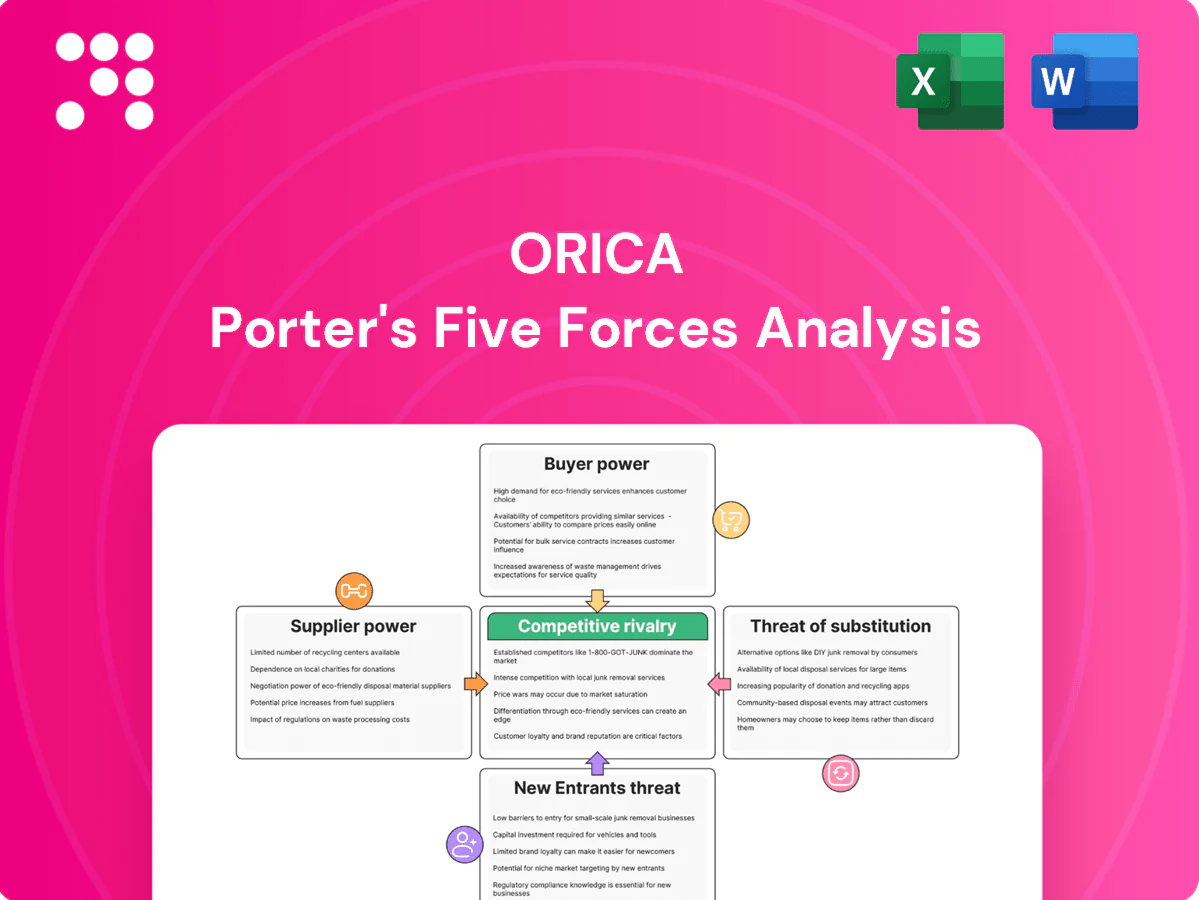
Orica Porter's Five Forces Analysis

From Overview to Strategy Blueprint
Orica's competitive landscape is shaped by the bargaining power of buyers, the threat of new entrants, and the intensity of rivalry within the explosives and mining chemicals sector. Understanding these forces is crucial for navigating market dynamics.
The complete report reveals the real forces shaping Orica’s industry—from supplier influence to threat of new entrants. Gain actionable insights to drive smarter decision-making.
Suppliers Bargaining Power

Concentration of Raw Material Suppliers
Orica's reliance on ammonium nitrate, a crucial component in explosives, highlights the bargaining power of its suppliers. The global market for ammonium nitrate is characterized by a limited number of large-scale producers, giving them considerable leverage in price negotiations. In 2024, the volatility in global energy prices, a key input for ammonium nitrate production, directly influenced the cost of this raw material for Orica.
Uniqueness and Importance of Inputs
The specialized nature of certain chemical inputs and advanced manufacturing equipment for commercial explosives, like Orica's, means some suppliers possess unique capabilities or intellectual property. This uniqueness can give them significant bargaining power, as Orica may have few alternative sources for these critical components or technologies. For instance, in 2024, Orica's reliance on specific nitrogen-based compounds, often sourced from a limited number of global producers, highlights this dependency.

Switching Costs for Orica
Switching suppliers for Orica's core components and specialized services presents substantial costs. These include the expense of re-qualifying new suppliers, reconfiguring intricate supply chains, and the potential for production downtime. For instance, in 2024, Orica's reliance on specialized explosives and blasting systems means that changing manufacturers could necessitate extensive testing and integration, impacting project timelines and operational efficiency.
These elevated switching costs inherently reduce Orica's bargaining power with its existing suppliers. Suppliers are aware that Orica faces significant hurdles in finding and onboarding alternatives, thus strengthening the suppliers' leverage in negotiations. This dynamic is further amplified by Orica's use of long-term supply agreements and deeply integrated relationships with key partners, creating even higher barriers to switching.

Threat of Forward Integration by Suppliers
The threat of suppliers integrating forward into commercial explosives manufacturing, while not a prevalent issue in the industry due to significant capital investment and stringent safety regulations, still grants them a degree of bargaining power. This theoretical possibility compels Orica to cultivate robust supplier relationships and potentially offer competitive pricing to ensure a stable and cost-effective supply chain.
For instance, in 2023, the global explosives market was valued at approximately USD 25 billion, with key raw materials like ammonium nitrate representing a substantial portion of manufacturing costs. Suppliers of these critical inputs, if they possessed the technological expertise and capital, could theoretically enter the market, directly competing with established players like Orica.
- Suppliers' Forward Integration Threat: While complex and regulated, suppliers of key raw materials could potentially enter the commercial explosives manufacturing market.
- Leverage for Suppliers: This theoretical threat gives suppliers leverage, influencing Orica's negotiation power.
- Orica's Response: Orica must maintain strong supplier relationships and offer favorable terms to secure its supply chain.
- Industry Context: The global explosives market, valued around USD 25 billion in 2023, highlights the importance of raw material costs, such as ammonium nitrate.
Impact of Commodity Price Volatility
The prices of crucial raw materials like ammonia and natural gas, essential for ammonium nitrate production, are heavily influenced by global commodity market swings. This volatility allows suppliers to directly pass on price increases to Orica, thereby escalating Orica's operational expenses. For instance, natural gas prices, a primary input for ammonia, saw significant fluctuations in 2024, impacting fertilizer producers globally.
This inherent price pressure, coupled with the potential for supply chain interruptions, significantly bolsters the bargaining power of Orica's suppliers. When supply is tight or demand spikes, suppliers are in a stronger position to dictate terms and pricing, directly affecting Orica's profitability and cost structure.
- Ammonia Price Volatility: Global ammonia prices experienced an upward trend in early 2024, driven by factors such as increased agricultural demand and geopolitical supply concerns.
- Natural Gas Impact: Natural gas, a key feedstock for ammonia, saw price surges in various regions throughout 2024, directly increasing production costs for ammonium nitrate.
- Supplier Leverage: Suppliers of these commodities can leverage market conditions to negotiate higher prices, reducing Orica's profit margins.
Supplier Leverage: A Key Factor in Orica's Supply Chain
Orica's suppliers, particularly those providing ammonium nitrate and specialized chemicals, wield significant bargaining power. This is due to the concentrated nature of the market for these inputs and the high switching costs associated with changing suppliers. In 2024, global energy price volatility directly impacted the cost of ammonium nitrate, a key raw material for Orica, underscoring supplier leverage.
The specialized nature of certain inputs and the significant investment required for Orica's explosives manufacturing mean that suppliers with unique capabilities or intellectual property hold considerable sway. This limits Orica's options and strengthens the suppliers' negotiating position. For instance, Orica's reliance on specific nitrogen-based compounds in 2024, sourced from a limited number of global producers, exemplifies this dependency.
High switching costs, including re-qualification, supply chain reconfiguration, and potential production downtime, further empower Orica's suppliers. In 2024, the need for extensive testing and integration for specialized explosives and blasting systems meant that changing manufacturers could significantly impact project timelines and operational efficiency for Orica.
The threat of suppliers integrating forward into commercial explosives, though mitigated by industry capital and regulatory hurdles, still provides them with leverage. This theoretical possibility compels Orica to maintain strong supplier relationships and potentially offer competitive pricing to ensure supply chain stability and cost-effectiveness.
| Factor | Impact on Orica | 2024 Data/Context |
|---|---|---|
| Supplier Concentration | High leverage for limited producers | Global ammonium nitrate market dominated by a few large-scale producers. |
| Switching Costs | Reduces Orica's bargaining power | Re-qualification, supply chain changes, and downtime are significant deterrents. |
| Input Price Volatility | Pass-through of costs to Orica | Fluctuations in natural gas and ammonia prices directly affect ammonium nitrate costs. |
| Supplier Integration Threat | Theoretical leverage for suppliers | While unlikely due to high barriers, it influences Orica's relationship management. |
What is included in the product
 Detailed Word Document
Orica's Porter's Five Forces analysis delves into the competitive intensity within the explosives and mining services sector, evaluating the bargaining power of buyers and suppliers, the threat of new entrants and substitutes, and the rivalry among existing players.

 Customizable Excel Spreadsheet
Instantly identify and quantify competitive pressures with a visual, interactive dashboard, simplifying complex market dynamics for strategic clarity.
Customers Bargaining Power

Customer Concentration and Purchase Volume
Orica's customer base is heavily concentrated among large global mining companies, quarrying operations, and major infrastructure developers. These entities are significant purchasers of commercial explosives, often buying in very substantial volumes.
This concentration of powerful buyers grants them considerable bargaining leverage over Orica. For instance, in 2023, Orica's top ten customers represented a significant portion of its revenue, allowing these major players to negotiate favorable pricing and contract terms.
Consequently, these large-scale buyers can effectively demand competitive pricing and require customized product and service solutions to meet their specific operational needs, thereby increasing their bargaining power.
Customer Switching Costs
While switching commercial explosives suppliers can involve some logistical and technical adjustments, these costs aren't always a major barrier for customers. For instance, if a customer is primarily focused on price and reliable delivery of standard explosive products, the effort to change suppliers might be manageable. They'll often weigh alternatives based on cost-effectiveness and the proven success of blasting solutions.
Orica is actively working to make it harder for customers to switch away by investing in digital blasting solutions. These advanced technologies are designed to integrate deeply into a customer's day-to-day operations. By embedding their services and data platforms, Orica aims to create a higher level of dependency, effectively increasing the cost and complexity for customers considering a move to a competitor.

Threat of Backward Integration by Customers
Large mining companies, especially those with substantial capital, have the potential to manufacture some of their own commercial explosives, a move known as backward integration. This capability, though demanding due to high capital needs, strict regulations, and safety protocols, grants these customers considerable bargaining power. For instance, in 2024, major mining operations often involve multi-billion dollar investments, making the prospect of internal explosive production a financially calculable, albeit complex, option.
The mere existence of this backward integration threat compels Orica to consistently deliver superior value and service. This pressure ensures Orica remains competitive, focusing on customer retention by offering attractive pricing, reliable supply chains, and innovative solutions to prevent major clients from exploring in-house manufacturing.

Price Sensitivity and Product Standardization
For highly standardized explosive products, customers often display significant price sensitivity. This means they are more likely to switch suppliers based on price alone, intensifying competition. Orica faces pressure to remain cost-competitive, especially as explosives represent a substantial operational expense for industries like mining and construction. For instance, in 2024, global mining companies continued to focus on cost optimization, making the price of bulk explosives a key negotiation point.
Customers actively seek ways to reduce their overall project expenses, and the cost of explosives is a direct contributor to this. This reality compels suppliers like Orica to not only focus on competitive pricing but also to differentiate their offerings. Differentiation often comes through superior service, advanced technological solutions, and a strong emphasis on safety protocols, which can justify a premium price for customers who value reliability and risk reduction.
- Price Sensitivity: Customers for standardized explosives are highly sensitive to price fluctuations, impacting supplier competition.
- Cost Optimization: The cost of explosives is a major factor in mining and construction, driving customer demand for cost efficiency.
- Orica's Strategy: Orica must balance competitive pricing with value-added services, technology, and safety to maintain market position.
Importance of Orica's Offering to Customer Operations
Commercial explosives are absolutely essential for mining and infrastructure projects. Without them, these critical industries simply cannot function. This inherent necessity gives suppliers like Orica a certain degree of leverage, as customers are reliant on these inputs to maintain their operations.
However, customers aren't just looking for any explosive; they demand reliability, top-notch safety standards, and solutions that optimize their blasting performance. This focus shifts the conversation beyond just the price of the explosive itself. For instance, Orica's 2024 performance highlighted its ability to integrate digital blasting technologies and provide extensive technical support, directly addressing these customer needs and moving towards a value-based relationship.
- Indispensable Input: Commercial explosives are non-negotiable for mining and infrastructure, ensuring continuity of operations for customers.
- Demand for Value-Added Services: Customers prioritize supplier reliability, safety protocols, and performance enhancement over simple commodity pricing.
- Orica's Differentiators: Digital blasting solutions and technical expertise allow Orica to offer integrated packages that boost customer productivity and safety, reducing price sensitivity.
- Market Context: In 2024, the mining sector's continued demand for efficiency underscored the value of Orica's advanced solutions in meeting customer operational goals.
Customer Clout: Driving Explosives Market Terms
Orica's customers, primarily large mining and infrastructure firms, possess significant bargaining power due to their substantial purchase volumes and the essential nature of explosives. These buyers can negotiate favorable pricing and demand tailored solutions, influencing Orica's profitability. The threat of backward integration, where customers might produce their own explosives, further amplifies this power, compelling Orica to offer competitive pricing and value-added services.
| Customer Segment | Bargaining Power Factors | Orica's Response/Impact |
|---|---|---|
| Major Global Mining Companies | High volume purchases, potential for backward integration, price sensitivity for standardized products. | Negotiate lower prices, demand customized solutions and advanced digital blasting technologies. In 2024, cost optimization remained a key driver for these clients. |
| Quarrying Operations & Infrastructure Developers | Significant, though often smaller, volume purchases; focus on reliability and cost-effectiveness. | Seek competitive pricing, value reliable delivery and safety standards. Switching costs can be moderate for standard products. |
Preview Before You Purchase
Orica Porter's Five Forces Analysis
This preview displays the complete Orica Porter's Five Forces Analysis, offering a thorough examination of the competitive landscape within the explosives and mining chemicals industry. The document you see here is precisely the same professionally formatted and ready-to-use analysis you will receive immediately after purchase, ensuring no discrepancies or missing sections.

From Overview to Strategy Blueprint
Orica's competitive landscape is shaped by the bargaining power of buyers, the threat of new entrants, and the intensity of rivalry within the explosives and mining chemicals sector. Understanding these forces is crucial for navigating market dynamics.
The complete report reveals the real forces shaping Orica’s industry—from supplier influence to threat of new entrants. Gain actionable insights to drive smarter decision-making.
Suppliers Bargaining Power
Concentration of Raw Material Suppliers
Orica's reliance on ammonium nitrate, a crucial component in explosives, highlights the bargaining power of its suppliers. The global market for ammonium nitrate is characterized by a limited number of large-scale producers, giving them considerable leverage in price negotiations. In 2024, the volatility in global energy prices, a key input for ammonium nitrate production, directly influenced the cost of this raw material for Orica.
Uniqueness and Importance of Inputs
The specialized nature of certain chemical inputs and advanced manufacturing equipment for commercial explosives, like Orica's, means some suppliers possess unique capabilities or intellectual property. This uniqueness can give them significant bargaining power, as Orica may have few alternative sources for these critical components or technologies. For instance, in 2024, Orica's reliance on specific nitrogen-based compounds, often sourced from a limited number of global producers, highlights this dependency.
Switching Costs for Orica
Switching suppliers for Orica's core components and specialized services presents substantial costs. These include the expense of re-qualifying new suppliers, reconfiguring intricate supply chains, and the potential for production downtime. For instance, in 2024, Orica's reliance on specialized explosives and blasting systems means that changing manufacturers could necessitate extensive testing and integration, impacting project timelines and operational efficiency.
These elevated switching costs inherently reduce Orica's bargaining power with its existing suppliers. Suppliers are aware that Orica faces significant hurdles in finding and onboarding alternatives, thus strengthening the suppliers' leverage in negotiations. This dynamic is further amplified by Orica's use of long-term supply agreements and deeply integrated relationships with key partners, creating even higher barriers to switching.
Threat of Forward Integration by Suppliers
The threat of suppliers integrating forward into commercial explosives manufacturing, while not a prevalent issue in the industry due to significant capital investment and stringent safety regulations, still grants them a degree of bargaining power. This theoretical possibility compels Orica to cultivate robust supplier relationships and potentially offer competitive pricing to ensure a stable and cost-effective supply chain.
For instance, in 2023, the global explosives market was valued at approximately USD 25 billion, with key raw materials like ammonium nitrate representing a substantial portion of manufacturing costs. Suppliers of these critical inputs, if they possessed the technological expertise and capital, could theoretically enter the market, directly competing with established players like Orica.
- Suppliers' Forward Integration Threat: While complex and regulated, suppliers of key raw materials could potentially enter the commercial explosives manufacturing market.
- Leverage for Suppliers: This theoretical threat gives suppliers leverage, influencing Orica's negotiation power.
- Orica's Response: Orica must maintain strong supplier relationships and offer favorable terms to secure its supply chain.
- Industry Context: The global explosives market, valued around USD 25 billion in 2023, highlights the importance of raw material costs, such as ammonium nitrate.
Impact of Commodity Price Volatility
The prices of crucial raw materials like ammonia and natural gas, essential for ammonium nitrate production, are heavily influenced by global commodity market swings. This volatility allows suppliers to directly pass on price increases to Orica, thereby escalating Orica's operational expenses. For instance, natural gas prices, a primary input for ammonia, saw significant fluctuations in 2024, impacting fertilizer producers globally.
This inherent price pressure, coupled with the potential for supply chain interruptions, significantly bolsters the bargaining power of Orica's suppliers. When supply is tight or demand spikes, suppliers are in a stronger position to dictate terms and pricing, directly affecting Orica's profitability and cost structure.
- Ammonia Price Volatility: Global ammonia prices experienced an upward trend in early 2024, driven by factors such as increased agricultural demand and geopolitical supply concerns.
- Natural Gas Impact: Natural gas, a key feedstock for ammonia, saw price surges in various regions throughout 2024, directly increasing production costs for ammonium nitrate.
- Supplier Leverage: Suppliers of these commodities can leverage market conditions to negotiate higher prices, reducing Orica's profit margins.
Supplier Leverage: A Key Factor in Orica's Supply Chain
Orica's suppliers, particularly those providing ammonium nitrate and specialized chemicals, wield significant bargaining power. This is due to the concentrated nature of the market for these inputs and the high switching costs associated with changing suppliers. In 2024, global energy price volatility directly impacted the cost of ammonium nitrate, a key raw material for Orica, underscoring supplier leverage.
The specialized nature of certain inputs and the significant investment required for Orica's explosives manufacturing mean that suppliers with unique capabilities or intellectual property hold considerable sway. This limits Orica's options and strengthens the suppliers' negotiating position. For instance, Orica's reliance on specific nitrogen-based compounds in 2024, sourced from a limited number of global producers, exemplifies this dependency.
High switching costs, including re-qualification, supply chain reconfiguration, and potential production downtime, further empower Orica's suppliers. In 2024, the need for extensive testing and integration for specialized explosives and blasting systems meant that changing manufacturers could significantly impact project timelines and operational efficiency for Orica.
The threat of suppliers integrating forward into commercial explosives, though mitigated by industry capital and regulatory hurdles, still provides them with leverage. This theoretical possibility compels Orica to maintain strong supplier relationships and potentially offer competitive pricing to ensure supply chain stability and cost-effectiveness.
| Factor | Impact on Orica | 2024 Data/Context |
|---|---|---|
| Supplier Concentration | High leverage for limited producers | Global ammonium nitrate market dominated by a few large-scale producers. |
| Switching Costs | Reduces Orica's bargaining power | Re-qualification, supply chain changes, and downtime are significant deterrents. |
| Input Price Volatility | Pass-through of costs to Orica | Fluctuations in natural gas and ammonia prices directly affect ammonium nitrate costs. |
| Supplier Integration Threat | Theoretical leverage for suppliers | While unlikely due to high barriers, it influences Orica's relationship management. |
What is included in the product
Detailed Word Document
Orica's Porter's Five Forces analysis delves into the competitive intensity within the explosives and mining services sector, evaluating the bargaining power of buyers and suppliers, the threat of new entrants and substitutes, and the rivalry among existing players.
Customizable Excel Spreadsheet
Instantly identify and quantify competitive pressures with a visual, interactive dashboard, simplifying complex market dynamics for strategic clarity.
Customers Bargaining Power
Customer Concentration and Purchase Volume
Orica's customer base is heavily concentrated among large global mining companies, quarrying operations, and major infrastructure developers. These entities are significant purchasers of commercial explosives, often buying in very substantial volumes.
This concentration of powerful buyers grants them considerable bargaining leverage over Orica. For instance, in 2023, Orica's top ten customers represented a significant portion of its revenue, allowing these major players to negotiate favorable pricing and contract terms.
Consequently, these large-scale buyers can effectively demand competitive pricing and require customized product and service solutions to meet their specific operational needs, thereby increasing their bargaining power.
Customer Switching Costs
While switching commercial explosives suppliers can involve some logistical and technical adjustments, these costs aren't always a major barrier for customers. For instance, if a customer is primarily focused on price and reliable delivery of standard explosive products, the effort to change suppliers might be manageable. They'll often weigh alternatives based on cost-effectiveness and the proven success of blasting solutions.
Orica is actively working to make it harder for customers to switch away by investing in digital blasting solutions. These advanced technologies are designed to integrate deeply into a customer's day-to-day operations. By embedding their services and data platforms, Orica aims to create a higher level of dependency, effectively increasing the cost and complexity for customers considering a move to a competitor.
Threat of Backward Integration by Customers
Large mining companies, especially those with substantial capital, have the potential to manufacture some of their own commercial explosives, a move known as backward integration. This capability, though demanding due to high capital needs, strict regulations, and safety protocols, grants these customers considerable bargaining power. For instance, in 2024, major mining operations often involve multi-billion dollar investments, making the prospect of internal explosive production a financially calculable, albeit complex, option.
The mere existence of this backward integration threat compels Orica to consistently deliver superior value and service. This pressure ensures Orica remains competitive, focusing on customer retention by offering attractive pricing, reliable supply chains, and innovative solutions to prevent major clients from exploring in-house manufacturing.
Price Sensitivity and Product Standardization
For highly standardized explosive products, customers often display significant price sensitivity. This means they are more likely to switch suppliers based on price alone, intensifying competition. Orica faces pressure to remain cost-competitive, especially as explosives represent a substantial operational expense for industries like mining and construction. For instance, in 2024, global mining companies continued to focus on cost optimization, making the price of bulk explosives a key negotiation point.
Customers actively seek ways to reduce their overall project expenses, and the cost of explosives is a direct contributor to this. This reality compels suppliers like Orica to not only focus on competitive pricing but also to differentiate their offerings. Differentiation often comes through superior service, advanced technological solutions, and a strong emphasis on safety protocols, which can justify a premium price for customers who value reliability and risk reduction.
- Price Sensitivity: Customers for standardized explosives are highly sensitive to price fluctuations, impacting supplier competition.
- Cost Optimization: The cost of explosives is a major factor in mining and construction, driving customer demand for cost efficiency.
- Orica's Strategy: Orica must balance competitive pricing with value-added services, technology, and safety to maintain market position.
Importance of Orica's Offering to Customer Operations
Commercial explosives are absolutely essential for mining and infrastructure projects. Without them, these critical industries simply cannot function. This inherent necessity gives suppliers like Orica a certain degree of leverage, as customers are reliant on these inputs to maintain their operations.
However, customers aren't just looking for any explosive; they demand reliability, top-notch safety standards, and solutions that optimize their blasting performance. This focus shifts the conversation beyond just the price of the explosive itself. For instance, Orica's 2024 performance highlighted its ability to integrate digital blasting technologies and provide extensive technical support, directly addressing these customer needs and moving towards a value-based relationship.
- Indispensable Input: Commercial explosives are non-negotiable for mining and infrastructure, ensuring continuity of operations for customers.
- Demand for Value-Added Services: Customers prioritize supplier reliability, safety protocols, and performance enhancement over simple commodity pricing.
- Orica's Differentiators: Digital blasting solutions and technical expertise allow Orica to offer integrated packages that boost customer productivity and safety, reducing price sensitivity.
- Market Context: In 2024, the mining sector's continued demand for efficiency underscored the value of Orica's advanced solutions in meeting customer operational goals.
Customer Clout: Driving Explosives Market Terms
Orica's customers, primarily large mining and infrastructure firms, possess significant bargaining power due to their substantial purchase volumes and the essential nature of explosives. These buyers can negotiate favorable pricing and demand tailored solutions, influencing Orica's profitability. The threat of backward integration, where customers might produce their own explosives, further amplifies this power, compelling Orica to offer competitive pricing and value-added services.
| Customer Segment | Bargaining Power Factors | Orica's Response/Impact |
|---|---|---|
| Major Global Mining Companies | High volume purchases, potential for backward integration, price sensitivity for standardized products. | Negotiate lower prices, demand customized solutions and advanced digital blasting technologies. In 2024, cost optimization remained a key driver for these clients. |
| Quarrying Operations & Infrastructure Developers | Significant, though often smaller, volume purchases; focus on reliability and cost-effectiveness. | Seek competitive pricing, value reliable delivery and safety standards. Switching costs can be moderate for standard products. |
Preview Before You Purchase
Orica Porter's Five Forces Analysis
This preview displays the complete Orica Porter's Five Forces Analysis, offering a thorough examination of the competitive landscape within the explosives and mining chemicals industry. The document you see here is precisely the same professionally formatted and ready-to-use analysis you will receive immediately after purchase, ensuring no discrepancies or missing sections.
Original: $10.00
-65%$10.00
$3.50Description
From Overview to Strategy Blueprint
Orica's competitive landscape is shaped by the bargaining power of buyers, the threat of new entrants, and the intensity of rivalry within the explosives and mining chemicals sector. Understanding these forces is crucial for navigating market dynamics.
The complete report reveals the real forces shaping Orica’s industry—from supplier influence to threat of new entrants. Gain actionable insights to drive smarter decision-making.
Suppliers Bargaining Power
Concentration of Raw Material Suppliers
Orica's reliance on ammonium nitrate, a crucial component in explosives, highlights the bargaining power of its suppliers. The global market for ammonium nitrate is characterized by a limited number of large-scale producers, giving them considerable leverage in price negotiations. In 2024, the volatility in global energy prices, a key input for ammonium nitrate production, directly influenced the cost of this raw material for Orica.
Uniqueness and Importance of Inputs
The specialized nature of certain chemical inputs and advanced manufacturing equipment for commercial explosives, like Orica's, means some suppliers possess unique capabilities or intellectual property. This uniqueness can give them significant bargaining power, as Orica may have few alternative sources for these critical components or technologies. For instance, in 2024, Orica's reliance on specific nitrogen-based compounds, often sourced from a limited number of global producers, highlights this dependency.
Switching Costs for Orica
Switching suppliers for Orica's core components and specialized services presents substantial costs. These include the expense of re-qualifying new suppliers, reconfiguring intricate supply chains, and the potential for production downtime. For instance, in 2024, Orica's reliance on specialized explosives and blasting systems means that changing manufacturers could necessitate extensive testing and integration, impacting project timelines and operational efficiency.
These elevated switching costs inherently reduce Orica's bargaining power with its existing suppliers. Suppliers are aware that Orica faces significant hurdles in finding and onboarding alternatives, thus strengthening the suppliers' leverage in negotiations. This dynamic is further amplified by Orica's use of long-term supply agreements and deeply integrated relationships with key partners, creating even higher barriers to switching.
Threat of Forward Integration by Suppliers
The threat of suppliers integrating forward into commercial explosives manufacturing, while not a prevalent issue in the industry due to significant capital investment and stringent safety regulations, still grants them a degree of bargaining power. This theoretical possibility compels Orica to cultivate robust supplier relationships and potentially offer competitive pricing to ensure a stable and cost-effective supply chain.
For instance, in 2023, the global explosives market was valued at approximately USD 25 billion, with key raw materials like ammonium nitrate representing a substantial portion of manufacturing costs. Suppliers of these critical inputs, if they possessed the technological expertise and capital, could theoretically enter the market, directly competing with established players like Orica.
- Suppliers' Forward Integration Threat: While complex and regulated, suppliers of key raw materials could potentially enter the commercial explosives manufacturing market.
- Leverage for Suppliers: This theoretical threat gives suppliers leverage, influencing Orica's negotiation power.
- Orica's Response: Orica must maintain strong supplier relationships and offer favorable terms to secure its supply chain.
- Industry Context: The global explosives market, valued around USD 25 billion in 2023, highlights the importance of raw material costs, such as ammonium nitrate.
Impact of Commodity Price Volatility
The prices of crucial raw materials like ammonia and natural gas, essential for ammonium nitrate production, are heavily influenced by global commodity market swings. This volatility allows suppliers to directly pass on price increases to Orica, thereby escalating Orica's operational expenses. For instance, natural gas prices, a primary input for ammonia, saw significant fluctuations in 2024, impacting fertilizer producers globally.
This inherent price pressure, coupled with the potential for supply chain interruptions, significantly bolsters the bargaining power of Orica's suppliers. When supply is tight or demand spikes, suppliers are in a stronger position to dictate terms and pricing, directly affecting Orica's profitability and cost structure.
- Ammonia Price Volatility: Global ammonia prices experienced an upward trend in early 2024, driven by factors such as increased agricultural demand and geopolitical supply concerns.
- Natural Gas Impact: Natural gas, a key feedstock for ammonia, saw price surges in various regions throughout 2024, directly increasing production costs for ammonium nitrate.
- Supplier Leverage: Suppliers of these commodities can leverage market conditions to negotiate higher prices, reducing Orica's profit margins.
Supplier Leverage: A Key Factor in Orica's Supply Chain
Orica's suppliers, particularly those providing ammonium nitrate and specialized chemicals, wield significant bargaining power. This is due to the concentrated nature of the market for these inputs and the high switching costs associated with changing suppliers. In 2024, global energy price volatility directly impacted the cost of ammonium nitrate, a key raw material for Orica, underscoring supplier leverage.
The specialized nature of certain inputs and the significant investment required for Orica's explosives manufacturing mean that suppliers with unique capabilities or intellectual property hold considerable sway. This limits Orica's options and strengthens the suppliers' negotiating position. For instance, Orica's reliance on specific nitrogen-based compounds in 2024, sourced from a limited number of global producers, exemplifies this dependency.
High switching costs, including re-qualification, supply chain reconfiguration, and potential production downtime, further empower Orica's suppliers. In 2024, the need for extensive testing and integration for specialized explosives and blasting systems meant that changing manufacturers could significantly impact project timelines and operational efficiency for Orica.
The threat of suppliers integrating forward into commercial explosives, though mitigated by industry capital and regulatory hurdles, still provides them with leverage. This theoretical possibility compels Orica to maintain strong supplier relationships and potentially offer competitive pricing to ensure supply chain stability and cost-effectiveness.
| Factor | Impact on Orica | 2024 Data/Context |
|---|---|---|
| Supplier Concentration | High leverage for limited producers | Global ammonium nitrate market dominated by a few large-scale producers. |
| Switching Costs | Reduces Orica's bargaining power | Re-qualification, supply chain changes, and downtime are significant deterrents. |
| Input Price Volatility | Pass-through of costs to Orica | Fluctuations in natural gas and ammonia prices directly affect ammonium nitrate costs. |
| Supplier Integration Threat | Theoretical leverage for suppliers | While unlikely due to high barriers, it influences Orica's relationship management. |
What is included in the product
Detailed Word Document
Orica's Porter's Five Forces analysis delves into the competitive intensity within the explosives and mining services sector, evaluating the bargaining power of buyers and suppliers, the threat of new entrants and substitutes, and the rivalry among existing players.
Customizable Excel Spreadsheet
Instantly identify and quantify competitive pressures with a visual, interactive dashboard, simplifying complex market dynamics for strategic clarity.
Customers Bargaining Power
Customer Concentration and Purchase Volume
Orica's customer base is heavily concentrated among large global mining companies, quarrying operations, and major infrastructure developers. These entities are significant purchasers of commercial explosives, often buying in very substantial volumes.
This concentration of powerful buyers grants them considerable bargaining leverage over Orica. For instance, in 2023, Orica's top ten customers represented a significant portion of its revenue, allowing these major players to negotiate favorable pricing and contract terms.
Consequently, these large-scale buyers can effectively demand competitive pricing and require customized product and service solutions to meet their specific operational needs, thereby increasing their bargaining power.
Customer Switching Costs
While switching commercial explosives suppliers can involve some logistical and technical adjustments, these costs aren't always a major barrier for customers. For instance, if a customer is primarily focused on price and reliable delivery of standard explosive products, the effort to change suppliers might be manageable. They'll often weigh alternatives based on cost-effectiveness and the proven success of blasting solutions.
Orica is actively working to make it harder for customers to switch away by investing in digital blasting solutions. These advanced technologies are designed to integrate deeply into a customer's day-to-day operations. By embedding their services and data platforms, Orica aims to create a higher level of dependency, effectively increasing the cost and complexity for customers considering a move to a competitor.
Threat of Backward Integration by Customers
Large mining companies, especially those with substantial capital, have the potential to manufacture some of their own commercial explosives, a move known as backward integration. This capability, though demanding due to high capital needs, strict regulations, and safety protocols, grants these customers considerable bargaining power. For instance, in 2024, major mining operations often involve multi-billion dollar investments, making the prospect of internal explosive production a financially calculable, albeit complex, option.
The mere existence of this backward integration threat compels Orica to consistently deliver superior value and service. This pressure ensures Orica remains competitive, focusing on customer retention by offering attractive pricing, reliable supply chains, and innovative solutions to prevent major clients from exploring in-house manufacturing.
Price Sensitivity and Product Standardization
For highly standardized explosive products, customers often display significant price sensitivity. This means they are more likely to switch suppliers based on price alone, intensifying competition. Orica faces pressure to remain cost-competitive, especially as explosives represent a substantial operational expense for industries like mining and construction. For instance, in 2024, global mining companies continued to focus on cost optimization, making the price of bulk explosives a key negotiation point.
Customers actively seek ways to reduce their overall project expenses, and the cost of explosives is a direct contributor to this. This reality compels suppliers like Orica to not only focus on competitive pricing but also to differentiate their offerings. Differentiation often comes through superior service, advanced technological solutions, and a strong emphasis on safety protocols, which can justify a premium price for customers who value reliability and risk reduction.
- Price Sensitivity: Customers for standardized explosives are highly sensitive to price fluctuations, impacting supplier competition.
- Cost Optimization: The cost of explosives is a major factor in mining and construction, driving customer demand for cost efficiency.
- Orica's Strategy: Orica must balance competitive pricing with value-added services, technology, and safety to maintain market position.
Importance of Orica's Offering to Customer Operations
Commercial explosives are absolutely essential for mining and infrastructure projects. Without them, these critical industries simply cannot function. This inherent necessity gives suppliers like Orica a certain degree of leverage, as customers are reliant on these inputs to maintain their operations.
However, customers aren't just looking for any explosive; they demand reliability, top-notch safety standards, and solutions that optimize their blasting performance. This focus shifts the conversation beyond just the price of the explosive itself. For instance, Orica's 2024 performance highlighted its ability to integrate digital blasting technologies and provide extensive technical support, directly addressing these customer needs and moving towards a value-based relationship.
- Indispensable Input: Commercial explosives are non-negotiable for mining and infrastructure, ensuring continuity of operations for customers.
- Demand for Value-Added Services: Customers prioritize supplier reliability, safety protocols, and performance enhancement over simple commodity pricing.
- Orica's Differentiators: Digital blasting solutions and technical expertise allow Orica to offer integrated packages that boost customer productivity and safety, reducing price sensitivity.
- Market Context: In 2024, the mining sector's continued demand for efficiency underscored the value of Orica's advanced solutions in meeting customer operational goals.
Customer Clout: Driving Explosives Market Terms
Orica's customers, primarily large mining and infrastructure firms, possess significant bargaining power due to their substantial purchase volumes and the essential nature of explosives. These buyers can negotiate favorable pricing and demand tailored solutions, influencing Orica's profitability. The threat of backward integration, where customers might produce their own explosives, further amplifies this power, compelling Orica to offer competitive pricing and value-added services.
| Customer Segment | Bargaining Power Factors | Orica's Response/Impact |
|---|---|---|
| Major Global Mining Companies | High volume purchases, potential for backward integration, price sensitivity for standardized products. | Negotiate lower prices, demand customized solutions and advanced digital blasting technologies. In 2024, cost optimization remained a key driver for these clients. |
| Quarrying Operations & Infrastructure Developers | Significant, though often smaller, volume purchases; focus on reliability and cost-effectiveness. | Seek competitive pricing, value reliable delivery and safety standards. Switching costs can be moderate for standard products. |
Preview Before You Purchase
Orica Porter's Five Forces Analysis
This preview displays the complete Orica Porter's Five Forces Analysis, offering a thorough examination of the competitive landscape within the explosives and mining chemicals industry. The document you see here is precisely the same professionally formatted and ready-to-use analysis you will receive immediately after purchase, ensuring no discrepancies or missing sections.











