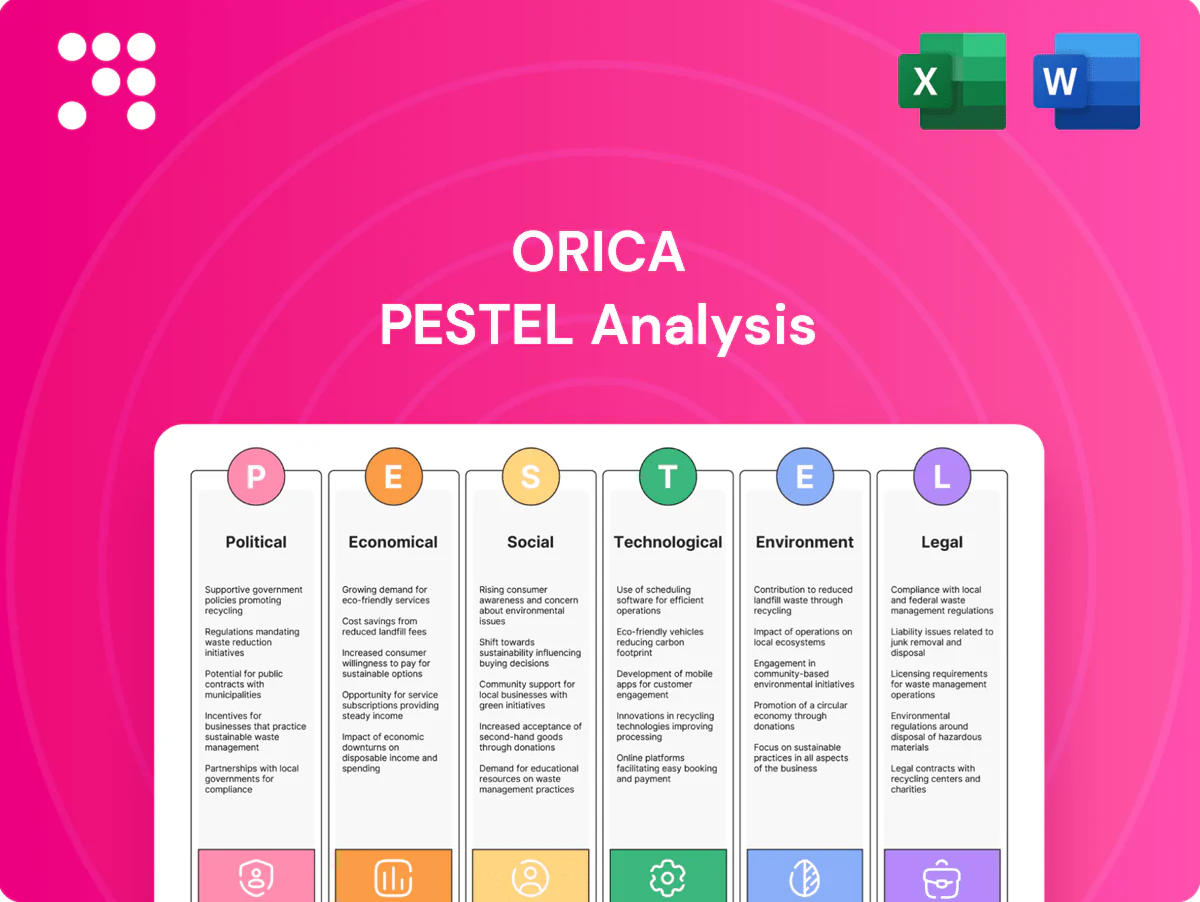
Orica PESTLE Analysis

Make Smarter Strategic Decisions with a Complete PESTEL View
Unlock Orica's strategic landscape with our comprehensive PESTLE analysis. Understand how political shifts, economic volatility, and technological advancements are shaping its future. Gain actionable intelligence to inform your own market strategies and secure a competitive advantage. Download the full report now for deep-dive insights.
Political factors

Government Mining Regulations
Orica's operations are heavily shaped by government mining regulations worldwide, affecting everything from resource extraction rights to the permits needed for operations. For instance, in 2024, many nations are reviewing or implementing stricter environmental standards for mining, which directly impacts Orica's product development and operational compliance costs related to explosives and blasting technologies.
Increased scrutiny on safety and environmental impact, particularly concerning the handling and use of commercial explosives, can lead to higher operational expenditures for Orica and potentially restrict market access in certain jurisdictions. These regulations are often driven by global trends towards sustainability and responsible resource management.
Conversely, government support for critical minerals, such as those essential for renewable energy technologies, presents a significant growth avenue for Orica. In 2025, we anticipate continued government investment in strategic mining sectors, creating demand for Orica's advanced blasting solutions and services to improve efficiency and safety in these key resource areas.
Geopolitical Stability and Trade Policies
Global geopolitical shifts and evolving trade policies are critical considerations for Orica, influencing everything from raw material sourcing to market access. Increased trade friction and protectionist measures, which have been a growing concern throughout 2024 and are projected to continue into 2025, can disrupt established supply chains for essential mining inputs.
These trade dynamics directly impact Orica's ability to secure necessary chemicals and equipment, potentially driving up costs and affecting production schedules. For instance, the mining industry as a whole has faced heightened scrutiny and potential trade barriers in key resource-rich regions during 2024, a trend expected to persist, necessitating robust risk management strategies for Orica.

Government Support for Infrastructure Projects
Government investment in large-scale infrastructure projects, particularly in tunnelling and construction, directly fuels demand for Orica's blasting systems and solutions. For instance, the Australian government's commitment to major infrastructure upgrades, with an estimated AUD 120 billion allocated for the 2024-2025 period, signifies a robust pipeline of projects requiring Orica's expertise.
Policies that champion national infrastructure development and urban expansion create a predictable and expanding market for Orica's core products. Orica's active participation in supplying solutions to the civil infrastructure sector, as seen in their involvement in projects like the Sydney Metro, demonstrates the tangible impact of these government initiatives on their business.

Permitting and Licensing Regimes
Orica's operations are heavily influenced by permitting and licensing regimes, which are intricate and differ significantly across various jurisdictions. These regulations govern every stage of the explosives lifecycle, from manufacturing and storage to transportation and end-use, demanding meticulous compliance. For example, the recent introduction of the Explosives Regulation 2024 in New South Wales, Australia, establishes a new licensing framework that Orica must navigate. Successfully managing these complex legal structures is paramount for ensuring Orica's continued operations and facilitating future growth opportunities.
Navigating these diverse regulatory landscapes presents both challenges and opportunities for Orica. The company's ability to adapt to evolving legislation, such as the aforementioned NSW regulation, directly impacts its operational efficiency and market access.
- Regulatory Compliance: Orica must adhere to stringent laws governing explosives manufacturing, storage, transport, and use, which vary by region.
- New South Wales Example: The Explosives Regulation 2024 in NSW mandates a new licensing framework that Orica needs to comply with.
- Operational Continuity: Effective management of these complex legal frameworks is essential for Orica's ongoing operations and expansion plans.
ESG-related Policy Pressure
Governments worldwide are intensifying their focus on Environmental, Social, and Governance (ESG) performance, directly impacting policy development and compelling companies like Orica to bolster their sustainability efforts. This growing scrutiny demands concrete actions, particularly concerning decarbonization targets and ethical operational practices.
Orica's FY2024 reporting underscores its proactive stance, detailing strategies for climate change mitigation and the prevention of modern slavery, directly responding to this escalating policy pressure. This reflects a broader trend where regulatory bodies are increasingly mandating ESG disclosures and performance benchmarks.
- Decarbonization Mandates: Many nations are setting ambitious net-zero targets, which translate into stricter emissions regulations for industrial sectors.
- Supply Chain Transparency: Policies are emerging that require companies to demonstrate ethical sourcing and labor practices throughout their entire value chain.
- Stakeholder Activism: Investors and consumer groups are leveraging ESG concerns to influence corporate behavior, often pushing for policies that align with their values.
- Reporting Standards: The push for standardized ESG reporting frameworks, such as those from the International Sustainability Standards Board (ISSB), is creating a more regulated environment for sustainability disclosures.
Government Policies Shape Mining and Infrastructure Demand
Government policies on mining and resource extraction significantly influence Orica's market. Stricter environmental regulations in 2024, for example, are increasing compliance costs for explosives and blasting technologies. Conversely, government support for critical minerals in 2025 is expected to boost demand for Orica's advanced solutions in strategic mining sectors.
Trade policies and geopolitical shifts also impact Orica's supply chains for raw materials and market access. Protectionist measures and trade friction, a growing concern in 2024 and projected for 2025, can disrupt the sourcing of essential mining inputs.
Government investment in infrastructure projects, such as Australia's AUD 120 billion allocation for 2024-2025, directly drives demand for Orica's blasting systems in the civil construction sector.
Orica must navigate complex permitting and licensing regimes worldwide, with new regulations like the Explosives Regulation 2024 in New South Wales requiring strict adherence for operational continuity.
What is included in the product
 Detailed Word Document
This PESTLE analysis of Orica provides a comprehensive examination of the external macro-environmental factors impacting the company across Political, Economic, Social, Technological, Environmental, and Legal dimensions.
It offers actionable insights for strategic decision-making by identifying key trends and their implications for Orica's operations and future growth.

 Customizable Excel Spreadsheet
A clear, actionable summary of Orica's PESTLE factors, highlighting key opportunities and threats to inform strategic decision-making and mitigate external risks.
Economic factors

Global Commodity Prices
Fluctuations in global commodity prices, especially for metals like copper and iron ore, directly influence Orica's mining clients. For instance, the price of iron ore, a key commodity for many Orica customers, saw significant swings in 2024, impacting mining company budgets and their willingness to invest in essential services like blasting.
When commodity prices are high, mining operations tend to expand, leading to greater demand for Orica's explosives and blasting solutions. In early 2025, forecasts indicated a potential uptick in mining investment driven by sustained demand for battery metals, which would benefit Orica.
However, sharp price drops can cause mining companies to scale back operations or postpone new projects. The volatility observed in nickel prices throughout 2024, for example, created uncertainty for some mining ventures, potentially dampening demand for Orica's offerings in those specific regions.
Economic Growth and Industrial Output
Global economic growth and industrial output are fundamental to Orica's business, directly influencing the demand for the raw materials extracted using their blasting and mining solutions. A healthy global economy typically translates into increased activity in construction, manufacturing, and infrastructure development, sectors that are heavily reliant on resource extraction.
Orica's performance in FY2024 and the first half of 2025 reflects this correlation, with strong results indicating robust market demand for their products and services. For instance, Orica reported a net profit after tax of AUD 343 million for FY2024, a significant increase from the previous year, underscoring the positive market conditions.

Inflation and Interest Rates
Inflationary pressures and rising interest rates present a dual challenge for Orica. Increased costs for raw materials, energy, and financing directly impact operating expenses and capital expenditure plans. For instance, Orica's 2024 financial results highlighted the persistent difficulties stemming from these inflationary trends and elevated energy prices.
These economic conditions also significantly influence Orica's customer base, primarily in the mining and infrastructure sectors. Higher borrowing costs and economic uncertainty can lead customers to delay or scale back their capital expenditure projects, thereby affecting demand for Orica's products and services.

Currency Exchange Rate Fluctuations
As a global entity, Orica faces inherent risks from currency exchange rate fluctuations, which can significantly influence its reported financial results, overall profitability, and the expenses associated with its international business activities. Unfavorable shifts in exchange rates can diminish the value of revenue generated in foreign markets when that revenue is converted back into Orica's primary reporting currency.
For instance, in Orica's financial year 2024, the company explicitly noted that foreign currency translation had a negative effect on its Earnings Before Interest and Taxes (EBIT). This highlights a tangible impact on its operational performance driven by currency volatility.
- Impact on Reported Earnings: Fluctuations can alter the value of overseas sales and profits when converted to Orica's reporting currency, potentially masking underlying operational performance.
- Profitability Concerns: Adverse currency movements can directly reduce profit margins on international transactions, impacting the bottom line.
- Cost of International Operations: Changes in exchange rates can make imported raw materials or components more expensive, increasing operational costs for Orica's global sites.
- FY2024 EBIT Effect: Orica reported an unfavourable impact on its EBIT in FY2024 due to foreign currency translation, underscoring the real-world financial consequences of these fluctuations.
Investment in Mining and Infrastructure
Investment in new mining projects and infrastructure development is a critical driver for Orica's business, as demand for its commercial explosives and blasting systems directly ties into these capital expenditures. For instance, in the 2023 fiscal year, Orica reported a significant increase in its mining services segment, benefiting from higher commodity prices and renewed exploration activity, which translates to greater demand for their core products.
Governments and mining companies are channeling substantial funds into expanding existing operations and initiating new ventures. Globally, infrastructure spending is projected to reach trillions in the coming years, with a notable portion allocated to resource extraction and transportation projects. This trend is a positive indicator for Orica's revenue streams.
Orica's strategic moves, such as the acquisition of Cyanco for $633 million in late 2022 and Terra Insights, underscore its intent to capitalize on and broaden its exposure to these investment trends. These acquisitions are designed to enhance Orica's service offerings and diversify its revenue base within the broader mining and infrastructure ecosystem.
Key investment drivers include:
- Increased mining capital expenditure: Global mining capital expenditure was anticipated to grow by approximately 5-7% in 2024, according to industry forecasts, directly boosting demand for blasting solutions.
- Infrastructure development projects: Major global infrastructure initiatives, particularly in emerging economies, are creating new opportunities for civil blasting, a segment Orica serves.
- Strategic acquisitions: Orica's integration of companies like Cyanco strengthens its position in essential mining chemicals and digital solutions, further leveraging upstream investment.
- Focus on efficiency and sustainability: Investments in advanced blasting technologies, supported by Orica's innovations, are crucial for mining companies seeking to optimize operations and meet environmental standards, driving adoption of Orica's solutions.
Economic Volatility: Impacting Global Operations
Economic factors significantly shape Orica's operational landscape, particularly through commodity price volatility and global economic growth. For example, the price of iron ore, a key commodity for Orica's mining clients, experienced notable fluctuations in 2024, directly impacting mining budgets and investment in blasting services.
A strong global economy typically fuels demand for Orica's products, as increased industrial output drives resource extraction. Orica's performance in FY2024 reflected this, with a net profit after tax of AUD 343 million, indicating robust market conditions and demand for their solutions.
However, inflationary pressures and rising interest rates pose challenges, increasing Orica's operating costs and potentially impacting customer capital expenditure. For instance, Orica's 2024 financial results highlighted persistent difficulties from these trends and elevated energy prices.
Currency exchange rate fluctuations also present a risk, as seen in FY2024 when foreign currency translation had a negative effect on Orica's Earnings Before Interest and Taxes (EBIT), impacting reported financial results.
Preview the Actual Deliverable
Orica PESTLE Analysis
The preview shown here is the exact document you’ll receive after purchase—fully formatted and ready to use. This comprehensive Orica PESTLE analysis delves into the Political, Economic, Social, Technological, Legal, and Environmental factors impacting the company. It provides a detailed overview of the external forces shaping Orica's strategic landscape.

Make Smarter Strategic Decisions with a Complete PESTEL View
Unlock Orica's strategic landscape with our comprehensive PESTLE analysis. Understand how political shifts, economic volatility, and technological advancements are shaping its future. Gain actionable intelligence to inform your own market strategies and secure a competitive advantage. Download the full report now for deep-dive insights.
Political factors
Government Mining Regulations
Orica's operations are heavily shaped by government mining regulations worldwide, affecting everything from resource extraction rights to the permits needed for operations. For instance, in 2024, many nations are reviewing or implementing stricter environmental standards for mining, which directly impacts Orica's product development and operational compliance costs related to explosives and blasting technologies.
Increased scrutiny on safety and environmental impact, particularly concerning the handling and use of commercial explosives, can lead to higher operational expenditures for Orica and potentially restrict market access in certain jurisdictions. These regulations are often driven by global trends towards sustainability and responsible resource management.
Conversely, government support for critical minerals, such as those essential for renewable energy technologies, presents a significant growth avenue for Orica. In 2025, we anticipate continued government investment in strategic mining sectors, creating demand for Orica's advanced blasting solutions and services to improve efficiency and safety in these key resource areas.
Geopolitical Stability and Trade Policies
Global geopolitical shifts and evolving trade policies are critical considerations for Orica, influencing everything from raw material sourcing to market access. Increased trade friction and protectionist measures, which have been a growing concern throughout 2024 and are projected to continue into 2025, can disrupt established supply chains for essential mining inputs.
These trade dynamics directly impact Orica's ability to secure necessary chemicals and equipment, potentially driving up costs and affecting production schedules. For instance, the mining industry as a whole has faced heightened scrutiny and potential trade barriers in key resource-rich regions during 2024, a trend expected to persist, necessitating robust risk management strategies for Orica.
Government Support for Infrastructure Projects
Government investment in large-scale infrastructure projects, particularly in tunnelling and construction, directly fuels demand for Orica's blasting systems and solutions. For instance, the Australian government's commitment to major infrastructure upgrades, with an estimated AUD 120 billion allocated for the 2024-2025 period, signifies a robust pipeline of projects requiring Orica's expertise.
Policies that champion national infrastructure development and urban expansion create a predictable and expanding market for Orica's core products. Orica's active participation in supplying solutions to the civil infrastructure sector, as seen in their involvement in projects like the Sydney Metro, demonstrates the tangible impact of these government initiatives on their business.
Permitting and Licensing Regimes
Orica's operations are heavily influenced by permitting and licensing regimes, which are intricate and differ significantly across various jurisdictions. These regulations govern every stage of the explosives lifecycle, from manufacturing and storage to transportation and end-use, demanding meticulous compliance. For example, the recent introduction of the Explosives Regulation 2024 in New South Wales, Australia, establishes a new licensing framework that Orica must navigate. Successfully managing these complex legal structures is paramount for ensuring Orica's continued operations and facilitating future growth opportunities.
Navigating these diverse regulatory landscapes presents both challenges and opportunities for Orica. The company's ability to adapt to evolving legislation, such as the aforementioned NSW regulation, directly impacts its operational efficiency and market access.
- Regulatory Compliance: Orica must adhere to stringent laws governing explosives manufacturing, storage, transport, and use, which vary by region.
- New South Wales Example: The Explosives Regulation 2024 in NSW mandates a new licensing framework that Orica needs to comply with.
- Operational Continuity: Effective management of these complex legal frameworks is essential for Orica's ongoing operations and expansion plans.
ESG-related Policy Pressure
Governments worldwide are intensifying their focus on Environmental, Social, and Governance (ESG) performance, directly impacting policy development and compelling companies like Orica to bolster their sustainability efforts. This growing scrutiny demands concrete actions, particularly concerning decarbonization targets and ethical operational practices.
Orica's FY2024 reporting underscores its proactive stance, detailing strategies for climate change mitigation and the prevention of modern slavery, directly responding to this escalating policy pressure. This reflects a broader trend where regulatory bodies are increasingly mandating ESG disclosures and performance benchmarks.
- Decarbonization Mandates: Many nations are setting ambitious net-zero targets, which translate into stricter emissions regulations for industrial sectors.
- Supply Chain Transparency: Policies are emerging that require companies to demonstrate ethical sourcing and labor practices throughout their entire value chain.
- Stakeholder Activism: Investors and consumer groups are leveraging ESG concerns to influence corporate behavior, often pushing for policies that align with their values.
- Reporting Standards: The push for standardized ESG reporting frameworks, such as those from the International Sustainability Standards Board (ISSB), is creating a more regulated environment for sustainability disclosures.
Government Policies Shape Mining and Infrastructure Demand
Government policies on mining and resource extraction significantly influence Orica's market. Stricter environmental regulations in 2024, for example, are increasing compliance costs for explosives and blasting technologies. Conversely, government support for critical minerals in 2025 is expected to boost demand for Orica's advanced solutions in strategic mining sectors.
Trade policies and geopolitical shifts also impact Orica's supply chains for raw materials and market access. Protectionist measures and trade friction, a growing concern in 2024 and projected for 2025, can disrupt the sourcing of essential mining inputs.
Government investment in infrastructure projects, such as Australia's AUD 120 billion allocation for 2024-2025, directly drives demand for Orica's blasting systems in the civil construction sector.
Orica must navigate complex permitting and licensing regimes worldwide, with new regulations like the Explosives Regulation 2024 in New South Wales requiring strict adherence for operational continuity.
What is included in the product
Detailed Word Document
This PESTLE analysis of Orica provides a comprehensive examination of the external macro-environmental factors impacting the company across Political, Economic, Social, Technological, Environmental, and Legal dimensions.
It offers actionable insights for strategic decision-making by identifying key trends and their implications for Orica's operations and future growth.
Customizable Excel Spreadsheet
A clear, actionable summary of Orica's PESTLE factors, highlighting key opportunities and threats to inform strategic decision-making and mitigate external risks.
Economic factors
Global Commodity Prices
Fluctuations in global commodity prices, especially for metals like copper and iron ore, directly influence Orica's mining clients. For instance, the price of iron ore, a key commodity for many Orica customers, saw significant swings in 2024, impacting mining company budgets and their willingness to invest in essential services like blasting.
When commodity prices are high, mining operations tend to expand, leading to greater demand for Orica's explosives and blasting solutions. In early 2025, forecasts indicated a potential uptick in mining investment driven by sustained demand for battery metals, which would benefit Orica.
However, sharp price drops can cause mining companies to scale back operations or postpone new projects. The volatility observed in nickel prices throughout 2024, for example, created uncertainty for some mining ventures, potentially dampening demand for Orica's offerings in those specific regions.
Economic Growth and Industrial Output
Global economic growth and industrial output are fundamental to Orica's business, directly influencing the demand for the raw materials extracted using their blasting and mining solutions. A healthy global economy typically translates into increased activity in construction, manufacturing, and infrastructure development, sectors that are heavily reliant on resource extraction.
Orica's performance in FY2024 and the first half of 2025 reflects this correlation, with strong results indicating robust market demand for their products and services. For instance, Orica reported a net profit after tax of AUD 343 million for FY2024, a significant increase from the previous year, underscoring the positive market conditions.
Inflation and Interest Rates
Inflationary pressures and rising interest rates present a dual challenge for Orica. Increased costs for raw materials, energy, and financing directly impact operating expenses and capital expenditure plans. For instance, Orica's 2024 financial results highlighted the persistent difficulties stemming from these inflationary trends and elevated energy prices.
These economic conditions also significantly influence Orica's customer base, primarily in the mining and infrastructure sectors. Higher borrowing costs and economic uncertainty can lead customers to delay or scale back their capital expenditure projects, thereby affecting demand for Orica's products and services.
Currency Exchange Rate Fluctuations
As a global entity, Orica faces inherent risks from currency exchange rate fluctuations, which can significantly influence its reported financial results, overall profitability, and the expenses associated with its international business activities. Unfavorable shifts in exchange rates can diminish the value of revenue generated in foreign markets when that revenue is converted back into Orica's primary reporting currency.
For instance, in Orica's financial year 2024, the company explicitly noted that foreign currency translation had a negative effect on its Earnings Before Interest and Taxes (EBIT). This highlights a tangible impact on its operational performance driven by currency volatility.
- Impact on Reported Earnings: Fluctuations can alter the value of overseas sales and profits when converted to Orica's reporting currency, potentially masking underlying operational performance.
- Profitability Concerns: Adverse currency movements can directly reduce profit margins on international transactions, impacting the bottom line.
- Cost of International Operations: Changes in exchange rates can make imported raw materials or components more expensive, increasing operational costs for Orica's global sites.
- FY2024 EBIT Effect: Orica reported an unfavourable impact on its EBIT in FY2024 due to foreign currency translation, underscoring the real-world financial consequences of these fluctuations.
Investment in Mining and Infrastructure
Investment in new mining projects and infrastructure development is a critical driver for Orica's business, as demand for its commercial explosives and blasting systems directly ties into these capital expenditures. For instance, in the 2023 fiscal year, Orica reported a significant increase in its mining services segment, benefiting from higher commodity prices and renewed exploration activity, which translates to greater demand for their core products.
Governments and mining companies are channeling substantial funds into expanding existing operations and initiating new ventures. Globally, infrastructure spending is projected to reach trillions in the coming years, with a notable portion allocated to resource extraction and transportation projects. This trend is a positive indicator for Orica's revenue streams.
Orica's strategic moves, such as the acquisition of Cyanco for $633 million in late 2022 and Terra Insights, underscore its intent to capitalize on and broaden its exposure to these investment trends. These acquisitions are designed to enhance Orica's service offerings and diversify its revenue base within the broader mining and infrastructure ecosystem.
Key investment drivers include:
- Increased mining capital expenditure: Global mining capital expenditure was anticipated to grow by approximately 5-7% in 2024, according to industry forecasts, directly boosting demand for blasting solutions.
- Infrastructure development projects: Major global infrastructure initiatives, particularly in emerging economies, are creating new opportunities for civil blasting, a segment Orica serves.
- Strategic acquisitions: Orica's integration of companies like Cyanco strengthens its position in essential mining chemicals and digital solutions, further leveraging upstream investment.
- Focus on efficiency and sustainability: Investments in advanced blasting technologies, supported by Orica's innovations, are crucial for mining companies seeking to optimize operations and meet environmental standards, driving adoption of Orica's solutions.
Economic Volatility: Impacting Global Operations
Economic factors significantly shape Orica's operational landscape, particularly through commodity price volatility and global economic growth. For example, the price of iron ore, a key commodity for Orica's mining clients, experienced notable fluctuations in 2024, directly impacting mining budgets and investment in blasting services.
A strong global economy typically fuels demand for Orica's products, as increased industrial output drives resource extraction. Orica's performance in FY2024 reflected this, with a net profit after tax of AUD 343 million, indicating robust market conditions and demand for their solutions.
However, inflationary pressures and rising interest rates pose challenges, increasing Orica's operating costs and potentially impacting customer capital expenditure. For instance, Orica's 2024 financial results highlighted persistent difficulties from these trends and elevated energy prices.
Currency exchange rate fluctuations also present a risk, as seen in FY2024 when foreign currency translation had a negative effect on Orica's Earnings Before Interest and Taxes (EBIT), impacting reported financial results.
Preview the Actual Deliverable
Orica PESTLE Analysis
The preview shown here is the exact document you’ll receive after purchase—fully formatted and ready to use. This comprehensive Orica PESTLE analysis delves into the Political, Economic, Social, Technological, Legal, and Environmental factors impacting the company. It provides a detailed overview of the external forces shaping Orica's strategic landscape.
Original: $10.00
-65%$10.00
$3.50Description
Make Smarter Strategic Decisions with a Complete PESTEL View
Unlock Orica's strategic landscape with our comprehensive PESTLE analysis. Understand how political shifts, economic volatility, and technological advancements are shaping its future. Gain actionable intelligence to inform your own market strategies and secure a competitive advantage. Download the full report now for deep-dive insights.
Political factors
Government Mining Regulations
Orica's operations are heavily shaped by government mining regulations worldwide, affecting everything from resource extraction rights to the permits needed for operations. For instance, in 2024, many nations are reviewing or implementing stricter environmental standards for mining, which directly impacts Orica's product development and operational compliance costs related to explosives and blasting technologies.
Increased scrutiny on safety and environmental impact, particularly concerning the handling and use of commercial explosives, can lead to higher operational expenditures for Orica and potentially restrict market access in certain jurisdictions. These regulations are often driven by global trends towards sustainability and responsible resource management.
Conversely, government support for critical minerals, such as those essential for renewable energy technologies, presents a significant growth avenue for Orica. In 2025, we anticipate continued government investment in strategic mining sectors, creating demand for Orica's advanced blasting solutions and services to improve efficiency and safety in these key resource areas.
Geopolitical Stability and Trade Policies
Global geopolitical shifts and evolving trade policies are critical considerations for Orica, influencing everything from raw material sourcing to market access. Increased trade friction and protectionist measures, which have been a growing concern throughout 2024 and are projected to continue into 2025, can disrupt established supply chains for essential mining inputs.
These trade dynamics directly impact Orica's ability to secure necessary chemicals and equipment, potentially driving up costs and affecting production schedules. For instance, the mining industry as a whole has faced heightened scrutiny and potential trade barriers in key resource-rich regions during 2024, a trend expected to persist, necessitating robust risk management strategies for Orica.
Government Support for Infrastructure Projects
Government investment in large-scale infrastructure projects, particularly in tunnelling and construction, directly fuels demand for Orica's blasting systems and solutions. For instance, the Australian government's commitment to major infrastructure upgrades, with an estimated AUD 120 billion allocated for the 2024-2025 period, signifies a robust pipeline of projects requiring Orica's expertise.
Policies that champion national infrastructure development and urban expansion create a predictable and expanding market for Orica's core products. Orica's active participation in supplying solutions to the civil infrastructure sector, as seen in their involvement in projects like the Sydney Metro, demonstrates the tangible impact of these government initiatives on their business.
Permitting and Licensing Regimes
Orica's operations are heavily influenced by permitting and licensing regimes, which are intricate and differ significantly across various jurisdictions. These regulations govern every stage of the explosives lifecycle, from manufacturing and storage to transportation and end-use, demanding meticulous compliance. For example, the recent introduction of the Explosives Regulation 2024 in New South Wales, Australia, establishes a new licensing framework that Orica must navigate. Successfully managing these complex legal structures is paramount for ensuring Orica's continued operations and facilitating future growth opportunities.
Navigating these diverse regulatory landscapes presents both challenges and opportunities for Orica. The company's ability to adapt to evolving legislation, such as the aforementioned NSW regulation, directly impacts its operational efficiency and market access.
- Regulatory Compliance: Orica must adhere to stringent laws governing explosives manufacturing, storage, transport, and use, which vary by region.
- New South Wales Example: The Explosives Regulation 2024 in NSW mandates a new licensing framework that Orica needs to comply with.
- Operational Continuity: Effective management of these complex legal frameworks is essential for Orica's ongoing operations and expansion plans.
ESG-related Policy Pressure
Governments worldwide are intensifying their focus on Environmental, Social, and Governance (ESG) performance, directly impacting policy development and compelling companies like Orica to bolster their sustainability efforts. This growing scrutiny demands concrete actions, particularly concerning decarbonization targets and ethical operational practices.
Orica's FY2024 reporting underscores its proactive stance, detailing strategies for climate change mitigation and the prevention of modern slavery, directly responding to this escalating policy pressure. This reflects a broader trend where regulatory bodies are increasingly mandating ESG disclosures and performance benchmarks.
- Decarbonization Mandates: Many nations are setting ambitious net-zero targets, which translate into stricter emissions regulations for industrial sectors.
- Supply Chain Transparency: Policies are emerging that require companies to demonstrate ethical sourcing and labor practices throughout their entire value chain.
- Stakeholder Activism: Investors and consumer groups are leveraging ESG concerns to influence corporate behavior, often pushing for policies that align with their values.
- Reporting Standards: The push for standardized ESG reporting frameworks, such as those from the International Sustainability Standards Board (ISSB), is creating a more regulated environment for sustainability disclosures.
Government Policies Shape Mining and Infrastructure Demand
Government policies on mining and resource extraction significantly influence Orica's market. Stricter environmental regulations in 2024, for example, are increasing compliance costs for explosives and blasting technologies. Conversely, government support for critical minerals in 2025 is expected to boost demand for Orica's advanced solutions in strategic mining sectors.
Trade policies and geopolitical shifts also impact Orica's supply chains for raw materials and market access. Protectionist measures and trade friction, a growing concern in 2024 and projected for 2025, can disrupt the sourcing of essential mining inputs.
Government investment in infrastructure projects, such as Australia's AUD 120 billion allocation for 2024-2025, directly drives demand for Orica's blasting systems in the civil construction sector.
Orica must navigate complex permitting and licensing regimes worldwide, with new regulations like the Explosives Regulation 2024 in New South Wales requiring strict adherence for operational continuity.
What is included in the product
Detailed Word Document
This PESTLE analysis of Orica provides a comprehensive examination of the external macro-environmental factors impacting the company across Political, Economic, Social, Technological, Environmental, and Legal dimensions.
It offers actionable insights for strategic decision-making by identifying key trends and their implications for Orica's operations and future growth.
Customizable Excel Spreadsheet
A clear, actionable summary of Orica's PESTLE factors, highlighting key opportunities and threats to inform strategic decision-making and mitigate external risks.
Economic factors
Global Commodity Prices
Fluctuations in global commodity prices, especially for metals like copper and iron ore, directly influence Orica's mining clients. For instance, the price of iron ore, a key commodity for many Orica customers, saw significant swings in 2024, impacting mining company budgets and their willingness to invest in essential services like blasting.
When commodity prices are high, mining operations tend to expand, leading to greater demand for Orica's explosives and blasting solutions. In early 2025, forecasts indicated a potential uptick in mining investment driven by sustained demand for battery metals, which would benefit Orica.
However, sharp price drops can cause mining companies to scale back operations or postpone new projects. The volatility observed in nickel prices throughout 2024, for example, created uncertainty for some mining ventures, potentially dampening demand for Orica's offerings in those specific regions.
Economic Growth and Industrial Output
Global economic growth and industrial output are fundamental to Orica's business, directly influencing the demand for the raw materials extracted using their blasting and mining solutions. A healthy global economy typically translates into increased activity in construction, manufacturing, and infrastructure development, sectors that are heavily reliant on resource extraction.
Orica's performance in FY2024 and the first half of 2025 reflects this correlation, with strong results indicating robust market demand for their products and services. For instance, Orica reported a net profit after tax of AUD 343 million for FY2024, a significant increase from the previous year, underscoring the positive market conditions.
Inflation and Interest Rates
Inflationary pressures and rising interest rates present a dual challenge for Orica. Increased costs for raw materials, energy, and financing directly impact operating expenses and capital expenditure plans. For instance, Orica's 2024 financial results highlighted the persistent difficulties stemming from these inflationary trends and elevated energy prices.
These economic conditions also significantly influence Orica's customer base, primarily in the mining and infrastructure sectors. Higher borrowing costs and economic uncertainty can lead customers to delay or scale back their capital expenditure projects, thereby affecting demand for Orica's products and services.
Currency Exchange Rate Fluctuations
As a global entity, Orica faces inherent risks from currency exchange rate fluctuations, which can significantly influence its reported financial results, overall profitability, and the expenses associated with its international business activities. Unfavorable shifts in exchange rates can diminish the value of revenue generated in foreign markets when that revenue is converted back into Orica's primary reporting currency.
For instance, in Orica's financial year 2024, the company explicitly noted that foreign currency translation had a negative effect on its Earnings Before Interest and Taxes (EBIT). This highlights a tangible impact on its operational performance driven by currency volatility.
- Impact on Reported Earnings: Fluctuations can alter the value of overseas sales and profits when converted to Orica's reporting currency, potentially masking underlying operational performance.
- Profitability Concerns: Adverse currency movements can directly reduce profit margins on international transactions, impacting the bottom line.
- Cost of International Operations: Changes in exchange rates can make imported raw materials or components more expensive, increasing operational costs for Orica's global sites.
- FY2024 EBIT Effect: Orica reported an unfavourable impact on its EBIT in FY2024 due to foreign currency translation, underscoring the real-world financial consequences of these fluctuations.
Investment in Mining and Infrastructure
Investment in new mining projects and infrastructure development is a critical driver for Orica's business, as demand for its commercial explosives and blasting systems directly ties into these capital expenditures. For instance, in the 2023 fiscal year, Orica reported a significant increase in its mining services segment, benefiting from higher commodity prices and renewed exploration activity, which translates to greater demand for their core products.
Governments and mining companies are channeling substantial funds into expanding existing operations and initiating new ventures. Globally, infrastructure spending is projected to reach trillions in the coming years, with a notable portion allocated to resource extraction and transportation projects. This trend is a positive indicator for Orica's revenue streams.
Orica's strategic moves, such as the acquisition of Cyanco for $633 million in late 2022 and Terra Insights, underscore its intent to capitalize on and broaden its exposure to these investment trends. These acquisitions are designed to enhance Orica's service offerings and diversify its revenue base within the broader mining and infrastructure ecosystem.
Key investment drivers include:
- Increased mining capital expenditure: Global mining capital expenditure was anticipated to grow by approximately 5-7% in 2024, according to industry forecasts, directly boosting demand for blasting solutions.
- Infrastructure development projects: Major global infrastructure initiatives, particularly in emerging economies, are creating new opportunities for civil blasting, a segment Orica serves.
- Strategic acquisitions: Orica's integration of companies like Cyanco strengthens its position in essential mining chemicals and digital solutions, further leveraging upstream investment.
- Focus on efficiency and sustainability: Investments in advanced blasting technologies, supported by Orica's innovations, are crucial for mining companies seeking to optimize operations and meet environmental standards, driving adoption of Orica's solutions.
Economic Volatility: Impacting Global Operations
Economic factors significantly shape Orica's operational landscape, particularly through commodity price volatility and global economic growth. For example, the price of iron ore, a key commodity for Orica's mining clients, experienced notable fluctuations in 2024, directly impacting mining budgets and investment in blasting services.
A strong global economy typically fuels demand for Orica's products, as increased industrial output drives resource extraction. Orica's performance in FY2024 reflected this, with a net profit after tax of AUD 343 million, indicating robust market conditions and demand for their solutions.
However, inflationary pressures and rising interest rates pose challenges, increasing Orica's operating costs and potentially impacting customer capital expenditure. For instance, Orica's 2024 financial results highlighted persistent difficulties from these trends and elevated energy prices.
Currency exchange rate fluctuations also present a risk, as seen in FY2024 when foreign currency translation had a negative effect on Orica's Earnings Before Interest and Taxes (EBIT), impacting reported financial results.
Preview the Actual Deliverable
Orica PESTLE Analysis
The preview shown here is the exact document you’ll receive after purchase—fully formatted and ready to use. This comprehensive Orica PESTLE analysis delves into the Political, Economic, Social, Technological, Legal, and Environmental factors impacting the company. It provides a detailed overview of the external forces shaping Orica's strategic landscape.











