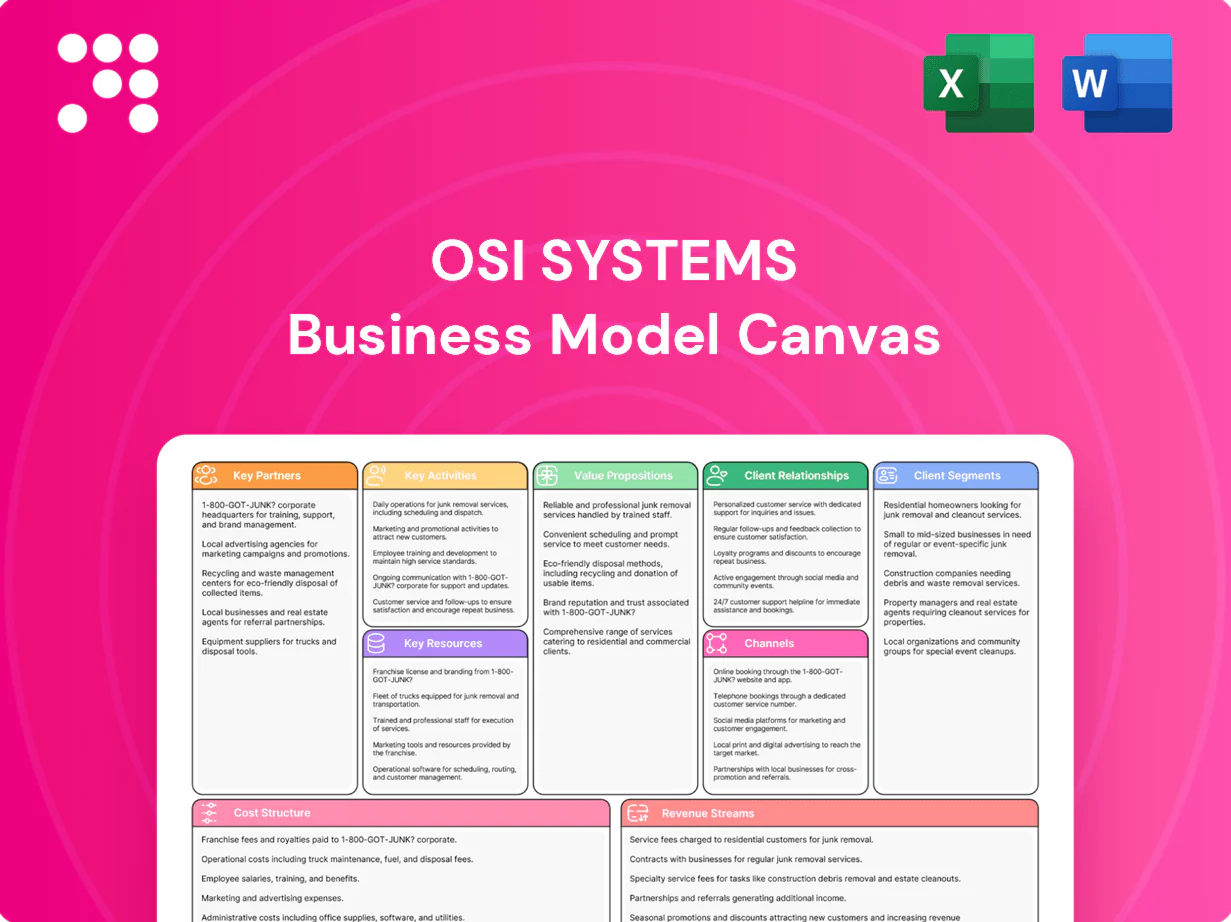
OSI Systems Business Model Canvas

Business Model Canvas: Actionable blueprint for security and medical tech investors
Unlock the full strategic blueprint behind OSI Systems with our Business Model Canvas—three to five sentences won’t capture the depth of its value propositions, key partners, and revenue levers. This comprehensive, editable canvas reveals how OSI scales, mitigates risk, and wins market share, making it ideal for investors, consultants, and founders. Download the full Word and Excel files to deploy these insights in your strategy or pitch today.
Partnerships

Government and defense agencies
Partner with homeland security, customs and defense bodies for certifications, pilots and large tenders; US DHS funding exceeded 88 billion in 2024 and DoD toplines were about 858 billion, making these channels critical for scale. These relationships enable requirements shaping and early visibility into multi-year budgets. Long procurement cycles of 18–36 months favor trusted suppliers with compliance track records. Joint trials and pilots, often tied to tenders above 10 million, validate performance in operational environments.
Hospitals and healthcare networks
Collaborations with hospitals and healthcare networks enable clinical trials, device validation, and workflow integration for monitors and anesthesia systems, leveraging about 6,000 US hospitals (AHA) and ClinicalTrials.gov’s >470,000 registered studies (2024) as evidence channels. Partnerships supply reference sites and real-world data for evidence generation. Integrated purchasing groups—used by over 90% of US hospitals—drive volume agreements and standardization. Continuous feedback loops shape product roadmaps and usability.

OEMs and industrial integrators
OSI partners with aerospace, semiconductor, automotive and industrial OEMs for optoelectronics and contract manufacturing, aligning with a global semiconductor market of about $594 billion in 2024. Co-design with OEMs ensures fit-for-purpose components and higher reliability. Long-term supply agreements stabilize demand and quality, reducing procurement volatility. Joint go-to-market expands reach into specialized niches and verticals.

Technology and component suppliers
Alliances with sensor, semicon, and software vendors secure access to critical technology and parts for OSI Systems, supporting its ~$1.03B revenue (2023). Roadmap alignment with vendors reduces obsolescence and improves performance and certification speed. Preferred pricing and allocations mitigate supply shocks while co-development accelerates feature velocity.
- Vendor alliances: supply access
- Roadmap alignment: lower obsolescence
- Preferred pricing: supply resilience
- Co-development: faster features
Regulatory and standards bodies
Engage proactively with FDA, TSA, IEC, ISO and similar bodies to secure approvals, influence standards and reduce certification cycles; early compliance planning shortens time-to-market and limits redesign costs. Participation helps shape safety and cybersecurity requirements; certification listings strengthen buyer confidence and tender eligibility.
- Regulatory approvals: FDA, TSA, IEC, ISO
- Early compliance: reduces time-to-market
- Certifications: improve tender success and buyer trust
Government, Healthcare & Semiconductor Partnerships for Scale, Certification, Supply Resilience
Key partnerships span government (US DHS $88B 2024; DoD $858B), healthcare (≈6,000 US hospitals; ClinicalTrials.gov >470,000 studies 2024), semiconductors ($594B market 2024), and suppliers supporting OSI Systems ~$1.03B revenue 2023 for scale, validation, supply resilience and certification.
| Partner | Role | Metric |
|---|---|---|
| Government | Tenders/cert | DHS $88B; DoD $858B (2024) |
| Healthcare | Validation | 6,000 hospitals; >470k studies (2024) |
| Semicon/OEM | Supply/co-design | $594B market (2024) |
What is included in the product
 Detailed Word Document
A comprehensive, pre-written Business Model Canvas tailored to OSI Systems’ strategy, covering the nine BMC blocks with detailed value propositions, customer segments, channels, revenue streams, and key resources/partners. Includes competitive advantage analysis and SWOT, reflects real-world operations, and is ideal for presentations, investor discussions, and validating strategic decisions.

 Customizable Excel Spreadsheet
High-level view of OSI Systems' business model with editable cells, condensing strategy into a digestible format for quick review. Saves hours of formatting and makes collaboration easy for teams, boardrooms, or competitive comparisons.
Activities

R&D in detection and medical technologies
R&D emphasizes advanced imaging, spectroscopy, sensors and patient-monitoring algorithms to raise diagnostic accuracy and processing speed while ensuring cross-platform interoperability.
Teams balance incremental upgrades with platform innovations to shorten time-to-market and sustain competitive differentiation in the ~44.5 billion global medical imaging market in 2024.
IP strategy combines patents and trade secrets to protect algorithms, sensor designs and system integration.
High-reliability manufacturing
Produce complex systems and optoelectronic components to sub-micron tolerances while operating ISO 13485 and AS9100 certified processes. Maintain cleanroom, SMT and final assembly lines with industry-first-pass SMT yields commonly above 95%. Scale rapidly from prototypes to volume production through controlled process transfer and statistical process control. Focus on yield optimization, traceability and supplier quality control.

Regulatory and quality management
Prepare submissions for FDA (510(k), PMA) and CE under EU MDR (effective 26 May 2021), TSA qualification and global approvals; manage verification, validation and post-market surveillance per MDR requirements. Implement CAPA and risk management aligned with ISO 13485:2016. Ensure cybersecurity and data privacy compliance including HIPAA where applicable.

Global sales, tendering, and service
Global sales teams respond to RFPs, RFQs and long-cycle government bids (often 12–24 month procurement timelines), converting large contracts into multi-year revenue streams.
Field services deliver installation, training, calibration and maintenance, supported by 24/7 technical support and spare-parts logistics to meet 99.5–99.9% SLA uptime guarantees.
- RFP/RFQ management
- Long-cycle bids (12–24 months)
- Installation & training
- Calibration & maintenance
- 24/7 support & spares
- 99.5–99.9% SLA
Supply chain and supplier management
OSI Systems secures critical parts via dual-sourcing and strategic safety buffers to mitigate shortages, while monitoring supplier quality through regular audits and corrective action plans; the approach supported supply resilience during 2024 as OSI reported roughly $1.27 billion in revenue. The company continually optimizes inventory and lead times using demand forecasting and regional stocking, hedges currency exposures, and centralizes cross‑region logistics to reduce transit variability and landed cost.
- Dual-sourcing: reduces single-supplier risk
- Supplier audits: enforce quality & compliance
- Inventory & lead-time optimization: lower carrying costs
- Currency hedging & regional logistics: protect margins
AI imaging + ISO mfg target $44.5B; 2024 rev $1.27B
R&D advances imaging, sensors and AI algorithms to improve diagnostic speed and interoperability, targeting the $44.5B medical imaging market (2024).
Manufacturing runs ISO 13485/AS9100 cleanrooms with >95% SMT yields, scaling to volume production and 99.5–99.9% SLA field uptime.
Regulatory teams manage FDA/CE submissions, global approvals and supply resilience; 2024 revenue ~ $1.27B.
| Metric | 2024 |
|---|---|
| Market size | $44.5B |
| Revenue | $1.27B |
| SMT yield | >95% |
| Field SLA | 99.5–99.9% |
Preview Before You Purchase
Business Model Canvas
The document previewed here is the exact OSI Systems Business Model Canvas you will receive after purchase—not a mockup or sample. Upon completing your order you’ll instantly download the full, editable file formatted exactly as shown. No hidden pages, no changes—ready to use for presentations or planning.

Business Model Canvas: Actionable blueprint for security and medical tech investors
Unlock the full strategic blueprint behind OSI Systems with our Business Model Canvas—three to five sentences won’t capture the depth of its value propositions, key partners, and revenue levers. This comprehensive, editable canvas reveals how OSI scales, mitigates risk, and wins market share, making it ideal for investors, consultants, and founders. Download the full Word and Excel files to deploy these insights in your strategy or pitch today.
Partnerships
Government and defense agencies
Partner with homeland security, customs and defense bodies for certifications, pilots and large tenders; US DHS funding exceeded 88 billion in 2024 and DoD toplines were about 858 billion, making these channels critical for scale. These relationships enable requirements shaping and early visibility into multi-year budgets. Long procurement cycles of 18–36 months favor trusted suppliers with compliance track records. Joint trials and pilots, often tied to tenders above 10 million, validate performance in operational environments.
Hospitals and healthcare networks
Collaborations with hospitals and healthcare networks enable clinical trials, device validation, and workflow integration for monitors and anesthesia systems, leveraging about 6,000 US hospitals (AHA) and ClinicalTrials.gov’s >470,000 registered studies (2024) as evidence channels. Partnerships supply reference sites and real-world data for evidence generation. Integrated purchasing groups—used by over 90% of US hospitals—drive volume agreements and standardization. Continuous feedback loops shape product roadmaps and usability.
OEMs and industrial integrators
OSI partners with aerospace, semiconductor, automotive and industrial OEMs for optoelectronics and contract manufacturing, aligning with a global semiconductor market of about $594 billion in 2024. Co-design with OEMs ensures fit-for-purpose components and higher reliability. Long-term supply agreements stabilize demand and quality, reducing procurement volatility. Joint go-to-market expands reach into specialized niches and verticals.
Technology and component suppliers
Alliances with sensor, semicon, and software vendors secure access to critical technology and parts for OSI Systems, supporting its ~$1.03B revenue (2023). Roadmap alignment with vendors reduces obsolescence and improves performance and certification speed. Preferred pricing and allocations mitigate supply shocks while co-development accelerates feature velocity.
- Vendor alliances: supply access
- Roadmap alignment: lower obsolescence
- Preferred pricing: supply resilience
- Co-development: faster features
Regulatory and standards bodies
Engage proactively with FDA, TSA, IEC, ISO and similar bodies to secure approvals, influence standards and reduce certification cycles; early compliance planning shortens time-to-market and limits redesign costs. Participation helps shape safety and cybersecurity requirements; certification listings strengthen buyer confidence and tender eligibility.
- Regulatory approvals: FDA, TSA, IEC, ISO
- Early compliance: reduces time-to-market
- Certifications: improve tender success and buyer trust
Government, Healthcare & Semiconductor Partnerships for Scale, Certification, Supply Resilience
Key partnerships span government (US DHS $88B 2024; DoD $858B), healthcare (≈6,000 US hospitals; ClinicalTrials.gov >470,000 studies 2024), semiconductors ($594B market 2024), and suppliers supporting OSI Systems ~$1.03B revenue 2023 for scale, validation, supply resilience and certification.
| Partner | Role | Metric |
|---|---|---|
| Government | Tenders/cert | DHS $88B; DoD $858B (2024) |
| Healthcare | Validation | 6,000 hospitals; >470k studies (2024) |
| Semicon/OEM | Supply/co-design | $594B market (2024) |
What is included in the product
Detailed Word Document
A comprehensive, pre-written Business Model Canvas tailored to OSI Systems’ strategy, covering the nine BMC blocks with detailed value propositions, customer segments, channels, revenue streams, and key resources/partners. Includes competitive advantage analysis and SWOT, reflects real-world operations, and is ideal for presentations, investor discussions, and validating strategic decisions.
Customizable Excel Spreadsheet
High-level view of OSI Systems' business model with editable cells, condensing strategy into a digestible format for quick review. Saves hours of formatting and makes collaboration easy for teams, boardrooms, or competitive comparisons.
Activities
R&D in detection and medical technologies
R&D emphasizes advanced imaging, spectroscopy, sensors and patient-monitoring algorithms to raise diagnostic accuracy and processing speed while ensuring cross-platform interoperability.
Teams balance incremental upgrades with platform innovations to shorten time-to-market and sustain competitive differentiation in the ~44.5 billion global medical imaging market in 2024.
IP strategy combines patents and trade secrets to protect algorithms, sensor designs and system integration.
High-reliability manufacturing
Produce complex systems and optoelectronic components to sub-micron tolerances while operating ISO 13485 and AS9100 certified processes. Maintain cleanroom, SMT and final assembly lines with industry-first-pass SMT yields commonly above 95%. Scale rapidly from prototypes to volume production through controlled process transfer and statistical process control. Focus on yield optimization, traceability and supplier quality control.
Regulatory and quality management
Prepare submissions for FDA (510(k), PMA) and CE under EU MDR (effective 26 May 2021), TSA qualification and global approvals; manage verification, validation and post-market surveillance per MDR requirements. Implement CAPA and risk management aligned with ISO 13485:2016. Ensure cybersecurity and data privacy compliance including HIPAA where applicable.
Global sales, tendering, and service
Global sales teams respond to RFPs, RFQs and long-cycle government bids (often 12–24 month procurement timelines), converting large contracts into multi-year revenue streams.
Field services deliver installation, training, calibration and maintenance, supported by 24/7 technical support and spare-parts logistics to meet 99.5–99.9% SLA uptime guarantees.
- RFP/RFQ management
- Long-cycle bids (12–24 months)
- Installation & training
- Calibration & maintenance
- 24/7 support & spares
- 99.5–99.9% SLA
Supply chain and supplier management
OSI Systems secures critical parts via dual-sourcing and strategic safety buffers to mitigate shortages, while monitoring supplier quality through regular audits and corrective action plans; the approach supported supply resilience during 2024 as OSI reported roughly $1.27 billion in revenue. The company continually optimizes inventory and lead times using demand forecasting and regional stocking, hedges currency exposures, and centralizes cross‑region logistics to reduce transit variability and landed cost.
- Dual-sourcing: reduces single-supplier risk
- Supplier audits: enforce quality & compliance
- Inventory & lead-time optimization: lower carrying costs
- Currency hedging & regional logistics: protect margins
AI imaging + ISO mfg target $44.5B; 2024 rev $1.27B
R&D advances imaging, sensors and AI algorithms to improve diagnostic speed and interoperability, targeting the $44.5B medical imaging market (2024).
Manufacturing runs ISO 13485/AS9100 cleanrooms with >95% SMT yields, scaling to volume production and 99.5–99.9% SLA field uptime.
Regulatory teams manage FDA/CE submissions, global approvals and supply resilience; 2024 revenue ~ $1.27B.
| Metric | 2024 |
|---|---|
| Market size | $44.5B |
| Revenue | $1.27B |
| SMT yield | >95% |
| Field SLA | 99.5–99.9% |
Preview Before You Purchase
Business Model Canvas
The document previewed here is the exact OSI Systems Business Model Canvas you will receive after purchase—not a mockup or sample. Upon completing your order you’ll instantly download the full, editable file formatted exactly as shown. No hidden pages, no changes—ready to use for presentations or planning.
Original: $10.00
-65%$10.00
$3.50Description
Business Model Canvas: Actionable blueprint for security and medical tech investors
Unlock the full strategic blueprint behind OSI Systems with our Business Model Canvas—three to five sentences won’t capture the depth of its value propositions, key partners, and revenue levers. This comprehensive, editable canvas reveals how OSI scales, mitigates risk, and wins market share, making it ideal for investors, consultants, and founders. Download the full Word and Excel files to deploy these insights in your strategy or pitch today.
Partnerships
Government and defense agencies
Partner with homeland security, customs and defense bodies for certifications, pilots and large tenders; US DHS funding exceeded 88 billion in 2024 and DoD toplines were about 858 billion, making these channels critical for scale. These relationships enable requirements shaping and early visibility into multi-year budgets. Long procurement cycles of 18–36 months favor trusted suppliers with compliance track records. Joint trials and pilots, often tied to tenders above 10 million, validate performance in operational environments.
Hospitals and healthcare networks
Collaborations with hospitals and healthcare networks enable clinical trials, device validation, and workflow integration for monitors and anesthesia systems, leveraging about 6,000 US hospitals (AHA) and ClinicalTrials.gov’s >470,000 registered studies (2024) as evidence channels. Partnerships supply reference sites and real-world data for evidence generation. Integrated purchasing groups—used by over 90% of US hospitals—drive volume agreements and standardization. Continuous feedback loops shape product roadmaps and usability.
OEMs and industrial integrators
OSI partners with aerospace, semiconductor, automotive and industrial OEMs for optoelectronics and contract manufacturing, aligning with a global semiconductor market of about $594 billion in 2024. Co-design with OEMs ensures fit-for-purpose components and higher reliability. Long-term supply agreements stabilize demand and quality, reducing procurement volatility. Joint go-to-market expands reach into specialized niches and verticals.
Technology and component suppliers
Alliances with sensor, semicon, and software vendors secure access to critical technology and parts for OSI Systems, supporting its ~$1.03B revenue (2023). Roadmap alignment with vendors reduces obsolescence and improves performance and certification speed. Preferred pricing and allocations mitigate supply shocks while co-development accelerates feature velocity.
- Vendor alliances: supply access
- Roadmap alignment: lower obsolescence
- Preferred pricing: supply resilience
- Co-development: faster features
Regulatory and standards bodies
Engage proactively with FDA, TSA, IEC, ISO and similar bodies to secure approvals, influence standards and reduce certification cycles; early compliance planning shortens time-to-market and limits redesign costs. Participation helps shape safety and cybersecurity requirements; certification listings strengthen buyer confidence and tender eligibility.
- Regulatory approvals: FDA, TSA, IEC, ISO
- Early compliance: reduces time-to-market
- Certifications: improve tender success and buyer trust
Government, Healthcare & Semiconductor Partnerships for Scale, Certification, Supply Resilience
Key partnerships span government (US DHS $88B 2024; DoD $858B), healthcare (≈6,000 US hospitals; ClinicalTrials.gov >470,000 studies 2024), semiconductors ($594B market 2024), and suppliers supporting OSI Systems ~$1.03B revenue 2023 for scale, validation, supply resilience and certification.
| Partner | Role | Metric |
|---|---|---|
| Government | Tenders/cert | DHS $88B; DoD $858B (2024) |
| Healthcare | Validation | 6,000 hospitals; >470k studies (2024) |
| Semicon/OEM | Supply/co-design | $594B market (2024) |
What is included in the product
Detailed Word Document
A comprehensive, pre-written Business Model Canvas tailored to OSI Systems’ strategy, covering the nine BMC blocks with detailed value propositions, customer segments, channels, revenue streams, and key resources/partners. Includes competitive advantage analysis and SWOT, reflects real-world operations, and is ideal for presentations, investor discussions, and validating strategic decisions.
Customizable Excel Spreadsheet
High-level view of OSI Systems' business model with editable cells, condensing strategy into a digestible format for quick review. Saves hours of formatting and makes collaboration easy for teams, boardrooms, or competitive comparisons.
Activities
R&D in detection and medical technologies
R&D emphasizes advanced imaging, spectroscopy, sensors and patient-monitoring algorithms to raise diagnostic accuracy and processing speed while ensuring cross-platform interoperability.
Teams balance incremental upgrades with platform innovations to shorten time-to-market and sustain competitive differentiation in the ~44.5 billion global medical imaging market in 2024.
IP strategy combines patents and trade secrets to protect algorithms, sensor designs and system integration.
High-reliability manufacturing
Produce complex systems and optoelectronic components to sub-micron tolerances while operating ISO 13485 and AS9100 certified processes. Maintain cleanroom, SMT and final assembly lines with industry-first-pass SMT yields commonly above 95%. Scale rapidly from prototypes to volume production through controlled process transfer and statistical process control. Focus on yield optimization, traceability and supplier quality control.
Regulatory and quality management
Prepare submissions for FDA (510(k), PMA) and CE under EU MDR (effective 26 May 2021), TSA qualification and global approvals; manage verification, validation and post-market surveillance per MDR requirements. Implement CAPA and risk management aligned with ISO 13485:2016. Ensure cybersecurity and data privacy compliance including HIPAA where applicable.
Global sales, tendering, and service
Global sales teams respond to RFPs, RFQs and long-cycle government bids (often 12–24 month procurement timelines), converting large contracts into multi-year revenue streams.
Field services deliver installation, training, calibration and maintenance, supported by 24/7 technical support and spare-parts logistics to meet 99.5–99.9% SLA uptime guarantees.
- RFP/RFQ management
- Long-cycle bids (12–24 months)
- Installation & training
- Calibration & maintenance
- 24/7 support & spares
- 99.5–99.9% SLA
Supply chain and supplier management
OSI Systems secures critical parts via dual-sourcing and strategic safety buffers to mitigate shortages, while monitoring supplier quality through regular audits and corrective action plans; the approach supported supply resilience during 2024 as OSI reported roughly $1.27 billion in revenue. The company continually optimizes inventory and lead times using demand forecasting and regional stocking, hedges currency exposures, and centralizes cross‑region logistics to reduce transit variability and landed cost.
- Dual-sourcing: reduces single-supplier risk
- Supplier audits: enforce quality & compliance
- Inventory & lead-time optimization: lower carrying costs
- Currency hedging & regional logistics: protect margins
AI imaging + ISO mfg target $44.5B; 2024 rev $1.27B
R&D advances imaging, sensors and AI algorithms to improve diagnostic speed and interoperability, targeting the $44.5B medical imaging market (2024).
Manufacturing runs ISO 13485/AS9100 cleanrooms with >95% SMT yields, scaling to volume production and 99.5–99.9% SLA field uptime.
Regulatory teams manage FDA/CE submissions, global approvals and supply resilience; 2024 revenue ~ $1.27B.
| Metric | 2024 |
|---|---|
| Market size | $44.5B |
| Revenue | $1.27B |
| SMT yield | >95% |
| Field SLA | 99.5–99.9% |
Preview Before You Purchase
Business Model Canvas
The document previewed here is the exact OSI Systems Business Model Canvas you will receive after purchase—not a mockup or sample. Upon completing your order you’ll instantly download the full, editable file formatted exactly as shown. No hidden pages, no changes—ready to use for presentations or planning.











