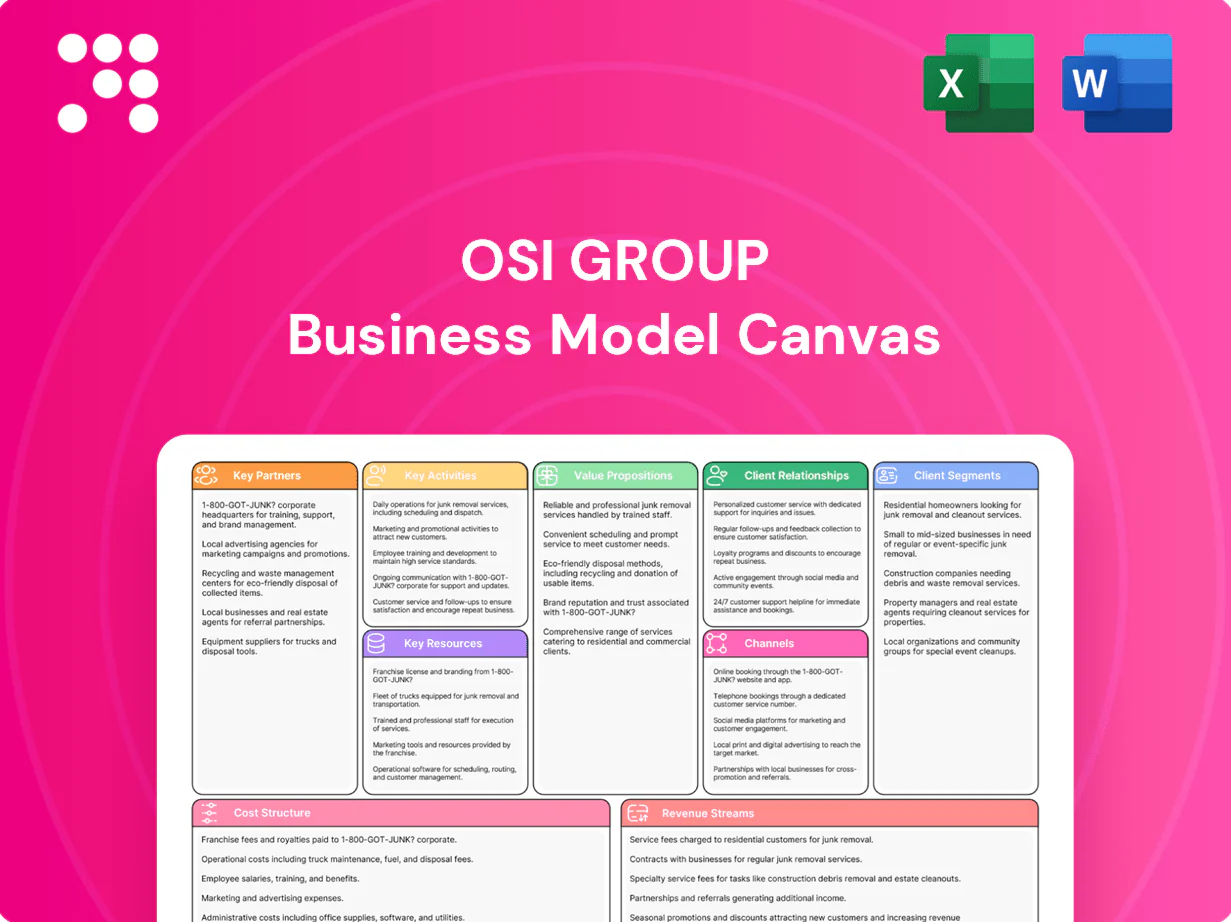
OSI Group Business Model Canvas

Business Model Canvas: Strategic blueprint for supply chain, partnerships, and revenue streams
Unlock the full strategic blueprint behind OSI Group's business model. This concise Business Model Canvas shows how OSI creates value across supply chain, partnerships, and revenue streams, revealing competitive levers and growth opportunities. Download the full, editable Canvas for actionable insights and benchmarking.
Partnerships

Global livestock suppliers
Partner with vetted beef, pork and poultry producers to ensure steady input volumes and full traceability, leveraging OSI Group’s global footprint of 65 facilities in 17 countries (2024). Long-term contracts stabilize pricing and quality across regions and are reinforced by joint monitoring of animal welfare and biosecurity standards. Seasonal and geopolitical risks are hedged through diversified sourcing across the Americas, Europe and Asia-Pacific.
Ingredient & packaging vendors
Ingredient and packaging vendors—spice, marinade, dough, cheese, veg suppliers and packaging innovators—co-develop specs to meet shelf-life, food-safety and sustainability targets (aiming for ~15% less packaging by 2025). Just-in-time delivery cuts inventory carrying costs by up to 25%, while co-innovation has been shown to accelerate new product launches by roughly 30%.

Retail & foodservice brands
Strategic co-manufacturing with QSRs, casual dining and retailers—OSI has supplied McDonald’s since 1955—drives steady volume across its more than 65 facilities in 17 countries. Joint R&D tailors formats and flavors to brand standards, shortening time-to-market for new SKUs. Forecasting and promotions are synchronized to customer demand plans via integrated planning systems. Multi-year MSAs lock in capacity and service levels with key accounts.

Cold-chain logistics partners
OSI leverages third-party refrigerated carriers and contract cold-storage to extend global reach, with industry 2024 OTIF benchmarks exceeding 95% to protect temperature integrity and food safety.
Backhaul programs commonly cut freight spend by about 10-20% while contingency routing and alternate gateways reduce disruption exposure and demurrage risk.
- third-party refrigerated carriers
- OTIF >95% (2024 benchmark)
- backhaul: -10-20% freight cost
- contingency routing: reduced disruption/demurrage
Regulatory & certification bodies
OSI partners with USDA, FDA, CFIA, EU authorities and halal/kosher certifiers to ensure regulatory alignment across its more than 65 plants in 17 countries (2024). Robust compliance frameworks and continuous training reduce recall and audit risks and maintain export eligibility. Halal/kosher certifications expand access to roughly 1.9 billion Muslim consumers and key export markets, boosting customer trust and sales channels.
- Regulators: USDA, FDA, CFIA, EU
- Certifiers: halal, kosher
- Scale: 65+ plants in 17 countries (2024)
- Market reach: ~1.9B Muslim consumers
Traceable supply: 65+ plants in 17 countries, OTIF >95%
Partnering with vetted beef, pork and poultry suppliers ensures traceable inputs across 65+ plants in 17 countries (2024) and stabilizes cost/quality via long-term contracts. Co-development with ingredient/packaging suppliers targets ~15% less packaging by 2025 and faster NPD. Logistics, certifiers and regulators maintain OTIF >95% (2024), halal/kosher access to ~1.9B consumers.
| Metric | Value (2024) |
|---|---|
| Plants/Countries | 65+ / 17 |
| OTIF | >95% |
| Packaging target | ~15% by 2025 |
| Halal market | ~1.9B |
What is included in the product
 Detailed Word Document
A comprehensive Business Model Canvas for OSI Group outlining its nine blocks—customer segments, value propositions, channels, customer relationships, revenue streams, key resources, key activities, key partners, and cost structure—reflecting operational realities, competitive advantages, SWOT-linked insights, and ready for presentations or investor review.

 Customizable Excel Spreadsheet
High-level, shareable Business Model Canvas for OSI Group that condenses strategy into a digestible, editable one-page snapshot—perfect for quickly aligning teams, saving hours on formatting, and comparing models side-by-side.
Activities

Custom food development
Co-create recipes, textures and formats with private-label and branded clients, leveraging OSI’s network across over 17 countries to match regional tastes. Pilot plant trials validate scalability and yield before scale-up, reducing production risk. Sensory panels and customer cuttings refine specs to retailer standards. Rapid prototyping accelerates commercialization, compressing time-to-market for new SKUs.
High-volume processing
OSI operates cook, raw and further-processing lines for proteins and value-added items across more than 65 facilities in 17 countries.
Lean and Six Sigma methodologies are applied plant-wide to drive throughput gains and reduce waste.
Rigorous sanitation and HACCP programs ensure food safety, while automation boosts product consistency and labor efficiency.

Quality & food safety management
OSI runs end-to-end QA from supplier approval through finished-goods testing, leveraging HACCP and ISO 22000 frameworks to meet global regulatory requirements. Critical control point monitoring and digital traceability capture lot-level data across the supply chain. Internal and customer audits occur regularly to verify compliance and continuous improvement. Rapid response protocols enable containment, root-cause analysis, and coordinated recalls when deviations occur.

Supply & demand planning
Supply & demand planning balances capacity, labor, and materials against customer forecasts, using S&OP to align procurement, production, and logistics and reduce stockouts. Safety stocks and dual sourcing hedge raw-material and transport volatility, while data analytics refines forecasts and service levels across OSI Group’s global operations.
- Aligns capacity, labor, materials
- S&OP links procurement, production, logistics
- Safety stock + dual sourcing hedge risk
- Analytics improves forecast accuracy & service
Sustainability & compliance
Advance responsible sourcing and waste-reduction programs across supply chains while tracking plant-level emissions, water and energy KPIs to align with EU CSRD requirements effective 2024 and customer ESG demands.
Commit to animal welfare and deforestation-free sourcing, publish annual progress reports to satisfy buyers and regulators, and integrate KPI data into procurement and compliance workflows.
- Scope 1-3 emissions tracking
- Water & energy KPIs per plant
- Deforestation-free & animal welfare commitments
Scale SKUs across 65+ sites in 17 countries; CSRD 2024
Co-develop recipes and run pilot plants to scale SKUs; operate cook, raw and further-processing lines across 65+ facilities in 17 countries; apply Lean/Six Sigma, HACCP/ISO 22000 and digital traceability; S&OP, safety stocks and dual sourcing balance supply/demand while tracking Scope 1-3 and CSRD-aligned ESG KPIs (effective 2024).
| Activity | KPI | 2024 |
|---|---|---|
| Manufacturing footprint | Facilities / Countries | 65+ / 17 |
| Regulatory/ESG | CSRD alignment | Effective 2024 |
Full Version Awaits
Business Model Canvas
The OSI Group Business Model Canvas you see is the actual deliverable, not a mockup, and reflects the full content and structure of the file you’ll receive. When you purchase, you’ll get this exact document—ready to download, edit, present, and share. No placeholders, no surprises—what you preview is what you own.

Business Model Canvas: Strategic blueprint for supply chain, partnerships, and revenue streams
Unlock the full strategic blueprint behind OSI Group's business model. This concise Business Model Canvas shows how OSI creates value across supply chain, partnerships, and revenue streams, revealing competitive levers and growth opportunities. Download the full, editable Canvas for actionable insights and benchmarking.
Partnerships
Global livestock suppliers
Partner with vetted beef, pork and poultry producers to ensure steady input volumes and full traceability, leveraging OSI Group’s global footprint of 65 facilities in 17 countries (2024). Long-term contracts stabilize pricing and quality across regions and are reinforced by joint monitoring of animal welfare and biosecurity standards. Seasonal and geopolitical risks are hedged through diversified sourcing across the Americas, Europe and Asia-Pacific.
Ingredient & packaging vendors
Ingredient and packaging vendors—spice, marinade, dough, cheese, veg suppliers and packaging innovators—co-develop specs to meet shelf-life, food-safety and sustainability targets (aiming for ~15% less packaging by 2025). Just-in-time delivery cuts inventory carrying costs by up to 25%, while co-innovation has been shown to accelerate new product launches by roughly 30%.
Retail & foodservice brands
Strategic co-manufacturing with QSRs, casual dining and retailers—OSI has supplied McDonald’s since 1955—drives steady volume across its more than 65 facilities in 17 countries. Joint R&D tailors formats and flavors to brand standards, shortening time-to-market for new SKUs. Forecasting and promotions are synchronized to customer demand plans via integrated planning systems. Multi-year MSAs lock in capacity and service levels with key accounts.
Cold-chain logistics partners
OSI leverages third-party refrigerated carriers and contract cold-storage to extend global reach, with industry 2024 OTIF benchmarks exceeding 95% to protect temperature integrity and food safety.
Backhaul programs commonly cut freight spend by about 10-20% while contingency routing and alternate gateways reduce disruption exposure and demurrage risk.
- third-party refrigerated carriers
- OTIF >95% (2024 benchmark)
- backhaul: -10-20% freight cost
- contingency routing: reduced disruption/demurrage
Regulatory & certification bodies
OSI partners with USDA, FDA, CFIA, EU authorities and halal/kosher certifiers to ensure regulatory alignment across its more than 65 plants in 17 countries (2024). Robust compliance frameworks and continuous training reduce recall and audit risks and maintain export eligibility. Halal/kosher certifications expand access to roughly 1.9 billion Muslim consumers and key export markets, boosting customer trust and sales channels.
- Regulators: USDA, FDA, CFIA, EU
- Certifiers: halal, kosher
- Scale: 65+ plants in 17 countries (2024)
- Market reach: ~1.9B Muslim consumers
Traceable supply: 65+ plants in 17 countries, OTIF >95%
Partnering with vetted beef, pork and poultry suppliers ensures traceable inputs across 65+ plants in 17 countries (2024) and stabilizes cost/quality via long-term contracts. Co-development with ingredient/packaging suppliers targets ~15% less packaging by 2025 and faster NPD. Logistics, certifiers and regulators maintain OTIF >95% (2024), halal/kosher access to ~1.9B consumers.
| Metric | Value (2024) |
|---|---|
| Plants/Countries | 65+ / 17 |
| OTIF | >95% |
| Packaging target | ~15% by 2025 |
| Halal market | ~1.9B |
What is included in the product
Detailed Word Document
A comprehensive Business Model Canvas for OSI Group outlining its nine blocks—customer segments, value propositions, channels, customer relationships, revenue streams, key resources, key activities, key partners, and cost structure—reflecting operational realities, competitive advantages, SWOT-linked insights, and ready for presentations or investor review.
Customizable Excel Spreadsheet
High-level, shareable Business Model Canvas for OSI Group that condenses strategy into a digestible, editable one-page snapshot—perfect for quickly aligning teams, saving hours on formatting, and comparing models side-by-side.
Activities
Custom food development
Co-create recipes, textures and formats with private-label and branded clients, leveraging OSI’s network across over 17 countries to match regional tastes. Pilot plant trials validate scalability and yield before scale-up, reducing production risk. Sensory panels and customer cuttings refine specs to retailer standards. Rapid prototyping accelerates commercialization, compressing time-to-market for new SKUs.
High-volume processing
OSI operates cook, raw and further-processing lines for proteins and value-added items across more than 65 facilities in 17 countries.
Lean and Six Sigma methodologies are applied plant-wide to drive throughput gains and reduce waste.
Rigorous sanitation and HACCP programs ensure food safety, while automation boosts product consistency and labor efficiency.
Quality & food safety management
OSI runs end-to-end QA from supplier approval through finished-goods testing, leveraging HACCP and ISO 22000 frameworks to meet global regulatory requirements. Critical control point monitoring and digital traceability capture lot-level data across the supply chain. Internal and customer audits occur regularly to verify compliance and continuous improvement. Rapid response protocols enable containment, root-cause analysis, and coordinated recalls when deviations occur.
Supply & demand planning
Supply & demand planning balances capacity, labor, and materials against customer forecasts, using S&OP to align procurement, production, and logistics and reduce stockouts. Safety stocks and dual sourcing hedge raw-material and transport volatility, while data analytics refines forecasts and service levels across OSI Group’s global operations.
- Aligns capacity, labor, materials
- S&OP links procurement, production, logistics
- Safety stock + dual sourcing hedge risk
- Analytics improves forecast accuracy & service
Sustainability & compliance
Advance responsible sourcing and waste-reduction programs across supply chains while tracking plant-level emissions, water and energy KPIs to align with EU CSRD requirements effective 2024 and customer ESG demands.
Commit to animal welfare and deforestation-free sourcing, publish annual progress reports to satisfy buyers and regulators, and integrate KPI data into procurement and compliance workflows.
- Scope 1-3 emissions tracking
- Water & energy KPIs per plant
- Deforestation-free & animal welfare commitments
Scale SKUs across 65+ sites in 17 countries; CSRD 2024
Co-develop recipes and run pilot plants to scale SKUs; operate cook, raw and further-processing lines across 65+ facilities in 17 countries; apply Lean/Six Sigma, HACCP/ISO 22000 and digital traceability; S&OP, safety stocks and dual sourcing balance supply/demand while tracking Scope 1-3 and CSRD-aligned ESG KPIs (effective 2024).
| Activity | KPI | 2024 |
|---|---|---|
| Manufacturing footprint | Facilities / Countries | 65+ / 17 |
| Regulatory/ESG | CSRD alignment | Effective 2024 |
Full Version Awaits
Business Model Canvas
The OSI Group Business Model Canvas you see is the actual deliverable, not a mockup, and reflects the full content and structure of the file you’ll receive. When you purchase, you’ll get this exact document—ready to download, edit, present, and share. No placeholders, no surprises—what you preview is what you own.
Original: $10.00
-65%$10.00
$3.50Description
Business Model Canvas: Strategic blueprint for supply chain, partnerships, and revenue streams
Unlock the full strategic blueprint behind OSI Group's business model. This concise Business Model Canvas shows how OSI creates value across supply chain, partnerships, and revenue streams, revealing competitive levers and growth opportunities. Download the full, editable Canvas for actionable insights and benchmarking.
Partnerships
Global livestock suppliers
Partner with vetted beef, pork and poultry producers to ensure steady input volumes and full traceability, leveraging OSI Group’s global footprint of 65 facilities in 17 countries (2024). Long-term contracts stabilize pricing and quality across regions and are reinforced by joint monitoring of animal welfare and biosecurity standards. Seasonal and geopolitical risks are hedged through diversified sourcing across the Americas, Europe and Asia-Pacific.
Ingredient & packaging vendors
Ingredient and packaging vendors—spice, marinade, dough, cheese, veg suppliers and packaging innovators—co-develop specs to meet shelf-life, food-safety and sustainability targets (aiming for ~15% less packaging by 2025). Just-in-time delivery cuts inventory carrying costs by up to 25%, while co-innovation has been shown to accelerate new product launches by roughly 30%.
Retail & foodservice brands
Strategic co-manufacturing with QSRs, casual dining and retailers—OSI has supplied McDonald’s since 1955—drives steady volume across its more than 65 facilities in 17 countries. Joint R&D tailors formats and flavors to brand standards, shortening time-to-market for new SKUs. Forecasting and promotions are synchronized to customer demand plans via integrated planning systems. Multi-year MSAs lock in capacity and service levels with key accounts.
Cold-chain logistics partners
OSI leverages third-party refrigerated carriers and contract cold-storage to extend global reach, with industry 2024 OTIF benchmarks exceeding 95% to protect temperature integrity and food safety.
Backhaul programs commonly cut freight spend by about 10-20% while contingency routing and alternate gateways reduce disruption exposure and demurrage risk.
- third-party refrigerated carriers
- OTIF >95% (2024 benchmark)
- backhaul: -10-20% freight cost
- contingency routing: reduced disruption/demurrage
Regulatory & certification bodies
OSI partners with USDA, FDA, CFIA, EU authorities and halal/kosher certifiers to ensure regulatory alignment across its more than 65 plants in 17 countries (2024). Robust compliance frameworks and continuous training reduce recall and audit risks and maintain export eligibility. Halal/kosher certifications expand access to roughly 1.9 billion Muslim consumers and key export markets, boosting customer trust and sales channels.
- Regulators: USDA, FDA, CFIA, EU
- Certifiers: halal, kosher
- Scale: 65+ plants in 17 countries (2024)
- Market reach: ~1.9B Muslim consumers
Traceable supply: 65+ plants in 17 countries, OTIF >95%
Partnering with vetted beef, pork and poultry suppliers ensures traceable inputs across 65+ plants in 17 countries (2024) and stabilizes cost/quality via long-term contracts. Co-development with ingredient/packaging suppliers targets ~15% less packaging by 2025 and faster NPD. Logistics, certifiers and regulators maintain OTIF >95% (2024), halal/kosher access to ~1.9B consumers.
| Metric | Value (2024) |
|---|---|
| Plants/Countries | 65+ / 17 |
| OTIF | >95% |
| Packaging target | ~15% by 2025 |
| Halal market | ~1.9B |
What is included in the product
Detailed Word Document
A comprehensive Business Model Canvas for OSI Group outlining its nine blocks—customer segments, value propositions, channels, customer relationships, revenue streams, key resources, key activities, key partners, and cost structure—reflecting operational realities, competitive advantages, SWOT-linked insights, and ready for presentations or investor review.
Customizable Excel Spreadsheet
High-level, shareable Business Model Canvas for OSI Group that condenses strategy into a digestible, editable one-page snapshot—perfect for quickly aligning teams, saving hours on formatting, and comparing models side-by-side.
Activities
Custom food development
Co-create recipes, textures and formats with private-label and branded clients, leveraging OSI’s network across over 17 countries to match regional tastes. Pilot plant trials validate scalability and yield before scale-up, reducing production risk. Sensory panels and customer cuttings refine specs to retailer standards. Rapid prototyping accelerates commercialization, compressing time-to-market for new SKUs.
High-volume processing
OSI operates cook, raw and further-processing lines for proteins and value-added items across more than 65 facilities in 17 countries.
Lean and Six Sigma methodologies are applied plant-wide to drive throughput gains and reduce waste.
Rigorous sanitation and HACCP programs ensure food safety, while automation boosts product consistency and labor efficiency.
Quality & food safety management
OSI runs end-to-end QA from supplier approval through finished-goods testing, leveraging HACCP and ISO 22000 frameworks to meet global regulatory requirements. Critical control point monitoring and digital traceability capture lot-level data across the supply chain. Internal and customer audits occur regularly to verify compliance and continuous improvement. Rapid response protocols enable containment, root-cause analysis, and coordinated recalls when deviations occur.
Supply & demand planning
Supply & demand planning balances capacity, labor, and materials against customer forecasts, using S&OP to align procurement, production, and logistics and reduce stockouts. Safety stocks and dual sourcing hedge raw-material and transport volatility, while data analytics refines forecasts and service levels across OSI Group’s global operations.
- Aligns capacity, labor, materials
- S&OP links procurement, production, logistics
- Safety stock + dual sourcing hedge risk
- Analytics improves forecast accuracy & service
Sustainability & compliance
Advance responsible sourcing and waste-reduction programs across supply chains while tracking plant-level emissions, water and energy KPIs to align with EU CSRD requirements effective 2024 and customer ESG demands.
Commit to animal welfare and deforestation-free sourcing, publish annual progress reports to satisfy buyers and regulators, and integrate KPI data into procurement and compliance workflows.
- Scope 1-3 emissions tracking
- Water & energy KPIs per plant
- Deforestation-free & animal welfare commitments
Scale SKUs across 65+ sites in 17 countries; CSRD 2024
Co-develop recipes and run pilot plants to scale SKUs; operate cook, raw and further-processing lines across 65+ facilities in 17 countries; apply Lean/Six Sigma, HACCP/ISO 22000 and digital traceability; S&OP, safety stocks and dual sourcing balance supply/demand while tracking Scope 1-3 and CSRD-aligned ESG KPIs (effective 2024).
| Activity | KPI | 2024 |
|---|---|---|
| Manufacturing footprint | Facilities / Countries | 65+ / 17 |
| Regulatory/ESG | CSRD alignment | Effective 2024 |
Full Version Awaits
Business Model Canvas
The OSI Group Business Model Canvas you see is the actual deliverable, not a mockup, and reflects the full content and structure of the file you’ll receive. When you purchase, you’ll get this exact document—ready to download, edit, present, and share. No placeholders, no surprises—what you preview is what you own.











