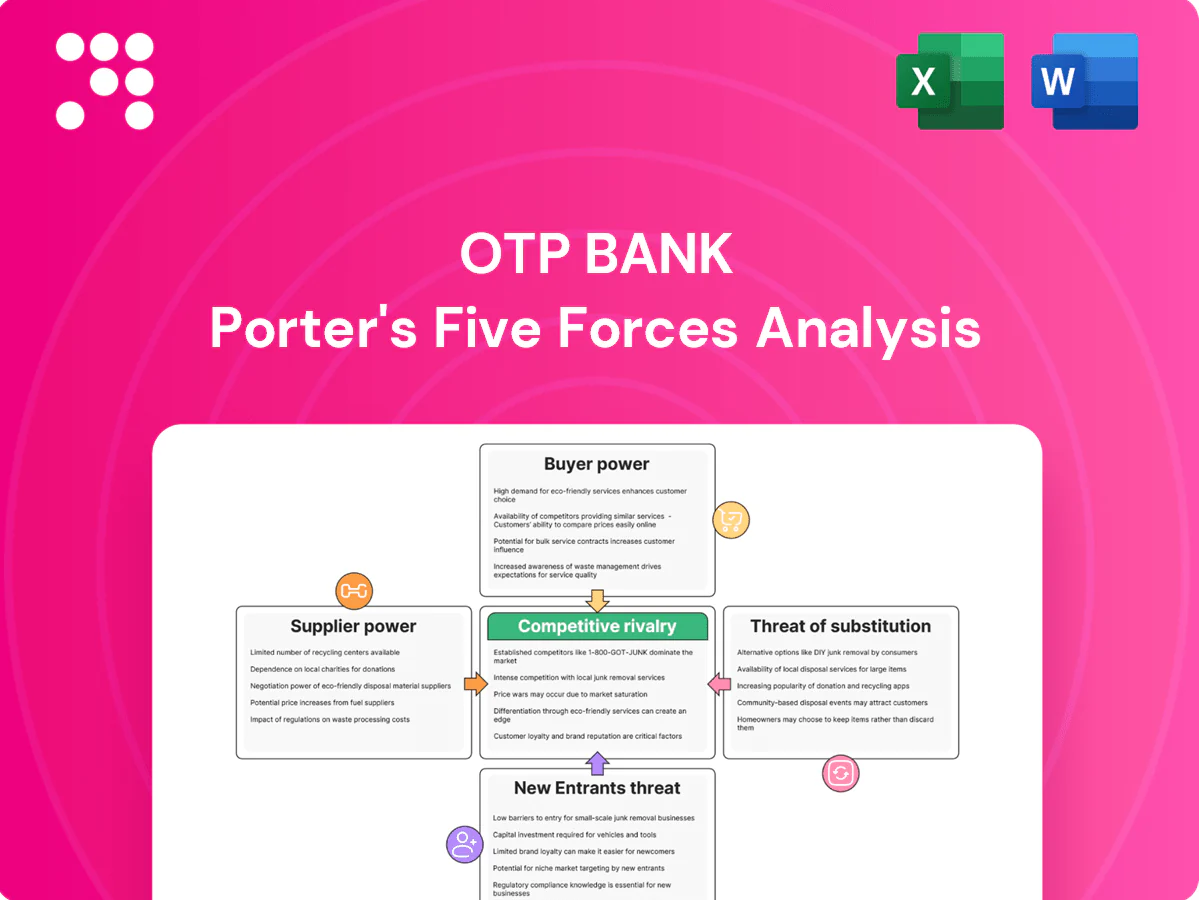
OTP Bank Porter's Five Forces Analysis

From Overview to Strategy Blueprint
OTP Bank faces moderate competitive rivalry, regulatory pressures, and evolving digital substitutes that reshape margins and customer loyalty; supplier and buyer power vary across retail and corporate segments. This snapshot highlights key tensions—unlock the full Porter's Five Forces Analysis to get force-by-force ratings, visuals, and actionable strategy to inform investment or strategic decisions.
Suppliers Bargaining Power

Concentrated wholesale funding
OTP Bank relies partly on interbank and capital markets for funding, with wholesale funding accounting for about 25% of liabilities in 2024, allowing large institutional lenders to influence terms. In stressed periods (2022–24) spreads widened and covenants tightened, pushing funding costs materially higher. Diversification across currencies and maturities mitigates risk, but dependence on key markets preserves supplier leverage; central bank facilities (used episodically in 2023–24) temper power cyclically but are not permanent substitutes.
Critical tech and data vendors
Critical tech and data vendors — core banking platforms, cloud providers, card networks and cybersecurity firms — are few and sticky, giving suppliers negotiation leverage. Synergy Research 2024 shows AWS ~33%, Azure ~22%, Google Cloud ~11% and Visa+Mastercard process over 70% of card volumes, concentrating dependency. High switching costs, integration complexity and regulatory certifications increase lock‑in; long‑term contracts and dual‑vendor strategies reduce outage risk but limit pricing flexibility. Vendor outages or lock‑in can materially impact service quality and the bank’s cost base.

Talent and specialist skills
Quant, risk, compliance and IT engineering talent is scarce across CEE, pushing wage pressure with tech salaries rising ≈10% year-on-year in 2024. Regulatory change (e.g., PSD2, Basel updates) and digital transformation drive demand for experienced professionals, lengthening hiring cycles. Retention packages and nearshoring mitigate supply shortfalls, but supplier (labor) power remains moderate-to-high, raising operational costs and extending project timelines.

Payment schemes and infrastructure
- tag:interchange_caps 0.2%/0.3%
- tag:sepa_coverage 36_countries
- tag:neg_power limited_by_network_effects
- tag:rebates offset_partially
Regulators as “license suppliers”
Regulators set capital, liquidity and conduct standards that shape OTP Bank’s cost of doing business: Basel III requires a 4.5% CET1 minimum plus a 2.5% capital conservation buffer (2024), with additional systemic buffers possible. Rule changes (e.g., higher buffers or consumer protection measures) can reprice loans and compress margins. Compliance is non-negotiable, giving supervisors de facto economic power; engagement and strong governance reduce surprises but not structural leverage.
- Supervisory capital: 4.5% CET1 min
- Capital conservation buffer: 2.5%
- Regulatory changes can reprice products
- Compliance = de facto supplier power
Wholesale funding ≈25%, cloud concentration and rising tech wages
OTP’s suppliers exert moderate-to-high power: wholesale funding (≈25% of liabilities in 2024) and episodic central‑bank reliance raise lender leverage; core cloud/card vendors are concentrated (AWS 33%/Azure 22%/GCP 11%, Visa+Mastercard >70%), while tech wages rose ≈10% YoY in 2024. Regulatory capital (CET1 4.5% + 2.5% buffer) and interchange caps (0.2%/0.3%) limit pricing flexibility.
| metric | 2024 value | tag |
|---|---|---|
| Wholesale funding | ≈25% liabilities | wholesale_25% |
| Cloud market | AWS33/Azure22/GCP11 | cloud_shares |
| Tech wage growth | ≈+10% YoY | tech_wages |
| Interchange caps | 0.2%/0.3% | interchange_caps |
| CET1 requirement | 4.5% + 2.5% buffer | cet1_4.5_+2.5 |
What is included in the product
 Detailed Word Document
Tailored Porter's Five Forces analysis for OTP Bank that uncovers competitive drivers, customer and supplier influence, entry barriers, substitute threats, and emerging disruptors, with strategic commentary to assess pricing power and profitability.

 Customizable Excel Spreadsheet
A concise Porter’s Five Forces snapshot for OTP Bank—clarifies competitive intensity, regulatory and interest-rate risks, and counterparty bargaining power to speed strategic decisions and slide-ready reporting.
Customers Bargaining Power

High price transparency
Digital channels and comparison sites make rates and fees easily comparable across banks, and in 2024 over 70% of CEE retail customers used online banking to compare offers, increasing switch rates among retail and SME clients. This empowers customers to negotiate better terms or move providers, compressing spreads and fee income—particularly in commoditized products where margins fell by low-single digits in 2024. OTP counters pressure with loyalty programs and bundled offerings to retain clients and protect fee revenue.
Multi-banking corporates
In 2024 multi-banking corporates increasingly run formal RFPs and maintain multi-bank relationships to extract pricing and service concessions. Cash management, FX and lending mandates are frequently contested, elevating buyer power and forcing OTP to demonstrate balance-sheet depth. OTP must tailor integrated solutions, deepen cross-selling and leverage regional coverage to regain wallet share and reduce client leverage.

Switching costs declining
Account mobility, interoperable payments and digital onboarding reduce frictions to switch for retail and micro-SME clients, with Hungary smartphone penetration at about 85% in 2024 enabling seamless app-driven moves. Fintech UX raises expectations for speed and service, increasing price and quality sensitivity and shifting bargaining power toward customers in low-complexity segments. Relationship banking still retains leverage for complex credit decisions, moderating the shift.

Regulated consumer protection
Regulated consumer protection — interest rate caps, mandated fee rules and transparency requirements shift bargaining power toward customers by limiting OTPs ability to price opaquely and extract rents.
Dispute resolution mechanisms and data portability rights raise customer leverage; OTP must compete on demonstrable value rather than hidden margins, increasing compliance costs and narrowing pricing flexibility.
- Interest rate caps strengthen customer position
- Fee rules and transparency reduce opacity
- Dispute resolution increases negotiating leverage
- Data portability limits switching costs
- Compliance costs rise; pricing flexibility narrows
Segment heterogeneity
Mass retail (c.16 million customers in 2024) exerts strong collective price sensitivity on standardized products, while affluent and SME clients extract concessions via volume and bundled services; niche and underserved segments show lower bargaining power but remain highly price sensitive. OTP can apply segmented pricing and tiered service levels to protect yield and retention, and data-driven personalization reduces perceived substitutability and churn.
- Mass retail: high collective leverage on standard products
- Affluent/SME: negotiate via volume and bundles
- Niche/underserved: low power, high price sensitivity
- Mitigation: segmented pricing, tiered service, personalization
Comparators plus 70% online use drive switching and squeeze margins
Digital comparators and 2024 CEE online-banking use (70%) plus Hungary smartphone penetration (85%) boost retail switching, compressing commoditized product margins by low-single digits. Multi-bank RFPs among corporates raise buyer leverage; OTP offsets via bundling, segmentation and regional coverage to protect yields and cross-sell.
| Metric | 2024 |
|---|---|
| Mass retail customers | c.16m |
| CEE online banking use | 70% |
| HU smartphone penetration | 85% |
| Margin compression | low-single digits |
Same Document Delivered
OTP Bank Porter's Five Forces Analysis
This preview shows the exact OTP Bank Porter's Five Forces analysis you'll receive immediately after purchase. The document is fully formatted, professionally written, and includes the complete strategic assessment—no placeholders or samples. You'll get instant access to this same file for download and use. What you see is what you get.

From Overview to Strategy Blueprint
OTP Bank faces moderate competitive rivalry, regulatory pressures, and evolving digital substitutes that reshape margins and customer loyalty; supplier and buyer power vary across retail and corporate segments. This snapshot highlights key tensions—unlock the full Porter's Five Forces Analysis to get force-by-force ratings, visuals, and actionable strategy to inform investment or strategic decisions.
Suppliers Bargaining Power
Concentrated wholesale funding
OTP Bank relies partly on interbank and capital markets for funding, with wholesale funding accounting for about 25% of liabilities in 2024, allowing large institutional lenders to influence terms. In stressed periods (2022–24) spreads widened and covenants tightened, pushing funding costs materially higher. Diversification across currencies and maturities mitigates risk, but dependence on key markets preserves supplier leverage; central bank facilities (used episodically in 2023–24) temper power cyclically but are not permanent substitutes.
Critical tech and data vendors
Critical tech and data vendors — core banking platforms, cloud providers, card networks and cybersecurity firms — are few and sticky, giving suppliers negotiation leverage. Synergy Research 2024 shows AWS ~33%, Azure ~22%, Google Cloud ~11% and Visa+Mastercard process over 70% of card volumes, concentrating dependency. High switching costs, integration complexity and regulatory certifications increase lock‑in; long‑term contracts and dual‑vendor strategies reduce outage risk but limit pricing flexibility. Vendor outages or lock‑in can materially impact service quality and the bank’s cost base.
Talent and specialist skills
Quant, risk, compliance and IT engineering talent is scarce across CEE, pushing wage pressure with tech salaries rising ≈10% year-on-year in 2024. Regulatory change (e.g., PSD2, Basel updates) and digital transformation drive demand for experienced professionals, lengthening hiring cycles. Retention packages and nearshoring mitigate supply shortfalls, but supplier (labor) power remains moderate-to-high, raising operational costs and extending project timelines.
Payment schemes and infrastructure
- tag:interchange_caps 0.2%/0.3%
- tag:sepa_coverage 36_countries
- tag:neg_power limited_by_network_effects
- tag:rebates offset_partially
Regulators as “license suppliers”
Regulators set capital, liquidity and conduct standards that shape OTP Bank’s cost of doing business: Basel III requires a 4.5% CET1 minimum plus a 2.5% capital conservation buffer (2024), with additional systemic buffers possible. Rule changes (e.g., higher buffers or consumer protection measures) can reprice loans and compress margins. Compliance is non-negotiable, giving supervisors de facto economic power; engagement and strong governance reduce surprises but not structural leverage.
- Supervisory capital: 4.5% CET1 min
- Capital conservation buffer: 2.5%
- Regulatory changes can reprice products
- Compliance = de facto supplier power
Wholesale funding ≈25%, cloud concentration and rising tech wages
OTP’s suppliers exert moderate-to-high power: wholesale funding (≈25% of liabilities in 2024) and episodic central‑bank reliance raise lender leverage; core cloud/card vendors are concentrated (AWS 33%/Azure 22%/GCP 11%, Visa+Mastercard >70%), while tech wages rose ≈10% YoY in 2024. Regulatory capital (CET1 4.5% + 2.5% buffer) and interchange caps (0.2%/0.3%) limit pricing flexibility.
| metric | 2024 value | tag |
|---|---|---|
| Wholesale funding | ≈25% liabilities | wholesale_25% |
| Cloud market | AWS33/Azure22/GCP11 | cloud_shares |
| Tech wage growth | ≈+10% YoY | tech_wages |
| Interchange caps | 0.2%/0.3% | interchange_caps |
| CET1 requirement | 4.5% + 2.5% buffer | cet1_4.5_+2.5 |
What is included in the product
Detailed Word Document
Tailored Porter's Five Forces analysis for OTP Bank that uncovers competitive drivers, customer and supplier influence, entry barriers, substitute threats, and emerging disruptors, with strategic commentary to assess pricing power and profitability.
Customizable Excel Spreadsheet
A concise Porter’s Five Forces snapshot for OTP Bank—clarifies competitive intensity, regulatory and interest-rate risks, and counterparty bargaining power to speed strategic decisions and slide-ready reporting.
Customers Bargaining Power
High price transparency
Digital channels and comparison sites make rates and fees easily comparable across banks, and in 2024 over 70% of CEE retail customers used online banking to compare offers, increasing switch rates among retail and SME clients. This empowers customers to negotiate better terms or move providers, compressing spreads and fee income—particularly in commoditized products where margins fell by low-single digits in 2024. OTP counters pressure with loyalty programs and bundled offerings to retain clients and protect fee revenue.
Multi-banking corporates
In 2024 multi-banking corporates increasingly run formal RFPs and maintain multi-bank relationships to extract pricing and service concessions. Cash management, FX and lending mandates are frequently contested, elevating buyer power and forcing OTP to demonstrate balance-sheet depth. OTP must tailor integrated solutions, deepen cross-selling and leverage regional coverage to regain wallet share and reduce client leverage.
Switching costs declining
Account mobility, interoperable payments and digital onboarding reduce frictions to switch for retail and micro-SME clients, with Hungary smartphone penetration at about 85% in 2024 enabling seamless app-driven moves. Fintech UX raises expectations for speed and service, increasing price and quality sensitivity and shifting bargaining power toward customers in low-complexity segments. Relationship banking still retains leverage for complex credit decisions, moderating the shift.
Regulated consumer protection
Regulated consumer protection — interest rate caps, mandated fee rules and transparency requirements shift bargaining power toward customers by limiting OTPs ability to price opaquely and extract rents.
Dispute resolution mechanisms and data portability rights raise customer leverage; OTP must compete on demonstrable value rather than hidden margins, increasing compliance costs and narrowing pricing flexibility.
- Interest rate caps strengthen customer position
- Fee rules and transparency reduce opacity
- Dispute resolution increases negotiating leverage
- Data portability limits switching costs
- Compliance costs rise; pricing flexibility narrows
Segment heterogeneity
Mass retail (c.16 million customers in 2024) exerts strong collective price sensitivity on standardized products, while affluent and SME clients extract concessions via volume and bundled services; niche and underserved segments show lower bargaining power but remain highly price sensitive. OTP can apply segmented pricing and tiered service levels to protect yield and retention, and data-driven personalization reduces perceived substitutability and churn.
- Mass retail: high collective leverage on standard products
- Affluent/SME: negotiate via volume and bundles
- Niche/underserved: low power, high price sensitivity
- Mitigation: segmented pricing, tiered service, personalization
Comparators plus 70% online use drive switching and squeeze margins
Digital comparators and 2024 CEE online-banking use (70%) plus Hungary smartphone penetration (85%) boost retail switching, compressing commoditized product margins by low-single digits. Multi-bank RFPs among corporates raise buyer leverage; OTP offsets via bundling, segmentation and regional coverage to protect yields and cross-sell.
| Metric | 2024 |
|---|---|
| Mass retail customers | c.16m |
| CEE online banking use | 70% |
| HU smartphone penetration | 85% |
| Margin compression | low-single digits |
Same Document Delivered
OTP Bank Porter's Five Forces Analysis
This preview shows the exact OTP Bank Porter's Five Forces analysis you'll receive immediately after purchase. The document is fully formatted, professionally written, and includes the complete strategic assessment—no placeholders or samples. You'll get instant access to this same file for download and use. What you see is what you get.
Original: $10.00
-65%$10.00
$3.50Description
From Overview to Strategy Blueprint
OTP Bank faces moderate competitive rivalry, regulatory pressures, and evolving digital substitutes that reshape margins and customer loyalty; supplier and buyer power vary across retail and corporate segments. This snapshot highlights key tensions—unlock the full Porter's Five Forces Analysis to get force-by-force ratings, visuals, and actionable strategy to inform investment or strategic decisions.
Suppliers Bargaining Power
Concentrated wholesale funding
OTP Bank relies partly on interbank and capital markets for funding, with wholesale funding accounting for about 25% of liabilities in 2024, allowing large institutional lenders to influence terms. In stressed periods (2022–24) spreads widened and covenants tightened, pushing funding costs materially higher. Diversification across currencies and maturities mitigates risk, but dependence on key markets preserves supplier leverage; central bank facilities (used episodically in 2023–24) temper power cyclically but are not permanent substitutes.
Critical tech and data vendors
Critical tech and data vendors — core banking platforms, cloud providers, card networks and cybersecurity firms — are few and sticky, giving suppliers negotiation leverage. Synergy Research 2024 shows AWS ~33%, Azure ~22%, Google Cloud ~11% and Visa+Mastercard process over 70% of card volumes, concentrating dependency. High switching costs, integration complexity and regulatory certifications increase lock‑in; long‑term contracts and dual‑vendor strategies reduce outage risk but limit pricing flexibility. Vendor outages or lock‑in can materially impact service quality and the bank’s cost base.
Talent and specialist skills
Quant, risk, compliance and IT engineering talent is scarce across CEE, pushing wage pressure with tech salaries rising ≈10% year-on-year in 2024. Regulatory change (e.g., PSD2, Basel updates) and digital transformation drive demand for experienced professionals, lengthening hiring cycles. Retention packages and nearshoring mitigate supply shortfalls, but supplier (labor) power remains moderate-to-high, raising operational costs and extending project timelines.
Payment schemes and infrastructure
- tag:interchange_caps 0.2%/0.3%
- tag:sepa_coverage 36_countries
- tag:neg_power limited_by_network_effects
- tag:rebates offset_partially
Regulators as “license suppliers”
Regulators set capital, liquidity and conduct standards that shape OTP Bank’s cost of doing business: Basel III requires a 4.5% CET1 minimum plus a 2.5% capital conservation buffer (2024), with additional systemic buffers possible. Rule changes (e.g., higher buffers or consumer protection measures) can reprice loans and compress margins. Compliance is non-negotiable, giving supervisors de facto economic power; engagement and strong governance reduce surprises but not structural leverage.
- Supervisory capital: 4.5% CET1 min
- Capital conservation buffer: 2.5%
- Regulatory changes can reprice products
- Compliance = de facto supplier power
Wholesale funding ≈25%, cloud concentration and rising tech wages
OTP’s suppliers exert moderate-to-high power: wholesale funding (≈25% of liabilities in 2024) and episodic central‑bank reliance raise lender leverage; core cloud/card vendors are concentrated (AWS 33%/Azure 22%/GCP 11%, Visa+Mastercard >70%), while tech wages rose ≈10% YoY in 2024. Regulatory capital (CET1 4.5% + 2.5% buffer) and interchange caps (0.2%/0.3%) limit pricing flexibility.
| metric | 2024 value | tag |
|---|---|---|
| Wholesale funding | ≈25% liabilities | wholesale_25% |
| Cloud market | AWS33/Azure22/GCP11 | cloud_shares |
| Tech wage growth | ≈+10% YoY | tech_wages |
| Interchange caps | 0.2%/0.3% | interchange_caps |
| CET1 requirement | 4.5% + 2.5% buffer | cet1_4.5_+2.5 |
What is included in the product
Detailed Word Document
Tailored Porter's Five Forces analysis for OTP Bank that uncovers competitive drivers, customer and supplier influence, entry barriers, substitute threats, and emerging disruptors, with strategic commentary to assess pricing power and profitability.
Customizable Excel Spreadsheet
A concise Porter’s Five Forces snapshot for OTP Bank—clarifies competitive intensity, regulatory and interest-rate risks, and counterparty bargaining power to speed strategic decisions and slide-ready reporting.
Customers Bargaining Power
High price transparency
Digital channels and comparison sites make rates and fees easily comparable across banks, and in 2024 over 70% of CEE retail customers used online banking to compare offers, increasing switch rates among retail and SME clients. This empowers customers to negotiate better terms or move providers, compressing spreads and fee income—particularly in commoditized products where margins fell by low-single digits in 2024. OTP counters pressure with loyalty programs and bundled offerings to retain clients and protect fee revenue.
Multi-banking corporates
In 2024 multi-banking corporates increasingly run formal RFPs and maintain multi-bank relationships to extract pricing and service concessions. Cash management, FX and lending mandates are frequently contested, elevating buyer power and forcing OTP to demonstrate balance-sheet depth. OTP must tailor integrated solutions, deepen cross-selling and leverage regional coverage to regain wallet share and reduce client leverage.
Switching costs declining
Account mobility, interoperable payments and digital onboarding reduce frictions to switch for retail and micro-SME clients, with Hungary smartphone penetration at about 85% in 2024 enabling seamless app-driven moves. Fintech UX raises expectations for speed and service, increasing price and quality sensitivity and shifting bargaining power toward customers in low-complexity segments. Relationship banking still retains leverage for complex credit decisions, moderating the shift.
Regulated consumer protection
Regulated consumer protection — interest rate caps, mandated fee rules and transparency requirements shift bargaining power toward customers by limiting OTPs ability to price opaquely and extract rents.
Dispute resolution mechanisms and data portability rights raise customer leverage; OTP must compete on demonstrable value rather than hidden margins, increasing compliance costs and narrowing pricing flexibility.
- Interest rate caps strengthen customer position
- Fee rules and transparency reduce opacity
- Dispute resolution increases negotiating leverage
- Data portability limits switching costs
- Compliance costs rise; pricing flexibility narrows
Segment heterogeneity
Mass retail (c.16 million customers in 2024) exerts strong collective price sensitivity on standardized products, while affluent and SME clients extract concessions via volume and bundled services; niche and underserved segments show lower bargaining power but remain highly price sensitive. OTP can apply segmented pricing and tiered service levels to protect yield and retention, and data-driven personalization reduces perceived substitutability and churn.
- Mass retail: high collective leverage on standard products
- Affluent/SME: negotiate via volume and bundles
- Niche/underserved: low power, high price sensitivity
- Mitigation: segmented pricing, tiered service, personalization
Comparators plus 70% online use drive switching and squeeze margins
Digital comparators and 2024 CEE online-banking use (70%) plus Hungary smartphone penetration (85%) boost retail switching, compressing commoditized product margins by low-single digits. Multi-bank RFPs among corporates raise buyer leverage; OTP offsets via bundling, segmentation and regional coverage to protect yields and cross-sell.
| Metric | 2024 |
|---|---|
| Mass retail customers | c.16m |
| CEE online banking use | 70% |
| HU smartphone penetration | 85% |
| Margin compression | low-single digits |
Same Document Delivered
OTP Bank Porter's Five Forces Analysis
This preview shows the exact OTP Bank Porter's Five Forces analysis you'll receive immediately after purchase. The document is fully formatted, professionally written, and includes the complete strategic assessment—no placeholders or samples. You'll get instant access to this same file for download and use. What you see is what you get.











