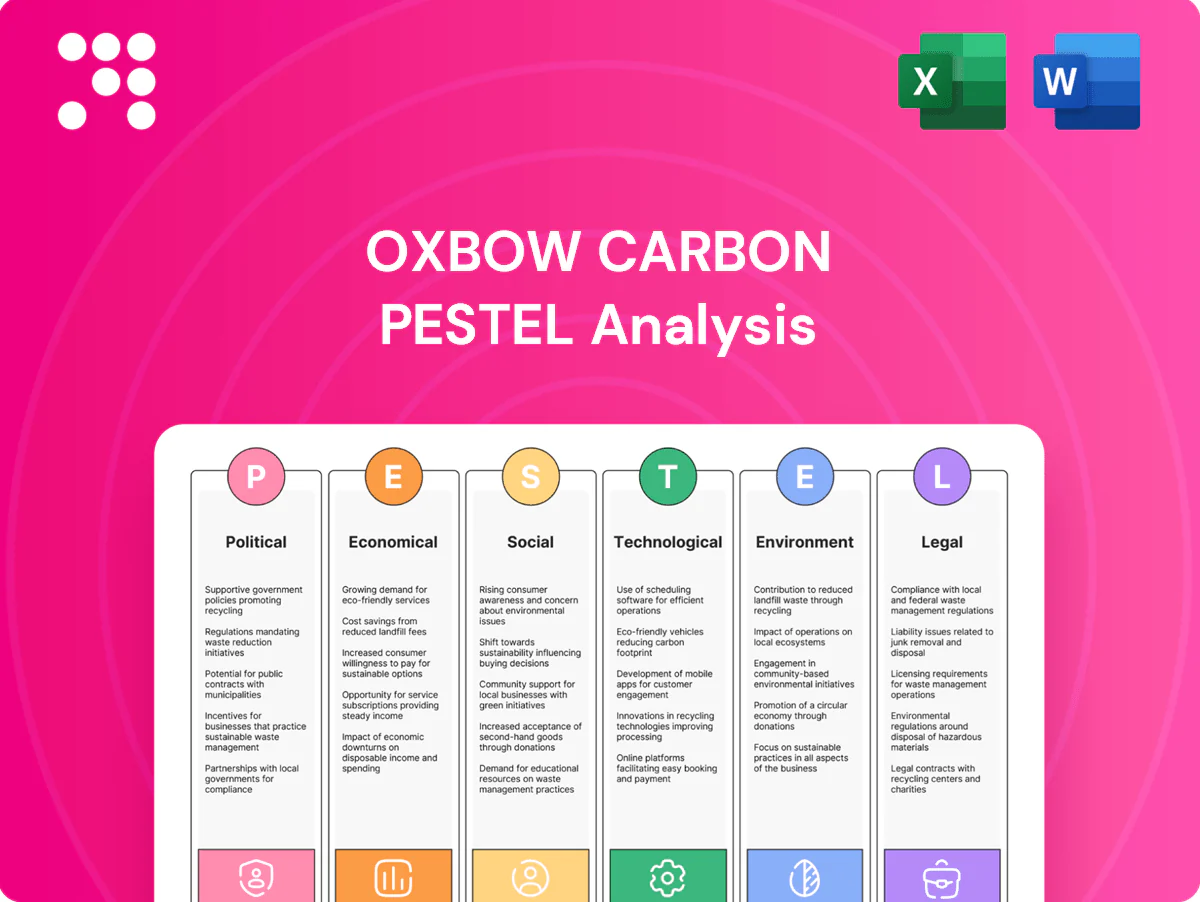
Oxbow Carbon PESTLE Analysis

Make Smarter Strategic Decisions with a Complete PESTEL View
Discover how political, economic, social, technological, legal, and environmental forces are reshaping Oxbow Carbon’s strategy and risk profile. This concise PESTLE snapshot highlights key external drivers and investment implications. Ideal for analysts and planners. Purchase the full report to access the detailed, actionable analysis and downloadable templates.
Political factors

Energy and climate policy shifts
National and regional decarbonization agendas—EU Fit for 55 targeting 55% emissions cut by 2030 and the US IRA mobilizing roughly $369 billion for clean energy—can restrict petroleum coke and coal use; renewables incentives are diverting investment from carbon‑intensive commodities. Oxbow must track policy trajectories to recalibrate sourcing, blending ratios and market focus.
Trade tariffs and export controls
Tariffs on coal, petcoke, or related equipment can alter trade flows and margins. Seaborne coal trade was about 1.1 billion tonnes in 2023, so even small tariffs (commonly 0–10%) can shift routes and compress spreads. Export controls, exemplified by Indonesia's 2022 temporary coal export restrictions, highlight supply risk. Strategic diversification of origins and destinations reduces tariff exposure.

Geopolitical risk in supply corridors
Conflicts and instability near ports, canals and railways can halt flows and spike costs — the 2021 Suez blockage highlighted global trade at risk, with Lloyds estimating up to $9.6 billion of trade transiting the canal daily. Sanctions regimes, notably post‑2022 measures on Russia, have narrowed counterparties and payment rails by restricting SWIFT access for designated banks. Building redundant routes and robust compliance screening reduces interruption and counterparty exposure.

Subsidies and state-owned competitors
State-backed miners, refiners and traders—notably in China (coal production ~4.0 billion tonnes in 2023)—can distort feedstock pricing and market access for Oxbow through preferential contracts and export controls.
Subsidized freight or fuel in key regional markets lowers competitors cost bases; Oxbow must employ adaptive pricing, flexible supply contracts and strategic partnerships to protect margins.
- State-backed pricing power: regional distortions;
- Subsidized logistics: shifts competitiveness;
- Oxbow response: adaptive pricing, partnerships;
Local permitting and community politics
Port expansions, storage terminals and transloading sites for Oxbow Carbon are contingent on municipal approvals; federal IIJA port funding of 17 billion USD (allocated 2021) increases local project activity and scrutiny.
Community opposition has introduced multi‑year permitting delays for similar energy and CO2 projects across the US, reshaping siting and capex schedules.
Proactive engagement, binding environmental safeguards and early mitigation plans improve odds of securing social license and reducing delay risk.
Decarbonization and trade frictions force coal/petcoke repricing and multi-year siting risk
Decarbonization policies (EU 55% by 2030; US IRA ~369 billion USD) are shrinking petcoke/coal demand and shifting capital to renewables, forcing Oxbow to reprice and rebalance supply. Trade measures and tariffs (seaborne coal ~1.1 bn t in 2023) plus export curbs (Indonesia 2022) raise sourcing risk; sanctions since 2022 constrain counterparties. Local permits, IIJA ports funding 17 billion USD and community opposition create multi‑year siting uncertainty.
| Metric | Value |
|---|---|
| US IRA | ~369 bn USD |
| Seaborne coal 2023 | 1.1 bn t |
| China coal 2023 | ~4.0 bn t |
| IIJA ports | 17 bn USD |
What is included in the product
 Detailed Word Document
Explores how Political, Economic, Social, Technological, Environmental and Legal forces uniquely impact Oxbow Carbon, using data-driven trends and regional regulatory context to identify risks, opportunities and strategic responses; tailored for executives, investors and planners with forward-looking insights for scenario planning.

 Customizable Excel Spreadsheet
A concise, visually segmented PESTLE summary of Oxbow Carbon that’s easy to share and drop into presentations, enabling quick cross-team alignment and streamlined discussion of external risks, regulatory shifts, and market positioning; editable for region- or business-specific notes.
Economic factors

Commodity price cyclicality
Coal and petcoke prices remain highly cyclical, with market swings exceeding 25% year-over-year in 2023–24 as refinery runs, Chinese steel output (global crude steel ~1.85 billion tonnes in 2024) and power fuel switching drove demand shifts. Margin management for Oxbow Carbon requires flexible supply contracts and active hedging to protect crushing spreads and coke margins. Maintaining counter-cyclical inventory buffers has proven to stabilize EBITDA and cash flow during 2023–25 volatility.
Freight and logistics costs
Ocean freight volatility, reflected in the Baltic Dry Index, and bunker fuel (which can comprise over 20% of voyage costs) alongside rail tariff changes materially affect delivered cost and can compress arbitrage during tight vessel supply or disruptions; long-term charters and multimodal optionality help preserve spreads by locking capacity and lowering spot exposure.

Currency and interest rate exposures
Global trade gives Oxbow multi-currency receivables and payables, exposing margins to FX swings as the US dollar strengthened ~3–5% vs major peers in 2024–H1 2025. Rate hikes (US policy rate ~5.25–5.50% mid‑2025) raise inventory carry and working capital costs materially. Active FX hedges and optimized credit lines (revolver capacity) are used to protect returns and stabilize cash flow.

Emerging market demand dynamics
Industrializing regions in South Asia and Africa drive petcoke and coal demand, notably from cement and power sectors; India produced about 353 million tonnes of cement in 2023–24, underpinning fuel needs. Policy-driven fuel switching (subsidy changes, emissions rules) can shift demand rapidly. Local partnerships and granular demand analytics improve placement accuracy and reduce logistics mismatch.
- Key sectors: cement, power
- Fact: India cement 353 Mt (2023–24)
- Risk: policy-driven swings
- Mitigation: local partnerships + analytics
Counterparty credit and liquidity
Commodity downcycles raise buyer and supplier default risk, pressuring cash flows and working capital for Oxbow Carbon, which remains privately held by Oxbow Group as of 2025. Private ownership makes external capital access and liquidity planning critical. Robust collateralization and trade credit insurance have materially limited counterparty losses in recent market stress.
- Counterparty default risk: elevated in downcycles
- Private ownership: higher liquidity planning needs
- Mitigants: strong collateral and trade credit insurance
Decarbonization and trade frictions force coal/petcoke repricing and multi-year siting risk
Coal/petcoke prices swung >25% YoY in 2023–24, forcing flexible contracts and hedges; inventory buffers stabilized EBITDA in 2023–25. Ocean freight and bunker (20%+ voyage cost) plus rail tariffs compressed spreads during 2023–25 vessel tightness. FX and rates (USD +3–5% vs peers 2024–H1 2025; US policy rate ~5.25–5.50% mid‑2025) raised working capital costs.
| Metric | Value |
|---|---|
| Coal/petcoke volatility | >25% YoY (2023–24) |
| Global crude steel | ~1.85 bn t (2024) |
| India cement | 353 Mt (2023–24) |
| US policy rate | ~5.25–5.50% (mid‑2025) |
Preview the Actual Deliverable
Oxbow Carbon PESTLE Analysis
The preview shown is the exact Oxbow Carbon PESTLE Analysis you’ll receive after purchase—fully formatted and ready to use. The layout, content, and structure visible here match the downloadable file you’ll get instantly after checkout. No placeholders or teasers—this is the final, professionally structured document for immediate application.

Make Smarter Strategic Decisions with a Complete PESTEL View
Discover how political, economic, social, technological, legal, and environmental forces are reshaping Oxbow Carbon’s strategy and risk profile. This concise PESTLE snapshot highlights key external drivers and investment implications. Ideal for analysts and planners. Purchase the full report to access the detailed, actionable analysis and downloadable templates.
Political factors
Energy and climate policy shifts
National and regional decarbonization agendas—EU Fit for 55 targeting 55% emissions cut by 2030 and the US IRA mobilizing roughly $369 billion for clean energy—can restrict petroleum coke and coal use; renewables incentives are diverting investment from carbon‑intensive commodities. Oxbow must track policy trajectories to recalibrate sourcing, blending ratios and market focus.
Trade tariffs and export controls
Tariffs on coal, petcoke, or related equipment can alter trade flows and margins. Seaborne coal trade was about 1.1 billion tonnes in 2023, so even small tariffs (commonly 0–10%) can shift routes and compress spreads. Export controls, exemplified by Indonesia's 2022 temporary coal export restrictions, highlight supply risk. Strategic diversification of origins and destinations reduces tariff exposure.
Geopolitical risk in supply corridors
Conflicts and instability near ports, canals and railways can halt flows and spike costs — the 2021 Suez blockage highlighted global trade at risk, with Lloyds estimating up to $9.6 billion of trade transiting the canal daily. Sanctions regimes, notably post‑2022 measures on Russia, have narrowed counterparties and payment rails by restricting SWIFT access for designated banks. Building redundant routes and robust compliance screening reduces interruption and counterparty exposure.
Subsidies and state-owned competitors
State-backed miners, refiners and traders—notably in China (coal production ~4.0 billion tonnes in 2023)—can distort feedstock pricing and market access for Oxbow through preferential contracts and export controls.
Subsidized freight or fuel in key regional markets lowers competitors cost bases; Oxbow must employ adaptive pricing, flexible supply contracts and strategic partnerships to protect margins.
- State-backed pricing power: regional distortions;
- Subsidized logistics: shifts competitiveness;
- Oxbow response: adaptive pricing, partnerships;
Local permitting and community politics
Port expansions, storage terminals and transloading sites for Oxbow Carbon are contingent on municipal approvals; federal IIJA port funding of 17 billion USD (allocated 2021) increases local project activity and scrutiny.
Community opposition has introduced multi‑year permitting delays for similar energy and CO2 projects across the US, reshaping siting and capex schedules.
Proactive engagement, binding environmental safeguards and early mitigation plans improve odds of securing social license and reducing delay risk.
Decarbonization and trade frictions force coal/petcoke repricing and multi-year siting risk
Decarbonization policies (EU 55% by 2030; US IRA ~369 billion USD) are shrinking petcoke/coal demand and shifting capital to renewables, forcing Oxbow to reprice and rebalance supply. Trade measures and tariffs (seaborne coal ~1.1 bn t in 2023) plus export curbs (Indonesia 2022) raise sourcing risk; sanctions since 2022 constrain counterparties. Local permits, IIJA ports funding 17 billion USD and community opposition create multi‑year siting uncertainty.
| Metric | Value |
|---|---|
| US IRA | ~369 bn USD |
| Seaborne coal 2023 | 1.1 bn t |
| China coal 2023 | ~4.0 bn t |
| IIJA ports | 17 bn USD |
What is included in the product
Detailed Word Document
Explores how Political, Economic, Social, Technological, Environmental and Legal forces uniquely impact Oxbow Carbon, using data-driven trends and regional regulatory context to identify risks, opportunities and strategic responses; tailored for executives, investors and planners with forward-looking insights for scenario planning.
Customizable Excel Spreadsheet
A concise, visually segmented PESTLE summary of Oxbow Carbon that’s easy to share and drop into presentations, enabling quick cross-team alignment and streamlined discussion of external risks, regulatory shifts, and market positioning; editable for region- or business-specific notes.
Economic factors
Commodity price cyclicality
Coal and petcoke prices remain highly cyclical, with market swings exceeding 25% year-over-year in 2023–24 as refinery runs, Chinese steel output (global crude steel ~1.85 billion tonnes in 2024) and power fuel switching drove demand shifts. Margin management for Oxbow Carbon requires flexible supply contracts and active hedging to protect crushing spreads and coke margins. Maintaining counter-cyclical inventory buffers has proven to stabilize EBITDA and cash flow during 2023–25 volatility.
Freight and logistics costs
Ocean freight volatility, reflected in the Baltic Dry Index, and bunker fuel (which can comprise over 20% of voyage costs) alongside rail tariff changes materially affect delivered cost and can compress arbitrage during tight vessel supply or disruptions; long-term charters and multimodal optionality help preserve spreads by locking capacity and lowering spot exposure.
Currency and interest rate exposures
Global trade gives Oxbow multi-currency receivables and payables, exposing margins to FX swings as the US dollar strengthened ~3–5% vs major peers in 2024–H1 2025. Rate hikes (US policy rate ~5.25–5.50% mid‑2025) raise inventory carry and working capital costs materially. Active FX hedges and optimized credit lines (revolver capacity) are used to protect returns and stabilize cash flow.
Emerging market demand dynamics
Industrializing regions in South Asia and Africa drive petcoke and coal demand, notably from cement and power sectors; India produced about 353 million tonnes of cement in 2023–24, underpinning fuel needs. Policy-driven fuel switching (subsidy changes, emissions rules) can shift demand rapidly. Local partnerships and granular demand analytics improve placement accuracy and reduce logistics mismatch.
- Key sectors: cement, power
- Fact: India cement 353 Mt (2023–24)
- Risk: policy-driven swings
- Mitigation: local partnerships + analytics
Counterparty credit and liquidity
Commodity downcycles raise buyer and supplier default risk, pressuring cash flows and working capital for Oxbow Carbon, which remains privately held by Oxbow Group as of 2025. Private ownership makes external capital access and liquidity planning critical. Robust collateralization and trade credit insurance have materially limited counterparty losses in recent market stress.
- Counterparty default risk: elevated in downcycles
- Private ownership: higher liquidity planning needs
- Mitigants: strong collateral and trade credit insurance
Decarbonization and trade frictions force coal/petcoke repricing and multi-year siting risk
Coal/petcoke prices swung >25% YoY in 2023–24, forcing flexible contracts and hedges; inventory buffers stabilized EBITDA in 2023–25. Ocean freight and bunker (20%+ voyage cost) plus rail tariffs compressed spreads during 2023–25 vessel tightness. FX and rates (USD +3–5% vs peers 2024–H1 2025; US policy rate ~5.25–5.50% mid‑2025) raised working capital costs.
| Metric | Value |
|---|---|
| Coal/petcoke volatility | >25% YoY (2023–24) |
| Global crude steel | ~1.85 bn t (2024) |
| India cement | 353 Mt (2023–24) |
| US policy rate | ~5.25–5.50% (mid‑2025) |
Preview the Actual Deliverable
Oxbow Carbon PESTLE Analysis
The preview shown is the exact Oxbow Carbon PESTLE Analysis you’ll receive after purchase—fully formatted and ready to use. The layout, content, and structure visible here match the downloadable file you’ll get instantly after checkout. No placeholders or teasers—this is the final, professionally structured document for immediate application.
Original: $10.00
-65%$10.00
$3.50Description
Make Smarter Strategic Decisions with a Complete PESTEL View
Discover how political, economic, social, technological, legal, and environmental forces are reshaping Oxbow Carbon’s strategy and risk profile. This concise PESTLE snapshot highlights key external drivers and investment implications. Ideal for analysts and planners. Purchase the full report to access the detailed, actionable analysis and downloadable templates.
Political factors
Energy and climate policy shifts
National and regional decarbonization agendas—EU Fit for 55 targeting 55% emissions cut by 2030 and the US IRA mobilizing roughly $369 billion for clean energy—can restrict petroleum coke and coal use; renewables incentives are diverting investment from carbon‑intensive commodities. Oxbow must track policy trajectories to recalibrate sourcing, blending ratios and market focus.
Trade tariffs and export controls
Tariffs on coal, petcoke, or related equipment can alter trade flows and margins. Seaborne coal trade was about 1.1 billion tonnes in 2023, so even small tariffs (commonly 0–10%) can shift routes and compress spreads. Export controls, exemplified by Indonesia's 2022 temporary coal export restrictions, highlight supply risk. Strategic diversification of origins and destinations reduces tariff exposure.
Geopolitical risk in supply corridors
Conflicts and instability near ports, canals and railways can halt flows and spike costs — the 2021 Suez blockage highlighted global trade at risk, with Lloyds estimating up to $9.6 billion of trade transiting the canal daily. Sanctions regimes, notably post‑2022 measures on Russia, have narrowed counterparties and payment rails by restricting SWIFT access for designated banks. Building redundant routes and robust compliance screening reduces interruption and counterparty exposure.
Subsidies and state-owned competitors
State-backed miners, refiners and traders—notably in China (coal production ~4.0 billion tonnes in 2023)—can distort feedstock pricing and market access for Oxbow through preferential contracts and export controls.
Subsidized freight or fuel in key regional markets lowers competitors cost bases; Oxbow must employ adaptive pricing, flexible supply contracts and strategic partnerships to protect margins.
- State-backed pricing power: regional distortions;
- Subsidized logistics: shifts competitiveness;
- Oxbow response: adaptive pricing, partnerships;
Local permitting and community politics
Port expansions, storage terminals and transloading sites for Oxbow Carbon are contingent on municipal approvals; federal IIJA port funding of 17 billion USD (allocated 2021) increases local project activity and scrutiny.
Community opposition has introduced multi‑year permitting delays for similar energy and CO2 projects across the US, reshaping siting and capex schedules.
Proactive engagement, binding environmental safeguards and early mitigation plans improve odds of securing social license and reducing delay risk.
Decarbonization and trade frictions force coal/petcoke repricing and multi-year siting risk
Decarbonization policies (EU 55% by 2030; US IRA ~369 billion USD) are shrinking petcoke/coal demand and shifting capital to renewables, forcing Oxbow to reprice and rebalance supply. Trade measures and tariffs (seaborne coal ~1.1 bn t in 2023) plus export curbs (Indonesia 2022) raise sourcing risk; sanctions since 2022 constrain counterparties. Local permits, IIJA ports funding 17 billion USD and community opposition create multi‑year siting uncertainty.
| Metric | Value |
|---|---|
| US IRA | ~369 bn USD |
| Seaborne coal 2023 | 1.1 bn t |
| China coal 2023 | ~4.0 bn t |
| IIJA ports | 17 bn USD |
What is included in the product
Detailed Word Document
Explores how Political, Economic, Social, Technological, Environmental and Legal forces uniquely impact Oxbow Carbon, using data-driven trends and regional regulatory context to identify risks, opportunities and strategic responses; tailored for executives, investors and planners with forward-looking insights for scenario planning.
Customizable Excel Spreadsheet
A concise, visually segmented PESTLE summary of Oxbow Carbon that’s easy to share and drop into presentations, enabling quick cross-team alignment and streamlined discussion of external risks, regulatory shifts, and market positioning; editable for region- or business-specific notes.
Economic factors
Commodity price cyclicality
Coal and petcoke prices remain highly cyclical, with market swings exceeding 25% year-over-year in 2023–24 as refinery runs, Chinese steel output (global crude steel ~1.85 billion tonnes in 2024) and power fuel switching drove demand shifts. Margin management for Oxbow Carbon requires flexible supply contracts and active hedging to protect crushing spreads and coke margins. Maintaining counter-cyclical inventory buffers has proven to stabilize EBITDA and cash flow during 2023–25 volatility.
Freight and logistics costs
Ocean freight volatility, reflected in the Baltic Dry Index, and bunker fuel (which can comprise over 20% of voyage costs) alongside rail tariff changes materially affect delivered cost and can compress arbitrage during tight vessel supply or disruptions; long-term charters and multimodal optionality help preserve spreads by locking capacity and lowering spot exposure.
Currency and interest rate exposures
Global trade gives Oxbow multi-currency receivables and payables, exposing margins to FX swings as the US dollar strengthened ~3–5% vs major peers in 2024–H1 2025. Rate hikes (US policy rate ~5.25–5.50% mid‑2025) raise inventory carry and working capital costs materially. Active FX hedges and optimized credit lines (revolver capacity) are used to protect returns and stabilize cash flow.
Emerging market demand dynamics
Industrializing regions in South Asia and Africa drive petcoke and coal demand, notably from cement and power sectors; India produced about 353 million tonnes of cement in 2023–24, underpinning fuel needs. Policy-driven fuel switching (subsidy changes, emissions rules) can shift demand rapidly. Local partnerships and granular demand analytics improve placement accuracy and reduce logistics mismatch.
- Key sectors: cement, power
- Fact: India cement 353 Mt (2023–24)
- Risk: policy-driven swings
- Mitigation: local partnerships + analytics
Counterparty credit and liquidity
Commodity downcycles raise buyer and supplier default risk, pressuring cash flows and working capital for Oxbow Carbon, which remains privately held by Oxbow Group as of 2025. Private ownership makes external capital access and liquidity planning critical. Robust collateralization and trade credit insurance have materially limited counterparty losses in recent market stress.
- Counterparty default risk: elevated in downcycles
- Private ownership: higher liquidity planning needs
- Mitigants: strong collateral and trade credit insurance
Decarbonization and trade frictions force coal/petcoke repricing and multi-year siting risk
Coal/petcoke prices swung >25% YoY in 2023–24, forcing flexible contracts and hedges; inventory buffers stabilized EBITDA in 2023–25. Ocean freight and bunker (20%+ voyage cost) plus rail tariffs compressed spreads during 2023–25 vessel tightness. FX and rates (USD +3–5% vs peers 2024–H1 2025; US policy rate ~5.25–5.50% mid‑2025) raised working capital costs.
| Metric | Value |
|---|---|
| Coal/petcoke volatility | >25% YoY (2023–24) |
| Global crude steel | ~1.85 bn t (2024) |
| India cement | 353 Mt (2023–24) |
| US policy rate | ~5.25–5.50% (mid‑2025) |
Preview the Actual Deliverable
Oxbow Carbon PESTLE Analysis
The preview shown is the exact Oxbow Carbon PESTLE Analysis you’ll receive after purchase—fully formatted and ready to use. The layout, content, and structure visible here match the downloadable file you’ll get instantly after checkout. No placeholders or teasers—this is the final, professionally structured document for immediate application.











