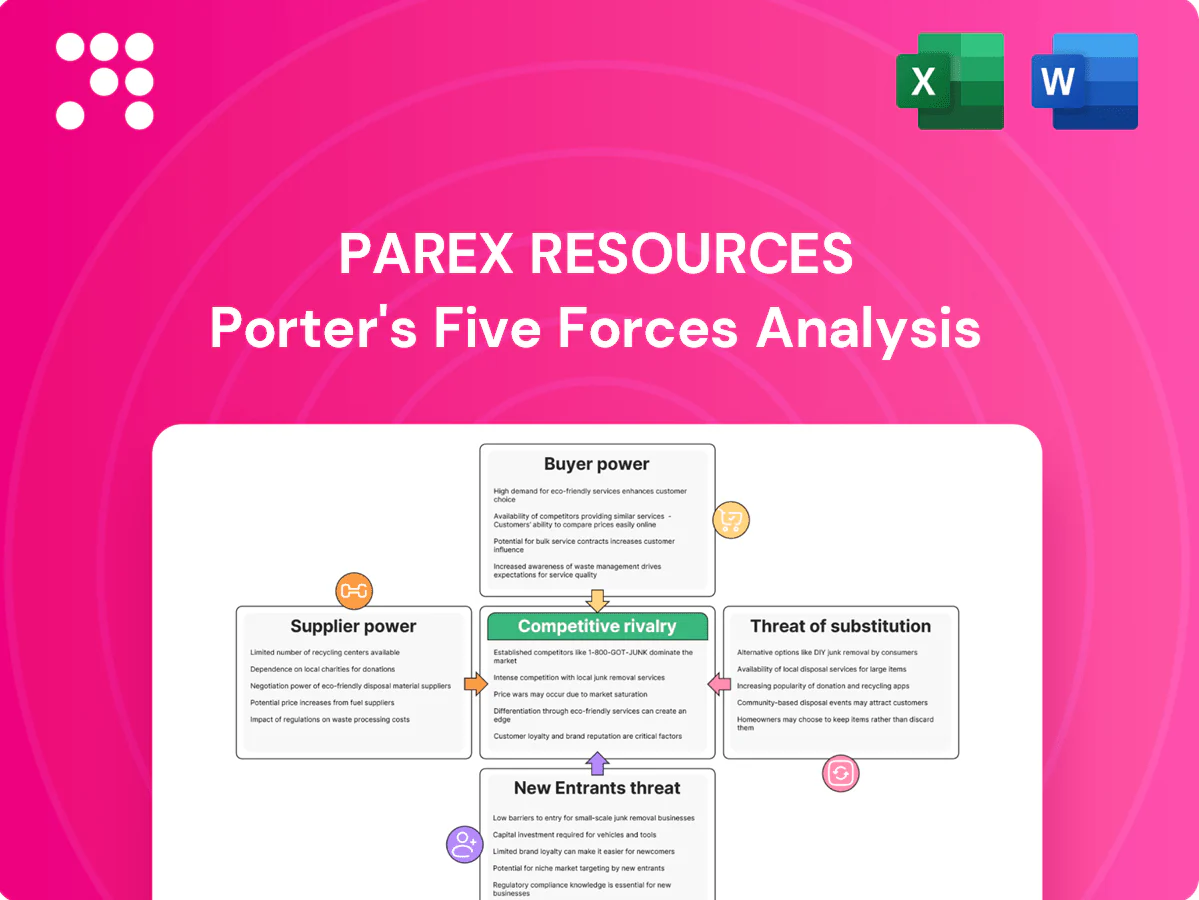
Parex Resources Porter's Five Forces Analysis

A Must-Have Tool for Decision-Makers
Parex Resources faces moderate supplier and buyer power, regional regulatory risks, and a tangible threat from substitutes and new entrants in Latin American oil & gas; competitive intensity hinges on production scale and exploration success. This brief snapshot only scratches the surface. Unlock the full Porter's Five Forces Analysis to explore Parex’s competitive dynamics in detail.
Suppliers Bargaining Power

Concentrated oilfield services base
Core drilling, seismic and completion services in Colombia are supplied by a concentrated set of regional and global contractors, which can push dayrates higher and lengthen lead times during upcycles. Parex mitigates this with multi-year contracts and vendor diversification to secure capacity. Despite these measures, specialized crews and tools for remote basins retain clear pricing power.
Pipeline and transport dependence
Access to pipelines, trucking, and export terminals is essential for Parex to monetize ~80,000 boe/d of 2024 production, so midstream bottlenecks or disruptions can raise transport costs and give carriers leverage. Capacity constraints during 2024 pushed tariffs and demurrage risk higher, compressing netbacks by several dollars per barrel. Long-term ship-or-pay contracts lower volume uncertainty but transfer fixed-cost risk to Parex, and any route interruption directly squeezes realized pricing and margins.

Specialized equipment and parts
Downhole tools, ESPs and critical spare parts for Parex typically come from a small set of international OEMs with few substitutes, concentrating supplier power. Import timelines of 8–16 weeks and FX/customs can add roughly 10–20% to landed costs in 2024. Supplier leverage spikes when inventories fall below 3 months or logistics are disrupted. Preventive stocking and local warehousing, often 3–6 months of cover, partially offset this exposure.

Skilled local labor and services
Colombian field operations for Parex rely heavily on skilled local labor, catering, security and environmental services, where 2024 minimum wage of about 1.3 million COP and regional wage premiums of 10–25% in tight markets raise supplier bargaining power. Community stipulations and limited vendor pools can push service costs higher; robust training pipelines and community relations reduce turnover and stabilize availability. Rapid changes in labor regulation or collective bargaining can quickly shift costs and negotiating leverage.
- Local wage baseline: ~1.3M COP (2024)
- Service cost premium in tight markets: 10–25%
- Mitigant: training pipelines and community relations
Regulatory and social license inputs
Permits, land access and environmental approvals act as quasi-supply inputs for Parex Resources, where Colombia project approvals have historically added 12–24 months to timelines, effectively increasing capital costs and discounting future cash flows. Government agencies and local communities can slow projects, raising situational bargaining power and contingency needs despite Parex’s 2024 ESG investments. Early engagement and robust ESG practices reduce friction but cannot eliminate approval risk, creating non-market leverage on negotiating terms and schedules.
- Permitting delays: 12–24 months
- Impact: raises project costs and financing risk
- 2024 focus: increased ESG spending to mitigate stakeholder friction
- Result: situational bargaining power rests with regulators and communities
Suppliers wield elevated power: midstream leverage, import delays and rising wages
Suppliers hold elevated power: concentrated drilling/completion contractors and OEMs push dayrates and spare-part premiums (import lead times 8–16 weeks; landed costs +10–20% in 2024). Midstream leverage is material for ~80,000 boe/d of 2024 production, raising tariffs/demurrage risk. Local labor (2024 min wage ~1.3M COP) plus 12–24 month permitting delays further amplify supplier/regulatory bargaining power.
| Factor | 2024 metric | Impact |
|---|---|---|
| Transport | ~80,000 boe/d | Tariffs/demurrage compress netbacks |
| Imports | 8–16 weeks; +10–20% cost | Spare parts scarcity |
| Labor | Min wage ~1.3M COP | Higher service costs |
| Permitting | 12–24 months | Capital/time risk |
What is included in the product
 Detailed Word Document
Uncovers key drivers of competition, customer influence, and market entry risks tailored to Parex Resources; evaluates supplier and buyer power, threats from substitutes, and rivalry intensity that shape pricing, margins, and strategic positioning.

 Customizable Excel Spreadsheet
One-sheet Porter's Five Forces for Parex Resources that turns complex exploration, commodity and geopolitical risks into a clear radar view—customize pressures, swap in your own data, and drop straight into pitch decks or Excel dashboards without macros.
Customers Bargaining Power

Few large crude buyers and traders
Crude from Parex is marketed into a limited pool of refiners and traders, often under term contracts, and in 2024 the top five trading houses handled roughly 50% of seaborne crude flows, concentrating buyer power. Buyer concentration can compress differentials and tighten payment terms; Parex mitigates this by accessing multiple offtakers and benchmarks to preserve optionality. Nonetheless, large buyers retain leverage in oversupplied markets, pressuring margins and timing of cash flows.
Commodity pricing and differentials
Sales are indexed to global benchmarks (Brent/WTI) with quality and location discounts; in 2024 Colombian heavy differentials widened to as much as 15–20 USD/bbl during logistical bottlenecks. Buyers pushed wider discounts when crude grades were less favored and liftings tight, increasing negotiating leverage. Improved blending and confirmed pipeline access can narrow discounts by roughly 5–8 USD/bbl. Market volatility in 2024 amplified buyer power at liftings.

Switching ease among suppliers
Buyers can readily switch among regional producers offering similar light crude slates, eroding Parex Resources’ pricing power as commodity-grade barrels compete on price; Brent averaged about $86 per barrel in 2024, anchoring regional differentials. Long-term reliability and on-time delivery can secure preferred status and modest premiums. Commodity fungibility, however, caps achievable premiums, keeping relationship value limited versus spot price competition.

Credit and payment terms
In 2024 larger trading houses negotiating with Parex Resources seek favorable credit and incoterms to optimize working capital; tighter global credit has pushed buyers to demand deeper discounts or extended payment terms. Use of letters of credit and a diversified counterparty mix reduces settlement risk and price pressure, while smaller buyers often pay premiums but raise counterparty concentration risk.
- 2024: big traders demand favorable credit/incoterms
- tighter credit → more discount/extended-term requests
- letters of credit + diversification mitigate risk
- smaller buyers = higher price, higher counterparty risk
Quality consistency and compliance
Buyers demand consistent API, BS&W and demonstrable ESG compliance; deviations commonly trigger penalties or outright shipment rejection, increasing buyer leverage over Parex in contract renegotiations.
Investment in inline measurement, strategic blending and third-party certification reduces quality disputes, while transparent 2024 ESG reporting broadens the buyer pool and supports improved pricing and terms.
- Quality/Compliance pressure: elevates buyer bargaining power
- Mitigation: measurement, blending, certification
- ESG transparency: expands buyers, improves terms
Concentrated buyers take ~50% seaborne flows; heavy diffs erode margins
Parex sells into a concentrated buyer pool; top five traders handled ~50% of seaborne flows in 2024, compressing differentials and payment terms. 2024 Brent averaged $86/bbl; Colombian heavy differentials widened to $15–20/bbl, eroding margins. Mitigants: multi-offtakers, blending (narrows discounts ~5–8 $/bbl) and letters of credit to secure payment.
| Metric | 2024 | Impact |
|---|---|---|
| Top-5 trader share | ~50% | Higher buyer power |
| Brent avg | $86/bbl | Pricing anchor |
| Colombian diff | $15–20/bbl | Margin pressure |
| Blending benefit | $5–8/bbl | Narrows discounts |
What You See Is What You Get
Parex Resources Porter's Five Forces Analysis
This preview displays the exact Parex Resources Porter’s Five Forces analysis you’ll receive after purchase—fully formatted, professionally written, and ready to download. There are no placeholders or samples; the file shown is the final deliverable. Once you complete payment, you’ll get instant access to this same document for immediate use.

A Must-Have Tool for Decision-Makers
Parex Resources faces moderate supplier and buyer power, regional regulatory risks, and a tangible threat from substitutes and new entrants in Latin American oil & gas; competitive intensity hinges on production scale and exploration success. This brief snapshot only scratches the surface. Unlock the full Porter's Five Forces Analysis to explore Parex’s competitive dynamics in detail.
Suppliers Bargaining Power
Concentrated oilfield services base
Core drilling, seismic and completion services in Colombia are supplied by a concentrated set of regional and global contractors, which can push dayrates higher and lengthen lead times during upcycles. Parex mitigates this with multi-year contracts and vendor diversification to secure capacity. Despite these measures, specialized crews and tools for remote basins retain clear pricing power.
Pipeline and transport dependence
Access to pipelines, trucking, and export terminals is essential for Parex to monetize ~80,000 boe/d of 2024 production, so midstream bottlenecks or disruptions can raise transport costs and give carriers leverage. Capacity constraints during 2024 pushed tariffs and demurrage risk higher, compressing netbacks by several dollars per barrel. Long-term ship-or-pay contracts lower volume uncertainty but transfer fixed-cost risk to Parex, and any route interruption directly squeezes realized pricing and margins.
Specialized equipment and parts
Downhole tools, ESPs and critical spare parts for Parex typically come from a small set of international OEMs with few substitutes, concentrating supplier power. Import timelines of 8–16 weeks and FX/customs can add roughly 10–20% to landed costs in 2024. Supplier leverage spikes when inventories fall below 3 months or logistics are disrupted. Preventive stocking and local warehousing, often 3–6 months of cover, partially offset this exposure.
Skilled local labor and services
Colombian field operations for Parex rely heavily on skilled local labor, catering, security and environmental services, where 2024 minimum wage of about 1.3 million COP and regional wage premiums of 10–25% in tight markets raise supplier bargaining power. Community stipulations and limited vendor pools can push service costs higher; robust training pipelines and community relations reduce turnover and stabilize availability. Rapid changes in labor regulation or collective bargaining can quickly shift costs and negotiating leverage.
- Local wage baseline: ~1.3M COP (2024)
- Service cost premium in tight markets: 10–25%
- Mitigant: training pipelines and community relations
Regulatory and social license inputs
Permits, land access and environmental approvals act as quasi-supply inputs for Parex Resources, where Colombia project approvals have historically added 12–24 months to timelines, effectively increasing capital costs and discounting future cash flows. Government agencies and local communities can slow projects, raising situational bargaining power and contingency needs despite Parex’s 2024 ESG investments. Early engagement and robust ESG practices reduce friction but cannot eliminate approval risk, creating non-market leverage on negotiating terms and schedules.
- Permitting delays: 12–24 months
- Impact: raises project costs and financing risk
- 2024 focus: increased ESG spending to mitigate stakeholder friction
- Result: situational bargaining power rests with regulators and communities
Suppliers wield elevated power: midstream leverage, import delays and rising wages
Suppliers hold elevated power: concentrated drilling/completion contractors and OEMs push dayrates and spare-part premiums (import lead times 8–16 weeks; landed costs +10–20% in 2024). Midstream leverage is material for ~80,000 boe/d of 2024 production, raising tariffs/demurrage risk. Local labor (2024 min wage ~1.3M COP) plus 12–24 month permitting delays further amplify supplier/regulatory bargaining power.
| Factor | 2024 metric | Impact |
|---|---|---|
| Transport | ~80,000 boe/d | Tariffs/demurrage compress netbacks |
| Imports | 8–16 weeks; +10–20% cost | Spare parts scarcity |
| Labor | Min wage ~1.3M COP | Higher service costs |
| Permitting | 12–24 months | Capital/time risk |
What is included in the product
Detailed Word Document
Uncovers key drivers of competition, customer influence, and market entry risks tailored to Parex Resources; evaluates supplier and buyer power, threats from substitutes, and rivalry intensity that shape pricing, margins, and strategic positioning.
Customizable Excel Spreadsheet
One-sheet Porter's Five Forces for Parex Resources that turns complex exploration, commodity and geopolitical risks into a clear radar view—customize pressures, swap in your own data, and drop straight into pitch decks or Excel dashboards without macros.
Customers Bargaining Power
Few large crude buyers and traders
Crude from Parex is marketed into a limited pool of refiners and traders, often under term contracts, and in 2024 the top five trading houses handled roughly 50% of seaborne crude flows, concentrating buyer power. Buyer concentration can compress differentials and tighten payment terms; Parex mitigates this by accessing multiple offtakers and benchmarks to preserve optionality. Nonetheless, large buyers retain leverage in oversupplied markets, pressuring margins and timing of cash flows.
Commodity pricing and differentials
Sales are indexed to global benchmarks (Brent/WTI) with quality and location discounts; in 2024 Colombian heavy differentials widened to as much as 15–20 USD/bbl during logistical bottlenecks. Buyers pushed wider discounts when crude grades were less favored and liftings tight, increasing negotiating leverage. Improved blending and confirmed pipeline access can narrow discounts by roughly 5–8 USD/bbl. Market volatility in 2024 amplified buyer power at liftings.
Switching ease among suppliers
Buyers can readily switch among regional producers offering similar light crude slates, eroding Parex Resources’ pricing power as commodity-grade barrels compete on price; Brent averaged about $86 per barrel in 2024, anchoring regional differentials. Long-term reliability and on-time delivery can secure preferred status and modest premiums. Commodity fungibility, however, caps achievable premiums, keeping relationship value limited versus spot price competition.
Credit and payment terms
In 2024 larger trading houses negotiating with Parex Resources seek favorable credit and incoterms to optimize working capital; tighter global credit has pushed buyers to demand deeper discounts or extended payment terms. Use of letters of credit and a diversified counterparty mix reduces settlement risk and price pressure, while smaller buyers often pay premiums but raise counterparty concentration risk.
- 2024: big traders demand favorable credit/incoterms
- tighter credit → more discount/extended-term requests
- letters of credit + diversification mitigate risk
- smaller buyers = higher price, higher counterparty risk
Quality consistency and compliance
Buyers demand consistent API, BS&W and demonstrable ESG compliance; deviations commonly trigger penalties or outright shipment rejection, increasing buyer leverage over Parex in contract renegotiations.
Investment in inline measurement, strategic blending and third-party certification reduces quality disputes, while transparent 2024 ESG reporting broadens the buyer pool and supports improved pricing and terms.
- Quality/Compliance pressure: elevates buyer bargaining power
- Mitigation: measurement, blending, certification
- ESG transparency: expands buyers, improves terms
Concentrated buyers take ~50% seaborne flows; heavy diffs erode margins
Parex sells into a concentrated buyer pool; top five traders handled ~50% of seaborne flows in 2024, compressing differentials and payment terms. 2024 Brent averaged $86/bbl; Colombian heavy differentials widened to $15–20/bbl, eroding margins. Mitigants: multi-offtakers, blending (narrows discounts ~5–8 $/bbl) and letters of credit to secure payment.
| Metric | 2024 | Impact |
|---|---|---|
| Top-5 trader share | ~50% | Higher buyer power |
| Brent avg | $86/bbl | Pricing anchor |
| Colombian diff | $15–20/bbl | Margin pressure |
| Blending benefit | $5–8/bbl | Narrows discounts |
What You See Is What You Get
Parex Resources Porter's Five Forces Analysis
This preview displays the exact Parex Resources Porter’s Five Forces analysis you’ll receive after purchase—fully formatted, professionally written, and ready to download. There are no placeholders or samples; the file shown is the final deliverable. Once you complete payment, you’ll get instant access to this same document for immediate use.
Original: $10.00
-65%$10.00
$3.50Description
A Must-Have Tool for Decision-Makers
Parex Resources faces moderate supplier and buyer power, regional regulatory risks, and a tangible threat from substitutes and new entrants in Latin American oil & gas; competitive intensity hinges on production scale and exploration success. This brief snapshot only scratches the surface. Unlock the full Porter's Five Forces Analysis to explore Parex’s competitive dynamics in detail.
Suppliers Bargaining Power
Concentrated oilfield services base
Core drilling, seismic and completion services in Colombia are supplied by a concentrated set of regional and global contractors, which can push dayrates higher and lengthen lead times during upcycles. Parex mitigates this with multi-year contracts and vendor diversification to secure capacity. Despite these measures, specialized crews and tools for remote basins retain clear pricing power.
Pipeline and transport dependence
Access to pipelines, trucking, and export terminals is essential for Parex to monetize ~80,000 boe/d of 2024 production, so midstream bottlenecks or disruptions can raise transport costs and give carriers leverage. Capacity constraints during 2024 pushed tariffs and demurrage risk higher, compressing netbacks by several dollars per barrel. Long-term ship-or-pay contracts lower volume uncertainty but transfer fixed-cost risk to Parex, and any route interruption directly squeezes realized pricing and margins.
Specialized equipment and parts
Downhole tools, ESPs and critical spare parts for Parex typically come from a small set of international OEMs with few substitutes, concentrating supplier power. Import timelines of 8–16 weeks and FX/customs can add roughly 10–20% to landed costs in 2024. Supplier leverage spikes when inventories fall below 3 months or logistics are disrupted. Preventive stocking and local warehousing, often 3–6 months of cover, partially offset this exposure.
Skilled local labor and services
Colombian field operations for Parex rely heavily on skilled local labor, catering, security and environmental services, where 2024 minimum wage of about 1.3 million COP and regional wage premiums of 10–25% in tight markets raise supplier bargaining power. Community stipulations and limited vendor pools can push service costs higher; robust training pipelines and community relations reduce turnover and stabilize availability. Rapid changes in labor regulation or collective bargaining can quickly shift costs and negotiating leverage.
- Local wage baseline: ~1.3M COP (2024)
- Service cost premium in tight markets: 10–25%
- Mitigant: training pipelines and community relations
Regulatory and social license inputs
Permits, land access and environmental approvals act as quasi-supply inputs for Parex Resources, where Colombia project approvals have historically added 12–24 months to timelines, effectively increasing capital costs and discounting future cash flows. Government agencies and local communities can slow projects, raising situational bargaining power and contingency needs despite Parex’s 2024 ESG investments. Early engagement and robust ESG practices reduce friction but cannot eliminate approval risk, creating non-market leverage on negotiating terms and schedules.
- Permitting delays: 12–24 months
- Impact: raises project costs and financing risk
- 2024 focus: increased ESG spending to mitigate stakeholder friction
- Result: situational bargaining power rests with regulators and communities
Suppliers wield elevated power: midstream leverage, import delays and rising wages
Suppliers hold elevated power: concentrated drilling/completion contractors and OEMs push dayrates and spare-part premiums (import lead times 8–16 weeks; landed costs +10–20% in 2024). Midstream leverage is material for ~80,000 boe/d of 2024 production, raising tariffs/demurrage risk. Local labor (2024 min wage ~1.3M COP) plus 12–24 month permitting delays further amplify supplier/regulatory bargaining power.
| Factor | 2024 metric | Impact |
|---|---|---|
| Transport | ~80,000 boe/d | Tariffs/demurrage compress netbacks |
| Imports | 8–16 weeks; +10–20% cost | Spare parts scarcity |
| Labor | Min wage ~1.3M COP | Higher service costs |
| Permitting | 12–24 months | Capital/time risk |
What is included in the product
Detailed Word Document
Uncovers key drivers of competition, customer influence, and market entry risks tailored to Parex Resources; evaluates supplier and buyer power, threats from substitutes, and rivalry intensity that shape pricing, margins, and strategic positioning.
Customizable Excel Spreadsheet
One-sheet Porter's Five Forces for Parex Resources that turns complex exploration, commodity and geopolitical risks into a clear radar view—customize pressures, swap in your own data, and drop straight into pitch decks or Excel dashboards without macros.
Customers Bargaining Power
Few large crude buyers and traders
Crude from Parex is marketed into a limited pool of refiners and traders, often under term contracts, and in 2024 the top five trading houses handled roughly 50% of seaborne crude flows, concentrating buyer power. Buyer concentration can compress differentials and tighten payment terms; Parex mitigates this by accessing multiple offtakers and benchmarks to preserve optionality. Nonetheless, large buyers retain leverage in oversupplied markets, pressuring margins and timing of cash flows.
Commodity pricing and differentials
Sales are indexed to global benchmarks (Brent/WTI) with quality and location discounts; in 2024 Colombian heavy differentials widened to as much as 15–20 USD/bbl during logistical bottlenecks. Buyers pushed wider discounts when crude grades were less favored and liftings tight, increasing negotiating leverage. Improved blending and confirmed pipeline access can narrow discounts by roughly 5–8 USD/bbl. Market volatility in 2024 amplified buyer power at liftings.
Switching ease among suppliers
Buyers can readily switch among regional producers offering similar light crude slates, eroding Parex Resources’ pricing power as commodity-grade barrels compete on price; Brent averaged about $86 per barrel in 2024, anchoring regional differentials. Long-term reliability and on-time delivery can secure preferred status and modest premiums. Commodity fungibility, however, caps achievable premiums, keeping relationship value limited versus spot price competition.
Credit and payment terms
In 2024 larger trading houses negotiating with Parex Resources seek favorable credit and incoterms to optimize working capital; tighter global credit has pushed buyers to demand deeper discounts or extended payment terms. Use of letters of credit and a diversified counterparty mix reduces settlement risk and price pressure, while smaller buyers often pay premiums but raise counterparty concentration risk.
- 2024: big traders demand favorable credit/incoterms
- tighter credit → more discount/extended-term requests
- letters of credit + diversification mitigate risk
- smaller buyers = higher price, higher counterparty risk
Quality consistency and compliance
Buyers demand consistent API, BS&W and demonstrable ESG compliance; deviations commonly trigger penalties or outright shipment rejection, increasing buyer leverage over Parex in contract renegotiations.
Investment in inline measurement, strategic blending and third-party certification reduces quality disputes, while transparent 2024 ESG reporting broadens the buyer pool and supports improved pricing and terms.
- Quality/Compliance pressure: elevates buyer bargaining power
- Mitigation: measurement, blending, certification
- ESG transparency: expands buyers, improves terms
Concentrated buyers take ~50% seaborne flows; heavy diffs erode margins
Parex sells into a concentrated buyer pool; top five traders handled ~50% of seaborne flows in 2024, compressing differentials and payment terms. 2024 Brent averaged $86/bbl; Colombian heavy differentials widened to $15–20/bbl, eroding margins. Mitigants: multi-offtakers, blending (narrows discounts ~5–8 $/bbl) and letters of credit to secure payment.
| Metric | 2024 | Impact |
|---|---|---|
| Top-5 trader share | ~50% | Higher buyer power |
| Brent avg | $86/bbl | Pricing anchor |
| Colombian diff | $15–20/bbl | Margin pressure |
| Blending benefit | $5–8/bbl | Narrows discounts |
What You See Is What You Get
Parex Resources Porter's Five Forces Analysis
This preview displays the exact Parex Resources Porter’s Five Forces analysis you’ll receive after purchase—fully formatted, professionally written, and ready to download. There are no placeholders or samples; the file shown is the final deliverable. Once you complete payment, you’ll get instant access to this same document for immediate use.











