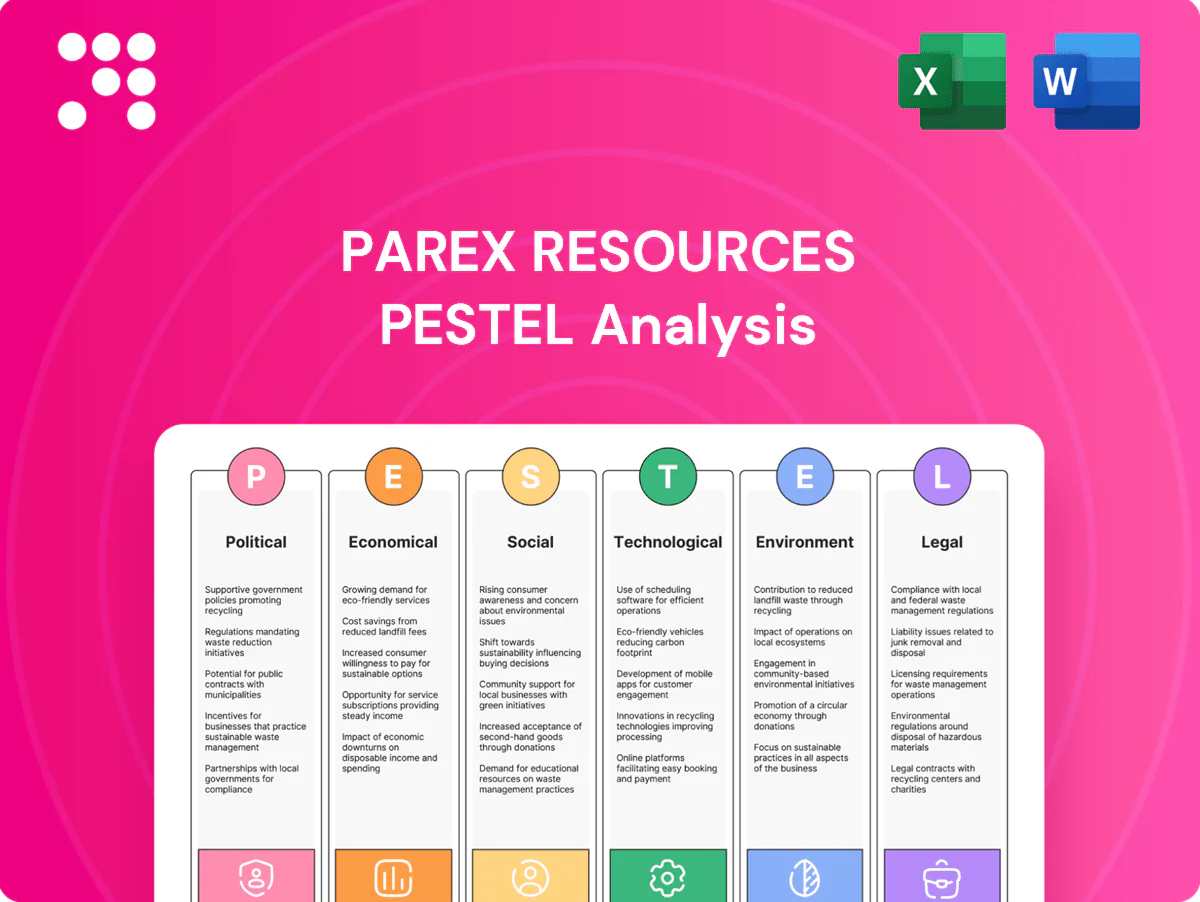
Parex Resources PESTLE Analysis

Plan Smarter. Present Sharper. Compete Stronger.
Our PESTLE Analysis of Parex Resources reveals how political dynamics in operating regions, oil-price volatility, environmental regulation and technological shifts in exploration combine to shape strategy. It highlights regulatory risks, economic sensitivities and ESG pressures affecting valuation and operations. Purchase the full, editable report for actionable, sourced insights to strengthen your investment or strategic decisions.
Political factors

Colombian policy stability
Colombian policy stability is pivotal for Parex since government priorities can swing between promoting hydrocarbons investment and tightening environmental and social requirements; Colombia's crude output around 0.8 million barrels per day (2023–24) underscores the sector's national importance. Policy continuity affects licensing timelines, tax incentives and development certainty; Parex’s onshore model—with over 95% of production and assets in Colombia—relies on predictable approvals and agency budgets. Political stability lowers risk premiums and borrowing costs, improving project economics and capital access.
Resource nationalism risk
Resource nationalism risk for Parex includes changes to royalty schemes, windfall taxes or increased state participation that can materially alter project economics and investor returns. Public pressure during oil price spikes often leads governments to push tougher fiscal terms, and while contracts are generally honored, renegotiations at renewal remain possible. Robust, ongoing stakeholder engagement is key to mitigating abrupt fiscal shifts.

Security and regional governance
Local security dynamics in Colombia’s Llanos and Magdalena producing regions, where national crude output was about 870,000 bpd in 2024, directly affect access, logistics and field uptime for Parex Resources. Coordination with regional authorities and communities is essential to maintain uninterrupted operations and limit non-technical downtime. Improved security has been linked to measurable uptime gains in Colombian fields. Contingency planning and local hiring strengthen operational resilience.

Infrastructure and permitting
Parex Resources, operating primarily in Colombia, faces pipeline access and road-quality constraints tied to public investment and bureaucracy; environmental and social approvals in Colombia commonly take 12–24 months, delaying cash flows and development schedules. Close collaboration with national and regional ministries has shortened procedural steps on key projects, and early planning of alternative evacuation routes limits bottleneck risk.
- Pipeline access: public investment-dependent
- Road quality: impacts logistics costs
- Permitting: 12–24 months typical
- Mitigation: ministerial collaboration + alternate routes
International relations and FDI
Bilateral treaties and investment protection agreements define repatriation and arbitration routes for Parex, with Colombia an ICSID signatory and multiple BITs shaping legal certainty. Global diplomacy and credit access influence financing and equipment imports; Colombia recorded roughly $12.6B FDI inflows in 2023 and ~0.9 mbpd oil output in 2024. Stable FDI policies and alignment with OECD/ESG norms bolster long-term upstream investment.
- ICSID membership and BITs: legal certainty for arbitration
- FDI inflows: ~$12.6B (2023)
- Oil output: ~0.9 mbpd (2024)
Colombia exposure (>95% production) makes licensing, royalties and security risks
Parex’s Colombia concentration (>95% production) ties company fortunes to national policy, with crude ~0.9 mbpd (2024) and FDI ~$12.6B (2023) shaping fiscal and permitting regimes. Licensing (12–24 months), potential royalty/tax shifts and local security directly affect project economics and access to capital.
| Metric | Value |
|---|---|
| Production share (Colombia) | >95% |
| Colombia crude | ~0.9 mbpd (2024) |
| FDI inflows | $12.6B (2023) |
| Permitting | 12–24 months |
| Arbitration | ICSID member |
What is included in the product
 Detailed Word Document
Examines how macro-environmental factors across Political, Economic, Social, Technological, Environmental and Legal dimensions uniquely impact Parex Resources, with data-backed trends and regional regulatory context. Designed for executives and investors, it offers forward-looking insights and actionable risks/opportunities for strategy and financing.

 Customizable Excel Spreadsheet
A concise, visually segmented Parex Resources PESTLE that can be dropped into presentations, edited with notes for local contexts, and shared across teams to streamline risk discussions and strategic planning.
Economic factors

Oil price volatility
Brent volatility directly drives Parex Resources revenue, capex pacing and reserve booking as Brent averaged about $86/b in 2024, causing management to sequence investment and sanction fewer high-cost projects.
Hedging programs smooth cash flows but cap upside; Parex uses partial collars to protect budgets.
Lower lifting costs (sub-$8/boe reported industry-wide) improve break-evens in downcycles and price sensitivity guides portfolio high-grading toward core, low-cost Llanos assets.
Exchange rate and inflation
COP movements (averaging about 4,000 COP/USD in 2024) materially affect Parex Resources by raising local costs against USD‑denominated oil revenue. Colombia inflation (~9% in 2024) pressures services, labor and materials, lifting operating expenses. Currency mismatches between COP costs and USD receipts can erode margins without active treasury hedging. Greater local sourcing and COP‑linked contracts can cushion FX shocks.

Access to capital
Credit conditions and risk appetite — with the US federal funds rate at about 5.25–5.50% through 2024–2025 — directly affect borrowing costs for E&P programs and corporate spreads. Parex’s emphasis on a strong balance sheet and positive free cash flow through 2024 supports self-funded growth and potential buybacks. ESG-linked financing, a market that surpassed roughly $650bn in cumulative volume by 2024, can lower spreads if targets are met, while transparent disclosures broaden the investor base.

Domestic demand and exports
Colombia’s refined product and gas demand — roughly 1.05 million b/d of liquid fuels in 2024 — shapes regional pricing differentials and evacuation options that influence Parex’s realized margins; export routes and port capacity (Cartagena, Barranquilla) constrain netbacks. Pipeline tariffs and downtime on OCENSA/ODL corridors materially affect realized prices, while Parex’s diversified offtake and sales agreements in 2024 lower revenue volatility.
- 2024 Colombia fuel demand ~1.05M b/d
- Key ports: Cartagena, Barranquilla
- Pipeline exposure: OCENSA/ODL tariffs & downtime
- Diversified offtake reduces volatility
Service sector capacity
- Rig availability: North American rig count ~620 (mid-2025)
- Frac fleets: ~140 active frac spreads (mid-2025)
- Mitigation: long-term contracts secure equipment, diversification lowers schedule risk
Colombia exposure (>95% production) makes licensing, royalties and security risks
Brent volatility (avg ~$86/b in 2024) drives Parex capex pacing and project sanctioning. COP ~4,000/USD and Colombia inflation ~9% in 2024 raise local costs vs USD revenues; hedging and COP‑linked contracts cushion FX risk. Higher rates (FFR ~5.25–5.50%) and tighter service markets (rigs ~620, frac spreads ~140 mid‑2025) increase financing and execution costs.
| Metric | Value |
|---|---|
| Brent 2024 | $86/b |
| COP/USD | ~4,000 |
| Colombia demand 2024 | 1.05M b/d |
| Fed funds | 5.25–5.50% |
| Rig/frac mid‑2025 | ~620 / ~140 |
Same Document Delivered
Parex Resources PESTLE Analysis
This Parex Resources PESTLE Analysis provides concise political, economic, social, technological, legal and environmental insights tailored to the company’s operating regions and risk profile. The content and structure shown in the preview is the same document you’ll download after payment. It’s fully formatted, professionally structured and ready to use for investment or strategic decisions.

Plan Smarter. Present Sharper. Compete Stronger.
Our PESTLE Analysis of Parex Resources reveals how political dynamics in operating regions, oil-price volatility, environmental regulation and technological shifts in exploration combine to shape strategy. It highlights regulatory risks, economic sensitivities and ESG pressures affecting valuation and operations. Purchase the full, editable report for actionable, sourced insights to strengthen your investment or strategic decisions.
Political factors
Colombian policy stability
Colombian policy stability is pivotal for Parex since government priorities can swing between promoting hydrocarbons investment and tightening environmental and social requirements; Colombia's crude output around 0.8 million barrels per day (2023–24) underscores the sector's national importance. Policy continuity affects licensing timelines, tax incentives and development certainty; Parex’s onshore model—with over 95% of production and assets in Colombia—relies on predictable approvals and agency budgets. Political stability lowers risk premiums and borrowing costs, improving project economics and capital access.
Resource nationalism risk
Resource nationalism risk for Parex includes changes to royalty schemes, windfall taxes or increased state participation that can materially alter project economics and investor returns. Public pressure during oil price spikes often leads governments to push tougher fiscal terms, and while contracts are generally honored, renegotiations at renewal remain possible. Robust, ongoing stakeholder engagement is key to mitigating abrupt fiscal shifts.
Security and regional governance
Local security dynamics in Colombia’s Llanos and Magdalena producing regions, where national crude output was about 870,000 bpd in 2024, directly affect access, logistics and field uptime for Parex Resources. Coordination with regional authorities and communities is essential to maintain uninterrupted operations and limit non-technical downtime. Improved security has been linked to measurable uptime gains in Colombian fields. Contingency planning and local hiring strengthen operational resilience.
Infrastructure and permitting
Parex Resources, operating primarily in Colombia, faces pipeline access and road-quality constraints tied to public investment and bureaucracy; environmental and social approvals in Colombia commonly take 12–24 months, delaying cash flows and development schedules. Close collaboration with national and regional ministries has shortened procedural steps on key projects, and early planning of alternative evacuation routes limits bottleneck risk.
- Pipeline access: public investment-dependent
- Road quality: impacts logistics costs
- Permitting: 12–24 months typical
- Mitigation: ministerial collaboration + alternate routes
International relations and FDI
Bilateral treaties and investment protection agreements define repatriation and arbitration routes for Parex, with Colombia an ICSID signatory and multiple BITs shaping legal certainty. Global diplomacy and credit access influence financing and equipment imports; Colombia recorded roughly $12.6B FDI inflows in 2023 and ~0.9 mbpd oil output in 2024. Stable FDI policies and alignment with OECD/ESG norms bolster long-term upstream investment.
- ICSID membership and BITs: legal certainty for arbitration
- FDI inflows: ~$12.6B (2023)
- Oil output: ~0.9 mbpd (2024)
Colombia exposure (>95% production) makes licensing, royalties and security risks
Parex’s Colombia concentration (>95% production) ties company fortunes to national policy, with crude ~0.9 mbpd (2024) and FDI ~$12.6B (2023) shaping fiscal and permitting regimes. Licensing (12–24 months), potential royalty/tax shifts and local security directly affect project economics and access to capital.
| Metric | Value |
|---|---|
| Production share (Colombia) | >95% |
| Colombia crude | ~0.9 mbpd (2024) |
| FDI inflows | $12.6B (2023) |
| Permitting | 12–24 months |
| Arbitration | ICSID member |
What is included in the product
Detailed Word Document
Examines how macro-environmental factors across Political, Economic, Social, Technological, Environmental and Legal dimensions uniquely impact Parex Resources, with data-backed trends and regional regulatory context. Designed for executives and investors, it offers forward-looking insights and actionable risks/opportunities for strategy and financing.
Customizable Excel Spreadsheet
A concise, visually segmented Parex Resources PESTLE that can be dropped into presentations, edited with notes for local contexts, and shared across teams to streamline risk discussions and strategic planning.
Economic factors
Oil price volatility
Brent volatility directly drives Parex Resources revenue, capex pacing and reserve booking as Brent averaged about $86/b in 2024, causing management to sequence investment and sanction fewer high-cost projects.
Hedging programs smooth cash flows but cap upside; Parex uses partial collars to protect budgets.
Lower lifting costs (sub-$8/boe reported industry-wide) improve break-evens in downcycles and price sensitivity guides portfolio high-grading toward core, low-cost Llanos assets.
Exchange rate and inflation
COP movements (averaging about 4,000 COP/USD in 2024) materially affect Parex Resources by raising local costs against USD‑denominated oil revenue. Colombia inflation (~9% in 2024) pressures services, labor and materials, lifting operating expenses. Currency mismatches between COP costs and USD receipts can erode margins without active treasury hedging. Greater local sourcing and COP‑linked contracts can cushion FX shocks.
Access to capital
Credit conditions and risk appetite — with the US federal funds rate at about 5.25–5.50% through 2024–2025 — directly affect borrowing costs for E&P programs and corporate spreads. Parex’s emphasis on a strong balance sheet and positive free cash flow through 2024 supports self-funded growth and potential buybacks. ESG-linked financing, a market that surpassed roughly $650bn in cumulative volume by 2024, can lower spreads if targets are met, while transparent disclosures broaden the investor base.
Domestic demand and exports
Colombia’s refined product and gas demand — roughly 1.05 million b/d of liquid fuels in 2024 — shapes regional pricing differentials and evacuation options that influence Parex’s realized margins; export routes and port capacity (Cartagena, Barranquilla) constrain netbacks. Pipeline tariffs and downtime on OCENSA/ODL corridors materially affect realized prices, while Parex’s diversified offtake and sales agreements in 2024 lower revenue volatility.
- 2024 Colombia fuel demand ~1.05M b/d
- Key ports: Cartagena, Barranquilla
- Pipeline exposure: OCENSA/ODL tariffs & downtime
- Diversified offtake reduces volatility
Service sector capacity
- Rig availability: North American rig count ~620 (mid-2025)
- Frac fleets: ~140 active frac spreads (mid-2025)
- Mitigation: long-term contracts secure equipment, diversification lowers schedule risk
Colombia exposure (>95% production) makes licensing, royalties and security risks
Brent volatility (avg ~$86/b in 2024) drives Parex capex pacing and project sanctioning. COP ~4,000/USD and Colombia inflation ~9% in 2024 raise local costs vs USD revenues; hedging and COP‑linked contracts cushion FX risk. Higher rates (FFR ~5.25–5.50%) and tighter service markets (rigs ~620, frac spreads ~140 mid‑2025) increase financing and execution costs.
| Metric | Value |
|---|---|
| Brent 2024 | $86/b |
| COP/USD | ~4,000 |
| Colombia demand 2024 | 1.05M b/d |
| Fed funds | 5.25–5.50% |
| Rig/frac mid‑2025 | ~620 / ~140 |
Same Document Delivered
Parex Resources PESTLE Analysis
This Parex Resources PESTLE Analysis provides concise political, economic, social, technological, legal and environmental insights tailored to the company’s operating regions and risk profile. The content and structure shown in the preview is the same document you’ll download after payment. It’s fully formatted, professionally structured and ready to use for investment or strategic decisions.
Description
Plan Smarter. Present Sharper. Compete Stronger.
Our PESTLE Analysis of Parex Resources reveals how political dynamics in operating regions, oil-price volatility, environmental regulation and technological shifts in exploration combine to shape strategy. It highlights regulatory risks, economic sensitivities and ESG pressures affecting valuation and operations. Purchase the full, editable report for actionable, sourced insights to strengthen your investment or strategic decisions.
Political factors
Colombian policy stability
Colombian policy stability is pivotal for Parex since government priorities can swing between promoting hydrocarbons investment and tightening environmental and social requirements; Colombia's crude output around 0.8 million barrels per day (2023–24) underscores the sector's national importance. Policy continuity affects licensing timelines, tax incentives and development certainty; Parex’s onshore model—with over 95% of production and assets in Colombia—relies on predictable approvals and agency budgets. Political stability lowers risk premiums and borrowing costs, improving project economics and capital access.
Resource nationalism risk
Resource nationalism risk for Parex includes changes to royalty schemes, windfall taxes or increased state participation that can materially alter project economics and investor returns. Public pressure during oil price spikes often leads governments to push tougher fiscal terms, and while contracts are generally honored, renegotiations at renewal remain possible. Robust, ongoing stakeholder engagement is key to mitigating abrupt fiscal shifts.
Security and regional governance
Local security dynamics in Colombia’s Llanos and Magdalena producing regions, where national crude output was about 870,000 bpd in 2024, directly affect access, logistics and field uptime for Parex Resources. Coordination with regional authorities and communities is essential to maintain uninterrupted operations and limit non-technical downtime. Improved security has been linked to measurable uptime gains in Colombian fields. Contingency planning and local hiring strengthen operational resilience.
Infrastructure and permitting
Parex Resources, operating primarily in Colombia, faces pipeline access and road-quality constraints tied to public investment and bureaucracy; environmental and social approvals in Colombia commonly take 12–24 months, delaying cash flows and development schedules. Close collaboration with national and regional ministries has shortened procedural steps on key projects, and early planning of alternative evacuation routes limits bottleneck risk.
- Pipeline access: public investment-dependent
- Road quality: impacts logistics costs
- Permitting: 12–24 months typical
- Mitigation: ministerial collaboration + alternate routes
International relations and FDI
Bilateral treaties and investment protection agreements define repatriation and arbitration routes for Parex, with Colombia an ICSID signatory and multiple BITs shaping legal certainty. Global diplomacy and credit access influence financing and equipment imports; Colombia recorded roughly $12.6B FDI inflows in 2023 and ~0.9 mbpd oil output in 2024. Stable FDI policies and alignment with OECD/ESG norms bolster long-term upstream investment.
- ICSID membership and BITs: legal certainty for arbitration
- FDI inflows: ~$12.6B (2023)
- Oil output: ~0.9 mbpd (2024)
Colombia exposure (>95% production) makes licensing, royalties and security risks
Parex’s Colombia concentration (>95% production) ties company fortunes to national policy, with crude ~0.9 mbpd (2024) and FDI ~$12.6B (2023) shaping fiscal and permitting regimes. Licensing (12–24 months), potential royalty/tax shifts and local security directly affect project economics and access to capital.
| Metric | Value |
|---|---|
| Production share (Colombia) | >95% |
| Colombia crude | ~0.9 mbpd (2024) |
| FDI inflows | $12.6B (2023) |
| Permitting | 12–24 months |
| Arbitration | ICSID member |
What is included in the product
Detailed Word Document
Examines how macro-environmental factors across Political, Economic, Social, Technological, Environmental and Legal dimensions uniquely impact Parex Resources, with data-backed trends and regional regulatory context. Designed for executives and investors, it offers forward-looking insights and actionable risks/opportunities for strategy and financing.
Customizable Excel Spreadsheet
A concise, visually segmented Parex Resources PESTLE that can be dropped into presentations, edited with notes for local contexts, and shared across teams to streamline risk discussions and strategic planning.
Economic factors
Oil price volatility
Brent volatility directly drives Parex Resources revenue, capex pacing and reserve booking as Brent averaged about $86/b in 2024, causing management to sequence investment and sanction fewer high-cost projects.
Hedging programs smooth cash flows but cap upside; Parex uses partial collars to protect budgets.
Lower lifting costs (sub-$8/boe reported industry-wide) improve break-evens in downcycles and price sensitivity guides portfolio high-grading toward core, low-cost Llanos assets.
Exchange rate and inflation
COP movements (averaging about 4,000 COP/USD in 2024) materially affect Parex Resources by raising local costs against USD‑denominated oil revenue. Colombia inflation (~9% in 2024) pressures services, labor and materials, lifting operating expenses. Currency mismatches between COP costs and USD receipts can erode margins without active treasury hedging. Greater local sourcing and COP‑linked contracts can cushion FX shocks.
Access to capital
Credit conditions and risk appetite — with the US federal funds rate at about 5.25–5.50% through 2024–2025 — directly affect borrowing costs for E&P programs and corporate spreads. Parex’s emphasis on a strong balance sheet and positive free cash flow through 2024 supports self-funded growth and potential buybacks. ESG-linked financing, a market that surpassed roughly $650bn in cumulative volume by 2024, can lower spreads if targets are met, while transparent disclosures broaden the investor base.
Domestic demand and exports
Colombia’s refined product and gas demand — roughly 1.05 million b/d of liquid fuels in 2024 — shapes regional pricing differentials and evacuation options that influence Parex’s realized margins; export routes and port capacity (Cartagena, Barranquilla) constrain netbacks. Pipeline tariffs and downtime on OCENSA/ODL corridors materially affect realized prices, while Parex’s diversified offtake and sales agreements in 2024 lower revenue volatility.
- 2024 Colombia fuel demand ~1.05M b/d
- Key ports: Cartagena, Barranquilla
- Pipeline exposure: OCENSA/ODL tariffs & downtime
- Diversified offtake reduces volatility
Service sector capacity
- Rig availability: North American rig count ~620 (mid-2025)
- Frac fleets: ~140 active frac spreads (mid-2025)
- Mitigation: long-term contracts secure equipment, diversification lowers schedule risk
Colombia exposure (>95% production) makes licensing, royalties and security risks
Brent volatility (avg ~$86/b in 2024) drives Parex capex pacing and project sanctioning. COP ~4,000/USD and Colombia inflation ~9% in 2024 raise local costs vs USD revenues; hedging and COP‑linked contracts cushion FX risk. Higher rates (FFR ~5.25–5.50%) and tighter service markets (rigs ~620, frac spreads ~140 mid‑2025) increase financing and execution costs.
| Metric | Value |
|---|---|
| Brent 2024 | $86/b |
| COP/USD | ~4,000 |
| Colombia demand 2024 | 1.05M b/d |
| Fed funds | 5.25–5.50% |
| Rig/frac mid‑2025 | ~620 / ~140 |
Same Document Delivered
Parex Resources PESTLE Analysis
This Parex Resources PESTLE Analysis provides concise political, economic, social, technological, legal and environmental insights tailored to the company’s operating regions and risk profile. The content and structure shown in the preview is the same document you’ll download after payment. It’s fully formatted, professionally structured and ready to use for investment or strategic decisions.











