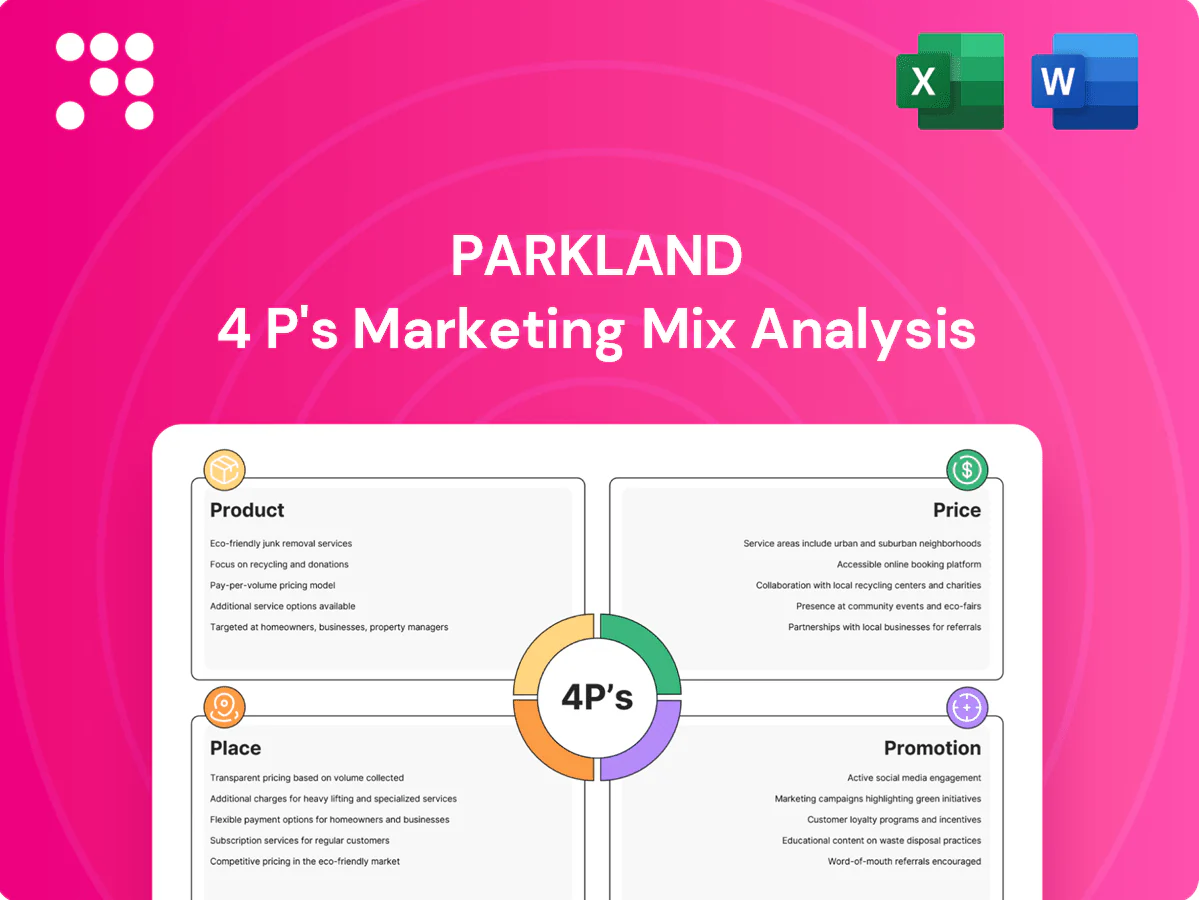
Parkland Marketing Mix

Ready-Made Marketing Analysis, Ready to Use
Discover how Parkland’s Product, Price, Place, and Promotion choices fuel market performance—this concise preview highlights strengths and gaps; unlock the full 4Ps Marketing Mix Analysis for actionable insights, editable slides, real data, and strategic recommendations to save time and drive results.
Product

Integrated fuel portfolio
Parkland's integrated fuel portfolio bundles gasoline, diesel, aviation and marine fuels for retail and commercial customers, supporting Parkland's CAD 17.1 billion revenue in 2023 and expanded 2024 supply footprint. Premium and additive-enhanced grades boost engine performance and efficiency, while lubricants and DEF complement fleet and industrial sales. Quality, safety and reliability meet stringent regulatory and ISO standards across operations.
Convenience retail and foodservice
Parkland’s on-the-run convenience retail mixes snacks, beverages, essentials and private-labels with hot food and coffee, where foodservice now represents about 20% of c-store sales and can lift basket sizes by 20–30%. Quick-serve offerings and daypart-targeted assortments boost average ticket and dwell time. Car wash and ancillary services typically increase visit frequency and attachment rates by roughly 10–15%, and assortments are localized to neighborhood and daypart demand.

Loyalty and value-added services
Journie-style loyalty rewards drive repeat visits across fuel and convenience, with industry studies showing loyalty members spend 12–18% more and visit more often. App-based rewards, targeted offers and partner tie-ins increase perceived value and engagement via personalized push offers. Fleet cards and payment solutions simplify B2B purchasing and controls, while roadside, safety and seasonal services deepen differentiation and retention.

Energy transition offerings
Parkland’s energy transition offerings combine blended and renewable fuels to lower carbon intensity where available, pilot and corridor EV charging sites to serve early adopters and commuters, and efficiency-focused products that help commercial customers meet ESG targets while using clear sustainability messaging to build trust with regulators and communities.
- blended/renewable fuels: lower-carbon options
- EV pilots: corridor charging for commuters
- efficiency products: commercial ESG support
- sustainability messaging: regulator and community trust
Commercial and industrial solutions
Parkland Commercial and Industrial solutions combine bulk fuel delivery, cardlock access and on-site tanks to serve fleets, construction and resource sectors; contracted supply programs deliver predictable costs and high uptime. Technical support and product matching optimize equipment performance while invoicing, reporting and telematics integrations improve operational transparency.
- Bulk delivery & cardlock for fleet continuity
- Contracted supply reduces price volatility
- Product matching + tech support for uptime
- Invoicing, reporting, telematics integrations
Fuel, foodservice & ancillaries:CAD 17.1B loyalty +12–18%
Parkland bundles fuels, lubricants and DEF across retail, commercial and marine channels, supporting CAD 17.1B revenue in 2023 and an expanded 2024 supply footprint. C-store foodservice ≈20% of sales, boosting basket sizes 20–30% and ancillaries (car wash) lift visits/attachment ~10–15%. Loyalty members spend ~12–18% more, while blended renewables and EV pilots advance lower-carbon options.
| Metric | Value |
|---|---|
| Revenue (2023) | CAD 17.1B |
| C-store foodservice | ≈20% of sales |
| Loyalty lift | 12–18% higher spend |
| Ancillary lift | Car wash +10–15% |
What is included in the product
 Detailed Word Document
Delivers a company-specific deep dive into Parkland’s Product, Price, Place and Promotion strategies, using real brand practices and competitive context to show positioning, examples and strategic implications—ideal for managers, consultants and marketers needing a ready-to-use, evidence-based marketing breakdown.

 Customizable Excel Spreadsheet
Condenses Parkland’s 4P marketing insights into a concise, plug-and-play one-pager that relieves briefing and alignment pain points for leadership and cross-functional teams. Easily customizable for decks, meetings, or side-by-side brand comparisons to accelerate decisions and simplify stakeholder communication.
Place

Broad retail footprint
Parkland operates about 1,900 retail sites across Canada, the United States, the Caribbean and parts of South America, providing broad geographic coverage. Sites are deliberately sited on highways, urban corridors and commuter routes to capture high traffic flows. High network density enhances brand visibility and customer convenience, while strategic clustering reduces distribution miles and improves labor scheduling and logistics efficiency.
Integrated supply chain
Parkland’s integrated supply chain links over 1,700 terminals, storage and distribution points to pipeline, rail and marine modes, enabling cross-modal transfers and hubbed inventory. Optimized routing and centralized scheduling drive availability while controlling logistics spend across regions. Refining and blending capabilities support roughly 50 fuel grades for market flexibility and resilience. Business continuity plans cover all major terminals to mitigate regional disruptions.

Multi-channel distribution
Parkland leverages a multi-channel network—about 1,800 retail forecourts plus cardlocks and dealer/franchise sites—to broaden reach; direct commercial delivery supports fleets, industrial, marine and aviation clients, serving thousands of commercial accounts; digital ordering and account portals reduce B2B replenishment time and wholesale channels extend volume and market coverage, contributing to Parkland’s multi-billion-dollar fuel distribution platform.

Partnerships and dealer networks
Dealer-operated and co-branded locations accelerate Parkland’s market entry across Canada, the US, UK, Ireland and the Caribbean, leveraging local operators to scale quickly; Parkland’s retail network exceeds 1,700 sites as of 2024. Franchise and supply agreements balance corporate standards with local entrepreneurship, while real estate partners enable infill and high-traffic placements. Collaboration improves local merchandising and regulatory compliance, supporting consistent fuel and convenience margins.
- Dealer-operated: rapid scale
- Franchise/supply: control + local incentive
- Real estate partners: infill/high-traffic
- Collaboration: better merchandising & compliance
Format and assortment localization
Parkland tailors store sizes and layouts to urban, suburban and rural demand, operating about 1,700 retail sites as of 2024 and deploying compact urban footprints versus larger forecourt formats in rural locations. Assortments are optimized for commuter, tourist and industrial traffic with site-level category mixes and cold-chain capacity scaled to local throughput and margin potential. Seasonal sets rotate for regional climate and events to capture peak demand.
- sites: ~1,700 (2024)
- format: compact urban vs full forecourt
- assortment: commuter/tourist/industrial mixes
- cold-chain: site-scaled capability
- seasonal: regional climate/events
~1,700 sites, integrated supply chain, ~50 fuel grades
Parkland operates ~1,700 retail sites (2024) across Canada, US, Caribbean, UK/Ireland and parts of South America, sited on highways and commuter routes to maximize traffic and convenience. An integrated supply chain links >1,700 terminals/storage points with pipeline, rail and marine modes, supporting ~50 fuel grades and cross-modal hubbing. Multi-channel distribution (retail, cardlock, wholesale, direct commercial) underpins a multi-billion-dollar fuel platform.
| Metric | Value (2024/2025) |
|---|---|
| Retail sites | ~1,700 |
| Terminals & storage | >1,700 |
| Fuel grades | ~50 |
| Channels | Retail, cardlock, wholesale, direct commercial |
| Geographic coverage | Canada, US, Caribbean, UK/Ireland, S America |
Same Document Delivered
Parkland 4P's Marketing Mix Analysis
The preview shown here is the actual Parkland 4P's Marketing Mix Analysis you’ll receive instantly after purchase—no surprises. This is the same ready-made, fully editable and comprehensive document you'll download immediately after checkout. You're viewing the exact final version, complete and ready to use for strategy or presentation.

Ready-Made Marketing Analysis, Ready to Use
Discover how Parkland’s Product, Price, Place, and Promotion choices fuel market performance—this concise preview highlights strengths and gaps; unlock the full 4Ps Marketing Mix Analysis for actionable insights, editable slides, real data, and strategic recommendations to save time and drive results.
Product
Integrated fuel portfolio
Parkland's integrated fuel portfolio bundles gasoline, diesel, aviation and marine fuels for retail and commercial customers, supporting Parkland's CAD 17.1 billion revenue in 2023 and expanded 2024 supply footprint. Premium and additive-enhanced grades boost engine performance and efficiency, while lubricants and DEF complement fleet and industrial sales. Quality, safety and reliability meet stringent regulatory and ISO standards across operations.
Convenience retail and foodservice
Parkland’s on-the-run convenience retail mixes snacks, beverages, essentials and private-labels with hot food and coffee, where foodservice now represents about 20% of c-store sales and can lift basket sizes by 20–30%. Quick-serve offerings and daypart-targeted assortments boost average ticket and dwell time. Car wash and ancillary services typically increase visit frequency and attachment rates by roughly 10–15%, and assortments are localized to neighborhood and daypart demand.
Loyalty and value-added services
Journie-style loyalty rewards drive repeat visits across fuel and convenience, with industry studies showing loyalty members spend 12–18% more and visit more often. App-based rewards, targeted offers and partner tie-ins increase perceived value and engagement via personalized push offers. Fleet cards and payment solutions simplify B2B purchasing and controls, while roadside, safety and seasonal services deepen differentiation and retention.
Energy transition offerings
Parkland’s energy transition offerings combine blended and renewable fuels to lower carbon intensity where available, pilot and corridor EV charging sites to serve early adopters and commuters, and efficiency-focused products that help commercial customers meet ESG targets while using clear sustainability messaging to build trust with regulators and communities.
- blended/renewable fuels: lower-carbon options
- EV pilots: corridor charging for commuters
- efficiency products: commercial ESG support
- sustainability messaging: regulator and community trust
Commercial and industrial solutions
Parkland Commercial and Industrial solutions combine bulk fuel delivery, cardlock access and on-site tanks to serve fleets, construction and resource sectors; contracted supply programs deliver predictable costs and high uptime. Technical support and product matching optimize equipment performance while invoicing, reporting and telematics integrations improve operational transparency.
- Bulk delivery & cardlock for fleet continuity
- Contracted supply reduces price volatility
- Product matching + tech support for uptime
- Invoicing, reporting, telematics integrations
Fuel, foodservice & ancillaries:CAD 17.1B loyalty +12–18%
Parkland bundles fuels, lubricants and DEF across retail, commercial and marine channels, supporting CAD 17.1B revenue in 2023 and an expanded 2024 supply footprint. C-store foodservice ≈20% of sales, boosting basket sizes 20–30% and ancillaries (car wash) lift visits/attachment ~10–15%. Loyalty members spend ~12–18% more, while blended renewables and EV pilots advance lower-carbon options.
| Metric | Value |
|---|---|
| Revenue (2023) | CAD 17.1B |
| C-store foodservice | ≈20% of sales |
| Loyalty lift | 12–18% higher spend |
| Ancillary lift | Car wash +10–15% |
What is included in the product
Detailed Word Document
Delivers a company-specific deep dive into Parkland’s Product, Price, Place and Promotion strategies, using real brand practices and competitive context to show positioning, examples and strategic implications—ideal for managers, consultants and marketers needing a ready-to-use, evidence-based marketing breakdown.
Customizable Excel Spreadsheet
Condenses Parkland’s 4P marketing insights into a concise, plug-and-play one-pager that relieves briefing and alignment pain points for leadership and cross-functional teams. Easily customizable for decks, meetings, or side-by-side brand comparisons to accelerate decisions and simplify stakeholder communication.
Place
Broad retail footprint
Parkland operates about 1,900 retail sites across Canada, the United States, the Caribbean and parts of South America, providing broad geographic coverage. Sites are deliberately sited on highways, urban corridors and commuter routes to capture high traffic flows. High network density enhances brand visibility and customer convenience, while strategic clustering reduces distribution miles and improves labor scheduling and logistics efficiency.
Integrated supply chain
Parkland’s integrated supply chain links over 1,700 terminals, storage and distribution points to pipeline, rail and marine modes, enabling cross-modal transfers and hubbed inventory. Optimized routing and centralized scheduling drive availability while controlling logistics spend across regions. Refining and blending capabilities support roughly 50 fuel grades for market flexibility and resilience. Business continuity plans cover all major terminals to mitigate regional disruptions.
Multi-channel distribution
Parkland leverages a multi-channel network—about 1,800 retail forecourts plus cardlocks and dealer/franchise sites—to broaden reach; direct commercial delivery supports fleets, industrial, marine and aviation clients, serving thousands of commercial accounts; digital ordering and account portals reduce B2B replenishment time and wholesale channels extend volume and market coverage, contributing to Parkland’s multi-billion-dollar fuel distribution platform.
Partnerships and dealer networks
Dealer-operated and co-branded locations accelerate Parkland’s market entry across Canada, the US, UK, Ireland and the Caribbean, leveraging local operators to scale quickly; Parkland’s retail network exceeds 1,700 sites as of 2024. Franchise and supply agreements balance corporate standards with local entrepreneurship, while real estate partners enable infill and high-traffic placements. Collaboration improves local merchandising and regulatory compliance, supporting consistent fuel and convenience margins.
- Dealer-operated: rapid scale
- Franchise/supply: control + local incentive
- Real estate partners: infill/high-traffic
- Collaboration: better merchandising & compliance
Format and assortment localization
Parkland tailors store sizes and layouts to urban, suburban and rural demand, operating about 1,700 retail sites as of 2024 and deploying compact urban footprints versus larger forecourt formats in rural locations. Assortments are optimized for commuter, tourist and industrial traffic with site-level category mixes and cold-chain capacity scaled to local throughput and margin potential. Seasonal sets rotate for regional climate and events to capture peak demand.
- sites: ~1,700 (2024)
- format: compact urban vs full forecourt
- assortment: commuter/tourist/industrial mixes
- cold-chain: site-scaled capability
- seasonal: regional climate/events
~1,700 sites, integrated supply chain, ~50 fuel grades
Parkland operates ~1,700 retail sites (2024) across Canada, US, Caribbean, UK/Ireland and parts of South America, sited on highways and commuter routes to maximize traffic and convenience. An integrated supply chain links >1,700 terminals/storage points with pipeline, rail and marine modes, supporting ~50 fuel grades and cross-modal hubbing. Multi-channel distribution (retail, cardlock, wholesale, direct commercial) underpins a multi-billion-dollar fuel platform.
| Metric | Value (2024/2025) |
|---|---|
| Retail sites | ~1,700 |
| Terminals & storage | >1,700 |
| Fuel grades | ~50 |
| Channels | Retail, cardlock, wholesale, direct commercial |
| Geographic coverage | Canada, US, Caribbean, UK/Ireland, S America |
Same Document Delivered
Parkland 4P's Marketing Mix Analysis
The preview shown here is the actual Parkland 4P's Marketing Mix Analysis you’ll receive instantly after purchase—no surprises. This is the same ready-made, fully editable and comprehensive document you'll download immediately after checkout. You're viewing the exact final version, complete and ready to use for strategy or presentation.
Description
Ready-Made Marketing Analysis, Ready to Use
Discover how Parkland’s Product, Price, Place, and Promotion choices fuel market performance—this concise preview highlights strengths and gaps; unlock the full 4Ps Marketing Mix Analysis for actionable insights, editable slides, real data, and strategic recommendations to save time and drive results.
Product
Integrated fuel portfolio
Parkland's integrated fuel portfolio bundles gasoline, diesel, aviation and marine fuels for retail and commercial customers, supporting Parkland's CAD 17.1 billion revenue in 2023 and expanded 2024 supply footprint. Premium and additive-enhanced grades boost engine performance and efficiency, while lubricants and DEF complement fleet and industrial sales. Quality, safety and reliability meet stringent regulatory and ISO standards across operations.
Convenience retail and foodservice
Parkland’s on-the-run convenience retail mixes snacks, beverages, essentials and private-labels with hot food and coffee, where foodservice now represents about 20% of c-store sales and can lift basket sizes by 20–30%. Quick-serve offerings and daypart-targeted assortments boost average ticket and dwell time. Car wash and ancillary services typically increase visit frequency and attachment rates by roughly 10–15%, and assortments are localized to neighborhood and daypart demand.
Loyalty and value-added services
Journie-style loyalty rewards drive repeat visits across fuel and convenience, with industry studies showing loyalty members spend 12–18% more and visit more often. App-based rewards, targeted offers and partner tie-ins increase perceived value and engagement via personalized push offers. Fleet cards and payment solutions simplify B2B purchasing and controls, while roadside, safety and seasonal services deepen differentiation and retention.
Energy transition offerings
Parkland’s energy transition offerings combine blended and renewable fuels to lower carbon intensity where available, pilot and corridor EV charging sites to serve early adopters and commuters, and efficiency-focused products that help commercial customers meet ESG targets while using clear sustainability messaging to build trust with regulators and communities.
- blended/renewable fuels: lower-carbon options
- EV pilots: corridor charging for commuters
- efficiency products: commercial ESG support
- sustainability messaging: regulator and community trust
Commercial and industrial solutions
Parkland Commercial and Industrial solutions combine bulk fuel delivery, cardlock access and on-site tanks to serve fleets, construction and resource sectors; contracted supply programs deliver predictable costs and high uptime. Technical support and product matching optimize equipment performance while invoicing, reporting and telematics integrations improve operational transparency.
- Bulk delivery & cardlock for fleet continuity
- Contracted supply reduces price volatility
- Product matching + tech support for uptime
- Invoicing, reporting, telematics integrations
Fuel, foodservice & ancillaries:CAD 17.1B loyalty +12–18%
Parkland bundles fuels, lubricants and DEF across retail, commercial and marine channels, supporting CAD 17.1B revenue in 2023 and an expanded 2024 supply footprint. C-store foodservice ≈20% of sales, boosting basket sizes 20–30% and ancillaries (car wash) lift visits/attachment ~10–15%. Loyalty members spend ~12–18% more, while blended renewables and EV pilots advance lower-carbon options.
| Metric | Value |
|---|---|
| Revenue (2023) | CAD 17.1B |
| C-store foodservice | ≈20% of sales |
| Loyalty lift | 12–18% higher spend |
| Ancillary lift | Car wash +10–15% |
What is included in the product
Detailed Word Document
Delivers a company-specific deep dive into Parkland’s Product, Price, Place and Promotion strategies, using real brand practices and competitive context to show positioning, examples and strategic implications—ideal for managers, consultants and marketers needing a ready-to-use, evidence-based marketing breakdown.
Customizable Excel Spreadsheet
Condenses Parkland’s 4P marketing insights into a concise, plug-and-play one-pager that relieves briefing and alignment pain points for leadership and cross-functional teams. Easily customizable for decks, meetings, or side-by-side brand comparisons to accelerate decisions and simplify stakeholder communication.
Place
Broad retail footprint
Parkland operates about 1,900 retail sites across Canada, the United States, the Caribbean and parts of South America, providing broad geographic coverage. Sites are deliberately sited on highways, urban corridors and commuter routes to capture high traffic flows. High network density enhances brand visibility and customer convenience, while strategic clustering reduces distribution miles and improves labor scheduling and logistics efficiency.
Integrated supply chain
Parkland’s integrated supply chain links over 1,700 terminals, storage and distribution points to pipeline, rail and marine modes, enabling cross-modal transfers and hubbed inventory. Optimized routing and centralized scheduling drive availability while controlling logistics spend across regions. Refining and blending capabilities support roughly 50 fuel grades for market flexibility and resilience. Business continuity plans cover all major terminals to mitigate regional disruptions.
Multi-channel distribution
Parkland leverages a multi-channel network—about 1,800 retail forecourts plus cardlocks and dealer/franchise sites—to broaden reach; direct commercial delivery supports fleets, industrial, marine and aviation clients, serving thousands of commercial accounts; digital ordering and account portals reduce B2B replenishment time and wholesale channels extend volume and market coverage, contributing to Parkland’s multi-billion-dollar fuel distribution platform.
Partnerships and dealer networks
Dealer-operated and co-branded locations accelerate Parkland’s market entry across Canada, the US, UK, Ireland and the Caribbean, leveraging local operators to scale quickly; Parkland’s retail network exceeds 1,700 sites as of 2024. Franchise and supply agreements balance corporate standards with local entrepreneurship, while real estate partners enable infill and high-traffic placements. Collaboration improves local merchandising and regulatory compliance, supporting consistent fuel and convenience margins.
- Dealer-operated: rapid scale
- Franchise/supply: control + local incentive
- Real estate partners: infill/high-traffic
- Collaboration: better merchandising & compliance
Format and assortment localization
Parkland tailors store sizes and layouts to urban, suburban and rural demand, operating about 1,700 retail sites as of 2024 and deploying compact urban footprints versus larger forecourt formats in rural locations. Assortments are optimized for commuter, tourist and industrial traffic with site-level category mixes and cold-chain capacity scaled to local throughput and margin potential. Seasonal sets rotate for regional climate and events to capture peak demand.
- sites: ~1,700 (2024)
- format: compact urban vs full forecourt
- assortment: commuter/tourist/industrial mixes
- cold-chain: site-scaled capability
- seasonal: regional climate/events
~1,700 sites, integrated supply chain, ~50 fuel grades
Parkland operates ~1,700 retail sites (2024) across Canada, US, Caribbean, UK/Ireland and parts of South America, sited on highways and commuter routes to maximize traffic and convenience. An integrated supply chain links >1,700 terminals/storage points with pipeline, rail and marine modes, supporting ~50 fuel grades and cross-modal hubbing. Multi-channel distribution (retail, cardlock, wholesale, direct commercial) underpins a multi-billion-dollar fuel platform.
| Metric | Value (2024/2025) |
|---|---|
| Retail sites | ~1,700 |
| Terminals & storage | >1,700 |
| Fuel grades | ~50 |
| Channels | Retail, cardlock, wholesale, direct commercial |
| Geographic coverage | Canada, US, Caribbean, UK/Ireland, S America |
Same Document Delivered
Parkland 4P's Marketing Mix Analysis
The preview shown here is the actual Parkland 4P's Marketing Mix Analysis you’ll receive instantly after purchase—no surprises. This is the same ready-made, fully editable and comprehensive document you'll download immediately after checkout. You're viewing the exact final version, complete and ready to use for strategy or presentation.











