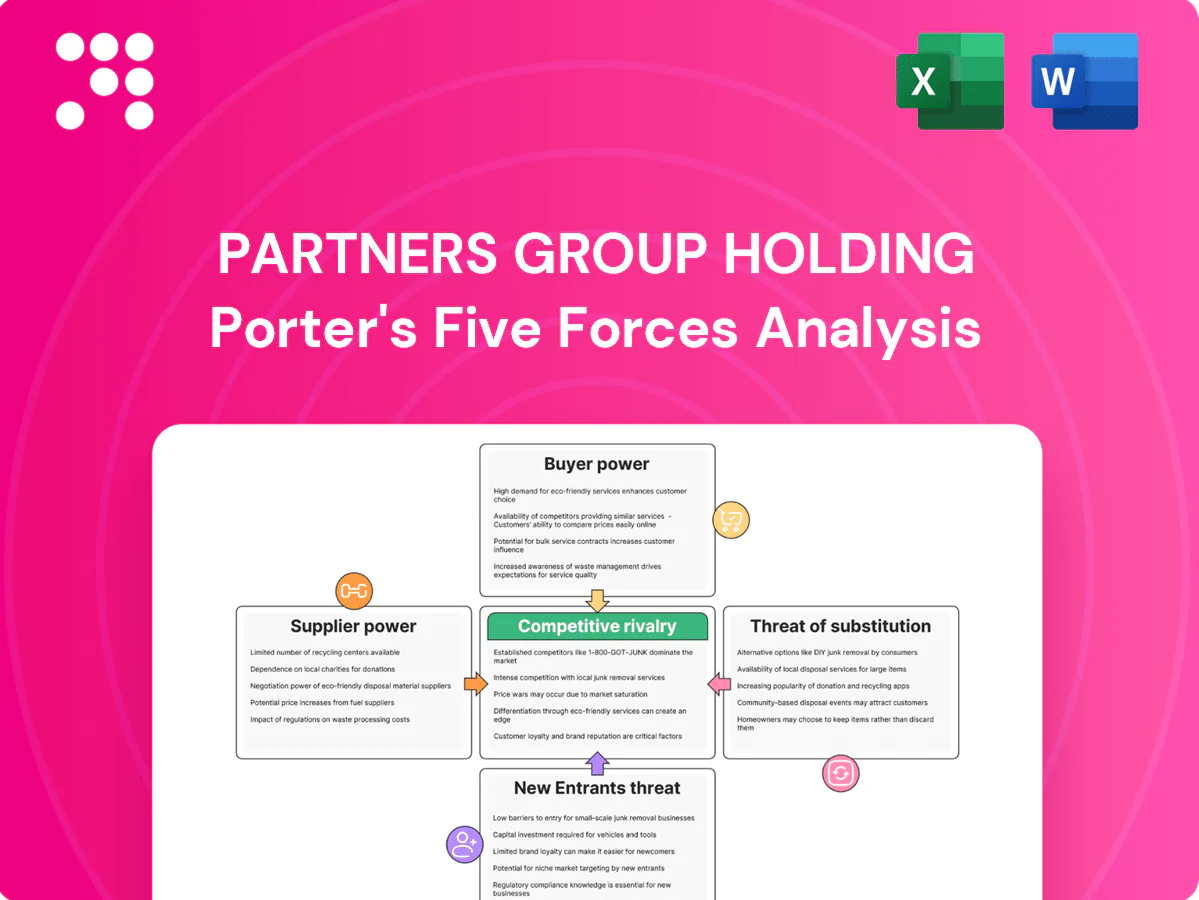
Partners Group Holding Porter's Five Forces Analysis

Elevate Your Analysis with the Complete Porter's Five Forces Analysis
Partners Group Holding faces moderate buyer power, specialized supplier dynamics, and high rivalry amid private markets growth, while barriers to entry and substitute threats shift with fundraising cycles. This snapshot teases strategic levers and risk vectors; unlock the full Porter’s Five Forces Analysis for force-by-force ratings, visuals, and actionable investment guidance.
Suppliers Bargaining Power

Scarce high-quality deal flow
The supply of top-tier private assets is limited relative to capital, with global private capital dry powder exceeding $2 trillion in 2024, letting owners of desirable companies, properties and infrastructure demand higher valuations and tighter terms. This scarcity elevates sellers’ bargaining power in auctions and pushes pricing up. Partners Group mitigates pressure through proprietary sourcing, direct co-investments and buy-and-build strategies to secure preferred access and improve returns.
Intermediated pipelines and club deals
Investment banks, brokers and placement agents gatekeep many deals, charging placement fees typically in the 1–3% range and shaping access; competitive auctions and club deals have pushed effective fees up and reduced exclusivity. Intermediaries can control timelines and information asymmetries, favoring bidders with relationships, while Partners Group’s off‑market origination and deep sponsor ties lessen reliance on intermediaries.

Portfolio management and operating partners
Specialist operators, consultants and management teams are central to Partners Group value creation, with the firm managing about USD 155 billion in assets under management in 2024, increasing demand for top talent. Scarcity lets elite operators command premium pay and broaden deal scope, risking dilution of investor control and returns. Misalignment between sponsors and operators has been shown to erode realized IRRs. Partners Group mitigation includes in-house operating teams and long-term incentive plans to align interests and retain control.

Financing providers for leveraged deals
- Banks: set covenants and senior leverage
- Private credit: ~1.5tn USD AUM in 2024, flexible but pricier
- Syndicates: distribute risk, influence terms
- Optionality: multi-source + in-house private debt reduces dependency
Data, tech, and legal service vendors
- Concentration: Bloomberg ~325,000 terminals (2023)
- Pricing power: large data vendors drive vendor margins
- Stickiness: integration and switching costs
- Mitigation: build internal tools, use panel vendors
Dry powder > USD 2tn and vendor concentration lift valuations
Supply scarcity (global private capital dry powder >USD 2tn in 2024) and concentrated intermediaries raise supplier bargaining power, lifting valuations and fees. Partners Group (AUM ~USD 155bn in 2024) limits exposure via proprietary sourcing, co‑invests, in‑house operators and multi‑source debt. Vendor concentration (Bloomberg ~325,000 terminals; private credit AUM ~USD 1.5tn) sustains supplier pricing power.
| Metric | 2024 value |
|---|---|
| Dry powder | >USD 2tn |
| Partners Group AUM | ~USD 155bn |
| Private credit AUM | ~USD 1.5tn |
| Bloomberg terminals | ~325,000 |
What is included in the product
 Detailed Word Document
Comprehensive Porter's Five Forces analysis tailored to Partners Group Holding, uncovering key competitive drivers, buyer and supplier power, entry barriers, substitutes, and emerging disruptors that shape its pricing power and strategic positioning.

 Customizable Excel Spreadsheet
A concise one-sheet Porter's Five Forces for Partners Group Holding—instantly highlights competitive pressures and strategic levers to relieve analysis bottlenecks. Customize inputs, swap in your own data, and export clean spider charts and slide-ready visuals for decks or integrated dashboards.
Customers Bargaining Power

Institutional LP concentration
Large pensions, sovereign wealth funds and insurers—which collectively manage tens of trillions of dollars globally—hold sizable allocations with Partners Group and push on management fees, carry and co-invest rights. Concentration among a few large LPs increases their leverage in mandate renewals and can materially pressure economics and access. Diversifying by channel and geography—direct, advisory, retail and across regions—helps temper this bargaining power.
Fee pressure and customization
Investors press Partners Group for lower base fees, tiered pricing and bespoke SMA solutions, reflecting institutional demands in 2024; Partners Group reported AUM of CHF 151bn in 2024. Transparent net-return comparisons from LP portals intensify fee negotiations and performance scrutiny. Rising co-investment volumes lower blended fees and raise expectations, while scalable platforms and strict cost discipline help protect margins.

Track record and switching costs
LPs prize multi-cycle performance but can reallocate capital across vintages within 12–36 months, pressuring managers with inconsistent returns. Partners Group reported CHF 146.9bn AUM in mid-2024, and lock-up periods plus long-standing LP relationships create moderate switching frictions. Underperformance precipitates rapid outflows from subsequent funds, while consistent DPI and proactive communication have historically cut churn and preserved rollovers.

Product substitutes within alternatives
LPs can rotate capital across private equity, credit, real estate and infrastructure, with industry reallocation driving fundraising sensitivity; Partners Group reported AUM around USD 150bn in 2024, illustrating scale that competes for mobile LP mandates. Flexibility to chase superior risk‑adjusted returns raises buyer power during capital cycles, while multi‑asset suites help retain wallet share and dampen switching.
- LP mobility across four asset classes
- Partners Group AUM ~USD 150bn (2024)
- Capital follows superior risk‑adjusted returns
- Multi‑asset offerings support retention
ESG and reporting demands
LPs now treat enhanced ESG, climate, and impact metrics as baseline: IFRS S1/S2 were published in 2023 and CSRD phasing began in 2024, compressing reporting deadlines and raising compliance costs. Side letters and standardized data requirements give LPs clear enforcement levers, increasing bargaining power. Robust ESG integration lets Partners Group turn compliance into differentiation and potential fee premiums.
- IFRS S1/S2 effective 2024 — standardized disclosure
- CSRD phased from 2024 — tighter EU deadlines
- Side letters + data standards = stronger LP enforcement
Large LPs wield fee, access and ESG leverage; scale tempers but doesn't erase bargaining
Large institutional LPs (pensions, SWFs, insurers) exert strong fee and access pressure on Partners Group, leveraging mandate renewals and side‑letters. Partners Group’s multi‑asset scale and long LP relationships temper but do not eliminate bargaining power; inconsistent performance prompts rapid reallocation within 12–36 months. ESG/regulatory demands (IFRS S1/S2, CSRD) add compliance leverage to LPs.
| Metric | Value |
|---|---|
| AUM | CHF 151bn (2024) |
| LP reallocation window | 12–36 months |
| Regulatory drivers | IFRS S1/S2 (2023), CSRD phased 2024 |
Preview Before You Purchase
Partners Group Holding Porter's Five Forces Analysis
This preview is the exact Porter’s Five Forces analysis for Partners Group Holding you'll receive after purchase—no placeholders or samples. It contains a full assessment of competitive rivalry, supplier and buyer power, threat of entrants and substitutes, and strategic implications. The file is fully formatted and ready for immediate download and use.

Elevate Your Analysis with the Complete Porter's Five Forces Analysis
Partners Group Holding faces moderate buyer power, specialized supplier dynamics, and high rivalry amid private markets growth, while barriers to entry and substitute threats shift with fundraising cycles. This snapshot teases strategic levers and risk vectors; unlock the full Porter’s Five Forces Analysis for force-by-force ratings, visuals, and actionable investment guidance.
Suppliers Bargaining Power
Scarce high-quality deal flow
The supply of top-tier private assets is limited relative to capital, with global private capital dry powder exceeding $2 trillion in 2024, letting owners of desirable companies, properties and infrastructure demand higher valuations and tighter terms. This scarcity elevates sellers’ bargaining power in auctions and pushes pricing up. Partners Group mitigates pressure through proprietary sourcing, direct co-investments and buy-and-build strategies to secure preferred access and improve returns.
Intermediated pipelines and club deals
Investment banks, brokers and placement agents gatekeep many deals, charging placement fees typically in the 1–3% range and shaping access; competitive auctions and club deals have pushed effective fees up and reduced exclusivity. Intermediaries can control timelines and information asymmetries, favoring bidders with relationships, while Partners Group’s off‑market origination and deep sponsor ties lessen reliance on intermediaries.
Portfolio management and operating partners
Specialist operators, consultants and management teams are central to Partners Group value creation, with the firm managing about USD 155 billion in assets under management in 2024, increasing demand for top talent. Scarcity lets elite operators command premium pay and broaden deal scope, risking dilution of investor control and returns. Misalignment between sponsors and operators has been shown to erode realized IRRs. Partners Group mitigation includes in-house operating teams and long-term incentive plans to align interests and retain control.
Financing providers for leveraged deals
- Banks: set covenants and senior leverage
- Private credit: ~1.5tn USD AUM in 2024, flexible but pricier
- Syndicates: distribute risk, influence terms
- Optionality: multi-source + in-house private debt reduces dependency
Data, tech, and legal service vendors
- Concentration: Bloomberg ~325,000 terminals (2023)
- Pricing power: large data vendors drive vendor margins
- Stickiness: integration and switching costs
- Mitigation: build internal tools, use panel vendors
Dry powder > USD 2tn and vendor concentration lift valuations
Supply scarcity (global private capital dry powder >USD 2tn in 2024) and concentrated intermediaries raise supplier bargaining power, lifting valuations and fees. Partners Group (AUM ~USD 155bn in 2024) limits exposure via proprietary sourcing, co‑invests, in‑house operators and multi‑source debt. Vendor concentration (Bloomberg ~325,000 terminals; private credit AUM ~USD 1.5tn) sustains supplier pricing power.
| Metric | 2024 value |
|---|---|
| Dry powder | >USD 2tn |
| Partners Group AUM | ~USD 155bn |
| Private credit AUM | ~USD 1.5tn |
| Bloomberg terminals | ~325,000 |
What is included in the product
Detailed Word Document
Comprehensive Porter's Five Forces analysis tailored to Partners Group Holding, uncovering key competitive drivers, buyer and supplier power, entry barriers, substitutes, and emerging disruptors that shape its pricing power and strategic positioning.
Customizable Excel Spreadsheet
A concise one-sheet Porter's Five Forces for Partners Group Holding—instantly highlights competitive pressures and strategic levers to relieve analysis bottlenecks. Customize inputs, swap in your own data, and export clean spider charts and slide-ready visuals for decks or integrated dashboards.
Customers Bargaining Power
Institutional LP concentration
Large pensions, sovereign wealth funds and insurers—which collectively manage tens of trillions of dollars globally—hold sizable allocations with Partners Group and push on management fees, carry and co-invest rights. Concentration among a few large LPs increases their leverage in mandate renewals and can materially pressure economics and access. Diversifying by channel and geography—direct, advisory, retail and across regions—helps temper this bargaining power.
Fee pressure and customization
Investors press Partners Group for lower base fees, tiered pricing and bespoke SMA solutions, reflecting institutional demands in 2024; Partners Group reported AUM of CHF 151bn in 2024. Transparent net-return comparisons from LP portals intensify fee negotiations and performance scrutiny. Rising co-investment volumes lower blended fees and raise expectations, while scalable platforms and strict cost discipline help protect margins.
Track record and switching costs
LPs prize multi-cycle performance but can reallocate capital across vintages within 12–36 months, pressuring managers with inconsistent returns. Partners Group reported CHF 146.9bn AUM in mid-2024, and lock-up periods plus long-standing LP relationships create moderate switching frictions. Underperformance precipitates rapid outflows from subsequent funds, while consistent DPI and proactive communication have historically cut churn and preserved rollovers.
Product substitutes within alternatives
LPs can rotate capital across private equity, credit, real estate and infrastructure, with industry reallocation driving fundraising sensitivity; Partners Group reported AUM around USD 150bn in 2024, illustrating scale that competes for mobile LP mandates. Flexibility to chase superior risk‑adjusted returns raises buyer power during capital cycles, while multi‑asset suites help retain wallet share and dampen switching.
- LP mobility across four asset classes
- Partners Group AUM ~USD 150bn (2024)
- Capital follows superior risk‑adjusted returns
- Multi‑asset offerings support retention
ESG and reporting demands
LPs now treat enhanced ESG, climate, and impact metrics as baseline: IFRS S1/S2 were published in 2023 and CSRD phasing began in 2024, compressing reporting deadlines and raising compliance costs. Side letters and standardized data requirements give LPs clear enforcement levers, increasing bargaining power. Robust ESG integration lets Partners Group turn compliance into differentiation and potential fee premiums.
- IFRS S1/S2 effective 2024 — standardized disclosure
- CSRD phased from 2024 — tighter EU deadlines
- Side letters + data standards = stronger LP enforcement
Large LPs wield fee, access and ESG leverage; scale tempers but doesn't erase bargaining
Large institutional LPs (pensions, SWFs, insurers) exert strong fee and access pressure on Partners Group, leveraging mandate renewals and side‑letters. Partners Group’s multi‑asset scale and long LP relationships temper but do not eliminate bargaining power; inconsistent performance prompts rapid reallocation within 12–36 months. ESG/regulatory demands (IFRS S1/S2, CSRD) add compliance leverage to LPs.
| Metric | Value |
|---|---|
| AUM | CHF 151bn (2024) |
| LP reallocation window | 12–36 months |
| Regulatory drivers | IFRS S1/S2 (2023), CSRD phased 2024 |
Preview Before You Purchase
Partners Group Holding Porter's Five Forces Analysis
This preview is the exact Porter’s Five Forces analysis for Partners Group Holding you'll receive after purchase—no placeholders or samples. It contains a full assessment of competitive rivalry, supplier and buyer power, threat of entrants and substitutes, and strategic implications. The file is fully formatted and ready for immediate download and use.
Original: $10.00
-65%$10.00
$3.50Description
Elevate Your Analysis with the Complete Porter's Five Forces Analysis
Partners Group Holding faces moderate buyer power, specialized supplier dynamics, and high rivalry amid private markets growth, while barriers to entry and substitute threats shift with fundraising cycles. This snapshot teases strategic levers and risk vectors; unlock the full Porter’s Five Forces Analysis for force-by-force ratings, visuals, and actionable investment guidance.
Suppliers Bargaining Power
Scarce high-quality deal flow
The supply of top-tier private assets is limited relative to capital, with global private capital dry powder exceeding $2 trillion in 2024, letting owners of desirable companies, properties and infrastructure demand higher valuations and tighter terms. This scarcity elevates sellers’ bargaining power in auctions and pushes pricing up. Partners Group mitigates pressure through proprietary sourcing, direct co-investments and buy-and-build strategies to secure preferred access and improve returns.
Intermediated pipelines and club deals
Investment banks, brokers and placement agents gatekeep many deals, charging placement fees typically in the 1–3% range and shaping access; competitive auctions and club deals have pushed effective fees up and reduced exclusivity. Intermediaries can control timelines and information asymmetries, favoring bidders with relationships, while Partners Group’s off‑market origination and deep sponsor ties lessen reliance on intermediaries.
Portfolio management and operating partners
Specialist operators, consultants and management teams are central to Partners Group value creation, with the firm managing about USD 155 billion in assets under management in 2024, increasing demand for top talent. Scarcity lets elite operators command premium pay and broaden deal scope, risking dilution of investor control and returns. Misalignment between sponsors and operators has been shown to erode realized IRRs. Partners Group mitigation includes in-house operating teams and long-term incentive plans to align interests and retain control.
Financing providers for leveraged deals
- Banks: set covenants and senior leverage
- Private credit: ~1.5tn USD AUM in 2024, flexible but pricier
- Syndicates: distribute risk, influence terms
- Optionality: multi-source + in-house private debt reduces dependency
Data, tech, and legal service vendors
- Concentration: Bloomberg ~325,000 terminals (2023)
- Pricing power: large data vendors drive vendor margins
- Stickiness: integration and switching costs
- Mitigation: build internal tools, use panel vendors
Dry powder > USD 2tn and vendor concentration lift valuations
Supply scarcity (global private capital dry powder >USD 2tn in 2024) and concentrated intermediaries raise supplier bargaining power, lifting valuations and fees. Partners Group (AUM ~USD 155bn in 2024) limits exposure via proprietary sourcing, co‑invests, in‑house operators and multi‑source debt. Vendor concentration (Bloomberg ~325,000 terminals; private credit AUM ~USD 1.5tn) sustains supplier pricing power.
| Metric | 2024 value |
|---|---|
| Dry powder | >USD 2tn |
| Partners Group AUM | ~USD 155bn |
| Private credit AUM | ~USD 1.5tn |
| Bloomberg terminals | ~325,000 |
What is included in the product
Detailed Word Document
Comprehensive Porter's Five Forces analysis tailored to Partners Group Holding, uncovering key competitive drivers, buyer and supplier power, entry barriers, substitutes, and emerging disruptors that shape its pricing power and strategic positioning.
Customizable Excel Spreadsheet
A concise one-sheet Porter's Five Forces for Partners Group Holding—instantly highlights competitive pressures and strategic levers to relieve analysis bottlenecks. Customize inputs, swap in your own data, and export clean spider charts and slide-ready visuals for decks or integrated dashboards.
Customers Bargaining Power
Institutional LP concentration
Large pensions, sovereign wealth funds and insurers—which collectively manage tens of trillions of dollars globally—hold sizable allocations with Partners Group and push on management fees, carry and co-invest rights. Concentration among a few large LPs increases their leverage in mandate renewals and can materially pressure economics and access. Diversifying by channel and geography—direct, advisory, retail and across regions—helps temper this bargaining power.
Fee pressure and customization
Investors press Partners Group for lower base fees, tiered pricing and bespoke SMA solutions, reflecting institutional demands in 2024; Partners Group reported AUM of CHF 151bn in 2024. Transparent net-return comparisons from LP portals intensify fee negotiations and performance scrutiny. Rising co-investment volumes lower blended fees and raise expectations, while scalable platforms and strict cost discipline help protect margins.
Track record and switching costs
LPs prize multi-cycle performance but can reallocate capital across vintages within 12–36 months, pressuring managers with inconsistent returns. Partners Group reported CHF 146.9bn AUM in mid-2024, and lock-up periods plus long-standing LP relationships create moderate switching frictions. Underperformance precipitates rapid outflows from subsequent funds, while consistent DPI and proactive communication have historically cut churn and preserved rollovers.
Product substitutes within alternatives
LPs can rotate capital across private equity, credit, real estate and infrastructure, with industry reallocation driving fundraising sensitivity; Partners Group reported AUM around USD 150bn in 2024, illustrating scale that competes for mobile LP mandates. Flexibility to chase superior risk‑adjusted returns raises buyer power during capital cycles, while multi‑asset suites help retain wallet share and dampen switching.
- LP mobility across four asset classes
- Partners Group AUM ~USD 150bn (2024)
- Capital follows superior risk‑adjusted returns
- Multi‑asset offerings support retention
ESG and reporting demands
LPs now treat enhanced ESG, climate, and impact metrics as baseline: IFRS S1/S2 were published in 2023 and CSRD phasing began in 2024, compressing reporting deadlines and raising compliance costs. Side letters and standardized data requirements give LPs clear enforcement levers, increasing bargaining power. Robust ESG integration lets Partners Group turn compliance into differentiation and potential fee premiums.
- IFRS S1/S2 effective 2024 — standardized disclosure
- CSRD phased from 2024 — tighter EU deadlines
- Side letters + data standards = stronger LP enforcement
Large LPs wield fee, access and ESG leverage; scale tempers but doesn't erase bargaining
Large institutional LPs (pensions, SWFs, insurers) exert strong fee and access pressure on Partners Group, leveraging mandate renewals and side‑letters. Partners Group’s multi‑asset scale and long LP relationships temper but do not eliminate bargaining power; inconsistent performance prompts rapid reallocation within 12–36 months. ESG/regulatory demands (IFRS S1/S2, CSRD) add compliance leverage to LPs.
| Metric | Value |
|---|---|
| AUM | CHF 151bn (2024) |
| LP reallocation window | 12–36 months |
| Regulatory drivers | IFRS S1/S2 (2023), CSRD phased 2024 |
Preview Before You Purchase
Partners Group Holding Porter's Five Forces Analysis
This preview is the exact Porter’s Five Forces analysis for Partners Group Holding you'll receive after purchase—no placeholders or samples. It contains a full assessment of competitive rivalry, supplier and buyer power, threat of entrants and substitutes, and strategic implications. The file is fully formatted and ready for immediate download and use.











