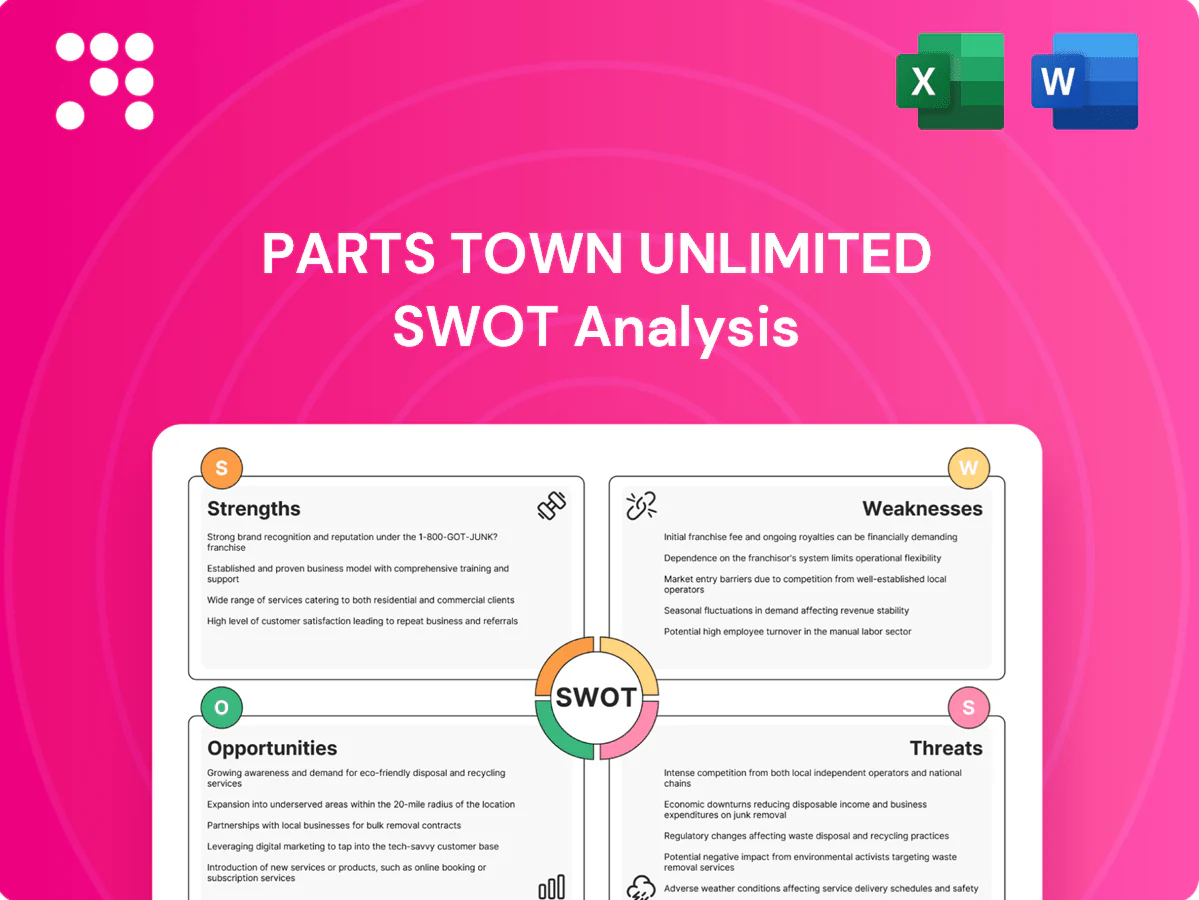
Parts Town Unlimited SWOT Analysis

Dive Deeper Into the Company’s Strategic Blueprint
Explore Parts Town Unlimited’s strategic position with our concise SWOT preview—highlighting core strengths, competitive risks, and growth levers across parts distribution and service models. Want deeper, actionable analysis? Purchase the full SWOT for a research-backed, editable Word report plus Excel matrix to support investment, strategy, and planning.
Strengths

Deep OEM partnerships
Exclusive, long-standing OEM relationships give Parts Town access to over 1.5 million OEM SKUs and supply agreements that ensure genuine parts availability and authenticity. This reliability builds trust with service companies and operators who require warranty-safe components, reflected in serving more than 125,000 customers. Those ties create meaningful switching costs and differentiate the Parts Town catalog from generic marketplaces.
Rapid fulfillment network
Optimized logistics and same-day shipping reduce equipment downtime for commercial kitchens and HVAC technicians, improving uptime and service continuity; this speed drives higher customer loyalty and a premium perception that supports pricing power on time-critical SKUs, especially for emergency parts and seasonal demand.

Comprehensive inventory breadth
Comprehensive inventory breadth drives higher first-fill rates and enables one-stop procurement by consolidating multi-brand needs into a single order. Extensive SKU coverage reduces buyer need to multi-source, shortening lead times and lowering procurement complexity. This breadth increases average basket size and creates cross-sell opportunities across foodservice, residential appliance, and HVAC lines. Broad selection strengthens customer retention and repeat purchase frequency.

Digital tools and workflow
Parts Towns digital tools—robust search, equipment diagrams and mobile-friendly ordering—streamline part identification and speed fulfillment, embedding the platform in technicians workflows and boosting retention and repeat purchases.
- Reduced time-on-task: integrated account management and order tracking
- Workflow embed: diagrams + mobile ordering improve repeat buy rates
- Search efficiency: faster part identification for field techs
Global multi-vertical reach
Parts Towns global multi-vertical reach across foodservice, residential appliance and HVAC smooths demand seasonality and leverages cross-vertical SKU synergies; the company, founded in 1987, reported continued expansion into HVAC and international channels through 2024.
- diversified demand cycles
- expanded TAM via international distribution (2024 expansion)
- cross-vertical data improves forecasting and assortment
OEM access: 1.5M SKUs, 125k customers, same-day shipping drives pricing power
Exclusive OEM relationships grant access to over 1.5 million OEM SKUs and warranty-safe parts, serving 125,000+ customers and creating high switching costs. Fast logistics and same-day shipping capability reduce downtime for critical repairs, supporting pricing power on time-sensitive SKUs. Broad multi-vertical reach (foodservice, appliance, HVAC) and 2024 international expansion diversify demand and boost cross-sell.
| Metric | Value |
|---|---|
| OEM SKUs | 1.5M+ |
| Customers | 125,000+ |
| Founded | 1987 |
| Expansion | HVAC & international (2024) |
What is included in the product
 Detailed Word Document
Delivers a strategic overview of Parts Town Unlimited’s internal and external business factors, outlining strengths, weaknesses, opportunities, and threats to inform competitive positioning and growth strategy.

 Customizable Excel Spreadsheet
Parts Town Unlimited SWOT Analysis provides a concise, editable SWOT matrix for fast visual strategy alignment and quick stakeholder-ready summaries, easing planning and communication across teams.
Weaknesses

OEM supply dependence
Reliance on OEM manufacturing schedules constrains Parts Town Unlimited’s availability and lead times, so OEM production hiccups ripple directly into fulfillment and customer service metrics; industry reports in 2024 continued to highlight OEM-driven delays as a primary cause of backorders, while limited negotiation leverage with OEMs restricts pricing flexibility and margin control.
Inventory carrying costs
Wide SKU breadth forces Parts Town Unlimited to hold large inventories, with typical inventory carrying costs in distribution running about 20–30% of inventory value annually; commercial kitchen equipment lifecycles often span roughly 7–10 years, raising obsolescence risk as models sunset; missed demand forecasting can erode gross margins, commonly compressing margins by several percentage points in parts distribution.

Complex catalog management
Maintaining accurate fitment data across thousands of models is resource-intensive, requiring specialized teams and tooling. Data errors drive returns, technician delays and customer frustration; U.S. retail returns were estimated at $761 billion in 2022 (NRF), illustrating scale risk for parts-intensive channels. Continuous content upkeep remains a structural operating burden that erodes margins and increases working capital needs.

Pricing transparency pressure
Pricing transparency pressure: online comparability and secondary markets erode premium pricing as roughly 70% of B2B buyers in 2024 report comparing suppliers online; customers increasingly choose near-equivalents or aftermarket parts, forcing Parts Town Unlimited to defend margins through clearer value communication and differentiated service offerings.
- Higher shopper comparison: 70% of B2B buyers compare online (2024)
- Aftermarket substitution rising: increases price competition
- Margin defense: requires continual value messaging and service differentiation
Integration complexity with customers
Embedding Parts Town Unlimited into diverse customer ERPs and field-service systems is often slow, frequently extending implementation timelines and delaying realization of subscription revenue; industry reports through 2024 note integration complexities as a top barrier to SaaS adoption. Integration projects increase upfront costs and can lengthen sales cycles, while fragmented customer tech stacks limit uptake of advanced digital features and reduce per-customer ARPU expansion.
- Integration delays: longer time-to-value
- Higher implementation costs: compress margins
- Extended sales cycles: slower ARR growth
- Fragmented stacks: reduced feature adoption
OEM reliance, 20-30% carry costs & 6-9 month integrations heighten fulfillment and ARR risk
Dependence on OEMs causes fulfillment volatility (OEM delays cited as top backorder driver in 2024); large SKU breadth drives 20–30% annual inventory carrying costs and obsolescence risk given 7–10 year equipment cycles; 70% of B2B buyers compare suppliers online (2024), boosting aftermarket substitution; integrations typically take 6–9 months, slowing ARR expansion.
| Weakness | Key metric | Impact |
|---|---|---|
| OEM dependence | 2024: leading backorder cause | Fulfillment volatility |
| Inventory cost | 20–30% annual carry | Margin compression |
| Buyer comparison | 70% B2B compare online (2024) | Price pressure |
| Integration | 6–9 month avg | Slower ARR |
Preview Before You Purchase
Parts Town Unlimited SWOT Analysis
This is the actual SWOT analysis document you’ll receive upon purchase—no surprises, just professional quality. The preview below is taken directly from the full SWOT report you'll get, and purchase unlocks the complete, editable version. You’re viewing a live preview of the actual file; the entire, detailed report becomes available immediately after checkout.

Dive Deeper Into the Company’s Strategic Blueprint
Explore Parts Town Unlimited’s strategic position with our concise SWOT preview—highlighting core strengths, competitive risks, and growth levers across parts distribution and service models. Want deeper, actionable analysis? Purchase the full SWOT for a research-backed, editable Word report plus Excel matrix to support investment, strategy, and planning.
Strengths
Deep OEM partnerships
Exclusive, long-standing OEM relationships give Parts Town access to over 1.5 million OEM SKUs and supply agreements that ensure genuine parts availability and authenticity. This reliability builds trust with service companies and operators who require warranty-safe components, reflected in serving more than 125,000 customers. Those ties create meaningful switching costs and differentiate the Parts Town catalog from generic marketplaces.
Rapid fulfillment network
Optimized logistics and same-day shipping reduce equipment downtime for commercial kitchens and HVAC technicians, improving uptime and service continuity; this speed drives higher customer loyalty and a premium perception that supports pricing power on time-critical SKUs, especially for emergency parts and seasonal demand.
Comprehensive inventory breadth
Comprehensive inventory breadth drives higher first-fill rates and enables one-stop procurement by consolidating multi-brand needs into a single order. Extensive SKU coverage reduces buyer need to multi-source, shortening lead times and lowering procurement complexity. This breadth increases average basket size and creates cross-sell opportunities across foodservice, residential appliance, and HVAC lines. Broad selection strengthens customer retention and repeat purchase frequency.
Digital tools and workflow
Parts Towns digital tools—robust search, equipment diagrams and mobile-friendly ordering—streamline part identification and speed fulfillment, embedding the platform in technicians workflows and boosting retention and repeat purchases.
- Reduced time-on-task: integrated account management and order tracking
- Workflow embed: diagrams + mobile ordering improve repeat buy rates
- Search efficiency: faster part identification for field techs
Global multi-vertical reach
Parts Towns global multi-vertical reach across foodservice, residential appliance and HVAC smooths demand seasonality and leverages cross-vertical SKU synergies; the company, founded in 1987, reported continued expansion into HVAC and international channels through 2024.
- diversified demand cycles
- expanded TAM via international distribution (2024 expansion)
- cross-vertical data improves forecasting and assortment
OEM access: 1.5M SKUs, 125k customers, same-day shipping drives pricing power
Exclusive OEM relationships grant access to over 1.5 million OEM SKUs and warranty-safe parts, serving 125,000+ customers and creating high switching costs. Fast logistics and same-day shipping capability reduce downtime for critical repairs, supporting pricing power on time-sensitive SKUs. Broad multi-vertical reach (foodservice, appliance, HVAC) and 2024 international expansion diversify demand and boost cross-sell.
| Metric | Value |
|---|---|
| OEM SKUs | 1.5M+ |
| Customers | 125,000+ |
| Founded | 1987 |
| Expansion | HVAC & international (2024) |
What is included in the product
Detailed Word Document
Delivers a strategic overview of Parts Town Unlimited’s internal and external business factors, outlining strengths, weaknesses, opportunities, and threats to inform competitive positioning and growth strategy.
Customizable Excel Spreadsheet
Parts Town Unlimited SWOT Analysis provides a concise, editable SWOT matrix for fast visual strategy alignment and quick stakeholder-ready summaries, easing planning and communication across teams.
Weaknesses
OEM supply dependence
Reliance on OEM manufacturing schedules constrains Parts Town Unlimited’s availability and lead times, so OEM production hiccups ripple directly into fulfillment and customer service metrics; industry reports in 2024 continued to highlight OEM-driven delays as a primary cause of backorders, while limited negotiation leverage with OEMs restricts pricing flexibility and margin control.
Inventory carrying costs
Wide SKU breadth forces Parts Town Unlimited to hold large inventories, with typical inventory carrying costs in distribution running about 20–30% of inventory value annually; commercial kitchen equipment lifecycles often span roughly 7–10 years, raising obsolescence risk as models sunset; missed demand forecasting can erode gross margins, commonly compressing margins by several percentage points in parts distribution.
Complex catalog management
Maintaining accurate fitment data across thousands of models is resource-intensive, requiring specialized teams and tooling. Data errors drive returns, technician delays and customer frustration; U.S. retail returns were estimated at $761 billion in 2022 (NRF), illustrating scale risk for parts-intensive channels. Continuous content upkeep remains a structural operating burden that erodes margins and increases working capital needs.
Pricing transparency pressure
Pricing transparency pressure: online comparability and secondary markets erode premium pricing as roughly 70% of B2B buyers in 2024 report comparing suppliers online; customers increasingly choose near-equivalents or aftermarket parts, forcing Parts Town Unlimited to defend margins through clearer value communication and differentiated service offerings.
- Higher shopper comparison: 70% of B2B buyers compare online (2024)
- Aftermarket substitution rising: increases price competition
- Margin defense: requires continual value messaging and service differentiation
Integration complexity with customers
Embedding Parts Town Unlimited into diverse customer ERPs and field-service systems is often slow, frequently extending implementation timelines and delaying realization of subscription revenue; industry reports through 2024 note integration complexities as a top barrier to SaaS adoption. Integration projects increase upfront costs and can lengthen sales cycles, while fragmented customer tech stacks limit uptake of advanced digital features and reduce per-customer ARPU expansion.
- Integration delays: longer time-to-value
- Higher implementation costs: compress margins
- Extended sales cycles: slower ARR growth
- Fragmented stacks: reduced feature adoption
OEM reliance, 20-30% carry costs & 6-9 month integrations heighten fulfillment and ARR risk
Dependence on OEMs causes fulfillment volatility (OEM delays cited as top backorder driver in 2024); large SKU breadth drives 20–30% annual inventory carrying costs and obsolescence risk given 7–10 year equipment cycles; 70% of B2B buyers compare suppliers online (2024), boosting aftermarket substitution; integrations typically take 6–9 months, slowing ARR expansion.
| Weakness | Key metric | Impact |
|---|---|---|
| OEM dependence | 2024: leading backorder cause | Fulfillment volatility |
| Inventory cost | 20–30% annual carry | Margin compression |
| Buyer comparison | 70% B2B compare online (2024) | Price pressure |
| Integration | 6–9 month avg | Slower ARR |
Preview Before You Purchase
Parts Town Unlimited SWOT Analysis
This is the actual SWOT analysis document you’ll receive upon purchase—no surprises, just professional quality. The preview below is taken directly from the full SWOT report you'll get, and purchase unlocks the complete, editable version. You’re viewing a live preview of the actual file; the entire, detailed report becomes available immediately after checkout.
Description
Dive Deeper Into the Company’s Strategic Blueprint
Explore Parts Town Unlimited’s strategic position with our concise SWOT preview—highlighting core strengths, competitive risks, and growth levers across parts distribution and service models. Want deeper, actionable analysis? Purchase the full SWOT for a research-backed, editable Word report plus Excel matrix to support investment, strategy, and planning.
Strengths
Deep OEM partnerships
Exclusive, long-standing OEM relationships give Parts Town access to over 1.5 million OEM SKUs and supply agreements that ensure genuine parts availability and authenticity. This reliability builds trust with service companies and operators who require warranty-safe components, reflected in serving more than 125,000 customers. Those ties create meaningful switching costs and differentiate the Parts Town catalog from generic marketplaces.
Rapid fulfillment network
Optimized logistics and same-day shipping reduce equipment downtime for commercial kitchens and HVAC technicians, improving uptime and service continuity; this speed drives higher customer loyalty and a premium perception that supports pricing power on time-critical SKUs, especially for emergency parts and seasonal demand.
Comprehensive inventory breadth
Comprehensive inventory breadth drives higher first-fill rates and enables one-stop procurement by consolidating multi-brand needs into a single order. Extensive SKU coverage reduces buyer need to multi-source, shortening lead times and lowering procurement complexity. This breadth increases average basket size and creates cross-sell opportunities across foodservice, residential appliance, and HVAC lines. Broad selection strengthens customer retention and repeat purchase frequency.
Digital tools and workflow
Parts Towns digital tools—robust search, equipment diagrams and mobile-friendly ordering—streamline part identification and speed fulfillment, embedding the platform in technicians workflows and boosting retention and repeat purchases.
- Reduced time-on-task: integrated account management and order tracking
- Workflow embed: diagrams + mobile ordering improve repeat buy rates
- Search efficiency: faster part identification for field techs
Global multi-vertical reach
Parts Towns global multi-vertical reach across foodservice, residential appliance and HVAC smooths demand seasonality and leverages cross-vertical SKU synergies; the company, founded in 1987, reported continued expansion into HVAC and international channels through 2024.
- diversified demand cycles
- expanded TAM via international distribution (2024 expansion)
- cross-vertical data improves forecasting and assortment
OEM access: 1.5M SKUs, 125k customers, same-day shipping drives pricing power
Exclusive OEM relationships grant access to over 1.5 million OEM SKUs and warranty-safe parts, serving 125,000+ customers and creating high switching costs. Fast logistics and same-day shipping capability reduce downtime for critical repairs, supporting pricing power on time-sensitive SKUs. Broad multi-vertical reach (foodservice, appliance, HVAC) and 2024 international expansion diversify demand and boost cross-sell.
| Metric | Value |
|---|---|
| OEM SKUs | 1.5M+ |
| Customers | 125,000+ |
| Founded | 1987 |
| Expansion | HVAC & international (2024) |
What is included in the product
Detailed Word Document
Delivers a strategic overview of Parts Town Unlimited’s internal and external business factors, outlining strengths, weaknesses, opportunities, and threats to inform competitive positioning and growth strategy.
Customizable Excel Spreadsheet
Parts Town Unlimited SWOT Analysis provides a concise, editable SWOT matrix for fast visual strategy alignment and quick stakeholder-ready summaries, easing planning and communication across teams.
Weaknesses
OEM supply dependence
Reliance on OEM manufacturing schedules constrains Parts Town Unlimited’s availability and lead times, so OEM production hiccups ripple directly into fulfillment and customer service metrics; industry reports in 2024 continued to highlight OEM-driven delays as a primary cause of backorders, while limited negotiation leverage with OEMs restricts pricing flexibility and margin control.
Inventory carrying costs
Wide SKU breadth forces Parts Town Unlimited to hold large inventories, with typical inventory carrying costs in distribution running about 20–30% of inventory value annually; commercial kitchen equipment lifecycles often span roughly 7–10 years, raising obsolescence risk as models sunset; missed demand forecasting can erode gross margins, commonly compressing margins by several percentage points in parts distribution.
Complex catalog management
Maintaining accurate fitment data across thousands of models is resource-intensive, requiring specialized teams and tooling. Data errors drive returns, technician delays and customer frustration; U.S. retail returns were estimated at $761 billion in 2022 (NRF), illustrating scale risk for parts-intensive channels. Continuous content upkeep remains a structural operating burden that erodes margins and increases working capital needs.
Pricing transparency pressure
Pricing transparency pressure: online comparability and secondary markets erode premium pricing as roughly 70% of B2B buyers in 2024 report comparing suppliers online; customers increasingly choose near-equivalents or aftermarket parts, forcing Parts Town Unlimited to defend margins through clearer value communication and differentiated service offerings.
- Higher shopper comparison: 70% of B2B buyers compare online (2024)
- Aftermarket substitution rising: increases price competition
- Margin defense: requires continual value messaging and service differentiation
Integration complexity with customers
Embedding Parts Town Unlimited into diverse customer ERPs and field-service systems is often slow, frequently extending implementation timelines and delaying realization of subscription revenue; industry reports through 2024 note integration complexities as a top barrier to SaaS adoption. Integration projects increase upfront costs and can lengthen sales cycles, while fragmented customer tech stacks limit uptake of advanced digital features and reduce per-customer ARPU expansion.
- Integration delays: longer time-to-value
- Higher implementation costs: compress margins
- Extended sales cycles: slower ARR growth
- Fragmented stacks: reduced feature adoption
OEM reliance, 20-30% carry costs & 6-9 month integrations heighten fulfillment and ARR risk
Dependence on OEMs causes fulfillment volatility (OEM delays cited as top backorder driver in 2024); large SKU breadth drives 20–30% annual inventory carrying costs and obsolescence risk given 7–10 year equipment cycles; 70% of B2B buyers compare suppliers online (2024), boosting aftermarket substitution; integrations typically take 6–9 months, slowing ARR expansion.
| Weakness | Key metric | Impact |
|---|---|---|
| OEM dependence | 2024: leading backorder cause | Fulfillment volatility |
| Inventory cost | 20–30% annual carry | Margin compression |
| Buyer comparison | 70% B2B compare online (2024) | Price pressure |
| Integration | 6–9 month avg | Slower ARR |
Preview Before You Purchase
Parts Town Unlimited SWOT Analysis
This is the actual SWOT analysis document you’ll receive upon purchase—no surprises, just professional quality. The preview below is taken directly from the full SWOT report you'll get, and purchase unlocks the complete, editable version. You’re viewing a live preview of the actual file; the entire, detailed report becomes available immediately after checkout.











