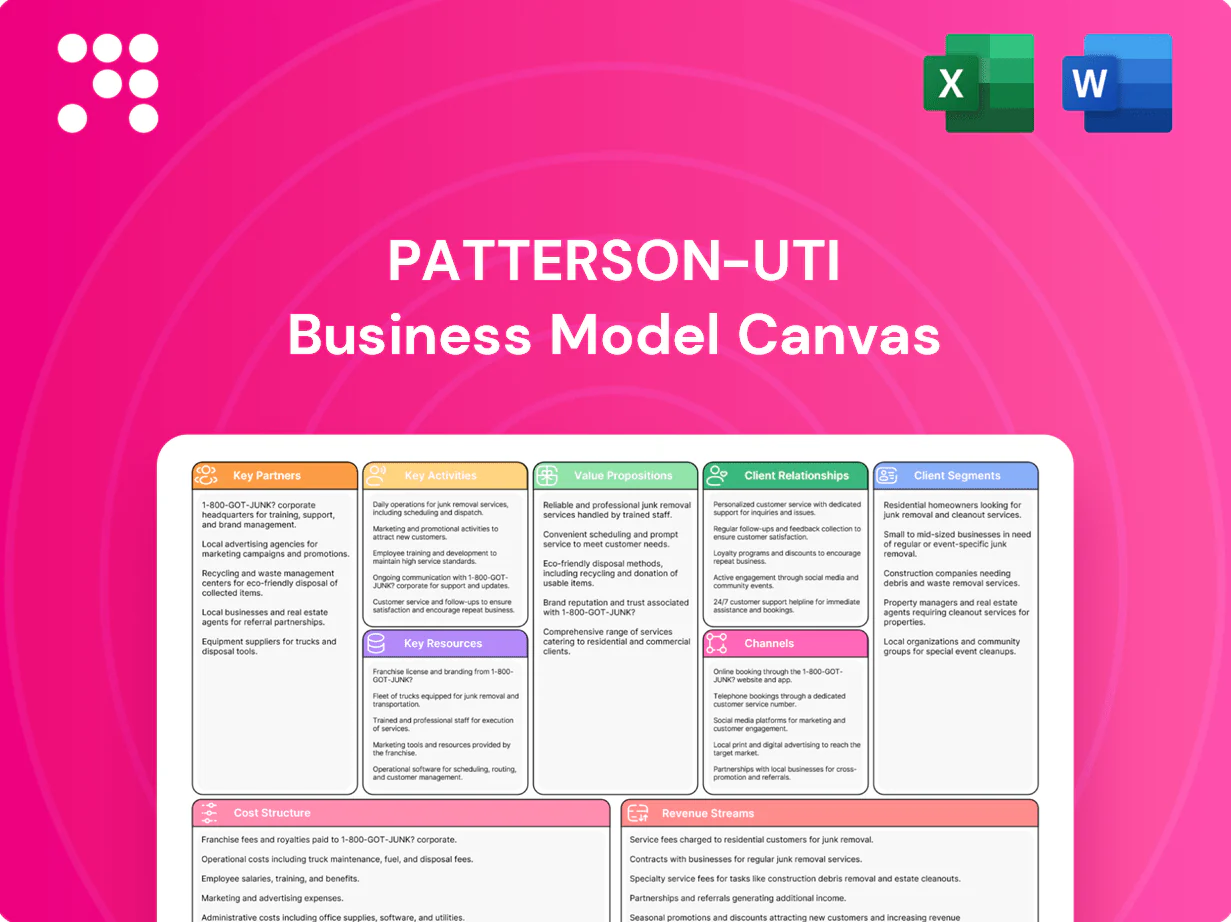
Patterson-UTI Business Model Canvas

Business Model Canvas: Operational Excellence, Partnerships, and Scalable Revenue
Unlock the strategic engine behind Patterson-UTI with our concise Business Model Canvas—three key value propositions, core customer segments, and scalable revenue streams mapped clearly. This snapshot shows how operational excellence and partnerships drive growth. Purchase the full, editable Canvas for a section-by-section playbook ideal for investors, analysts, and strategists.
Partnerships

E&P operator alliances
Multi-year alliances with E&P operators stabilize Patterson-UTI rig and frac crew utilization, reducing downtime and smoothing revenue streams; Baker Hughes reported a US onshore rig count averaging about 610 rigs in 2024, underscoring persistent demand. Collaborative planning for pad drilling and frac scheduling improves cycle times and fleet efficiency. Shared KPIs align uptime, safety, and cost targets, underpinning more predictable cash flows.
Equipment OEMs and technology vendors
Partnerships with rig, pump, and downhole tool manufacturers give Patterson-UTI prioritized access to high-spec equipment and timely upgrades. Joint development programs accelerate automation, digital monitoring, and emissions-reduction technologies. Vendor service support lowers downtime and maintenance expense while supplier agreements secure favorable pricing and parts availability.

Consumables and logistics suppliers
Reliable sourcing of sand, chemicals, fuel and casing underpins Patterson-UTI pressure pumping and drilling operations, with US onshore activity averaging about 600 rigs in 2024, driving sustained proppant and consumable demand. Logistics partners optimize last-mile delivery to wellsites, reducing wait times and transport costs. Long-term supply contracts hedge price volatility and supply risk. Coordinated planning with suppliers and haulers cuts NPT and demurrage, improving fleet utilization.

Workforce, training, and safety partners
External trainers and safety consultants (IADC, API partners) bolster competency and compliance, driving certified well control and HSE programs used by Patterson-UTI in 2024. Certification bodies standardize equipment operation and reduce variability. Strong training partnerships improve retention and rig performance. Robust safety culture cuts incidents and can lower insurance and workers compensation costs by 20–40%.
- Partners: IADC, API, external HSE firms
- Impact: retention + performance, certified crews
- Benefit: incident reduction → 20–40% insurance savings
Data, analytics, and directional technology partners
Software and tool providers enable real-time drilling optimization and downhole insights, with 2024 industry analyses showing up to 15% faster rate of penetration. Data-sharing improved wellbore quality and reduced sidetracks by about 10% in 2024. Integrated MWD/LWD partnerships plus analytics support continuous improvement and richer client reporting, enhancing Patterson-UTI service differentiation.
- 15% ROP gain (2024 industry)
- ~10% fewer sidetracks (2024)
- 24/7 telemetry + MWD/LWD integration
- Continuous analytics for client reporting
Alliances stabilize onshore utilization near 610 rigs; automation lifts ROP ~15%
Multi-year alliances with E&P operators and suppliers stabilize Patterson-UTI utilization and cash flows amid a ~610 US onshore rig environment in 2024. Equipment, software, and logistics partners accelerate automation, 15% ROP gains and ~10% fewer sidetracks, lowering NPT. Training and HSE partners cut incidents and support 20–40% insurance cost reductions.
| Partner | Impact | 2024 Metric |
|---|---|---|
| E&P operators | Utilization | ~610 rigs |
| Tech/vendors | Performance | +15% ROP |
| HSE/trainers | Risk/cost | 20–40% insurance |
What is included in the product
 Detailed Word Document
A comprehensive Business Model Canvas for Patterson-UTI outlining the 9 BMC blocks—customer segments, value propositions, channels, customer relationships, revenue streams, key resources, key activities, partners, and cost structure—tailored to its oilfield services and equipment rental strategy, with integrated competitive advantages and SWOT insights for investor presentations and strategic decision-making.

 Customizable Excel Spreadsheet
High-level view of Patterson-UTI’s business model with editable cells, condensing complex drilling services, asset utilization, and revenue streams into a one-page snapshot for fast decision-making and team collaboration.
Activities

Onshore contract drilling operations
Deploy, rig up, and operate over 200 high-performance land rigs across U.S. basins, executing pad drilling with efficient moves and low cycle times to support multiwell pads. Focused preventive maintenance targets uptime above 90%, reducing unplanned downtime and protecting revenue. Operations deliver safe, compliant well construction in line with industry HSE standards and regulatory requirements.
Pressure pumping and hydraulic fracturing
We plan and pump multi-stage frac jobs with precise rates and pressures to achieve target stage counts and proppant placement, supporting US onshore production that averaged 12.6 million bpd in 2024 (EIA). We manage sand, chemicals, water and fuel logistics across fleets. We monitor equipment health and emissions per EPA guidance and optimize designs to improve EUR and lower per-well costs.

Directional drilling and downhole services
Provide directional motors, MWD and performance tools for precise trajectory control, leveraging real-time telemetry that industry studies show can reduce drilling days by up to 25% and lower non-productive time. Improve hole quality and reduce risk, with geosteering coordination shown to cut sidetracks and corrective runs by roughly 30%. Coordinate closely with operators and geosteering teams and maintain telemetry uptime above 95% for actionable decisions.

Asset maintenance and fleet optimization
Patterson-UTI schedules inspections, overhauls and component replacements across its drilling and frac fleets, and uses telemetry and condition-based maintenance to reduce failures by an industry-quoted 20–40% (2024 benchmarks). Standardizing rigs and frac spreads improves utilization agility, enabling rapid reallocation of assets to active basins to capture higher dayrates.
- Schedule inspections/overhauls/component swaps
- Telemetry & condition-based maintenance: −20–40% failures (2024)
- Standardize rigs/frac spreads for agility
- Reallocate assets to active basins to maximize utilization
Safety, compliance, and ESG execution
Implement rigorous HSE programs at the wellsite with standardized checklists, incident reporting, and behavioral-based safety to drive down incidents and ensure regulatory compliance. Track emissions, noise, and spill prevention through real-time monitoring and quarterly ESG reporting aligned to SASB/TCFD, while training crews and auditing processes to sustain performance. Pursue lower-carbon operations by electrification of fleets and fuel-efficiency measures, and disclose progress in annual ESG reports for 2024.
- HSE programs: standardized checklists, incident reporting
- Monitoring: real-time emissions, noise, spill sensors
- Training & audits: crew certification, quarterly audits
- ESG reporting: SASB/TCFD-aligned, 2024 annual disclosure
Operate 200+ rigs, >90% uptime, >95% telemetry, 20–40% fewer failures
Operate 200+ land rigs and frac fleets with >90% rig uptime and telemetry uptime >95%, executing multiwell pad drilling and multi-stage fracs to support US onshore (12.6 million bpd 2024, EIA). Condition-based maintenance cuts failures 20–40% (2024), enabling rapid asset reallocation and lower per-well costs.
| Activity | Metric | 2024 |
|---|---|---|
| Rigs/Frac | Units | 200+ |
| Rig uptime | % | >90% |
| Telemetry | Uptime | >95% |
| Failures | Reduction | 20–40% |
Delivered as Displayed
Business Model Canvas
The document you're previewing is the actual Patterson-UTI Business Model Canvas deliverable. It's not a sample—it's the exact file you'll receive after purchase. When you buy, you'll download the complete, editable document formatted for immediate use in Word and Excel. No hidden pages—what you see is what you'll own.

Business Model Canvas: Operational Excellence, Partnerships, and Scalable Revenue
Unlock the strategic engine behind Patterson-UTI with our concise Business Model Canvas—three key value propositions, core customer segments, and scalable revenue streams mapped clearly. This snapshot shows how operational excellence and partnerships drive growth. Purchase the full, editable Canvas for a section-by-section playbook ideal for investors, analysts, and strategists.
Partnerships
E&P operator alliances
Multi-year alliances with E&P operators stabilize Patterson-UTI rig and frac crew utilization, reducing downtime and smoothing revenue streams; Baker Hughes reported a US onshore rig count averaging about 610 rigs in 2024, underscoring persistent demand. Collaborative planning for pad drilling and frac scheduling improves cycle times and fleet efficiency. Shared KPIs align uptime, safety, and cost targets, underpinning more predictable cash flows.
Equipment OEMs and technology vendors
Partnerships with rig, pump, and downhole tool manufacturers give Patterson-UTI prioritized access to high-spec equipment and timely upgrades. Joint development programs accelerate automation, digital monitoring, and emissions-reduction technologies. Vendor service support lowers downtime and maintenance expense while supplier agreements secure favorable pricing and parts availability.
Consumables and logistics suppliers
Reliable sourcing of sand, chemicals, fuel and casing underpins Patterson-UTI pressure pumping and drilling operations, with US onshore activity averaging about 600 rigs in 2024, driving sustained proppant and consumable demand. Logistics partners optimize last-mile delivery to wellsites, reducing wait times and transport costs. Long-term supply contracts hedge price volatility and supply risk. Coordinated planning with suppliers and haulers cuts NPT and demurrage, improving fleet utilization.
Workforce, training, and safety partners
External trainers and safety consultants (IADC, API partners) bolster competency and compliance, driving certified well control and HSE programs used by Patterson-UTI in 2024. Certification bodies standardize equipment operation and reduce variability. Strong training partnerships improve retention and rig performance. Robust safety culture cuts incidents and can lower insurance and workers compensation costs by 20–40%.
- Partners: IADC, API, external HSE firms
- Impact: retention + performance, certified crews
- Benefit: incident reduction → 20–40% insurance savings
Data, analytics, and directional technology partners
Software and tool providers enable real-time drilling optimization and downhole insights, with 2024 industry analyses showing up to 15% faster rate of penetration. Data-sharing improved wellbore quality and reduced sidetracks by about 10% in 2024. Integrated MWD/LWD partnerships plus analytics support continuous improvement and richer client reporting, enhancing Patterson-UTI service differentiation.
- 15% ROP gain (2024 industry)
- ~10% fewer sidetracks (2024)
- 24/7 telemetry + MWD/LWD integration
- Continuous analytics for client reporting
Alliances stabilize onshore utilization near 610 rigs; automation lifts ROP ~15%
Multi-year alliances with E&P operators and suppliers stabilize Patterson-UTI utilization and cash flows amid a ~610 US onshore rig environment in 2024. Equipment, software, and logistics partners accelerate automation, 15% ROP gains and ~10% fewer sidetracks, lowering NPT. Training and HSE partners cut incidents and support 20–40% insurance cost reductions.
| Partner | Impact | 2024 Metric |
|---|---|---|
| E&P operators | Utilization | ~610 rigs |
| Tech/vendors | Performance | +15% ROP |
| HSE/trainers | Risk/cost | 20–40% insurance |
What is included in the product
Detailed Word Document
A comprehensive Business Model Canvas for Patterson-UTI outlining the 9 BMC blocks—customer segments, value propositions, channels, customer relationships, revenue streams, key resources, key activities, partners, and cost structure—tailored to its oilfield services and equipment rental strategy, with integrated competitive advantages and SWOT insights for investor presentations and strategic decision-making.
Customizable Excel Spreadsheet
High-level view of Patterson-UTI’s business model with editable cells, condensing complex drilling services, asset utilization, and revenue streams into a one-page snapshot for fast decision-making and team collaboration.
Activities
Onshore contract drilling operations
Deploy, rig up, and operate over 200 high-performance land rigs across U.S. basins, executing pad drilling with efficient moves and low cycle times to support multiwell pads. Focused preventive maintenance targets uptime above 90%, reducing unplanned downtime and protecting revenue. Operations deliver safe, compliant well construction in line with industry HSE standards and regulatory requirements.
Pressure pumping and hydraulic fracturing
We plan and pump multi-stage frac jobs with precise rates and pressures to achieve target stage counts and proppant placement, supporting US onshore production that averaged 12.6 million bpd in 2024 (EIA). We manage sand, chemicals, water and fuel logistics across fleets. We monitor equipment health and emissions per EPA guidance and optimize designs to improve EUR and lower per-well costs.
Directional drilling and downhole services
Provide directional motors, MWD and performance tools for precise trajectory control, leveraging real-time telemetry that industry studies show can reduce drilling days by up to 25% and lower non-productive time. Improve hole quality and reduce risk, with geosteering coordination shown to cut sidetracks and corrective runs by roughly 30%. Coordinate closely with operators and geosteering teams and maintain telemetry uptime above 95% for actionable decisions.
Asset maintenance and fleet optimization
Patterson-UTI schedules inspections, overhauls and component replacements across its drilling and frac fleets, and uses telemetry and condition-based maintenance to reduce failures by an industry-quoted 20–40% (2024 benchmarks). Standardizing rigs and frac spreads improves utilization agility, enabling rapid reallocation of assets to active basins to capture higher dayrates.
- Schedule inspections/overhauls/component swaps
- Telemetry & condition-based maintenance: −20–40% failures (2024)
- Standardize rigs/frac spreads for agility
- Reallocate assets to active basins to maximize utilization
Safety, compliance, and ESG execution
Implement rigorous HSE programs at the wellsite with standardized checklists, incident reporting, and behavioral-based safety to drive down incidents and ensure regulatory compliance. Track emissions, noise, and spill prevention through real-time monitoring and quarterly ESG reporting aligned to SASB/TCFD, while training crews and auditing processes to sustain performance. Pursue lower-carbon operations by electrification of fleets and fuel-efficiency measures, and disclose progress in annual ESG reports for 2024.
- HSE programs: standardized checklists, incident reporting
- Monitoring: real-time emissions, noise, spill sensors
- Training & audits: crew certification, quarterly audits
- ESG reporting: SASB/TCFD-aligned, 2024 annual disclosure
Operate 200+ rigs, >90% uptime, >95% telemetry, 20–40% fewer failures
Operate 200+ land rigs and frac fleets with >90% rig uptime and telemetry uptime >95%, executing multiwell pad drilling and multi-stage fracs to support US onshore (12.6 million bpd 2024, EIA). Condition-based maintenance cuts failures 20–40% (2024), enabling rapid asset reallocation and lower per-well costs.
| Activity | Metric | 2024 |
|---|---|---|
| Rigs/Frac | Units | 200+ |
| Rig uptime | % | >90% |
| Telemetry | Uptime | >95% |
| Failures | Reduction | 20–40% |
Delivered as Displayed
Business Model Canvas
The document you're previewing is the actual Patterson-UTI Business Model Canvas deliverable. It's not a sample—it's the exact file you'll receive after purchase. When you buy, you'll download the complete, editable document formatted for immediate use in Word and Excel. No hidden pages—what you see is what you'll own.
Description
Business Model Canvas: Operational Excellence, Partnerships, and Scalable Revenue
Unlock the strategic engine behind Patterson-UTI with our concise Business Model Canvas—three key value propositions, core customer segments, and scalable revenue streams mapped clearly. This snapshot shows how operational excellence and partnerships drive growth. Purchase the full, editable Canvas for a section-by-section playbook ideal for investors, analysts, and strategists.
Partnerships
E&P operator alliances
Multi-year alliances with E&P operators stabilize Patterson-UTI rig and frac crew utilization, reducing downtime and smoothing revenue streams; Baker Hughes reported a US onshore rig count averaging about 610 rigs in 2024, underscoring persistent demand. Collaborative planning for pad drilling and frac scheduling improves cycle times and fleet efficiency. Shared KPIs align uptime, safety, and cost targets, underpinning more predictable cash flows.
Equipment OEMs and technology vendors
Partnerships with rig, pump, and downhole tool manufacturers give Patterson-UTI prioritized access to high-spec equipment and timely upgrades. Joint development programs accelerate automation, digital monitoring, and emissions-reduction technologies. Vendor service support lowers downtime and maintenance expense while supplier agreements secure favorable pricing and parts availability.
Consumables and logistics suppliers
Reliable sourcing of sand, chemicals, fuel and casing underpins Patterson-UTI pressure pumping and drilling operations, with US onshore activity averaging about 600 rigs in 2024, driving sustained proppant and consumable demand. Logistics partners optimize last-mile delivery to wellsites, reducing wait times and transport costs. Long-term supply contracts hedge price volatility and supply risk. Coordinated planning with suppliers and haulers cuts NPT and demurrage, improving fleet utilization.
Workforce, training, and safety partners
External trainers and safety consultants (IADC, API partners) bolster competency and compliance, driving certified well control and HSE programs used by Patterson-UTI in 2024. Certification bodies standardize equipment operation and reduce variability. Strong training partnerships improve retention and rig performance. Robust safety culture cuts incidents and can lower insurance and workers compensation costs by 20–40%.
- Partners: IADC, API, external HSE firms
- Impact: retention + performance, certified crews
- Benefit: incident reduction → 20–40% insurance savings
Data, analytics, and directional technology partners
Software and tool providers enable real-time drilling optimization and downhole insights, with 2024 industry analyses showing up to 15% faster rate of penetration. Data-sharing improved wellbore quality and reduced sidetracks by about 10% in 2024. Integrated MWD/LWD partnerships plus analytics support continuous improvement and richer client reporting, enhancing Patterson-UTI service differentiation.
- 15% ROP gain (2024 industry)
- ~10% fewer sidetracks (2024)
- 24/7 telemetry + MWD/LWD integration
- Continuous analytics for client reporting
Alliances stabilize onshore utilization near 610 rigs; automation lifts ROP ~15%
Multi-year alliances with E&P operators and suppliers stabilize Patterson-UTI utilization and cash flows amid a ~610 US onshore rig environment in 2024. Equipment, software, and logistics partners accelerate automation, 15% ROP gains and ~10% fewer sidetracks, lowering NPT. Training and HSE partners cut incidents and support 20–40% insurance cost reductions.
| Partner | Impact | 2024 Metric |
|---|---|---|
| E&P operators | Utilization | ~610 rigs |
| Tech/vendors | Performance | +15% ROP |
| HSE/trainers | Risk/cost | 20–40% insurance |
What is included in the product
Detailed Word Document
A comprehensive Business Model Canvas for Patterson-UTI outlining the 9 BMC blocks—customer segments, value propositions, channels, customer relationships, revenue streams, key resources, key activities, partners, and cost structure—tailored to its oilfield services and equipment rental strategy, with integrated competitive advantages and SWOT insights for investor presentations and strategic decision-making.
Customizable Excel Spreadsheet
High-level view of Patterson-UTI’s business model with editable cells, condensing complex drilling services, asset utilization, and revenue streams into a one-page snapshot for fast decision-making and team collaboration.
Activities
Onshore contract drilling operations
Deploy, rig up, and operate over 200 high-performance land rigs across U.S. basins, executing pad drilling with efficient moves and low cycle times to support multiwell pads. Focused preventive maintenance targets uptime above 90%, reducing unplanned downtime and protecting revenue. Operations deliver safe, compliant well construction in line with industry HSE standards and regulatory requirements.
Pressure pumping and hydraulic fracturing
We plan and pump multi-stage frac jobs with precise rates and pressures to achieve target stage counts and proppant placement, supporting US onshore production that averaged 12.6 million bpd in 2024 (EIA). We manage sand, chemicals, water and fuel logistics across fleets. We monitor equipment health and emissions per EPA guidance and optimize designs to improve EUR and lower per-well costs.
Directional drilling and downhole services
Provide directional motors, MWD and performance tools for precise trajectory control, leveraging real-time telemetry that industry studies show can reduce drilling days by up to 25% and lower non-productive time. Improve hole quality and reduce risk, with geosteering coordination shown to cut sidetracks and corrective runs by roughly 30%. Coordinate closely with operators and geosteering teams and maintain telemetry uptime above 95% for actionable decisions.
Asset maintenance and fleet optimization
Patterson-UTI schedules inspections, overhauls and component replacements across its drilling and frac fleets, and uses telemetry and condition-based maintenance to reduce failures by an industry-quoted 20–40% (2024 benchmarks). Standardizing rigs and frac spreads improves utilization agility, enabling rapid reallocation of assets to active basins to capture higher dayrates.
- Schedule inspections/overhauls/component swaps
- Telemetry & condition-based maintenance: −20–40% failures (2024)
- Standardize rigs/frac spreads for agility
- Reallocate assets to active basins to maximize utilization
Safety, compliance, and ESG execution
Implement rigorous HSE programs at the wellsite with standardized checklists, incident reporting, and behavioral-based safety to drive down incidents and ensure regulatory compliance. Track emissions, noise, and spill prevention through real-time monitoring and quarterly ESG reporting aligned to SASB/TCFD, while training crews and auditing processes to sustain performance. Pursue lower-carbon operations by electrification of fleets and fuel-efficiency measures, and disclose progress in annual ESG reports for 2024.
- HSE programs: standardized checklists, incident reporting
- Monitoring: real-time emissions, noise, spill sensors
- Training & audits: crew certification, quarterly audits
- ESG reporting: SASB/TCFD-aligned, 2024 annual disclosure
Operate 200+ rigs, >90% uptime, >95% telemetry, 20–40% fewer failures
Operate 200+ land rigs and frac fleets with >90% rig uptime and telemetry uptime >95%, executing multiwell pad drilling and multi-stage fracs to support US onshore (12.6 million bpd 2024, EIA). Condition-based maintenance cuts failures 20–40% (2024), enabling rapid asset reallocation and lower per-well costs.
| Activity | Metric | 2024 |
|---|---|---|
| Rigs/Frac | Units | 200+ |
| Rig uptime | % | >90% |
| Telemetry | Uptime | >95% |
| Failures | Reduction | 20–40% |
Delivered as Displayed
Business Model Canvas
The document you're previewing is the actual Patterson-UTI Business Model Canvas deliverable. It's not a sample—it's the exact file you'll receive after purchase. When you buy, you'll download the complete, editable document formatted for immediate use in Word and Excel. No hidden pages—what you see is what you'll own.











