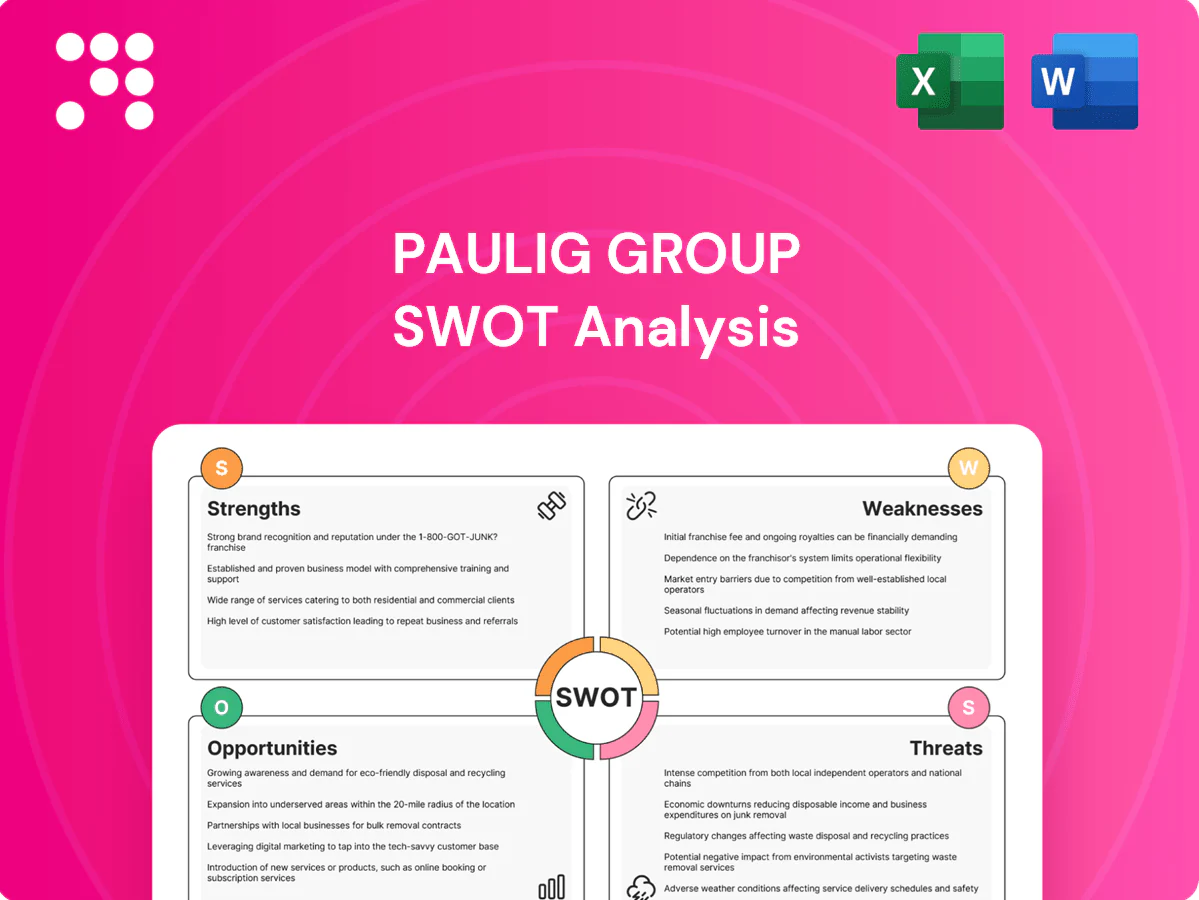
Paulig Group SWOT Analysis

Elevate Your Analysis with the Complete SWOT Report
Paulig Group's SWOT highlights a strong brand portfolio, sustainable sourcing and resilient Nordic market presence, alongside supply-chain and competition risks and clear growth levers in premium and international expansion. Want the full picture? Purchase the complete SWOT for a professionally written, editable Word and Excel report to plan, pitch, or invest with confidence.
Strengths

Diversified product portfolio
Operating across five categories—coffee, spices, Tex Mex, snacks and plant-based spreads—Paulig spreads risk and drives cross-category synergies. Category breadth enables shared sourcing, R&D and marketing efficiencies, improving margin leverage across the portfolio. This diversification cushions cyclical downturns in any single segment and strengthens retailer negotiations and shelf presence.
Strong Nordic brand heritage
Family ownership and Nordic roots since 1876 (149 years in 2025) underpin trust, quality and sustainability credentials that resonate with consumers and B2B partners. Established brands in Finland and the Baltics command premium positioning and loyalty, supported by Paulig’s presence in over 10 markets. Local credibility strengthens foodservice and retail partnerships, while this brand equity lowers customer acquisition costs for new product launches.

Multi-channel reach (retail & foodservice)
Paulig serves both consumers and professional foodservice clients, balancing high-volume contracts with higher-margin retail SKUs and contributing to Group net sales of about EUR 1.34 billion in 2023. Foodservice operations feed real-time insights into product development and emerging flavor trends, accelerating launches. Channel diversification boosts resilience to demand shocks and broadens touchpoints for brand-building and consumer trial.

Sustainability leadership credentials
Paulig’s sustainability leadership, driven by responsible sourcing in coffee and spices, aligns with EU policy (55% GHG reduction by 2030) and rising retailer due-diligence expectations, strengthening brand differentiation versus private labels and supporting premium pricing and multi-year supplier contracts.
- Traceability: reduces reputational risk
- Certifications: support retailer compliance
- Premium justified: stronger margins
Innovation in flavor & plant-based
Paulig leverages Santa Maria expertise in spices and Tex Mex to capitalize on trend-led flavor platforms, supporting rapid roll-outs into plant-based and global seasoning trends.
Aligned with a flexitarian shift—global plant-based food market CAGR ~10% (2023–2030, Grand View Research)—Paulig’s plant-based SKUs meet rising demand while agile NPD cycles enable seasonal and regional line extensions.
Innovation and premium flavor development help unlock higher-margin segments through premium pricing and assortment differentiation.
- Tag: Santa Maria leadership in Tex Mex
- Tag: Plant-based CAGR ~10% (2023–2030)
- Tag: Agile NPD = faster seasonal/regional launches
- Tag: Innovation → premium margin capture
Nordic food portfolio drives EUR 1.34bn sales, heritage & sustainability edge
Paulig's diversified portfolio (coffee, spices, Tex Mex, snacks, plant-based) drives cross-category synergies, supporting EUR 1.34bn net sales (2023) and margin leverage. 149-year family ownership and strong Nordic brands deliver premium positioning and retailer clout. Sustainability and traceability (aligned with EU 55% GHG target) plus agile NPD capture ~10% plant-based CAGR.
| Metric | Value |
|---|---|
| Net sales (2023) | EUR 1.34bn |
| Heritage | 149 yrs (1876–2025) |
| Plant-based CAGR | ~10% (2023–2030) |
What is included in the product
 Detailed Word Document
Delivers a strategic overview of Paulig Group’s internal strengths and weaknesses and external opportunities and threats, mapping its competitive position, growth drivers, operational gaps, and market risks to inform strategic decision-making.

 Customizable Excel Spreadsheet
Provides a concise SWOT matrix for fast strategic alignment across Paulig Group, clarifying brand-level strengths and risks while highlighting growth opportunities and competitive threats for quick decision-making.
Weaknesses

Geographic concentration in Europe
Paulig's heavy reliance on the Nordics and selected European markets — where it generates the majority of its revenue (net sales approx. EUR 1.1bn in 2023) — constrains global scale and diversification. Concentration elevates exposure to EU retailer dynamics and tightening food regulations. Without faster internationalization, growth risks plateauing beyond Europe. Currency swings and regional macro cycles can disproportionately affect margins and earnings volatility.
Commodity price exposure
Paulig Group reported net sales of about EUR 1.6 billion in 2023, yet core inputs such as coffee and spices remain climate-sensitive and highly volatile. Hedging can smooth cost swings but cannot eliminate sudden price spikes, which pressure margins or force retail price hikes and can erode competitiveness versus larger, better-hedged rivals.

Smaller scale vs global giants
Competing with global giants like Nestlé, JDE Peet’s, McCormick and PepsiCo-owned snack brands strains Paulig’s resources; Paulig’s ~EUR 1.6bn net sales (2023) leave less procurement leverage and smaller media budgets versus multibillion-euro rivals. Shelf space battles in key retailers drive costly promotional spend, and international expansion demands significant capital and capabilities to scale operations and distribution.

Premium pricing sensitivity
Paulig s premium quality and sustainability positioning commands higher price points, leaving the brand vulnerable when consumers trade down during cost-of-living pressure; Euro area inflation eased to about 2.4% in 2024 (Eurostat) but sensitivity remains as retailers resist list-price rises and elasticity can cut volumes in entry-level coffee and food segments.
- Higher ASPs vs private label pressure
- Retailer pushback on price hikes
- Volume risk in entry-level segments
- Inflation backdrop: Euro area ~2.4% (2024, Eurostat)
Brand and portfolio complexity
Paulig Group's broad brand and category mix increases operational complexity across supply chains, making sourcing, production scheduling and logistics harder to standardize. Maintaining a coherent brand architecture across regions is challenging, which can slow decision-making and dilute strategic focus. The portfolio breadth also raises working capital and inventory management demands, increasing the risk of slower execution.
- Supply-chain complexity
- Brand-architecture strain
- Slower execution
- Higher working capital needs
Europe-focused roaster: EUR 1.6bn sales, input volatility and retail concentration risk
Paulig's EUR 1.6bn net sales (2023) and heavy Nordic/European concentration limit global scale and raise exposure to regional retailer dynamics and regulation. Climate-driven input volatility (coffee, spices) and limited hedging power squeeze margins versus larger rivals. Premium positioning increases volume risk under consumer downtrading.
| Metric | Value |
|---|---|
| Net sales (2023) | EUR 1.6bn |
| Euro area inflation (2024, Eurostat) | 2.4% |
| Geographic concentration | Majority revenue from Nordics/Europe |
Preview the Actual Deliverable
Paulig Group SWOT Analysis
This is the actual Paulig Group SWOT analysis document you’ll receive upon purchase—no surprises, just professional quality. The preview below is taken directly from the full report and reflects the complete, editable file. Buy now to unlock the entire, detailed version.

Elevate Your Analysis with the Complete SWOT Report
Paulig Group's SWOT highlights a strong brand portfolio, sustainable sourcing and resilient Nordic market presence, alongside supply-chain and competition risks and clear growth levers in premium and international expansion. Want the full picture? Purchase the complete SWOT for a professionally written, editable Word and Excel report to plan, pitch, or invest with confidence.
Strengths
Diversified product portfolio
Operating across five categories—coffee, spices, Tex Mex, snacks and plant-based spreads—Paulig spreads risk and drives cross-category synergies. Category breadth enables shared sourcing, R&D and marketing efficiencies, improving margin leverage across the portfolio. This diversification cushions cyclical downturns in any single segment and strengthens retailer negotiations and shelf presence.
Strong Nordic brand heritage
Family ownership and Nordic roots since 1876 (149 years in 2025) underpin trust, quality and sustainability credentials that resonate with consumers and B2B partners. Established brands in Finland and the Baltics command premium positioning and loyalty, supported by Paulig’s presence in over 10 markets. Local credibility strengthens foodservice and retail partnerships, while this brand equity lowers customer acquisition costs for new product launches.
Multi-channel reach (retail & foodservice)
Paulig serves both consumers and professional foodservice clients, balancing high-volume contracts with higher-margin retail SKUs and contributing to Group net sales of about EUR 1.34 billion in 2023. Foodservice operations feed real-time insights into product development and emerging flavor trends, accelerating launches. Channel diversification boosts resilience to demand shocks and broadens touchpoints for brand-building and consumer trial.
Sustainability leadership credentials
Paulig’s sustainability leadership, driven by responsible sourcing in coffee and spices, aligns with EU policy (55% GHG reduction by 2030) and rising retailer due-diligence expectations, strengthening brand differentiation versus private labels and supporting premium pricing and multi-year supplier contracts.
- Traceability: reduces reputational risk
- Certifications: support retailer compliance
- Premium justified: stronger margins
Innovation in flavor & plant-based
Paulig leverages Santa Maria expertise in spices and Tex Mex to capitalize on trend-led flavor platforms, supporting rapid roll-outs into plant-based and global seasoning trends.
Aligned with a flexitarian shift—global plant-based food market CAGR ~10% (2023–2030, Grand View Research)—Paulig’s plant-based SKUs meet rising demand while agile NPD cycles enable seasonal and regional line extensions.
Innovation and premium flavor development help unlock higher-margin segments through premium pricing and assortment differentiation.
- Tag: Santa Maria leadership in Tex Mex
- Tag: Plant-based CAGR ~10% (2023–2030)
- Tag: Agile NPD = faster seasonal/regional launches
- Tag: Innovation → premium margin capture
Nordic food portfolio drives EUR 1.34bn sales, heritage & sustainability edge
Paulig's diversified portfolio (coffee, spices, Tex Mex, snacks, plant-based) drives cross-category synergies, supporting EUR 1.34bn net sales (2023) and margin leverage. 149-year family ownership and strong Nordic brands deliver premium positioning and retailer clout. Sustainability and traceability (aligned with EU 55% GHG target) plus agile NPD capture ~10% plant-based CAGR.
| Metric | Value |
|---|---|
| Net sales (2023) | EUR 1.34bn |
| Heritage | 149 yrs (1876–2025) |
| Plant-based CAGR | ~10% (2023–2030) |
What is included in the product
Detailed Word Document
Delivers a strategic overview of Paulig Group’s internal strengths and weaknesses and external opportunities and threats, mapping its competitive position, growth drivers, operational gaps, and market risks to inform strategic decision-making.
Customizable Excel Spreadsheet
Provides a concise SWOT matrix for fast strategic alignment across Paulig Group, clarifying brand-level strengths and risks while highlighting growth opportunities and competitive threats for quick decision-making.
Weaknesses
Geographic concentration in Europe
Paulig's heavy reliance on the Nordics and selected European markets — where it generates the majority of its revenue (net sales approx. EUR 1.1bn in 2023) — constrains global scale and diversification. Concentration elevates exposure to EU retailer dynamics and tightening food regulations. Without faster internationalization, growth risks plateauing beyond Europe. Currency swings and regional macro cycles can disproportionately affect margins and earnings volatility.
Commodity price exposure
Paulig Group reported net sales of about EUR 1.6 billion in 2023, yet core inputs such as coffee and spices remain climate-sensitive and highly volatile. Hedging can smooth cost swings but cannot eliminate sudden price spikes, which pressure margins or force retail price hikes and can erode competitiveness versus larger, better-hedged rivals.
Smaller scale vs global giants
Competing with global giants like Nestlé, JDE Peet’s, McCormick and PepsiCo-owned snack brands strains Paulig’s resources; Paulig’s ~EUR 1.6bn net sales (2023) leave less procurement leverage and smaller media budgets versus multibillion-euro rivals. Shelf space battles in key retailers drive costly promotional spend, and international expansion demands significant capital and capabilities to scale operations and distribution.
Premium pricing sensitivity
Paulig s premium quality and sustainability positioning commands higher price points, leaving the brand vulnerable when consumers trade down during cost-of-living pressure; Euro area inflation eased to about 2.4% in 2024 (Eurostat) but sensitivity remains as retailers resist list-price rises and elasticity can cut volumes in entry-level coffee and food segments.
- Higher ASPs vs private label pressure
- Retailer pushback on price hikes
- Volume risk in entry-level segments
- Inflation backdrop: Euro area ~2.4% (2024, Eurostat)
Brand and portfolio complexity
Paulig Group's broad brand and category mix increases operational complexity across supply chains, making sourcing, production scheduling and logistics harder to standardize. Maintaining a coherent brand architecture across regions is challenging, which can slow decision-making and dilute strategic focus. The portfolio breadth also raises working capital and inventory management demands, increasing the risk of slower execution.
- Supply-chain complexity
- Brand-architecture strain
- Slower execution
- Higher working capital needs
Europe-focused roaster: EUR 1.6bn sales, input volatility and retail concentration risk
Paulig's EUR 1.6bn net sales (2023) and heavy Nordic/European concentration limit global scale and raise exposure to regional retailer dynamics and regulation. Climate-driven input volatility (coffee, spices) and limited hedging power squeeze margins versus larger rivals. Premium positioning increases volume risk under consumer downtrading.
| Metric | Value |
|---|---|
| Net sales (2023) | EUR 1.6bn |
| Euro area inflation (2024, Eurostat) | 2.4% |
| Geographic concentration | Majority revenue from Nordics/Europe |
Preview the Actual Deliverable
Paulig Group SWOT Analysis
This is the actual Paulig Group SWOT analysis document you’ll receive upon purchase—no surprises, just professional quality. The preview below is taken directly from the full report and reflects the complete, editable file. Buy now to unlock the entire, detailed version.
Description
Elevate Your Analysis with the Complete SWOT Report
Paulig Group's SWOT highlights a strong brand portfolio, sustainable sourcing and resilient Nordic market presence, alongside supply-chain and competition risks and clear growth levers in premium and international expansion. Want the full picture? Purchase the complete SWOT for a professionally written, editable Word and Excel report to plan, pitch, or invest with confidence.
Strengths
Diversified product portfolio
Operating across five categories—coffee, spices, Tex Mex, snacks and plant-based spreads—Paulig spreads risk and drives cross-category synergies. Category breadth enables shared sourcing, R&D and marketing efficiencies, improving margin leverage across the portfolio. This diversification cushions cyclical downturns in any single segment and strengthens retailer negotiations and shelf presence.
Strong Nordic brand heritage
Family ownership and Nordic roots since 1876 (149 years in 2025) underpin trust, quality and sustainability credentials that resonate with consumers and B2B partners. Established brands in Finland and the Baltics command premium positioning and loyalty, supported by Paulig’s presence in over 10 markets. Local credibility strengthens foodservice and retail partnerships, while this brand equity lowers customer acquisition costs for new product launches.
Multi-channel reach (retail & foodservice)
Paulig serves both consumers and professional foodservice clients, balancing high-volume contracts with higher-margin retail SKUs and contributing to Group net sales of about EUR 1.34 billion in 2023. Foodservice operations feed real-time insights into product development and emerging flavor trends, accelerating launches. Channel diversification boosts resilience to demand shocks and broadens touchpoints for brand-building and consumer trial.
Sustainability leadership credentials
Paulig’s sustainability leadership, driven by responsible sourcing in coffee and spices, aligns with EU policy (55% GHG reduction by 2030) and rising retailer due-diligence expectations, strengthening brand differentiation versus private labels and supporting premium pricing and multi-year supplier contracts.
- Traceability: reduces reputational risk
- Certifications: support retailer compliance
- Premium justified: stronger margins
Innovation in flavor & plant-based
Paulig leverages Santa Maria expertise in spices and Tex Mex to capitalize on trend-led flavor platforms, supporting rapid roll-outs into plant-based and global seasoning trends.
Aligned with a flexitarian shift—global plant-based food market CAGR ~10% (2023–2030, Grand View Research)—Paulig’s plant-based SKUs meet rising demand while agile NPD cycles enable seasonal and regional line extensions.
Innovation and premium flavor development help unlock higher-margin segments through premium pricing and assortment differentiation.
- Tag: Santa Maria leadership in Tex Mex
- Tag: Plant-based CAGR ~10% (2023–2030)
- Tag: Agile NPD = faster seasonal/regional launches
- Tag: Innovation → premium margin capture
Nordic food portfolio drives EUR 1.34bn sales, heritage & sustainability edge
Paulig's diversified portfolio (coffee, spices, Tex Mex, snacks, plant-based) drives cross-category synergies, supporting EUR 1.34bn net sales (2023) and margin leverage. 149-year family ownership and strong Nordic brands deliver premium positioning and retailer clout. Sustainability and traceability (aligned with EU 55% GHG target) plus agile NPD capture ~10% plant-based CAGR.
| Metric | Value |
|---|---|
| Net sales (2023) | EUR 1.34bn |
| Heritage | 149 yrs (1876–2025) |
| Plant-based CAGR | ~10% (2023–2030) |
What is included in the product
Detailed Word Document
Delivers a strategic overview of Paulig Group’s internal strengths and weaknesses and external opportunities and threats, mapping its competitive position, growth drivers, operational gaps, and market risks to inform strategic decision-making.
Customizable Excel Spreadsheet
Provides a concise SWOT matrix for fast strategic alignment across Paulig Group, clarifying brand-level strengths and risks while highlighting growth opportunities and competitive threats for quick decision-making.
Weaknesses
Geographic concentration in Europe
Paulig's heavy reliance on the Nordics and selected European markets — where it generates the majority of its revenue (net sales approx. EUR 1.1bn in 2023) — constrains global scale and diversification. Concentration elevates exposure to EU retailer dynamics and tightening food regulations. Without faster internationalization, growth risks plateauing beyond Europe. Currency swings and regional macro cycles can disproportionately affect margins and earnings volatility.
Commodity price exposure
Paulig Group reported net sales of about EUR 1.6 billion in 2023, yet core inputs such as coffee and spices remain climate-sensitive and highly volatile. Hedging can smooth cost swings but cannot eliminate sudden price spikes, which pressure margins or force retail price hikes and can erode competitiveness versus larger, better-hedged rivals.
Smaller scale vs global giants
Competing with global giants like Nestlé, JDE Peet’s, McCormick and PepsiCo-owned snack brands strains Paulig’s resources; Paulig’s ~EUR 1.6bn net sales (2023) leave less procurement leverage and smaller media budgets versus multibillion-euro rivals. Shelf space battles in key retailers drive costly promotional spend, and international expansion demands significant capital and capabilities to scale operations and distribution.
Premium pricing sensitivity
Paulig s premium quality and sustainability positioning commands higher price points, leaving the brand vulnerable when consumers trade down during cost-of-living pressure; Euro area inflation eased to about 2.4% in 2024 (Eurostat) but sensitivity remains as retailers resist list-price rises and elasticity can cut volumes in entry-level coffee and food segments.
- Higher ASPs vs private label pressure
- Retailer pushback on price hikes
- Volume risk in entry-level segments
- Inflation backdrop: Euro area ~2.4% (2024, Eurostat)
Brand and portfolio complexity
Paulig Group's broad brand and category mix increases operational complexity across supply chains, making sourcing, production scheduling and logistics harder to standardize. Maintaining a coherent brand architecture across regions is challenging, which can slow decision-making and dilute strategic focus. The portfolio breadth also raises working capital and inventory management demands, increasing the risk of slower execution.
- Supply-chain complexity
- Brand-architecture strain
- Slower execution
- Higher working capital needs
Europe-focused roaster: EUR 1.6bn sales, input volatility and retail concentration risk
Paulig's EUR 1.6bn net sales (2023) and heavy Nordic/European concentration limit global scale and raise exposure to regional retailer dynamics and regulation. Climate-driven input volatility (coffee, spices) and limited hedging power squeeze margins versus larger rivals. Premium positioning increases volume risk under consumer downtrading.
| Metric | Value |
|---|---|
| Net sales (2023) | EUR 1.6bn |
| Euro area inflation (2024, Eurostat) | 2.4% |
| Geographic concentration | Majority revenue from Nordics/Europe |
Preview the Actual Deliverable
Paulig Group SWOT Analysis
This is the actual Paulig Group SWOT analysis document you’ll receive upon purchase—no surprises, just professional quality. The preview below is taken directly from the full report and reflects the complete, editable file. Buy now to unlock the entire, detailed version.











