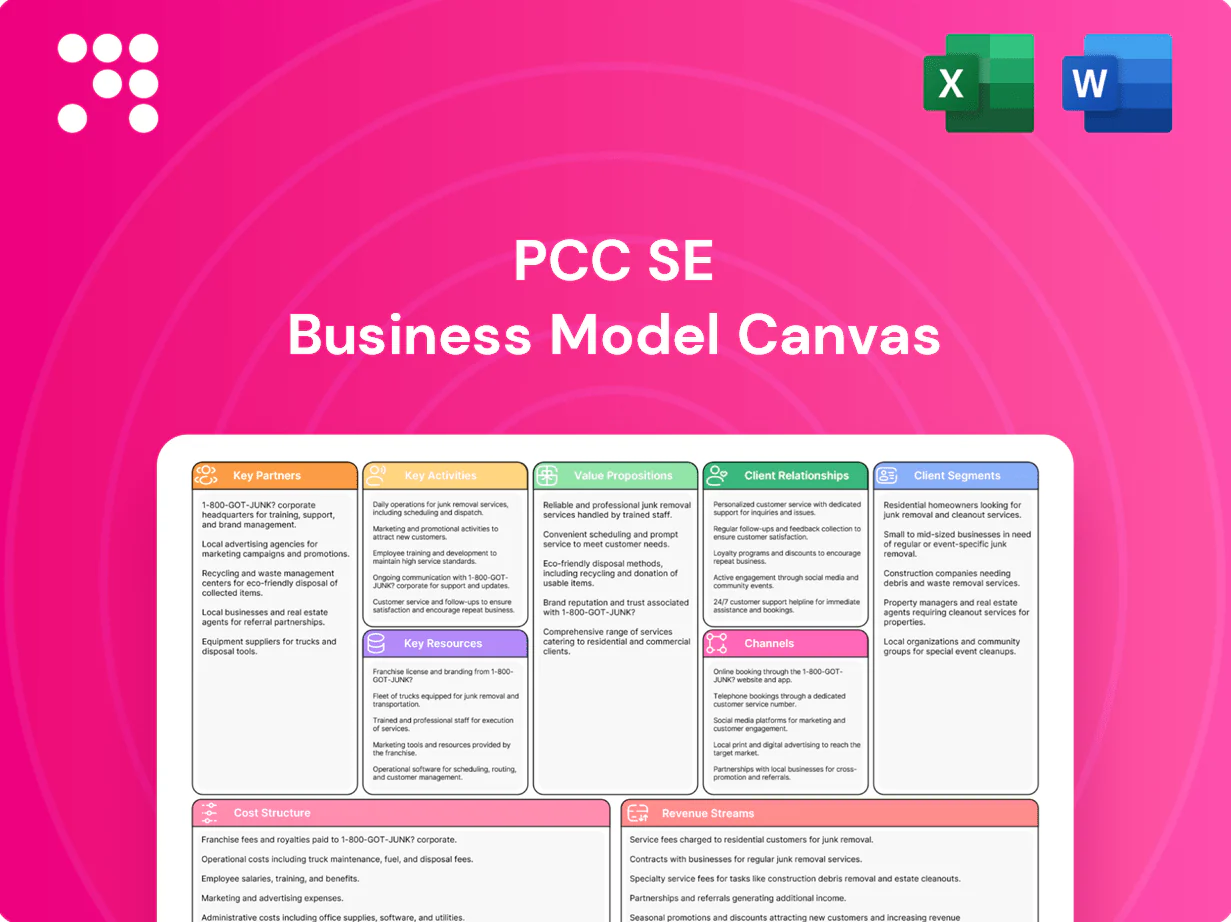
PCC SE Business Model Canvas

Business Model Canvas: concise snapshot of value propositions, partners, and revenue
Explore PCC SE’s Business Model Canvas to understand its value propositions, key partners, and revenue engines in a concise strategic snapshot. This brief overview highlights growth levers, operational strengths, and market positioning. For full section-by-section analysis, editable templates, and investor-ready insights, purchase the complete Business Model Canvas to apply directly to your strategy or due diligence.
Partnerships

Strategic chemical JV partners
PCC SE partners with upstream and downstream chemical firms via strategic JVs to secure feedstock and co-develop specialty products, sharing regulatory and safety expertise across plants; these joint ventures lower capex and accelerate niche market entry while long-term offtake agreements stabilize volumes and pricing.
Energy and renewable project partners
PCC SE partners with utilities, independent power producers and technology providers to develop power generation and renewables projects, while EPC firms and turbine/solar OEMs de-risk construction and operations through turnkey delivery and long-term equipment warranties. Power purchase agreements, typically spanning 10–15 years, underpin bankability and predictable cash flows for project finance. Grid operators and balancing service partners secure reliable dispatch and system integration.

Mining and raw material suppliers
PCC SE sources brine, salt, limestone, quartzite and metallurgical coal/coke for its chlor-alkali and silicon metal operations via long-term mining agreements to secure feedstock quality and continuity. Multi-year contracts with miners reduce supply volatility and underpin planning for production and capex. Close supplier collaboration enables cost optimization and integrated logistics planning. Rigorous sustainability standards and supplier audits mitigate ESG and reputational risks in the supply chain.

Logistics carriers and terminal operators
PCC SE partners with rail, barge, trucking and port terminal operators to move bulk chemicals and metals, leveraging dedicated tank farms and silo capacity to improve terminal turnaround and inventory rotation. In 2024 3PL providers and customs brokers streamlined cross-border flows, while safety-certified carriers reduced incident rates and lowered insurance exposures.
- Rail, barge, truck, port
- Dedicated tanks/silos
- 3PL & customs brokers
- Safety-certified carriers
R&D institutions and technology licensors
PCC SE partners with universities, research institutes and technology licensors to drive process improvements and develop new formulations, leveraging access to proprietary catalysts, membranes and electrolyzers to boost efficiency. Pilot programs accelerate scale-up and shorten time-to-market for specialty polyols and derivatives, while IP sharing frameworks and licensing agreements preserve competitive advantage and ensure controlled technology transfer.
- R&D collaboration: universities, institutes, licensors
- Proprietary assets: catalysts, membranes, electrolyzers
- Pilots: faster scale-up for specialty polyols
- IP frameworks: protect competitive edge
JVs secure feedstock; 10-15yr PPAs de-risk power; long-term logistics ensure continuity
PCC SE leverages JVs with chemical partners to secure feedstock, share capex and accelerate specialty product entry while long-term offtake stabilizes volumes. The company uses 10–15 year PPAs (2024) and EPC/OEM partnerships to de-risk power and renewables projects. Long-term mining and logistics contracts plus 3PLs (2024) secure continuity and lower operational risk.
| Partner type | Role | 2024 metric |
|---|---|---|
| JVs | Feedstock, capex share | active |
| PPAs/EPC | Project bankability | tenor 10–15 years |
| Logistics/mining | Continuity, ESG | 3PL adoption 2024 |
What is included in the product
 Detailed Word Document
A concise, pre-written Business Model Canvas for PCC SE outlining customer segments, value propositions, channels, key resources/activities, partners, cost structure and revenue streams across the 9 BMC blocks, reflecting the company’s industrial-chemical strategy, sustainability focus and competitive advantages for presentations, investor discussions and strategic planning.

 Customizable Excel Spreadsheet
High-level, editable one-page canvas that distills PCC SE’s strategy into a clean snapshot, relieving hours spent formatting and aligning teams for meetings or investor reviews.
Activities

Chemical manufacturing operations
PCC SE operates chlor-alkali, polyols and silicon metal production lines under strict quality control. Continuous process optimization programs target higher yields and lower energy intensity across plants. Rigorous plant maintenance and safety management protocols sustain high uptime. Compliance with REACH and other international chemical standards is embedded in operations.
Energy generation and trading
PCC SE develops and operates power assets, including renewables, to supply its plants and external markets, integrating onsite generation with market sales. Active hedging and energy trading are used to balance price risks and secure margins. Demand-side management shifts industrial consumption to match green power availability while grid services such as frequency and capacity offerings provide additional revenue optionality.

Integrated logistics services
PCC SE provides transport, warehousing and terminal handling for bulk and hazardous goods, serving industrial customers in 2024 with integrated multimodal solutions. Route planning and combined rail/sea/truck logistics cut lead times and costs, supported by ISO tank management and specialist packaging to protect product integrity. 24/7 digital tracking delivers real-time shipment visibility and exception alerts.

Investment selection and portfolio management
PCC SE identifies, acquires, and scales industrial assets with long-term value potential, prioritizing capital allocation to cash-generative, defensible niches. Active governance and hands-on operational improvements drive margin expansion and resilience. Disciplined divestments recycle capital from non-core holdings to fund higher-return opportunities.
- Investment selection: niche industrials
- Capital allocation: cash-generative focus
- Governance: active, performance-driven
- Divestment: recycle non-core capital
Product development and technical service
PCC SE develops tailored polyols and chemical solutions, validating formulations in application labs and ensuring regulatory compliance; the group leverages its Frankfurt-listed platform (ISIN DE0005008007) to scale customer-specific products.
Technical service supports process integration and troubleshooting, maintaining feedback loops that drive iterative improvements and product lifecycle updates.
- application labs: 3
- ISIN: DE0005008007
- focus: tailored polyols & chemical solutions
Chemicals group raises yields, lowers energy use, runs 3 labs and on-site power trading
PCC SE runs chlor-alkali, polyols and silicon-metal lines with continuous yield and energy-intensity improvements. The group operates on-site and market-facing power assets, using hedging and trading to stabilise margins. Integrated multimodal logistics and 3 application labs support customer-specific formulations (ISIN DE0005008007) and 2024 industrial service delivery. Active asset M&A and disciplined divestments recycle capital.
| Metric | Value |
|---|---|
| Application labs | 3 |
| ISIN | DE0005008007 |
| Year | 2024 |
What You See Is What You Get
Business Model Canvas
The Business Model Canvas preview you see for PCC SE is the actual deliverable, not a mockup. When you purchase, you’ll receive this same document—with all sections and content included—ready to edit and present. The file is provided in editable Word and Excel formats for immediate use.

Business Model Canvas: concise snapshot of value propositions, partners, and revenue
Explore PCC SE’s Business Model Canvas to understand its value propositions, key partners, and revenue engines in a concise strategic snapshot. This brief overview highlights growth levers, operational strengths, and market positioning. For full section-by-section analysis, editable templates, and investor-ready insights, purchase the complete Business Model Canvas to apply directly to your strategy or due diligence.
Partnerships
Strategic chemical JV partners
PCC SE partners with upstream and downstream chemical firms via strategic JVs to secure feedstock and co-develop specialty products, sharing regulatory and safety expertise across plants; these joint ventures lower capex and accelerate niche market entry while long-term offtake agreements stabilize volumes and pricing.
Energy and renewable project partners
PCC SE partners with utilities, independent power producers and technology providers to develop power generation and renewables projects, while EPC firms and turbine/solar OEMs de-risk construction and operations through turnkey delivery and long-term equipment warranties. Power purchase agreements, typically spanning 10–15 years, underpin bankability and predictable cash flows for project finance. Grid operators and balancing service partners secure reliable dispatch and system integration.
Mining and raw material suppliers
PCC SE sources brine, salt, limestone, quartzite and metallurgical coal/coke for its chlor-alkali and silicon metal operations via long-term mining agreements to secure feedstock quality and continuity. Multi-year contracts with miners reduce supply volatility and underpin planning for production and capex. Close supplier collaboration enables cost optimization and integrated logistics planning. Rigorous sustainability standards and supplier audits mitigate ESG and reputational risks in the supply chain.
Logistics carriers and terminal operators
PCC SE partners with rail, barge, trucking and port terminal operators to move bulk chemicals and metals, leveraging dedicated tank farms and silo capacity to improve terminal turnaround and inventory rotation. In 2024 3PL providers and customs brokers streamlined cross-border flows, while safety-certified carriers reduced incident rates and lowered insurance exposures.
- Rail, barge, truck, port
- Dedicated tanks/silos
- 3PL & customs brokers
- Safety-certified carriers
R&D institutions and technology licensors
PCC SE partners with universities, research institutes and technology licensors to drive process improvements and develop new formulations, leveraging access to proprietary catalysts, membranes and electrolyzers to boost efficiency. Pilot programs accelerate scale-up and shorten time-to-market for specialty polyols and derivatives, while IP sharing frameworks and licensing agreements preserve competitive advantage and ensure controlled technology transfer.
- R&D collaboration: universities, institutes, licensors
- Proprietary assets: catalysts, membranes, electrolyzers
- Pilots: faster scale-up for specialty polyols
- IP frameworks: protect competitive edge
JVs secure feedstock; 10-15yr PPAs de-risk power; long-term logistics ensure continuity
PCC SE leverages JVs with chemical partners to secure feedstock, share capex and accelerate specialty product entry while long-term offtake stabilizes volumes. The company uses 10–15 year PPAs (2024) and EPC/OEM partnerships to de-risk power and renewables projects. Long-term mining and logistics contracts plus 3PLs (2024) secure continuity and lower operational risk.
| Partner type | Role | 2024 metric |
|---|---|---|
| JVs | Feedstock, capex share | active |
| PPAs/EPC | Project bankability | tenor 10–15 years |
| Logistics/mining | Continuity, ESG | 3PL adoption 2024 |
What is included in the product
Detailed Word Document
A concise, pre-written Business Model Canvas for PCC SE outlining customer segments, value propositions, channels, key resources/activities, partners, cost structure and revenue streams across the 9 BMC blocks, reflecting the company’s industrial-chemical strategy, sustainability focus and competitive advantages for presentations, investor discussions and strategic planning.
Customizable Excel Spreadsheet
High-level, editable one-page canvas that distills PCC SE’s strategy into a clean snapshot, relieving hours spent formatting and aligning teams for meetings or investor reviews.
Activities
Chemical manufacturing operations
PCC SE operates chlor-alkali, polyols and silicon metal production lines under strict quality control. Continuous process optimization programs target higher yields and lower energy intensity across plants. Rigorous plant maintenance and safety management protocols sustain high uptime. Compliance with REACH and other international chemical standards is embedded in operations.
Energy generation and trading
PCC SE develops and operates power assets, including renewables, to supply its plants and external markets, integrating onsite generation with market sales. Active hedging and energy trading are used to balance price risks and secure margins. Demand-side management shifts industrial consumption to match green power availability while grid services such as frequency and capacity offerings provide additional revenue optionality.
Integrated logistics services
PCC SE provides transport, warehousing and terminal handling for bulk and hazardous goods, serving industrial customers in 2024 with integrated multimodal solutions. Route planning and combined rail/sea/truck logistics cut lead times and costs, supported by ISO tank management and specialist packaging to protect product integrity. 24/7 digital tracking delivers real-time shipment visibility and exception alerts.
Investment selection and portfolio management
PCC SE identifies, acquires, and scales industrial assets with long-term value potential, prioritizing capital allocation to cash-generative, defensible niches. Active governance and hands-on operational improvements drive margin expansion and resilience. Disciplined divestments recycle capital from non-core holdings to fund higher-return opportunities.
- Investment selection: niche industrials
- Capital allocation: cash-generative focus
- Governance: active, performance-driven
- Divestment: recycle non-core capital
Product development and technical service
PCC SE develops tailored polyols and chemical solutions, validating formulations in application labs and ensuring regulatory compliance; the group leverages its Frankfurt-listed platform (ISIN DE0005008007) to scale customer-specific products.
Technical service supports process integration and troubleshooting, maintaining feedback loops that drive iterative improvements and product lifecycle updates.
- application labs: 3
- ISIN: DE0005008007
- focus: tailored polyols & chemical solutions
Chemicals group raises yields, lowers energy use, runs 3 labs and on-site power trading
PCC SE runs chlor-alkali, polyols and silicon-metal lines with continuous yield and energy-intensity improvements. The group operates on-site and market-facing power assets, using hedging and trading to stabilise margins. Integrated multimodal logistics and 3 application labs support customer-specific formulations (ISIN DE0005008007) and 2024 industrial service delivery. Active asset M&A and disciplined divestments recycle capital.
| Metric | Value |
|---|---|
| Application labs | 3 |
| ISIN | DE0005008007 |
| Year | 2024 |
What You See Is What You Get
Business Model Canvas
The Business Model Canvas preview you see for PCC SE is the actual deliverable, not a mockup. When you purchase, you’ll receive this same document—with all sections and content included—ready to edit and present. The file is provided in editable Word and Excel formats for immediate use.
Original: $10.00
-65%$10.00
$3.50Description
Business Model Canvas: concise snapshot of value propositions, partners, and revenue
Explore PCC SE’s Business Model Canvas to understand its value propositions, key partners, and revenue engines in a concise strategic snapshot. This brief overview highlights growth levers, operational strengths, and market positioning. For full section-by-section analysis, editable templates, and investor-ready insights, purchase the complete Business Model Canvas to apply directly to your strategy or due diligence.
Partnerships
Strategic chemical JV partners
PCC SE partners with upstream and downstream chemical firms via strategic JVs to secure feedstock and co-develop specialty products, sharing regulatory and safety expertise across plants; these joint ventures lower capex and accelerate niche market entry while long-term offtake agreements stabilize volumes and pricing.
Energy and renewable project partners
PCC SE partners with utilities, independent power producers and technology providers to develop power generation and renewables projects, while EPC firms and turbine/solar OEMs de-risk construction and operations through turnkey delivery and long-term equipment warranties. Power purchase agreements, typically spanning 10–15 years, underpin bankability and predictable cash flows for project finance. Grid operators and balancing service partners secure reliable dispatch and system integration.
Mining and raw material suppliers
PCC SE sources brine, salt, limestone, quartzite and metallurgical coal/coke for its chlor-alkali and silicon metal operations via long-term mining agreements to secure feedstock quality and continuity. Multi-year contracts with miners reduce supply volatility and underpin planning for production and capex. Close supplier collaboration enables cost optimization and integrated logistics planning. Rigorous sustainability standards and supplier audits mitigate ESG and reputational risks in the supply chain.
Logistics carriers and terminal operators
PCC SE partners with rail, barge, trucking and port terminal operators to move bulk chemicals and metals, leveraging dedicated tank farms and silo capacity to improve terminal turnaround and inventory rotation. In 2024 3PL providers and customs brokers streamlined cross-border flows, while safety-certified carriers reduced incident rates and lowered insurance exposures.
- Rail, barge, truck, port
- Dedicated tanks/silos
- 3PL & customs brokers
- Safety-certified carriers
R&D institutions and technology licensors
PCC SE partners with universities, research institutes and technology licensors to drive process improvements and develop new formulations, leveraging access to proprietary catalysts, membranes and electrolyzers to boost efficiency. Pilot programs accelerate scale-up and shorten time-to-market for specialty polyols and derivatives, while IP sharing frameworks and licensing agreements preserve competitive advantage and ensure controlled technology transfer.
- R&D collaboration: universities, institutes, licensors
- Proprietary assets: catalysts, membranes, electrolyzers
- Pilots: faster scale-up for specialty polyols
- IP frameworks: protect competitive edge
JVs secure feedstock; 10-15yr PPAs de-risk power; long-term logistics ensure continuity
PCC SE leverages JVs with chemical partners to secure feedstock, share capex and accelerate specialty product entry while long-term offtake stabilizes volumes. The company uses 10–15 year PPAs (2024) and EPC/OEM partnerships to de-risk power and renewables projects. Long-term mining and logistics contracts plus 3PLs (2024) secure continuity and lower operational risk.
| Partner type | Role | 2024 metric |
|---|---|---|
| JVs | Feedstock, capex share | active |
| PPAs/EPC | Project bankability | tenor 10–15 years |
| Logistics/mining | Continuity, ESG | 3PL adoption 2024 |
What is included in the product
Detailed Word Document
A concise, pre-written Business Model Canvas for PCC SE outlining customer segments, value propositions, channels, key resources/activities, partners, cost structure and revenue streams across the 9 BMC blocks, reflecting the company’s industrial-chemical strategy, sustainability focus and competitive advantages for presentations, investor discussions and strategic planning.
Customizable Excel Spreadsheet
High-level, editable one-page canvas that distills PCC SE’s strategy into a clean snapshot, relieving hours spent formatting and aligning teams for meetings or investor reviews.
Activities
Chemical manufacturing operations
PCC SE operates chlor-alkali, polyols and silicon metal production lines under strict quality control. Continuous process optimization programs target higher yields and lower energy intensity across plants. Rigorous plant maintenance and safety management protocols sustain high uptime. Compliance with REACH and other international chemical standards is embedded in operations.
Energy generation and trading
PCC SE develops and operates power assets, including renewables, to supply its plants and external markets, integrating onsite generation with market sales. Active hedging and energy trading are used to balance price risks and secure margins. Demand-side management shifts industrial consumption to match green power availability while grid services such as frequency and capacity offerings provide additional revenue optionality.
Integrated logistics services
PCC SE provides transport, warehousing and terminal handling for bulk and hazardous goods, serving industrial customers in 2024 with integrated multimodal solutions. Route planning and combined rail/sea/truck logistics cut lead times and costs, supported by ISO tank management and specialist packaging to protect product integrity. 24/7 digital tracking delivers real-time shipment visibility and exception alerts.
Investment selection and portfolio management
PCC SE identifies, acquires, and scales industrial assets with long-term value potential, prioritizing capital allocation to cash-generative, defensible niches. Active governance and hands-on operational improvements drive margin expansion and resilience. Disciplined divestments recycle capital from non-core holdings to fund higher-return opportunities.
- Investment selection: niche industrials
- Capital allocation: cash-generative focus
- Governance: active, performance-driven
- Divestment: recycle non-core capital
Product development and technical service
PCC SE develops tailored polyols and chemical solutions, validating formulations in application labs and ensuring regulatory compliance; the group leverages its Frankfurt-listed platform (ISIN DE0005008007) to scale customer-specific products.
Technical service supports process integration and troubleshooting, maintaining feedback loops that drive iterative improvements and product lifecycle updates.
- application labs: 3
- ISIN: DE0005008007
- focus: tailored polyols & chemical solutions
Chemicals group raises yields, lowers energy use, runs 3 labs and on-site power trading
PCC SE runs chlor-alkali, polyols and silicon-metal lines with continuous yield and energy-intensity improvements. The group operates on-site and market-facing power assets, using hedging and trading to stabilise margins. Integrated multimodal logistics and 3 application labs support customer-specific formulations (ISIN DE0005008007) and 2024 industrial service delivery. Active asset M&A and disciplined divestments recycle capital.
| Metric | Value |
|---|---|
| Application labs | 3 |
| ISIN | DE0005008007 |
| Year | 2024 |
What You See Is What You Get
Business Model Canvas
The Business Model Canvas preview you see for PCC SE is the actual deliverable, not a mockup. When you purchase, you’ll receive this same document—with all sections and content included—ready to edit and present. The file is provided in editable Word and Excel formats for immediate use.











