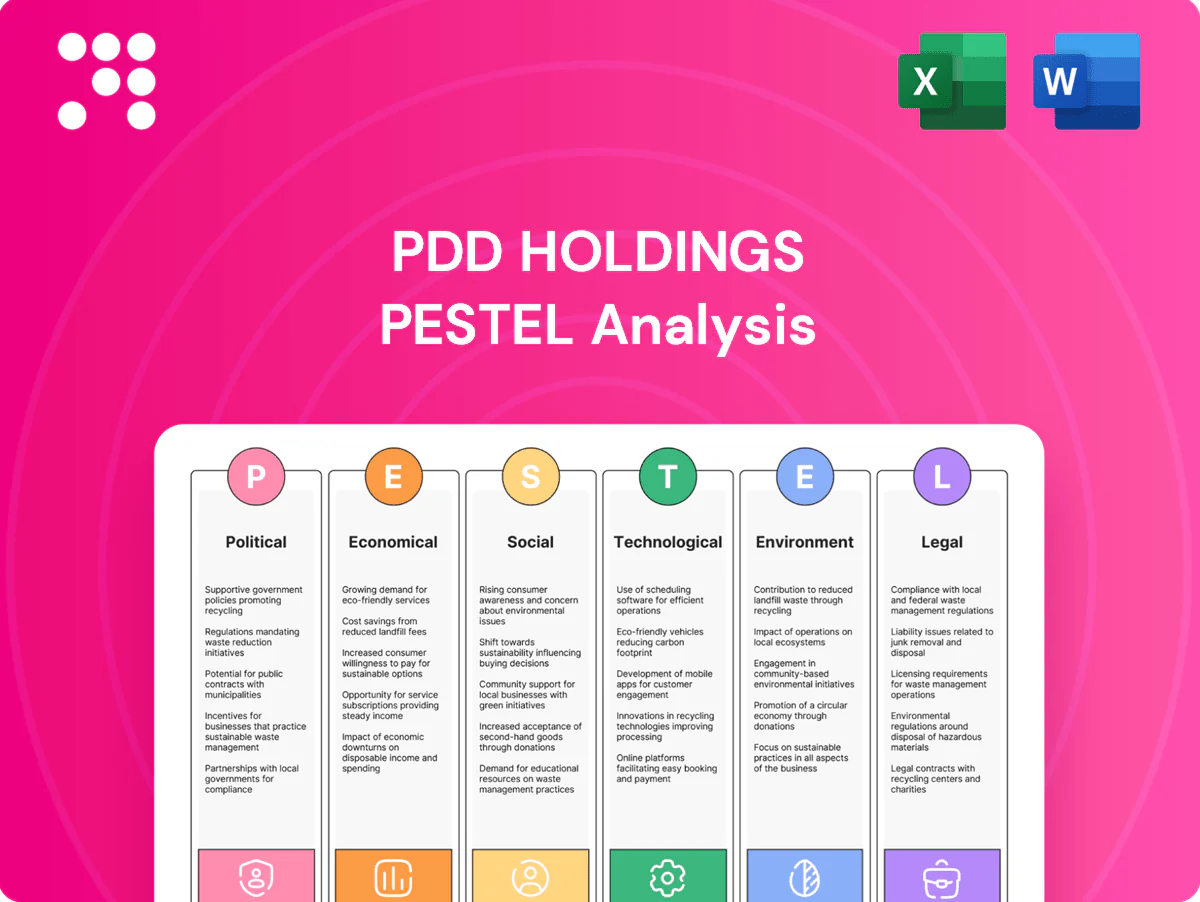
PDD Holdings PESTLE Analysis

Plan Smarter. Present Sharper. Compete Stronger.
Our PESTLE analysis of PDD Holdings reveals how regulatory shifts, macroeconomic pressures, and rapid tech adoption are reshaping its e-commerce model, while social trends and environmental scrutiny create both risks and new market opportunities; buy the full report for the complete, actionable breakdown and strategic recommendations.
Political factors

US–China tensions
Geopolitical rivalry is reshaping cross‑border trade, app‑store scrutiny and public sentiment toward Chinese platforms, affecting Temu and Pinduoduo market access. US export controls on advanced semiconductors (tightened Oct 2022) and tariff swings can disrupt category availability and pricing. Sensor Tower ranked Temu as the top shopping app by global downloads in 2023, while heightened US/allied oversight raises potential compliance costs, so scenario planning for abrupt regulatory shifts is essential.
Chinese industrial policy
China’s 14th Five‑Year Plan (2021–25) and Rural Revitalization strategy prioritize digital economy and agricultural modernization, aligning directly with PDD’s agri‑commerce model and platform initiatives. Targeted subsidies and logistics incentives in lower‑tier and rural areas have lowered seller costs and expanded reach, boosting PDD’s rural penetration. Recent regulatory shifts toward “high‑quality growth” and platform responsibility (eg platform regulation updates since 2021) raise compliance and operational standards. Close alignment with government priorities can unlock public‑private partnerships but increases accountability and oversight.

Trade and customs regimes
De‑minimis thresholds — notably the US $800 limit — and evolving CBEC rules directly shape Temu’s delivery economics and duty exposure, with the EU eliminating its small‑consignment VAT exemption in July 2021. Policy shifts in the US, EU and emerging markets risking removal of exemptions or new data mandates could raise landed costs. Customs delays and extra documentation extend fulfilment by days to weeks and increase churn. Investing in proactive compliance tech cuts clearance friction and fines.

Platform governance scrutiny
Global policymakers are increasingly targeting marketplace integrity, counterfeit prevention, and seller verification, prompting PDD to face faster takedowns and stricter onboarding that raise operating costs and compliance headcount. Consistent enforcement can bolster buyer trust and reduce fraud, though it may temporarily shrink SKU breadth and third-party seller variety. Transparent reporting of takedowns and compliance metrics helps mitigate reputational risk and investor scrutiny.
- Regulatory focus: marketplace integrity, counterfeit prevention, seller verification
- Impact: faster takedowns, stricter onboarding → higher operating costs
- Trade-off: stronger trust vs. reduced SKU breadth short-term
- Mitigation: transparent reporting to lower reputational risk
Localization and market access
Government demands on local jobs, taxes and data handling shape PDD Holdings’ market entry: China’s PIPL allows fines up to 50 million RMB or 5% of annual turnover, raising compliance costs and forcing regional data localization and hiring. Partnering with domestic logistics and payment providers lowers political resistance and speeds approvals; localized content and customer service reduce scrutiny and the risk of app bans or heavy fines.
- Regulatory risk: PIPL fines up to 50M RMB or 5% revenue
- Mitigation: local logistics/payment partnerships ease approvals
- Operational: localized content & service cut ban/fine risk
Geopolitics, export curbs & PIPL lift costs; $800 de‑minimis raises risk
Geopolitical scrutiny and US export controls (semiconductors tightened Oct 2022) threaten category access and raise compliance costs; Sensor Tower ranked Temu top shopping app by global downloads in 2023. De‑minimis US $800 and EU VAT changes (July 2021) increase landed costs; PIPL fines up to 50M RMB or 5% turnover force data/localization measures.
| Factor | 2023–25 data | Impact |
|---|---|---|
| Geopolitics | Top Temu downloads 2023 | Market access, scrutiny |
| Export controls | Oct 2022 semiconductor curbs | Category limits, supply costs |
| Trade rules | US $800 de‑minimis; EU VAT removed 2021 | Higher landed cost |
| Data law | PIPL fines ≤50M RMB or 5% rev | Localization & compliance spend |
What is included in the product
 Detailed Word Document
Explores how macro-environmental factors uniquely affect PDD Holdings across six dimensions—Political, Economic, Social, Technological, Environmental, and Legal—using current data and industry trends to identify risks and opportunities. Designed for executives, consultants, and investors, the analysis is region- and industry-specific, forward-looking, and ready for inclusion in plans, decks, or reports.

 Customizable Excel Spreadsheet
A concise, visually segmented PESTLE summary of PDD Holdings that’s easily dropped into presentations, editable for regional notes, and shareable for quick team alignment—helping stakeholders assess external risks and market positioning fast.
Economic factors

Consumer demand cycles
Slower global growth (IMF WEO Apr 2025 proj. ~3.1% for 2025) and real‑income pressure boost value‑seeking, favoring Temu/PDD’s low‑price positioning; China’s 2024 GDP rose 5.2% while retail sales recovered unevenly (retail sales growth ~6.7% in 2024), benefiting Pinduoduo’s lower‑tier, bargain focus. Elastic demand raises promo responsiveness but compresses margins; inventory‑light models reduce working‑capital volatility and support rapid price promos.
FX and cost inflation
Currency swings — USD/CNY ~7.2 in mid‑2025 — and fluctuations in seller‑market currencies materially alter landed costs and pricing power for PDD, shifting margins on cross‑border goods. Shipping, labor and packaging inflation (container rates down materially since 2021 peaks) compress take‑rate and subsidy budgets and raise CAC. Active FX hedging and dynamic pricing stabilize unit economics. Supplier diversification reduces single‑country cost shocks.

Logistics capacity and rates
Parcel network congestion and international freight rates, which surged roughly 200–300% versus 2019 during the 2021–22 peak and remained elevated into 2023–24, have lengthened delivery times and pressured PDD’s NPS. Scale contracts can secure capacity but lock in volume commitments; near‑shoring and regional hubs shorten lead times and cut WISMO tickets. Data‑driven routing has reduced cost per order in e‑commerce pilots by double‑digit percentages.

SME digitization
- More supply: manufacturers/farmers moving online
- Seller stickiness: onboarding tools + financing
- Scale benefits: better ad yields, denser fulfillment
- Risk: investment timing must match seller ROI
Advertising yield
- 2024: ad mix share rose as CPMs softened
- Better targeting/attribution aided yield recovery in 2024
- Cross-border GMV growth expanded ad inventory
Geopolitics, export curbs & PIPL lift costs; $800 de‑minimis raises risk
Slower global growth (IMF WEO 2025 ~3.1%) and China’s 2024 GDP (+5.2%) boost value‑seeking, favoring PDD/Temu; PDD reported 800M annual active buyers (2024) and Temu ~150M installs (end‑2024). FX at USD/CNY ~7.2 (mid‑2025) and elevated freight (peak +200–300% vs 2019) compress margins but scale, seller financing and ad-monetization mitigate impact.
| Metric | Value |
|---|---|
| Global GDP 2025 (IMF) | ~3.1% |
| China GDP 2024 | +5.2% |
| PDD annual active buyers 2024 | 800M |
| Temu installs end‑2024 | ~150M |
| USD/CNY mid‑2025 | ~7.2 |
Same Document Delivered
PDD Holdings PESTLE Analysis
The preview shown here is the exact PESTLE analysis of PDD Holdings you’ll receive after purchase—fully formatted and ready to use. It contains the complete political, economic, social, technological, legal, and environmental assessment as displayed, with no placeholders or edits. After payment you’ll instantly download this same professionally structured file.

Plan Smarter. Present Sharper. Compete Stronger.
Our PESTLE analysis of PDD Holdings reveals how regulatory shifts, macroeconomic pressures, and rapid tech adoption are reshaping its e-commerce model, while social trends and environmental scrutiny create both risks and new market opportunities; buy the full report for the complete, actionable breakdown and strategic recommendations.
Political factors
US–China tensions
Geopolitical rivalry is reshaping cross‑border trade, app‑store scrutiny and public sentiment toward Chinese platforms, affecting Temu and Pinduoduo market access. US export controls on advanced semiconductors (tightened Oct 2022) and tariff swings can disrupt category availability and pricing. Sensor Tower ranked Temu as the top shopping app by global downloads in 2023, while heightened US/allied oversight raises potential compliance costs, so scenario planning for abrupt regulatory shifts is essential.
Chinese industrial policy
China’s 14th Five‑Year Plan (2021–25) and Rural Revitalization strategy prioritize digital economy and agricultural modernization, aligning directly with PDD’s agri‑commerce model and platform initiatives. Targeted subsidies and logistics incentives in lower‑tier and rural areas have lowered seller costs and expanded reach, boosting PDD’s rural penetration. Recent regulatory shifts toward “high‑quality growth” and platform responsibility (eg platform regulation updates since 2021) raise compliance and operational standards. Close alignment with government priorities can unlock public‑private partnerships but increases accountability and oversight.
Trade and customs regimes
De‑minimis thresholds — notably the US $800 limit — and evolving CBEC rules directly shape Temu’s delivery economics and duty exposure, with the EU eliminating its small‑consignment VAT exemption in July 2021. Policy shifts in the US, EU and emerging markets risking removal of exemptions or new data mandates could raise landed costs. Customs delays and extra documentation extend fulfilment by days to weeks and increase churn. Investing in proactive compliance tech cuts clearance friction and fines.
Platform governance scrutiny
Global policymakers are increasingly targeting marketplace integrity, counterfeit prevention, and seller verification, prompting PDD to face faster takedowns and stricter onboarding that raise operating costs and compliance headcount. Consistent enforcement can bolster buyer trust and reduce fraud, though it may temporarily shrink SKU breadth and third-party seller variety. Transparent reporting of takedowns and compliance metrics helps mitigate reputational risk and investor scrutiny.
- Regulatory focus: marketplace integrity, counterfeit prevention, seller verification
- Impact: faster takedowns, stricter onboarding → higher operating costs
- Trade-off: stronger trust vs. reduced SKU breadth short-term
- Mitigation: transparent reporting to lower reputational risk
Localization and market access
Government demands on local jobs, taxes and data handling shape PDD Holdings’ market entry: China’s PIPL allows fines up to 50 million RMB or 5% of annual turnover, raising compliance costs and forcing regional data localization and hiring. Partnering with domestic logistics and payment providers lowers political resistance and speeds approvals; localized content and customer service reduce scrutiny and the risk of app bans or heavy fines.
- Regulatory risk: PIPL fines up to 50M RMB or 5% revenue
- Mitigation: local logistics/payment partnerships ease approvals
- Operational: localized content & service cut ban/fine risk
Geopolitics, export curbs & PIPL lift costs; $800 de‑minimis raises risk
Geopolitical scrutiny and US export controls (semiconductors tightened Oct 2022) threaten category access and raise compliance costs; Sensor Tower ranked Temu top shopping app by global downloads in 2023. De‑minimis US $800 and EU VAT changes (July 2021) increase landed costs; PIPL fines up to 50M RMB or 5% turnover force data/localization measures.
| Factor | 2023–25 data | Impact |
|---|---|---|
| Geopolitics | Top Temu downloads 2023 | Market access, scrutiny |
| Export controls | Oct 2022 semiconductor curbs | Category limits, supply costs |
| Trade rules | US $800 de‑minimis; EU VAT removed 2021 | Higher landed cost |
| Data law | PIPL fines ≤50M RMB or 5% rev | Localization & compliance spend |
What is included in the product
Detailed Word Document
Explores how macro-environmental factors uniquely affect PDD Holdings across six dimensions—Political, Economic, Social, Technological, Environmental, and Legal—using current data and industry trends to identify risks and opportunities. Designed for executives, consultants, and investors, the analysis is region- and industry-specific, forward-looking, and ready for inclusion in plans, decks, or reports.
Customizable Excel Spreadsheet
A concise, visually segmented PESTLE summary of PDD Holdings that’s easily dropped into presentations, editable for regional notes, and shareable for quick team alignment—helping stakeholders assess external risks and market positioning fast.
Economic factors
Consumer demand cycles
Slower global growth (IMF WEO Apr 2025 proj. ~3.1% for 2025) and real‑income pressure boost value‑seeking, favoring Temu/PDD’s low‑price positioning; China’s 2024 GDP rose 5.2% while retail sales recovered unevenly (retail sales growth ~6.7% in 2024), benefiting Pinduoduo’s lower‑tier, bargain focus. Elastic demand raises promo responsiveness but compresses margins; inventory‑light models reduce working‑capital volatility and support rapid price promos.
FX and cost inflation
Currency swings — USD/CNY ~7.2 in mid‑2025 — and fluctuations in seller‑market currencies materially alter landed costs and pricing power for PDD, shifting margins on cross‑border goods. Shipping, labor and packaging inflation (container rates down materially since 2021 peaks) compress take‑rate and subsidy budgets and raise CAC. Active FX hedging and dynamic pricing stabilize unit economics. Supplier diversification reduces single‑country cost shocks.
Logistics capacity and rates
Parcel network congestion and international freight rates, which surged roughly 200–300% versus 2019 during the 2021–22 peak and remained elevated into 2023–24, have lengthened delivery times and pressured PDD’s NPS. Scale contracts can secure capacity but lock in volume commitments; near‑shoring and regional hubs shorten lead times and cut WISMO tickets. Data‑driven routing has reduced cost per order in e‑commerce pilots by double‑digit percentages.
SME digitization
- More supply: manufacturers/farmers moving online
- Seller stickiness: onboarding tools + financing
- Scale benefits: better ad yields, denser fulfillment
- Risk: investment timing must match seller ROI
Advertising yield
- 2024: ad mix share rose as CPMs softened
- Better targeting/attribution aided yield recovery in 2024
- Cross-border GMV growth expanded ad inventory
Geopolitics, export curbs & PIPL lift costs; $800 de‑minimis raises risk
Slower global growth (IMF WEO 2025 ~3.1%) and China’s 2024 GDP (+5.2%) boost value‑seeking, favoring PDD/Temu; PDD reported 800M annual active buyers (2024) and Temu ~150M installs (end‑2024). FX at USD/CNY ~7.2 (mid‑2025) and elevated freight (peak +200–300% vs 2019) compress margins but scale, seller financing and ad-monetization mitigate impact.
| Metric | Value |
|---|---|
| Global GDP 2025 (IMF) | ~3.1% |
| China GDP 2024 | +5.2% |
| PDD annual active buyers 2024 | 800M |
| Temu installs end‑2024 | ~150M |
| USD/CNY mid‑2025 | ~7.2 |
Same Document Delivered
PDD Holdings PESTLE Analysis
The preview shown here is the exact PESTLE analysis of PDD Holdings you’ll receive after purchase—fully formatted and ready to use. It contains the complete political, economic, social, technological, legal, and environmental assessment as displayed, with no placeholders or edits. After payment you’ll instantly download this same professionally structured file.
Original: $10.00
-65%$10.00
$3.50Description
Plan Smarter. Present Sharper. Compete Stronger.
Our PESTLE analysis of PDD Holdings reveals how regulatory shifts, macroeconomic pressures, and rapid tech adoption are reshaping its e-commerce model, while social trends and environmental scrutiny create both risks and new market opportunities; buy the full report for the complete, actionable breakdown and strategic recommendations.
Political factors
US–China tensions
Geopolitical rivalry is reshaping cross‑border trade, app‑store scrutiny and public sentiment toward Chinese platforms, affecting Temu and Pinduoduo market access. US export controls on advanced semiconductors (tightened Oct 2022) and tariff swings can disrupt category availability and pricing. Sensor Tower ranked Temu as the top shopping app by global downloads in 2023, while heightened US/allied oversight raises potential compliance costs, so scenario planning for abrupt regulatory shifts is essential.
Chinese industrial policy
China’s 14th Five‑Year Plan (2021–25) and Rural Revitalization strategy prioritize digital economy and agricultural modernization, aligning directly with PDD’s agri‑commerce model and platform initiatives. Targeted subsidies and logistics incentives in lower‑tier and rural areas have lowered seller costs and expanded reach, boosting PDD’s rural penetration. Recent regulatory shifts toward “high‑quality growth” and platform responsibility (eg platform regulation updates since 2021) raise compliance and operational standards. Close alignment with government priorities can unlock public‑private partnerships but increases accountability and oversight.
Trade and customs regimes
De‑minimis thresholds — notably the US $800 limit — and evolving CBEC rules directly shape Temu’s delivery economics and duty exposure, with the EU eliminating its small‑consignment VAT exemption in July 2021. Policy shifts in the US, EU and emerging markets risking removal of exemptions or new data mandates could raise landed costs. Customs delays and extra documentation extend fulfilment by days to weeks and increase churn. Investing in proactive compliance tech cuts clearance friction and fines.
Platform governance scrutiny
Global policymakers are increasingly targeting marketplace integrity, counterfeit prevention, and seller verification, prompting PDD to face faster takedowns and stricter onboarding that raise operating costs and compliance headcount. Consistent enforcement can bolster buyer trust and reduce fraud, though it may temporarily shrink SKU breadth and third-party seller variety. Transparent reporting of takedowns and compliance metrics helps mitigate reputational risk and investor scrutiny.
- Regulatory focus: marketplace integrity, counterfeit prevention, seller verification
- Impact: faster takedowns, stricter onboarding → higher operating costs
- Trade-off: stronger trust vs. reduced SKU breadth short-term
- Mitigation: transparent reporting to lower reputational risk
Localization and market access
Government demands on local jobs, taxes and data handling shape PDD Holdings’ market entry: China’s PIPL allows fines up to 50 million RMB or 5% of annual turnover, raising compliance costs and forcing regional data localization and hiring. Partnering with domestic logistics and payment providers lowers political resistance and speeds approvals; localized content and customer service reduce scrutiny and the risk of app bans or heavy fines.
- Regulatory risk: PIPL fines up to 50M RMB or 5% revenue
- Mitigation: local logistics/payment partnerships ease approvals
- Operational: localized content & service cut ban/fine risk
Geopolitics, export curbs & PIPL lift costs; $800 de‑minimis raises risk
Geopolitical scrutiny and US export controls (semiconductors tightened Oct 2022) threaten category access and raise compliance costs; Sensor Tower ranked Temu top shopping app by global downloads in 2023. De‑minimis US $800 and EU VAT changes (July 2021) increase landed costs; PIPL fines up to 50M RMB or 5% turnover force data/localization measures.
| Factor | 2023–25 data | Impact |
|---|---|---|
| Geopolitics | Top Temu downloads 2023 | Market access, scrutiny |
| Export controls | Oct 2022 semiconductor curbs | Category limits, supply costs |
| Trade rules | US $800 de‑minimis; EU VAT removed 2021 | Higher landed cost |
| Data law | PIPL fines ≤50M RMB or 5% rev | Localization & compliance spend |
What is included in the product
Detailed Word Document
Explores how macro-environmental factors uniquely affect PDD Holdings across six dimensions—Political, Economic, Social, Technological, Environmental, and Legal—using current data and industry trends to identify risks and opportunities. Designed for executives, consultants, and investors, the analysis is region- and industry-specific, forward-looking, and ready for inclusion in plans, decks, or reports.
Customizable Excel Spreadsheet
A concise, visually segmented PESTLE summary of PDD Holdings that’s easily dropped into presentations, editable for regional notes, and shareable for quick team alignment—helping stakeholders assess external risks and market positioning fast.
Economic factors
Consumer demand cycles
Slower global growth (IMF WEO Apr 2025 proj. ~3.1% for 2025) and real‑income pressure boost value‑seeking, favoring Temu/PDD’s low‑price positioning; China’s 2024 GDP rose 5.2% while retail sales recovered unevenly (retail sales growth ~6.7% in 2024), benefiting Pinduoduo’s lower‑tier, bargain focus. Elastic demand raises promo responsiveness but compresses margins; inventory‑light models reduce working‑capital volatility and support rapid price promos.
FX and cost inflation
Currency swings — USD/CNY ~7.2 in mid‑2025 — and fluctuations in seller‑market currencies materially alter landed costs and pricing power for PDD, shifting margins on cross‑border goods. Shipping, labor and packaging inflation (container rates down materially since 2021 peaks) compress take‑rate and subsidy budgets and raise CAC. Active FX hedging and dynamic pricing stabilize unit economics. Supplier diversification reduces single‑country cost shocks.
Logistics capacity and rates
Parcel network congestion and international freight rates, which surged roughly 200–300% versus 2019 during the 2021–22 peak and remained elevated into 2023–24, have lengthened delivery times and pressured PDD’s NPS. Scale contracts can secure capacity but lock in volume commitments; near‑shoring and regional hubs shorten lead times and cut WISMO tickets. Data‑driven routing has reduced cost per order in e‑commerce pilots by double‑digit percentages.
SME digitization
- More supply: manufacturers/farmers moving online
- Seller stickiness: onboarding tools + financing
- Scale benefits: better ad yields, denser fulfillment
- Risk: investment timing must match seller ROI
Advertising yield
- 2024: ad mix share rose as CPMs softened
- Better targeting/attribution aided yield recovery in 2024
- Cross-border GMV growth expanded ad inventory
Geopolitics, export curbs & PIPL lift costs; $800 de‑minimis raises risk
Slower global growth (IMF WEO 2025 ~3.1%) and China’s 2024 GDP (+5.2%) boost value‑seeking, favoring PDD/Temu; PDD reported 800M annual active buyers (2024) and Temu ~150M installs (end‑2024). FX at USD/CNY ~7.2 (mid‑2025) and elevated freight (peak +200–300% vs 2019) compress margins but scale, seller financing and ad-monetization mitigate impact.
| Metric | Value |
|---|---|
| Global GDP 2025 (IMF) | ~3.1% |
| China GDP 2024 | +5.2% |
| PDD annual active buyers 2024 | 800M |
| Temu installs end‑2024 | ~150M |
| USD/CNY mid‑2025 | ~7.2 |
Same Document Delivered
PDD Holdings PESTLE Analysis
The preview shown here is the exact PESTLE analysis of PDD Holdings you’ll receive after purchase—fully formatted and ready to use. It contains the complete political, economic, social, technological, legal, and environmental assessment as displayed, with no placeholders or edits. After payment you’ll instantly download this same professionally structured file.











