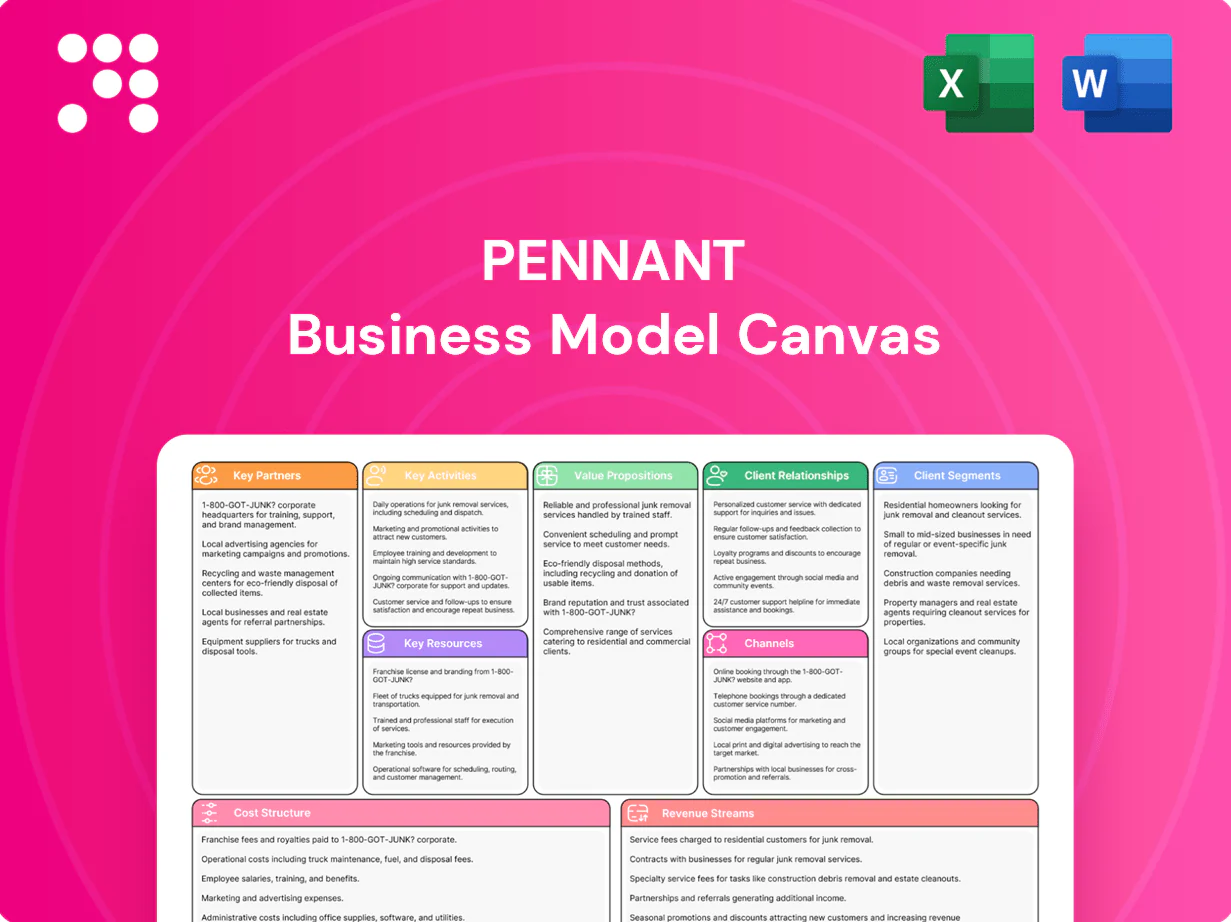
Pennant Business Model Canvas

Unlock the strategic playbook: 3-page Business Model Canvas for investors and founders
Unlock Pennant’s strategic playbook with the full Business Model Canvas—three pages of concise, company-specific insights that show how value is created, scaled, and monetized. Perfect for investors, founders, and analysts seeking actionable clarity. Download the editable Word and Excel files to benchmark, adapt, and execute faster.
Partnerships

Hospital and physician referral networks
Partner with hospitals, primary care practices, and specialists—among roughly 6,100 US hospitals—to drive home health and hospice referrals and capture transitions of care. Establish preferred provider status by demonstrating superior outcomes, low 30-day readmission rates and rapid responsiveness. Hold regular case conferences and discharge planning touchpoints to streamline handoffs. Align incentives with value-based care as Medicare Advantage penetration exceeded 50% in 2024.
Payers and risk-bearing entities
Collaborate with Medicare Advantage plans, ACOs, and managed Medicaid for in‑network access and bundled arrangements. Negotiate rates tied to quality and utilization, leveraging MA growth—about 50% of Medicare beneficiaries (~31 million in 2024) and ACOs covering >12 million. Share claims and clinical data to support risk adjustment and care coordination, with managed Medicaid covering >70% of enrollees. Pilot value‑based contracts in underserved markets to test downside risk.

Technology and EMR vendors
Work with home health and senior living EMR providers for clinical documentation, scheduling, and analytics, aligning modules to field workflows and KPI dashboards. Integrate telehealth, remote monitoring, and eMAR tools to cut readmissions and medication errors. Ensure interoperability with hospital systems—95% of US hospitals use EHRs—so transitions are smoother. Co-develop workflows that boost field productivity and reduce visit documentation time.

Workforce, education, and staffing partners
Build pipelines with nursing schools, therapy programs, and CNA training centers to tap a 2024 talent pool pressure point; use contingent staffing agencies to buffer demand spikes and reduce vacancy costs by up to 30% per industry reports; offer accredited continuing education (CE) to retain staff; standardize competencies while preserving local autonomy to adapt care models.
- Partner count: prioritize top regional schools
- Contingent buffer: deploy 10–20% flex staff
- CE: accredited credits annually
- Competency: core standardized modules, local electives
Real estate, facilities, and community organizations
Partner with REITs, developers, and maintenance vendors to scale access to senior living assets across the roughly 1.1 million US senior housing units (NIC 2024), while engaging nonprofits, faith-based groups, and veteran services for targeted community support and referrals. Coordinate transportation and social services to address SDoH, and leverage local alliances to enter underserved geographies with lower supply and higher demand.
- REITs/developers: scale access to 1.1M units (NIC 2024)
- Nonprofits/faith-based: referral and wraparound support
- Veteran services: targeted outreach
- Transport/social services: mitigate SDoH
- Local alliances: enter underserved markets
Partner with hospitals, MA plans, ACOs and EHRs to cut vacancy costs up to 30%
Partner with ~6,100 US hospitals, MA plans (~31M beneficiaries in 2024), ACOs (>12M covered), REITs (1.1M senior housing units) and EMR/telehealth vendors to secure referrals, in‑network access, interoperability (95% hospital EHR adoption) and bundled value contracts. Use 10–20% contingent staffing to reduce vacancy costs up to 30% and co-develop workflows and CE to improve outcomes and lower 30‑day readmissions.
| Partner | Key metric |
|---|---|
| Hospitals | ~6,100 |
| Medicare Advantage | ~31M benes (2024) |
| ACOs | >12M covered |
| Senior housing | 1.1M units |
| EHR adoption | 95% |
What is included in the product
 Detailed Word Document
A comprehensive, pre-written business model tailored to Pennant’s strategy, organized into the 9 BMC blocks with full narratives and actionable insights. Includes customer segments, channels, value propositions, competitive-advantage analysis, linked SWOT, and a polished design for presentations, investor pitches, and informed decision-making.

 Customizable Excel Spreadsheet
High-level view of your business with editable cells that condense strategy into a digestible one-page snapshot, saving hours of formatting and simplifying team collaboration.
Activities

Skilled home health and hospice care delivery
Provide nursing, therapy, aide and palliative services at home to address rising demand—CMS reported about 3.5 million Medicare home health users in 2022 and NHPCO reported ~1.7 million hospice users in 2022. Focus on symptom control, medication reconciliation (reducing adverse drug events by ~30%) and individualized care plans. Ensure timely visits, interdisciplinary coordination and documentation that meets payer and regulatory standards.
Senior living operations and resident services
Operate assisted living and memory care communities with 24/7 clinical and concierge support, delivering ADL assistance, wellness programs, and medication management that aim to reduce hospital readmissions; target occupancy optimization (industry-average assisted living occupancy ~81% in 2024) and refine resident acuity mix to maximize revenue per unit; maintain life-safety protocols and state licensure compliance at all sites.

Referral management and intake
Coordinate intake, eligibility checks, and authorizations with a goal of 24-hour authorization turnaround; liaise with discharge planners to enable rapid start-of-care and reduce time-to-admission by ~30% (e.g., from 48 to 34 hours). Standardize triage and scheduling to shorten delays and improve patient flow. Track conversion rates (target 45%) and analyze referral-source performance weekly to optimize channel ROI.

Quality assurance, compliance, and outcomes improvement
Monitor clinical KPIs (rehospitalizations, visit timeliness, CAHPS), run audits, peer reviews and corrective actions, and prepare for surveys and accreditation; apply continuous improvement to lift star ratings and HEDIS outcomes through targeted interventions and staff training.
- KPIs tracked: rehospitalizations, timeliness, CAHPS
- Processes: audits, peer review, corrective action
- Preparedness: surveys & accreditation
- Goal: improve star ratings & HEDIS
Local leadership development and market expansion
Empower administrators and directors under a decentralized model to drive local growth, aligning with US market reach of about 339 million people (2024 est). Launch de novo agencies or tuck-in acquisitions in targeted MSAs, tailoring services to community needs and aiming for unit-level profitability. Share best practices via lightweight central support to scale efficient operations and improve time-to-market.
- Decentralized leadership
- De novo and tuck-in expansion
- Community-customized services
- Lightweight central playbook
24h intake, 45% conversion, reduce readmissions
Deliver home health, hospice, assisted living and memory care with timely interdisciplinary visits, med reconciliation and palliative focus to reduce readmissions. Standardize intake/authorization to hit 24-hour turnaround and 45% conversion, optimize occupancy and acuity mix for unit-level profitability. Run KPI-driven QA (rehospitalizations, timeliness, CAHPS), audits and decentralized ops with central playbook.
| Activity | KPI | 2022/2024 |
|---|---|---|
| Home health/hospice | Users | Medicare HH 3.5M (2022); hospice 1.7M (2022) |
| Assisted living | Occupancy | 81% (2024 avg) |
| Intake | Auth turnaround | 24h target; −30% time-to-admit |
What You See Is What You Get
Business Model Canvas
The Pennant Business Model Canvas shown here is a true preview of the exact deliverable you’ll receive—this is not a mockup. After purchase you’ll download the same fully formatted, editable file (Word and Excel) with all sections included and ready for immediate use. No surprises, just the real document.

Unlock the strategic playbook: 3-page Business Model Canvas for investors and founders
Unlock Pennant’s strategic playbook with the full Business Model Canvas—three pages of concise, company-specific insights that show how value is created, scaled, and monetized. Perfect for investors, founders, and analysts seeking actionable clarity. Download the editable Word and Excel files to benchmark, adapt, and execute faster.
Partnerships
Hospital and physician referral networks
Partner with hospitals, primary care practices, and specialists—among roughly 6,100 US hospitals—to drive home health and hospice referrals and capture transitions of care. Establish preferred provider status by demonstrating superior outcomes, low 30-day readmission rates and rapid responsiveness. Hold regular case conferences and discharge planning touchpoints to streamline handoffs. Align incentives with value-based care as Medicare Advantage penetration exceeded 50% in 2024.
Payers and risk-bearing entities
Collaborate with Medicare Advantage plans, ACOs, and managed Medicaid for in‑network access and bundled arrangements. Negotiate rates tied to quality and utilization, leveraging MA growth—about 50% of Medicare beneficiaries (~31 million in 2024) and ACOs covering >12 million. Share claims and clinical data to support risk adjustment and care coordination, with managed Medicaid covering >70% of enrollees. Pilot value‑based contracts in underserved markets to test downside risk.
Technology and EMR vendors
Work with home health and senior living EMR providers for clinical documentation, scheduling, and analytics, aligning modules to field workflows and KPI dashboards. Integrate telehealth, remote monitoring, and eMAR tools to cut readmissions and medication errors. Ensure interoperability with hospital systems—95% of US hospitals use EHRs—so transitions are smoother. Co-develop workflows that boost field productivity and reduce visit documentation time.
Workforce, education, and staffing partners
Build pipelines with nursing schools, therapy programs, and CNA training centers to tap a 2024 talent pool pressure point; use contingent staffing agencies to buffer demand spikes and reduce vacancy costs by up to 30% per industry reports; offer accredited continuing education (CE) to retain staff; standardize competencies while preserving local autonomy to adapt care models.
- Partner count: prioritize top regional schools
- Contingent buffer: deploy 10–20% flex staff
- CE: accredited credits annually
- Competency: core standardized modules, local electives
Real estate, facilities, and community organizations
Partner with REITs, developers, and maintenance vendors to scale access to senior living assets across the roughly 1.1 million US senior housing units (NIC 2024), while engaging nonprofits, faith-based groups, and veteran services for targeted community support and referrals. Coordinate transportation and social services to address SDoH, and leverage local alliances to enter underserved geographies with lower supply and higher demand.
- REITs/developers: scale access to 1.1M units (NIC 2024)
- Nonprofits/faith-based: referral and wraparound support
- Veteran services: targeted outreach
- Transport/social services: mitigate SDoH
- Local alliances: enter underserved markets
Partner with hospitals, MA plans, ACOs and EHRs to cut vacancy costs up to 30%
Partner with ~6,100 US hospitals, MA plans (~31M beneficiaries in 2024), ACOs (>12M covered), REITs (1.1M senior housing units) and EMR/telehealth vendors to secure referrals, in‑network access, interoperability (95% hospital EHR adoption) and bundled value contracts. Use 10–20% contingent staffing to reduce vacancy costs up to 30% and co-develop workflows and CE to improve outcomes and lower 30‑day readmissions.
| Partner | Key metric |
|---|---|
| Hospitals | ~6,100 |
| Medicare Advantage | ~31M benes (2024) |
| ACOs | >12M covered |
| Senior housing | 1.1M units |
| EHR adoption | 95% |
What is included in the product
Detailed Word Document
A comprehensive, pre-written business model tailored to Pennant’s strategy, organized into the 9 BMC blocks with full narratives and actionable insights. Includes customer segments, channels, value propositions, competitive-advantage analysis, linked SWOT, and a polished design for presentations, investor pitches, and informed decision-making.
Customizable Excel Spreadsheet
High-level view of your business with editable cells that condense strategy into a digestible one-page snapshot, saving hours of formatting and simplifying team collaboration.
Activities
Skilled home health and hospice care delivery
Provide nursing, therapy, aide and palliative services at home to address rising demand—CMS reported about 3.5 million Medicare home health users in 2022 and NHPCO reported ~1.7 million hospice users in 2022. Focus on symptom control, medication reconciliation (reducing adverse drug events by ~30%) and individualized care plans. Ensure timely visits, interdisciplinary coordination and documentation that meets payer and regulatory standards.
Senior living operations and resident services
Operate assisted living and memory care communities with 24/7 clinical and concierge support, delivering ADL assistance, wellness programs, and medication management that aim to reduce hospital readmissions; target occupancy optimization (industry-average assisted living occupancy ~81% in 2024) and refine resident acuity mix to maximize revenue per unit; maintain life-safety protocols and state licensure compliance at all sites.
Referral management and intake
Coordinate intake, eligibility checks, and authorizations with a goal of 24-hour authorization turnaround; liaise with discharge planners to enable rapid start-of-care and reduce time-to-admission by ~30% (e.g., from 48 to 34 hours). Standardize triage and scheduling to shorten delays and improve patient flow. Track conversion rates (target 45%) and analyze referral-source performance weekly to optimize channel ROI.
Quality assurance, compliance, and outcomes improvement
Monitor clinical KPIs (rehospitalizations, visit timeliness, CAHPS), run audits, peer reviews and corrective actions, and prepare for surveys and accreditation; apply continuous improvement to lift star ratings and HEDIS outcomes through targeted interventions and staff training.
- KPIs tracked: rehospitalizations, timeliness, CAHPS
- Processes: audits, peer review, corrective action
- Preparedness: surveys & accreditation
- Goal: improve star ratings & HEDIS
Local leadership development and market expansion
Empower administrators and directors under a decentralized model to drive local growth, aligning with US market reach of about 339 million people (2024 est). Launch de novo agencies or tuck-in acquisitions in targeted MSAs, tailoring services to community needs and aiming for unit-level profitability. Share best practices via lightweight central support to scale efficient operations and improve time-to-market.
- Decentralized leadership
- De novo and tuck-in expansion
- Community-customized services
- Lightweight central playbook
24h intake, 45% conversion, reduce readmissions
Deliver home health, hospice, assisted living and memory care with timely interdisciplinary visits, med reconciliation and palliative focus to reduce readmissions. Standardize intake/authorization to hit 24-hour turnaround and 45% conversion, optimize occupancy and acuity mix for unit-level profitability. Run KPI-driven QA (rehospitalizations, timeliness, CAHPS), audits and decentralized ops with central playbook.
| Activity | KPI | 2022/2024 |
|---|---|---|
| Home health/hospice | Users | Medicare HH 3.5M (2022); hospice 1.7M (2022) |
| Assisted living | Occupancy | 81% (2024 avg) |
| Intake | Auth turnaround | 24h target; −30% time-to-admit |
What You See Is What You Get
Business Model Canvas
The Pennant Business Model Canvas shown here is a true preview of the exact deliverable you’ll receive—this is not a mockup. After purchase you’ll download the same fully formatted, editable file (Word and Excel) with all sections included and ready for immediate use. No surprises, just the real document.
Original: $10.00
-65%$10.00
$3.50Description
Unlock the strategic playbook: 3-page Business Model Canvas for investors and founders
Unlock Pennant’s strategic playbook with the full Business Model Canvas—three pages of concise, company-specific insights that show how value is created, scaled, and monetized. Perfect for investors, founders, and analysts seeking actionable clarity. Download the editable Word and Excel files to benchmark, adapt, and execute faster.
Partnerships
Hospital and physician referral networks
Partner with hospitals, primary care practices, and specialists—among roughly 6,100 US hospitals—to drive home health and hospice referrals and capture transitions of care. Establish preferred provider status by demonstrating superior outcomes, low 30-day readmission rates and rapid responsiveness. Hold regular case conferences and discharge planning touchpoints to streamline handoffs. Align incentives with value-based care as Medicare Advantage penetration exceeded 50% in 2024.
Payers and risk-bearing entities
Collaborate with Medicare Advantage plans, ACOs, and managed Medicaid for in‑network access and bundled arrangements. Negotiate rates tied to quality and utilization, leveraging MA growth—about 50% of Medicare beneficiaries (~31 million in 2024) and ACOs covering >12 million. Share claims and clinical data to support risk adjustment and care coordination, with managed Medicaid covering >70% of enrollees. Pilot value‑based contracts in underserved markets to test downside risk.
Technology and EMR vendors
Work with home health and senior living EMR providers for clinical documentation, scheduling, and analytics, aligning modules to field workflows and KPI dashboards. Integrate telehealth, remote monitoring, and eMAR tools to cut readmissions and medication errors. Ensure interoperability with hospital systems—95% of US hospitals use EHRs—so transitions are smoother. Co-develop workflows that boost field productivity and reduce visit documentation time.
Workforce, education, and staffing partners
Build pipelines with nursing schools, therapy programs, and CNA training centers to tap a 2024 talent pool pressure point; use contingent staffing agencies to buffer demand spikes and reduce vacancy costs by up to 30% per industry reports; offer accredited continuing education (CE) to retain staff; standardize competencies while preserving local autonomy to adapt care models.
- Partner count: prioritize top regional schools
- Contingent buffer: deploy 10–20% flex staff
- CE: accredited credits annually
- Competency: core standardized modules, local electives
Real estate, facilities, and community organizations
Partner with REITs, developers, and maintenance vendors to scale access to senior living assets across the roughly 1.1 million US senior housing units (NIC 2024), while engaging nonprofits, faith-based groups, and veteran services for targeted community support and referrals. Coordinate transportation and social services to address SDoH, and leverage local alliances to enter underserved geographies with lower supply and higher demand.
- REITs/developers: scale access to 1.1M units (NIC 2024)
- Nonprofits/faith-based: referral and wraparound support
- Veteran services: targeted outreach
- Transport/social services: mitigate SDoH
- Local alliances: enter underserved markets
Partner with hospitals, MA plans, ACOs and EHRs to cut vacancy costs up to 30%
Partner with ~6,100 US hospitals, MA plans (~31M beneficiaries in 2024), ACOs (>12M covered), REITs (1.1M senior housing units) and EMR/telehealth vendors to secure referrals, in‑network access, interoperability (95% hospital EHR adoption) and bundled value contracts. Use 10–20% contingent staffing to reduce vacancy costs up to 30% and co-develop workflows and CE to improve outcomes and lower 30‑day readmissions.
| Partner | Key metric |
|---|---|
| Hospitals | ~6,100 |
| Medicare Advantage | ~31M benes (2024) |
| ACOs | >12M covered |
| Senior housing | 1.1M units |
| EHR adoption | 95% |
What is included in the product
Detailed Word Document
A comprehensive, pre-written business model tailored to Pennant’s strategy, organized into the 9 BMC blocks with full narratives and actionable insights. Includes customer segments, channels, value propositions, competitive-advantage analysis, linked SWOT, and a polished design for presentations, investor pitches, and informed decision-making.
Customizable Excel Spreadsheet
High-level view of your business with editable cells that condense strategy into a digestible one-page snapshot, saving hours of formatting and simplifying team collaboration.
Activities
Skilled home health and hospice care delivery
Provide nursing, therapy, aide and palliative services at home to address rising demand—CMS reported about 3.5 million Medicare home health users in 2022 and NHPCO reported ~1.7 million hospice users in 2022. Focus on symptom control, medication reconciliation (reducing adverse drug events by ~30%) and individualized care plans. Ensure timely visits, interdisciplinary coordination and documentation that meets payer and regulatory standards.
Senior living operations and resident services
Operate assisted living and memory care communities with 24/7 clinical and concierge support, delivering ADL assistance, wellness programs, and medication management that aim to reduce hospital readmissions; target occupancy optimization (industry-average assisted living occupancy ~81% in 2024) and refine resident acuity mix to maximize revenue per unit; maintain life-safety protocols and state licensure compliance at all sites.
Referral management and intake
Coordinate intake, eligibility checks, and authorizations with a goal of 24-hour authorization turnaround; liaise with discharge planners to enable rapid start-of-care and reduce time-to-admission by ~30% (e.g., from 48 to 34 hours). Standardize triage and scheduling to shorten delays and improve patient flow. Track conversion rates (target 45%) and analyze referral-source performance weekly to optimize channel ROI.
Quality assurance, compliance, and outcomes improvement
Monitor clinical KPIs (rehospitalizations, visit timeliness, CAHPS), run audits, peer reviews and corrective actions, and prepare for surveys and accreditation; apply continuous improvement to lift star ratings and HEDIS outcomes through targeted interventions and staff training.
- KPIs tracked: rehospitalizations, timeliness, CAHPS
- Processes: audits, peer review, corrective action
- Preparedness: surveys & accreditation
- Goal: improve star ratings & HEDIS
Local leadership development and market expansion
Empower administrators and directors under a decentralized model to drive local growth, aligning with US market reach of about 339 million people (2024 est). Launch de novo agencies or tuck-in acquisitions in targeted MSAs, tailoring services to community needs and aiming for unit-level profitability. Share best practices via lightweight central support to scale efficient operations and improve time-to-market.
- Decentralized leadership
- De novo and tuck-in expansion
- Community-customized services
- Lightweight central playbook
24h intake, 45% conversion, reduce readmissions
Deliver home health, hospice, assisted living and memory care with timely interdisciplinary visits, med reconciliation and palliative focus to reduce readmissions. Standardize intake/authorization to hit 24-hour turnaround and 45% conversion, optimize occupancy and acuity mix for unit-level profitability. Run KPI-driven QA (rehospitalizations, timeliness, CAHPS), audits and decentralized ops with central playbook.
| Activity | KPI | 2022/2024 |
|---|---|---|
| Home health/hospice | Users | Medicare HH 3.5M (2022); hospice 1.7M (2022) |
| Assisted living | Occupancy | 81% (2024 avg) |
| Intake | Auth turnaround | 24h target; −30% time-to-admit |
What You See Is What You Get
Business Model Canvas
The Pennant Business Model Canvas shown here is a true preview of the exact deliverable you’ll receive—this is not a mockup. After purchase you’ll download the same fully formatted, editable file (Word and Excel) with all sections included and ready for immediate use. No surprises, just the real document.











