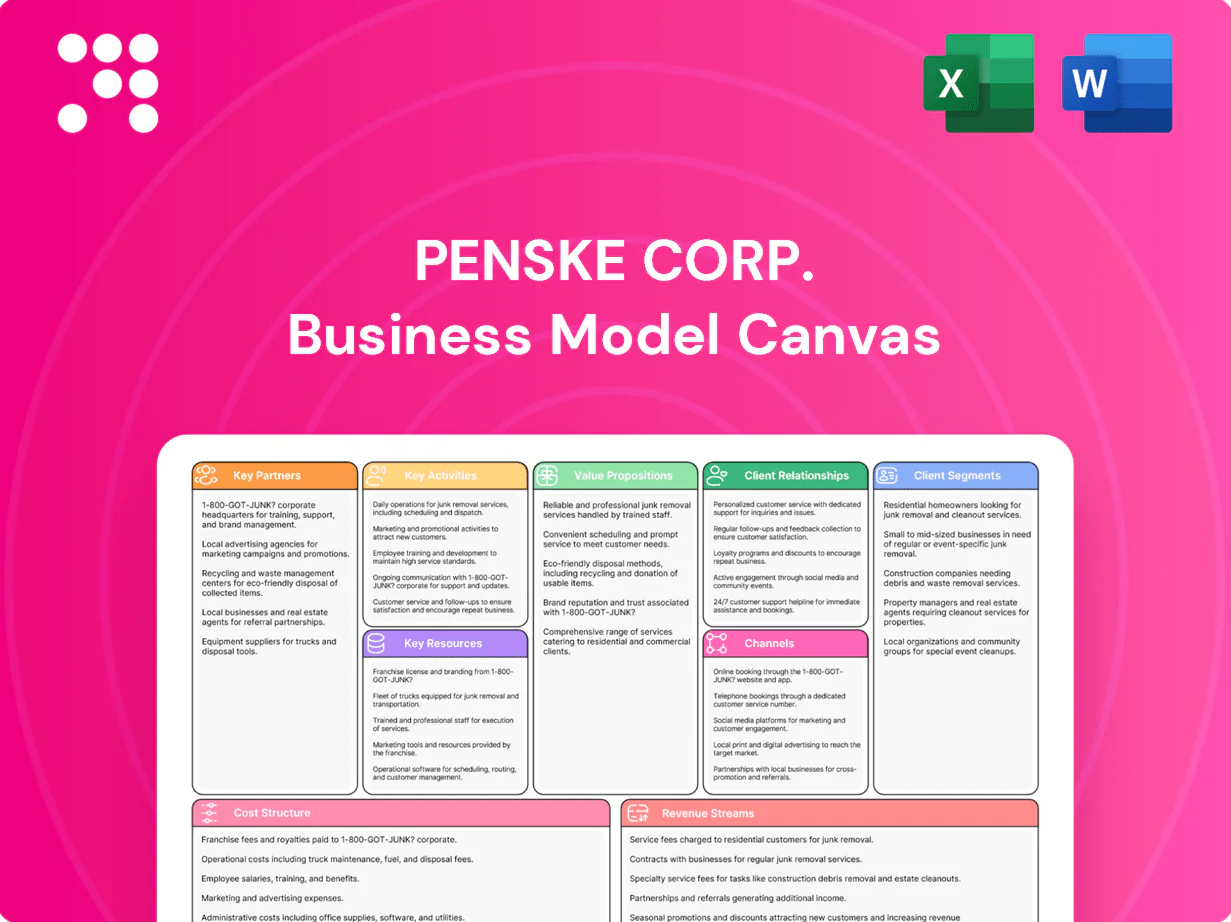
Penske Corp. Business Model Canvas

Unlock the Business Model Canvas: value drivers, partnerships, revenue, growth levers
Unlock the strategic blueprint behind Penske Corp.'s Business Model Canvas. This concise preview highlights value propositions, key partnerships, revenue streams and operational levers that drive scale and resilience. Buy the full downloadable Canvas (Word & Excel) for a section-by-section breakdown, financial implications and actionable insights for investors, consultants and founders.
Partnerships

OEM & Fleet Vehicle Suppliers
Partnerships with OEMs such as Daimler and PACCAR secure Penske’s vehicle supply, specs and negotiated pricing, supporting a commercial fleet exceeding 300,000 vehicles as of 2024. Co-development on maintenance protocols and telematics (real‑time diagnostics, predictive alerts) improves uptime and lowers service costs. Joint marketing, warranty backing and lifecycle data sharing boost customer confidence and resale values. These ties stabilize costs and availability across leasing, rental and retail.
Technology & Telematics Providers
Penske partners with telematics, routing, and TMS vendors to power connected fleet services, integrating data across more than 250,000 assets to enable predictive maintenance, fuel optimization, and compliance. Data-driven workflows have reduced maintenance downtime by up to 15% and improved fuel efficiency around 6% in 2024 pilot programs. APIs link logistics control towers with customer ERPs and WMS, accelerating digital differentiation and scalable service delivery.

Finance & Insurance Institutions
Banking and captive-like financing partners underwrite Penske leases, floorplan and customer credit, tapping into a US auto loan market of about $1.6 trillion in 2024 to ensure liquidity. Insurance partners provide bundled coverage and fleet risk solutions, lowering loss exposure for operators and buyers. Structured finance reduces capital intensity and improves asset turns, enabling competitive pricing and flexible terms.

Carrier & 3PL/4PL Networks
Alliances with carriers expand capacity for dedicated and brokerage operations, enabling Penske to scale lanes quickly. 3PL/4PL collaborations extend modal options and geographic reach, aligning with a global 3PL market ~ $1.1T in 2024. SLAs and performance dashboards enforce real-time KPIs for >95% on-time targets and service consistency. This network elasticity absorbs seasonal peaks and disruptions.
- Capacity scaling via carrier alliances
- Modal/geographic extension through 3PL/4PL
- SLA-driven dashboards for consistent KPIs
- Elastic network absorbs seasonality
Dealers, Aftermarket & Service Vendors
Dealers, aftermarket parts suppliers, tire manufacturers and service subcontractors enable Penske Corp to sustain rapid maintenance cycles and high uptime across its fleets; dealer networks also handle retail inventory and warranty work while national accounts secure volume discounts and priority service for large corporate clients.
- Parts suppliers: fast replenishment, warranty support
- Tire partners: fleet pricing, expedited replacement
- Service subcontractors: scalable maintenance capacity
- Dealers: retail throughput, warranty fulfillment
OEM alliances secure >300,000 vehicles; telematics on ~250,000 cut downtime ~15%, fuel ~6%
Penske’s OEM alliances secure supply for a commercial fleet >300,000 vehicles (2024), co-develop telematics and specs to lower service cost. Telematics/TMS integrations across ~250,000 assets cut downtime ~15% and improve fuel use ~6% in 2024 pilots. Financing and insurance partners tap a US auto loan market ~$1.6T and support flexible leasing; 3PL/4PL ties expand reach in a ~$1.1T market with >95% OTIF.
| Metric | 2024 Value |
|---|---|
| Fleet size | >300,000 vehicles |
| Connected assets | ~250,000 |
| Downtime reduction | ~15% |
| Fuel efficiency gain | ~6% |
| US auto loan market | ~$1.6T |
| Global 3PL market | ~$1.1T |
| OTIF target | >95% |
What is included in the product
 Detailed Word Document
A comprehensive Business Model Canvas for Penske Corporation detailing customer segments, channels, value propositions, revenue streams, key resources, partners, activities, cost structure and customer relationships aligned to its transportation, logistics, truck leasing, and retail operations. Ideal for presentations and funding discussions, it reflects real-world strategy, competitive advantages, and linked SWOT insights to support investor and management decision-making.

 Customizable Excel Spreadsheet
High-level view of Penske Corp’s business model with editable cells — accelerates strategic alignment across fleet services, logistics, and retail by surfacing revenue drivers, cost levers, and partnership opportunities for faster decision-making.
Activities

Full-Service Leasing & Rental Ops
Full-service leasing and rental ops spec, acquire, and rotate trucks and tractors to match duty cycles, managing leases, rentals, maintenance, and 24/7 roadside assistance to maximize uptime. Penske manages roughly 450,000 vehicles (2024), enabling scale in asset remarketing to optimize residuals. Continuous fleet right-sizing for customers reduces cost-per-mile and aligns capacity with seasonal demand.
Logistics & Supply Chain Execution
Designing and running dedicated transportation, warehousing, and distribution networks enables Penske to tailor capacity and service to customer SLAs. Control-tower planning and routing provide real-time visibility and exception management across multimodal lanes. Continuous improvement leverages lean methodologies and data analytics to reduce dwell times and optimize routing. Seasonal capacity planning aligns assets and labor to peak demand cycles.

Automotive Retail & Aftersales
Penske’s automotive retail & aftersales sells new and used vehicles across ~670 retail franchises in multiple geographies (2024), while F&I, service, parts and collision—which industry data show deliver over 50% of dealership gross profit—drive lifetime value. Digital retailing and omnichannel journeys increase conversion and lead velocity, and inventory, dynamic pricing and trade-in optimization improve gross per unit and turnover.

Fleet Maintenance & Asset Management
Penske runs preventive and corrective maintenance across a nationwide shop network, integrating telematics-driven diagnostics for predictive repairs to minimize downtime and optimize uptime. Centralized parts sourcing and warranty recovery streamline costs and improve service margins while lifecycle planning, residual risk assessment and strategic disposition maximize asset returns. Operations tie maintenance KPIs to utilization and total cost of ownership.
- preventive maintenance
- telematics diagnostics & predictive repairs
- parts sourcing & warranty recovery
- lifecycle planning, residual risk, disposition
Technology & Data Enablement
Penske integrates telematics, TMS/WMS and customer systems to power analytics for route, fuel and capacity optimization, achieving industry fuel savings up to 15% and route-mile reductions up to 20% (2024 studies). It delivers customer portals, mobile apps and e-commerce for real-time booking, tracking and load orchestration. Cybersecurity, compliance and data governance are prioritized, with average breach cost cited at $4.45M (IBM 2023).
- Integrations: telematics, TMS/WMS, customer APIs
- Analytics: route/fuel/capacity optimization (≤15% fuel, ≤20% miles)
- Digital touchpoints: portals, mobile apps, e-commerce
- Security & governance: compliance, data protection (avg breach cost $4.45M)
~450,000 vehicles, ≤15% fuel savings via full-service fleet
Penske operates full-service leasing/rental, dedicated transport, retail & aftersales and nationwide maintenance, managing ~450,000 vehicles (2024) across ~670 franchises (2024) to optimize uptime, residuals and TCO. Telematics, TMS/WMS integrations and analytics drive ≤15% fuel and ≤20% route-mile savings while digital channels and parts/warranty recovery boost margins.
| Metric | 2024 |
|---|---|
| Fleet size | ~450,000 |
| Franchises | ~670 |
| Fuel savings | ≤15% |
| Route miles | ≤20% reduction |
What You See Is What You Get
Business Model Canvas
The Penske Corporation Business Model Canvas shown here outlines key partners, core activities, value propositions, customer segments and revenue streams in a clear, editable layout. This preview is the exact, unabridged document you will receive upon purchase. After ordering you'll download the same ready-to-use file in Word and Excel formats.

Unlock the Business Model Canvas: value drivers, partnerships, revenue, growth levers
Unlock the strategic blueprint behind Penske Corp.'s Business Model Canvas. This concise preview highlights value propositions, key partnerships, revenue streams and operational levers that drive scale and resilience. Buy the full downloadable Canvas (Word & Excel) for a section-by-section breakdown, financial implications and actionable insights for investors, consultants and founders.
Partnerships
OEM & Fleet Vehicle Suppliers
Partnerships with OEMs such as Daimler and PACCAR secure Penske’s vehicle supply, specs and negotiated pricing, supporting a commercial fleet exceeding 300,000 vehicles as of 2024. Co-development on maintenance protocols and telematics (real‑time diagnostics, predictive alerts) improves uptime and lowers service costs. Joint marketing, warranty backing and lifecycle data sharing boost customer confidence and resale values. These ties stabilize costs and availability across leasing, rental and retail.
Technology & Telematics Providers
Penske partners with telematics, routing, and TMS vendors to power connected fleet services, integrating data across more than 250,000 assets to enable predictive maintenance, fuel optimization, and compliance. Data-driven workflows have reduced maintenance downtime by up to 15% and improved fuel efficiency around 6% in 2024 pilot programs. APIs link logistics control towers with customer ERPs and WMS, accelerating digital differentiation and scalable service delivery.
Finance & Insurance Institutions
Banking and captive-like financing partners underwrite Penske leases, floorplan and customer credit, tapping into a US auto loan market of about $1.6 trillion in 2024 to ensure liquidity. Insurance partners provide bundled coverage and fleet risk solutions, lowering loss exposure for operators and buyers. Structured finance reduces capital intensity and improves asset turns, enabling competitive pricing and flexible terms.
Carrier & 3PL/4PL Networks
Alliances with carriers expand capacity for dedicated and brokerage operations, enabling Penske to scale lanes quickly. 3PL/4PL collaborations extend modal options and geographic reach, aligning with a global 3PL market ~ $1.1T in 2024. SLAs and performance dashboards enforce real-time KPIs for >95% on-time targets and service consistency. This network elasticity absorbs seasonal peaks and disruptions.
- Capacity scaling via carrier alliances
- Modal/geographic extension through 3PL/4PL
- SLA-driven dashboards for consistent KPIs
- Elastic network absorbs seasonality
Dealers, Aftermarket & Service Vendors
Dealers, aftermarket parts suppliers, tire manufacturers and service subcontractors enable Penske Corp to sustain rapid maintenance cycles and high uptime across its fleets; dealer networks also handle retail inventory and warranty work while national accounts secure volume discounts and priority service for large corporate clients.
- Parts suppliers: fast replenishment, warranty support
- Tire partners: fleet pricing, expedited replacement
- Service subcontractors: scalable maintenance capacity
- Dealers: retail throughput, warranty fulfillment
OEM alliances secure >300,000 vehicles; telematics on ~250,000 cut downtime ~15%, fuel ~6%
Penske’s OEM alliances secure supply for a commercial fleet >300,000 vehicles (2024), co-develop telematics and specs to lower service cost. Telematics/TMS integrations across ~250,000 assets cut downtime ~15% and improve fuel use ~6% in 2024 pilots. Financing and insurance partners tap a US auto loan market ~$1.6T and support flexible leasing; 3PL/4PL ties expand reach in a ~$1.1T market with >95% OTIF.
| Metric | 2024 Value |
|---|---|
| Fleet size | >300,000 vehicles |
| Connected assets | ~250,000 |
| Downtime reduction | ~15% |
| Fuel efficiency gain | ~6% |
| US auto loan market | ~$1.6T |
| Global 3PL market | ~$1.1T |
| OTIF target | >95% |
What is included in the product
Detailed Word Document
A comprehensive Business Model Canvas for Penske Corporation detailing customer segments, channels, value propositions, revenue streams, key resources, partners, activities, cost structure and customer relationships aligned to its transportation, logistics, truck leasing, and retail operations. Ideal for presentations and funding discussions, it reflects real-world strategy, competitive advantages, and linked SWOT insights to support investor and management decision-making.
Customizable Excel Spreadsheet
High-level view of Penske Corp’s business model with editable cells — accelerates strategic alignment across fleet services, logistics, and retail by surfacing revenue drivers, cost levers, and partnership opportunities for faster decision-making.
Activities
Full-Service Leasing & Rental Ops
Full-service leasing and rental ops spec, acquire, and rotate trucks and tractors to match duty cycles, managing leases, rentals, maintenance, and 24/7 roadside assistance to maximize uptime. Penske manages roughly 450,000 vehicles (2024), enabling scale in asset remarketing to optimize residuals. Continuous fleet right-sizing for customers reduces cost-per-mile and aligns capacity with seasonal demand.
Logistics & Supply Chain Execution
Designing and running dedicated transportation, warehousing, and distribution networks enables Penske to tailor capacity and service to customer SLAs. Control-tower planning and routing provide real-time visibility and exception management across multimodal lanes. Continuous improvement leverages lean methodologies and data analytics to reduce dwell times and optimize routing. Seasonal capacity planning aligns assets and labor to peak demand cycles.
Automotive Retail & Aftersales
Penske’s automotive retail & aftersales sells new and used vehicles across ~670 retail franchises in multiple geographies (2024), while F&I, service, parts and collision—which industry data show deliver over 50% of dealership gross profit—drive lifetime value. Digital retailing and omnichannel journeys increase conversion and lead velocity, and inventory, dynamic pricing and trade-in optimization improve gross per unit and turnover.
Fleet Maintenance & Asset Management
Penske runs preventive and corrective maintenance across a nationwide shop network, integrating telematics-driven diagnostics for predictive repairs to minimize downtime and optimize uptime. Centralized parts sourcing and warranty recovery streamline costs and improve service margins while lifecycle planning, residual risk assessment and strategic disposition maximize asset returns. Operations tie maintenance KPIs to utilization and total cost of ownership.
- preventive maintenance
- telematics diagnostics & predictive repairs
- parts sourcing & warranty recovery
- lifecycle planning, residual risk, disposition
Technology & Data Enablement
Penske integrates telematics, TMS/WMS and customer systems to power analytics for route, fuel and capacity optimization, achieving industry fuel savings up to 15% and route-mile reductions up to 20% (2024 studies). It delivers customer portals, mobile apps and e-commerce for real-time booking, tracking and load orchestration. Cybersecurity, compliance and data governance are prioritized, with average breach cost cited at $4.45M (IBM 2023).
- Integrations: telematics, TMS/WMS, customer APIs
- Analytics: route/fuel/capacity optimization (≤15% fuel, ≤20% miles)
- Digital touchpoints: portals, mobile apps, e-commerce
- Security & governance: compliance, data protection (avg breach cost $4.45M)
~450,000 vehicles, ≤15% fuel savings via full-service fleet
Penske operates full-service leasing/rental, dedicated transport, retail & aftersales and nationwide maintenance, managing ~450,000 vehicles (2024) across ~670 franchises (2024) to optimize uptime, residuals and TCO. Telematics, TMS/WMS integrations and analytics drive ≤15% fuel and ≤20% route-mile savings while digital channels and parts/warranty recovery boost margins.
| Metric | 2024 |
|---|---|
| Fleet size | ~450,000 |
| Franchises | ~670 |
| Fuel savings | ≤15% |
| Route miles | ≤20% reduction |
What You See Is What You Get
Business Model Canvas
The Penske Corporation Business Model Canvas shown here outlines key partners, core activities, value propositions, customer segments and revenue streams in a clear, editable layout. This preview is the exact, unabridged document you will receive upon purchase. After ordering you'll download the same ready-to-use file in Word and Excel formats.
Original: $10.00
-65%$10.00
$3.50Description
Unlock the Business Model Canvas: value drivers, partnerships, revenue, growth levers
Unlock the strategic blueprint behind Penske Corp.'s Business Model Canvas. This concise preview highlights value propositions, key partnerships, revenue streams and operational levers that drive scale and resilience. Buy the full downloadable Canvas (Word & Excel) for a section-by-section breakdown, financial implications and actionable insights for investors, consultants and founders.
Partnerships
OEM & Fleet Vehicle Suppliers
Partnerships with OEMs such as Daimler and PACCAR secure Penske’s vehicle supply, specs and negotiated pricing, supporting a commercial fleet exceeding 300,000 vehicles as of 2024. Co-development on maintenance protocols and telematics (real‑time diagnostics, predictive alerts) improves uptime and lowers service costs. Joint marketing, warranty backing and lifecycle data sharing boost customer confidence and resale values. These ties stabilize costs and availability across leasing, rental and retail.
Technology & Telematics Providers
Penske partners with telematics, routing, and TMS vendors to power connected fleet services, integrating data across more than 250,000 assets to enable predictive maintenance, fuel optimization, and compliance. Data-driven workflows have reduced maintenance downtime by up to 15% and improved fuel efficiency around 6% in 2024 pilot programs. APIs link logistics control towers with customer ERPs and WMS, accelerating digital differentiation and scalable service delivery.
Finance & Insurance Institutions
Banking and captive-like financing partners underwrite Penske leases, floorplan and customer credit, tapping into a US auto loan market of about $1.6 trillion in 2024 to ensure liquidity. Insurance partners provide bundled coverage and fleet risk solutions, lowering loss exposure for operators and buyers. Structured finance reduces capital intensity and improves asset turns, enabling competitive pricing and flexible terms.
Carrier & 3PL/4PL Networks
Alliances with carriers expand capacity for dedicated and brokerage operations, enabling Penske to scale lanes quickly. 3PL/4PL collaborations extend modal options and geographic reach, aligning with a global 3PL market ~ $1.1T in 2024. SLAs and performance dashboards enforce real-time KPIs for >95% on-time targets and service consistency. This network elasticity absorbs seasonal peaks and disruptions.
- Capacity scaling via carrier alliances
- Modal/geographic extension through 3PL/4PL
- SLA-driven dashboards for consistent KPIs
- Elastic network absorbs seasonality
Dealers, Aftermarket & Service Vendors
Dealers, aftermarket parts suppliers, tire manufacturers and service subcontractors enable Penske Corp to sustain rapid maintenance cycles and high uptime across its fleets; dealer networks also handle retail inventory and warranty work while national accounts secure volume discounts and priority service for large corporate clients.
- Parts suppliers: fast replenishment, warranty support
- Tire partners: fleet pricing, expedited replacement
- Service subcontractors: scalable maintenance capacity
- Dealers: retail throughput, warranty fulfillment
OEM alliances secure >300,000 vehicles; telematics on ~250,000 cut downtime ~15%, fuel ~6%
Penske’s OEM alliances secure supply for a commercial fleet >300,000 vehicles (2024), co-develop telematics and specs to lower service cost. Telematics/TMS integrations across ~250,000 assets cut downtime ~15% and improve fuel use ~6% in 2024 pilots. Financing and insurance partners tap a US auto loan market ~$1.6T and support flexible leasing; 3PL/4PL ties expand reach in a ~$1.1T market with >95% OTIF.
| Metric | 2024 Value |
|---|---|
| Fleet size | >300,000 vehicles |
| Connected assets | ~250,000 |
| Downtime reduction | ~15% |
| Fuel efficiency gain | ~6% |
| US auto loan market | ~$1.6T |
| Global 3PL market | ~$1.1T |
| OTIF target | >95% |
What is included in the product
Detailed Word Document
A comprehensive Business Model Canvas for Penske Corporation detailing customer segments, channels, value propositions, revenue streams, key resources, partners, activities, cost structure and customer relationships aligned to its transportation, logistics, truck leasing, and retail operations. Ideal for presentations and funding discussions, it reflects real-world strategy, competitive advantages, and linked SWOT insights to support investor and management decision-making.
Customizable Excel Spreadsheet
High-level view of Penske Corp’s business model with editable cells — accelerates strategic alignment across fleet services, logistics, and retail by surfacing revenue drivers, cost levers, and partnership opportunities for faster decision-making.
Activities
Full-Service Leasing & Rental Ops
Full-service leasing and rental ops spec, acquire, and rotate trucks and tractors to match duty cycles, managing leases, rentals, maintenance, and 24/7 roadside assistance to maximize uptime. Penske manages roughly 450,000 vehicles (2024), enabling scale in asset remarketing to optimize residuals. Continuous fleet right-sizing for customers reduces cost-per-mile and aligns capacity with seasonal demand.
Logistics & Supply Chain Execution
Designing and running dedicated transportation, warehousing, and distribution networks enables Penske to tailor capacity and service to customer SLAs. Control-tower planning and routing provide real-time visibility and exception management across multimodal lanes. Continuous improvement leverages lean methodologies and data analytics to reduce dwell times and optimize routing. Seasonal capacity planning aligns assets and labor to peak demand cycles.
Automotive Retail & Aftersales
Penske’s automotive retail & aftersales sells new and used vehicles across ~670 retail franchises in multiple geographies (2024), while F&I, service, parts and collision—which industry data show deliver over 50% of dealership gross profit—drive lifetime value. Digital retailing and omnichannel journeys increase conversion and lead velocity, and inventory, dynamic pricing and trade-in optimization improve gross per unit and turnover.
Fleet Maintenance & Asset Management
Penske runs preventive and corrective maintenance across a nationwide shop network, integrating telematics-driven diagnostics for predictive repairs to minimize downtime and optimize uptime. Centralized parts sourcing and warranty recovery streamline costs and improve service margins while lifecycle planning, residual risk assessment and strategic disposition maximize asset returns. Operations tie maintenance KPIs to utilization and total cost of ownership.
- preventive maintenance
- telematics diagnostics & predictive repairs
- parts sourcing & warranty recovery
- lifecycle planning, residual risk, disposition
Technology & Data Enablement
Penske integrates telematics, TMS/WMS and customer systems to power analytics for route, fuel and capacity optimization, achieving industry fuel savings up to 15% and route-mile reductions up to 20% (2024 studies). It delivers customer portals, mobile apps and e-commerce for real-time booking, tracking and load orchestration. Cybersecurity, compliance and data governance are prioritized, with average breach cost cited at $4.45M (IBM 2023).
- Integrations: telematics, TMS/WMS, customer APIs
- Analytics: route/fuel/capacity optimization (≤15% fuel, ≤20% miles)
- Digital touchpoints: portals, mobile apps, e-commerce
- Security & governance: compliance, data protection (avg breach cost $4.45M)
~450,000 vehicles, ≤15% fuel savings via full-service fleet
Penske operates full-service leasing/rental, dedicated transport, retail & aftersales and nationwide maintenance, managing ~450,000 vehicles (2024) across ~670 franchises (2024) to optimize uptime, residuals and TCO. Telematics, TMS/WMS integrations and analytics drive ≤15% fuel and ≤20% route-mile savings while digital channels and parts/warranty recovery boost margins.
| Metric | 2024 |
|---|---|
| Fleet size | ~450,000 |
| Franchises | ~670 |
| Fuel savings | ≤15% |
| Route miles | ≤20% reduction |
What You See Is What You Get
Business Model Canvas
The Penske Corporation Business Model Canvas shown here outlines key partners, core activities, value propositions, customer segments and revenue streams in a clear, editable layout. This preview is the exact, unabridged document you will receive upon purchase. After ordering you'll download the same ready-to-use file in Word and Excel formats.











