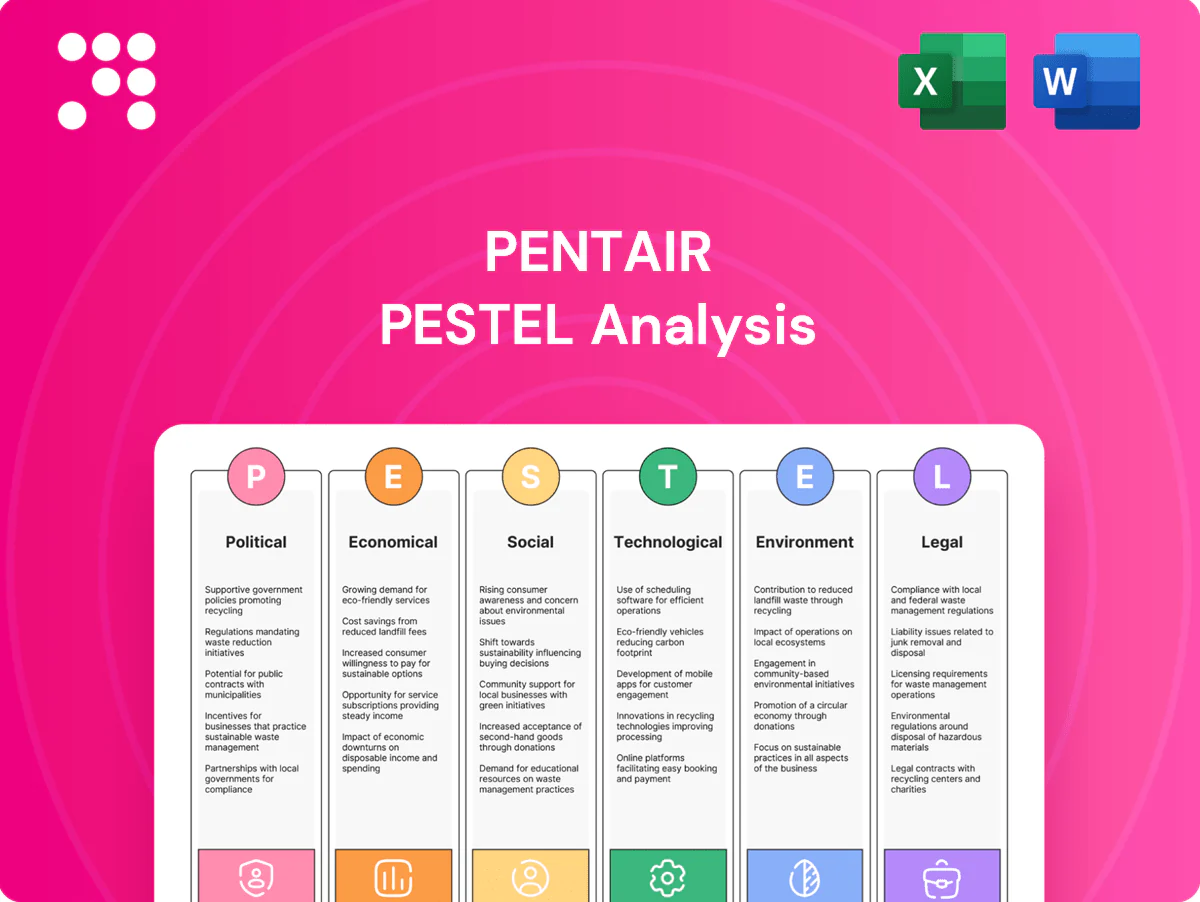
Pentair PESTLE Analysis

Make Smarter Strategic Decisions with a Complete PESTEL View
Discover how political, economic, social, technological, legal, and environmental forces are shaping Pentair’s strategic outlook in our concise PESTLE summary. This 3–5 sentence snapshot highlights key risks and opportunities to inform investment and planning decisions. For the full, actionable analysis with data-driven insights and ready-to-use charts, download the complete PESTLE report now.
Political factors

Infrastructure funding and policy priorities
Government budgets and the US Bipartisan Infrastructure Law's roughly $55 billion for water infrastructure directly boost municipal and industrial demand relevant to Pentair. Shifts toward drinking water safety, wastewater resilience or flood control can reallocate procurement across Pentair’s filtration and pump portfolios. Increased use of public–private partnerships speeds deployment but raises contracting complexity and risk. Election cycles (eg 2024) create timing uncertainty for approvals and appropriations.
Regulatory oversight of water quality
Stricter national and local standards for PFAS, nitrates and microbes increase demand for advanced treatment, with PFAS regulated at parts per trillion levels and the US nitrate MCL at 10 mg/L (as nitrogen). Fragmented state and EU rules force product variants and separate certification pathways, raising development and compliance costs. Policy harmonization lowers costs, while divergence and higher enforcement intensity accelerate retrofit and replacement cycles.

Trade policy, tariffs, and localization
Tariffs on components, metals and electronics (US steel 25%, aluminum 10%, Section 301 China tariffs ~7.5–25%) raise input costs and squeeze Pentair margins and pricing flexibility.
Localization incentives from the IRA and CHIPS Act (tax credits/grants) push regional manufacturing and supply bases to capture incentives.
Export controls and sanctions (Russia restrictions, tightened US controls on advanced semiconductors since 2022) limit sales to some markets.
Rules-of-origin in RTAs (eg USMCA 75% auto threshold) reshape sourcing and supplier qualification.

Municipal procurement and tendering practices
Municipal tenders prioritize proven performance, life-cycle cost and local content, with public procurement representing about 12% of GDP in OECD countries, sharpening Pentairs competitive focus on reliability and local partnerships; lengthy tender cycles often exceed six months, compressing revenue visibility and tying up working capital while political demands for transparency raise documentation and compliance costs, favoring incumbents with installed bases.
Water governance and basin-level management
- Allocation priority: basin compacts
- Fragmented buyers: utilities/community systems
- Conservation push: ~8% smart meter CAGR
- Geopolitical risk: cross-border disputes
$55bn funding and tariffs reshape water treatment markets
Bipartisan Infrastructure Law ~$55bn for water and PFAS/nitrate rules (PFAS ppt; nitrate MCL 10 mg/L) boost advanced-treatment demand.
Tariffs (US steel 25%, aluminum 10%, China 7.5–25%) and export controls raise costs and restrict market access.
Public procurement ≈12% of OECD GDP; tenders >6 months favor incumbents; 1.8bn water-stressed by 2025; smart meters ~8% CAGR to 2029.
| Policy | Metric | Relevance |
|---|---|---|
| Infrastructure funding | $55bn | Demand boost |
| Procurement | ≈12% GDP | Competitive edge |
| Water stress | 1.8bn by 2025 | Market growth |
What is included in the product
 Detailed Word Document
Explores how macro-environmental factors uniquely affect Pentair across Political, Economic, Social, Technological, Environmental, and Legal dimensions, with each category backed by current data and trends to reveal risks and opportunities. Designed for executives, investors, and strategists, it inclusively reflects industry and regional dynamics and offers forward-looking insights ready for reports or decks.

 Customizable Excel Spreadsheet
A concise, visually segmented Pentair PESTLE summary that’s editable for region or product lines, easily dropped into slides or shared across teams to streamline meetings and support discussions on external risks and market positioning.
Economic factors

Housing, remodeling, and pool market cycles
Residential construction and remodeling drive Pentair demand for pumps, filters and water treatment; U.S. home improvement spending was about $450B in 2023 and single‑family starts ran near 1.1M in 2024, underpinning replacement cycles. Pool installations track consumer confidence and home equity—U.S. homeowner equity topped $30T in 2024—while slowdowns shift mix to repair/replace. Seasonality and weather amplify quarterly volatility, with peak demand in Q2–Q3.
Industrial capex and utility spending
Industrial capex for process water and filtration tracks manufacturing cycles, with Pentair benefiting when OEM spending rebounds after cyclical troughs; Pentair reported roughly $4.5bn revenue in FY2024, underscoring exposure to capex swings. Utility budgets depend on rate cases, municipal bond costs and utility margins, which in 2024 were pressured by higher interest rates. Project deferrals in downturns elongate sales cycles, while recoveries favor backlog conversion and higher-margin retrofit upgrades.

Input costs and inflation
Resins, membranes, copper, steel and electronics inflation have pressured Pentairs gross margins as input-costs rose across water-treatment and filtration product lines. Energy and freight cost volatility increases production and distribution economics, particularly for global pump and membrane supply chains. Pricing power hinges on brand strength, channel relationships and clear value propositions, while lagged cost pass-through often causes temporary margin compression.

Interest rates and financing conditions
Rising global policy rates — US fed funds at about 5.25–5.50% and the 10‑year Treasury near 4.1% in mid‑2025 — have depressed US housing starts and consumer discretionary spending, reducing demand for Pentair residential products; higher rates also raise municipal and industrial borrowing costs, delaying water and infrastructure projects. Pentair’s WACC directly affects valuation and capex decisions, while FX and rate differentials alter cross‑border competitiveness.
- Higher policy rates: US fed funds 5.25–5.50% (mid‑2025)
- 10‑yr Treasury ~4.1% increases muni/industrial financing costs
- Lower housing demand hits residential water product sales
- WACC and FX differentials shape investment and pricing
Foreign exchange and emerging market exposure
Currency volatility affects Pentairs reported revenues and input costs, with devaluations pressuring local pricing and demand while sometimes boosting exports from lower-cost plants; emerging markets offer growth — WHO/UNICEF estimates about 2 billion people lack safely managed drinking water — but carry higher credit and sovereign risk; hedging cuts FX volatility yet increases financial cost and operational complexity.
- FX exposure: translation and transaction risk
- EM growth: ~2 billion lacking safe water (WHO/UNICEF)
- Devaluation: local margin squeeze vs export advantage
- Hedging: lowers volatility, raises cost/complexity
$55bn funding and tariffs reshape water treatment markets
Residential demand (US home‑improve ~$450B in 2023; single‑family starts ~1.1M in 2024) and pool/repair cycles drive Pentair sales, while industrial/utility capex and FY2024 revenue ~$4.5B tie results to manufacturing cycles. Input inflation (resins, membranes, metals), energy/freight and FX volatility compress margins; policy rates (Fed 5.25–5.50% mid‑2025; 10y ~4.1%) raise financing costs and delay projects.
| Metric | Value |
|---|---|
| FY2024 Revenue | $4.5B |
| US Home Improve 2023 | $450B |
| Single‑family starts 2024 | ~1.1M |
| Fed funds (mid‑2025) | 5.25–5.50% |
| 10‑yr Treasury | ~4.1% |
| People lacking safely managed water | ~2B |
Preview the Actual Deliverable
Pentair PESTLE Analysis
The preview shown here is the exact Pentair PESTLE Analysis document you’ll receive after purchase—fully formatted and ready to use. No placeholders or teasers; the layout, content, and structure visible are the final file available for immediate download. What you see is what you’ll own after checkout, professionally structured for analysis and presentation.

Make Smarter Strategic Decisions with a Complete PESTEL View
Discover how political, economic, social, technological, legal, and environmental forces are shaping Pentair’s strategic outlook in our concise PESTLE summary. This 3–5 sentence snapshot highlights key risks and opportunities to inform investment and planning decisions. For the full, actionable analysis with data-driven insights and ready-to-use charts, download the complete PESTLE report now.
Political factors
Infrastructure funding and policy priorities
Government budgets and the US Bipartisan Infrastructure Law's roughly $55 billion for water infrastructure directly boost municipal and industrial demand relevant to Pentair. Shifts toward drinking water safety, wastewater resilience or flood control can reallocate procurement across Pentair’s filtration and pump portfolios. Increased use of public–private partnerships speeds deployment but raises contracting complexity and risk. Election cycles (eg 2024) create timing uncertainty for approvals and appropriations.
Regulatory oversight of water quality
Stricter national and local standards for PFAS, nitrates and microbes increase demand for advanced treatment, with PFAS regulated at parts per trillion levels and the US nitrate MCL at 10 mg/L (as nitrogen). Fragmented state and EU rules force product variants and separate certification pathways, raising development and compliance costs. Policy harmonization lowers costs, while divergence and higher enforcement intensity accelerate retrofit and replacement cycles.
Trade policy, tariffs, and localization
Tariffs on components, metals and electronics (US steel 25%, aluminum 10%, Section 301 China tariffs ~7.5–25%) raise input costs and squeeze Pentair margins and pricing flexibility.
Localization incentives from the IRA and CHIPS Act (tax credits/grants) push regional manufacturing and supply bases to capture incentives.
Export controls and sanctions (Russia restrictions, tightened US controls on advanced semiconductors since 2022) limit sales to some markets.
Rules-of-origin in RTAs (eg USMCA 75% auto threshold) reshape sourcing and supplier qualification.
Municipal procurement and tendering practices
Municipal tenders prioritize proven performance, life-cycle cost and local content, with public procurement representing about 12% of GDP in OECD countries, sharpening Pentairs competitive focus on reliability and local partnerships; lengthy tender cycles often exceed six months, compressing revenue visibility and tying up working capital while political demands for transparency raise documentation and compliance costs, favoring incumbents with installed bases.
Water governance and basin-level management
- Allocation priority: basin compacts
- Fragmented buyers: utilities/community systems
- Conservation push: ~8% smart meter CAGR
- Geopolitical risk: cross-border disputes
$55bn funding and tariffs reshape water treatment markets
Bipartisan Infrastructure Law ~$55bn for water and PFAS/nitrate rules (PFAS ppt; nitrate MCL 10 mg/L) boost advanced-treatment demand.
Tariffs (US steel 25%, aluminum 10%, China 7.5–25%) and export controls raise costs and restrict market access.
Public procurement ≈12% of OECD GDP; tenders >6 months favor incumbents; 1.8bn water-stressed by 2025; smart meters ~8% CAGR to 2029.
| Policy | Metric | Relevance |
|---|---|---|
| Infrastructure funding | $55bn | Demand boost |
| Procurement | ≈12% GDP | Competitive edge |
| Water stress | 1.8bn by 2025 | Market growth |
What is included in the product
Detailed Word Document
Explores how macro-environmental factors uniquely affect Pentair across Political, Economic, Social, Technological, Environmental, and Legal dimensions, with each category backed by current data and trends to reveal risks and opportunities. Designed for executives, investors, and strategists, it inclusively reflects industry and regional dynamics and offers forward-looking insights ready for reports or decks.
Customizable Excel Spreadsheet
A concise, visually segmented Pentair PESTLE summary that’s editable for region or product lines, easily dropped into slides or shared across teams to streamline meetings and support discussions on external risks and market positioning.
Economic factors
Housing, remodeling, and pool market cycles
Residential construction and remodeling drive Pentair demand for pumps, filters and water treatment; U.S. home improvement spending was about $450B in 2023 and single‑family starts ran near 1.1M in 2024, underpinning replacement cycles. Pool installations track consumer confidence and home equity—U.S. homeowner equity topped $30T in 2024—while slowdowns shift mix to repair/replace. Seasonality and weather amplify quarterly volatility, with peak demand in Q2–Q3.
Industrial capex and utility spending
Industrial capex for process water and filtration tracks manufacturing cycles, with Pentair benefiting when OEM spending rebounds after cyclical troughs; Pentair reported roughly $4.5bn revenue in FY2024, underscoring exposure to capex swings. Utility budgets depend on rate cases, municipal bond costs and utility margins, which in 2024 were pressured by higher interest rates. Project deferrals in downturns elongate sales cycles, while recoveries favor backlog conversion and higher-margin retrofit upgrades.
Input costs and inflation
Resins, membranes, copper, steel and electronics inflation have pressured Pentairs gross margins as input-costs rose across water-treatment and filtration product lines. Energy and freight cost volatility increases production and distribution economics, particularly for global pump and membrane supply chains. Pricing power hinges on brand strength, channel relationships and clear value propositions, while lagged cost pass-through often causes temporary margin compression.
Interest rates and financing conditions
Rising global policy rates — US fed funds at about 5.25–5.50% and the 10‑year Treasury near 4.1% in mid‑2025 — have depressed US housing starts and consumer discretionary spending, reducing demand for Pentair residential products; higher rates also raise municipal and industrial borrowing costs, delaying water and infrastructure projects. Pentair’s WACC directly affects valuation and capex decisions, while FX and rate differentials alter cross‑border competitiveness.
- Higher policy rates: US fed funds 5.25–5.50% (mid‑2025)
- 10‑yr Treasury ~4.1% increases muni/industrial financing costs
- Lower housing demand hits residential water product sales
- WACC and FX differentials shape investment and pricing
Foreign exchange and emerging market exposure
Currency volatility affects Pentairs reported revenues and input costs, with devaluations pressuring local pricing and demand while sometimes boosting exports from lower-cost plants; emerging markets offer growth — WHO/UNICEF estimates about 2 billion people lack safely managed drinking water — but carry higher credit and sovereign risk; hedging cuts FX volatility yet increases financial cost and operational complexity.
- FX exposure: translation and transaction risk
- EM growth: ~2 billion lacking safe water (WHO/UNICEF)
- Devaluation: local margin squeeze vs export advantage
- Hedging: lowers volatility, raises cost/complexity
$55bn funding and tariffs reshape water treatment markets
Residential demand (US home‑improve ~$450B in 2023; single‑family starts ~1.1M in 2024) and pool/repair cycles drive Pentair sales, while industrial/utility capex and FY2024 revenue ~$4.5B tie results to manufacturing cycles. Input inflation (resins, membranes, metals), energy/freight and FX volatility compress margins; policy rates (Fed 5.25–5.50% mid‑2025; 10y ~4.1%) raise financing costs and delay projects.
| Metric | Value |
|---|---|
| FY2024 Revenue | $4.5B |
| US Home Improve 2023 | $450B |
| Single‑family starts 2024 | ~1.1M |
| Fed funds (mid‑2025) | 5.25–5.50% |
| 10‑yr Treasury | ~4.1% |
| People lacking safely managed water | ~2B |
Preview the Actual Deliverable
Pentair PESTLE Analysis
The preview shown here is the exact Pentair PESTLE Analysis document you’ll receive after purchase—fully formatted and ready to use. No placeholders or teasers; the layout, content, and structure visible are the final file available for immediate download. What you see is what you’ll own after checkout, professionally structured for analysis and presentation.
Description
Make Smarter Strategic Decisions with a Complete PESTEL View
Discover how political, economic, social, technological, legal, and environmental forces are shaping Pentair’s strategic outlook in our concise PESTLE summary. This 3–5 sentence snapshot highlights key risks and opportunities to inform investment and planning decisions. For the full, actionable analysis with data-driven insights and ready-to-use charts, download the complete PESTLE report now.
Political factors
Infrastructure funding and policy priorities
Government budgets and the US Bipartisan Infrastructure Law's roughly $55 billion for water infrastructure directly boost municipal and industrial demand relevant to Pentair. Shifts toward drinking water safety, wastewater resilience or flood control can reallocate procurement across Pentair’s filtration and pump portfolios. Increased use of public–private partnerships speeds deployment but raises contracting complexity and risk. Election cycles (eg 2024) create timing uncertainty for approvals and appropriations.
Regulatory oversight of water quality
Stricter national and local standards for PFAS, nitrates and microbes increase demand for advanced treatment, with PFAS regulated at parts per trillion levels and the US nitrate MCL at 10 mg/L (as nitrogen). Fragmented state and EU rules force product variants and separate certification pathways, raising development and compliance costs. Policy harmonization lowers costs, while divergence and higher enforcement intensity accelerate retrofit and replacement cycles.
Trade policy, tariffs, and localization
Tariffs on components, metals and electronics (US steel 25%, aluminum 10%, Section 301 China tariffs ~7.5–25%) raise input costs and squeeze Pentair margins and pricing flexibility.
Localization incentives from the IRA and CHIPS Act (tax credits/grants) push regional manufacturing and supply bases to capture incentives.
Export controls and sanctions (Russia restrictions, tightened US controls on advanced semiconductors since 2022) limit sales to some markets.
Rules-of-origin in RTAs (eg USMCA 75% auto threshold) reshape sourcing and supplier qualification.
Municipal procurement and tendering practices
Municipal tenders prioritize proven performance, life-cycle cost and local content, with public procurement representing about 12% of GDP in OECD countries, sharpening Pentairs competitive focus on reliability and local partnerships; lengthy tender cycles often exceed six months, compressing revenue visibility and tying up working capital while political demands for transparency raise documentation and compliance costs, favoring incumbents with installed bases.
Water governance and basin-level management
- Allocation priority: basin compacts
- Fragmented buyers: utilities/community systems
- Conservation push: ~8% smart meter CAGR
- Geopolitical risk: cross-border disputes
$55bn funding and tariffs reshape water treatment markets
Bipartisan Infrastructure Law ~$55bn for water and PFAS/nitrate rules (PFAS ppt; nitrate MCL 10 mg/L) boost advanced-treatment demand.
Tariffs (US steel 25%, aluminum 10%, China 7.5–25%) and export controls raise costs and restrict market access.
Public procurement ≈12% of OECD GDP; tenders >6 months favor incumbents; 1.8bn water-stressed by 2025; smart meters ~8% CAGR to 2029.
| Policy | Metric | Relevance |
|---|---|---|
| Infrastructure funding | $55bn | Demand boost |
| Procurement | ≈12% GDP | Competitive edge |
| Water stress | 1.8bn by 2025 | Market growth |
What is included in the product
Detailed Word Document
Explores how macro-environmental factors uniquely affect Pentair across Political, Economic, Social, Technological, Environmental, and Legal dimensions, with each category backed by current data and trends to reveal risks and opportunities. Designed for executives, investors, and strategists, it inclusively reflects industry and regional dynamics and offers forward-looking insights ready for reports or decks.
Customizable Excel Spreadsheet
A concise, visually segmented Pentair PESTLE summary that’s editable for region or product lines, easily dropped into slides or shared across teams to streamline meetings and support discussions on external risks and market positioning.
Economic factors
Housing, remodeling, and pool market cycles
Residential construction and remodeling drive Pentair demand for pumps, filters and water treatment; U.S. home improvement spending was about $450B in 2023 and single‑family starts ran near 1.1M in 2024, underpinning replacement cycles. Pool installations track consumer confidence and home equity—U.S. homeowner equity topped $30T in 2024—while slowdowns shift mix to repair/replace. Seasonality and weather amplify quarterly volatility, with peak demand in Q2–Q3.
Industrial capex and utility spending
Industrial capex for process water and filtration tracks manufacturing cycles, with Pentair benefiting when OEM spending rebounds after cyclical troughs; Pentair reported roughly $4.5bn revenue in FY2024, underscoring exposure to capex swings. Utility budgets depend on rate cases, municipal bond costs and utility margins, which in 2024 were pressured by higher interest rates. Project deferrals in downturns elongate sales cycles, while recoveries favor backlog conversion and higher-margin retrofit upgrades.
Input costs and inflation
Resins, membranes, copper, steel and electronics inflation have pressured Pentairs gross margins as input-costs rose across water-treatment and filtration product lines. Energy and freight cost volatility increases production and distribution economics, particularly for global pump and membrane supply chains. Pricing power hinges on brand strength, channel relationships and clear value propositions, while lagged cost pass-through often causes temporary margin compression.
Interest rates and financing conditions
Rising global policy rates — US fed funds at about 5.25–5.50% and the 10‑year Treasury near 4.1% in mid‑2025 — have depressed US housing starts and consumer discretionary spending, reducing demand for Pentair residential products; higher rates also raise municipal and industrial borrowing costs, delaying water and infrastructure projects. Pentair’s WACC directly affects valuation and capex decisions, while FX and rate differentials alter cross‑border competitiveness.
- Higher policy rates: US fed funds 5.25–5.50% (mid‑2025)
- 10‑yr Treasury ~4.1% increases muni/industrial financing costs
- Lower housing demand hits residential water product sales
- WACC and FX differentials shape investment and pricing
Foreign exchange and emerging market exposure
Currency volatility affects Pentairs reported revenues and input costs, with devaluations pressuring local pricing and demand while sometimes boosting exports from lower-cost plants; emerging markets offer growth — WHO/UNICEF estimates about 2 billion people lack safely managed drinking water — but carry higher credit and sovereign risk; hedging cuts FX volatility yet increases financial cost and operational complexity.
- FX exposure: translation and transaction risk
- EM growth: ~2 billion lacking safe water (WHO/UNICEF)
- Devaluation: local margin squeeze vs export advantage
- Hedging: lowers volatility, raises cost/complexity
$55bn funding and tariffs reshape water treatment markets
Residential demand (US home‑improve ~$450B in 2023; single‑family starts ~1.1M in 2024) and pool/repair cycles drive Pentair sales, while industrial/utility capex and FY2024 revenue ~$4.5B tie results to manufacturing cycles. Input inflation (resins, membranes, metals), energy/freight and FX volatility compress margins; policy rates (Fed 5.25–5.50% mid‑2025; 10y ~4.1%) raise financing costs and delay projects.
| Metric | Value |
|---|---|
| FY2024 Revenue | $4.5B |
| US Home Improve 2023 | $450B |
| Single‑family starts 2024 | ~1.1M |
| Fed funds (mid‑2025) | 5.25–5.50% |
| 10‑yr Treasury | ~4.1% |
| People lacking safely managed water | ~2B |
Preview the Actual Deliverable
Pentair PESTLE Analysis
The preview shown here is the exact Pentair PESTLE Analysis document you’ll receive after purchase—fully formatted and ready to use. No placeholders or teasers; the layout, content, and structure visible are the final file available for immediate download. What you see is what you’ll own after checkout, professionally structured for analysis and presentation.











