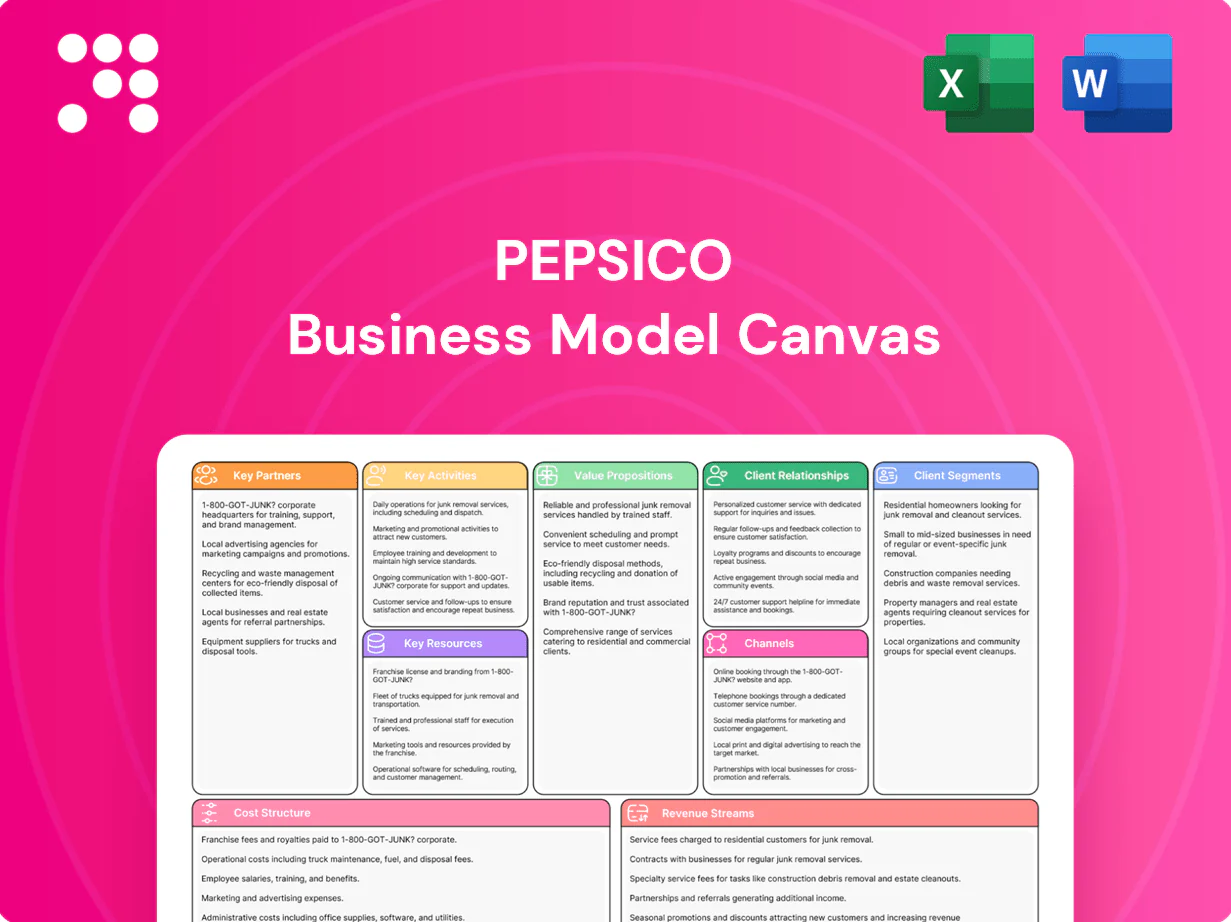
PepsiCo Business Model Canvas

Portfolio-driven CPG model: global distribution, co-manufacturing and margin drivers
PepsiCo’s Business Model Canvas reveals how its portfolio-driven value propositions, global distribution network, and co-manufacturing partnerships drive scale and margins. This snapshot highlights customer segments, revenue streams and cost structure—making complex strategy accessible. Purchase the full, editable Canvas to get section-by-section insights, financial implications and templates for benchmarking or investor decks.
Partnerships

Global ingredient suppliers
PepsiCo partners with agricultural producers and processors for corn, potatoes, sugar, flavorings and packaging inputs across more than 200 countries, leveraging 2023 net revenue of $86.39 billion to secure volume, quality and price stability. Long-term contracts and regional sourcing reduce supply risk while supplier collaboration accelerates healthier formulation innovation and sustainability targets.
Bottling and co-manufacturing alliances
Franchise bottlers and contract manufacturers expand PepsiCo's capacity and geographic reach across more than 200 countries and territories. They handle localized production, packaging and distribution for beverages and select snacks, operating under performance agreements that ensure quality and service levels. Shared investments with partners enable rapid market scaling and capital efficiency.

Retailers, foodservice, and QSR partners
Strategic tie-ups with supermarkets, convenience stores, restaurants and stadiums drive volume, supporting PepsiCo’s global retail footprint contributing to about $86.6 billion in 2024 net revenue. Fountain and pouring-rights agreements secure high-traffic placements in major venues and QSRs (partnering with roughly 20 of the top 25 global chains). Joint promotions can lift basket size by double digits, while data-sharing refines assortment and dynamic pricing.

Logistics and cold-chain providers
Third-party logistics and cold-chain partners optimize warehousing, last-mile delivery and temperature-controlled transport across PepsiCo’s footprint in 200 countries and territories, sustaining freshness and availability. Route-to-market efficiency helps preserve product quality and supports promotional cadence. Collaboration drives on-time, in-full performance improvements and network flexibility for seasonal peaks.
- Temperature-controlled transport
- Last-mile delivery optimization
- On-time, in-full gains
- Scalable network for promotions
Technology, data, and marketing platforms
PepsiCo leverages partnerships with ad-tech, analytics, and e-commerce platforms to sharpen targeting and improve ROI, supporting scale across a company with $86.4 billion in 2023 net revenue. Digital tools bolster demand forecasting, optimize trade spend, and expand retail media monetization. Co-marketing and innovation partners accelerate new-product testing, personalization, and omnichannel reach.
- ad-tech: better targeting, higher ROI
- analytics: demand forecasting, trade spend
- e-commerce: retail media growth
- innovation: rapid testing, personalization
Global partners fuel distribution, sustainability, digital growth- $86.39B
PepsiCo relies on agricultural suppliers, franchise bottlers, retailers and cold-chain/logistics partners to secure inputs, scale production and distribution across ~200 countries, supporting $86.39B net revenue in 2023. Long-term contracts and co-investments reduce supply risk and enable innovation toward sustainability and healthier portfolios. Digital ad-tech and e-commerce partners boost ROI, retail media and omnichannel growth.
| Partner type | Role | Key metric |
|---|---|---|
| Agriculture | Supply & quality | ~200 countries |
| Bottlers | Local production | 20 of top 25 QSRs |
| Logistics | Cold-chain & delivery | On-time, in-full |
What is included in the product
 Detailed Word Document
A concise, presentation-ready Business Model Canvas for PepsiCo that maps customer segments, channels, value propositions, revenue streams, key activities, partners, resources, cost structure and customer relationships, with linked competitive advantages and SWOT insights to support investor pitches and strategic decisions.

 Customizable Excel Spreadsheet
High-level, editable snapshot that quickly maps PepsiCo’s integrated snacks-and-beverages model—streamlining analysis of key channels, supply-chain efficiencies, and partner economics to save hours and support fast strategic decisions.
Activities

Product development and innovation
PepsiCo R&D prioritizes taste, health-forward options, functional beverages and packaging innovation, using rapid prototyping and consumer testing to speed time-to-market. Reformulation programs target reductions in sugar, sodium and additives across portfolios. Pipeline management balances investment in core franchises and new platforms, supporting 23 PepsiCo brands that each generate over $1 billion in annual retail sales.
Manufacturing and quality control
PepsiCo runs hundreds of high-throughput plants across more than 200 countries, producing snacks and beverages to strict global standards and supporting over $80 billion in 2024 net revenue. Lean operations and targeted automation investments in 2024 improved throughput and lowered unit costs. Robust quality systems ensure product consistency across markets, while dynamic capacity planning aligns production with seasonal and promotional demand cycles.

Brand marketing and portfolio management
Integrated campaigns build equity for flagship and local brands, leveraging PepsiCo's portfolio of 23 brands that each generate over $1 billion to scale messaging. Trade promotions and retail media drive conversion at shelf and online, supported by billions in annual merchandising spend. Sponsorships and experiential marketing deepen engagement through events and sports partnerships. Portfolio pruning and disciplined pricing optimize the margin mix across snacks and beverages.

Distribution and route-to-market execution
PepsiCo uses direct-store-delivery and warehouse delivery to maximize coverage across 200+ countries and territories, while shelf management and merchandising secure premium placement; data-driven routing raises service frequency and responsiveness, and local partnerships expand reach in emerging markets.
- DSD + warehouse: broad coverage
- Shelf management: prime placement
- Data routing: higher service frequency
- Partnerships: growth in emerging markets
Supply chain and procurement optimization
PepsiCo optimizes supply chain and procurement through category sourcing, hedging, and vendor development to lower input costs and secure supply, while inventory planning balances service levels with working capital efficiency. Sustainability programs target a greater-than-40% reduction in value-chain GHG by 2030 versus 2015 and cut waste through packaging and process changes. Risk management focuses on crop variability and logistical disruptions via diversified sourcing and hedging.
- Category sourcing: centralized contracts, global scale
- Hedging: commodity risk mitigation
- Inventory planning: service vs working capital
- Sustainability: >40% value-chain GHG cut by 2030
Global F&B leader: ~USD 80B revenue, 23 $1B+ brands, presence in 200+ countries
PepsiCo runs integrated R&D and pipeline management to reformulate products and launch health-forward SKUs, supporting 23 brands each with >$1B retail sales. Its global manufacturing network serves 200+ countries, underpinning ~USD 80B net revenue in 2024 with automation raising throughput and lowering unit costs. Supply chain, category sourcing and hedging secure inputs, target >40% value-chain GHG cut by 2030.
Full Version Awaits
Business Model Canvas
The PepsiCo Business Model Canvas shown here is the actual deliverable, not a mockup. When you purchase, you will receive this same document—complete, formatted, and editable—ready for presentation and strategic use. Files are delivered in Word and Excel formats for immediate customization. No placeholders, no surprises.

Portfolio-driven CPG model: global distribution, co-manufacturing and margin drivers
PepsiCo’s Business Model Canvas reveals how its portfolio-driven value propositions, global distribution network, and co-manufacturing partnerships drive scale and margins. This snapshot highlights customer segments, revenue streams and cost structure—making complex strategy accessible. Purchase the full, editable Canvas to get section-by-section insights, financial implications and templates for benchmarking or investor decks.
Partnerships
Global ingredient suppliers
PepsiCo partners with agricultural producers and processors for corn, potatoes, sugar, flavorings and packaging inputs across more than 200 countries, leveraging 2023 net revenue of $86.39 billion to secure volume, quality and price stability. Long-term contracts and regional sourcing reduce supply risk while supplier collaboration accelerates healthier formulation innovation and sustainability targets.
Bottling and co-manufacturing alliances
Franchise bottlers and contract manufacturers expand PepsiCo's capacity and geographic reach across more than 200 countries and territories. They handle localized production, packaging and distribution for beverages and select snacks, operating under performance agreements that ensure quality and service levels. Shared investments with partners enable rapid market scaling and capital efficiency.
Retailers, foodservice, and QSR partners
Strategic tie-ups with supermarkets, convenience stores, restaurants and stadiums drive volume, supporting PepsiCo’s global retail footprint contributing to about $86.6 billion in 2024 net revenue. Fountain and pouring-rights agreements secure high-traffic placements in major venues and QSRs (partnering with roughly 20 of the top 25 global chains). Joint promotions can lift basket size by double digits, while data-sharing refines assortment and dynamic pricing.
Logistics and cold-chain providers
Third-party logistics and cold-chain partners optimize warehousing, last-mile delivery and temperature-controlled transport across PepsiCo’s footprint in 200 countries and territories, sustaining freshness and availability. Route-to-market efficiency helps preserve product quality and supports promotional cadence. Collaboration drives on-time, in-full performance improvements and network flexibility for seasonal peaks.
- Temperature-controlled transport
- Last-mile delivery optimization
- On-time, in-full gains
- Scalable network for promotions
Technology, data, and marketing platforms
PepsiCo leverages partnerships with ad-tech, analytics, and e-commerce platforms to sharpen targeting and improve ROI, supporting scale across a company with $86.4 billion in 2023 net revenue. Digital tools bolster demand forecasting, optimize trade spend, and expand retail media monetization. Co-marketing and innovation partners accelerate new-product testing, personalization, and omnichannel reach.
- ad-tech: better targeting, higher ROI
- analytics: demand forecasting, trade spend
- e-commerce: retail media growth
- innovation: rapid testing, personalization
Global partners fuel distribution, sustainability, digital growth- $86.39B
PepsiCo relies on agricultural suppliers, franchise bottlers, retailers and cold-chain/logistics partners to secure inputs, scale production and distribution across ~200 countries, supporting $86.39B net revenue in 2023. Long-term contracts and co-investments reduce supply risk and enable innovation toward sustainability and healthier portfolios. Digital ad-tech and e-commerce partners boost ROI, retail media and omnichannel growth.
| Partner type | Role | Key metric |
|---|---|---|
| Agriculture | Supply & quality | ~200 countries |
| Bottlers | Local production | 20 of top 25 QSRs |
| Logistics | Cold-chain & delivery | On-time, in-full |
What is included in the product
Detailed Word Document
A concise, presentation-ready Business Model Canvas for PepsiCo that maps customer segments, channels, value propositions, revenue streams, key activities, partners, resources, cost structure and customer relationships, with linked competitive advantages and SWOT insights to support investor pitches and strategic decisions.
Customizable Excel Spreadsheet
High-level, editable snapshot that quickly maps PepsiCo’s integrated snacks-and-beverages model—streamlining analysis of key channels, supply-chain efficiencies, and partner economics to save hours and support fast strategic decisions.
Activities
Product development and innovation
PepsiCo R&D prioritizes taste, health-forward options, functional beverages and packaging innovation, using rapid prototyping and consumer testing to speed time-to-market. Reformulation programs target reductions in sugar, sodium and additives across portfolios. Pipeline management balances investment in core franchises and new platforms, supporting 23 PepsiCo brands that each generate over $1 billion in annual retail sales.
Manufacturing and quality control
PepsiCo runs hundreds of high-throughput plants across more than 200 countries, producing snacks and beverages to strict global standards and supporting over $80 billion in 2024 net revenue. Lean operations and targeted automation investments in 2024 improved throughput and lowered unit costs. Robust quality systems ensure product consistency across markets, while dynamic capacity planning aligns production with seasonal and promotional demand cycles.
Brand marketing and portfolio management
Integrated campaigns build equity for flagship and local brands, leveraging PepsiCo's portfolio of 23 brands that each generate over $1 billion to scale messaging. Trade promotions and retail media drive conversion at shelf and online, supported by billions in annual merchandising spend. Sponsorships and experiential marketing deepen engagement through events and sports partnerships. Portfolio pruning and disciplined pricing optimize the margin mix across snacks and beverages.
Distribution and route-to-market execution
PepsiCo uses direct-store-delivery and warehouse delivery to maximize coverage across 200+ countries and territories, while shelf management and merchandising secure premium placement; data-driven routing raises service frequency and responsiveness, and local partnerships expand reach in emerging markets.
- DSD + warehouse: broad coverage
- Shelf management: prime placement
- Data routing: higher service frequency
- Partnerships: growth in emerging markets
Supply chain and procurement optimization
PepsiCo optimizes supply chain and procurement through category sourcing, hedging, and vendor development to lower input costs and secure supply, while inventory planning balances service levels with working capital efficiency. Sustainability programs target a greater-than-40% reduction in value-chain GHG by 2030 versus 2015 and cut waste through packaging and process changes. Risk management focuses on crop variability and logistical disruptions via diversified sourcing and hedging.
- Category sourcing: centralized contracts, global scale
- Hedging: commodity risk mitigation
- Inventory planning: service vs working capital
- Sustainability: >40% value-chain GHG cut by 2030
Global F&B leader: ~USD 80B revenue, 23 $1B+ brands, presence in 200+ countries
PepsiCo runs integrated R&D and pipeline management to reformulate products and launch health-forward SKUs, supporting 23 brands each with >$1B retail sales. Its global manufacturing network serves 200+ countries, underpinning ~USD 80B net revenue in 2024 with automation raising throughput and lowering unit costs. Supply chain, category sourcing and hedging secure inputs, target >40% value-chain GHG cut by 2030.
Full Version Awaits
Business Model Canvas
The PepsiCo Business Model Canvas shown here is the actual deliverable, not a mockup. When you purchase, you will receive this same document—complete, formatted, and editable—ready for presentation and strategic use. Files are delivered in Word and Excel formats for immediate customization. No placeholders, no surprises.
Description
Portfolio-driven CPG model: global distribution, co-manufacturing and margin drivers
PepsiCo’s Business Model Canvas reveals how its portfolio-driven value propositions, global distribution network, and co-manufacturing partnerships drive scale and margins. This snapshot highlights customer segments, revenue streams and cost structure—making complex strategy accessible. Purchase the full, editable Canvas to get section-by-section insights, financial implications and templates for benchmarking or investor decks.
Partnerships
Global ingredient suppliers
PepsiCo partners with agricultural producers and processors for corn, potatoes, sugar, flavorings and packaging inputs across more than 200 countries, leveraging 2023 net revenue of $86.39 billion to secure volume, quality and price stability. Long-term contracts and regional sourcing reduce supply risk while supplier collaboration accelerates healthier formulation innovation and sustainability targets.
Bottling and co-manufacturing alliances
Franchise bottlers and contract manufacturers expand PepsiCo's capacity and geographic reach across more than 200 countries and territories. They handle localized production, packaging and distribution for beverages and select snacks, operating under performance agreements that ensure quality and service levels. Shared investments with partners enable rapid market scaling and capital efficiency.
Retailers, foodservice, and QSR partners
Strategic tie-ups with supermarkets, convenience stores, restaurants and stadiums drive volume, supporting PepsiCo’s global retail footprint contributing to about $86.6 billion in 2024 net revenue. Fountain and pouring-rights agreements secure high-traffic placements in major venues and QSRs (partnering with roughly 20 of the top 25 global chains). Joint promotions can lift basket size by double digits, while data-sharing refines assortment and dynamic pricing.
Logistics and cold-chain providers
Third-party logistics and cold-chain partners optimize warehousing, last-mile delivery and temperature-controlled transport across PepsiCo’s footprint in 200 countries and territories, sustaining freshness and availability. Route-to-market efficiency helps preserve product quality and supports promotional cadence. Collaboration drives on-time, in-full performance improvements and network flexibility for seasonal peaks.
- Temperature-controlled transport
- Last-mile delivery optimization
- On-time, in-full gains
- Scalable network for promotions
Technology, data, and marketing platforms
PepsiCo leverages partnerships with ad-tech, analytics, and e-commerce platforms to sharpen targeting and improve ROI, supporting scale across a company with $86.4 billion in 2023 net revenue. Digital tools bolster demand forecasting, optimize trade spend, and expand retail media monetization. Co-marketing and innovation partners accelerate new-product testing, personalization, and omnichannel reach.
- ad-tech: better targeting, higher ROI
- analytics: demand forecasting, trade spend
- e-commerce: retail media growth
- innovation: rapid testing, personalization
Global partners fuel distribution, sustainability, digital growth- $86.39B
PepsiCo relies on agricultural suppliers, franchise bottlers, retailers and cold-chain/logistics partners to secure inputs, scale production and distribution across ~200 countries, supporting $86.39B net revenue in 2023. Long-term contracts and co-investments reduce supply risk and enable innovation toward sustainability and healthier portfolios. Digital ad-tech and e-commerce partners boost ROI, retail media and omnichannel growth.
| Partner type | Role | Key metric |
|---|---|---|
| Agriculture | Supply & quality | ~200 countries |
| Bottlers | Local production | 20 of top 25 QSRs |
| Logistics | Cold-chain & delivery | On-time, in-full |
What is included in the product
Detailed Word Document
A concise, presentation-ready Business Model Canvas for PepsiCo that maps customer segments, channels, value propositions, revenue streams, key activities, partners, resources, cost structure and customer relationships, with linked competitive advantages and SWOT insights to support investor pitches and strategic decisions.
Customizable Excel Spreadsheet
High-level, editable snapshot that quickly maps PepsiCo’s integrated snacks-and-beverages model—streamlining analysis of key channels, supply-chain efficiencies, and partner economics to save hours and support fast strategic decisions.
Activities
Product development and innovation
PepsiCo R&D prioritizes taste, health-forward options, functional beverages and packaging innovation, using rapid prototyping and consumer testing to speed time-to-market. Reformulation programs target reductions in sugar, sodium and additives across portfolios. Pipeline management balances investment in core franchises and new platforms, supporting 23 PepsiCo brands that each generate over $1 billion in annual retail sales.
Manufacturing and quality control
PepsiCo runs hundreds of high-throughput plants across more than 200 countries, producing snacks and beverages to strict global standards and supporting over $80 billion in 2024 net revenue. Lean operations and targeted automation investments in 2024 improved throughput and lowered unit costs. Robust quality systems ensure product consistency across markets, while dynamic capacity planning aligns production with seasonal and promotional demand cycles.
Brand marketing and portfolio management
Integrated campaigns build equity for flagship and local brands, leveraging PepsiCo's portfolio of 23 brands that each generate over $1 billion to scale messaging. Trade promotions and retail media drive conversion at shelf and online, supported by billions in annual merchandising spend. Sponsorships and experiential marketing deepen engagement through events and sports partnerships. Portfolio pruning and disciplined pricing optimize the margin mix across snacks and beverages.
Distribution and route-to-market execution
PepsiCo uses direct-store-delivery and warehouse delivery to maximize coverage across 200+ countries and territories, while shelf management and merchandising secure premium placement; data-driven routing raises service frequency and responsiveness, and local partnerships expand reach in emerging markets.
- DSD + warehouse: broad coverage
- Shelf management: prime placement
- Data routing: higher service frequency
- Partnerships: growth in emerging markets
Supply chain and procurement optimization
PepsiCo optimizes supply chain and procurement through category sourcing, hedging, and vendor development to lower input costs and secure supply, while inventory planning balances service levels with working capital efficiency. Sustainability programs target a greater-than-40% reduction in value-chain GHG by 2030 versus 2015 and cut waste through packaging and process changes. Risk management focuses on crop variability and logistical disruptions via diversified sourcing and hedging.
- Category sourcing: centralized contracts, global scale
- Hedging: commodity risk mitigation
- Inventory planning: service vs working capital
- Sustainability: >40% value-chain GHG cut by 2030
Global F&B leader: ~USD 80B revenue, 23 $1B+ brands, presence in 200+ countries
PepsiCo runs integrated R&D and pipeline management to reformulate products and launch health-forward SKUs, supporting 23 brands each with >$1B retail sales. Its global manufacturing network serves 200+ countries, underpinning ~USD 80B net revenue in 2024 with automation raising throughput and lowering unit costs. Supply chain, category sourcing and hedging secure inputs, target >40% value-chain GHG cut by 2030.
Full Version Awaits
Business Model Canvas
The PepsiCo Business Model Canvas shown here is the actual deliverable, not a mockup. When you purchase, you will receive this same document—complete, formatted, and editable—ready for presentation and strategic use. Files are delivered in Word and Excel formats for immediate customization. No placeholders, no surprises.











