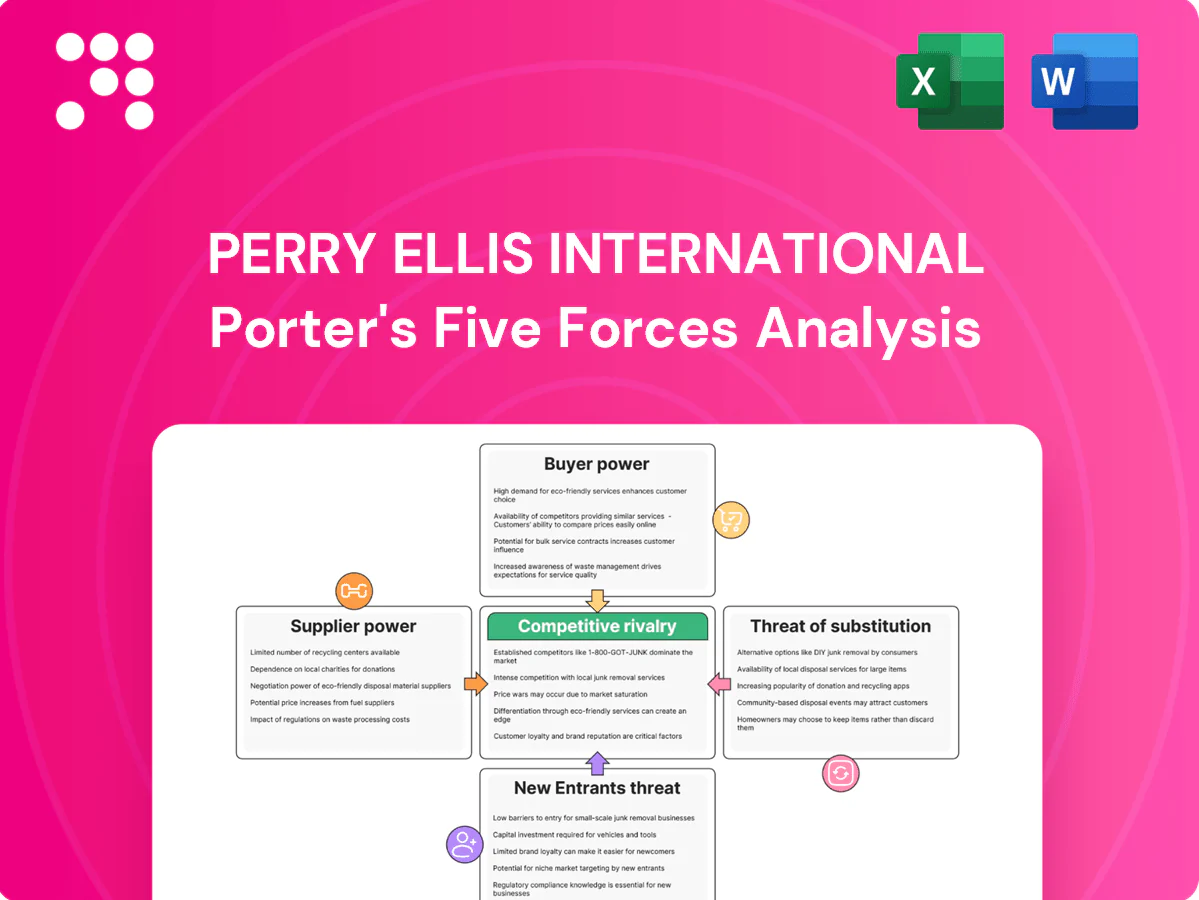
Perry Ellis International Porter's Five Forces Analysis

Go Beyond the Preview—Access the Full Strategic Report
Perry Ellis International faces moderate buyer power, fragmented suppliers, and rising online competition that tighten margins and elevate competitive intensity. Brand strength and wholesale partnerships mitigate new entrant and substitute risks. This brief snapshot only scratches the surface—unlock the full Porter's Five Forces Analysis to explore strategic implications in depth.
Suppliers Bargaining Power

Global sourcing spread
As of 2024 PEI sources fabrics, trims and finished goods across multiple regions, diluting single-supplier leverage and lowering concentration risk.
Multi-sourcing and interchangeable vendors keep switching costs moderate, enabling buying flexibility and margin management.
However, specialty materials and fragrance components create pockets of dependence, and currency swings or geopolitical disruptions can quickly tighten supplier power.
Input cost volatility
Cotton at roughly $0.90/lb in 2024 and polyester feedstock swings, alongside Drewry WCI container rates near $1,500–2,000 per 40ft in 2024, pass upstream cost pressure to brands and compress PEI margins during rapid spikes. Suppliers have enforced surtaxes in tight capacity cycles, though PEI can hedge, re-spec materials, and use scale contracting to partially offset volatility. Short-term margin hits remain likely.

Compliance and ESG
Stricter 2024 labor, traceability and sustainability standards have narrowed PEI’s approved vendor pool, concentrating spend among fewer factories. Qualified compliant factories thus gain bargaining leverage, often securing longer contracts and premium pricing. PEI’s brand and ESG-related reputation risk raises the cost of switching to non-compliant sources, and long-term partnerships trade higher transparency for steadier pricing and lower disruption risk.

Capacity and lead times
Peak seasons and rapid fashion cycles push factory utilization toward 90–95%, elevating supplier leverage; suppliers offering 2–4 week lead times and flexible minimum order quantities command 10–25% premiums. Nearshoring (e.g., Mexico/Central America) can cut lead times but often raises unit costs by ~10–20% as of 2024. Improved forecasting and demand smoothing materially reduce this supplier bargaining power.
- Peak utilization ~90–95%
- Lead-time premium 10–25%
- Nearshoring cost +10–20%
- Planning reduces supplier leverage
Licensing co-manufacture
Fragrance and niche accessories for Perry Ellis depend on specialized licensors and co-manufacturers whose technical know-how and regulatory approvals (e.g., IFRA compliance) raise switching frictions, boosting supplier power versus basic apparel; global fragrance market was about $43B in 2024, highlighting scale and concentration pressures; royalty structures (commonly 5–12%) further limit margin negotiation for licensees.
- Specialized licensors: higher leverage
- Regulatory barriers: raise switching costs
- Royalty rates: constrain margins
- Fragrance market 2024: ~$43B
Specialty inputs and fragrances concentrate supplier leverage; nearshoring adds +10-20% cost
As of 2024 PEI's multi-sourcing and scale moderate supplier power, but specialty materials, fragrances and compliant factories concentrate leverage.
Cost passthroughs—cotton ~$0.90/lb, container $1,500–2,000/40ft—can compress margins during spikes.
Nearshoring raises unit costs ~10–20% while compliant factories and fragrance licensors command premiums and longer contracts.
| Metric | 2024 |
|---|---|
| Cotton | $0.90/lb |
| Container rates | $1,500–2,000/40ft |
| Fragrance market | $43B |
| Nearshoring cost | +10–20% |
What is included in the product
 Detailed Word Document
Tailored Porter’s Five Forces analysis of Perry Ellis International identifying competitive rivalry, buyer/supplier power, threat of new entrants and substitutes, and emerging disruptive risks affecting pricing, margins, and market positioning.

 Customizable Excel Spreadsheet
A concise Porter’s Five Forces one-sheet for Perry Ellis International—instantly highlights competitive pressures and strategic levers for quick boardroom decisions.
Customers Bargaining Power

Retail consolidation
Department stores, off-price chains and mass merchants wield scale and data advantages — TJX alone reported $52.8 billion revenue in FY2024 — enabling aggressive demands for markdown allowances, chargebacks and strict service-level terms. Consolidation raises retailer concentration, creating take-it-or-leave-it negotiating positions that compress supplier margins. Perry Ellis mitigates exposure through diversified brand mix and channel diversification, shifting sales toward direct-to-consumer and licensed partners.
E-commerce platforms
Marketplaces and pure‑play e-tailers boost price transparency—Amazon (~38% US e‑commerce share in 2024) and marketplaces drive algorithmic price cuts that favor sharp pricing and fast inventory turns, increasing buyer leverage. Ratings and apparel return rates (about 20–30% in 2024) further pressure margins. PEI responds by expanding DTC channels and tighter controlled distribution to protect pricing and margin integrity.

Consumer price sensitivity
Mid-market apparel shoppers for Perry Ellis switch easily between brands chasing deals and fast-moving trends. Heavy promotional intensity in the channel trains consumers to delay purchases until discounts appear. Elevated inflation pressures household budgets, making clear value propositions and price-per-wear messaging critical. Strong brand equity and consistent fit reduce churn but do not eliminate price sensitivity.

Private label competition
Retailers increasingly substitute national apparel with private-label lines, often priced 20-30% lower and representing roughly 15-20% of apparel assortments in 2024, boosting buyer negotiating power over brands like Perry Ellis. To defend shelf space, Perry Ellis must emphasize differentiated design and brand storytelling and pursue exclusive capsule collections that align retailer incentives.
- Private label: 20-30% lower price
- Assortment share 2024: ~15-20%
- Defense: design, storytelling, exclusives
Multi-brand portfolio buffer
PEI’s multi-brand portfolio (Perry Ellis, Original Penguin, Jantzen, Rafaella, Cubavera, Laundry, Farah per 2024 company disclosures) spans lifestyle, price tiers and categories, giving buyers broad assortment and lowering single-brand dependence; cross-selling across channels reduces switching, but underperforming labels face delisting risk.
- Brand count: 7+ noted in 2024 filings
- Effect: lower single-brand exposure
- Risk: delisting for weak labels
Retailer scale, Amazon dominance and high returns squeeze apparel margins
Retailers' scale and data (TJX revenue $52.8B FY2024) and consolidation give buyers strong leverage; Amazon ~38% US e‑commerce share (2024) and 20–30% apparel return rates amplify price pressure. Private label (~15–20% assortment; 20–30% lower price) and promotional trade down margins. PEI's 7+ brands and DTC shift mitigate but do not eliminate buyer power.
| Metric | 2024 |
|---|---|
| TJX revenue | $52.8B |
| Amazon e‑commerce share | ~38% |
| Apparel returns | 20–30% |
| Private label assortment | 15–20% |
| PEI brands | 7+ |
What You See Is What You Get
Perry Ellis International Porter's Five Forces Analysis
This preview is the exact Porter’s Five Forces analysis of Perry Ellis International you’ll receive upon purchase—fully formatted and ready for use. It assesses competitive rivalry, supplier and buyer power, threat of substitutes, and barriers to entry with data-driven insights. No samples or placeholders; buy to download this identical document instantly.

Go Beyond the Preview—Access the Full Strategic Report
Perry Ellis International faces moderate buyer power, fragmented suppliers, and rising online competition that tighten margins and elevate competitive intensity. Brand strength and wholesale partnerships mitigate new entrant and substitute risks. This brief snapshot only scratches the surface—unlock the full Porter's Five Forces Analysis to explore strategic implications in depth.
Suppliers Bargaining Power
Global sourcing spread
As of 2024 PEI sources fabrics, trims and finished goods across multiple regions, diluting single-supplier leverage and lowering concentration risk.
Multi-sourcing and interchangeable vendors keep switching costs moderate, enabling buying flexibility and margin management.
However, specialty materials and fragrance components create pockets of dependence, and currency swings or geopolitical disruptions can quickly tighten supplier power.
Input cost volatility
Cotton at roughly $0.90/lb in 2024 and polyester feedstock swings, alongside Drewry WCI container rates near $1,500–2,000 per 40ft in 2024, pass upstream cost pressure to brands and compress PEI margins during rapid spikes. Suppliers have enforced surtaxes in tight capacity cycles, though PEI can hedge, re-spec materials, and use scale contracting to partially offset volatility. Short-term margin hits remain likely.
Compliance and ESG
Stricter 2024 labor, traceability and sustainability standards have narrowed PEI’s approved vendor pool, concentrating spend among fewer factories. Qualified compliant factories thus gain bargaining leverage, often securing longer contracts and premium pricing. PEI’s brand and ESG-related reputation risk raises the cost of switching to non-compliant sources, and long-term partnerships trade higher transparency for steadier pricing and lower disruption risk.
Capacity and lead times
Peak seasons and rapid fashion cycles push factory utilization toward 90–95%, elevating supplier leverage; suppliers offering 2–4 week lead times and flexible minimum order quantities command 10–25% premiums. Nearshoring (e.g., Mexico/Central America) can cut lead times but often raises unit costs by ~10–20% as of 2024. Improved forecasting and demand smoothing materially reduce this supplier bargaining power.
- Peak utilization ~90–95%
- Lead-time premium 10–25%
- Nearshoring cost +10–20%
- Planning reduces supplier leverage
Licensing co-manufacture
Fragrance and niche accessories for Perry Ellis depend on specialized licensors and co-manufacturers whose technical know-how and regulatory approvals (e.g., IFRA compliance) raise switching frictions, boosting supplier power versus basic apparel; global fragrance market was about $43B in 2024, highlighting scale and concentration pressures; royalty structures (commonly 5–12%) further limit margin negotiation for licensees.
- Specialized licensors: higher leverage
- Regulatory barriers: raise switching costs
- Royalty rates: constrain margins
- Fragrance market 2024: ~$43B
Specialty inputs and fragrances concentrate supplier leverage; nearshoring adds +10-20% cost
As of 2024 PEI's multi-sourcing and scale moderate supplier power, but specialty materials, fragrances and compliant factories concentrate leverage.
Cost passthroughs—cotton ~$0.90/lb, container $1,500–2,000/40ft—can compress margins during spikes.
Nearshoring raises unit costs ~10–20% while compliant factories and fragrance licensors command premiums and longer contracts.
| Metric | 2024 |
|---|---|
| Cotton | $0.90/lb |
| Container rates | $1,500–2,000/40ft |
| Fragrance market | $43B |
| Nearshoring cost | +10–20% |
What is included in the product
Detailed Word Document
Tailored Porter’s Five Forces analysis of Perry Ellis International identifying competitive rivalry, buyer/supplier power, threat of new entrants and substitutes, and emerging disruptive risks affecting pricing, margins, and market positioning.
Customizable Excel Spreadsheet
A concise Porter’s Five Forces one-sheet for Perry Ellis International—instantly highlights competitive pressures and strategic levers for quick boardroom decisions.
Customers Bargaining Power
Retail consolidation
Department stores, off-price chains and mass merchants wield scale and data advantages — TJX alone reported $52.8 billion revenue in FY2024 — enabling aggressive demands for markdown allowances, chargebacks and strict service-level terms. Consolidation raises retailer concentration, creating take-it-or-leave-it negotiating positions that compress supplier margins. Perry Ellis mitigates exposure through diversified brand mix and channel diversification, shifting sales toward direct-to-consumer and licensed partners.
E-commerce platforms
Marketplaces and pure‑play e-tailers boost price transparency—Amazon (~38% US e‑commerce share in 2024) and marketplaces drive algorithmic price cuts that favor sharp pricing and fast inventory turns, increasing buyer leverage. Ratings and apparel return rates (about 20–30% in 2024) further pressure margins. PEI responds by expanding DTC channels and tighter controlled distribution to protect pricing and margin integrity.
Consumer price sensitivity
Mid-market apparel shoppers for Perry Ellis switch easily between brands chasing deals and fast-moving trends. Heavy promotional intensity in the channel trains consumers to delay purchases until discounts appear. Elevated inflation pressures household budgets, making clear value propositions and price-per-wear messaging critical. Strong brand equity and consistent fit reduce churn but do not eliminate price sensitivity.
Private label competition
Retailers increasingly substitute national apparel with private-label lines, often priced 20-30% lower and representing roughly 15-20% of apparel assortments in 2024, boosting buyer negotiating power over brands like Perry Ellis. To defend shelf space, Perry Ellis must emphasize differentiated design and brand storytelling and pursue exclusive capsule collections that align retailer incentives.
- Private label: 20-30% lower price
- Assortment share 2024: ~15-20%
- Defense: design, storytelling, exclusives
Multi-brand portfolio buffer
PEI’s multi-brand portfolio (Perry Ellis, Original Penguin, Jantzen, Rafaella, Cubavera, Laundry, Farah per 2024 company disclosures) spans lifestyle, price tiers and categories, giving buyers broad assortment and lowering single-brand dependence; cross-selling across channels reduces switching, but underperforming labels face delisting risk.
- Brand count: 7+ noted in 2024 filings
- Effect: lower single-brand exposure
- Risk: delisting for weak labels
Retailer scale, Amazon dominance and high returns squeeze apparel margins
Retailers' scale and data (TJX revenue $52.8B FY2024) and consolidation give buyers strong leverage; Amazon ~38% US e‑commerce share (2024) and 20–30% apparel return rates amplify price pressure. Private label (~15–20% assortment; 20–30% lower price) and promotional trade down margins. PEI's 7+ brands and DTC shift mitigate but do not eliminate buyer power.
| Metric | 2024 |
|---|---|
| TJX revenue | $52.8B |
| Amazon e‑commerce share | ~38% |
| Apparel returns | 20–30% |
| Private label assortment | 15–20% |
| PEI brands | 7+ |
What You See Is What You Get
Perry Ellis International Porter's Five Forces Analysis
This preview is the exact Porter’s Five Forces analysis of Perry Ellis International you’ll receive upon purchase—fully formatted and ready for use. It assesses competitive rivalry, supplier and buyer power, threat of substitutes, and barriers to entry with data-driven insights. No samples or placeholders; buy to download this identical document instantly.
Description
Go Beyond the Preview—Access the Full Strategic Report
Perry Ellis International faces moderate buyer power, fragmented suppliers, and rising online competition that tighten margins and elevate competitive intensity. Brand strength and wholesale partnerships mitigate new entrant and substitute risks. This brief snapshot only scratches the surface—unlock the full Porter's Five Forces Analysis to explore strategic implications in depth.
Suppliers Bargaining Power
Global sourcing spread
As of 2024 PEI sources fabrics, trims and finished goods across multiple regions, diluting single-supplier leverage and lowering concentration risk.
Multi-sourcing and interchangeable vendors keep switching costs moderate, enabling buying flexibility and margin management.
However, specialty materials and fragrance components create pockets of dependence, and currency swings or geopolitical disruptions can quickly tighten supplier power.
Input cost volatility
Cotton at roughly $0.90/lb in 2024 and polyester feedstock swings, alongside Drewry WCI container rates near $1,500–2,000 per 40ft in 2024, pass upstream cost pressure to brands and compress PEI margins during rapid spikes. Suppliers have enforced surtaxes in tight capacity cycles, though PEI can hedge, re-spec materials, and use scale contracting to partially offset volatility. Short-term margin hits remain likely.
Compliance and ESG
Stricter 2024 labor, traceability and sustainability standards have narrowed PEI’s approved vendor pool, concentrating spend among fewer factories. Qualified compliant factories thus gain bargaining leverage, often securing longer contracts and premium pricing. PEI’s brand and ESG-related reputation risk raises the cost of switching to non-compliant sources, and long-term partnerships trade higher transparency for steadier pricing and lower disruption risk.
Capacity and lead times
Peak seasons and rapid fashion cycles push factory utilization toward 90–95%, elevating supplier leverage; suppliers offering 2–4 week lead times and flexible minimum order quantities command 10–25% premiums. Nearshoring (e.g., Mexico/Central America) can cut lead times but often raises unit costs by ~10–20% as of 2024. Improved forecasting and demand smoothing materially reduce this supplier bargaining power.
- Peak utilization ~90–95%
- Lead-time premium 10–25%
- Nearshoring cost +10–20%
- Planning reduces supplier leverage
Licensing co-manufacture
Fragrance and niche accessories for Perry Ellis depend on specialized licensors and co-manufacturers whose technical know-how and regulatory approvals (e.g., IFRA compliance) raise switching frictions, boosting supplier power versus basic apparel; global fragrance market was about $43B in 2024, highlighting scale and concentration pressures; royalty structures (commonly 5–12%) further limit margin negotiation for licensees.
- Specialized licensors: higher leverage
- Regulatory barriers: raise switching costs
- Royalty rates: constrain margins
- Fragrance market 2024: ~$43B
Specialty inputs and fragrances concentrate supplier leverage; nearshoring adds +10-20% cost
As of 2024 PEI's multi-sourcing and scale moderate supplier power, but specialty materials, fragrances and compliant factories concentrate leverage.
Cost passthroughs—cotton ~$0.90/lb, container $1,500–2,000/40ft—can compress margins during spikes.
Nearshoring raises unit costs ~10–20% while compliant factories and fragrance licensors command premiums and longer contracts.
| Metric | 2024 |
|---|---|
| Cotton | $0.90/lb |
| Container rates | $1,500–2,000/40ft |
| Fragrance market | $43B |
| Nearshoring cost | +10–20% |
What is included in the product
Detailed Word Document
Tailored Porter’s Five Forces analysis of Perry Ellis International identifying competitive rivalry, buyer/supplier power, threat of new entrants and substitutes, and emerging disruptive risks affecting pricing, margins, and market positioning.
Customizable Excel Spreadsheet
A concise Porter’s Five Forces one-sheet for Perry Ellis International—instantly highlights competitive pressures and strategic levers for quick boardroom decisions.
Customers Bargaining Power
Retail consolidation
Department stores, off-price chains and mass merchants wield scale and data advantages — TJX alone reported $52.8 billion revenue in FY2024 — enabling aggressive demands for markdown allowances, chargebacks and strict service-level terms. Consolidation raises retailer concentration, creating take-it-or-leave-it negotiating positions that compress supplier margins. Perry Ellis mitigates exposure through diversified brand mix and channel diversification, shifting sales toward direct-to-consumer and licensed partners.
E-commerce platforms
Marketplaces and pure‑play e-tailers boost price transparency—Amazon (~38% US e‑commerce share in 2024) and marketplaces drive algorithmic price cuts that favor sharp pricing and fast inventory turns, increasing buyer leverage. Ratings and apparel return rates (about 20–30% in 2024) further pressure margins. PEI responds by expanding DTC channels and tighter controlled distribution to protect pricing and margin integrity.
Consumer price sensitivity
Mid-market apparel shoppers for Perry Ellis switch easily between brands chasing deals and fast-moving trends. Heavy promotional intensity in the channel trains consumers to delay purchases until discounts appear. Elevated inflation pressures household budgets, making clear value propositions and price-per-wear messaging critical. Strong brand equity and consistent fit reduce churn but do not eliminate price sensitivity.
Private label competition
Retailers increasingly substitute national apparel with private-label lines, often priced 20-30% lower and representing roughly 15-20% of apparel assortments in 2024, boosting buyer negotiating power over brands like Perry Ellis. To defend shelf space, Perry Ellis must emphasize differentiated design and brand storytelling and pursue exclusive capsule collections that align retailer incentives.
- Private label: 20-30% lower price
- Assortment share 2024: ~15-20%
- Defense: design, storytelling, exclusives
Multi-brand portfolio buffer
PEI’s multi-brand portfolio (Perry Ellis, Original Penguin, Jantzen, Rafaella, Cubavera, Laundry, Farah per 2024 company disclosures) spans lifestyle, price tiers and categories, giving buyers broad assortment and lowering single-brand dependence; cross-selling across channels reduces switching, but underperforming labels face delisting risk.
- Brand count: 7+ noted in 2024 filings
- Effect: lower single-brand exposure
- Risk: delisting for weak labels
Retailer scale, Amazon dominance and high returns squeeze apparel margins
Retailers' scale and data (TJX revenue $52.8B FY2024) and consolidation give buyers strong leverage; Amazon ~38% US e‑commerce share (2024) and 20–30% apparel return rates amplify price pressure. Private label (~15–20% assortment; 20–30% lower price) and promotional trade down margins. PEI's 7+ brands and DTC shift mitigate but do not eliminate buyer power.
| Metric | 2024 |
|---|---|
| TJX revenue | $52.8B |
| Amazon e‑commerce share | ~38% |
| Apparel returns | 20–30% |
| Private label assortment | 15–20% |
| PEI brands | 7+ |
What You See Is What You Get
Perry Ellis International Porter's Five Forces Analysis
This preview is the exact Porter’s Five Forces analysis of Perry Ellis International you’ll receive upon purchase—fully formatted and ready for use. It assesses competitive rivalry, supplier and buyer power, threat of substitutes, and barriers to entry with data-driven insights. No samples or placeholders; buy to download this identical document instantly.











