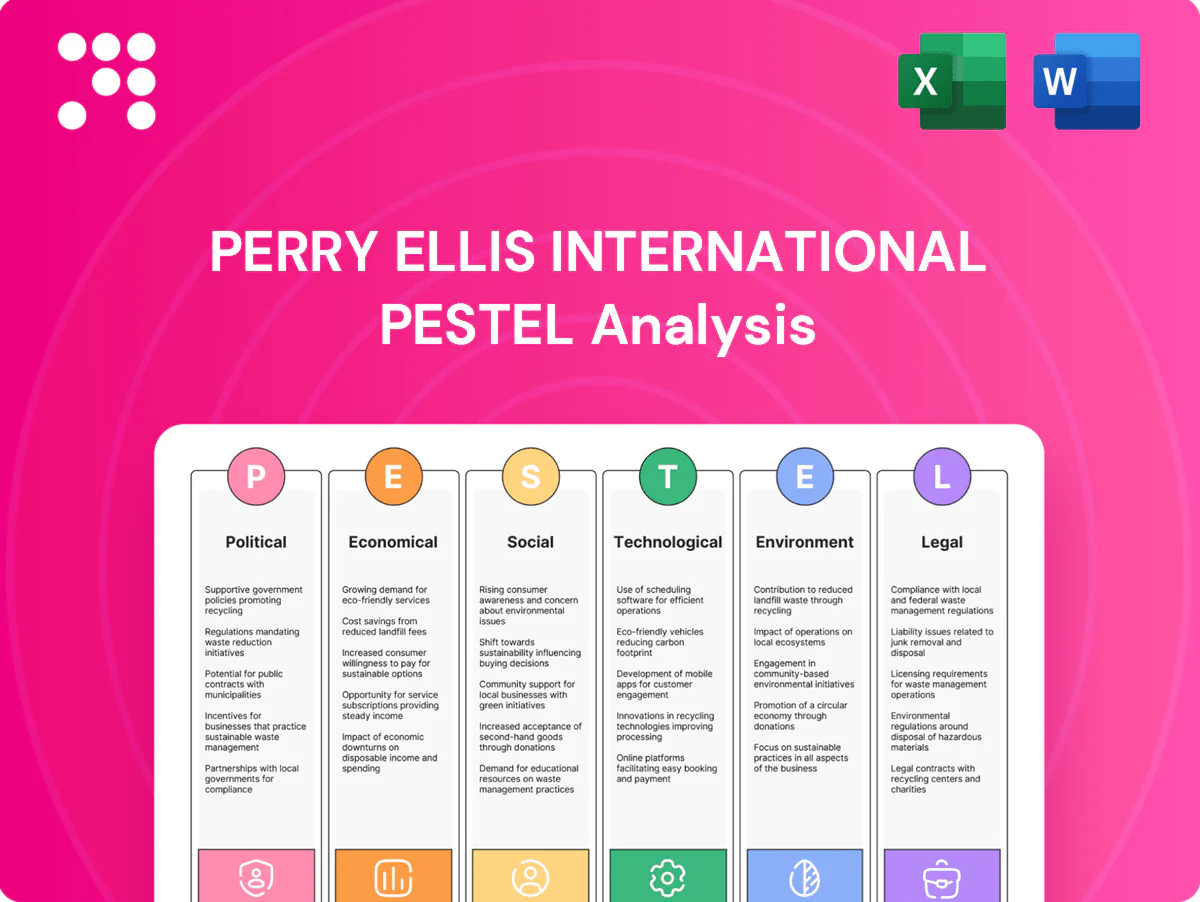
Perry Ellis International PESTLE Analysis

Skip the Research. Get the Strategy.
Gain strategic clarity with our PESTLE analysis of Perry Ellis International, revealing political, economic, social, technological, legal, and environmental forces shaping its prospects. Ideal for investors, consultants, and executives, this concise briefing highlights key risks and actionable growth opportunities. Purchase the full, editable report for a deep-dive, instant-download intelligence boost.
Political factors

Trade tariffs and duties
As a global apparel importer, Perry Ellis faces landed-cost shocks when tariffs shift: US Section 301 measures raised rates on many China-origin apparel by roughly 7.5–25%, often adding 10–25% to unit costs. Bilateral tariff swings can reshape sourcing overnight, so Perry Ellis must diversify country-of-origin, renegotiate vendor terms and use proactive customs planning and duty-drawback programs (recovering up to 99% of duties) to protect margins.
Geopolitical supply risk
Political instability in key apparel hubs like Bangladesh and Vietnam can halt raw-material flows, factories and logistics, increasing Perry Ellis Internationals supply risk; ocean container rates surged over 200% versus 2019 during 2021–22, illustrating cost exposure. Port congestion and sanctions can lengthen lead times and raise freight rates, squeezing margins. Dual-sourcing and nearshoring lower concentration risk, while scenario plans and safety stock sustain service continuity.

Government incentives
Textile clusters often secure export rebates, tax holidays (commonly 3–10 years) and infrastructure support, lowering input and logistics costs for apparel firms. Leveraging special economic zones and bonded warehouses can cut manufacturing and warehousing expenses by double-digit percentages for global brands. Incentives are frequently time-bound and politically contingent, so Perry Ellis should reassess periodically to ensure benefits exceed relocation frictions.

Public health policy
Pandemic-era mandates (WHO ended global emergency May 5, 2023; US national emergency ended May 11, 2023) showed store footfall and staffing volatility, pushing Perry Ellis to bolster DTC and wholesale contingency playbooks. Health regulations still force changes to store operations and DC protocols, while flexible scheduling and digital fulfillment reduce disruption risk; US e-commerce remains ~16% of retail sales (2023 US Census).
- mandates→footfall/staffing
- regulations→store/DC ops
- contingency playbooks→channel resilience
- flex scheduling + digital fulfillment→mitigation
Trade compliance
Trade compliance for Perry Ellis hinges on rules of origin, the Uyghur Forced Labor Prevention Act and sanctions that demand rigorous vendor vetting. Non-compliance risks seizures, fines and major reputational harm as CBP enforcement intensifies. End-to-end traceability, third-party audits and continuous training keep teams aligned with evolving requirements.
- End-to-end traceability
- Third-party audits
- Continuous training
China tariffs 7.5–25% and Bangladesh/Vietnam supply risks spur nearshoring
Perry Ellis faces tariff shocks (US Section 301: ~7.5–25% on China apparel) and supply disruption risk from instability in Bangladesh/Vietnam; dual-sourcing and nearshoring mitigate. Trade compliance (Uyghur Forced Labor Prevention Act, rules of origin) and CBP scrutiny raise seizure/fine risk. Pandemic mandates (WHO ended global emergency May 5, 2023) shifted mix toward DTC; US e‑commerce ≈16% (2023).
| Risk | Metric/Year |
|---|---|
| Tariff range | 7.5–25% |
| US e‑commerce | ≈16% (2023) |
| WHO emergency end | May 5, 2023 |
What is included in the product
 Detailed Word Document
Explores how macro-environmental forces—Political, Economic, Social, Technological, Environmental, and Legal—specifically impact Perry Ellis International, pairing data-driven trends with industry examples to reveal risks, opportunities, and forward-looking scenarios; tailored for executives, investors, and strategists and formatted for direct inclusion in plans and reports.

 Customizable Excel Spreadsheet
A concise, visually segmented PESTLE summary for Perry Ellis International that’s easy to drop into presentations, share across teams, and annotate with region- or product-specific notes to streamline strategy discussions and risk planning.
Economic factors

Consumer spending cycles
Apparel demand is highly cyclical and tracks disposable income and employment, with US unemployment averaging about 3.7% in 2024, making Perry Ellis vulnerable to downturns. In slowdowns value tiers and promotions gain share while premium capsules sustain brand equity and protect margins. A balanced price architecture across value, core, and premium ranges hedges revenue volatility.
Inflation and input costs
Fabric, trims and freight inflation compress Perry Ellis International margins—Perry Ellis reported net sales of about $1.6 billion in fiscal 2024—unless recovered through dynamic pricing, cost engineering and calendar optimization; long-term vendor partnerships improve input predictability, while hedging fuel and freight costs has been used industry-wide to smooth freight swings and limit quarter-to-quarter margin volatility.

FX volatility
Global sourcing and international sales leave Perry Ellis earnings exposed to currency swings; a stronger dollar (DXY around 105 in mid‑2025) can reduce import costs but compress translated overseas revenue. The company mitigates P&L noise through natural hedges and financial derivatives reported in filings, and increasingly uses local‑currency contracts with pass‑through clauses to share FX risk.

Channel mix shifts
Channel mix shifts at Perry Ellis show DTC and e-commerce rising against wholesale/department-store volumes; e-commerce now represents roughly one-third of US apparel sales (≈36% in 2024), lifting gross margins but increasing fulfillment and returns costs. Optimizing assortments by channel improves sell-through and reduces markdowns, while omnichannel services (buy-online-pickup, returns) raise conversion and lifetime value.
- Wholesale: lower margin, larger volume
- Department stores: promotional pressure
- DTC/e-commerce: higher margin but +fulfillment spend
- Omnichannel: ↑conversion, ↑LTV
Credit and inventory
Tighter credit and a federal funds rate near 5.25–5.50% (mid‑2025) raise Perry Ellis International’s working capital costs and pressure retail partners’ solvency; conservative buy plans and strict open‑to‑buy controls reduce markdown risk. Vendor‑managed inventory and quick‑response sourcing cut holding risk, while disciplined AR management preserves cash flow.
- Higher rates → costlier working capital
- Conservative buys limit markdowns
- VMI/quick response lowers inventory risk
- Strong AR protects liquidity
China tariffs 7.5–25% and Bangladesh/Vietnam supply risks spur nearshoring
Apparel demand tied to disposable income (US unemployment ~3.7% in 2024) makes Perry Ellis cyclically exposed; fiscal 2024 net sales ≈ $1.6B. Input inflation and freight pressure margins; DXY ≈105 (mid‑2025) affects FX translation. E‑commerce ≈36% (2024) boosts margins but raises fulfillment costs; fed funds ~5.25–5.50% (mid‑2025) increases working capital costs.
| Metric | Value | Implication |
|---|---|---|
| Net sales | $1.6B (FY2024) | Revenue base |
| E‑commerce | 36% (2024) | Higher GM, ↑fulfillment |
| Fed funds | 5.25–5.50% (mid‑2025) | ↑W/C cost |
Full Version Awaits
Perry Ellis International PESTLE Analysis
The preview shown here is the exact Perry Ellis International PESTLE Analysis you’ll receive after purchase, fully formatted and ready to use. This is the real, final file—no placeholders or teasers—delivered exactly as displayed. After checkout you’ll be able to download this professionally structured document immediately.

Skip the Research. Get the Strategy.
Gain strategic clarity with our PESTLE analysis of Perry Ellis International, revealing political, economic, social, technological, legal, and environmental forces shaping its prospects. Ideal for investors, consultants, and executives, this concise briefing highlights key risks and actionable growth opportunities. Purchase the full, editable report for a deep-dive, instant-download intelligence boost.
Political factors
Trade tariffs and duties
As a global apparel importer, Perry Ellis faces landed-cost shocks when tariffs shift: US Section 301 measures raised rates on many China-origin apparel by roughly 7.5–25%, often adding 10–25% to unit costs. Bilateral tariff swings can reshape sourcing overnight, so Perry Ellis must diversify country-of-origin, renegotiate vendor terms and use proactive customs planning and duty-drawback programs (recovering up to 99% of duties) to protect margins.
Geopolitical supply risk
Political instability in key apparel hubs like Bangladesh and Vietnam can halt raw-material flows, factories and logistics, increasing Perry Ellis Internationals supply risk; ocean container rates surged over 200% versus 2019 during 2021–22, illustrating cost exposure. Port congestion and sanctions can lengthen lead times and raise freight rates, squeezing margins. Dual-sourcing and nearshoring lower concentration risk, while scenario plans and safety stock sustain service continuity.
Government incentives
Textile clusters often secure export rebates, tax holidays (commonly 3–10 years) and infrastructure support, lowering input and logistics costs for apparel firms. Leveraging special economic zones and bonded warehouses can cut manufacturing and warehousing expenses by double-digit percentages for global brands. Incentives are frequently time-bound and politically contingent, so Perry Ellis should reassess periodically to ensure benefits exceed relocation frictions.
Public health policy
Pandemic-era mandates (WHO ended global emergency May 5, 2023; US national emergency ended May 11, 2023) showed store footfall and staffing volatility, pushing Perry Ellis to bolster DTC and wholesale contingency playbooks. Health regulations still force changes to store operations and DC protocols, while flexible scheduling and digital fulfillment reduce disruption risk; US e-commerce remains ~16% of retail sales (2023 US Census).
- mandates→footfall/staffing
- regulations→store/DC ops
- contingency playbooks→channel resilience
- flex scheduling + digital fulfillment→mitigation
Trade compliance
Trade compliance for Perry Ellis hinges on rules of origin, the Uyghur Forced Labor Prevention Act and sanctions that demand rigorous vendor vetting. Non-compliance risks seizures, fines and major reputational harm as CBP enforcement intensifies. End-to-end traceability, third-party audits and continuous training keep teams aligned with evolving requirements.
- End-to-end traceability
- Third-party audits
- Continuous training
China tariffs 7.5–25% and Bangladesh/Vietnam supply risks spur nearshoring
Perry Ellis faces tariff shocks (US Section 301: ~7.5–25% on China apparel) and supply disruption risk from instability in Bangladesh/Vietnam; dual-sourcing and nearshoring mitigate. Trade compliance (Uyghur Forced Labor Prevention Act, rules of origin) and CBP scrutiny raise seizure/fine risk. Pandemic mandates (WHO ended global emergency May 5, 2023) shifted mix toward DTC; US e‑commerce ≈16% (2023).
| Risk | Metric/Year |
|---|---|
| Tariff range | 7.5–25% |
| US e‑commerce | ≈16% (2023) |
| WHO emergency end | May 5, 2023 |
What is included in the product
Detailed Word Document
Explores how macro-environmental forces—Political, Economic, Social, Technological, Environmental, and Legal—specifically impact Perry Ellis International, pairing data-driven trends with industry examples to reveal risks, opportunities, and forward-looking scenarios; tailored for executives, investors, and strategists and formatted for direct inclusion in plans and reports.
Customizable Excel Spreadsheet
A concise, visually segmented PESTLE summary for Perry Ellis International that’s easy to drop into presentations, share across teams, and annotate with region- or product-specific notes to streamline strategy discussions and risk planning.
Economic factors
Consumer spending cycles
Apparel demand is highly cyclical and tracks disposable income and employment, with US unemployment averaging about 3.7% in 2024, making Perry Ellis vulnerable to downturns. In slowdowns value tiers and promotions gain share while premium capsules sustain brand equity and protect margins. A balanced price architecture across value, core, and premium ranges hedges revenue volatility.
Inflation and input costs
Fabric, trims and freight inflation compress Perry Ellis International margins—Perry Ellis reported net sales of about $1.6 billion in fiscal 2024—unless recovered through dynamic pricing, cost engineering and calendar optimization; long-term vendor partnerships improve input predictability, while hedging fuel and freight costs has been used industry-wide to smooth freight swings and limit quarter-to-quarter margin volatility.
FX volatility
Global sourcing and international sales leave Perry Ellis earnings exposed to currency swings; a stronger dollar (DXY around 105 in mid‑2025) can reduce import costs but compress translated overseas revenue. The company mitigates P&L noise through natural hedges and financial derivatives reported in filings, and increasingly uses local‑currency contracts with pass‑through clauses to share FX risk.
Channel mix shifts
Channel mix shifts at Perry Ellis show DTC and e-commerce rising against wholesale/department-store volumes; e-commerce now represents roughly one-third of US apparel sales (≈36% in 2024), lifting gross margins but increasing fulfillment and returns costs. Optimizing assortments by channel improves sell-through and reduces markdowns, while omnichannel services (buy-online-pickup, returns) raise conversion and lifetime value.
- Wholesale: lower margin, larger volume
- Department stores: promotional pressure
- DTC/e-commerce: higher margin but +fulfillment spend
- Omnichannel: ↑conversion, ↑LTV
Credit and inventory
Tighter credit and a federal funds rate near 5.25–5.50% (mid‑2025) raise Perry Ellis International’s working capital costs and pressure retail partners’ solvency; conservative buy plans and strict open‑to‑buy controls reduce markdown risk. Vendor‑managed inventory and quick‑response sourcing cut holding risk, while disciplined AR management preserves cash flow.
- Higher rates → costlier working capital
- Conservative buys limit markdowns
- VMI/quick response lowers inventory risk
- Strong AR protects liquidity
China tariffs 7.5–25% and Bangladesh/Vietnam supply risks spur nearshoring
Apparel demand tied to disposable income (US unemployment ~3.7% in 2024) makes Perry Ellis cyclically exposed; fiscal 2024 net sales ≈ $1.6B. Input inflation and freight pressure margins; DXY ≈105 (mid‑2025) affects FX translation. E‑commerce ≈36% (2024) boosts margins but raises fulfillment costs; fed funds ~5.25–5.50% (mid‑2025) increases working capital costs.
| Metric | Value | Implication |
|---|---|---|
| Net sales | $1.6B (FY2024) | Revenue base |
| E‑commerce | 36% (2024) | Higher GM, ↑fulfillment |
| Fed funds | 5.25–5.50% (mid‑2025) | ↑W/C cost |
Full Version Awaits
Perry Ellis International PESTLE Analysis
The preview shown here is the exact Perry Ellis International PESTLE Analysis you’ll receive after purchase, fully formatted and ready to use. This is the real, final file—no placeholders or teasers—delivered exactly as displayed. After checkout you’ll be able to download this professionally structured document immediately.
Description
Skip the Research. Get the Strategy.
Gain strategic clarity with our PESTLE analysis of Perry Ellis International, revealing political, economic, social, technological, legal, and environmental forces shaping its prospects. Ideal for investors, consultants, and executives, this concise briefing highlights key risks and actionable growth opportunities. Purchase the full, editable report for a deep-dive, instant-download intelligence boost.
Political factors
Trade tariffs and duties
As a global apparel importer, Perry Ellis faces landed-cost shocks when tariffs shift: US Section 301 measures raised rates on many China-origin apparel by roughly 7.5–25%, often adding 10–25% to unit costs. Bilateral tariff swings can reshape sourcing overnight, so Perry Ellis must diversify country-of-origin, renegotiate vendor terms and use proactive customs planning and duty-drawback programs (recovering up to 99% of duties) to protect margins.
Geopolitical supply risk
Political instability in key apparel hubs like Bangladesh and Vietnam can halt raw-material flows, factories and logistics, increasing Perry Ellis Internationals supply risk; ocean container rates surged over 200% versus 2019 during 2021–22, illustrating cost exposure. Port congestion and sanctions can lengthen lead times and raise freight rates, squeezing margins. Dual-sourcing and nearshoring lower concentration risk, while scenario plans and safety stock sustain service continuity.
Government incentives
Textile clusters often secure export rebates, tax holidays (commonly 3–10 years) and infrastructure support, lowering input and logistics costs for apparel firms. Leveraging special economic zones and bonded warehouses can cut manufacturing and warehousing expenses by double-digit percentages for global brands. Incentives are frequently time-bound and politically contingent, so Perry Ellis should reassess periodically to ensure benefits exceed relocation frictions.
Public health policy
Pandemic-era mandates (WHO ended global emergency May 5, 2023; US national emergency ended May 11, 2023) showed store footfall and staffing volatility, pushing Perry Ellis to bolster DTC and wholesale contingency playbooks. Health regulations still force changes to store operations and DC protocols, while flexible scheduling and digital fulfillment reduce disruption risk; US e-commerce remains ~16% of retail sales (2023 US Census).
- mandates→footfall/staffing
- regulations→store/DC ops
- contingency playbooks→channel resilience
- flex scheduling + digital fulfillment→mitigation
Trade compliance
Trade compliance for Perry Ellis hinges on rules of origin, the Uyghur Forced Labor Prevention Act and sanctions that demand rigorous vendor vetting. Non-compliance risks seizures, fines and major reputational harm as CBP enforcement intensifies. End-to-end traceability, third-party audits and continuous training keep teams aligned with evolving requirements.
- End-to-end traceability
- Third-party audits
- Continuous training
China tariffs 7.5–25% and Bangladesh/Vietnam supply risks spur nearshoring
Perry Ellis faces tariff shocks (US Section 301: ~7.5–25% on China apparel) and supply disruption risk from instability in Bangladesh/Vietnam; dual-sourcing and nearshoring mitigate. Trade compliance (Uyghur Forced Labor Prevention Act, rules of origin) and CBP scrutiny raise seizure/fine risk. Pandemic mandates (WHO ended global emergency May 5, 2023) shifted mix toward DTC; US e‑commerce ≈16% (2023).
| Risk | Metric/Year |
|---|---|
| Tariff range | 7.5–25% |
| US e‑commerce | ≈16% (2023) |
| WHO emergency end | May 5, 2023 |
What is included in the product
Detailed Word Document
Explores how macro-environmental forces—Political, Economic, Social, Technological, Environmental, and Legal—specifically impact Perry Ellis International, pairing data-driven trends with industry examples to reveal risks, opportunities, and forward-looking scenarios; tailored for executives, investors, and strategists and formatted for direct inclusion in plans and reports.
Customizable Excel Spreadsheet
A concise, visually segmented PESTLE summary for Perry Ellis International that’s easy to drop into presentations, share across teams, and annotate with region- or product-specific notes to streamline strategy discussions and risk planning.
Economic factors
Consumer spending cycles
Apparel demand is highly cyclical and tracks disposable income and employment, with US unemployment averaging about 3.7% in 2024, making Perry Ellis vulnerable to downturns. In slowdowns value tiers and promotions gain share while premium capsules sustain brand equity and protect margins. A balanced price architecture across value, core, and premium ranges hedges revenue volatility.
Inflation and input costs
Fabric, trims and freight inflation compress Perry Ellis International margins—Perry Ellis reported net sales of about $1.6 billion in fiscal 2024—unless recovered through dynamic pricing, cost engineering and calendar optimization; long-term vendor partnerships improve input predictability, while hedging fuel and freight costs has been used industry-wide to smooth freight swings and limit quarter-to-quarter margin volatility.
FX volatility
Global sourcing and international sales leave Perry Ellis earnings exposed to currency swings; a stronger dollar (DXY around 105 in mid‑2025) can reduce import costs but compress translated overseas revenue. The company mitigates P&L noise through natural hedges and financial derivatives reported in filings, and increasingly uses local‑currency contracts with pass‑through clauses to share FX risk.
Channel mix shifts
Channel mix shifts at Perry Ellis show DTC and e-commerce rising against wholesale/department-store volumes; e-commerce now represents roughly one-third of US apparel sales (≈36% in 2024), lifting gross margins but increasing fulfillment and returns costs. Optimizing assortments by channel improves sell-through and reduces markdowns, while omnichannel services (buy-online-pickup, returns) raise conversion and lifetime value.
- Wholesale: lower margin, larger volume
- Department stores: promotional pressure
- DTC/e-commerce: higher margin but +fulfillment spend
- Omnichannel: ↑conversion, ↑LTV
Credit and inventory
Tighter credit and a federal funds rate near 5.25–5.50% (mid‑2025) raise Perry Ellis International’s working capital costs and pressure retail partners’ solvency; conservative buy plans and strict open‑to‑buy controls reduce markdown risk. Vendor‑managed inventory and quick‑response sourcing cut holding risk, while disciplined AR management preserves cash flow.
- Higher rates → costlier working capital
- Conservative buys limit markdowns
- VMI/quick response lowers inventory risk
- Strong AR protects liquidity
China tariffs 7.5–25% and Bangladesh/Vietnam supply risks spur nearshoring
Apparel demand tied to disposable income (US unemployment ~3.7% in 2024) makes Perry Ellis cyclically exposed; fiscal 2024 net sales ≈ $1.6B. Input inflation and freight pressure margins; DXY ≈105 (mid‑2025) affects FX translation. E‑commerce ≈36% (2024) boosts margins but raises fulfillment costs; fed funds ~5.25–5.50% (mid‑2025) increases working capital costs.
| Metric | Value | Implication |
|---|---|---|
| Net sales | $1.6B (FY2024) | Revenue base |
| E‑commerce | 36% (2024) | Higher GM, ↑fulfillment |
| Fed funds | 5.25–5.50% (mid‑2025) | ↑W/C cost |
Full Version Awaits
Perry Ellis International PESTLE Analysis
The preview shown here is the exact Perry Ellis International PESTLE Analysis you’ll receive after purchase, fully formatted and ready to use. This is the real, final file—no placeholders or teasers—delivered exactly as displayed. After checkout you’ll be able to download this professionally structured document immediately.











