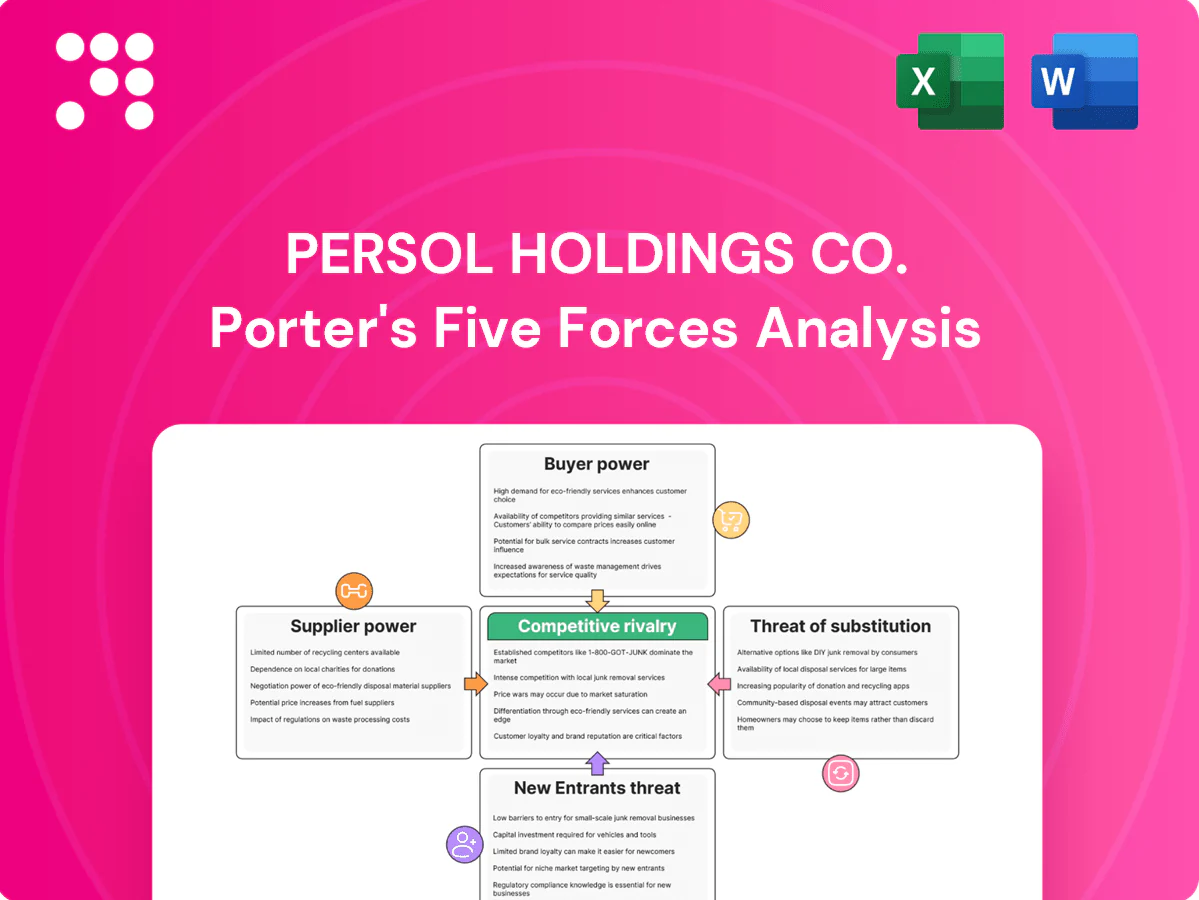
Persol Holdings Co. Porter's Five Forces Analysis

Go Beyond the Preview—Access the Full Strategic Report
Persol Holdings faces moderate buyer power and fragmentary supplier influence, while rivalry in Japan's staffing market and regulatory shifts raise competitive intensity; digital platforms and remote work pose emerging substitute threats. This snapshot only scratches the surface. Unlock the full Porter's Five Forces Analysis for detailed force ratings, visuals, and strategic implications.
Suppliers Bargaining Power

Tight labor markets raise talent leverage
Tight labor markets (Japan unemployment ~2.5% in 2024, job-to-applicant ratio ~1.33) give candidates and contractors leverage to demand higher pay and better terms, squeezing staffing intermediaries’ margins. Persol must ramp sourcing and retention spend to secure supply, increasing SG&A and compressing placement margins. Cyclical swings can rapidly shift bargaining power toward talent pools, amplifying volatility in revenue and margins.
Specialized/tech skills command premiums
Engineers, IT and healthcare professionals in Japan have multiple placement avenues and can command premiums; Japan’s 65+ population reached about 29% in 2024, intensifying healthcare staff scarcity and bargaining power. Such specialists can negotiate higher bill rates or bypass agencies, forcing Persol to offer differentiated value—targeted training, clear career paths and niche services—to compete; premium segments exert far more supplier power than general clerical roles.

Dependence on third-party platforms/tools
Job boards and assessment vendors can raise fees or restrict candidate access; e.g., LinkedIn reached about 930 million members by 2024, increasing platform leverage. Tool switching is costly due to data migration and workflow retraining. Vendor concentration in niche segments further raises supplier power; Persol offsets this with proprietary candidate databases and multi-sourcing of VMS/ATS and assessment providers.

Regulatory and union influences
Regulatory and union influences in Japan—strict labor laws and the equal pay for equal work rule—limit Persol's flexibility in assignments and rates, raising supplier power; non-regular employment was about 38% in 2023, constraining supply mix. Organized labor (unionization ~16% nationwide in 2023, higher in some sectors) can negotiate collectively, elevating institutional leverage beyond individual workers.
- Equal pay rule: statutory limits on pay differentials
- Non-regular workers ~38% (2023)
- Unionization ~16% (2023), higher in specific sectors
- Compliance reduces assignment and rate flexibility
Demographic and immigration dynamics
Japan’s 65+ population reached about 29.1% in 2023 and the domestic working-age pool is shrinking, while registered foreign workers totaled roughly 2.09 million (end‑2023), tightening supplier labor supply and raising sourcing costs; immigration policy shifts create uneven access to talent, forcing Persol to expand training and cross‑border hiring to sustain margins and fill roles.
- 29.1% 65+ population (2023)
- 2.09M foreign workers (end‑2023)
- Need: upskilling and cross‑border pipelines
Tight labor market raises supplier power, squeezes margins, forces upskilling, offshoring
Tight 2024 labor market (unemp ~2.5%, job-to-applicant ~1.33) plus specialist scarcity, high platform leverage (LinkedIn ~930M, 2024) and regulatory constraints (non-regular ~38% 2023; unions ~16% 2023) raise suppliers’ bargaining power, pressuring Persol’s margins and forcing upskilling/cross-border sourcing.
| Metric | Value |
|---|---|
| Unemployment (2024) | ~2.5% |
| Job-to-applicant (2024) | ~1.33 |
| 65+ pop (2023) | 29.1% |
| Foreign workers (end‑2023) | 2.09M |
What is included in the product
 Detailed Word Document
Tailored Porter's Five Forces analysis for Persol Holdings Co. uncovering competitive rivalry, buyer and supplier power, threat of new entrants and substitutes, and disruptive labor-market trends. Provides strategic insights on pricing influence, market entry barriers, and emerging threats to market share.

 Customizable Excel Spreadsheet
A concise one-sheet Porter’s Five Forces for Persol Holdings—perfect for quickly spotting recruitment-market pressures and strategic gaps. Clean layout ready for pitch decks, with customizable pressure levels to reflect staffing trends and regulatory shifts.
Customers Bargaining Power

Large enterprises drive pricing via MSP/VMS
Corporate clients consolidate spend through MSP/VMS, with large buyers in Japan and globally channeling an estimated majority of enterprise contingent spend via these platforms in 2024, pressuring suppliers to conform to standardized SLAs and competitive bidding.
Standardized SLAs and reverse auctions commonly compress margins by narrowing rate bands; Persol reported group revenue of about ¥1,195.2bn for FY2023 (year to Mar 2024) and leans on fill speed, compliance, and service breadth to defend rates.
Low switching costs in commoditized roles
For general administrative and light-industrial staffing, low switching costs let buyers rotate agencies easily, with short contract cycles and comparable offerings heightening price sensitivity. Differentiation depends on reliability and candidate quality, and with Japan’s 2024 unemployment around 2.5% buyer power rises in high-volume, low-skill segments.

Outcome metrics increase accountability
Clients increasingly demand KPIs such as time-to-fill, retention, and diversity targets; underperformance can trigger penalties or loss of preferred supplier status. Transparent outcome metrics and reporting heighten scrutiny on fees and contract terms. To reduce buyer leverage, Persol must demonstrate measurable, auditable value through improved KPIs and clear ROIs tied to client outcomes.

Multi-sourcing reduces dependence
Many corporate buyers maintain panels of staffing agencies to preserve competition and resilience; RFPs and quarterly business reviews drive continuous repricing and keep buyer optionality high, while Persol can respond by offering bundled workforce solutions and exclusive talent pools to raise switching costs.
- Multi-sourcing panels preserve buyer optionality
- RFPs/QBRs enable continuous repricing
- Persol leverages bundled services
- Exclusive talent pools counter buyer power
Strategic partnerships can temper power
When Persol embeds teams onsite or offers integrated BPO/RPO, switching becomes harder as process integration, co-developed tech and domain expertise raise exit costs, lowering buyer bargaining power over time. Value-added services shift negotiations from pure rate cards to outcomes and KPIs, aligning incentives and reducing price-only pressure. Japan's job openings-to-applicants ratio stood near 1.26 in 2024, sustaining demand for integrated workforce solutions.
MSP/VMS consolidation tightens RFPs, standardizes SLAs and compresses staffing rates in 2024
Buyers consolidate via MSP/VMS in 2024, driving competitive RFPs, standardized SLAs and compressed rates.
Persol reported group revenue ¥1,195.2bn (FY2023, to Mar 2024) and defends margins via fill speed, compliance and bundled services.
Low switching costs in low-skill staffing elevate buyer power; onsite BPO/RPO and proprietary tech raise exit barriers as job openings/applicants ≈1.26 and unemployment ≈2.5% (2024).
| Metric | Value |
|---|---|
| Persol revenue FY2023 | ¥1,195.2bn |
| Job openings/applicants 2024 | 1.26 |
| Unemployment Japan 2024 | ≈2.5% |
Preview the Actual Deliverable
Persol Holdings Co. Porter's Five Forces Analysis
This Porter's Five Forces analysis for Persol Holdings evaluates competitive rivalry, buyer and supplier power, and the threats of new entrants and substitutes within the staffing services industry. Findings indicate moderate–high rivalry and buyer power, low supplier power, high entry barriers from scale and relationships, and moderate substitute threats from automation and freelance platforms. This preview shows the exact document you'll receive immediately after purchase—no surprises, no placeholders.

Go Beyond the Preview—Access the Full Strategic Report
Persol Holdings faces moderate buyer power and fragmentary supplier influence, while rivalry in Japan's staffing market and regulatory shifts raise competitive intensity; digital platforms and remote work pose emerging substitute threats. This snapshot only scratches the surface. Unlock the full Porter's Five Forces Analysis for detailed force ratings, visuals, and strategic implications.
Suppliers Bargaining Power
Tight labor markets raise talent leverage
Tight labor markets (Japan unemployment ~2.5% in 2024, job-to-applicant ratio ~1.33) give candidates and contractors leverage to demand higher pay and better terms, squeezing staffing intermediaries’ margins. Persol must ramp sourcing and retention spend to secure supply, increasing SG&A and compressing placement margins. Cyclical swings can rapidly shift bargaining power toward talent pools, amplifying volatility in revenue and margins.
Specialized/tech skills command premiums
Engineers, IT and healthcare professionals in Japan have multiple placement avenues and can command premiums; Japan’s 65+ population reached about 29% in 2024, intensifying healthcare staff scarcity and bargaining power. Such specialists can negotiate higher bill rates or bypass agencies, forcing Persol to offer differentiated value—targeted training, clear career paths and niche services—to compete; premium segments exert far more supplier power than general clerical roles.
Dependence on third-party platforms/tools
Job boards and assessment vendors can raise fees or restrict candidate access; e.g., LinkedIn reached about 930 million members by 2024, increasing platform leverage. Tool switching is costly due to data migration and workflow retraining. Vendor concentration in niche segments further raises supplier power; Persol offsets this with proprietary candidate databases and multi-sourcing of VMS/ATS and assessment providers.
Regulatory and union influences
Regulatory and union influences in Japan—strict labor laws and the equal pay for equal work rule—limit Persol's flexibility in assignments and rates, raising supplier power; non-regular employment was about 38% in 2023, constraining supply mix. Organized labor (unionization ~16% nationwide in 2023, higher in some sectors) can negotiate collectively, elevating institutional leverage beyond individual workers.
- Equal pay rule: statutory limits on pay differentials
- Non-regular workers ~38% (2023)
- Unionization ~16% (2023), higher in specific sectors
- Compliance reduces assignment and rate flexibility
Demographic and immigration dynamics
Japan’s 65+ population reached about 29.1% in 2023 and the domestic working-age pool is shrinking, while registered foreign workers totaled roughly 2.09 million (end‑2023), tightening supplier labor supply and raising sourcing costs; immigration policy shifts create uneven access to talent, forcing Persol to expand training and cross‑border hiring to sustain margins and fill roles.
- 29.1% 65+ population (2023)
- 2.09M foreign workers (end‑2023)
- Need: upskilling and cross‑border pipelines
Tight labor market raises supplier power, squeezes margins, forces upskilling, offshoring
Tight 2024 labor market (unemp ~2.5%, job-to-applicant ~1.33) plus specialist scarcity, high platform leverage (LinkedIn ~930M, 2024) and regulatory constraints (non-regular ~38% 2023; unions ~16% 2023) raise suppliers’ bargaining power, pressuring Persol’s margins and forcing upskilling/cross-border sourcing.
| Metric | Value |
|---|---|
| Unemployment (2024) | ~2.5% |
| Job-to-applicant (2024) | ~1.33 |
| 65+ pop (2023) | 29.1% |
| Foreign workers (end‑2023) | 2.09M |
What is included in the product
Detailed Word Document
Tailored Porter's Five Forces analysis for Persol Holdings Co. uncovering competitive rivalry, buyer and supplier power, threat of new entrants and substitutes, and disruptive labor-market trends. Provides strategic insights on pricing influence, market entry barriers, and emerging threats to market share.
Customizable Excel Spreadsheet
A concise one-sheet Porter’s Five Forces for Persol Holdings—perfect for quickly spotting recruitment-market pressures and strategic gaps. Clean layout ready for pitch decks, with customizable pressure levels to reflect staffing trends and regulatory shifts.
Customers Bargaining Power
Large enterprises drive pricing via MSP/VMS
Corporate clients consolidate spend through MSP/VMS, with large buyers in Japan and globally channeling an estimated majority of enterprise contingent spend via these platforms in 2024, pressuring suppliers to conform to standardized SLAs and competitive bidding.
Standardized SLAs and reverse auctions commonly compress margins by narrowing rate bands; Persol reported group revenue of about ¥1,195.2bn for FY2023 (year to Mar 2024) and leans on fill speed, compliance, and service breadth to defend rates.
Low switching costs in commoditized roles
For general administrative and light-industrial staffing, low switching costs let buyers rotate agencies easily, with short contract cycles and comparable offerings heightening price sensitivity. Differentiation depends on reliability and candidate quality, and with Japan’s 2024 unemployment around 2.5% buyer power rises in high-volume, low-skill segments.
Outcome metrics increase accountability
Clients increasingly demand KPIs such as time-to-fill, retention, and diversity targets; underperformance can trigger penalties or loss of preferred supplier status. Transparent outcome metrics and reporting heighten scrutiny on fees and contract terms. To reduce buyer leverage, Persol must demonstrate measurable, auditable value through improved KPIs and clear ROIs tied to client outcomes.
Multi-sourcing reduces dependence
Many corporate buyers maintain panels of staffing agencies to preserve competition and resilience; RFPs and quarterly business reviews drive continuous repricing and keep buyer optionality high, while Persol can respond by offering bundled workforce solutions and exclusive talent pools to raise switching costs.
- Multi-sourcing panels preserve buyer optionality
- RFPs/QBRs enable continuous repricing
- Persol leverages bundled services
- Exclusive talent pools counter buyer power
Strategic partnerships can temper power
When Persol embeds teams onsite or offers integrated BPO/RPO, switching becomes harder as process integration, co-developed tech and domain expertise raise exit costs, lowering buyer bargaining power over time. Value-added services shift negotiations from pure rate cards to outcomes and KPIs, aligning incentives and reducing price-only pressure. Japan's job openings-to-applicants ratio stood near 1.26 in 2024, sustaining demand for integrated workforce solutions.
MSP/VMS consolidation tightens RFPs, standardizes SLAs and compresses staffing rates in 2024
Buyers consolidate via MSP/VMS in 2024, driving competitive RFPs, standardized SLAs and compressed rates.
Persol reported group revenue ¥1,195.2bn (FY2023, to Mar 2024) and defends margins via fill speed, compliance and bundled services.
Low switching costs in low-skill staffing elevate buyer power; onsite BPO/RPO and proprietary tech raise exit barriers as job openings/applicants ≈1.26 and unemployment ≈2.5% (2024).
| Metric | Value |
|---|---|
| Persol revenue FY2023 | ¥1,195.2bn |
| Job openings/applicants 2024 | 1.26 |
| Unemployment Japan 2024 | ≈2.5% |
Preview the Actual Deliverable
Persol Holdings Co. Porter's Five Forces Analysis
This Porter's Five Forces analysis for Persol Holdings evaluates competitive rivalry, buyer and supplier power, and the threats of new entrants and substitutes within the staffing services industry. Findings indicate moderate–high rivalry and buyer power, low supplier power, high entry barriers from scale and relationships, and moderate substitute threats from automation and freelance platforms. This preview shows the exact document you'll receive immediately after purchase—no surprises, no placeholders.
Original: $10.00
-65%$10.00
$3.50Description
Go Beyond the Preview—Access the Full Strategic Report
Persol Holdings faces moderate buyer power and fragmentary supplier influence, while rivalry in Japan's staffing market and regulatory shifts raise competitive intensity; digital platforms and remote work pose emerging substitute threats. This snapshot only scratches the surface. Unlock the full Porter's Five Forces Analysis for detailed force ratings, visuals, and strategic implications.
Suppliers Bargaining Power
Tight labor markets raise talent leverage
Tight labor markets (Japan unemployment ~2.5% in 2024, job-to-applicant ratio ~1.33) give candidates and contractors leverage to demand higher pay and better terms, squeezing staffing intermediaries’ margins. Persol must ramp sourcing and retention spend to secure supply, increasing SG&A and compressing placement margins. Cyclical swings can rapidly shift bargaining power toward talent pools, amplifying volatility in revenue and margins.
Specialized/tech skills command premiums
Engineers, IT and healthcare professionals in Japan have multiple placement avenues and can command premiums; Japan’s 65+ population reached about 29% in 2024, intensifying healthcare staff scarcity and bargaining power. Such specialists can negotiate higher bill rates or bypass agencies, forcing Persol to offer differentiated value—targeted training, clear career paths and niche services—to compete; premium segments exert far more supplier power than general clerical roles.
Dependence on third-party platforms/tools
Job boards and assessment vendors can raise fees or restrict candidate access; e.g., LinkedIn reached about 930 million members by 2024, increasing platform leverage. Tool switching is costly due to data migration and workflow retraining. Vendor concentration in niche segments further raises supplier power; Persol offsets this with proprietary candidate databases and multi-sourcing of VMS/ATS and assessment providers.
Regulatory and union influences
Regulatory and union influences in Japan—strict labor laws and the equal pay for equal work rule—limit Persol's flexibility in assignments and rates, raising supplier power; non-regular employment was about 38% in 2023, constraining supply mix. Organized labor (unionization ~16% nationwide in 2023, higher in some sectors) can negotiate collectively, elevating institutional leverage beyond individual workers.
- Equal pay rule: statutory limits on pay differentials
- Non-regular workers ~38% (2023)
- Unionization ~16% (2023), higher in specific sectors
- Compliance reduces assignment and rate flexibility
Demographic and immigration dynamics
Japan’s 65+ population reached about 29.1% in 2023 and the domestic working-age pool is shrinking, while registered foreign workers totaled roughly 2.09 million (end‑2023), tightening supplier labor supply and raising sourcing costs; immigration policy shifts create uneven access to talent, forcing Persol to expand training and cross‑border hiring to sustain margins and fill roles.
- 29.1% 65+ population (2023)
- 2.09M foreign workers (end‑2023)
- Need: upskilling and cross‑border pipelines
Tight labor market raises supplier power, squeezes margins, forces upskilling, offshoring
Tight 2024 labor market (unemp ~2.5%, job-to-applicant ~1.33) plus specialist scarcity, high platform leverage (LinkedIn ~930M, 2024) and regulatory constraints (non-regular ~38% 2023; unions ~16% 2023) raise suppliers’ bargaining power, pressuring Persol’s margins and forcing upskilling/cross-border sourcing.
| Metric | Value |
|---|---|
| Unemployment (2024) | ~2.5% |
| Job-to-applicant (2024) | ~1.33 |
| 65+ pop (2023) | 29.1% |
| Foreign workers (end‑2023) | 2.09M |
What is included in the product
Detailed Word Document
Tailored Porter's Five Forces analysis for Persol Holdings Co. uncovering competitive rivalry, buyer and supplier power, threat of new entrants and substitutes, and disruptive labor-market trends. Provides strategic insights on pricing influence, market entry barriers, and emerging threats to market share.
Customizable Excel Spreadsheet
A concise one-sheet Porter’s Five Forces for Persol Holdings—perfect for quickly spotting recruitment-market pressures and strategic gaps. Clean layout ready for pitch decks, with customizable pressure levels to reflect staffing trends and regulatory shifts.
Customers Bargaining Power
Large enterprises drive pricing via MSP/VMS
Corporate clients consolidate spend through MSP/VMS, with large buyers in Japan and globally channeling an estimated majority of enterprise contingent spend via these platforms in 2024, pressuring suppliers to conform to standardized SLAs and competitive bidding.
Standardized SLAs and reverse auctions commonly compress margins by narrowing rate bands; Persol reported group revenue of about ¥1,195.2bn for FY2023 (year to Mar 2024) and leans on fill speed, compliance, and service breadth to defend rates.
Low switching costs in commoditized roles
For general administrative and light-industrial staffing, low switching costs let buyers rotate agencies easily, with short contract cycles and comparable offerings heightening price sensitivity. Differentiation depends on reliability and candidate quality, and with Japan’s 2024 unemployment around 2.5% buyer power rises in high-volume, low-skill segments.
Outcome metrics increase accountability
Clients increasingly demand KPIs such as time-to-fill, retention, and diversity targets; underperformance can trigger penalties or loss of preferred supplier status. Transparent outcome metrics and reporting heighten scrutiny on fees and contract terms. To reduce buyer leverage, Persol must demonstrate measurable, auditable value through improved KPIs and clear ROIs tied to client outcomes.
Multi-sourcing reduces dependence
Many corporate buyers maintain panels of staffing agencies to preserve competition and resilience; RFPs and quarterly business reviews drive continuous repricing and keep buyer optionality high, while Persol can respond by offering bundled workforce solutions and exclusive talent pools to raise switching costs.
- Multi-sourcing panels preserve buyer optionality
- RFPs/QBRs enable continuous repricing
- Persol leverages bundled services
- Exclusive talent pools counter buyer power
Strategic partnerships can temper power
When Persol embeds teams onsite or offers integrated BPO/RPO, switching becomes harder as process integration, co-developed tech and domain expertise raise exit costs, lowering buyer bargaining power over time. Value-added services shift negotiations from pure rate cards to outcomes and KPIs, aligning incentives and reducing price-only pressure. Japan's job openings-to-applicants ratio stood near 1.26 in 2024, sustaining demand for integrated workforce solutions.
MSP/VMS consolidation tightens RFPs, standardizes SLAs and compresses staffing rates in 2024
Buyers consolidate via MSP/VMS in 2024, driving competitive RFPs, standardized SLAs and compressed rates.
Persol reported group revenue ¥1,195.2bn (FY2023, to Mar 2024) and defends margins via fill speed, compliance and bundled services.
Low switching costs in low-skill staffing elevate buyer power; onsite BPO/RPO and proprietary tech raise exit barriers as job openings/applicants ≈1.26 and unemployment ≈2.5% (2024).
| Metric | Value |
|---|---|
| Persol revenue FY2023 | ¥1,195.2bn |
| Job openings/applicants 2024 | 1.26 |
| Unemployment Japan 2024 | ≈2.5% |
Preview the Actual Deliverable
Persol Holdings Co. Porter's Five Forces Analysis
This Porter's Five Forces analysis for Persol Holdings evaluates competitive rivalry, buyer and supplier power, and the threats of new entrants and substitutes within the staffing services industry. Findings indicate moderate–high rivalry and buyer power, low supplier power, high entry barriers from scale and relationships, and moderate substitute threats from automation and freelance platforms. This preview shows the exact document you'll receive immediately after purchase—no surprises, no placeholders.











