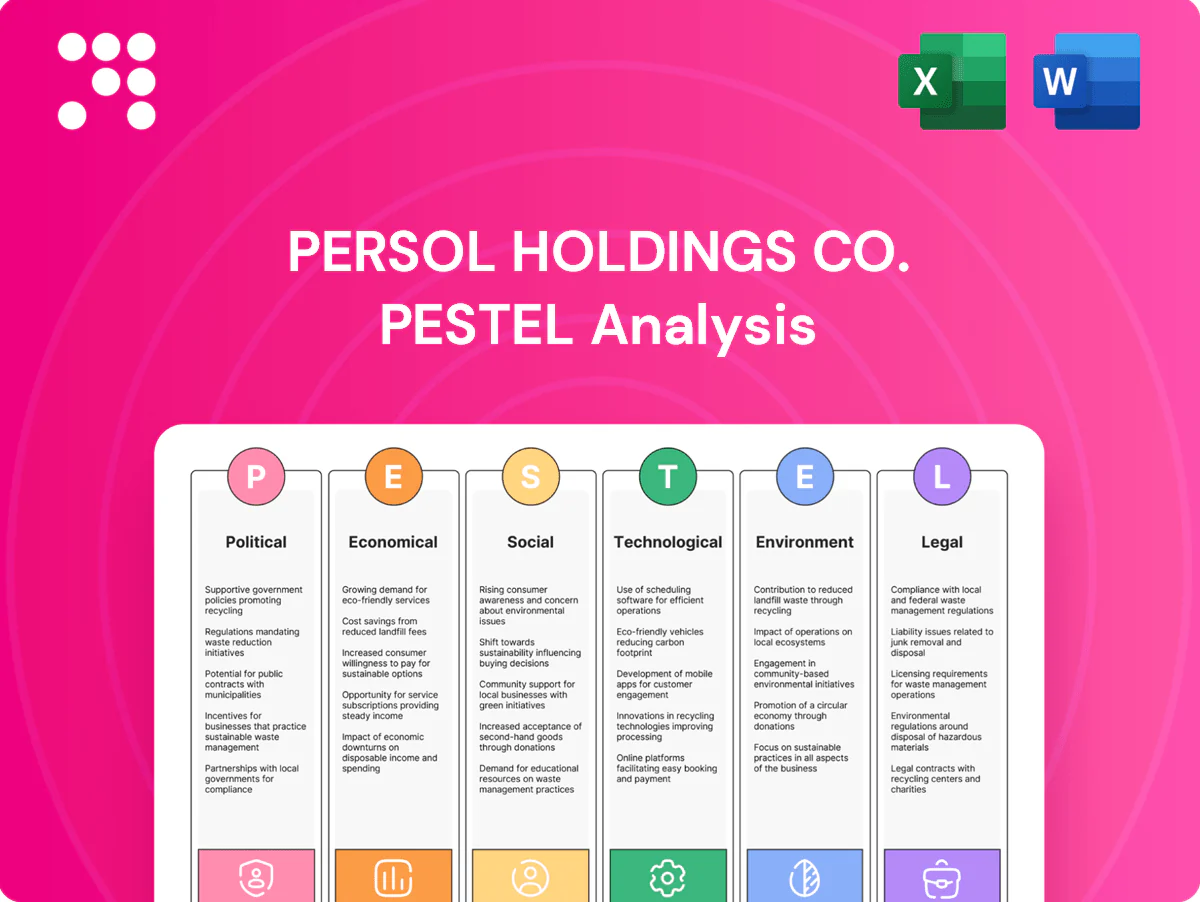
Persol Holdings Co. PESTLE Analysis

Plan Smarter. Present Sharper. Compete Stronger.
Our PESTLE snapshot reveals how regulatory shifts, labor-market dynamics, and digital transformation are reshaping Persol Holdings Co.'s growth prospects. Discover risks and opportunities across political, economic, social, technological, legal, and environmental fronts. Buy the full PESTLE to unlock actionable insights and strategic recommendations tailored for investors and executives.
Political factors

Work-style reform and labor policy direction
Japan’s Work Style Reform caps overtime at 45 hours/month and 360 hours/year (up to 720 in special months), mandates employers ensure at least 5 days of paid leave and enforces equal pay rules, reshaping staffing models. Persol must realign assignment lengths, rates and client advisories to these rules. Compliance tightening raises costs yet increases demand for outsourced staffing; proactive policy engagement can convert compliance advisory into a revenue stream.
Immigration and talent mobility strategy
Government stances on foreign worker visas and specified skilled worker categories directly affect supply for care, manufacturing and IT; easing inflows boosts placement volumes and diversity while tightening increases fulfillment gaps and wage pressure. Persol can build cross-border recruiting pipelines to hedge domestic shortages and diversify talent sources. Policy volatility forces scenario planning across sectors and regions to manage demand shocks.

Public sector digitalization and procurement
Japan’s Digital Agency, created in 2021, and local e-government drives have raised demand for IT contractors and PMO staffing; winning framework agreements (typically 3–5 year contracts) can secure stable multi-year revenue. Procurement rules and intense price competition compress margins, often forcing bids toward low single-digit fee cushions. Track tender cycles (often 1–3 years) and build credentials in cybersecurity and data services to win higher-value lots.

Monetary-fiscal coordination effects
Shifts in BoJ policy normalization and fiscal stimulus have raised demand for construction, green, and digital projects, boosting Persol’s temp and project staffing in 2023–24; Japan core CPI hit about 3.2% in 2023, prompting tighter monetary stance that affects hiring appetite.
- Stimulus-backed projects increase short-term staffing demand
- Rate hikes and subsidy roll-offs can reduce momentum
- Align sector coverage to policy-supported pools (construction, green, digital)
Geopolitics and supply chain realignment
US-China tensions and the US CHIPS Act (about $52.7 billion) plus Japan's multitrillion-yen friend-shoring incentives are accelerating domestic manufacturing, battery and semiconductor investment, driving spikes in technical staffing and training demand while export uncertainty can stall hiring.
- Build specialized talent benches near new industrial clusters
- Plan for rapid upskilling to meet semiconductor/battery roles
- Hedge hiring against export-policy volatility
Japan reforms, visa shifts reprice staffing; CHIPS Act and friend-shoring boost chip/battery hiring
Japan’s Work Style Reform and equal-pay rules force Persol to shorten assignment lengths, raise compliance costs and reprice contracts while increasing demand for outsourced staffing. Visa and skilled-worker policy shifts constrain or expand supply for care, manufacturing and IT; US CHIPS Act 52.7 billion and Japan friend-shoring incentives spur semiconductor/battery staffing. Digital Agency-led IT procurement lifts contract volume but compresses margins.
What is included in the product
 Detailed Word Document
Explores how Political, Economic, Social, Technological, Environmental and Legal forces uniquely affect Persol Holdings — with data-backed trends, region- and industry-specific examples, forward-looking insights and actionable implications to help executives and advisers identify risks, opportunities and strategic responses.

 Customizable Excel Spreadsheet
A concise, PESTLE‑segmented summary of Persol Holdings Co. that clarifies external risks and market positioning for meetings, can be dropped into presentations or planning sessions, annotated for local context, and easily shared across teams to streamline decision-making.
Economic factors

Labor shortages and wage inflation
Aging demographics (65+ ~29% of Japan’s population in 2023) tighten labor supply, lifting demand for Persol’s temp and permanent placement. Wage inflation (~3% nominal wage growth in 2024) supports higher bill rates but can compress margins if not passed through. Persol can protect spreads with pricing analytics and tiered solutions, while upskilling services unlock underutilized talent pools.
Interest rates, yen volatility, and client budgets
Rate normalization and yen swings shape corporate capex and hiring: with BOJ shifting toward modestly positive rates in 2024–25 (policy rates near 0–0.5%), firms reprioritize investment, slowing some hiring cycles. A weak yen (USD/JPY roughly 130–160 since 2022) boosts exporters and manufacturing staffing, while yen strength reverses that effect and reduces overseas earnings when translated. Persol, with ~¥1.1tn group revenue, cushions volatility via sector and geographic diversification.

Cyclical sensitivity of staffing volumes
Temporary staffing is highly cyclical, typically expanding early in recoveries and contracting rapidly in slowdowns, reflecting sensitivity to hiring demand shifts; the global staffing marketplace was roughly $500 billion in 2023 (Staffing Industry Analysts). Monitoring leading indicators such as PMIs and Japan’s job-offers-to-applicants ratio (about 1.29 in 2024, MHLW) guides capacity planning. Counter-cyclical services like outplacement and RPO help stabilize revenue, while flexible cost structures preserve profitability.

Productivity push and outsourcing demand
Firms are driving a productivity push via BPO, MSP and RPO to control costs and address talent scarcity; the global BPO market was valued at USD 245.8 billion in 2023 and is projected to grow at ~8.5% CAGR through 2030, favoring multi-year contracts and platform-based services; Persol can increase client stickiness by bundling analytics and SLA-driven delivery while economic pressure accelerates consolidation toward scaled providers.
- Multi-year contracts: higher renewal rates, predictable revenue
- Analytics + SLA bundling: increases retention and upsell
- Consolidation: clients prefer larger, scale providers
Sectoral shifts: green, digital, healthcare
Growth in renewables, digital transformation and elderly care create resilient hiring pockets for Persol; Japan’s 65+ cohort is about 29% (UN 2023) while healthcare absorbs rising staffing demand and accounted for roughly 11% of Japan’s GDP (OECD 2022).
Building domain-specific talent pools commands premium pricing; Persol’s specialist staffing can capture higher margins as DX and green skills remain scarce.
Training partnerships reduce time-to-fill and upskill pipelines, enabling Persol’s portfolio mix to potentially outgrow GDP by focusing on structural winners.
- Renewables: structural demand
- Digital: premium talent pricing
- Healthcare: ageing tailwind
- Training: lowers fill time
Japan reforms, visa shifts reprice staffing; CHIPS Act and friend-shoring boost chip/battery hiring
Aging population (65+ ~29% in 2023) and 2024 wage growth (~3%) lift demand and pricing for Persol but squeeze margins if not passed through. BOJ normalization (policy ~0–0.5% in 2024–25) and USD/JPY ~130–160 affect hiring, capex and translation of ¥1.1tn group revenue. Staffing cyclicality (global market ~$500bn in 2023) favors counter-cyclical services, BPO growth (USD245.8bn 2023, ~8.5% CAGR) and upskilling.
| Metric | Value |
|---|---|
| Japan 65+ | 29% (2023) |
| Persol revenue | ¥1.1tn |
| Staffing market | $500bn (2023) |
| BPO market | USD245.8bn (2023), ~8.5% CAGR |
| Job-offer/applicant | 1.29 (2024) |
| USD/JPY | ~130–160 (since 2022) |
Preview Before You Purchase
Persol Holdings Co. PESTLE Analysis
Persol Holdings Co. PESTLE analysis examines political, economic, social, technological, legal and environmental factors shaping its staffing and HR services across Japan and APAC. It highlights regulatory risks, labor market trends, digital transformation and sustainability pressures affecting revenue and margins. Strategic implications and mitigation options are provided. The preview shown here is the exact document you’ll receive after purchase—fully formatted and ready to use.

Plan Smarter. Present Sharper. Compete Stronger.
Our PESTLE snapshot reveals how regulatory shifts, labor-market dynamics, and digital transformation are reshaping Persol Holdings Co.'s growth prospects. Discover risks and opportunities across political, economic, social, technological, legal, and environmental fronts. Buy the full PESTLE to unlock actionable insights and strategic recommendations tailored for investors and executives.
Political factors
Work-style reform and labor policy direction
Japan’s Work Style Reform caps overtime at 45 hours/month and 360 hours/year (up to 720 in special months), mandates employers ensure at least 5 days of paid leave and enforces equal pay rules, reshaping staffing models. Persol must realign assignment lengths, rates and client advisories to these rules. Compliance tightening raises costs yet increases demand for outsourced staffing; proactive policy engagement can convert compliance advisory into a revenue stream.
Immigration and talent mobility strategy
Government stances on foreign worker visas and specified skilled worker categories directly affect supply for care, manufacturing and IT; easing inflows boosts placement volumes and diversity while tightening increases fulfillment gaps and wage pressure. Persol can build cross-border recruiting pipelines to hedge domestic shortages and diversify talent sources. Policy volatility forces scenario planning across sectors and regions to manage demand shocks.
Public sector digitalization and procurement
Japan’s Digital Agency, created in 2021, and local e-government drives have raised demand for IT contractors and PMO staffing; winning framework agreements (typically 3–5 year contracts) can secure stable multi-year revenue. Procurement rules and intense price competition compress margins, often forcing bids toward low single-digit fee cushions. Track tender cycles (often 1–3 years) and build credentials in cybersecurity and data services to win higher-value lots.
Monetary-fiscal coordination effects
Shifts in BoJ policy normalization and fiscal stimulus have raised demand for construction, green, and digital projects, boosting Persol’s temp and project staffing in 2023–24; Japan core CPI hit about 3.2% in 2023, prompting tighter monetary stance that affects hiring appetite.
- Stimulus-backed projects increase short-term staffing demand
- Rate hikes and subsidy roll-offs can reduce momentum
- Align sector coverage to policy-supported pools (construction, green, digital)
Geopolitics and supply chain realignment
US-China tensions and the US CHIPS Act (about $52.7 billion) plus Japan's multitrillion-yen friend-shoring incentives are accelerating domestic manufacturing, battery and semiconductor investment, driving spikes in technical staffing and training demand while export uncertainty can stall hiring.
- Build specialized talent benches near new industrial clusters
- Plan for rapid upskilling to meet semiconductor/battery roles
- Hedge hiring against export-policy volatility
Japan reforms, visa shifts reprice staffing; CHIPS Act and friend-shoring boost chip/battery hiring
Japan’s Work Style Reform and equal-pay rules force Persol to shorten assignment lengths, raise compliance costs and reprice contracts while increasing demand for outsourced staffing. Visa and skilled-worker policy shifts constrain or expand supply for care, manufacturing and IT; US CHIPS Act 52.7 billion and Japan friend-shoring incentives spur semiconductor/battery staffing. Digital Agency-led IT procurement lifts contract volume but compresses margins.
What is included in the product
Detailed Word Document
Explores how Political, Economic, Social, Technological, Environmental and Legal forces uniquely affect Persol Holdings — with data-backed trends, region- and industry-specific examples, forward-looking insights and actionable implications to help executives and advisers identify risks, opportunities and strategic responses.
Customizable Excel Spreadsheet
A concise, PESTLE‑segmented summary of Persol Holdings Co. that clarifies external risks and market positioning for meetings, can be dropped into presentations or planning sessions, annotated for local context, and easily shared across teams to streamline decision-making.
Economic factors
Labor shortages and wage inflation
Aging demographics (65+ ~29% of Japan’s population in 2023) tighten labor supply, lifting demand for Persol’s temp and permanent placement. Wage inflation (~3% nominal wage growth in 2024) supports higher bill rates but can compress margins if not passed through. Persol can protect spreads with pricing analytics and tiered solutions, while upskilling services unlock underutilized talent pools.
Interest rates, yen volatility, and client budgets
Rate normalization and yen swings shape corporate capex and hiring: with BOJ shifting toward modestly positive rates in 2024–25 (policy rates near 0–0.5%), firms reprioritize investment, slowing some hiring cycles. A weak yen (USD/JPY roughly 130–160 since 2022) boosts exporters and manufacturing staffing, while yen strength reverses that effect and reduces overseas earnings when translated. Persol, with ~¥1.1tn group revenue, cushions volatility via sector and geographic diversification.
Cyclical sensitivity of staffing volumes
Temporary staffing is highly cyclical, typically expanding early in recoveries and contracting rapidly in slowdowns, reflecting sensitivity to hiring demand shifts; the global staffing marketplace was roughly $500 billion in 2023 (Staffing Industry Analysts). Monitoring leading indicators such as PMIs and Japan’s job-offers-to-applicants ratio (about 1.29 in 2024, MHLW) guides capacity planning. Counter-cyclical services like outplacement and RPO help stabilize revenue, while flexible cost structures preserve profitability.
Productivity push and outsourcing demand
Firms are driving a productivity push via BPO, MSP and RPO to control costs and address talent scarcity; the global BPO market was valued at USD 245.8 billion in 2023 and is projected to grow at ~8.5% CAGR through 2030, favoring multi-year contracts and platform-based services; Persol can increase client stickiness by bundling analytics and SLA-driven delivery while economic pressure accelerates consolidation toward scaled providers.
- Multi-year contracts: higher renewal rates, predictable revenue
- Analytics + SLA bundling: increases retention and upsell
- Consolidation: clients prefer larger, scale providers
Sectoral shifts: green, digital, healthcare
Growth in renewables, digital transformation and elderly care create resilient hiring pockets for Persol; Japan’s 65+ cohort is about 29% (UN 2023) while healthcare absorbs rising staffing demand and accounted for roughly 11% of Japan’s GDP (OECD 2022).
Building domain-specific talent pools commands premium pricing; Persol’s specialist staffing can capture higher margins as DX and green skills remain scarce.
Training partnerships reduce time-to-fill and upskill pipelines, enabling Persol’s portfolio mix to potentially outgrow GDP by focusing on structural winners.
- Renewables: structural demand
- Digital: premium talent pricing
- Healthcare: ageing tailwind
- Training: lowers fill time
Japan reforms, visa shifts reprice staffing; CHIPS Act and friend-shoring boost chip/battery hiring
Aging population (65+ ~29% in 2023) and 2024 wage growth (~3%) lift demand and pricing for Persol but squeeze margins if not passed through. BOJ normalization (policy ~0–0.5% in 2024–25) and USD/JPY ~130–160 affect hiring, capex and translation of ¥1.1tn group revenue. Staffing cyclicality (global market ~$500bn in 2023) favors counter-cyclical services, BPO growth (USD245.8bn 2023, ~8.5% CAGR) and upskilling.
| Metric | Value |
|---|---|
| Japan 65+ | 29% (2023) |
| Persol revenue | ¥1.1tn |
| Staffing market | $500bn (2023) |
| BPO market | USD245.8bn (2023), ~8.5% CAGR |
| Job-offer/applicant | 1.29 (2024) |
| USD/JPY | ~130–160 (since 2022) |
Preview Before You Purchase
Persol Holdings Co. PESTLE Analysis
Persol Holdings Co. PESTLE analysis examines political, economic, social, technological, legal and environmental factors shaping its staffing and HR services across Japan and APAC. It highlights regulatory risks, labor market trends, digital transformation and sustainability pressures affecting revenue and margins. Strategic implications and mitigation options are provided. The preview shown here is the exact document you’ll receive after purchase—fully formatted and ready to use.
Original: $10.00
-65%$10.00
$3.50Description
Plan Smarter. Present Sharper. Compete Stronger.
Our PESTLE snapshot reveals how regulatory shifts, labor-market dynamics, and digital transformation are reshaping Persol Holdings Co.'s growth prospects. Discover risks and opportunities across political, economic, social, technological, legal, and environmental fronts. Buy the full PESTLE to unlock actionable insights and strategic recommendations tailored for investors and executives.
Political factors
Work-style reform and labor policy direction
Japan’s Work Style Reform caps overtime at 45 hours/month and 360 hours/year (up to 720 in special months), mandates employers ensure at least 5 days of paid leave and enforces equal pay rules, reshaping staffing models. Persol must realign assignment lengths, rates and client advisories to these rules. Compliance tightening raises costs yet increases demand for outsourced staffing; proactive policy engagement can convert compliance advisory into a revenue stream.
Immigration and talent mobility strategy
Government stances on foreign worker visas and specified skilled worker categories directly affect supply for care, manufacturing and IT; easing inflows boosts placement volumes and diversity while tightening increases fulfillment gaps and wage pressure. Persol can build cross-border recruiting pipelines to hedge domestic shortages and diversify talent sources. Policy volatility forces scenario planning across sectors and regions to manage demand shocks.
Public sector digitalization and procurement
Japan’s Digital Agency, created in 2021, and local e-government drives have raised demand for IT contractors and PMO staffing; winning framework agreements (typically 3–5 year contracts) can secure stable multi-year revenue. Procurement rules and intense price competition compress margins, often forcing bids toward low single-digit fee cushions. Track tender cycles (often 1–3 years) and build credentials in cybersecurity and data services to win higher-value lots.
Monetary-fiscal coordination effects
Shifts in BoJ policy normalization and fiscal stimulus have raised demand for construction, green, and digital projects, boosting Persol’s temp and project staffing in 2023–24; Japan core CPI hit about 3.2% in 2023, prompting tighter monetary stance that affects hiring appetite.
- Stimulus-backed projects increase short-term staffing demand
- Rate hikes and subsidy roll-offs can reduce momentum
- Align sector coverage to policy-supported pools (construction, green, digital)
Geopolitics and supply chain realignment
US-China tensions and the US CHIPS Act (about $52.7 billion) plus Japan's multitrillion-yen friend-shoring incentives are accelerating domestic manufacturing, battery and semiconductor investment, driving spikes in technical staffing and training demand while export uncertainty can stall hiring.
- Build specialized talent benches near new industrial clusters
- Plan for rapid upskilling to meet semiconductor/battery roles
- Hedge hiring against export-policy volatility
Japan reforms, visa shifts reprice staffing; CHIPS Act and friend-shoring boost chip/battery hiring
Japan’s Work Style Reform and equal-pay rules force Persol to shorten assignment lengths, raise compliance costs and reprice contracts while increasing demand for outsourced staffing. Visa and skilled-worker policy shifts constrain or expand supply for care, manufacturing and IT; US CHIPS Act 52.7 billion and Japan friend-shoring incentives spur semiconductor/battery staffing. Digital Agency-led IT procurement lifts contract volume but compresses margins.
What is included in the product
Detailed Word Document
Explores how Political, Economic, Social, Technological, Environmental and Legal forces uniquely affect Persol Holdings — with data-backed trends, region- and industry-specific examples, forward-looking insights and actionable implications to help executives and advisers identify risks, opportunities and strategic responses.
Customizable Excel Spreadsheet
A concise, PESTLE‑segmented summary of Persol Holdings Co. that clarifies external risks and market positioning for meetings, can be dropped into presentations or planning sessions, annotated for local context, and easily shared across teams to streamline decision-making.
Economic factors
Labor shortages and wage inflation
Aging demographics (65+ ~29% of Japan’s population in 2023) tighten labor supply, lifting demand for Persol’s temp and permanent placement. Wage inflation (~3% nominal wage growth in 2024) supports higher bill rates but can compress margins if not passed through. Persol can protect spreads with pricing analytics and tiered solutions, while upskilling services unlock underutilized talent pools.
Interest rates, yen volatility, and client budgets
Rate normalization and yen swings shape corporate capex and hiring: with BOJ shifting toward modestly positive rates in 2024–25 (policy rates near 0–0.5%), firms reprioritize investment, slowing some hiring cycles. A weak yen (USD/JPY roughly 130–160 since 2022) boosts exporters and manufacturing staffing, while yen strength reverses that effect and reduces overseas earnings when translated. Persol, with ~¥1.1tn group revenue, cushions volatility via sector and geographic diversification.
Cyclical sensitivity of staffing volumes
Temporary staffing is highly cyclical, typically expanding early in recoveries and contracting rapidly in slowdowns, reflecting sensitivity to hiring demand shifts; the global staffing marketplace was roughly $500 billion in 2023 (Staffing Industry Analysts). Monitoring leading indicators such as PMIs and Japan’s job-offers-to-applicants ratio (about 1.29 in 2024, MHLW) guides capacity planning. Counter-cyclical services like outplacement and RPO help stabilize revenue, while flexible cost structures preserve profitability.
Productivity push and outsourcing demand
Firms are driving a productivity push via BPO, MSP and RPO to control costs and address talent scarcity; the global BPO market was valued at USD 245.8 billion in 2023 and is projected to grow at ~8.5% CAGR through 2030, favoring multi-year contracts and platform-based services; Persol can increase client stickiness by bundling analytics and SLA-driven delivery while economic pressure accelerates consolidation toward scaled providers.
- Multi-year contracts: higher renewal rates, predictable revenue
- Analytics + SLA bundling: increases retention and upsell
- Consolidation: clients prefer larger, scale providers
Sectoral shifts: green, digital, healthcare
Growth in renewables, digital transformation and elderly care create resilient hiring pockets for Persol; Japan’s 65+ cohort is about 29% (UN 2023) while healthcare absorbs rising staffing demand and accounted for roughly 11% of Japan’s GDP (OECD 2022).
Building domain-specific talent pools commands premium pricing; Persol’s specialist staffing can capture higher margins as DX and green skills remain scarce.
Training partnerships reduce time-to-fill and upskill pipelines, enabling Persol’s portfolio mix to potentially outgrow GDP by focusing on structural winners.
- Renewables: structural demand
- Digital: premium talent pricing
- Healthcare: ageing tailwind
- Training: lowers fill time
Japan reforms, visa shifts reprice staffing; CHIPS Act and friend-shoring boost chip/battery hiring
Aging population (65+ ~29% in 2023) and 2024 wage growth (~3%) lift demand and pricing for Persol but squeeze margins if not passed through. BOJ normalization (policy ~0–0.5% in 2024–25) and USD/JPY ~130–160 affect hiring, capex and translation of ¥1.1tn group revenue. Staffing cyclicality (global market ~$500bn in 2023) favors counter-cyclical services, BPO growth (USD245.8bn 2023, ~8.5% CAGR) and upskilling.
| Metric | Value |
|---|---|
| Japan 65+ | 29% (2023) |
| Persol revenue | ¥1.1tn |
| Staffing market | $500bn (2023) |
| BPO market | USD245.8bn (2023), ~8.5% CAGR |
| Job-offer/applicant | 1.29 (2024) |
| USD/JPY | ~130–160 (since 2022) |
Preview Before You Purchase
Persol Holdings Co. PESTLE Analysis
Persol Holdings Co. PESTLE analysis examines political, economic, social, technological, legal and environmental factors shaping its staffing and HR services across Japan and APAC. It highlights regulatory risks, labor market trends, digital transformation and sustainability pressures affecting revenue and margins. Strategic implications and mitigation options are provided. The preview shown here is the exact document you’ll receive after purchase—fully formatted and ready to use.











