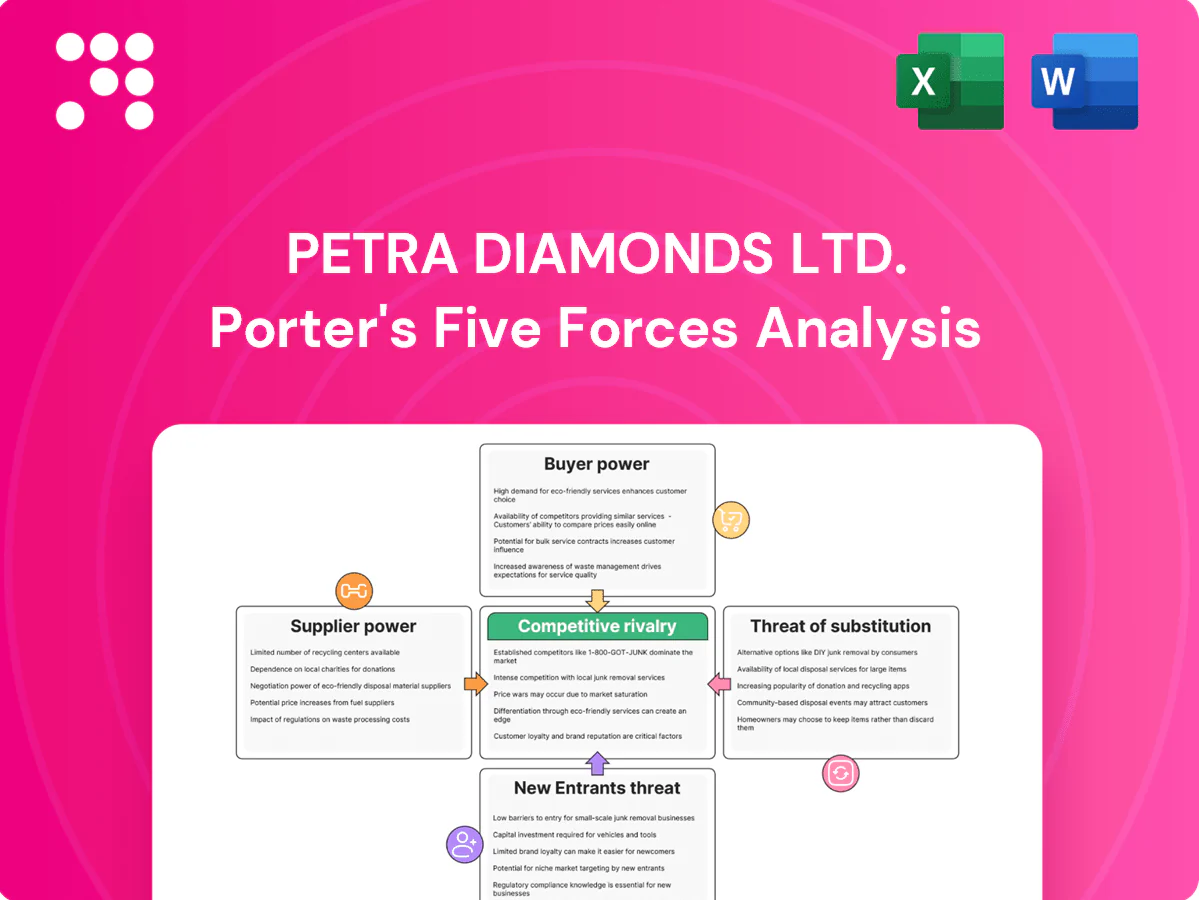
Petra Diamonds Ltd. Porter's Five Forces Analysis

Don't Miss the Bigger Picture
Petra Diamonds Ltd. faces intense buyer scrutiny, concentrated suppliers, and moderate threat from substitutes, while barriers to entry and rivalry hinge on capital intensity and mine access. This snapshot highlights key tensions shaping margins and strategic choices. Unlock the full Porter's Five Forces Analysis to explore Petra Diamonds Ltd.’s competitive dynamics in detail.
Suppliers Bargaining Power

Concentrated mining equipment OEMs
Petra depends on a concentrated group of OEMs (notably Epiroc and Sandvik) for underground fleets, drilling rigs and processing spares, with these suppliers accounting for the majority of underground OEM sales and giving them pricing leverage. Long lead times of 6–12 months and limited alternatives raise switching costs and margin pressure. Multi-year framework agreements (commonly 3–5 years) and predictive maintenance temper volatility. Localizing spares and dual-sourcing critical parts materially reduce disruption risk.
Energy and utilities dependence
Underground operations are highly energy intensive and remain exposed to South Africa’s grid reliability, with load-shedding continuing into 2023–24 (exceeding 2,000 hours in 2023), while rising tariffs have tightened margins; power and fuel suppliers can thus materially affect Petra Diamonds’ cost structure and uptime, increasing supplier power. On-site generation, efficiency programs and load management reduce exposure, and renewable PPAs plus backup capacity strengthen negotiating posture.

Explosives, reagents, and consumables
Explosives, ground support and processing reagents for Petra Diamonds are sourced from a very limited pool of certified vendors, with safety, regulatory and transport constraints further narrowing the base; long-term supply contracts commonly exceed 12 months and can embed annual price escalators. Inventory buffers typically cover 2–3 months of consumption and competitive tenders are used to balance cost and continuity, reducing disruption risk.

Skilled labor and contractors
Specialized underground mining skills for Petra Diamonds are scarce, strengthening supplier power as unions influence wage settlements and work rules, raising operational risk.
Investment in training pipelines and retention programs improves labor supply resilience but raises fixed labor and training costs for Petra.
Use of contractors adds flexibility; in tight labor markets contractors command premiums, while community agreements and local hiring improve social license and reduce disruption risk.
- scarcity: unions increase bargaining power
- training: raises fixed costs
- contractors: flexibility vs premium
- community hiring: boosts resilience
Technology and data systems
Geology software, fleet telemetry and advanced sorting tech create strong vendor lock-in for Petra Diamonds as integrated systems and shared datasets raise barriers to switching; retraining and measured operational risk can exceed 6–9 months of lost productivity. Co-development agreements and performance-based SLAs align incentives and can lower cost-of-failure. Open standards and modular architectures reduce dependency and total cost of ownership.
- Vendor lock-in: integration + data
- Switching cost: retraining, operational risk
- Mitigation: co-development, SLAs
- Long-term fix: open standards, modularity
Supply bottlenecks, 6-12m lead times & 2,000+ hrs outages
Petra faces strong supplier power from concentrated OEMs (lead times 6–12 months, framework deals 3–5 years) and limited reagents/explosives vendors (inventory 2–3 months), while grid reliability (load-shedding >2,000 hours in 2023) and scarce underground skills (retraining 6–9 months) increase costs and disruption risk; mitigation includes local spares, on-site generation, contractors and co-development SLAs.
| Metric | Value |
|---|---|
| OEM lead time | 6–12 months |
| Framework length | 3–5 yrs |
| Inventory cover | 2–3 months |
| Retrain downtime | 6–9 months |
What is included in the product
 Detailed Word Document
Uncovers key drivers of competition, customer influence, and market entry risks tailored to Petra Diamonds Ltd., evaluating supplier and buyer power, substitution threats, and barriers protecting incumbency.

 Customizable Excel Spreadsheet
A concise Porter's Five Forces one-sheet for Petra Diamonds Ltd.—instantly visualizing competitive pressures with a spider chart and customizable force levels to relieve analysis bottlenecks and slot directly into pitch decks or board reports.
Customers Bargaining Power

Concentrated midstream buyers
Rough diamonds are sold to a relatively concentrated set of traders, manufacturers and sightholders—dozens of specialist buyers whose ability to defer purchases raises bargaining power in weak markets. Tenders and auctions improve price discovery but tie Petra to volatile demand cycles and periodic price corrections. Expanding tenders, private sales and broadening the customer mix has moderated buyer pressure in recent years.
Price sensitivity and financing constraints
Midstream buyers exhibit high price sensitivity tied to credit availability and inventory cycles, typically managing 3-6 months of stock; when financing tightens they press harder on prices and assortments. Tight credit amplifies discounting and demand for flexible lot mixes, forcing sellers to offer extended payment terms to sustain volumes. Those terms transfer cashflow and price risk back to Petra. Demonstrable compliance and provenance for premium parcels can command higher prices despite buyer pressure.

Traceability and ESG demands
Buyers increasingly demand provenance, ethical sourcing and auditability, pushing Petra Diamonds to invest in traceability systems that raise unit costs but can justify premium pricing and lower substitution risk.

Product differentiation by quality mix
Petra’s realized value hinges on size, colour, clarity and recovery of special stones; in 2024 Petra produced c.2.06 million carats, with specials driving outsized revenue and lowering buyer leverage due to scarcity, while run-of-mine parcels faced deeper negotiation and discounts. Better recovery and sorting raised average prices per parcel, and data-rich parceling in 2024 improved matching to buyer preferences, reducing discounting.
- Size-driven scarcity reduces buyer power
- Run-of-mine parcels = higher negotiation, larger discounts
- Improved recovery/sorting increases realized prices
- 2024 focus on data-led parceling cut mismatch discounts
Alternative sourcing options
Buyers can shift to competing producers or secondary markets (auctions, traders), increasing leverage in Petra Diamonds tenders as similar assortments are available; this forces price concessions and shorter contract windows. Long-term offtakes provide price stability for Petra but cap upside during market rallies, while strong relationship management and reliable logistics help retain wallet share.
- Alternative sourcing: auctions, traders
- Assortment parity increases tender leverage
- Offtakes stabilize but limit upside
- Service & relationships protect share
Scarcity lifts premiums despite buyer leverage and 3–6 months inventory
Buyers hold moderate-to-high bargaining power due to concentrated midstream demand, 3–6 months typical inventory and ready alternative sourcing (auctions, traders), pressuring prices in weak markets. Scarcity of specials (Petra 2024 production c.2.06m carats) reduces buyer leverage for premium lots, while provenance requirements raise costs but can secure premiums. Offtakes add stability but cap upside.
| Metric | 2024 / Note |
|---|---|
| Production (carats) | c.2.06m |
| Buyer inventory | 3–6 months |
| Key buyer levers | Auctions, traders, financing |
Preview the Actual Deliverable
Petra Diamonds Ltd. Porter's Five Forces Analysis
This preview shows the exact document you'll receive immediately after purchase—no surprises. The Petra Diamonds Porter's Five Forces analysis assesses intense competitive rivalry in diamond mining, moderate supplier power, significant buyer influence from polished-diamond markets, low threat of new entrants due to capital and licensing barriers, and rising substitute pressure from lab-grown diamonds.

Don't Miss the Bigger Picture
Petra Diamonds Ltd. faces intense buyer scrutiny, concentrated suppliers, and moderate threat from substitutes, while barriers to entry and rivalry hinge on capital intensity and mine access. This snapshot highlights key tensions shaping margins and strategic choices. Unlock the full Porter's Five Forces Analysis to explore Petra Diamonds Ltd.’s competitive dynamics in detail.
Suppliers Bargaining Power
Concentrated mining equipment OEMs
Petra depends on a concentrated group of OEMs (notably Epiroc and Sandvik) for underground fleets, drilling rigs and processing spares, with these suppliers accounting for the majority of underground OEM sales and giving them pricing leverage. Long lead times of 6–12 months and limited alternatives raise switching costs and margin pressure. Multi-year framework agreements (commonly 3–5 years) and predictive maintenance temper volatility. Localizing spares and dual-sourcing critical parts materially reduce disruption risk.
Energy and utilities dependence
Underground operations are highly energy intensive and remain exposed to South Africa’s grid reliability, with load-shedding continuing into 2023–24 (exceeding 2,000 hours in 2023), while rising tariffs have tightened margins; power and fuel suppliers can thus materially affect Petra Diamonds’ cost structure and uptime, increasing supplier power. On-site generation, efficiency programs and load management reduce exposure, and renewable PPAs plus backup capacity strengthen negotiating posture.
Explosives, reagents, and consumables
Explosives, ground support and processing reagents for Petra Diamonds are sourced from a very limited pool of certified vendors, with safety, regulatory and transport constraints further narrowing the base; long-term supply contracts commonly exceed 12 months and can embed annual price escalators. Inventory buffers typically cover 2–3 months of consumption and competitive tenders are used to balance cost and continuity, reducing disruption risk.
Skilled labor and contractors
Specialized underground mining skills for Petra Diamonds are scarce, strengthening supplier power as unions influence wage settlements and work rules, raising operational risk.
Investment in training pipelines and retention programs improves labor supply resilience but raises fixed labor and training costs for Petra.
Use of contractors adds flexibility; in tight labor markets contractors command premiums, while community agreements and local hiring improve social license and reduce disruption risk.
- scarcity: unions increase bargaining power
- training: raises fixed costs
- contractors: flexibility vs premium
- community hiring: boosts resilience
Technology and data systems
Geology software, fleet telemetry and advanced sorting tech create strong vendor lock-in for Petra Diamonds as integrated systems and shared datasets raise barriers to switching; retraining and measured operational risk can exceed 6–9 months of lost productivity. Co-development agreements and performance-based SLAs align incentives and can lower cost-of-failure. Open standards and modular architectures reduce dependency and total cost of ownership.
- Vendor lock-in: integration + data
- Switching cost: retraining, operational risk
- Mitigation: co-development, SLAs
- Long-term fix: open standards, modularity
Supply bottlenecks, 6-12m lead times & 2,000+ hrs outages
Petra faces strong supplier power from concentrated OEMs (lead times 6–12 months, framework deals 3–5 years) and limited reagents/explosives vendors (inventory 2–3 months), while grid reliability (load-shedding >2,000 hours in 2023) and scarce underground skills (retraining 6–9 months) increase costs and disruption risk; mitigation includes local spares, on-site generation, contractors and co-development SLAs.
| Metric | Value |
|---|---|
| OEM lead time | 6–12 months |
| Framework length | 3–5 yrs |
| Inventory cover | 2–3 months |
| Retrain downtime | 6–9 months |
What is included in the product
Detailed Word Document
Uncovers key drivers of competition, customer influence, and market entry risks tailored to Petra Diamonds Ltd., evaluating supplier and buyer power, substitution threats, and barriers protecting incumbency.
Customizable Excel Spreadsheet
A concise Porter's Five Forces one-sheet for Petra Diamonds Ltd.—instantly visualizing competitive pressures with a spider chart and customizable force levels to relieve analysis bottlenecks and slot directly into pitch decks or board reports.
Customers Bargaining Power
Concentrated midstream buyers
Rough diamonds are sold to a relatively concentrated set of traders, manufacturers and sightholders—dozens of specialist buyers whose ability to defer purchases raises bargaining power in weak markets. Tenders and auctions improve price discovery but tie Petra to volatile demand cycles and periodic price corrections. Expanding tenders, private sales and broadening the customer mix has moderated buyer pressure in recent years.
Price sensitivity and financing constraints
Midstream buyers exhibit high price sensitivity tied to credit availability and inventory cycles, typically managing 3-6 months of stock; when financing tightens they press harder on prices and assortments. Tight credit amplifies discounting and demand for flexible lot mixes, forcing sellers to offer extended payment terms to sustain volumes. Those terms transfer cashflow and price risk back to Petra. Demonstrable compliance and provenance for premium parcels can command higher prices despite buyer pressure.
Traceability and ESG demands
Buyers increasingly demand provenance, ethical sourcing and auditability, pushing Petra Diamonds to invest in traceability systems that raise unit costs but can justify premium pricing and lower substitution risk.
Product differentiation by quality mix
Petra’s realized value hinges on size, colour, clarity and recovery of special stones; in 2024 Petra produced c.2.06 million carats, with specials driving outsized revenue and lowering buyer leverage due to scarcity, while run-of-mine parcels faced deeper negotiation and discounts. Better recovery and sorting raised average prices per parcel, and data-rich parceling in 2024 improved matching to buyer preferences, reducing discounting.
- Size-driven scarcity reduces buyer power
- Run-of-mine parcels = higher negotiation, larger discounts
- Improved recovery/sorting increases realized prices
- 2024 focus on data-led parceling cut mismatch discounts
Alternative sourcing options
Buyers can shift to competing producers or secondary markets (auctions, traders), increasing leverage in Petra Diamonds tenders as similar assortments are available; this forces price concessions and shorter contract windows. Long-term offtakes provide price stability for Petra but cap upside during market rallies, while strong relationship management and reliable logistics help retain wallet share.
- Alternative sourcing: auctions, traders
- Assortment parity increases tender leverage
- Offtakes stabilize but limit upside
- Service & relationships protect share
Scarcity lifts premiums despite buyer leverage and 3–6 months inventory
Buyers hold moderate-to-high bargaining power due to concentrated midstream demand, 3–6 months typical inventory and ready alternative sourcing (auctions, traders), pressuring prices in weak markets. Scarcity of specials (Petra 2024 production c.2.06m carats) reduces buyer leverage for premium lots, while provenance requirements raise costs but can secure premiums. Offtakes add stability but cap upside.
| Metric | 2024 / Note |
|---|---|
| Production (carats) | c.2.06m |
| Buyer inventory | 3–6 months |
| Key buyer levers | Auctions, traders, financing |
Preview the Actual Deliverable
Petra Diamonds Ltd. Porter's Five Forces Analysis
This preview shows the exact document you'll receive immediately after purchase—no surprises. The Petra Diamonds Porter's Five Forces analysis assesses intense competitive rivalry in diamond mining, moderate supplier power, significant buyer influence from polished-diamond markets, low threat of new entrants due to capital and licensing barriers, and rising substitute pressure from lab-grown diamonds.
Original: $10.00
-65%$10.00
$3.50Description
Don't Miss the Bigger Picture
Petra Diamonds Ltd. faces intense buyer scrutiny, concentrated suppliers, and moderate threat from substitutes, while barriers to entry and rivalry hinge on capital intensity and mine access. This snapshot highlights key tensions shaping margins and strategic choices. Unlock the full Porter's Five Forces Analysis to explore Petra Diamonds Ltd.’s competitive dynamics in detail.
Suppliers Bargaining Power
Concentrated mining equipment OEMs
Petra depends on a concentrated group of OEMs (notably Epiroc and Sandvik) for underground fleets, drilling rigs and processing spares, with these suppliers accounting for the majority of underground OEM sales and giving them pricing leverage. Long lead times of 6–12 months and limited alternatives raise switching costs and margin pressure. Multi-year framework agreements (commonly 3–5 years) and predictive maintenance temper volatility. Localizing spares and dual-sourcing critical parts materially reduce disruption risk.
Energy and utilities dependence
Underground operations are highly energy intensive and remain exposed to South Africa’s grid reliability, with load-shedding continuing into 2023–24 (exceeding 2,000 hours in 2023), while rising tariffs have tightened margins; power and fuel suppliers can thus materially affect Petra Diamonds’ cost structure and uptime, increasing supplier power. On-site generation, efficiency programs and load management reduce exposure, and renewable PPAs plus backup capacity strengthen negotiating posture.
Explosives, reagents, and consumables
Explosives, ground support and processing reagents for Petra Diamonds are sourced from a very limited pool of certified vendors, with safety, regulatory and transport constraints further narrowing the base; long-term supply contracts commonly exceed 12 months and can embed annual price escalators. Inventory buffers typically cover 2–3 months of consumption and competitive tenders are used to balance cost and continuity, reducing disruption risk.
Skilled labor and contractors
Specialized underground mining skills for Petra Diamonds are scarce, strengthening supplier power as unions influence wage settlements and work rules, raising operational risk.
Investment in training pipelines and retention programs improves labor supply resilience but raises fixed labor and training costs for Petra.
Use of contractors adds flexibility; in tight labor markets contractors command premiums, while community agreements and local hiring improve social license and reduce disruption risk.
- scarcity: unions increase bargaining power
- training: raises fixed costs
- contractors: flexibility vs premium
- community hiring: boosts resilience
Technology and data systems
Geology software, fleet telemetry and advanced sorting tech create strong vendor lock-in for Petra Diamonds as integrated systems and shared datasets raise barriers to switching; retraining and measured operational risk can exceed 6–9 months of lost productivity. Co-development agreements and performance-based SLAs align incentives and can lower cost-of-failure. Open standards and modular architectures reduce dependency and total cost of ownership.
- Vendor lock-in: integration + data
- Switching cost: retraining, operational risk
- Mitigation: co-development, SLAs
- Long-term fix: open standards, modularity
Supply bottlenecks, 6-12m lead times & 2,000+ hrs outages
Petra faces strong supplier power from concentrated OEMs (lead times 6–12 months, framework deals 3–5 years) and limited reagents/explosives vendors (inventory 2–3 months), while grid reliability (load-shedding >2,000 hours in 2023) and scarce underground skills (retraining 6–9 months) increase costs and disruption risk; mitigation includes local spares, on-site generation, contractors and co-development SLAs.
| Metric | Value |
|---|---|
| OEM lead time | 6–12 months |
| Framework length | 3–5 yrs |
| Inventory cover | 2–3 months |
| Retrain downtime | 6–9 months |
What is included in the product
Detailed Word Document
Uncovers key drivers of competition, customer influence, and market entry risks tailored to Petra Diamonds Ltd., evaluating supplier and buyer power, substitution threats, and barriers protecting incumbency.
Customizable Excel Spreadsheet
A concise Porter's Five Forces one-sheet for Petra Diamonds Ltd.—instantly visualizing competitive pressures with a spider chart and customizable force levels to relieve analysis bottlenecks and slot directly into pitch decks or board reports.
Customers Bargaining Power
Concentrated midstream buyers
Rough diamonds are sold to a relatively concentrated set of traders, manufacturers and sightholders—dozens of specialist buyers whose ability to defer purchases raises bargaining power in weak markets. Tenders and auctions improve price discovery but tie Petra to volatile demand cycles and periodic price corrections. Expanding tenders, private sales and broadening the customer mix has moderated buyer pressure in recent years.
Price sensitivity and financing constraints
Midstream buyers exhibit high price sensitivity tied to credit availability and inventory cycles, typically managing 3-6 months of stock; when financing tightens they press harder on prices and assortments. Tight credit amplifies discounting and demand for flexible lot mixes, forcing sellers to offer extended payment terms to sustain volumes. Those terms transfer cashflow and price risk back to Petra. Demonstrable compliance and provenance for premium parcels can command higher prices despite buyer pressure.
Traceability and ESG demands
Buyers increasingly demand provenance, ethical sourcing and auditability, pushing Petra Diamonds to invest in traceability systems that raise unit costs but can justify premium pricing and lower substitution risk.
Product differentiation by quality mix
Petra’s realized value hinges on size, colour, clarity and recovery of special stones; in 2024 Petra produced c.2.06 million carats, with specials driving outsized revenue and lowering buyer leverage due to scarcity, while run-of-mine parcels faced deeper negotiation and discounts. Better recovery and sorting raised average prices per parcel, and data-rich parceling in 2024 improved matching to buyer preferences, reducing discounting.
- Size-driven scarcity reduces buyer power
- Run-of-mine parcels = higher negotiation, larger discounts
- Improved recovery/sorting increases realized prices
- 2024 focus on data-led parceling cut mismatch discounts
Alternative sourcing options
Buyers can shift to competing producers or secondary markets (auctions, traders), increasing leverage in Petra Diamonds tenders as similar assortments are available; this forces price concessions and shorter contract windows. Long-term offtakes provide price stability for Petra but cap upside during market rallies, while strong relationship management and reliable logistics help retain wallet share.
- Alternative sourcing: auctions, traders
- Assortment parity increases tender leverage
- Offtakes stabilize but limit upside
- Service & relationships protect share
Scarcity lifts premiums despite buyer leverage and 3–6 months inventory
Buyers hold moderate-to-high bargaining power due to concentrated midstream demand, 3–6 months typical inventory and ready alternative sourcing (auctions, traders), pressuring prices in weak markets. Scarcity of specials (Petra 2024 production c.2.06m carats) reduces buyer leverage for premium lots, while provenance requirements raise costs but can secure premiums. Offtakes add stability but cap upside.
| Metric | 2024 / Note |
|---|---|
| Production (carats) | c.2.06m |
| Buyer inventory | 3–6 months |
| Key buyer levers | Auctions, traders, financing |
Preview the Actual Deliverable
Petra Diamonds Ltd. Porter's Five Forces Analysis
This preview shows the exact document you'll receive immediately after purchase—no surprises. The Petra Diamonds Porter's Five Forces analysis assesses intense competitive rivalry in diamond mining, moderate supplier power, significant buyer influence from polished-diamond markets, low threat of new entrants due to capital and licensing barriers, and rising substitute pressure from lab-grown diamonds.











