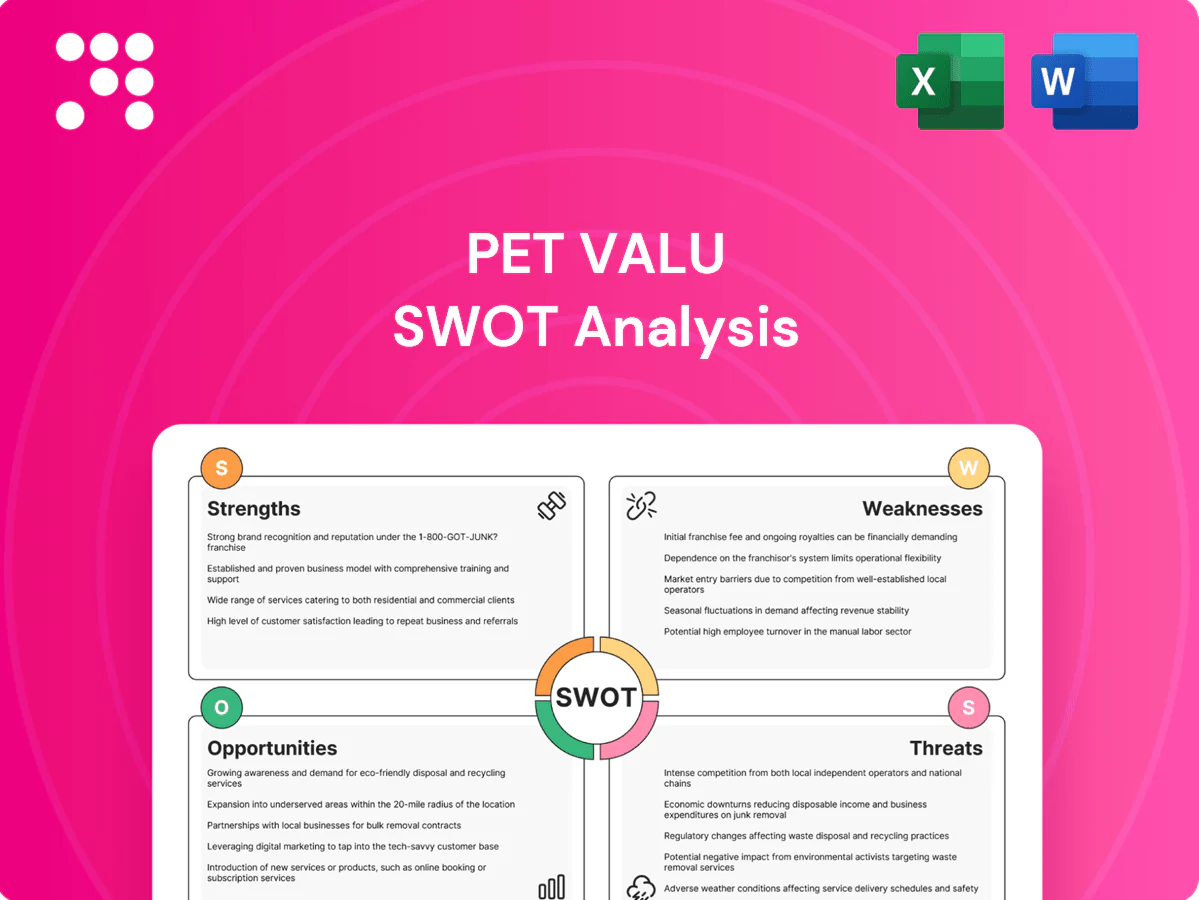
Pet Valu SWOT Analysis

Your Strategic Toolkit Starts Here
Pet Valu’s SWOT analysis highlights a strong brand presence and franchise network, counterbalanced by competitive pressure and supply-chain risks. This concise overview flags growth opportunities in omnichannel expansion and private-label products. Want the full story behind strengths, risks, and growth drivers? Purchase the complete SWOT analysis for a professionally written, editable report to inform strategy and investment decisions.
Strengths

Nationwide specialty footprint
Pet Valu’s nationwide specialty footprint—with over 600 stores across Canada—offers convenient local access for pet owners and differentiates the chain from general merchandisers through dedicated pet assortments. The focused product mix supports repeat traffic and community engagement via in-store services and events. Scale enables regional procurement leverage and unified marketing campaigns, lowering unit costs and amplifying brand reach.
Premium and private label mix
Pet Valu’s emphasis on premium and super-premium nutrition attracts higher-spending customers, aligning with a premium pet food segment that grew about 7.5% in 2024. Proprietary private-label assortments boost gross margins—typically 15–25% above national brands—and drive repeat purchases. Curated ranges address protein, grain-free and veterinary diets, and mix optimization across tiers improves resilience to price shifts.

Hybrid corporate–franchise model
The hybrid corporate–franchise model has enabled rapid expansion with lower capital intensity, supporting over 600 Pet Valu locations across North America as of 2024 and accelerating store roll‑out through franchisee-funded capex. Local owner‑operators provide stronger community ties and higher service quality, while corporate stores preserve strategic control and allow best‑practice testing. Shared systems and centralized purchasing improve scalability and unit economics via volume leverage and lower per‑unit costs.

Strong brand and loyal community
Pet Valu is one of the most recognized names in Canada’s pet specialty market, with strong storefront visibility and national reach; its loyalty program and frequent community events drive measurable repeat visits and basket growth. Trust is reinforced by knowledgeable store staff and advice-driven selling that increases attachment rates, while word-of-mouth and formal rescue partnerships bolster brand equity and local goodwill.
- National brand recognition
- Loyalty program driving repeat visits
- Advice-driven sales by trained staff
- Rescue partnerships enhancing reputation
Omnichannel and service ecosystem
- Omnichannel: e-commerce + click-and-collect + delivery
- Services: grooming/self-wash increase frequency
- Cross-sell: services → consumables uplift
- Data: omnichannel insights improve promos/merch
600+ stores, premium segment ~7.5% growth (2024); private‑label margins 15–25%
Pet Valu’s >600 stores (2024) and specialty assortment drive convenience, repeat traffic and local engagement. Premium/super‑premium pet food segment grew ~7.5% in 2024, supporting higher AOVs; private‑label margins run ~15–25% above national brands. Hybrid corporate‑franchise model lowers capex and scales purchasing; omnichannel (e‑commerce + click‑and‑collect) raises frequency and data capture.
| Metric | Value |
|---|---|
| Store count (2024) | >600 |
| Premium segment growth (2024) | ~7.5% |
| Private‑label margin uplift | 15–25% |
| Omnichannel | E‑commerce + click‑&‑collect |
What is included in the product
 Detailed Word Document
Delivers a strategic overview of Pet Valu’s internal and external business factors, outlining strengths, weaknesses, opportunities and threats to assess competitive position, growth drivers, operational gaps and market risks.

 Customizable Excel Spreadsheet
Provides a concise Pet Valu SWOT matrix for fast, visual strategy alignment and executive snapshot; editable format enables quick updates to reflect shifting market trends, franchise dynamics, and competitive pressures.
Weaknesses

Canada-only concentration
Operating almost exclusively in Canada—with over 600 stores concentrated domestically—creates revenue concentration risk as Pet Valu earns the majority of sales from one market.
This leaves the company exposed to Canadian economic cycles and consumer confidence; the Bank of Canada policy rate hovered near 5% through 2024, tightening household budgets.
Cold-weather and regional seasonality (spikes in spring/summer grooming and holiday pet spending) amplify volatility, limiting the diversification benefits available to multinational peers.
Franchise consistency challenges
Franchise consistency challenges manifest as variability in execution, service quality and merchandising across Pet Valu’s network of over 700 franchised stores (2024), forcing centralized oversight and recurring training investments to maintain standards. These compliance and training programs increase SG&A and franchise support costs while underperforming locations create measurable brand risk and depress systemwide same-store sales. Complex franchised governance slows rapid rollout of systemwide promotions, technology and product assortments.

Scale gap vs big-box and online
Pet Valu faces a scale gap versus mass retailers and e-commerce giants: Walmart reported US$611B revenue in FY2024 and Amazon’s platform drives a multi‑billion ad business, giving them superior purchasing leverage and logistics density. That squeezes pricing and creates consumer expectations for low/no shipping fees and 1–2 day delivery as e‑commerce reached ~18% of retail sales (2024). National media and digital ad budgets favor big players, and rising last‑mile costs (~US$12/parcel) add cost headwinds.

Supplier and category dependence
Pet Valu relies heavily on a few major pet-food brands and limited specialty-diet suppliers, leaving it exposed to vendor pricing shifts, allocations and reformulations that can compress margins and reduce assortment appeal; SKU rationalization by manufacturers can remove traffic-driving SKUs, while recalls in high-volume wet/dry food categories can sharply dent sales and store traffic.
- High supplier concentration
- Pricing and allocation vulnerability
- SKU cuts reduce traffic
- Recall risk in core categories
Real estate and labor intensity
Pet Valu’s network of over 600 stores concentrates lease risk in prime retail corridors, exposing the chain to escalating rents in high-traffic malls and strip centres; recent urban retail rent pressures have raised occupancy costs. The business relies on knowledgeable staff for advisory selling, driving elevated training and retention expenses, while wage inflation (around 4% in 2024) compresses margins.
- Lease exposure: over 600 store leases
- Staff dependence: advisory selling requires skilled hires
- Costs: ongoing training and retention spend
- Margin pressure: ~4% wage inflation in 2024
Canada-focused pet retailer faces margin squeeze from scale, franchise mix and rising costs
Pet Valu’s domestic focus (>600 stores in Canada, 2024) concentrates revenue and macro risk amid a ~5% Bank of Canada policy rate and ~18% e‑commerce penetration (2024). Franchise variability across ~700 franchised locations raises compliance, SG&A and brand risk while limiting rapid tech/promotional rollout. Scale and supplier concentration versus giants (Walmart US$611B FY2024) compress margins; wage inflation ~4% and ~$12 last‑mile costs add pressure.
| Metric | 2024/2025 |
|---|---|
| Stores (Canada) | >600 |
| Franchised | ~700 |
| BoC rate | ~5% |
| E‑commerce share | ~18% |
| Wage inflation | ~4% |
Preview the Actual Deliverable
Pet Valu SWOT Analysis
This is the actual SWOT analysis document you’ll receive upon purchase—no surprises, just professional quality. The preview below is taken directly from the full SWOT report you'll get; purchase unlocks the editable, complete version. You’re viewing a live preview of the real file and the full, detailed report becomes available after checkout.

Your Strategic Toolkit Starts Here
Pet Valu’s SWOT analysis highlights a strong brand presence and franchise network, counterbalanced by competitive pressure and supply-chain risks. This concise overview flags growth opportunities in omnichannel expansion and private-label products. Want the full story behind strengths, risks, and growth drivers? Purchase the complete SWOT analysis for a professionally written, editable report to inform strategy and investment decisions.
Strengths
Nationwide specialty footprint
Pet Valu’s nationwide specialty footprint—with over 600 stores across Canada—offers convenient local access for pet owners and differentiates the chain from general merchandisers through dedicated pet assortments. The focused product mix supports repeat traffic and community engagement via in-store services and events. Scale enables regional procurement leverage and unified marketing campaigns, lowering unit costs and amplifying brand reach.
Premium and private label mix
Pet Valu’s emphasis on premium and super-premium nutrition attracts higher-spending customers, aligning with a premium pet food segment that grew about 7.5% in 2024. Proprietary private-label assortments boost gross margins—typically 15–25% above national brands—and drive repeat purchases. Curated ranges address protein, grain-free and veterinary diets, and mix optimization across tiers improves resilience to price shifts.
Hybrid corporate–franchise model
The hybrid corporate–franchise model has enabled rapid expansion with lower capital intensity, supporting over 600 Pet Valu locations across North America as of 2024 and accelerating store roll‑out through franchisee-funded capex. Local owner‑operators provide stronger community ties and higher service quality, while corporate stores preserve strategic control and allow best‑practice testing. Shared systems and centralized purchasing improve scalability and unit economics via volume leverage and lower per‑unit costs.
Strong brand and loyal community
Pet Valu is one of the most recognized names in Canada’s pet specialty market, with strong storefront visibility and national reach; its loyalty program and frequent community events drive measurable repeat visits and basket growth. Trust is reinforced by knowledgeable store staff and advice-driven selling that increases attachment rates, while word-of-mouth and formal rescue partnerships bolster brand equity and local goodwill.
- National brand recognition
- Loyalty program driving repeat visits
- Advice-driven sales by trained staff
- Rescue partnerships enhancing reputation
Omnichannel and service ecosystem
- Omnichannel: e-commerce + click-and-collect + delivery
- Services: grooming/self-wash increase frequency
- Cross-sell: services → consumables uplift
- Data: omnichannel insights improve promos/merch
600+ stores, premium segment ~7.5% growth (2024); private‑label margins 15–25%
Pet Valu’s >600 stores (2024) and specialty assortment drive convenience, repeat traffic and local engagement. Premium/super‑premium pet food segment grew ~7.5% in 2024, supporting higher AOVs; private‑label margins run ~15–25% above national brands. Hybrid corporate‑franchise model lowers capex and scales purchasing; omnichannel (e‑commerce + click‑and‑collect) raises frequency and data capture.
| Metric | Value |
|---|---|
| Store count (2024) | >600 |
| Premium segment growth (2024) | ~7.5% |
| Private‑label margin uplift | 15–25% |
| Omnichannel | E‑commerce + click‑&‑collect |
What is included in the product
Detailed Word Document
Delivers a strategic overview of Pet Valu’s internal and external business factors, outlining strengths, weaknesses, opportunities and threats to assess competitive position, growth drivers, operational gaps and market risks.
Customizable Excel Spreadsheet
Provides a concise Pet Valu SWOT matrix for fast, visual strategy alignment and executive snapshot; editable format enables quick updates to reflect shifting market trends, franchise dynamics, and competitive pressures.
Weaknesses
Canada-only concentration
Operating almost exclusively in Canada—with over 600 stores concentrated domestically—creates revenue concentration risk as Pet Valu earns the majority of sales from one market.
This leaves the company exposed to Canadian economic cycles and consumer confidence; the Bank of Canada policy rate hovered near 5% through 2024, tightening household budgets.
Cold-weather and regional seasonality (spikes in spring/summer grooming and holiday pet spending) amplify volatility, limiting the diversification benefits available to multinational peers.
Franchise consistency challenges
Franchise consistency challenges manifest as variability in execution, service quality and merchandising across Pet Valu’s network of over 700 franchised stores (2024), forcing centralized oversight and recurring training investments to maintain standards. These compliance and training programs increase SG&A and franchise support costs while underperforming locations create measurable brand risk and depress systemwide same-store sales. Complex franchised governance slows rapid rollout of systemwide promotions, technology and product assortments.
Scale gap vs big-box and online
Pet Valu faces a scale gap versus mass retailers and e-commerce giants: Walmart reported US$611B revenue in FY2024 and Amazon’s platform drives a multi‑billion ad business, giving them superior purchasing leverage and logistics density. That squeezes pricing and creates consumer expectations for low/no shipping fees and 1–2 day delivery as e‑commerce reached ~18% of retail sales (2024). National media and digital ad budgets favor big players, and rising last‑mile costs (~US$12/parcel) add cost headwinds.
Supplier and category dependence
Pet Valu relies heavily on a few major pet-food brands and limited specialty-diet suppliers, leaving it exposed to vendor pricing shifts, allocations and reformulations that can compress margins and reduce assortment appeal; SKU rationalization by manufacturers can remove traffic-driving SKUs, while recalls in high-volume wet/dry food categories can sharply dent sales and store traffic.
- High supplier concentration
- Pricing and allocation vulnerability
- SKU cuts reduce traffic
- Recall risk in core categories
Real estate and labor intensity
Pet Valu’s network of over 600 stores concentrates lease risk in prime retail corridors, exposing the chain to escalating rents in high-traffic malls and strip centres; recent urban retail rent pressures have raised occupancy costs. The business relies on knowledgeable staff for advisory selling, driving elevated training and retention expenses, while wage inflation (around 4% in 2024) compresses margins.
- Lease exposure: over 600 store leases
- Staff dependence: advisory selling requires skilled hires
- Costs: ongoing training and retention spend
- Margin pressure: ~4% wage inflation in 2024
Canada-focused pet retailer faces margin squeeze from scale, franchise mix and rising costs
Pet Valu’s domestic focus (>600 stores in Canada, 2024) concentrates revenue and macro risk amid a ~5% Bank of Canada policy rate and ~18% e‑commerce penetration (2024). Franchise variability across ~700 franchised locations raises compliance, SG&A and brand risk while limiting rapid tech/promotional rollout. Scale and supplier concentration versus giants (Walmart US$611B FY2024) compress margins; wage inflation ~4% and ~$12 last‑mile costs add pressure.
| Metric | 2024/2025 |
|---|---|
| Stores (Canada) | >600 |
| Franchised | ~700 |
| BoC rate | ~5% |
| E‑commerce share | ~18% |
| Wage inflation | ~4% |
Preview the Actual Deliverable
Pet Valu SWOT Analysis
This is the actual SWOT analysis document you’ll receive upon purchase—no surprises, just professional quality. The preview below is taken directly from the full SWOT report you'll get; purchase unlocks the editable, complete version. You’re viewing a live preview of the real file and the full, detailed report becomes available after checkout.
Original: $10.00
-65%$10.00
$3.50Description
Your Strategic Toolkit Starts Here
Pet Valu’s SWOT analysis highlights a strong brand presence and franchise network, counterbalanced by competitive pressure and supply-chain risks. This concise overview flags growth opportunities in omnichannel expansion and private-label products. Want the full story behind strengths, risks, and growth drivers? Purchase the complete SWOT analysis for a professionally written, editable report to inform strategy and investment decisions.
Strengths
Nationwide specialty footprint
Pet Valu’s nationwide specialty footprint—with over 600 stores across Canada—offers convenient local access for pet owners and differentiates the chain from general merchandisers through dedicated pet assortments. The focused product mix supports repeat traffic and community engagement via in-store services and events. Scale enables regional procurement leverage and unified marketing campaigns, lowering unit costs and amplifying brand reach.
Premium and private label mix
Pet Valu’s emphasis on premium and super-premium nutrition attracts higher-spending customers, aligning with a premium pet food segment that grew about 7.5% in 2024. Proprietary private-label assortments boost gross margins—typically 15–25% above national brands—and drive repeat purchases. Curated ranges address protein, grain-free and veterinary diets, and mix optimization across tiers improves resilience to price shifts.
Hybrid corporate–franchise model
The hybrid corporate–franchise model has enabled rapid expansion with lower capital intensity, supporting over 600 Pet Valu locations across North America as of 2024 and accelerating store roll‑out through franchisee-funded capex. Local owner‑operators provide stronger community ties and higher service quality, while corporate stores preserve strategic control and allow best‑practice testing. Shared systems and centralized purchasing improve scalability and unit economics via volume leverage and lower per‑unit costs.
Strong brand and loyal community
Pet Valu is one of the most recognized names in Canada’s pet specialty market, with strong storefront visibility and national reach; its loyalty program and frequent community events drive measurable repeat visits and basket growth. Trust is reinforced by knowledgeable store staff and advice-driven selling that increases attachment rates, while word-of-mouth and formal rescue partnerships bolster brand equity and local goodwill.
- National brand recognition
- Loyalty program driving repeat visits
- Advice-driven sales by trained staff
- Rescue partnerships enhancing reputation
Omnichannel and service ecosystem
- Omnichannel: e-commerce + click-and-collect + delivery
- Services: grooming/self-wash increase frequency
- Cross-sell: services → consumables uplift
- Data: omnichannel insights improve promos/merch
600+ stores, premium segment ~7.5% growth (2024); private‑label margins 15–25%
Pet Valu’s >600 stores (2024) and specialty assortment drive convenience, repeat traffic and local engagement. Premium/super‑premium pet food segment grew ~7.5% in 2024, supporting higher AOVs; private‑label margins run ~15–25% above national brands. Hybrid corporate‑franchise model lowers capex and scales purchasing; omnichannel (e‑commerce + click‑and‑collect) raises frequency and data capture.
| Metric | Value |
|---|---|
| Store count (2024) | >600 |
| Premium segment growth (2024) | ~7.5% |
| Private‑label margin uplift | 15–25% |
| Omnichannel | E‑commerce + click‑&‑collect |
What is included in the product
Detailed Word Document
Delivers a strategic overview of Pet Valu’s internal and external business factors, outlining strengths, weaknesses, opportunities and threats to assess competitive position, growth drivers, operational gaps and market risks.
Customizable Excel Spreadsheet
Provides a concise Pet Valu SWOT matrix for fast, visual strategy alignment and executive snapshot; editable format enables quick updates to reflect shifting market trends, franchise dynamics, and competitive pressures.
Weaknesses
Canada-only concentration
Operating almost exclusively in Canada—with over 600 stores concentrated domestically—creates revenue concentration risk as Pet Valu earns the majority of sales from one market.
This leaves the company exposed to Canadian economic cycles and consumer confidence; the Bank of Canada policy rate hovered near 5% through 2024, tightening household budgets.
Cold-weather and regional seasonality (spikes in spring/summer grooming and holiday pet spending) amplify volatility, limiting the diversification benefits available to multinational peers.
Franchise consistency challenges
Franchise consistency challenges manifest as variability in execution, service quality and merchandising across Pet Valu’s network of over 700 franchised stores (2024), forcing centralized oversight and recurring training investments to maintain standards. These compliance and training programs increase SG&A and franchise support costs while underperforming locations create measurable brand risk and depress systemwide same-store sales. Complex franchised governance slows rapid rollout of systemwide promotions, technology and product assortments.
Scale gap vs big-box and online
Pet Valu faces a scale gap versus mass retailers and e-commerce giants: Walmart reported US$611B revenue in FY2024 and Amazon’s platform drives a multi‑billion ad business, giving them superior purchasing leverage and logistics density. That squeezes pricing and creates consumer expectations for low/no shipping fees and 1–2 day delivery as e‑commerce reached ~18% of retail sales (2024). National media and digital ad budgets favor big players, and rising last‑mile costs (~US$12/parcel) add cost headwinds.
Supplier and category dependence
Pet Valu relies heavily on a few major pet-food brands and limited specialty-diet suppliers, leaving it exposed to vendor pricing shifts, allocations and reformulations that can compress margins and reduce assortment appeal; SKU rationalization by manufacturers can remove traffic-driving SKUs, while recalls in high-volume wet/dry food categories can sharply dent sales and store traffic.
- High supplier concentration
- Pricing and allocation vulnerability
- SKU cuts reduce traffic
- Recall risk in core categories
Real estate and labor intensity
Pet Valu’s network of over 600 stores concentrates lease risk in prime retail corridors, exposing the chain to escalating rents in high-traffic malls and strip centres; recent urban retail rent pressures have raised occupancy costs. The business relies on knowledgeable staff for advisory selling, driving elevated training and retention expenses, while wage inflation (around 4% in 2024) compresses margins.
- Lease exposure: over 600 store leases
- Staff dependence: advisory selling requires skilled hires
- Costs: ongoing training and retention spend
- Margin pressure: ~4% wage inflation in 2024
Canada-focused pet retailer faces margin squeeze from scale, franchise mix and rising costs
Pet Valu’s domestic focus (>600 stores in Canada, 2024) concentrates revenue and macro risk amid a ~5% Bank of Canada policy rate and ~18% e‑commerce penetration (2024). Franchise variability across ~700 franchised locations raises compliance, SG&A and brand risk while limiting rapid tech/promotional rollout. Scale and supplier concentration versus giants (Walmart US$611B FY2024) compress margins; wage inflation ~4% and ~$12 last‑mile costs add pressure.
| Metric | 2024/2025 |
|---|---|
| Stores (Canada) | >600 |
| Franchised | ~700 |
| BoC rate | ~5% |
| E‑commerce share | ~18% |
| Wage inflation | ~4% |
Preview the Actual Deliverable
Pet Valu SWOT Analysis
This is the actual SWOT analysis document you’ll receive upon purchase—no surprises, just professional quality. The preview below is taken directly from the full SWOT report you'll get; purchase unlocks the editable, complete version. You’re viewing a live preview of the real file and the full, detailed report becomes available after checkout.











