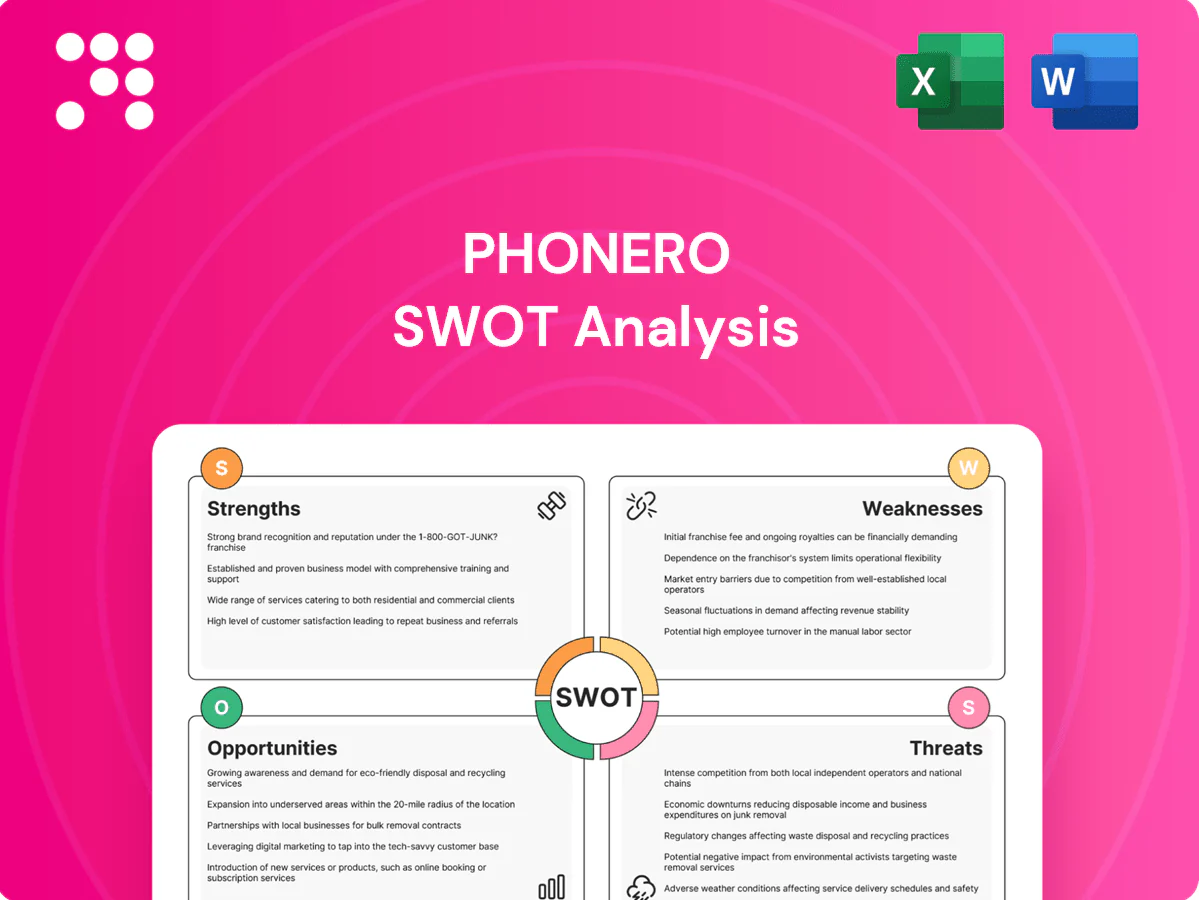
Phonero SWOT Analysis

Your Strategic Toolkit Starts Here
Phonero’s SWOT highlights robust network coverage, steady B2B revenue, and digital service expansion, alongside competitive pricing pressures and regulatory risks. Want the full story behind its growth levers and vulnerabilities? Purchase the complete SWOT analysis for a research-backed, editable Word and Excel report to support strategic decisions and investor pitches.
Strengths

Enterprise-focused mobile expertise
Enterprise-focused mobile expertise enables tailored plans, SLAs and support models that align with corporate procurement, compliance and IT integration. This focus sharpens product-market fit for corporate workflows in markets where Norway recorded about 130 mobile subscriptions per 100 inhabitants in 2024. It differentiates Phonero versus consumer-centric offerings by delivering compliance-ready solutions and measurable uptime targets.
Unified communications portfolio
Phonero’s unified communications portfolio pairs UC platforms with mobile, creating a one-stop communication stack that simplifies procurement and support. Bundling voice, messaging, collaboration and PBX features reduces vendor sprawl and lowers integration costs for customers. Interoperability drives faster user adoption and simpler administration, strengthening switching costs and account stickiness. The global UCaaS market is projected to exceed USD 50B by 2028, underscoring demand.

IoT capability for business use cases
IoT connectivity expands Phonero’s addressable revenue across logistics, utilities and asset tracking, tapping a market GSMA and McKinsey tied to 5.8 billion cellular IoT connections and $4–11 trillion economic value by 2025. Tailored SIMs, device management and data plans enable diverse deployments and simplify rollouts. Cross-selling IoT into mobile accounts can raise ARPU, while IoT analytics sharpen customer insight and drive targeted upsell.

Tailored solutions and configurability
Tailored plans, granular security and policy controls let Phonero meet varied corporate requirements, improving win rates on RFPs that demand compliance or specific features; Statista 2024 reports 62% of enterprises prioritize customizable telecom services. Flexible provisioning and open APIs streamline IT workflows, reducing manual setup and accelerating time-to-service. This configurability boosts perceived value versus generic bundles, supporting upsell and retention.
- Customization: fits diverse corporate needs
- Security & policy: enables compliance wins
- APIs & provisioning: speeds IT workflows
- Perceived value: outcompetes generic bundles
Service simplicity and efficiency focus
Phoneros positioning on service simplicity resonates with lean IT teams, especially as Norway recorded roughly 98% broadband household penetration in 2024, shifting procurement toward ease of management. Streamlined onboarding and centralized admin demonstrably lower total cost of ownership, while clear pricing and defined support pathways reduce procurement friction. This focus supports higher retention and increased referral velocity among SME clients.
Enterprise SLAs, UCaaS upsells and IoT APIs lift ARPU in Norway's hyperconnected market
Enterprise focus yields compliance-ready SLAs and tailored plans, leveraging Norway’s ~130 mobile subscriptions/100 inhabitants (2024) to fit corporate workflows.
Unified communications bundles reduce vendor sprawl, tapping a UCaaS market >USD 50B by 2028 for upsell potential.
IoT connectivity (5.8B cellular IoT connections by 2025) and APIs drive ARPU, faster provisioning and higher retention.
| Metric | Value |
|---|---|
| Mobile subs/100 (NO, 2024) | ~130 |
| Broadband HH pen. (NO, 2024) | ~98% |
| UCaaS market (proj.) | >USD 50B (2028) |
| Cellular IoT (2025) | 5.8B |
What is included in the product
 Detailed Word Document
Provides a concise strategic overview of Phonero’s internal strengths and weaknesses alongside external opportunities and threats to assess its competitive position and future growth risks.

 Customizable Excel Spreadsheet
Provides a concise Phonero SWOT matrix for fast, visual strategy alignment and pain-point relief, with an editable format that lets teams quickly update strengths, weaknesses, opportunities, and threats to produce stakeholder-ready summaries.
Weaknesses

Scale disadvantage vs major incumbents
Large national carriers Telenor (~53% mobile market share) and Telia (~30%) control roughly 83% of Norway’s mobile market as of 2024, limiting Phonero’s pricing power and national marketing reach. Enterprise buyers often view smaller providers as higher risk, complicating large corporate deals. Negotiating device subsidies, bulk handset pricing and favorable roaming terms is harder without incumbents’ scale and balance-sheet leverage.
Network dependence and coverage perceptions
Reliance on wholesale or partner networks limits Phonero’s control over coverage and quality, especially given Telenor and Telia’s combined ~87% share of Norway’s mobile infrastructure in 2023. Any partner outages or gaps can breach SLAs and damage business reputation. Perceptions of weaker rural or in‑building coverage slow enterprise sales. Mitigation requires transparent KPIs, active monitoring and network redundancy.

Narrow geographic footprint
Primarily serving Norway (population ~5.5 million) constrains scale economies compared with the wider Nordic market (~27 million people), limiting revenue pool and bargaining power.
Multinational clients often favor providers with broader Nordic or global footprints for single-vendor contracts and unified SLAs.
Even though Norway is in the EEA and Roam Like at Home applies, cross-border roaming, regulatory differences and enterprise support complexity can raise costs; growth likely requires partnerships or capital investment to expand.

Product breadth versus depth trade-offs
- R&D strain
- Feature gap risk
- Integration overhead
- Higher OPEX, slower releases
Sales cycle concentration in B2B
Enterprise procurement cycles in B2B telecoms typically span 6–12 months, making Phonero's revenue timing cyclical and renewal-dependent; large account wins or losses can shift quarterly results materially.
When revenue concentrates in fewer, larger customers, churn events have outsized impact on EBITDA and operating cash flow, while RFP outcomes and renewal timing directly affect liquidity and forecasting accuracy.
- Procurement cycles: 6–12 months
- Revenue concentration: few large accounts amplify risk
- Churn impact: outsized on EBITDA and cash flow
- RFPs/renewals: key drivers of short-term liquidity
Incumbents 53% / 30% dominate, limiting pricing, coverage and scale
Dominant incumbents (Telenor 53%, Telia 30% in 2024) limit pricing power and device/roaming leverage. Heavy reliance on wholesale networks (incumbents ~87% infrastructure share in 2023) constrains control of coverage and SLAs. Norway-only footprint (~5.5M) and UCaaS 17% CAGR (2024–30) pressure scale, R&D and feature parity; customer concentration amplifies churn impact.
| Metric | Value |
|---|---|
| Norway population | ~5.5M (2024) |
| Telenor/Telia market share | 53% / 30% (2024) |
| Infrastructure share | ~87% incumbents (2023) |
| UCaaS CAGR | 17% (2024–30) |
Full Version Awaits
Phonero SWOT Analysis
This is the actual SWOT analysis document you’ll receive upon purchase—no surprises, just professional quality. The preview below is taken directly from the full SWOT report you'll get; buying unlocks the editable, in-depth version. You’re viewing a live preview of the real file—complete content is available immediately after checkout.

Your Strategic Toolkit Starts Here
Phonero’s SWOT highlights robust network coverage, steady B2B revenue, and digital service expansion, alongside competitive pricing pressures and regulatory risks. Want the full story behind its growth levers and vulnerabilities? Purchase the complete SWOT analysis for a research-backed, editable Word and Excel report to support strategic decisions and investor pitches.
Strengths
Enterprise-focused mobile expertise
Enterprise-focused mobile expertise enables tailored plans, SLAs and support models that align with corporate procurement, compliance and IT integration. This focus sharpens product-market fit for corporate workflows in markets where Norway recorded about 130 mobile subscriptions per 100 inhabitants in 2024. It differentiates Phonero versus consumer-centric offerings by delivering compliance-ready solutions and measurable uptime targets.
Unified communications portfolio
Phonero’s unified communications portfolio pairs UC platforms with mobile, creating a one-stop communication stack that simplifies procurement and support. Bundling voice, messaging, collaboration and PBX features reduces vendor sprawl and lowers integration costs for customers. Interoperability drives faster user adoption and simpler administration, strengthening switching costs and account stickiness. The global UCaaS market is projected to exceed USD 50B by 2028, underscoring demand.
IoT capability for business use cases
IoT connectivity expands Phonero’s addressable revenue across logistics, utilities and asset tracking, tapping a market GSMA and McKinsey tied to 5.8 billion cellular IoT connections and $4–11 trillion economic value by 2025. Tailored SIMs, device management and data plans enable diverse deployments and simplify rollouts. Cross-selling IoT into mobile accounts can raise ARPU, while IoT analytics sharpen customer insight and drive targeted upsell.
Tailored solutions and configurability
Tailored plans, granular security and policy controls let Phonero meet varied corporate requirements, improving win rates on RFPs that demand compliance or specific features; Statista 2024 reports 62% of enterprises prioritize customizable telecom services. Flexible provisioning and open APIs streamline IT workflows, reducing manual setup and accelerating time-to-service. This configurability boosts perceived value versus generic bundles, supporting upsell and retention.
- Customization: fits diverse corporate needs
- Security & policy: enables compliance wins
- APIs & provisioning: speeds IT workflows
- Perceived value: outcompetes generic bundles
Service simplicity and efficiency focus
Phoneros positioning on service simplicity resonates with lean IT teams, especially as Norway recorded roughly 98% broadband household penetration in 2024, shifting procurement toward ease of management. Streamlined onboarding and centralized admin demonstrably lower total cost of ownership, while clear pricing and defined support pathways reduce procurement friction. This focus supports higher retention and increased referral velocity among SME clients.
Enterprise SLAs, UCaaS upsells and IoT APIs lift ARPU in Norway's hyperconnected market
Enterprise focus yields compliance-ready SLAs and tailored plans, leveraging Norway’s ~130 mobile subscriptions/100 inhabitants (2024) to fit corporate workflows.
Unified communications bundles reduce vendor sprawl, tapping a UCaaS market >USD 50B by 2028 for upsell potential.
IoT connectivity (5.8B cellular IoT connections by 2025) and APIs drive ARPU, faster provisioning and higher retention.
| Metric | Value |
|---|---|
| Mobile subs/100 (NO, 2024) | ~130 |
| Broadband HH pen. (NO, 2024) | ~98% |
| UCaaS market (proj.) | >USD 50B (2028) |
| Cellular IoT (2025) | 5.8B |
What is included in the product
Detailed Word Document
Provides a concise strategic overview of Phonero’s internal strengths and weaknesses alongside external opportunities and threats to assess its competitive position and future growth risks.
Customizable Excel Spreadsheet
Provides a concise Phonero SWOT matrix for fast, visual strategy alignment and pain-point relief, with an editable format that lets teams quickly update strengths, weaknesses, opportunities, and threats to produce stakeholder-ready summaries.
Weaknesses
Scale disadvantage vs major incumbents
Large national carriers Telenor (~53% mobile market share) and Telia (~30%) control roughly 83% of Norway’s mobile market as of 2024, limiting Phonero’s pricing power and national marketing reach. Enterprise buyers often view smaller providers as higher risk, complicating large corporate deals. Negotiating device subsidies, bulk handset pricing and favorable roaming terms is harder without incumbents’ scale and balance-sheet leverage.
Network dependence and coverage perceptions
Reliance on wholesale or partner networks limits Phonero’s control over coverage and quality, especially given Telenor and Telia’s combined ~87% share of Norway’s mobile infrastructure in 2023. Any partner outages or gaps can breach SLAs and damage business reputation. Perceptions of weaker rural or in‑building coverage slow enterprise sales. Mitigation requires transparent KPIs, active monitoring and network redundancy.
Narrow geographic footprint
Primarily serving Norway (population ~5.5 million) constrains scale economies compared with the wider Nordic market (~27 million people), limiting revenue pool and bargaining power.
Multinational clients often favor providers with broader Nordic or global footprints for single-vendor contracts and unified SLAs.
Even though Norway is in the EEA and Roam Like at Home applies, cross-border roaming, regulatory differences and enterprise support complexity can raise costs; growth likely requires partnerships or capital investment to expand.
Product breadth versus depth trade-offs
- R&D strain
- Feature gap risk
- Integration overhead
- Higher OPEX, slower releases
Sales cycle concentration in B2B
Enterprise procurement cycles in B2B telecoms typically span 6–12 months, making Phonero's revenue timing cyclical and renewal-dependent; large account wins or losses can shift quarterly results materially.
When revenue concentrates in fewer, larger customers, churn events have outsized impact on EBITDA and operating cash flow, while RFP outcomes and renewal timing directly affect liquidity and forecasting accuracy.
- Procurement cycles: 6–12 months
- Revenue concentration: few large accounts amplify risk
- Churn impact: outsized on EBITDA and cash flow
- RFPs/renewals: key drivers of short-term liquidity
Incumbents 53% / 30% dominate, limiting pricing, coverage and scale
Dominant incumbents (Telenor 53%, Telia 30% in 2024) limit pricing power and device/roaming leverage. Heavy reliance on wholesale networks (incumbents ~87% infrastructure share in 2023) constrains control of coverage and SLAs. Norway-only footprint (~5.5M) and UCaaS 17% CAGR (2024–30) pressure scale, R&D and feature parity; customer concentration amplifies churn impact.
| Metric | Value |
|---|---|
| Norway population | ~5.5M (2024) |
| Telenor/Telia market share | 53% / 30% (2024) |
| Infrastructure share | ~87% incumbents (2023) |
| UCaaS CAGR | 17% (2024–30) |
Full Version Awaits
Phonero SWOT Analysis
This is the actual SWOT analysis document you’ll receive upon purchase—no surprises, just professional quality. The preview below is taken directly from the full SWOT report you'll get; buying unlocks the editable, in-depth version. You’re viewing a live preview of the real file—complete content is available immediately after checkout.
Original: $10.00
-65%$10.00
$3.50Description
Your Strategic Toolkit Starts Here
Phonero’s SWOT highlights robust network coverage, steady B2B revenue, and digital service expansion, alongside competitive pricing pressures and regulatory risks. Want the full story behind its growth levers and vulnerabilities? Purchase the complete SWOT analysis for a research-backed, editable Word and Excel report to support strategic decisions and investor pitches.
Strengths
Enterprise-focused mobile expertise
Enterprise-focused mobile expertise enables tailored plans, SLAs and support models that align with corporate procurement, compliance and IT integration. This focus sharpens product-market fit for corporate workflows in markets where Norway recorded about 130 mobile subscriptions per 100 inhabitants in 2024. It differentiates Phonero versus consumer-centric offerings by delivering compliance-ready solutions and measurable uptime targets.
Unified communications portfolio
Phonero’s unified communications portfolio pairs UC platforms with mobile, creating a one-stop communication stack that simplifies procurement and support. Bundling voice, messaging, collaboration and PBX features reduces vendor sprawl and lowers integration costs for customers. Interoperability drives faster user adoption and simpler administration, strengthening switching costs and account stickiness. The global UCaaS market is projected to exceed USD 50B by 2028, underscoring demand.
IoT capability for business use cases
IoT connectivity expands Phonero’s addressable revenue across logistics, utilities and asset tracking, tapping a market GSMA and McKinsey tied to 5.8 billion cellular IoT connections and $4–11 trillion economic value by 2025. Tailored SIMs, device management and data plans enable diverse deployments and simplify rollouts. Cross-selling IoT into mobile accounts can raise ARPU, while IoT analytics sharpen customer insight and drive targeted upsell.
Tailored solutions and configurability
Tailored plans, granular security and policy controls let Phonero meet varied corporate requirements, improving win rates on RFPs that demand compliance or specific features; Statista 2024 reports 62% of enterprises prioritize customizable telecom services. Flexible provisioning and open APIs streamline IT workflows, reducing manual setup and accelerating time-to-service. This configurability boosts perceived value versus generic bundles, supporting upsell and retention.
- Customization: fits diverse corporate needs
- Security & policy: enables compliance wins
- APIs & provisioning: speeds IT workflows
- Perceived value: outcompetes generic bundles
Service simplicity and efficiency focus
Phoneros positioning on service simplicity resonates with lean IT teams, especially as Norway recorded roughly 98% broadband household penetration in 2024, shifting procurement toward ease of management. Streamlined onboarding and centralized admin demonstrably lower total cost of ownership, while clear pricing and defined support pathways reduce procurement friction. This focus supports higher retention and increased referral velocity among SME clients.
Enterprise SLAs, UCaaS upsells and IoT APIs lift ARPU in Norway's hyperconnected market
Enterprise focus yields compliance-ready SLAs and tailored plans, leveraging Norway’s ~130 mobile subscriptions/100 inhabitants (2024) to fit corporate workflows.
Unified communications bundles reduce vendor sprawl, tapping a UCaaS market >USD 50B by 2028 for upsell potential.
IoT connectivity (5.8B cellular IoT connections by 2025) and APIs drive ARPU, faster provisioning and higher retention.
| Metric | Value |
|---|---|
| Mobile subs/100 (NO, 2024) | ~130 |
| Broadband HH pen. (NO, 2024) | ~98% |
| UCaaS market (proj.) | >USD 50B (2028) |
| Cellular IoT (2025) | 5.8B |
What is included in the product
Detailed Word Document
Provides a concise strategic overview of Phonero’s internal strengths and weaknesses alongside external opportunities and threats to assess its competitive position and future growth risks.
Customizable Excel Spreadsheet
Provides a concise Phonero SWOT matrix for fast, visual strategy alignment and pain-point relief, with an editable format that lets teams quickly update strengths, weaknesses, opportunities, and threats to produce stakeholder-ready summaries.
Weaknesses
Scale disadvantage vs major incumbents
Large national carriers Telenor (~53% mobile market share) and Telia (~30%) control roughly 83% of Norway’s mobile market as of 2024, limiting Phonero’s pricing power and national marketing reach. Enterprise buyers often view smaller providers as higher risk, complicating large corporate deals. Negotiating device subsidies, bulk handset pricing and favorable roaming terms is harder without incumbents’ scale and balance-sheet leverage.
Network dependence and coverage perceptions
Reliance on wholesale or partner networks limits Phonero’s control over coverage and quality, especially given Telenor and Telia’s combined ~87% share of Norway’s mobile infrastructure in 2023. Any partner outages or gaps can breach SLAs and damage business reputation. Perceptions of weaker rural or in‑building coverage slow enterprise sales. Mitigation requires transparent KPIs, active monitoring and network redundancy.
Narrow geographic footprint
Primarily serving Norway (population ~5.5 million) constrains scale economies compared with the wider Nordic market (~27 million people), limiting revenue pool and bargaining power.
Multinational clients often favor providers with broader Nordic or global footprints for single-vendor contracts and unified SLAs.
Even though Norway is in the EEA and Roam Like at Home applies, cross-border roaming, regulatory differences and enterprise support complexity can raise costs; growth likely requires partnerships or capital investment to expand.
Product breadth versus depth trade-offs
- R&D strain
- Feature gap risk
- Integration overhead
- Higher OPEX, slower releases
Sales cycle concentration in B2B
Enterprise procurement cycles in B2B telecoms typically span 6–12 months, making Phonero's revenue timing cyclical and renewal-dependent; large account wins or losses can shift quarterly results materially.
When revenue concentrates in fewer, larger customers, churn events have outsized impact on EBITDA and operating cash flow, while RFP outcomes and renewal timing directly affect liquidity and forecasting accuracy.
- Procurement cycles: 6–12 months
- Revenue concentration: few large accounts amplify risk
- Churn impact: outsized on EBITDA and cash flow
- RFPs/renewals: key drivers of short-term liquidity
Incumbents 53% / 30% dominate, limiting pricing, coverage and scale
Dominant incumbents (Telenor 53%, Telia 30% in 2024) limit pricing power and device/roaming leverage. Heavy reliance on wholesale networks (incumbents ~87% infrastructure share in 2023) constrains control of coverage and SLAs. Norway-only footprint (~5.5M) and UCaaS 17% CAGR (2024–30) pressure scale, R&D and feature parity; customer concentration amplifies churn impact.
| Metric | Value |
|---|---|
| Norway population | ~5.5M (2024) |
| Telenor/Telia market share | 53% / 30% (2024) |
| Infrastructure share | ~87% incumbents (2023) |
| UCaaS CAGR | 17% (2024–30) |
Full Version Awaits
Phonero SWOT Analysis
This is the actual SWOT analysis document you’ll receive upon purchase—no surprises, just professional quality. The preview below is taken directly from the full SWOT report you'll get; buying unlocks the editable, in-depth version. You’re viewing a live preview of the real file—complete content is available immediately after checkout.











