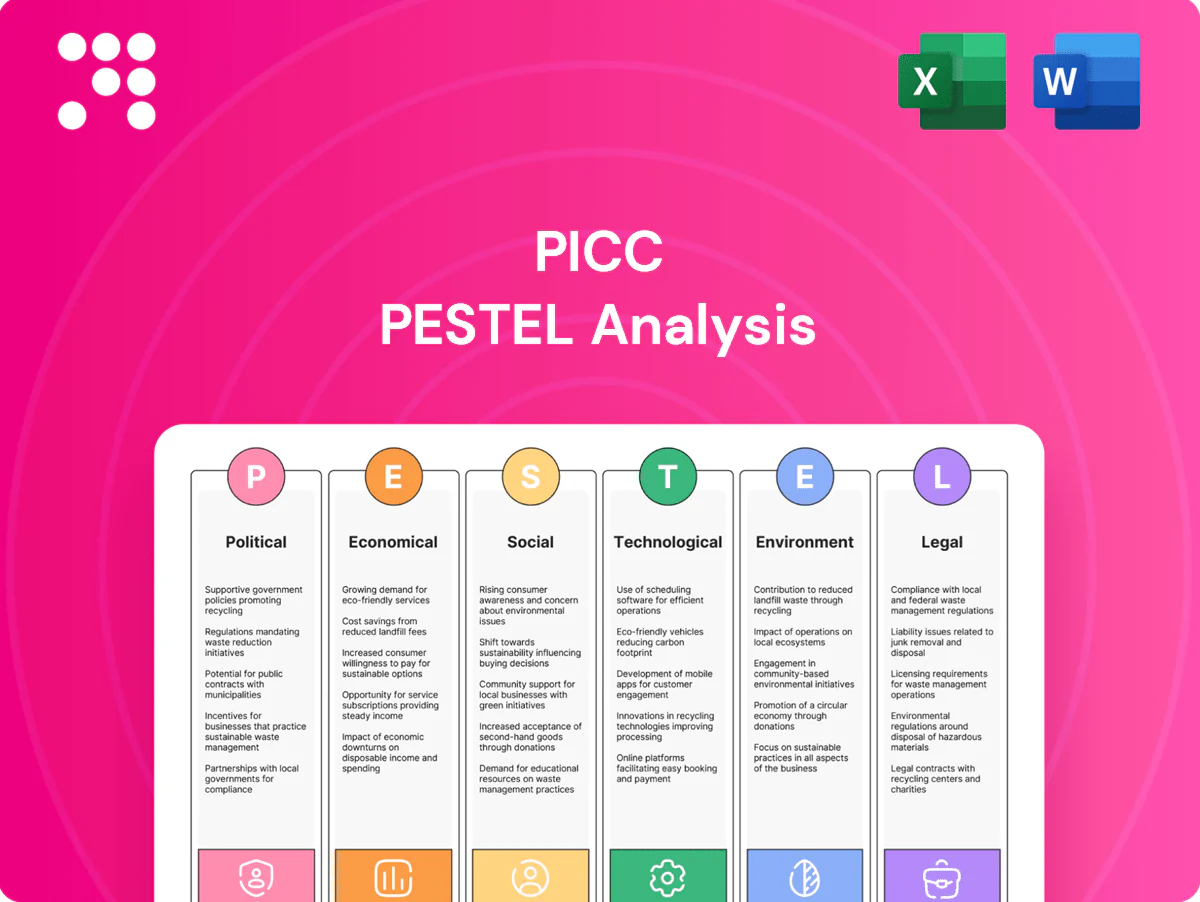
PICC PESTLE Analysis

Make Smarter Strategic Decisions with a Complete PESTEL View
Gain a strategic edge with our PESTLE Analysis of PICC—three concise yet powerful insights into political, economic, and regulatory forces shaping its future. Ideal for investors, analysts, and strategists, this report translates external trends into actionable risks and opportunities. Purchase the full analysis now for the complete, editable breakdown and make smarter, faster decisions.
Political factors

State influence and policy alignment
As a major Chinese insurer with state majority ownership (>50%), PICC operates under strong state guidance and industrial policy priorities. Alignment with national goals such as common prosperity, social safety net expansion and rural revitalization shapes product design, pricing and distribution. Policy support can unlock subsidies and channel access but also constrains commercial flexibility, and shifts in government focus can rapidly redirect capital allocation.
Regulatory oversight by NAFR/CBIRC successor
Since the National Administration of Financial Regulation was established in March 2023 as the successor to parts of CBIRC, prudential rules, solvency regimes and product approvals are tightly supervised by China’s regulator. Periodic tightening on capital, investment limits or pricing has directly affected insurers’ growth and profitability. Macro‑prudential measures are used to curb risk appetite during market volatility. Consistent compliance remains core to maintaining licenses and reputation.

Cross-border and geopolitical sensitivities
International tensions squeeze reinsurance capacity, complicate cross-border data flows and narrow investment channels, forcing PICC, the largest property insurer in China, to reassess foreign exposure. Sanctions and export controls have constrained overseas partnerships and asset allocation in key markets. Belt and Road ties across 150+ countries create premium growth opportunities but raise concentrated political risk. PICC must balance domestic mandates with prudent international diversification.

Public-sector customer base and procurement
PICC’s client mix is heavily public-sector led—state ownership secures preferential access to government and SOE accounts that drive core premium volumes and higher retention; this scale helped PICC report gross written premiums around RMB 360 billion in 2024. Tender rules and policy-driven pricing, including regulated rate ceilings on public projects, compress margins, while contracting cycles remain sensitive to fiscal priorities and China’s infrastructure agenda.
- Public-sector concentration: majority SOE/government clients
- Scale advantage: preferential public project access
- Margin pressure: tender rules and policy pricing
- Timing risk: contracts tied to fiscal and infrastructure cycles
Disaster response and social stability mandates
Authorities expect rapid claims handling for catastrophes and public emergencies, pressuring insurers to accelerate payouts and expand coverage beyond actuarial norms, which PICC meets through designated catastrophe teams and expedited settlement protocols.
Participation in agricultural and micro-insurance supports financial inclusion and social stability, enhancing PICC brand legitimacy while adding operational strain from higher claim frequency and distribution costs.
- rapid payouts: regulatory pressure
- expanded coverage: social mandate
- agri/micro-insurance: inclusion role
- trade-off: brand legitimacy vs operational strain
State-majority insurer: national goals, tight regulatory oversight, Belt & Road in 150+ countries
PICC’s state majority ownership (>50%) and alignment with national goals (common prosperity, rural revitalization) shape product, pricing and distribution while constraining commercial flexibility. Tight supervision since the National Administration of Financial Regulation (Mar 2023) enforces prudential, solvency and product rules that affect growth and margins. International tensions limit reinsurance and cross‑border investments even as Belt and Road exposure (150+ countries) offers premium opportunities.
| Metric | Value/Year |
|---|---|
| State ownership | >50% |
| Gross written premium | RMB 360 billion (2024) |
| Regulator | National Administration of Financial Regulation (est. Mar 2023) |
| Belt & Road presence | 150+ countries |
What is included in the product
 Detailed Word Document
Explores how macro-environmental factors specifically impact PICC across Political, Economic, Social, Technological, Environmental, and Legal dimensions, with each section grounded in relevant data and current trends. Designed for executives and advisors to identify threats, opportunities, and actionable, forward-looking scenarios.

 Customizable Excel Spreadsheet
A concise, visually segmented PESTLE summary of PICC that’s easily dropped into presentations, shareable across teams, and editable for regional or business-line notes—ideal for quick alignment and focused external risk discussions during planning sessions.
Economic factors

China GDP growth and insurance penetration
China GDP growth slowed to about 5.2% in 2024 with IMF 2025 forecasts near 4.8%, while urbanization reached roughly 67% and rising household incomes fuel premium growth tied to urban consumption and corporate investment cycles. Insurance penetration remains low at about 7–8% of GDP, offering a long-term tailwind; cyclical slowdowns dent new business and renewals, but PICC’s scale positions it to capture market formalization gains.
Interest rates and investment yields
Life and health reserve economics hinge on long-duration yields—China 10-year gov bond ~2.9% and US 10-year ~4.5% (H1 2025) —so lower rates compress spread income and strain guaranteed products. Robust asset-liability management is critical to stabilize margins, while strategic shifts into credit, infrastructure and alternatives (targeting 100–200bps pickup) can improve returns within risk limits.

Property market and credit risk spillovers
China’s property adjustment, with real estate and related sectors representing roughly 30% of GDP and high-profile developer liabilities (Evergrande >300 billion USD), heightens mortgage protection, construction-line and corporate credit risk. SME cash stress could boost claims and lapses, while investment portfolios face mark-to-market and default losses. Prudent sector limits and active rebalancing cut contagion risk.

Inflation and medical cost trend
Medical inflation continues to outpace headline CPI, pressuring PICC health loss ratios—China medical prices rose about 5.5% in 2024 versus headline CPI near 0.8%, forcing more frequent pricing and benefit redesigns.
Stronger procurement, formularies and provider network management can curb claims leakage and cost drift, while inflation also pushed average motor and property repair costs up ~6–7% in 2024, widening underwriting pressure.
- Medical inflation > CPI (2024: medical ~5.5%, CPI ~0.8%)
- Need for dynamic pricing and benefit resets
- Procurement and network controls reduce leakage
- Motor/property repair costs rose ~6–7% (2024)
Catastrophe frequency and capital buffer needs
Climate-related events drive higher catastrophe losses and earnings volatility; Swiss Re estimates insured catastrophe losses at about USD 120 billion in 2023, pressuring underwriting results. Economic exposure growth in coastal and urban regions—UN data shows roughly 40% of the global population lives within 100 km of a coast—elevates aggregate risk. Reinsurance, ILS and advanced catastrophe modeling guide PICC's capital planning, while robust solvency buffers support ratings and growth.
- Insured losses ~USD 120bn (Swiss Re, 2023)
- ~40% population within 100 km of coast (UN)
- Reinsurance + ILS used to transfer peak risks
- Strong solvency buffers preserve ratings and expansion
State-majority insurer: national goals, tight regulatory oversight, Belt & Road in 150+ countries
China GDP 2024 ~5.2%, IMF 2025 ~4.8%; insurance penetration 7–8% of GDP, urbanization ~67% boosting premium growth. China 10y ~2.9% (H1 2025), US10y ~4.5%—low yields pressure life reserves; strategic shift to credit/infrastructure targets 100–200bps pickup. Property ~30% GDP, medical inflation 5.5% vs CPI 0.8% (2024); insured losses ~USD120bn (2023).
| Metric | Value |
|---|---|
| China GDP growth (2024/2025) | 5.2% / 4.8% (IMF) |
| Insurance penetration | 7–8% of GDP |
| 10y yields (China / US) | 2.9% / 4.5% (H1 2025) |
| Medical vs CPI (2024) | 5.5% vs 0.8% |
| Property share of GDP | ~30% |
| Insured catastrophe losses (2023) | USD 120bn |
Same Document Delivered
PICC PESTLE Analysis
The PICC PESTLE Analysis preview shown here is the exact document you’ll receive after purchase—fully formatted and ready to use. The layout, content, and structure visible are identical to the file you’ll download immediately after payment. No placeholders or surprises: this is the final, professionally structured report you’ll own upon checkout.

Make Smarter Strategic Decisions with a Complete PESTEL View
Gain a strategic edge with our PESTLE Analysis of PICC—three concise yet powerful insights into political, economic, and regulatory forces shaping its future. Ideal for investors, analysts, and strategists, this report translates external trends into actionable risks and opportunities. Purchase the full analysis now for the complete, editable breakdown and make smarter, faster decisions.
Political factors
State influence and policy alignment
As a major Chinese insurer with state majority ownership (>50%), PICC operates under strong state guidance and industrial policy priorities. Alignment with national goals such as common prosperity, social safety net expansion and rural revitalization shapes product design, pricing and distribution. Policy support can unlock subsidies and channel access but also constrains commercial flexibility, and shifts in government focus can rapidly redirect capital allocation.
Regulatory oversight by NAFR/CBIRC successor
Since the National Administration of Financial Regulation was established in March 2023 as the successor to parts of CBIRC, prudential rules, solvency regimes and product approvals are tightly supervised by China’s regulator. Periodic tightening on capital, investment limits or pricing has directly affected insurers’ growth and profitability. Macro‑prudential measures are used to curb risk appetite during market volatility. Consistent compliance remains core to maintaining licenses and reputation.
Cross-border and geopolitical sensitivities
International tensions squeeze reinsurance capacity, complicate cross-border data flows and narrow investment channels, forcing PICC, the largest property insurer in China, to reassess foreign exposure. Sanctions and export controls have constrained overseas partnerships and asset allocation in key markets. Belt and Road ties across 150+ countries create premium growth opportunities but raise concentrated political risk. PICC must balance domestic mandates with prudent international diversification.
Public-sector customer base and procurement
PICC’s client mix is heavily public-sector led—state ownership secures preferential access to government and SOE accounts that drive core premium volumes and higher retention; this scale helped PICC report gross written premiums around RMB 360 billion in 2024. Tender rules and policy-driven pricing, including regulated rate ceilings on public projects, compress margins, while contracting cycles remain sensitive to fiscal priorities and China’s infrastructure agenda.
- Public-sector concentration: majority SOE/government clients
- Scale advantage: preferential public project access
- Margin pressure: tender rules and policy pricing
- Timing risk: contracts tied to fiscal and infrastructure cycles
Disaster response and social stability mandates
Authorities expect rapid claims handling for catastrophes and public emergencies, pressuring insurers to accelerate payouts and expand coverage beyond actuarial norms, which PICC meets through designated catastrophe teams and expedited settlement protocols.
Participation in agricultural and micro-insurance supports financial inclusion and social stability, enhancing PICC brand legitimacy while adding operational strain from higher claim frequency and distribution costs.
- rapid payouts: regulatory pressure
- expanded coverage: social mandate
- agri/micro-insurance: inclusion role
- trade-off: brand legitimacy vs operational strain
State-majority insurer: national goals, tight regulatory oversight, Belt & Road in 150+ countries
PICC’s state majority ownership (>50%) and alignment with national goals (common prosperity, rural revitalization) shape product, pricing and distribution while constraining commercial flexibility. Tight supervision since the National Administration of Financial Regulation (Mar 2023) enforces prudential, solvency and product rules that affect growth and margins. International tensions limit reinsurance and cross‑border investments even as Belt and Road exposure (150+ countries) offers premium opportunities.
| Metric | Value/Year |
|---|---|
| State ownership | >50% |
| Gross written premium | RMB 360 billion (2024) |
| Regulator | National Administration of Financial Regulation (est. Mar 2023) |
| Belt & Road presence | 150+ countries |
What is included in the product
Detailed Word Document
Explores how macro-environmental factors specifically impact PICC across Political, Economic, Social, Technological, Environmental, and Legal dimensions, with each section grounded in relevant data and current trends. Designed for executives and advisors to identify threats, opportunities, and actionable, forward-looking scenarios.
Customizable Excel Spreadsheet
A concise, visually segmented PESTLE summary of PICC that’s easily dropped into presentations, shareable across teams, and editable for regional or business-line notes—ideal for quick alignment and focused external risk discussions during planning sessions.
Economic factors
China GDP growth and insurance penetration
China GDP growth slowed to about 5.2% in 2024 with IMF 2025 forecasts near 4.8%, while urbanization reached roughly 67% and rising household incomes fuel premium growth tied to urban consumption and corporate investment cycles. Insurance penetration remains low at about 7–8% of GDP, offering a long-term tailwind; cyclical slowdowns dent new business and renewals, but PICC’s scale positions it to capture market formalization gains.
Interest rates and investment yields
Life and health reserve economics hinge on long-duration yields—China 10-year gov bond ~2.9% and US 10-year ~4.5% (H1 2025) —so lower rates compress spread income and strain guaranteed products. Robust asset-liability management is critical to stabilize margins, while strategic shifts into credit, infrastructure and alternatives (targeting 100–200bps pickup) can improve returns within risk limits.
Property market and credit risk spillovers
China’s property adjustment, with real estate and related sectors representing roughly 30% of GDP and high-profile developer liabilities (Evergrande >300 billion USD), heightens mortgage protection, construction-line and corporate credit risk. SME cash stress could boost claims and lapses, while investment portfolios face mark-to-market and default losses. Prudent sector limits and active rebalancing cut contagion risk.
Inflation and medical cost trend
Medical inflation continues to outpace headline CPI, pressuring PICC health loss ratios—China medical prices rose about 5.5% in 2024 versus headline CPI near 0.8%, forcing more frequent pricing and benefit redesigns.
Stronger procurement, formularies and provider network management can curb claims leakage and cost drift, while inflation also pushed average motor and property repair costs up ~6–7% in 2024, widening underwriting pressure.
- Medical inflation > CPI (2024: medical ~5.5%, CPI ~0.8%)
- Need for dynamic pricing and benefit resets
- Procurement and network controls reduce leakage
- Motor/property repair costs rose ~6–7% (2024)
Catastrophe frequency and capital buffer needs
Climate-related events drive higher catastrophe losses and earnings volatility; Swiss Re estimates insured catastrophe losses at about USD 120 billion in 2023, pressuring underwriting results. Economic exposure growth in coastal and urban regions—UN data shows roughly 40% of the global population lives within 100 km of a coast—elevates aggregate risk. Reinsurance, ILS and advanced catastrophe modeling guide PICC's capital planning, while robust solvency buffers support ratings and growth.
- Insured losses ~USD 120bn (Swiss Re, 2023)
- ~40% population within 100 km of coast (UN)
- Reinsurance + ILS used to transfer peak risks
- Strong solvency buffers preserve ratings and expansion
State-majority insurer: national goals, tight regulatory oversight, Belt & Road in 150+ countries
China GDP 2024 ~5.2%, IMF 2025 ~4.8%; insurance penetration 7–8% of GDP, urbanization ~67% boosting premium growth. China 10y ~2.9% (H1 2025), US10y ~4.5%—low yields pressure life reserves; strategic shift to credit/infrastructure targets 100–200bps pickup. Property ~30% GDP, medical inflation 5.5% vs CPI 0.8% (2024); insured losses ~USD120bn (2023).
| Metric | Value |
|---|---|
| China GDP growth (2024/2025) | 5.2% / 4.8% (IMF) |
| Insurance penetration | 7–8% of GDP |
| 10y yields (China / US) | 2.9% / 4.5% (H1 2025) |
| Medical vs CPI (2024) | 5.5% vs 0.8% |
| Property share of GDP | ~30% |
| Insured catastrophe losses (2023) | USD 120bn |
Same Document Delivered
PICC PESTLE Analysis
The PICC PESTLE Analysis preview shown here is the exact document you’ll receive after purchase—fully formatted and ready to use. The layout, content, and structure visible are identical to the file you’ll download immediately after payment. No placeholders or surprises: this is the final, professionally structured report you’ll own upon checkout.
Original: $10.00
-65%$10.00
$3.50Description
Make Smarter Strategic Decisions with a Complete PESTEL View
Gain a strategic edge with our PESTLE Analysis of PICC—three concise yet powerful insights into political, economic, and regulatory forces shaping its future. Ideal for investors, analysts, and strategists, this report translates external trends into actionable risks and opportunities. Purchase the full analysis now for the complete, editable breakdown and make smarter, faster decisions.
Political factors
State influence and policy alignment
As a major Chinese insurer with state majority ownership (>50%), PICC operates under strong state guidance and industrial policy priorities. Alignment with national goals such as common prosperity, social safety net expansion and rural revitalization shapes product design, pricing and distribution. Policy support can unlock subsidies and channel access but also constrains commercial flexibility, and shifts in government focus can rapidly redirect capital allocation.
Regulatory oversight by NAFR/CBIRC successor
Since the National Administration of Financial Regulation was established in March 2023 as the successor to parts of CBIRC, prudential rules, solvency regimes and product approvals are tightly supervised by China’s regulator. Periodic tightening on capital, investment limits or pricing has directly affected insurers’ growth and profitability. Macro‑prudential measures are used to curb risk appetite during market volatility. Consistent compliance remains core to maintaining licenses and reputation.
Cross-border and geopolitical sensitivities
International tensions squeeze reinsurance capacity, complicate cross-border data flows and narrow investment channels, forcing PICC, the largest property insurer in China, to reassess foreign exposure. Sanctions and export controls have constrained overseas partnerships and asset allocation in key markets. Belt and Road ties across 150+ countries create premium growth opportunities but raise concentrated political risk. PICC must balance domestic mandates with prudent international diversification.
Public-sector customer base and procurement
PICC’s client mix is heavily public-sector led—state ownership secures preferential access to government and SOE accounts that drive core premium volumes and higher retention; this scale helped PICC report gross written premiums around RMB 360 billion in 2024. Tender rules and policy-driven pricing, including regulated rate ceilings on public projects, compress margins, while contracting cycles remain sensitive to fiscal priorities and China’s infrastructure agenda.
- Public-sector concentration: majority SOE/government clients
- Scale advantage: preferential public project access
- Margin pressure: tender rules and policy pricing
- Timing risk: contracts tied to fiscal and infrastructure cycles
Disaster response and social stability mandates
Authorities expect rapid claims handling for catastrophes and public emergencies, pressuring insurers to accelerate payouts and expand coverage beyond actuarial norms, which PICC meets through designated catastrophe teams and expedited settlement protocols.
Participation in agricultural and micro-insurance supports financial inclusion and social stability, enhancing PICC brand legitimacy while adding operational strain from higher claim frequency and distribution costs.
- rapid payouts: regulatory pressure
- expanded coverage: social mandate
- agri/micro-insurance: inclusion role
- trade-off: brand legitimacy vs operational strain
State-majority insurer: national goals, tight regulatory oversight, Belt & Road in 150+ countries
PICC’s state majority ownership (>50%) and alignment with national goals (common prosperity, rural revitalization) shape product, pricing and distribution while constraining commercial flexibility. Tight supervision since the National Administration of Financial Regulation (Mar 2023) enforces prudential, solvency and product rules that affect growth and margins. International tensions limit reinsurance and cross‑border investments even as Belt and Road exposure (150+ countries) offers premium opportunities.
| Metric | Value/Year |
|---|---|
| State ownership | >50% |
| Gross written premium | RMB 360 billion (2024) |
| Regulator | National Administration of Financial Regulation (est. Mar 2023) |
| Belt & Road presence | 150+ countries |
What is included in the product
Detailed Word Document
Explores how macro-environmental factors specifically impact PICC across Political, Economic, Social, Technological, Environmental, and Legal dimensions, with each section grounded in relevant data and current trends. Designed for executives and advisors to identify threats, opportunities, and actionable, forward-looking scenarios.
Customizable Excel Spreadsheet
A concise, visually segmented PESTLE summary of PICC that’s easily dropped into presentations, shareable across teams, and editable for regional or business-line notes—ideal for quick alignment and focused external risk discussions during planning sessions.
Economic factors
China GDP growth and insurance penetration
China GDP growth slowed to about 5.2% in 2024 with IMF 2025 forecasts near 4.8%, while urbanization reached roughly 67% and rising household incomes fuel premium growth tied to urban consumption and corporate investment cycles. Insurance penetration remains low at about 7–8% of GDP, offering a long-term tailwind; cyclical slowdowns dent new business and renewals, but PICC’s scale positions it to capture market formalization gains.
Interest rates and investment yields
Life and health reserve economics hinge on long-duration yields—China 10-year gov bond ~2.9% and US 10-year ~4.5% (H1 2025) —so lower rates compress spread income and strain guaranteed products. Robust asset-liability management is critical to stabilize margins, while strategic shifts into credit, infrastructure and alternatives (targeting 100–200bps pickup) can improve returns within risk limits.
Property market and credit risk spillovers
China’s property adjustment, with real estate and related sectors representing roughly 30% of GDP and high-profile developer liabilities (Evergrande >300 billion USD), heightens mortgage protection, construction-line and corporate credit risk. SME cash stress could boost claims and lapses, while investment portfolios face mark-to-market and default losses. Prudent sector limits and active rebalancing cut contagion risk.
Inflation and medical cost trend
Medical inflation continues to outpace headline CPI, pressuring PICC health loss ratios—China medical prices rose about 5.5% in 2024 versus headline CPI near 0.8%, forcing more frequent pricing and benefit redesigns.
Stronger procurement, formularies and provider network management can curb claims leakage and cost drift, while inflation also pushed average motor and property repair costs up ~6–7% in 2024, widening underwriting pressure.
- Medical inflation > CPI (2024: medical ~5.5%, CPI ~0.8%)
- Need for dynamic pricing and benefit resets
- Procurement and network controls reduce leakage
- Motor/property repair costs rose ~6–7% (2024)
Catastrophe frequency and capital buffer needs
Climate-related events drive higher catastrophe losses and earnings volatility; Swiss Re estimates insured catastrophe losses at about USD 120 billion in 2023, pressuring underwriting results. Economic exposure growth in coastal and urban regions—UN data shows roughly 40% of the global population lives within 100 km of a coast—elevates aggregate risk. Reinsurance, ILS and advanced catastrophe modeling guide PICC's capital planning, while robust solvency buffers support ratings and growth.
- Insured losses ~USD 120bn (Swiss Re, 2023)
- ~40% population within 100 km of coast (UN)
- Reinsurance + ILS used to transfer peak risks
- Strong solvency buffers preserve ratings and expansion
State-majority insurer: national goals, tight regulatory oversight, Belt & Road in 150+ countries
China GDP 2024 ~5.2%, IMF 2025 ~4.8%; insurance penetration 7–8% of GDP, urbanization ~67% boosting premium growth. China 10y ~2.9% (H1 2025), US10y ~4.5%—low yields pressure life reserves; strategic shift to credit/infrastructure targets 100–200bps pickup. Property ~30% GDP, medical inflation 5.5% vs CPI 0.8% (2024); insured losses ~USD120bn (2023).
| Metric | Value |
|---|---|
| China GDP growth (2024/2025) | 5.2% / 4.8% (IMF) |
| Insurance penetration | 7–8% of GDP |
| 10y yields (China / US) | 2.9% / 4.5% (H1 2025) |
| Medical vs CPI (2024) | 5.5% vs 0.8% |
| Property share of GDP | ~30% |
| Insured catastrophe losses (2023) | USD 120bn |
Same Document Delivered
PICC PESTLE Analysis
The PICC PESTLE Analysis preview shown here is the exact document you’ll receive after purchase—fully formatted and ready to use. The layout, content, and structure visible are identical to the file you’ll download immediately after payment. No placeholders or surprises: this is the final, professionally structured report you’ll own upon checkout.











