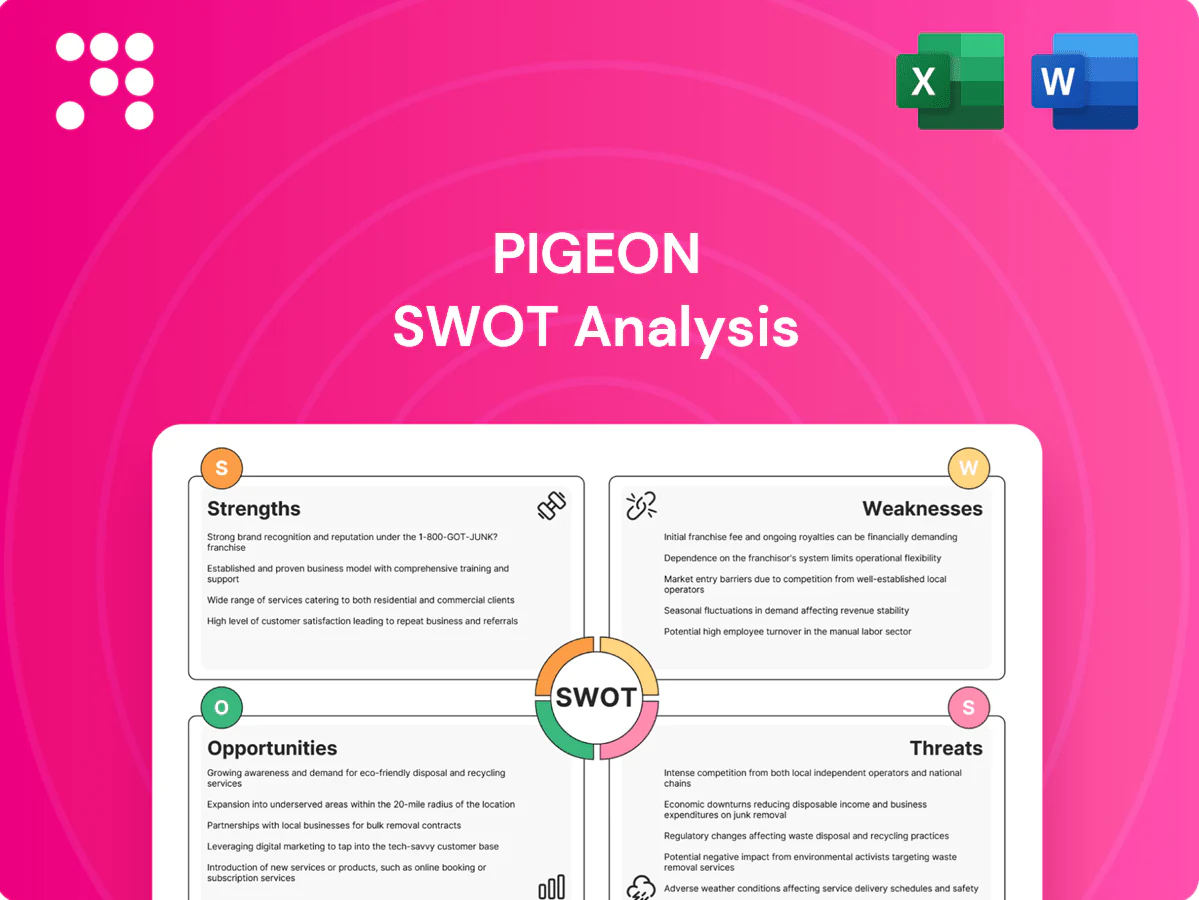
Pigeon SWOT Analysis

Go Beyond the Preview—Access the Full Strategic Report
Pigeon’s SWOT highlights clear operational strengths, market opportunities, and potential risks that every investor and strategist should know; our concise preview just scratches the surface. Purchase the full SWOT analysis to access a research-backed, editable Word and Excel package with financial context, strategic recommendations, and investor-ready insights to act with confidence.
Strengths

Trusted global baby-care brand
With 68 years since its 1957 founding, Pigeon has built strong brand equity and parental trust across Japan and 50+ Asian and global markets, enabling premium pricing and high repeat purchase rates. This trust reduces perceived risk for new parents, improving conversion across product categories, and the brand halo strengthens relationships with hospitals and pediatric channels.
Diversified product portfolio
Pigeon spans six core categories — bottles, nipples, pacifiers, skincare, breast pumps, and feeding accessories — giving it a diversified product portfolio that reduces reliance on any single SKU.
This breadth captures multiple touchpoints across the caregiving journey, enabling cross-selling to raise customer lifetime value and strengthen retention.
An integrated innovation pipeline lets product iterations and regulatory learnings move efficiently across adjacent categories.

Quality and safety reputation
Founded in 1957 (over 68 years), Pigeon’s strict quality and safety standards differentiate it in a sensitive baby-care category; medical and hospital endorsements reinforce credibility, and consistent product performance strengthens reviews and word-of-mouth. This reliability lowers returns and eases regulatory friction, supporting steady retail relationships and brand trust.

Strong distribution in Asia
Strong distribution in Asia: Pigeon combines deep retail penetration in Japan with a growing footprint in China and Southeast Asia, leveraging omnichannel access across pharmacies, baby-specialty stores, supermarkets and e-commerce to boost availability. Localized assortments align products to regional preferences, while distributor and hospital partnerships create durable, defensible market positions.
- Deep Japan retail reach; expanding China/SEA presence
- Omnichannel: pharmacies, specialty, supermarkets, e-commerce
- Localized assortments for regional fit
- Distributor and hospital partnerships strengthen defenses
R&D and user-centered design
R&D and user-centered design drive Pigeon’s competitive edge through ergonomic, infant-safe materials and iterative feedback from parents and healthcare professionals, enabling continuous product refinements; the global baby care market was ~USD 69B in 2023 with ~5% CAGR, supporting premium positioning. Patents and proprietary designs secure differentiation and R&D underpins premium tiers and margin resilience.
- Ergonomics & safety focus
- Parent & clinician feedback loops
- Patents protect IP
- R&D supports premium margins
Heritage baby-care leader: 68 yrs, 50+ markets, USD 69B
Pigeon (founded 1957; 68 years) has strong brand trust across 50+ markets, premium pricing and high repeat rates; diversified six core categories reduce SKU risk and enable cross-selling. Robust Japan retail reach with expanding China/SEA omnichannel distribution and hospital endorsements supports durable market positions. R&D, patents and clinician feedback drive safety-led premium margins; global baby-care market ~USD 69B (2023), ~5% CAGR.
| Metric | Value |
|---|---|
| Brand age | 68 years (1957) |
| Markets | 50+ |
| Core categories | 6 |
| Market size (2023) | USD 69B |
| CAGR | ~5% |
What is included in the product
 Detailed Word Document
Provides a concise SWOT assessment of Pigeon, outlining internal strengths and weaknesses alongside external opportunities and threats to inform strategic decision-making.

 Customizable Excel Spreadsheet
Delivers a concise Pigeon SWOT matrix that quickly pinpoints operational pain points and relief strategies for rapid strategic alignment. Editable visual format enables swift updates and stakeholder-ready summaries for fast decision-making.
Weaknesses

Exposure to birth-rate declines
Core demand ties closely to fertility trends, notably Japan TFR 1.26 (2023), South Korea 0.78 (2023) and China ~1.09, pressuring baby-product demand. Volume declines in these markets can offset market-share gains. Portfolio concentration in infant categories limits hedges against demographic headwinds and heightens revenue volatility in mature markets.
Mid-to-premium price positioning
Mid-to-premium pricing risks deterring value-conscious consumers as mid-single-digit inflation persisted across many markets in 2024, squeezing household budgets. Downtrading to private-labels and local competitors—private-label penetration reached around 20% in several markets—can erode share. Price gaps limit affordable scale in emerging markets, and heavier promotional reliance to defend volume can shave several percentage points off margins.

Product recall and compliance risk
Baby products face stringent safety regulations across jurisdictions, including 27 EU member states and US CPSC oversight, raising documentation and approval burdens. Any defect or recall can quickly damage trust and sales, with recalls often causing multi-week supply disruptions. Compliance testing and certification commonly add 6–12 weeks to time-to-market and increase costs. Cross-border regulatory differences add operational and legal complexity for exporters.

Dependence on plastics and specific materials
Dependence on plastics and specialty silicones exposes Pigeon to input-cost volatility—resin markets in 2024 saw monthly swings often exceeding 10%, squeezing gross margins. Growing material-sustainability scrutiny raises reputational risk and regulatory compliance costs. Shifting to eco-friendly alternatives requires CAPEX and redesign cycles, while supply disruptions can dent service levels and inventory turns.
- Input-cost swings: resin/silicone price volatility (~10%+ monthly in 2024)
- Sustainability risk: higher compliance and brand scrutiny
- Transition cost: CAPEX and R&D for eco-materials
- Supply fragility: potential service-level impact
Limited diversification beyond infant care
Pigeon’s concentration in baby and maternity narrows revenue streams versus broader CPG peers, limiting portfolio resilience. Limited exposure to adjacent life-stage categories caps cross-life-cycle growth and restricts scale economies and bargaining power with retailers and suppliers. This focus amplifies cyclicality tied to early-childhood demand and seasonal birth-rate fluctuations.
- Concentration: baby & maternity focused
- Growth cap: limited adjacent categories
- Scale: constrained bargaining power
- Cyclicality: sensitive to early-childhood demand
Demographic decline, private-label gains and input-cost swings squeeze mid-premium baby-care margins
Pigeon is highly exposed to declining fertility (Japan TFR 1.26, S.Korea 0.78, China ~1.09) that can erode core volumes and amplify revenue volatility. Mid-premium pricing amid 2024 mid-single-digit inflation and ~20% private-label penetration risks downtrading and margin pressure. Input-cost volatility (resin/silicone swings ~10%+) and regulatory/sustainability transition costs raise CAPEX and compliance burdens.
| Metric | Value |
|---|---|
| Japan TFR (2023) | 1.26 |
| S.Korea TFR (2023) | 0.78 |
| China TFR (~2023) | ~1.09 |
| 2024 inflation | mid-single-digit |
| Private-label | ~20% |
| Resin/silicone volatility (2024) | ~10%+ |
What You See Is What You Get
Pigeon SWOT Analysis
This is the actual Pigeon SWOT analysis document you’ll receive upon purchase—no surprises, just professional quality. The preview below is taken directly from the full SWOT report you'll get, covering strengths, weaknesses, opportunities and threats. The file shown is the real, editable analysis included in your download. Unlock the complete version after checkout.

Go Beyond the Preview—Access the Full Strategic Report
Pigeon’s SWOT highlights clear operational strengths, market opportunities, and potential risks that every investor and strategist should know; our concise preview just scratches the surface. Purchase the full SWOT analysis to access a research-backed, editable Word and Excel package with financial context, strategic recommendations, and investor-ready insights to act with confidence.
Strengths
Trusted global baby-care brand
With 68 years since its 1957 founding, Pigeon has built strong brand equity and parental trust across Japan and 50+ Asian and global markets, enabling premium pricing and high repeat purchase rates. This trust reduces perceived risk for new parents, improving conversion across product categories, and the brand halo strengthens relationships with hospitals and pediatric channels.
Diversified product portfolio
Pigeon spans six core categories — bottles, nipples, pacifiers, skincare, breast pumps, and feeding accessories — giving it a diversified product portfolio that reduces reliance on any single SKU.
This breadth captures multiple touchpoints across the caregiving journey, enabling cross-selling to raise customer lifetime value and strengthen retention.
An integrated innovation pipeline lets product iterations and regulatory learnings move efficiently across adjacent categories.
Quality and safety reputation
Founded in 1957 (over 68 years), Pigeon’s strict quality and safety standards differentiate it in a sensitive baby-care category; medical and hospital endorsements reinforce credibility, and consistent product performance strengthens reviews and word-of-mouth. This reliability lowers returns and eases regulatory friction, supporting steady retail relationships and brand trust.
Strong distribution in Asia
Strong distribution in Asia: Pigeon combines deep retail penetration in Japan with a growing footprint in China and Southeast Asia, leveraging omnichannel access across pharmacies, baby-specialty stores, supermarkets and e-commerce to boost availability. Localized assortments align products to regional preferences, while distributor and hospital partnerships create durable, defensible market positions.
- Deep Japan retail reach; expanding China/SEA presence
- Omnichannel: pharmacies, specialty, supermarkets, e-commerce
- Localized assortments for regional fit
- Distributor and hospital partnerships strengthen defenses
R&D and user-centered design
R&D and user-centered design drive Pigeon’s competitive edge through ergonomic, infant-safe materials and iterative feedback from parents and healthcare professionals, enabling continuous product refinements; the global baby care market was ~USD 69B in 2023 with ~5% CAGR, supporting premium positioning. Patents and proprietary designs secure differentiation and R&D underpins premium tiers and margin resilience.
- Ergonomics & safety focus
- Parent & clinician feedback loops
- Patents protect IP
- R&D supports premium margins
Heritage baby-care leader: 68 yrs, 50+ markets, USD 69B
Pigeon (founded 1957; 68 years) has strong brand trust across 50+ markets, premium pricing and high repeat rates; diversified six core categories reduce SKU risk and enable cross-selling. Robust Japan retail reach with expanding China/SEA omnichannel distribution and hospital endorsements supports durable market positions. R&D, patents and clinician feedback drive safety-led premium margins; global baby-care market ~USD 69B (2023), ~5% CAGR.
| Metric | Value |
|---|---|
| Brand age | 68 years (1957) |
| Markets | 50+ |
| Core categories | 6 |
| Market size (2023) | USD 69B |
| CAGR | ~5% |
What is included in the product
Detailed Word Document
Provides a concise SWOT assessment of Pigeon, outlining internal strengths and weaknesses alongside external opportunities and threats to inform strategic decision-making.
Customizable Excel Spreadsheet
Delivers a concise Pigeon SWOT matrix that quickly pinpoints operational pain points and relief strategies for rapid strategic alignment. Editable visual format enables swift updates and stakeholder-ready summaries for fast decision-making.
Weaknesses
Exposure to birth-rate declines
Core demand ties closely to fertility trends, notably Japan TFR 1.26 (2023), South Korea 0.78 (2023) and China ~1.09, pressuring baby-product demand. Volume declines in these markets can offset market-share gains. Portfolio concentration in infant categories limits hedges against demographic headwinds and heightens revenue volatility in mature markets.
Mid-to-premium price positioning
Mid-to-premium pricing risks deterring value-conscious consumers as mid-single-digit inflation persisted across many markets in 2024, squeezing household budgets. Downtrading to private-labels and local competitors—private-label penetration reached around 20% in several markets—can erode share. Price gaps limit affordable scale in emerging markets, and heavier promotional reliance to defend volume can shave several percentage points off margins.
Product recall and compliance risk
Baby products face stringent safety regulations across jurisdictions, including 27 EU member states and US CPSC oversight, raising documentation and approval burdens. Any defect or recall can quickly damage trust and sales, with recalls often causing multi-week supply disruptions. Compliance testing and certification commonly add 6–12 weeks to time-to-market and increase costs. Cross-border regulatory differences add operational and legal complexity for exporters.
Dependence on plastics and specific materials
Dependence on plastics and specialty silicones exposes Pigeon to input-cost volatility—resin markets in 2024 saw monthly swings often exceeding 10%, squeezing gross margins. Growing material-sustainability scrutiny raises reputational risk and regulatory compliance costs. Shifting to eco-friendly alternatives requires CAPEX and redesign cycles, while supply disruptions can dent service levels and inventory turns.
- Input-cost swings: resin/silicone price volatility (~10%+ monthly in 2024)
- Sustainability risk: higher compliance and brand scrutiny
- Transition cost: CAPEX and R&D for eco-materials
- Supply fragility: potential service-level impact
Limited diversification beyond infant care
Pigeon’s concentration in baby and maternity narrows revenue streams versus broader CPG peers, limiting portfolio resilience. Limited exposure to adjacent life-stage categories caps cross-life-cycle growth and restricts scale economies and bargaining power with retailers and suppliers. This focus amplifies cyclicality tied to early-childhood demand and seasonal birth-rate fluctuations.
- Concentration: baby & maternity focused
- Growth cap: limited adjacent categories
- Scale: constrained bargaining power
- Cyclicality: sensitive to early-childhood demand
Demographic decline, private-label gains and input-cost swings squeeze mid-premium baby-care margins
Pigeon is highly exposed to declining fertility (Japan TFR 1.26, S.Korea 0.78, China ~1.09) that can erode core volumes and amplify revenue volatility. Mid-premium pricing amid 2024 mid-single-digit inflation and ~20% private-label penetration risks downtrading and margin pressure. Input-cost volatility (resin/silicone swings ~10%+) and regulatory/sustainability transition costs raise CAPEX and compliance burdens.
| Metric | Value |
|---|---|
| Japan TFR (2023) | 1.26 |
| S.Korea TFR (2023) | 0.78 |
| China TFR (~2023) | ~1.09 |
| 2024 inflation | mid-single-digit |
| Private-label | ~20% |
| Resin/silicone volatility (2024) | ~10%+ |
What You See Is What You Get
Pigeon SWOT Analysis
This is the actual Pigeon SWOT analysis document you’ll receive upon purchase—no surprises, just professional quality. The preview below is taken directly from the full SWOT report you'll get, covering strengths, weaknesses, opportunities and threats. The file shown is the real, editable analysis included in your download. Unlock the complete version after checkout.
Original: $10.00
-65%$10.00
$3.50Description
Go Beyond the Preview—Access the Full Strategic Report
Pigeon’s SWOT highlights clear operational strengths, market opportunities, and potential risks that every investor and strategist should know; our concise preview just scratches the surface. Purchase the full SWOT analysis to access a research-backed, editable Word and Excel package with financial context, strategic recommendations, and investor-ready insights to act with confidence.
Strengths
Trusted global baby-care brand
With 68 years since its 1957 founding, Pigeon has built strong brand equity and parental trust across Japan and 50+ Asian and global markets, enabling premium pricing and high repeat purchase rates. This trust reduces perceived risk for new parents, improving conversion across product categories, and the brand halo strengthens relationships with hospitals and pediatric channels.
Diversified product portfolio
Pigeon spans six core categories — bottles, nipples, pacifiers, skincare, breast pumps, and feeding accessories — giving it a diversified product portfolio that reduces reliance on any single SKU.
This breadth captures multiple touchpoints across the caregiving journey, enabling cross-selling to raise customer lifetime value and strengthen retention.
An integrated innovation pipeline lets product iterations and regulatory learnings move efficiently across adjacent categories.
Quality and safety reputation
Founded in 1957 (over 68 years), Pigeon’s strict quality and safety standards differentiate it in a sensitive baby-care category; medical and hospital endorsements reinforce credibility, and consistent product performance strengthens reviews and word-of-mouth. This reliability lowers returns and eases regulatory friction, supporting steady retail relationships and brand trust.
Strong distribution in Asia
Strong distribution in Asia: Pigeon combines deep retail penetration in Japan with a growing footprint in China and Southeast Asia, leveraging omnichannel access across pharmacies, baby-specialty stores, supermarkets and e-commerce to boost availability. Localized assortments align products to regional preferences, while distributor and hospital partnerships create durable, defensible market positions.
- Deep Japan retail reach; expanding China/SEA presence
- Omnichannel: pharmacies, specialty, supermarkets, e-commerce
- Localized assortments for regional fit
- Distributor and hospital partnerships strengthen defenses
R&D and user-centered design
R&D and user-centered design drive Pigeon’s competitive edge through ergonomic, infant-safe materials and iterative feedback from parents and healthcare professionals, enabling continuous product refinements; the global baby care market was ~USD 69B in 2023 with ~5% CAGR, supporting premium positioning. Patents and proprietary designs secure differentiation and R&D underpins premium tiers and margin resilience.
- Ergonomics & safety focus
- Parent & clinician feedback loops
- Patents protect IP
- R&D supports premium margins
Heritage baby-care leader: 68 yrs, 50+ markets, USD 69B
Pigeon (founded 1957; 68 years) has strong brand trust across 50+ markets, premium pricing and high repeat rates; diversified six core categories reduce SKU risk and enable cross-selling. Robust Japan retail reach with expanding China/SEA omnichannel distribution and hospital endorsements supports durable market positions. R&D, patents and clinician feedback drive safety-led premium margins; global baby-care market ~USD 69B (2023), ~5% CAGR.
| Metric | Value |
|---|---|
| Brand age | 68 years (1957) |
| Markets | 50+ |
| Core categories | 6 |
| Market size (2023) | USD 69B |
| CAGR | ~5% |
What is included in the product
Detailed Word Document
Provides a concise SWOT assessment of Pigeon, outlining internal strengths and weaknesses alongside external opportunities and threats to inform strategic decision-making.
Customizable Excel Spreadsheet
Delivers a concise Pigeon SWOT matrix that quickly pinpoints operational pain points and relief strategies for rapid strategic alignment. Editable visual format enables swift updates and stakeholder-ready summaries for fast decision-making.
Weaknesses
Exposure to birth-rate declines
Core demand ties closely to fertility trends, notably Japan TFR 1.26 (2023), South Korea 0.78 (2023) and China ~1.09, pressuring baby-product demand. Volume declines in these markets can offset market-share gains. Portfolio concentration in infant categories limits hedges against demographic headwinds and heightens revenue volatility in mature markets.
Mid-to-premium price positioning
Mid-to-premium pricing risks deterring value-conscious consumers as mid-single-digit inflation persisted across many markets in 2024, squeezing household budgets. Downtrading to private-labels and local competitors—private-label penetration reached around 20% in several markets—can erode share. Price gaps limit affordable scale in emerging markets, and heavier promotional reliance to defend volume can shave several percentage points off margins.
Product recall and compliance risk
Baby products face stringent safety regulations across jurisdictions, including 27 EU member states and US CPSC oversight, raising documentation and approval burdens. Any defect or recall can quickly damage trust and sales, with recalls often causing multi-week supply disruptions. Compliance testing and certification commonly add 6–12 weeks to time-to-market and increase costs. Cross-border regulatory differences add operational and legal complexity for exporters.
Dependence on plastics and specific materials
Dependence on plastics and specialty silicones exposes Pigeon to input-cost volatility—resin markets in 2024 saw monthly swings often exceeding 10%, squeezing gross margins. Growing material-sustainability scrutiny raises reputational risk and regulatory compliance costs. Shifting to eco-friendly alternatives requires CAPEX and redesign cycles, while supply disruptions can dent service levels and inventory turns.
- Input-cost swings: resin/silicone price volatility (~10%+ monthly in 2024)
- Sustainability risk: higher compliance and brand scrutiny
- Transition cost: CAPEX and R&D for eco-materials
- Supply fragility: potential service-level impact
Limited diversification beyond infant care
Pigeon’s concentration in baby and maternity narrows revenue streams versus broader CPG peers, limiting portfolio resilience. Limited exposure to adjacent life-stage categories caps cross-life-cycle growth and restricts scale economies and bargaining power with retailers and suppliers. This focus amplifies cyclicality tied to early-childhood demand and seasonal birth-rate fluctuations.
- Concentration: baby & maternity focused
- Growth cap: limited adjacent categories
- Scale: constrained bargaining power
- Cyclicality: sensitive to early-childhood demand
Demographic decline, private-label gains and input-cost swings squeeze mid-premium baby-care margins
Pigeon is highly exposed to declining fertility (Japan TFR 1.26, S.Korea 0.78, China ~1.09) that can erode core volumes and amplify revenue volatility. Mid-premium pricing amid 2024 mid-single-digit inflation and ~20% private-label penetration risks downtrading and margin pressure. Input-cost volatility (resin/silicone swings ~10%+) and regulatory/sustainability transition costs raise CAPEX and compliance burdens.
| Metric | Value |
|---|---|
| Japan TFR (2023) | 1.26 |
| S.Korea TFR (2023) | 0.78 |
| China TFR (~2023) | ~1.09 |
| 2024 inflation | mid-single-digit |
| Private-label | ~20% |
| Resin/silicone volatility (2024) | ~10%+ |
What You See Is What You Get
Pigeon SWOT Analysis
This is the actual Pigeon SWOT analysis document you’ll receive upon purchase—no surprises, just professional quality. The preview below is taken directly from the full SWOT report you'll get, covering strengths, weaknesses, opportunities and threats. The file shown is the real, editable analysis included in your download. Unlock the complete version after checkout.











