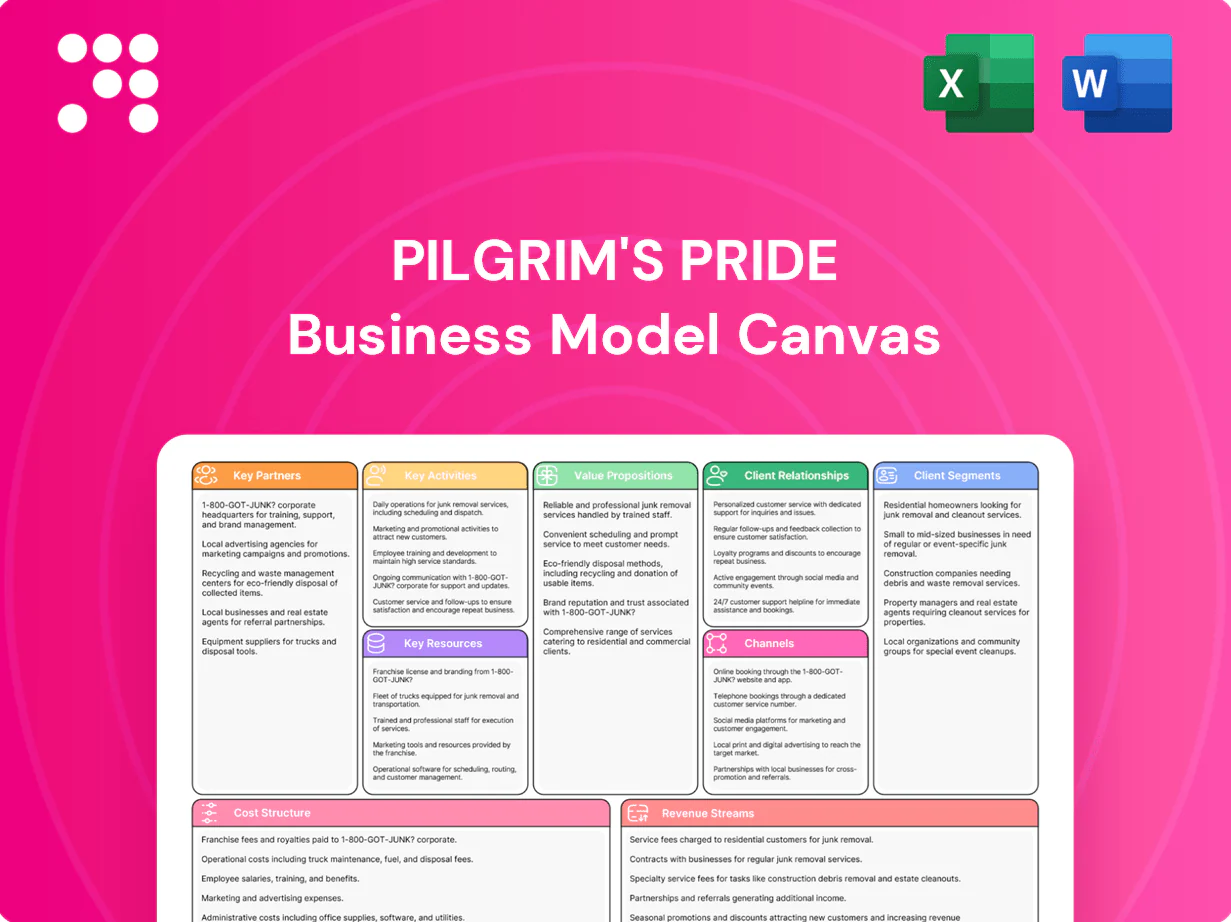
Pilgrim's Pride Business Model Canvas

Unlock a concise Business Model Canvas mapping value props, partners, revenue streams
Unlock Pilgrim's Pride’s strategic blueprint with a concise Business Model Canvas that maps value propositions, key partners, revenue streams and cost drivers. This snapshot reveals how the company scales, manages risks, and captures market share. Purchase the full editable Canvas for detailed, company-specific insights and ready-to-use templates.
Partnerships

Contract growers and farming cooperatives
Independent contract growers supply Pilgrim’s bird grow-out capacity under long-term agreements, stabilizing supply and spreading biological risk across regions. Pilgrim’s supplies chicks, feed and technical guidance to ensure uniformity and performance, enabling rapid volume flexing by region and season. In 2024 over 90% of US broiler production operated under production contracts, making these partnerships core to cost efficiency and scaled animal welfare.
Feed grain suppliers and risk management partners
Strategic sourcing of corn, soymeal and additives via grain merchants and mills underpins Pilgrim's cost base and helps manage margins as U.S. corn futures averaged about $4.80/bu in 2024. Hedging and basis contracts with banks and commodity brokers reduce volatility exposure. Tight supplier ties ensure quality, traceability and continuity during shocks. Co-location or dedicated mill capacity lowers logistics costs and improves margin control.

Retail, foodservice, and distributor alliances
Long-term programs with grocers, QSRs, and broadline distributors secure stable demand for Pilgrim's Pride, supporting company net sales of approximately $13 billion in 2023 and multi-year commitments that cover a majority of planned production. Joint planning aligns assortments, promos, specs, and service levels to optimize throughput and reduce stockouts. Private-label and branded commitments boost line utilization and cut waste, while data sharing improves forecast accuracy and fill rates.

Cold chain logistics and export partners
Cold chain logistics partners—refrigerated carriers, 3PLs, ports, and customs brokers—ensure Pilgrim’s Pride maintains product integrity across domestic and international flows, while export agents secure certifications and market access. Dedicated refrigerated capacity and tailored routing reduce dwell times and spoilage, and network optimization drives on-time delivery and cost efficiency.
- Refrigerated carriers
- 3PLs
- Ports & customs brokers
- Export agents
- Dedicated capacity & network optimization
Animal health, equipment, and technology providers
Veterinary services, vaccines, and biosecurity partners are central to protecting flock health and reducing mortality, with Pilgrim's Pride in 2024 continuing targeted investments in vaccination programs and on-farm biosecurity. Processing equipment OEMs and maintenance partners sustain throughput and yield, while IT and automation vendors enable traceability, quality control, and production planning. Collaboration accelerates innovation in food safety, yield improvements, and labor productivity gains.
- Biosecurity & vaccines: on-farm disease prevention and mortality reduction
- OEMs & maintenance: sustain uptime and yield consistency
- IT & automation: traceability, QC, planning
- Partnerships: drive safety, yield, and labor productivity
Contract growers, grain hedging and cold-chain partners stabilize US poultry supply
Independent contract growers supply Pilgrim’s bird grow-out capacity under long-term agreements, with Pilgrim’s providing chicks, feed and guidance to stabilize output. Strategic grain sourcing and hedging offset feed cost risk; U.S. corn futures averaged $4.80/bu in 2024. Multi-year retailer and QSR programs support demand; Pilgrim’s net sales were about $13B in 2023. Cold-chain, vets, OEMs and IT partners protect quality and throughput.
| Metric | Value |
|---|---|
| Net sales (2023) | $13B |
| US broiler under contract (2024) | >90% |
| US corn futures avg (2024) | $4.80/bu |
What is included in the product
 Detailed Word Document
A comprehensive Business Model Canvas for Pilgrim's Pride outlining customer segments, channels, value propositions, key partners, activities, resources, cost structure and revenue streams tied to poultry production and integrated supply chain operations. Designed for investors and analysts, it includes competitive advantages, SWOT-linked insights and practical guidance for strategic decisions and funding discussions.

 Customizable Excel Spreadsheet
Condenses Pilgrim's Pride’s poultry production and distribution strategy into a one-page, editable Business Model Canvas to quickly pinpoint supply-chain, cost, and market pain points. Great for fast internal reviews, board sessions, or comparing operational scenarios side-by-side.
Activities

Vertically integrated production and processing
Breeding, hatchery, grow-out, processing and packaging are managed end-to-end under Pilgrim's Pride's vertically integrated model, enabling tight quality control, cost containment and predictable yields. Majority-owned by JBS, Pilgrim's Pride uses this integration to implement rapid spec changes for key accounts. Capacity balancing across plants optimizes throughput, reduces bottlenecks and supports consistent margins.
Food safety, quality assurance, and compliance
HACCP plans, pathogen-reduction steps and daily audit programs are executed across Pilgrim's Pride operations to control food safety risks. Compliance covers USDA, EU and Mexican standards plus retailer-specific protocols, supported by continuous testing and end-to-end traceability to mitigate recalls and reputational damage. Certifications and GFSI-aligned schemes enable access to premium markets; FY2024 net sales were $14.6 billion and operations span over 60 facilities.

Product development and value-added innovation
Pilgrim's Pride leverages marinated, seasoned, fully cooked and ready-to-heat formats to capture higher margins versus commodity cuts, driving a shift toward value-added mix. Co-creation with retail and foodservice customers tailors flavor, form factor and packaging to channel needs, supported by pilot runs and sensory testing that reduce launch risk and time-to-shelf. In 2024 the industry saw accelerated demand for convenience proteins, underpinning the strategic move away from commodity exposure.

Demand planning, S&OP, and price risk management
Integrated forecasting aligns live production cycles with customer orders, reducing out-of-stock and shrink across Pilgrim’s vertically integrated poultry network.
S&OP synchronizes supply, inventory and service levels, enabling more consistent fill rates and lower working capital.
Commodity hedging and contracting temper feed-cost swings through forward corn and soybean contracts; pricing programs trade volume commitments for margin protection.
- Integrated forecasting
- S&OP synchronization
- Feed-cost hedging
- Volume-pricing balance
Export market development and certifications
Securing and maintaining country-specific approvals opens demand outlets and allows Pilgrim's Pride to access markets with higher margin potential; halal and specialty certifications enable differentiated sales to Muslim and niche consumers. Market diversification reduces exposure to U.S. oversupply and price volatility while strategic importer relationships improve lane economics and fill international capacity.
- Country approvals: market access
- Certifications: halal/niche premiums
- Diversification: lowers domestic oversupply risk
- Importer ties: better freight and margins
Vertically integrated poultry: $14.6B, 60+ sites, rising margins
Pilgrim's Pride runs end-to-end vertically integrated poultry operations—breeding, hatchery, grow-out, processing and packaging—across 60+ facilities, enabling tight quality control and cost containment. FY2024 net sales were $14.6 billion. S&OP, integrated forecasting and feed hedging stabilize margins while value-added prepared foods shift mix toward higher-margin products.
| Metric | 2024 |
|---|---|
| Net sales | $14.6B |
| Facilities | 60+ |
| Operations | End-to-end vertical integration |
Full Version Awaits
Business Model Canvas
The Pilgrim's Pride Business Model Canvas previewed here is the actual deliverable, not a mockup or excerpt—you’re seeing the real file you’ll receive after purchase. When you buy, you’ll instantly download this same complete, editable document formatted for immediate use. No surprises—what you see is what you get.

Unlock a concise Business Model Canvas mapping value props, partners, revenue streams
Unlock Pilgrim's Pride’s strategic blueprint with a concise Business Model Canvas that maps value propositions, key partners, revenue streams and cost drivers. This snapshot reveals how the company scales, manages risks, and captures market share. Purchase the full editable Canvas for detailed, company-specific insights and ready-to-use templates.
Partnerships
Contract growers and farming cooperatives
Independent contract growers supply Pilgrim’s bird grow-out capacity under long-term agreements, stabilizing supply and spreading biological risk across regions. Pilgrim’s supplies chicks, feed and technical guidance to ensure uniformity and performance, enabling rapid volume flexing by region and season. In 2024 over 90% of US broiler production operated under production contracts, making these partnerships core to cost efficiency and scaled animal welfare.
Feed grain suppliers and risk management partners
Strategic sourcing of corn, soymeal and additives via grain merchants and mills underpins Pilgrim's cost base and helps manage margins as U.S. corn futures averaged about $4.80/bu in 2024. Hedging and basis contracts with banks and commodity brokers reduce volatility exposure. Tight supplier ties ensure quality, traceability and continuity during shocks. Co-location or dedicated mill capacity lowers logistics costs and improves margin control.
Retail, foodservice, and distributor alliances
Long-term programs with grocers, QSRs, and broadline distributors secure stable demand for Pilgrim's Pride, supporting company net sales of approximately $13 billion in 2023 and multi-year commitments that cover a majority of planned production. Joint planning aligns assortments, promos, specs, and service levels to optimize throughput and reduce stockouts. Private-label and branded commitments boost line utilization and cut waste, while data sharing improves forecast accuracy and fill rates.
Cold chain logistics and export partners
Cold chain logistics partners—refrigerated carriers, 3PLs, ports, and customs brokers—ensure Pilgrim’s Pride maintains product integrity across domestic and international flows, while export agents secure certifications and market access. Dedicated refrigerated capacity and tailored routing reduce dwell times and spoilage, and network optimization drives on-time delivery and cost efficiency.
- Refrigerated carriers
- 3PLs
- Ports & customs brokers
- Export agents
- Dedicated capacity & network optimization
Animal health, equipment, and technology providers
Veterinary services, vaccines, and biosecurity partners are central to protecting flock health and reducing mortality, with Pilgrim's Pride in 2024 continuing targeted investments in vaccination programs and on-farm biosecurity. Processing equipment OEMs and maintenance partners sustain throughput and yield, while IT and automation vendors enable traceability, quality control, and production planning. Collaboration accelerates innovation in food safety, yield improvements, and labor productivity gains.
- Biosecurity & vaccines: on-farm disease prevention and mortality reduction
- OEMs & maintenance: sustain uptime and yield consistency
- IT & automation: traceability, QC, planning
- Partnerships: drive safety, yield, and labor productivity
Contract growers, grain hedging and cold-chain partners stabilize US poultry supply
Independent contract growers supply Pilgrim’s bird grow-out capacity under long-term agreements, with Pilgrim’s providing chicks, feed and guidance to stabilize output. Strategic grain sourcing and hedging offset feed cost risk; U.S. corn futures averaged $4.80/bu in 2024. Multi-year retailer and QSR programs support demand; Pilgrim’s net sales were about $13B in 2023. Cold-chain, vets, OEMs and IT partners protect quality and throughput.
| Metric | Value |
|---|---|
| Net sales (2023) | $13B |
| US broiler under contract (2024) | >90% |
| US corn futures avg (2024) | $4.80/bu |
What is included in the product
Detailed Word Document
A comprehensive Business Model Canvas for Pilgrim's Pride outlining customer segments, channels, value propositions, key partners, activities, resources, cost structure and revenue streams tied to poultry production and integrated supply chain operations. Designed for investors and analysts, it includes competitive advantages, SWOT-linked insights and practical guidance for strategic decisions and funding discussions.
Customizable Excel Spreadsheet
Condenses Pilgrim's Pride’s poultry production and distribution strategy into a one-page, editable Business Model Canvas to quickly pinpoint supply-chain, cost, and market pain points. Great for fast internal reviews, board sessions, or comparing operational scenarios side-by-side.
Activities
Vertically integrated production and processing
Breeding, hatchery, grow-out, processing and packaging are managed end-to-end under Pilgrim's Pride's vertically integrated model, enabling tight quality control, cost containment and predictable yields. Majority-owned by JBS, Pilgrim's Pride uses this integration to implement rapid spec changes for key accounts. Capacity balancing across plants optimizes throughput, reduces bottlenecks and supports consistent margins.
Food safety, quality assurance, and compliance
HACCP plans, pathogen-reduction steps and daily audit programs are executed across Pilgrim's Pride operations to control food safety risks. Compliance covers USDA, EU and Mexican standards plus retailer-specific protocols, supported by continuous testing and end-to-end traceability to mitigate recalls and reputational damage. Certifications and GFSI-aligned schemes enable access to premium markets; FY2024 net sales were $14.6 billion and operations span over 60 facilities.
Product development and value-added innovation
Pilgrim's Pride leverages marinated, seasoned, fully cooked and ready-to-heat formats to capture higher margins versus commodity cuts, driving a shift toward value-added mix. Co-creation with retail and foodservice customers tailors flavor, form factor and packaging to channel needs, supported by pilot runs and sensory testing that reduce launch risk and time-to-shelf. In 2024 the industry saw accelerated demand for convenience proteins, underpinning the strategic move away from commodity exposure.
Demand planning, S&OP, and price risk management
Integrated forecasting aligns live production cycles with customer orders, reducing out-of-stock and shrink across Pilgrim’s vertically integrated poultry network.
S&OP synchronizes supply, inventory and service levels, enabling more consistent fill rates and lower working capital.
Commodity hedging and contracting temper feed-cost swings through forward corn and soybean contracts; pricing programs trade volume commitments for margin protection.
- Integrated forecasting
- S&OP synchronization
- Feed-cost hedging
- Volume-pricing balance
Export market development and certifications
Securing and maintaining country-specific approvals opens demand outlets and allows Pilgrim's Pride to access markets with higher margin potential; halal and specialty certifications enable differentiated sales to Muslim and niche consumers. Market diversification reduces exposure to U.S. oversupply and price volatility while strategic importer relationships improve lane economics and fill international capacity.
- Country approvals: market access
- Certifications: halal/niche premiums
- Diversification: lowers domestic oversupply risk
- Importer ties: better freight and margins
Vertically integrated poultry: $14.6B, 60+ sites, rising margins
Pilgrim's Pride runs end-to-end vertically integrated poultry operations—breeding, hatchery, grow-out, processing and packaging—across 60+ facilities, enabling tight quality control and cost containment. FY2024 net sales were $14.6 billion. S&OP, integrated forecasting and feed hedging stabilize margins while value-added prepared foods shift mix toward higher-margin products.
| Metric | 2024 |
|---|---|
| Net sales | $14.6B |
| Facilities | 60+ |
| Operations | End-to-end vertical integration |
Full Version Awaits
Business Model Canvas
The Pilgrim's Pride Business Model Canvas previewed here is the actual deliverable, not a mockup or excerpt—you’re seeing the real file you’ll receive after purchase. When you buy, you’ll instantly download this same complete, editable document formatted for immediate use. No surprises—what you see is what you get.
Original: $10.00
-65%$10.00
$3.50Description
Unlock a concise Business Model Canvas mapping value props, partners, revenue streams
Unlock Pilgrim's Pride’s strategic blueprint with a concise Business Model Canvas that maps value propositions, key partners, revenue streams and cost drivers. This snapshot reveals how the company scales, manages risks, and captures market share. Purchase the full editable Canvas for detailed, company-specific insights and ready-to-use templates.
Partnerships
Contract growers and farming cooperatives
Independent contract growers supply Pilgrim’s bird grow-out capacity under long-term agreements, stabilizing supply and spreading biological risk across regions. Pilgrim’s supplies chicks, feed and technical guidance to ensure uniformity and performance, enabling rapid volume flexing by region and season. In 2024 over 90% of US broiler production operated under production contracts, making these partnerships core to cost efficiency and scaled animal welfare.
Feed grain suppliers and risk management partners
Strategic sourcing of corn, soymeal and additives via grain merchants and mills underpins Pilgrim's cost base and helps manage margins as U.S. corn futures averaged about $4.80/bu in 2024. Hedging and basis contracts with banks and commodity brokers reduce volatility exposure. Tight supplier ties ensure quality, traceability and continuity during shocks. Co-location or dedicated mill capacity lowers logistics costs and improves margin control.
Retail, foodservice, and distributor alliances
Long-term programs with grocers, QSRs, and broadline distributors secure stable demand for Pilgrim's Pride, supporting company net sales of approximately $13 billion in 2023 and multi-year commitments that cover a majority of planned production. Joint planning aligns assortments, promos, specs, and service levels to optimize throughput and reduce stockouts. Private-label and branded commitments boost line utilization and cut waste, while data sharing improves forecast accuracy and fill rates.
Cold chain logistics and export partners
Cold chain logistics partners—refrigerated carriers, 3PLs, ports, and customs brokers—ensure Pilgrim’s Pride maintains product integrity across domestic and international flows, while export agents secure certifications and market access. Dedicated refrigerated capacity and tailored routing reduce dwell times and spoilage, and network optimization drives on-time delivery and cost efficiency.
- Refrigerated carriers
- 3PLs
- Ports & customs brokers
- Export agents
- Dedicated capacity & network optimization
Animal health, equipment, and technology providers
Veterinary services, vaccines, and biosecurity partners are central to protecting flock health and reducing mortality, with Pilgrim's Pride in 2024 continuing targeted investments in vaccination programs and on-farm biosecurity. Processing equipment OEMs and maintenance partners sustain throughput and yield, while IT and automation vendors enable traceability, quality control, and production planning. Collaboration accelerates innovation in food safety, yield improvements, and labor productivity gains.
- Biosecurity & vaccines: on-farm disease prevention and mortality reduction
- OEMs & maintenance: sustain uptime and yield consistency
- IT & automation: traceability, QC, planning
- Partnerships: drive safety, yield, and labor productivity
Contract growers, grain hedging and cold-chain partners stabilize US poultry supply
Independent contract growers supply Pilgrim’s bird grow-out capacity under long-term agreements, with Pilgrim’s providing chicks, feed and guidance to stabilize output. Strategic grain sourcing and hedging offset feed cost risk; U.S. corn futures averaged $4.80/bu in 2024. Multi-year retailer and QSR programs support demand; Pilgrim’s net sales were about $13B in 2023. Cold-chain, vets, OEMs and IT partners protect quality and throughput.
| Metric | Value |
|---|---|
| Net sales (2023) | $13B |
| US broiler under contract (2024) | >90% |
| US corn futures avg (2024) | $4.80/bu |
What is included in the product
Detailed Word Document
A comprehensive Business Model Canvas for Pilgrim's Pride outlining customer segments, channels, value propositions, key partners, activities, resources, cost structure and revenue streams tied to poultry production and integrated supply chain operations. Designed for investors and analysts, it includes competitive advantages, SWOT-linked insights and practical guidance for strategic decisions and funding discussions.
Customizable Excel Spreadsheet
Condenses Pilgrim's Pride’s poultry production and distribution strategy into a one-page, editable Business Model Canvas to quickly pinpoint supply-chain, cost, and market pain points. Great for fast internal reviews, board sessions, or comparing operational scenarios side-by-side.
Activities
Vertically integrated production and processing
Breeding, hatchery, grow-out, processing and packaging are managed end-to-end under Pilgrim's Pride's vertically integrated model, enabling tight quality control, cost containment and predictable yields. Majority-owned by JBS, Pilgrim's Pride uses this integration to implement rapid spec changes for key accounts. Capacity balancing across plants optimizes throughput, reduces bottlenecks and supports consistent margins.
Food safety, quality assurance, and compliance
HACCP plans, pathogen-reduction steps and daily audit programs are executed across Pilgrim's Pride operations to control food safety risks. Compliance covers USDA, EU and Mexican standards plus retailer-specific protocols, supported by continuous testing and end-to-end traceability to mitigate recalls and reputational damage. Certifications and GFSI-aligned schemes enable access to premium markets; FY2024 net sales were $14.6 billion and operations span over 60 facilities.
Product development and value-added innovation
Pilgrim's Pride leverages marinated, seasoned, fully cooked and ready-to-heat formats to capture higher margins versus commodity cuts, driving a shift toward value-added mix. Co-creation with retail and foodservice customers tailors flavor, form factor and packaging to channel needs, supported by pilot runs and sensory testing that reduce launch risk and time-to-shelf. In 2024 the industry saw accelerated demand for convenience proteins, underpinning the strategic move away from commodity exposure.
Demand planning, S&OP, and price risk management
Integrated forecasting aligns live production cycles with customer orders, reducing out-of-stock and shrink across Pilgrim’s vertically integrated poultry network.
S&OP synchronizes supply, inventory and service levels, enabling more consistent fill rates and lower working capital.
Commodity hedging and contracting temper feed-cost swings through forward corn and soybean contracts; pricing programs trade volume commitments for margin protection.
- Integrated forecasting
- S&OP synchronization
- Feed-cost hedging
- Volume-pricing balance
Export market development and certifications
Securing and maintaining country-specific approvals opens demand outlets and allows Pilgrim's Pride to access markets with higher margin potential; halal and specialty certifications enable differentiated sales to Muslim and niche consumers. Market diversification reduces exposure to U.S. oversupply and price volatility while strategic importer relationships improve lane economics and fill international capacity.
- Country approvals: market access
- Certifications: halal/niche premiums
- Diversification: lowers domestic oversupply risk
- Importer ties: better freight and margins
Vertically integrated poultry: $14.6B, 60+ sites, rising margins
Pilgrim's Pride runs end-to-end vertically integrated poultry operations—breeding, hatchery, grow-out, processing and packaging—across 60+ facilities, enabling tight quality control and cost containment. FY2024 net sales were $14.6 billion. S&OP, integrated forecasting and feed hedging stabilize margins while value-added prepared foods shift mix toward higher-margin products.
| Metric | 2024 |
|---|---|
| Net sales | $14.6B |
| Facilities | 60+ |
| Operations | End-to-end vertical integration |
Full Version Awaits
Business Model Canvas
The Pilgrim's Pride Business Model Canvas previewed here is the actual deliverable, not a mockup or excerpt—you’re seeing the real file you’ll receive after purchase. When you buy, you’ll instantly download this same complete, editable document formatted for immediate use. No surprises—what you see is what you get.











