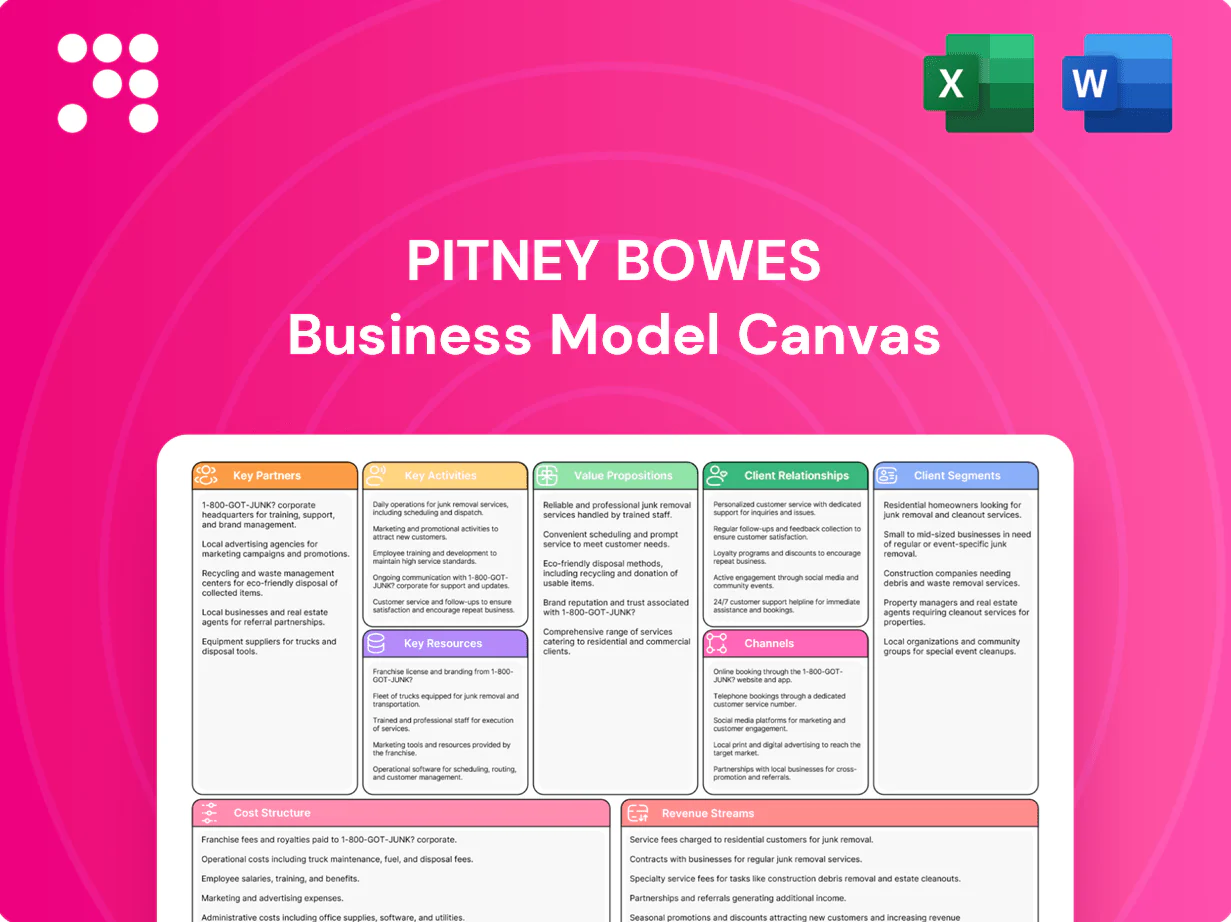
Pitney Bowes Business Model Canvas

Unlock the strategic Business Model Canvas for mail, e-commerce and logistics players
Unlock the full strategic blueprint behind Pitney Bowes with our Business Model Canvas. This concise, sector-specific analysis maps value propositions, channels, revenue streams and key partners to reveal growth levers and risks. Download the full Word/Excel canvas to benchmark, plan, or pitch with confidence.
Partnerships

Carrier and postal alliances
Collaboration with national postal services and 100+ private carriers expands Pitney Bowes delivery options and reliability across global markets. These partnerships enable discounted rates and optimized routing that reduce shipping spend and transit times. Joint service-level agreements target predictable performance with industry-grade 99%+ delivery compliance. Co-marketing and data-sharing deepen mutual reach and drive volume growth.
Technology and cloud providers
Alliances with cloud, data and cybersecurity vendors power Pitney Bowes scalable platforms, leveraging a global public cloud market that surpassed 600 billion USD in 2024 to reduce infrastructure cost and time-to-market. Integration partners enable APIs for shipping, billing and address validation, processing millions of transactions daily. Co-innovation programs accelerate product roadmaps and shared standards boost compliance and 99.99% uptime SLAs.

E-commerce platforms and marketplaces
Partnerships with leading e-commerce platforms streamline checkout, labeling and returns, improving conversion and last‑mile experience across merchants; platforms power access to the $6.3 trillion global e-commerce market projected for 2024. Pre-built connectors reduce merchant onboarding friction and integration time, accelerating time-to-revenue. Joint value propositions and co-selling with platforms unlock SMB and mid-market accounts by bundling conversion and delivery guarantees.

Financial institutions and underwriters
Financial institutions and underwriters enable Pitney Bowes to offer lending, leasing and payments, with 2024 partnerships expanding financing for mailroom and e-commerce equipment; shared risk models increase customer credit access and uptake. Embedded finance tied to software bundles boosts equipment adoption, while joint compliance frameworks reduce regulatory friction.
- Banking partners: support lending/leasing
- Risk sharing: broadens credit availability
- Embedded finance: raises adoption of hardware/software
- Compliance frameworks: lower regulatory barriers
Print, fulfillment, and 3PL networks
Service bureaus and third-party logistics extend Pitney Bowes production and delivery capacity, plugging into its global network that spans 100+ countries and ~10,000 employees (2024). Regional partners improve speed-to-door and last-mile coverage, lowering transit times and cost-per-delivery. White-label arrangements expand solution breadth for clients; shared SLAs preserve consistency across regions and channels.
- Service bureaus: capacity on demand
- 3PL: last-mile reach
- Regional partners: faster delivery
- White-label: broader solutions
- Shared SLAs: uniform quality
Carrier-cloud partnerships: 100+ countries, lower shipping, 99.99% uptime
Collaboration with postal/private carriers, cloud vendors, e‑commerce platforms and banks expands reach, cuts shipping costs and enables embedded finance; 2024 stats: 100+ countries, ~10,000 employees, $600B cloud market, $6.3T e‑commerce. SLAs target 99%+ delivery and 99.99% uptime to drive volume and reduce churn.
| Partner | 2024 stat | Benefit |
|---|---|---|
| Carriers/cloud/platforms/banks | 100+ countries; $600B cloud; $6.3T ecommerce | Lower cost, faster delivery, finance |
What is included in the product
 Detailed Word Document
A concise, pre-written Business Model Canvas for Pitney Bowes detailing customer segments, channels, key activities and value propositions across the 9 BMC blocks, with competitive advantages, SWOT-linked insights and practical use for strategy reviews, presentations, and investor discussions.

 Customizable Excel Spreadsheet
High-level view of Pitney Bowes’ business model with editable cells, condensing complex mailing, shipping and e-commerce software services into a one-page snapshot for fast strategic review and team collaboration.
Activities

Shipping and mailing operations
Processing, rating, tracking and manifesting parcels at scale are core, with Pitney Bowes handling millions of shipments monthly and reporting roughly $2.2 billion revenue in 2024. Integrated systems orchestrate carriers, labels and regulatory compliance across domestic and cross‑border routes. Continuous performance tuning cut transit times and costs via routing optimization and carrier mix analysis. Robust exceptions handling and real‑time alerts ensure delivery assurance.
Software development and integration
Building SaaS platforms, APIs, and connectors—supporting Pitney Bowes' global customer base of over 90,000—drives product value and seamless integration across mail, ecommerce, and shipping workflows. Secure, resilient architecture targets enterprise-class uptime and regional redundancy to protect operations. Data pipelines ingest billions of events to power analytics and automation. Roadmap execution maps releases to customer workflows and SLAs.

Customer success and support
Onboarding, training, and 24/7 technical support sustain adoption at Pitney Bowes (NYSE: PBI); proactive health checks reduce churn and improve retention, while dedicated customer success managers guide optimization and usage growth. Continuous feedback loops feed product teams for iterative improvements; company founded 1920 (104 years in 2024).

Data management and analytics
Data management and analytics power address validation, fraud mitigation and rate optimization; Pitney Bowes leverages centralized data lakes and ML models to improve routing and cost control, contributing to its FY2024 revenue of roughly $3.0 billion and sustained margins.
- Address validation
- Fraud mitigation
- Rate optimization
- ML routing & cost control
- Dashboards for visibility
- Governance & compliance
Compliance and risk management
Adherence to postal, customs, and financial regulations underpins Pitney Bowes operations, with the company citing $1.4B revenue in FY2024 while serving postal and e-commerce clients globally. Robust security frameworks (SOC2/SOC1) protect customer and transaction data, and credit underwriting limits exposure across leasing and financing portfolios. Regular audits and certifications sustain customer trust and regulatory compliance.
- Regulatory compliance: postal, customs, finance
- Security: SOC1/SOC2 frameworks
- Credit controls: underwriting limits
- Governance: audits and certifications
ML-driven logistics platform optimizing millions of monthly shipments for 90,000+ customers
Processing, rating, tracking and manifesting millions of shipments monthly support core logistics, with routing optimization and carrier mix reducing transit time and costs. SaaS platforms, APIs and ML-driven analytics serve 90,000+ customers and ingest billions of events for address validation, fraud mitigation and rate optimization. 24/7 support, onboarding and compliance (SOC1/SOC2, postal/customs) sustain retention and regulatory trust.
| Metric | 2024 |
|---|---|
| Customers | 90,000+ |
| Shipments | millions/month |
| FY revenue (reported) | $3.0B / $2.2B / $1.4B |
Full Document Unlocks After Purchase
Business Model Canvas
The Pitney Bowes Business Model Canvas you’re previewing is the actual deliverable, not a mockup—what you see is a direct snapshot of the final file. Upon purchase you’ll receive this exact document, fully formatted and complete, ready to download and edit in Word and Excel. No placeholders, no surprises—just the live, professional canvas shown here.

Unlock the strategic Business Model Canvas for mail, e-commerce and logistics players
Unlock the full strategic blueprint behind Pitney Bowes with our Business Model Canvas. This concise, sector-specific analysis maps value propositions, channels, revenue streams and key partners to reveal growth levers and risks. Download the full Word/Excel canvas to benchmark, plan, or pitch with confidence.
Partnerships
Carrier and postal alliances
Collaboration with national postal services and 100+ private carriers expands Pitney Bowes delivery options and reliability across global markets. These partnerships enable discounted rates and optimized routing that reduce shipping spend and transit times. Joint service-level agreements target predictable performance with industry-grade 99%+ delivery compliance. Co-marketing and data-sharing deepen mutual reach and drive volume growth.
Technology and cloud providers
Alliances with cloud, data and cybersecurity vendors power Pitney Bowes scalable platforms, leveraging a global public cloud market that surpassed 600 billion USD in 2024 to reduce infrastructure cost and time-to-market. Integration partners enable APIs for shipping, billing and address validation, processing millions of transactions daily. Co-innovation programs accelerate product roadmaps and shared standards boost compliance and 99.99% uptime SLAs.
E-commerce platforms and marketplaces
Partnerships with leading e-commerce platforms streamline checkout, labeling and returns, improving conversion and last‑mile experience across merchants; platforms power access to the $6.3 trillion global e-commerce market projected for 2024. Pre-built connectors reduce merchant onboarding friction and integration time, accelerating time-to-revenue. Joint value propositions and co-selling with platforms unlock SMB and mid-market accounts by bundling conversion and delivery guarantees.
Financial institutions and underwriters
Financial institutions and underwriters enable Pitney Bowes to offer lending, leasing and payments, with 2024 partnerships expanding financing for mailroom and e-commerce equipment; shared risk models increase customer credit access and uptake. Embedded finance tied to software bundles boosts equipment adoption, while joint compliance frameworks reduce regulatory friction.
- Banking partners: support lending/leasing
- Risk sharing: broadens credit availability
- Embedded finance: raises adoption of hardware/software
- Compliance frameworks: lower regulatory barriers
Print, fulfillment, and 3PL networks
Service bureaus and third-party logistics extend Pitney Bowes production and delivery capacity, plugging into its global network that spans 100+ countries and ~10,000 employees (2024). Regional partners improve speed-to-door and last-mile coverage, lowering transit times and cost-per-delivery. White-label arrangements expand solution breadth for clients; shared SLAs preserve consistency across regions and channels.
- Service bureaus: capacity on demand
- 3PL: last-mile reach
- Regional partners: faster delivery
- White-label: broader solutions
- Shared SLAs: uniform quality
Carrier-cloud partnerships: 100+ countries, lower shipping, 99.99% uptime
Collaboration with postal/private carriers, cloud vendors, e‑commerce platforms and banks expands reach, cuts shipping costs and enables embedded finance; 2024 stats: 100+ countries, ~10,000 employees, $600B cloud market, $6.3T e‑commerce. SLAs target 99%+ delivery and 99.99% uptime to drive volume and reduce churn.
| Partner | 2024 stat | Benefit |
|---|---|---|
| Carriers/cloud/platforms/banks | 100+ countries; $600B cloud; $6.3T ecommerce | Lower cost, faster delivery, finance |
What is included in the product
Detailed Word Document
A concise, pre-written Business Model Canvas for Pitney Bowes detailing customer segments, channels, key activities and value propositions across the 9 BMC blocks, with competitive advantages, SWOT-linked insights and practical use for strategy reviews, presentations, and investor discussions.
Customizable Excel Spreadsheet
High-level view of Pitney Bowes’ business model with editable cells, condensing complex mailing, shipping and e-commerce software services into a one-page snapshot for fast strategic review and team collaboration.
Activities
Shipping and mailing operations
Processing, rating, tracking and manifesting parcels at scale are core, with Pitney Bowes handling millions of shipments monthly and reporting roughly $2.2 billion revenue in 2024. Integrated systems orchestrate carriers, labels and regulatory compliance across domestic and cross‑border routes. Continuous performance tuning cut transit times and costs via routing optimization and carrier mix analysis. Robust exceptions handling and real‑time alerts ensure delivery assurance.
Software development and integration
Building SaaS platforms, APIs, and connectors—supporting Pitney Bowes' global customer base of over 90,000—drives product value and seamless integration across mail, ecommerce, and shipping workflows. Secure, resilient architecture targets enterprise-class uptime and regional redundancy to protect operations. Data pipelines ingest billions of events to power analytics and automation. Roadmap execution maps releases to customer workflows and SLAs.
Customer success and support
Onboarding, training, and 24/7 technical support sustain adoption at Pitney Bowes (NYSE: PBI); proactive health checks reduce churn and improve retention, while dedicated customer success managers guide optimization and usage growth. Continuous feedback loops feed product teams for iterative improvements; company founded 1920 (104 years in 2024).
Data management and analytics
Data management and analytics power address validation, fraud mitigation and rate optimization; Pitney Bowes leverages centralized data lakes and ML models to improve routing and cost control, contributing to its FY2024 revenue of roughly $3.0 billion and sustained margins.
- Address validation
- Fraud mitigation
- Rate optimization
- ML routing & cost control
- Dashboards for visibility
- Governance & compliance
Compliance and risk management
Adherence to postal, customs, and financial regulations underpins Pitney Bowes operations, with the company citing $1.4B revenue in FY2024 while serving postal and e-commerce clients globally. Robust security frameworks (SOC2/SOC1) protect customer and transaction data, and credit underwriting limits exposure across leasing and financing portfolios. Regular audits and certifications sustain customer trust and regulatory compliance.
- Regulatory compliance: postal, customs, finance
- Security: SOC1/SOC2 frameworks
- Credit controls: underwriting limits
- Governance: audits and certifications
ML-driven logistics platform optimizing millions of monthly shipments for 90,000+ customers
Processing, rating, tracking and manifesting millions of shipments monthly support core logistics, with routing optimization and carrier mix reducing transit time and costs. SaaS platforms, APIs and ML-driven analytics serve 90,000+ customers and ingest billions of events for address validation, fraud mitigation and rate optimization. 24/7 support, onboarding and compliance (SOC1/SOC2, postal/customs) sustain retention and regulatory trust.
| Metric | 2024 |
|---|---|
| Customers | 90,000+ |
| Shipments | millions/month |
| FY revenue (reported) | $3.0B / $2.2B / $1.4B |
Full Document Unlocks After Purchase
Business Model Canvas
The Pitney Bowes Business Model Canvas you’re previewing is the actual deliverable, not a mockup—what you see is a direct snapshot of the final file. Upon purchase you’ll receive this exact document, fully formatted and complete, ready to download and edit in Word and Excel. No placeholders, no surprises—just the live, professional canvas shown here.
Description
Unlock the strategic Business Model Canvas for mail, e-commerce and logistics players
Unlock the full strategic blueprint behind Pitney Bowes with our Business Model Canvas. This concise, sector-specific analysis maps value propositions, channels, revenue streams and key partners to reveal growth levers and risks. Download the full Word/Excel canvas to benchmark, plan, or pitch with confidence.
Partnerships
Carrier and postal alliances
Collaboration with national postal services and 100+ private carriers expands Pitney Bowes delivery options and reliability across global markets. These partnerships enable discounted rates and optimized routing that reduce shipping spend and transit times. Joint service-level agreements target predictable performance with industry-grade 99%+ delivery compliance. Co-marketing and data-sharing deepen mutual reach and drive volume growth.
Technology and cloud providers
Alliances with cloud, data and cybersecurity vendors power Pitney Bowes scalable platforms, leveraging a global public cloud market that surpassed 600 billion USD in 2024 to reduce infrastructure cost and time-to-market. Integration partners enable APIs for shipping, billing and address validation, processing millions of transactions daily. Co-innovation programs accelerate product roadmaps and shared standards boost compliance and 99.99% uptime SLAs.
E-commerce platforms and marketplaces
Partnerships with leading e-commerce platforms streamline checkout, labeling and returns, improving conversion and last‑mile experience across merchants; platforms power access to the $6.3 trillion global e-commerce market projected for 2024. Pre-built connectors reduce merchant onboarding friction and integration time, accelerating time-to-revenue. Joint value propositions and co-selling with platforms unlock SMB and mid-market accounts by bundling conversion and delivery guarantees.
Financial institutions and underwriters
Financial institutions and underwriters enable Pitney Bowes to offer lending, leasing and payments, with 2024 partnerships expanding financing for mailroom and e-commerce equipment; shared risk models increase customer credit access and uptake. Embedded finance tied to software bundles boosts equipment adoption, while joint compliance frameworks reduce regulatory friction.
- Banking partners: support lending/leasing
- Risk sharing: broadens credit availability
- Embedded finance: raises adoption of hardware/software
- Compliance frameworks: lower regulatory barriers
Print, fulfillment, and 3PL networks
Service bureaus and third-party logistics extend Pitney Bowes production and delivery capacity, plugging into its global network that spans 100+ countries and ~10,000 employees (2024). Regional partners improve speed-to-door and last-mile coverage, lowering transit times and cost-per-delivery. White-label arrangements expand solution breadth for clients; shared SLAs preserve consistency across regions and channels.
- Service bureaus: capacity on demand
- 3PL: last-mile reach
- Regional partners: faster delivery
- White-label: broader solutions
- Shared SLAs: uniform quality
Carrier-cloud partnerships: 100+ countries, lower shipping, 99.99% uptime
Collaboration with postal/private carriers, cloud vendors, e‑commerce platforms and banks expands reach, cuts shipping costs and enables embedded finance; 2024 stats: 100+ countries, ~10,000 employees, $600B cloud market, $6.3T e‑commerce. SLAs target 99%+ delivery and 99.99% uptime to drive volume and reduce churn.
| Partner | 2024 stat | Benefit |
|---|---|---|
| Carriers/cloud/platforms/banks | 100+ countries; $600B cloud; $6.3T ecommerce | Lower cost, faster delivery, finance |
What is included in the product
Detailed Word Document
A concise, pre-written Business Model Canvas for Pitney Bowes detailing customer segments, channels, key activities and value propositions across the 9 BMC blocks, with competitive advantages, SWOT-linked insights and practical use for strategy reviews, presentations, and investor discussions.
Customizable Excel Spreadsheet
High-level view of Pitney Bowes’ business model with editable cells, condensing complex mailing, shipping and e-commerce software services into a one-page snapshot for fast strategic review and team collaboration.
Activities
Shipping and mailing operations
Processing, rating, tracking and manifesting parcels at scale are core, with Pitney Bowes handling millions of shipments monthly and reporting roughly $2.2 billion revenue in 2024. Integrated systems orchestrate carriers, labels and regulatory compliance across domestic and cross‑border routes. Continuous performance tuning cut transit times and costs via routing optimization and carrier mix analysis. Robust exceptions handling and real‑time alerts ensure delivery assurance.
Software development and integration
Building SaaS platforms, APIs, and connectors—supporting Pitney Bowes' global customer base of over 90,000—drives product value and seamless integration across mail, ecommerce, and shipping workflows. Secure, resilient architecture targets enterprise-class uptime and regional redundancy to protect operations. Data pipelines ingest billions of events to power analytics and automation. Roadmap execution maps releases to customer workflows and SLAs.
Customer success and support
Onboarding, training, and 24/7 technical support sustain adoption at Pitney Bowes (NYSE: PBI); proactive health checks reduce churn and improve retention, while dedicated customer success managers guide optimization and usage growth. Continuous feedback loops feed product teams for iterative improvements; company founded 1920 (104 years in 2024).
Data management and analytics
Data management and analytics power address validation, fraud mitigation and rate optimization; Pitney Bowes leverages centralized data lakes and ML models to improve routing and cost control, contributing to its FY2024 revenue of roughly $3.0 billion and sustained margins.
- Address validation
- Fraud mitigation
- Rate optimization
- ML routing & cost control
- Dashboards for visibility
- Governance & compliance
Compliance and risk management
Adherence to postal, customs, and financial regulations underpins Pitney Bowes operations, with the company citing $1.4B revenue in FY2024 while serving postal and e-commerce clients globally. Robust security frameworks (SOC2/SOC1) protect customer and transaction data, and credit underwriting limits exposure across leasing and financing portfolios. Regular audits and certifications sustain customer trust and regulatory compliance.
- Regulatory compliance: postal, customs, finance
- Security: SOC1/SOC2 frameworks
- Credit controls: underwriting limits
- Governance: audits and certifications
ML-driven logistics platform optimizing millions of monthly shipments for 90,000+ customers
Processing, rating, tracking and manifesting millions of shipments monthly support core logistics, with routing optimization and carrier mix reducing transit time and costs. SaaS platforms, APIs and ML-driven analytics serve 90,000+ customers and ingest billions of events for address validation, fraud mitigation and rate optimization. 24/7 support, onboarding and compliance (SOC1/SOC2, postal/customs) sustain retention and regulatory trust.
| Metric | 2024 |
|---|---|
| Customers | 90,000+ |
| Shipments | millions/month |
| FY revenue (reported) | $3.0B / $2.2B / $1.4B |
Full Document Unlocks After Purchase
Business Model Canvas
The Pitney Bowes Business Model Canvas you’re previewing is the actual deliverable, not a mockup—what you see is a direct snapshot of the final file. Upon purchase you’ll receive this exact document, fully formatted and complete, ready to download and edit in Word and Excel. No placeholders, no surprises—just the live, professional canvas shown here.











