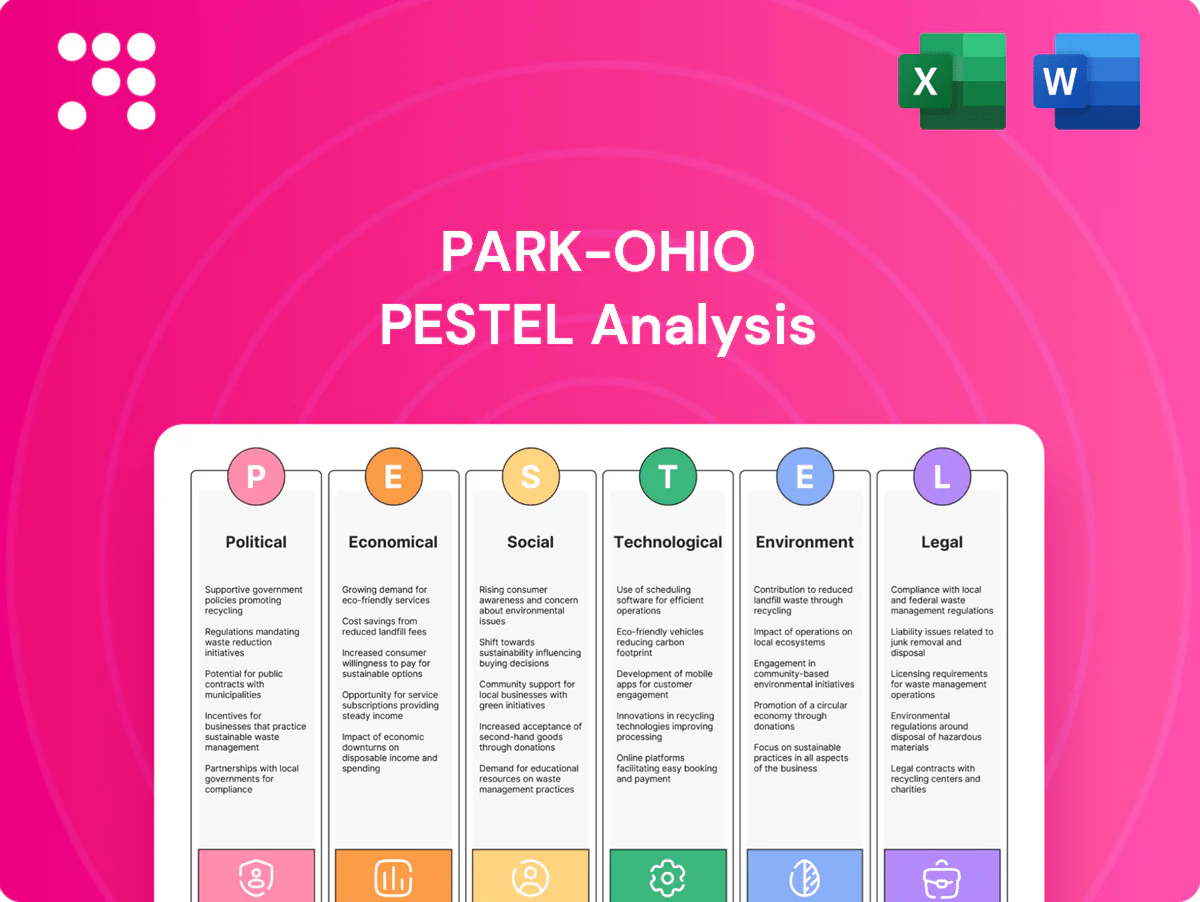
Park-Ohio PESTLE Analysis

Your Shortcut to Market Insight Starts Here
Uncover the critical political, economic, social, technological, environmental, and legal factors shaping Park-Ohio's trajectory. This comprehensive PESTEL analysis provides actionable intelligence, empowering you to anticipate challenges and capitalize on emerging opportunities. Download the full report to gain a strategic advantage.
Political factors

Government Regulations and Industrial Policy
Government regulations significantly shape Park-Ohio's environment. For instance, evolving environmental standards for manufacturing processes, particularly in sectors like automotive and aerospace where Park-Ohio has a strong presence, can necessitate costly upgrades or shifts in production methods. In 2024, the US Department of Commerce continued to emphasize reshoring initiatives, potentially benefiting domestic manufacturers like Park-Ohio by incentivizing onshoring of critical supply chains.
International Trade Agreements and Tariffs
Park-Ohio's global operations mean it's directly impacted by international trade policies. For instance, changes in trade agreements, like potential renegotiations of existing pacts or the imposition of new tariffs, can significantly alter the cost of imported components and the price competitiveness of its exported goods. The United States, a key market for Park-Ohio, has seen fluctuating trade policies, including tariffs on steel and aluminum in recent years, which directly affect manufacturing inputs.

Geopolitical Stability and Conflicts
Operating globally, Park-Ohio's business is significantly exposed to geopolitical risks. For instance, ongoing conflicts in Eastern Europe and the Middle East, as of early 2024, have continued to create supply chain vulnerabilities and price volatility for raw materials and energy, directly impacting manufacturing costs.
Political instability and sanctions in key markets can disrupt Park-Ohio's operations and demand. For example, trade restrictions or tariffs imposed by major economies could affect the company's ability to source components or sell finished goods, necessitating constant adaptation of its global strategy.
These geopolitical events can also influence demand in critical sectors like defense and automotive. Increased defense spending due to global tensions might boost demand for certain Park-Ohio products, while instability in automotive markets could dampen sales, requiring agile risk management and diversified market approaches.

Defense Spending and Government Contracts
Park-Ohio's engagement in the defense industry means that shifts in government defense spending are a critical political consideration. For instance, the U.S. Department of Defense budget for fiscal year 2024 was approximately $886 billion, highlighting the scale of potential government contracts. Fluctuations in these budgets directly impact the demand for Park-Ohio's engineered products, influencing its revenue and growth prospects.
The awarding of government contracts is another key political factor. These contracts can represent significant revenue streams, but their allocation is subject to political priorities and geopolitical events. In 2023, defense contractors saw varying impacts based on contract wins and losses, underscoring the importance of securing these agreements for companies like Park-Ohio.
- Defense Budget Trends: The U.S. defense budget has seen a general upward trend in recent years, with projections indicating continued investment in defense capabilities through 2025.
- Contract Awarding Processes: Government contracts are awarded through competitive bidding processes, influenced by factors such as national security priorities, technological advancements, and political relationships.
- Geopolitical Influences: International conflicts and global security concerns can lead to increased defense spending and a greater demand for specialized military components, potentially benefiting Park-Ohio.
Environmental and Labor Policy Enforcement
Stricter enforcement of environmental protection policies and labor laws in countries where Park-Ohio operates, such as the United States and Germany, presents a significant political factor. For instance, increased scrutiny on emissions standards, as seen with evolving EPA regulations in the US, can necessitate substantial capital expenditure for compliance. Similarly, labor law updates, like those concerning worker safety and wage parity, can directly impact operational costs and workforce management strategies.
These politically driven mandates require continuous investment in sustainable practices and adherence to fair labor standards. Failure to comply can result in hefty fines and damage to Park-Ohio's corporate reputation, impacting its ability to attract talent and maintain customer trust. For example, in 2023, the US Department of Labor reported over $23 million in back wages recovered due to wage and hour violations, highlighting the financial risks of non-compliance.
- Increased Compliance Costs: Environmental regulations and labor law enforcement can lead to higher operational expenses for Park-Ohio.
- Operational Adjustments: Companies may need to modify production processes or supply chain management to meet new policy requirements.
- Reputational Risk: Non-compliance can negatively affect brand image and stakeholder confidence.
- Investment in Sustainability: Political pressure often drives the need for ongoing investment in eco-friendly technologies and ethical labor practices.
Government & Geopolitical Factors Impacting Business
Government regulations continue to influence Park-Ohio's operational landscape, with a particular focus on environmental standards and reshoring initiatives. For example, the US Department of Commerce's emphasis on bringing manufacturing back onshore in 2024 could provide a competitive edge for domestic players like Park-Ohio.
International trade policies and geopolitical stability remain critical factors affecting Park-Ohio's global business. Fluctuations in trade agreements and ongoing global conflicts can impact raw material costs and market access, as seen with tariffs on steel and aluminum impacting manufacturing inputs.
Defense spending is a significant political driver for Park-Ohio, given its role in the defense industry. The U.S. defense budget for fiscal year 2024, approximately $886 billion, underscores the potential impact of government contracts on revenue, with trends suggesting continued investment through 2025.
What is included in the product
 Detailed Word Document
This Park-Ohio PESTLE analysis examines the influence of Political, Economic, Social, Technological, Environmental, and Legal factors on the company's operations and strategic planning.

 Customizable Excel Spreadsheet
The Park-Ohio PESTLE analysis offers a clean, summarized version of the full analysis for easy referencing during meetings or presentations, simplifying complex external factors.
Economic factors

Global Economic Growth and Recession Risks
Park-Ohio's fortunes are closely linked to the ebb and flow of the global economy, especially within its key markets like automotive, industrial, aerospace, and defense. When the world economy is humming along, demand for Park-Ohio's engineered products and supply chain solutions tends to rise, as businesses ramp up production and investment.
Conversely, economic downturns, or recessions, present significant headwinds. During these periods, industrial activity often slows, leading to decreased demand for Park-Ohio's offerings and potentially impacting sales volumes. For instance, a global slowdown in manufacturing output, a common feature of recessions, directly translates to fewer orders for the components and services Park-Ohio provides.
Looking at recent trends, the International Monetary Fund (IMF) projected global growth to be around 3.2% in 2024, a slight slowdown from previous years but still indicating expansion. However, risks of recession remain, particularly in certain regions, due to persistent inflation and geopolitical uncertainties, which could dampen industrial demand throughout 2024 and into 2025.
Inflation and Raw Material Costs
High inflation rates and the resulting volatility in raw material prices, particularly for metals and energy, present a significant challenge for Park-Ohio. These fluctuations directly impact the company's manufacturing expenses and, consequently, its profitability across its various business segments. For instance, the Producer Price Index for manufactured goods saw an increase of 2.7% for the year ending May 2024, reflecting these broader cost pressures.
To navigate this dynamic economic landscape, Park-Ohio must employ robust cost management strategies. This includes optimizing sourcing to secure favorable pricing for essential inputs, utilizing hedging instruments to mitigate price risks, and implementing strategic pricing adjustments to pass on increased costs where feasible, all while striving to maintain healthy profit margins.

Interest Rates and Access to Capital
Interest rates significantly impact Park-Ohio's operational costs and investment decisions. For instance, a rise in the Federal Reserve's benchmark interest rate, which stood at 5.25%-5.50% as of early 2024, directly increases the cost of borrowing for capital expenditures and working capital needs. This can deter large-scale projects or expansions if the expected returns do not sufficiently outweigh the higher financing expenses.
Higher borrowing costs can constrain Park-Ohio's ability to pursue growth opportunities, potentially slowing down innovation or capacity expansion. For example, if the company was planning a new manufacturing facility requiring a $100 million loan, a 1% increase in interest rates could add $1 million annually to its debt servicing, impacting profitability and the viability of the project.
Conversely, a decrease in interest rates, as seen in some periods of 2024 with potential rate cuts anticipated, would lower Park-Ohio's borrowing costs. This could encourage investment in new equipment, technology upgrades, or acquisitions, thereby supporting its financial leverage and strategic growth initiatives by making capital more accessible and affordable.

Supply Chain Disruptions and Logistics Costs
Rising energy prices, persistent labor shortages, and aging infrastructure are creating significant headwinds for global supply chains. These factors directly translate to increased logistics costs, impacting companies like Park-Ohio. For instance, the average cost to ship a 40-foot container from Asia to the US West Coast saw dramatic fluctuations in 2024, at times exceeding $5,000, a stark increase from pre-pandemic levels. This environment, however, can also create opportunities for companies specializing in supply chain management outsourcing.
The ongoing challenges in logistics mean that companies are actively seeking solutions to mitigate these rising costs and improve efficiency. Labor shortages, particularly in trucking and warehousing, continue to exacerbate delays and inflate operational expenses. For example, the American Trucking Associations reported a shortage of over 78,000 drivers in 2024, a critical bottleneck. This presents a clear avenue for Park-Ohio to offer its expertise in streamlining operations and managing these complex logistical hurdles.
- Energy Price Volatility: Fluctuations in fuel prices directly impact transportation costs, a major component of logistics.
- Labor Shortages: A lack of skilled workers in transportation and warehousing sectors leads to increased wages and reduced operational capacity.
- Infrastructure Deficiencies: Underinvestment in roads, bridges, and ports causes bottlenecks and delays, adding to transit times and costs.
- Increased Demand for Outsourcing: Companies are increasingly looking to third-party providers to navigate complex supply chain challenges and reduce their own operational burdens.
Currency Exchange Rate Fluctuations
As a global enterprise, Park-Ohio's operations span numerous countries, exposing it to the inherent volatility of currency exchange rates. These fluctuations directly influence the conversion of foreign-denominated revenues and expenses into its reporting currency, impacting overall financial performance. For instance, a strengthening US dollar against other currencies could reduce the reported value of Park-Ohio's international sales.
The company's susceptibility to these movements necessitates robust financial management, including the strategic use of hedging instruments to mitigate potential negative impacts on profitability. In 2024, the Euro experienced a period of weakness against the US dollar, which could have presented challenges for companies with significant European operations, like Park-Ohio, if not adequately hedged.
- Impact on Revenue: Unfavorable currency shifts can decrease the reported value of international sales when translated back to the home currency.
- Cost Management: Fluctuations also affect the cost of imported raw materials or components, potentially increasing expenses.
- Profitability: Net income can be significantly altered by currency translation effects, requiring careful forecasting and risk mitigation.
- Hedging Strategies: Park-Ohio likely employs financial instruments such as forward contracts or options to lock in exchange rates and reduce uncertainty.
Economic Factors Drive Performance and Costs
Economic factors significantly shape Park-Ohio's performance, with global growth trends directly influencing demand for its engineered products and supply chain solutions. While the IMF projected 3.2% global growth for 2024, persistent inflation and geopolitical risks could temper industrial activity into 2025, impacting sales volumes.
Inflationary pressures and volatile raw material prices, such as the 2.7% year-over-year increase in the Producer Price Index for manufactured goods ending May 2024, directly affect Park-Ohio's manufacturing costs and profitability. Higher interest rates, with the Federal Reserve's benchmark rate at 5.25%-5.50% in early 2024, increase borrowing costs, potentially hindering capital expenditures and growth initiatives.
Supply chain disruptions, driven by energy price volatility and labor shortages, like the estimated 78,000 truck driver deficit in 2024, escalate logistics costs. Currency exchange rate fluctuations also pose a risk, impacting the reported value of international sales, as seen with the Euro's weakness against the US dollar in 2024, necessitating robust hedging strategies.
Full Version Awaits
Park-Ohio PESTLE Analysis
The preview shown here is the exact Park-Ohio PESTLE Analysis document you’ll receive after purchase—fully formatted and ready to use.
This is a real screenshot of the product you’re buying—delivered exactly as shown, no surprises, allowing you to assess the depth and quality of the analysis.
The content and structure shown in the preview is the same Park-Ohio PESTLE Analysis document you’ll download after payment, providing immediate access to valuable strategic insights.

Your Shortcut to Market Insight Starts Here
Uncover the critical political, economic, social, technological, environmental, and legal factors shaping Park-Ohio's trajectory. This comprehensive PESTEL analysis provides actionable intelligence, empowering you to anticipate challenges and capitalize on emerging opportunities. Download the full report to gain a strategic advantage.
Political factors
Government Regulations and Industrial Policy
Government regulations significantly shape Park-Ohio's environment. For instance, evolving environmental standards for manufacturing processes, particularly in sectors like automotive and aerospace where Park-Ohio has a strong presence, can necessitate costly upgrades or shifts in production methods. In 2024, the US Department of Commerce continued to emphasize reshoring initiatives, potentially benefiting domestic manufacturers like Park-Ohio by incentivizing onshoring of critical supply chains.
International Trade Agreements and Tariffs
Park-Ohio's global operations mean it's directly impacted by international trade policies. For instance, changes in trade agreements, like potential renegotiations of existing pacts or the imposition of new tariffs, can significantly alter the cost of imported components and the price competitiveness of its exported goods. The United States, a key market for Park-Ohio, has seen fluctuating trade policies, including tariffs on steel and aluminum in recent years, which directly affect manufacturing inputs.
Geopolitical Stability and Conflicts
Operating globally, Park-Ohio's business is significantly exposed to geopolitical risks. For instance, ongoing conflicts in Eastern Europe and the Middle East, as of early 2024, have continued to create supply chain vulnerabilities and price volatility for raw materials and energy, directly impacting manufacturing costs.
Political instability and sanctions in key markets can disrupt Park-Ohio's operations and demand. For example, trade restrictions or tariffs imposed by major economies could affect the company's ability to source components or sell finished goods, necessitating constant adaptation of its global strategy.
These geopolitical events can also influence demand in critical sectors like defense and automotive. Increased defense spending due to global tensions might boost demand for certain Park-Ohio products, while instability in automotive markets could dampen sales, requiring agile risk management and diversified market approaches.
Defense Spending and Government Contracts
Park-Ohio's engagement in the defense industry means that shifts in government defense spending are a critical political consideration. For instance, the U.S. Department of Defense budget for fiscal year 2024 was approximately $886 billion, highlighting the scale of potential government contracts. Fluctuations in these budgets directly impact the demand for Park-Ohio's engineered products, influencing its revenue and growth prospects.
The awarding of government contracts is another key political factor. These contracts can represent significant revenue streams, but their allocation is subject to political priorities and geopolitical events. In 2023, defense contractors saw varying impacts based on contract wins and losses, underscoring the importance of securing these agreements for companies like Park-Ohio.
- Defense Budget Trends: The U.S. defense budget has seen a general upward trend in recent years, with projections indicating continued investment in defense capabilities through 2025.
- Contract Awarding Processes: Government contracts are awarded through competitive bidding processes, influenced by factors such as national security priorities, technological advancements, and political relationships.
- Geopolitical Influences: International conflicts and global security concerns can lead to increased defense spending and a greater demand for specialized military components, potentially benefiting Park-Ohio.
Environmental and Labor Policy Enforcement
Stricter enforcement of environmental protection policies and labor laws in countries where Park-Ohio operates, such as the United States and Germany, presents a significant political factor. For instance, increased scrutiny on emissions standards, as seen with evolving EPA regulations in the US, can necessitate substantial capital expenditure for compliance. Similarly, labor law updates, like those concerning worker safety and wage parity, can directly impact operational costs and workforce management strategies.
These politically driven mandates require continuous investment in sustainable practices and adherence to fair labor standards. Failure to comply can result in hefty fines and damage to Park-Ohio's corporate reputation, impacting its ability to attract talent and maintain customer trust. For example, in 2023, the US Department of Labor reported over $23 million in back wages recovered due to wage and hour violations, highlighting the financial risks of non-compliance.
- Increased Compliance Costs: Environmental regulations and labor law enforcement can lead to higher operational expenses for Park-Ohio.
- Operational Adjustments: Companies may need to modify production processes or supply chain management to meet new policy requirements.
- Reputational Risk: Non-compliance can negatively affect brand image and stakeholder confidence.
- Investment in Sustainability: Political pressure often drives the need for ongoing investment in eco-friendly technologies and ethical labor practices.
Government & Geopolitical Factors Impacting Business
Government regulations continue to influence Park-Ohio's operational landscape, with a particular focus on environmental standards and reshoring initiatives. For example, the US Department of Commerce's emphasis on bringing manufacturing back onshore in 2024 could provide a competitive edge for domestic players like Park-Ohio.
International trade policies and geopolitical stability remain critical factors affecting Park-Ohio's global business. Fluctuations in trade agreements and ongoing global conflicts can impact raw material costs and market access, as seen with tariffs on steel and aluminum impacting manufacturing inputs.
Defense spending is a significant political driver for Park-Ohio, given its role in the defense industry. The U.S. defense budget for fiscal year 2024, approximately $886 billion, underscores the potential impact of government contracts on revenue, with trends suggesting continued investment through 2025.
What is included in the product
Detailed Word Document
This Park-Ohio PESTLE analysis examines the influence of Political, Economic, Social, Technological, Environmental, and Legal factors on the company's operations and strategic planning.
Customizable Excel Spreadsheet
The Park-Ohio PESTLE analysis offers a clean, summarized version of the full analysis for easy referencing during meetings or presentations, simplifying complex external factors.
Economic factors
Global Economic Growth and Recession Risks
Park-Ohio's fortunes are closely linked to the ebb and flow of the global economy, especially within its key markets like automotive, industrial, aerospace, and defense. When the world economy is humming along, demand for Park-Ohio's engineered products and supply chain solutions tends to rise, as businesses ramp up production and investment.
Conversely, economic downturns, or recessions, present significant headwinds. During these periods, industrial activity often slows, leading to decreased demand for Park-Ohio's offerings and potentially impacting sales volumes. For instance, a global slowdown in manufacturing output, a common feature of recessions, directly translates to fewer orders for the components and services Park-Ohio provides.
Looking at recent trends, the International Monetary Fund (IMF) projected global growth to be around 3.2% in 2024, a slight slowdown from previous years but still indicating expansion. However, risks of recession remain, particularly in certain regions, due to persistent inflation and geopolitical uncertainties, which could dampen industrial demand throughout 2024 and into 2025.
Inflation and Raw Material Costs
High inflation rates and the resulting volatility in raw material prices, particularly for metals and energy, present a significant challenge for Park-Ohio. These fluctuations directly impact the company's manufacturing expenses and, consequently, its profitability across its various business segments. For instance, the Producer Price Index for manufactured goods saw an increase of 2.7% for the year ending May 2024, reflecting these broader cost pressures.
To navigate this dynamic economic landscape, Park-Ohio must employ robust cost management strategies. This includes optimizing sourcing to secure favorable pricing for essential inputs, utilizing hedging instruments to mitigate price risks, and implementing strategic pricing adjustments to pass on increased costs where feasible, all while striving to maintain healthy profit margins.
Interest Rates and Access to Capital
Interest rates significantly impact Park-Ohio's operational costs and investment decisions. For instance, a rise in the Federal Reserve's benchmark interest rate, which stood at 5.25%-5.50% as of early 2024, directly increases the cost of borrowing for capital expenditures and working capital needs. This can deter large-scale projects or expansions if the expected returns do not sufficiently outweigh the higher financing expenses.
Higher borrowing costs can constrain Park-Ohio's ability to pursue growth opportunities, potentially slowing down innovation or capacity expansion. For example, if the company was planning a new manufacturing facility requiring a $100 million loan, a 1% increase in interest rates could add $1 million annually to its debt servicing, impacting profitability and the viability of the project.
Conversely, a decrease in interest rates, as seen in some periods of 2024 with potential rate cuts anticipated, would lower Park-Ohio's borrowing costs. This could encourage investment in new equipment, technology upgrades, or acquisitions, thereby supporting its financial leverage and strategic growth initiatives by making capital more accessible and affordable.
Supply Chain Disruptions and Logistics Costs
Rising energy prices, persistent labor shortages, and aging infrastructure are creating significant headwinds for global supply chains. These factors directly translate to increased logistics costs, impacting companies like Park-Ohio. For instance, the average cost to ship a 40-foot container from Asia to the US West Coast saw dramatic fluctuations in 2024, at times exceeding $5,000, a stark increase from pre-pandemic levels. This environment, however, can also create opportunities for companies specializing in supply chain management outsourcing.
The ongoing challenges in logistics mean that companies are actively seeking solutions to mitigate these rising costs and improve efficiency. Labor shortages, particularly in trucking and warehousing, continue to exacerbate delays and inflate operational expenses. For example, the American Trucking Associations reported a shortage of over 78,000 drivers in 2024, a critical bottleneck. This presents a clear avenue for Park-Ohio to offer its expertise in streamlining operations and managing these complex logistical hurdles.
- Energy Price Volatility: Fluctuations in fuel prices directly impact transportation costs, a major component of logistics.
- Labor Shortages: A lack of skilled workers in transportation and warehousing sectors leads to increased wages and reduced operational capacity.
- Infrastructure Deficiencies: Underinvestment in roads, bridges, and ports causes bottlenecks and delays, adding to transit times and costs.
- Increased Demand for Outsourcing: Companies are increasingly looking to third-party providers to navigate complex supply chain challenges and reduce their own operational burdens.
Currency Exchange Rate Fluctuations
As a global enterprise, Park-Ohio's operations span numerous countries, exposing it to the inherent volatility of currency exchange rates. These fluctuations directly influence the conversion of foreign-denominated revenues and expenses into its reporting currency, impacting overall financial performance. For instance, a strengthening US dollar against other currencies could reduce the reported value of Park-Ohio's international sales.
The company's susceptibility to these movements necessitates robust financial management, including the strategic use of hedging instruments to mitigate potential negative impacts on profitability. In 2024, the Euro experienced a period of weakness against the US dollar, which could have presented challenges for companies with significant European operations, like Park-Ohio, if not adequately hedged.
- Impact on Revenue: Unfavorable currency shifts can decrease the reported value of international sales when translated back to the home currency.
- Cost Management: Fluctuations also affect the cost of imported raw materials or components, potentially increasing expenses.
- Profitability: Net income can be significantly altered by currency translation effects, requiring careful forecasting and risk mitigation.
- Hedging Strategies: Park-Ohio likely employs financial instruments such as forward contracts or options to lock in exchange rates and reduce uncertainty.
Economic Factors Drive Performance and Costs
Economic factors significantly shape Park-Ohio's performance, with global growth trends directly influencing demand for its engineered products and supply chain solutions. While the IMF projected 3.2% global growth for 2024, persistent inflation and geopolitical risks could temper industrial activity into 2025, impacting sales volumes.
Inflationary pressures and volatile raw material prices, such as the 2.7% year-over-year increase in the Producer Price Index for manufactured goods ending May 2024, directly affect Park-Ohio's manufacturing costs and profitability. Higher interest rates, with the Federal Reserve's benchmark rate at 5.25%-5.50% in early 2024, increase borrowing costs, potentially hindering capital expenditures and growth initiatives.
Supply chain disruptions, driven by energy price volatility and labor shortages, like the estimated 78,000 truck driver deficit in 2024, escalate logistics costs. Currency exchange rate fluctuations also pose a risk, impacting the reported value of international sales, as seen with the Euro's weakness against the US dollar in 2024, necessitating robust hedging strategies.
Full Version Awaits
Park-Ohio PESTLE Analysis
The preview shown here is the exact Park-Ohio PESTLE Analysis document you’ll receive after purchase—fully formatted and ready to use.
This is a real screenshot of the product you’re buying—delivered exactly as shown, no surprises, allowing you to assess the depth and quality of the analysis.
The content and structure shown in the preview is the same Park-Ohio PESTLE Analysis document you’ll download after payment, providing immediate access to valuable strategic insights.
Original: $10.00
-65%$10.00
$3.50Description
Your Shortcut to Market Insight Starts Here
Uncover the critical political, economic, social, technological, environmental, and legal factors shaping Park-Ohio's trajectory. This comprehensive PESTEL analysis provides actionable intelligence, empowering you to anticipate challenges and capitalize on emerging opportunities. Download the full report to gain a strategic advantage.
Political factors
Government Regulations and Industrial Policy
Government regulations significantly shape Park-Ohio's environment. For instance, evolving environmental standards for manufacturing processes, particularly in sectors like automotive and aerospace where Park-Ohio has a strong presence, can necessitate costly upgrades or shifts in production methods. In 2024, the US Department of Commerce continued to emphasize reshoring initiatives, potentially benefiting domestic manufacturers like Park-Ohio by incentivizing onshoring of critical supply chains.
International Trade Agreements and Tariffs
Park-Ohio's global operations mean it's directly impacted by international trade policies. For instance, changes in trade agreements, like potential renegotiations of existing pacts or the imposition of new tariffs, can significantly alter the cost of imported components and the price competitiveness of its exported goods. The United States, a key market for Park-Ohio, has seen fluctuating trade policies, including tariffs on steel and aluminum in recent years, which directly affect manufacturing inputs.
Geopolitical Stability and Conflicts
Operating globally, Park-Ohio's business is significantly exposed to geopolitical risks. For instance, ongoing conflicts in Eastern Europe and the Middle East, as of early 2024, have continued to create supply chain vulnerabilities and price volatility for raw materials and energy, directly impacting manufacturing costs.
Political instability and sanctions in key markets can disrupt Park-Ohio's operations and demand. For example, trade restrictions or tariffs imposed by major economies could affect the company's ability to source components or sell finished goods, necessitating constant adaptation of its global strategy.
These geopolitical events can also influence demand in critical sectors like defense and automotive. Increased defense spending due to global tensions might boost demand for certain Park-Ohio products, while instability in automotive markets could dampen sales, requiring agile risk management and diversified market approaches.
Defense Spending and Government Contracts
Park-Ohio's engagement in the defense industry means that shifts in government defense spending are a critical political consideration. For instance, the U.S. Department of Defense budget for fiscal year 2024 was approximately $886 billion, highlighting the scale of potential government contracts. Fluctuations in these budgets directly impact the demand for Park-Ohio's engineered products, influencing its revenue and growth prospects.
The awarding of government contracts is another key political factor. These contracts can represent significant revenue streams, but their allocation is subject to political priorities and geopolitical events. In 2023, defense contractors saw varying impacts based on contract wins and losses, underscoring the importance of securing these agreements for companies like Park-Ohio.
- Defense Budget Trends: The U.S. defense budget has seen a general upward trend in recent years, with projections indicating continued investment in defense capabilities through 2025.
- Contract Awarding Processes: Government contracts are awarded through competitive bidding processes, influenced by factors such as national security priorities, technological advancements, and political relationships.
- Geopolitical Influences: International conflicts and global security concerns can lead to increased defense spending and a greater demand for specialized military components, potentially benefiting Park-Ohio.
Environmental and Labor Policy Enforcement
Stricter enforcement of environmental protection policies and labor laws in countries where Park-Ohio operates, such as the United States and Germany, presents a significant political factor. For instance, increased scrutiny on emissions standards, as seen with evolving EPA regulations in the US, can necessitate substantial capital expenditure for compliance. Similarly, labor law updates, like those concerning worker safety and wage parity, can directly impact operational costs and workforce management strategies.
These politically driven mandates require continuous investment in sustainable practices and adherence to fair labor standards. Failure to comply can result in hefty fines and damage to Park-Ohio's corporate reputation, impacting its ability to attract talent and maintain customer trust. For example, in 2023, the US Department of Labor reported over $23 million in back wages recovered due to wage and hour violations, highlighting the financial risks of non-compliance.
- Increased Compliance Costs: Environmental regulations and labor law enforcement can lead to higher operational expenses for Park-Ohio.
- Operational Adjustments: Companies may need to modify production processes or supply chain management to meet new policy requirements.
- Reputational Risk: Non-compliance can negatively affect brand image and stakeholder confidence.
- Investment in Sustainability: Political pressure often drives the need for ongoing investment in eco-friendly technologies and ethical labor practices.
Government & Geopolitical Factors Impacting Business
Government regulations continue to influence Park-Ohio's operational landscape, with a particular focus on environmental standards and reshoring initiatives. For example, the US Department of Commerce's emphasis on bringing manufacturing back onshore in 2024 could provide a competitive edge for domestic players like Park-Ohio.
International trade policies and geopolitical stability remain critical factors affecting Park-Ohio's global business. Fluctuations in trade agreements and ongoing global conflicts can impact raw material costs and market access, as seen with tariffs on steel and aluminum impacting manufacturing inputs.
Defense spending is a significant political driver for Park-Ohio, given its role in the defense industry. The U.S. defense budget for fiscal year 2024, approximately $886 billion, underscores the potential impact of government contracts on revenue, with trends suggesting continued investment through 2025.
What is included in the product
Detailed Word Document
This Park-Ohio PESTLE analysis examines the influence of Political, Economic, Social, Technological, Environmental, and Legal factors on the company's operations and strategic planning.
Customizable Excel Spreadsheet
The Park-Ohio PESTLE analysis offers a clean, summarized version of the full analysis for easy referencing during meetings or presentations, simplifying complex external factors.
Economic factors
Global Economic Growth and Recession Risks
Park-Ohio's fortunes are closely linked to the ebb and flow of the global economy, especially within its key markets like automotive, industrial, aerospace, and defense. When the world economy is humming along, demand for Park-Ohio's engineered products and supply chain solutions tends to rise, as businesses ramp up production and investment.
Conversely, economic downturns, or recessions, present significant headwinds. During these periods, industrial activity often slows, leading to decreased demand for Park-Ohio's offerings and potentially impacting sales volumes. For instance, a global slowdown in manufacturing output, a common feature of recessions, directly translates to fewer orders for the components and services Park-Ohio provides.
Looking at recent trends, the International Monetary Fund (IMF) projected global growth to be around 3.2% in 2024, a slight slowdown from previous years but still indicating expansion. However, risks of recession remain, particularly in certain regions, due to persistent inflation and geopolitical uncertainties, which could dampen industrial demand throughout 2024 and into 2025.
Inflation and Raw Material Costs
High inflation rates and the resulting volatility in raw material prices, particularly for metals and energy, present a significant challenge for Park-Ohio. These fluctuations directly impact the company's manufacturing expenses and, consequently, its profitability across its various business segments. For instance, the Producer Price Index for manufactured goods saw an increase of 2.7% for the year ending May 2024, reflecting these broader cost pressures.
To navigate this dynamic economic landscape, Park-Ohio must employ robust cost management strategies. This includes optimizing sourcing to secure favorable pricing for essential inputs, utilizing hedging instruments to mitigate price risks, and implementing strategic pricing adjustments to pass on increased costs where feasible, all while striving to maintain healthy profit margins.
Interest Rates and Access to Capital
Interest rates significantly impact Park-Ohio's operational costs and investment decisions. For instance, a rise in the Federal Reserve's benchmark interest rate, which stood at 5.25%-5.50% as of early 2024, directly increases the cost of borrowing for capital expenditures and working capital needs. This can deter large-scale projects or expansions if the expected returns do not sufficiently outweigh the higher financing expenses.
Higher borrowing costs can constrain Park-Ohio's ability to pursue growth opportunities, potentially slowing down innovation or capacity expansion. For example, if the company was planning a new manufacturing facility requiring a $100 million loan, a 1% increase in interest rates could add $1 million annually to its debt servicing, impacting profitability and the viability of the project.
Conversely, a decrease in interest rates, as seen in some periods of 2024 with potential rate cuts anticipated, would lower Park-Ohio's borrowing costs. This could encourage investment in new equipment, technology upgrades, or acquisitions, thereby supporting its financial leverage and strategic growth initiatives by making capital more accessible and affordable.
Supply Chain Disruptions and Logistics Costs
Rising energy prices, persistent labor shortages, and aging infrastructure are creating significant headwinds for global supply chains. These factors directly translate to increased logistics costs, impacting companies like Park-Ohio. For instance, the average cost to ship a 40-foot container from Asia to the US West Coast saw dramatic fluctuations in 2024, at times exceeding $5,000, a stark increase from pre-pandemic levels. This environment, however, can also create opportunities for companies specializing in supply chain management outsourcing.
The ongoing challenges in logistics mean that companies are actively seeking solutions to mitigate these rising costs and improve efficiency. Labor shortages, particularly in trucking and warehousing, continue to exacerbate delays and inflate operational expenses. For example, the American Trucking Associations reported a shortage of over 78,000 drivers in 2024, a critical bottleneck. This presents a clear avenue for Park-Ohio to offer its expertise in streamlining operations and managing these complex logistical hurdles.
- Energy Price Volatility: Fluctuations in fuel prices directly impact transportation costs, a major component of logistics.
- Labor Shortages: A lack of skilled workers in transportation and warehousing sectors leads to increased wages and reduced operational capacity.
- Infrastructure Deficiencies: Underinvestment in roads, bridges, and ports causes bottlenecks and delays, adding to transit times and costs.
- Increased Demand for Outsourcing: Companies are increasingly looking to third-party providers to navigate complex supply chain challenges and reduce their own operational burdens.
Currency Exchange Rate Fluctuations
As a global enterprise, Park-Ohio's operations span numerous countries, exposing it to the inherent volatility of currency exchange rates. These fluctuations directly influence the conversion of foreign-denominated revenues and expenses into its reporting currency, impacting overall financial performance. For instance, a strengthening US dollar against other currencies could reduce the reported value of Park-Ohio's international sales.
The company's susceptibility to these movements necessitates robust financial management, including the strategic use of hedging instruments to mitigate potential negative impacts on profitability. In 2024, the Euro experienced a period of weakness against the US dollar, which could have presented challenges for companies with significant European operations, like Park-Ohio, if not adequately hedged.
- Impact on Revenue: Unfavorable currency shifts can decrease the reported value of international sales when translated back to the home currency.
- Cost Management: Fluctuations also affect the cost of imported raw materials or components, potentially increasing expenses.
- Profitability: Net income can be significantly altered by currency translation effects, requiring careful forecasting and risk mitigation.
- Hedging Strategies: Park-Ohio likely employs financial instruments such as forward contracts or options to lock in exchange rates and reduce uncertainty.
Economic Factors Drive Performance and Costs
Economic factors significantly shape Park-Ohio's performance, with global growth trends directly influencing demand for its engineered products and supply chain solutions. While the IMF projected 3.2% global growth for 2024, persistent inflation and geopolitical risks could temper industrial activity into 2025, impacting sales volumes.
Inflationary pressures and volatile raw material prices, such as the 2.7% year-over-year increase in the Producer Price Index for manufactured goods ending May 2024, directly affect Park-Ohio's manufacturing costs and profitability. Higher interest rates, with the Federal Reserve's benchmark rate at 5.25%-5.50% in early 2024, increase borrowing costs, potentially hindering capital expenditures and growth initiatives.
Supply chain disruptions, driven by energy price volatility and labor shortages, like the estimated 78,000 truck driver deficit in 2024, escalate logistics costs. Currency exchange rate fluctuations also pose a risk, impacting the reported value of international sales, as seen with the Euro's weakness against the US dollar in 2024, necessitating robust hedging strategies.
Full Version Awaits
Park-Ohio PESTLE Analysis
The preview shown here is the exact Park-Ohio PESTLE Analysis document you’ll receive after purchase—fully formatted and ready to use.
This is a real screenshot of the product you’re buying—delivered exactly as shown, no surprises, allowing you to assess the depth and quality of the analysis.
The content and structure shown in the preview is the same Park-Ohio PESTLE Analysis document you’ll download after payment, providing immediate access to valuable strategic insights.











