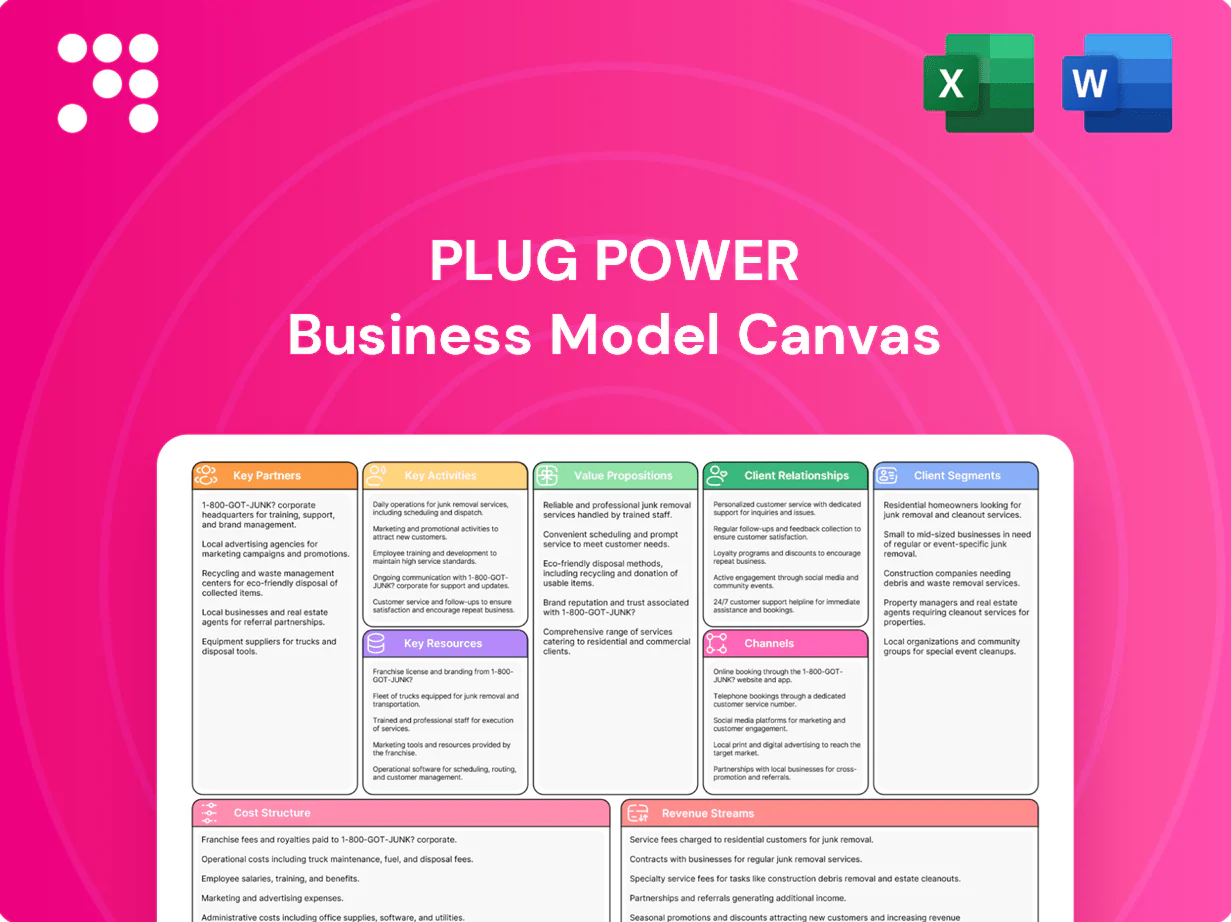
Plug Power Business Model Canvas

Business Model Canvas preview: 3-5 key insights on value, revenue, and partnerships
Explore Plug Power’s strategic engine with our concise Business Model Canvas preview—three to five key insights into its value proposition, revenue streams, and partnerships that power growth. Download the full, editable Canvas to unlock a complete, investor-ready blueprint for competitive advantage.
Partnerships

Renewable power providers
Partner with wind, solar and hydro producers to secure low‑cost, low‑carbon electricity for electrolysis, leveraging long‑term PPAs (typically 10–20 years) to stabilize input costs and improve green hydrogen economics. Co‑location near renewable assets reduces transmission losses and curtailment, tapping a market that saw 436 GW of renewable capacity added in 2023 (IRENA). These alliances underpin Plug Power’s green hydrogen value proposition.
Electrolyzer and stack component suppliers
Collaborate with advanced membrane, catalyst, and balance-of-plant vendors to improve PEM performance and durability. Joint development lowers cost per kW and accelerates product roadmaps, enabling MW- to GW-scale commercialization. Dual-sourcing mitigates supply risk for critical platinum-group metals. Qualification programs ensure repeatable quality and scalable production for MW/GW volumes.

OEMs and integrators
Plug Power partners with vehicle OEMs, material-handling firms and genset integrators to embed fuel cells directly into platforms, leveraging co-engineering to align performance, certification and warranty requirements. These integrations de-risk adoption for new customers and expand aftersales support networks; Plug Power reported roughly $484.5m revenue in 2023, underscoring growing commercial traction. Partners broaden market reach and accelerate deployment.

Logistics and infrastructure partners
Plug Power aligns with gas utilities, pipeline firms, and cryogenic logistics providers to store and move hydrogen, reducing site capex and accelerating rollout; in 2024 Plug Power expanded logistics partnerships to scale supply reliability. Fueling station operators and EPCs streamline permitting and construction, enabling a predictable, scalable hydrogen network.
- Shared infrastructure lowers capex per site
- Partnerships speed permitting and buildout
- Networked logistics enable reliable supply
Government and strategic financiers
Plug Power leverages public agencies for grants, tax credits and hydrogen hubs support—DOE’s hydrogen hubs program totals about $7 billion and the IRA 45V clean hydrogen tax credit can reach up to $3/kg, improving project economics. Strategic financiers co-fund large plants and offtake-backed projects, while policy partnerships help navigate standards, safety and incentives to boost bankability and returns.
- Grants: DOE $7B hydrogen hubs
- Tax credit: 45V up to $3/kg
- Strategic co‑funding improves bankability
Long PPAs + 436 GW renewables and DOE hubs cut green H2 costs
Long‑term PPAs (10–20 yr) with wind/solar secure low‑cost power; 436 GW renewables added in 2023 supports green H2 scale. Supplier JVs improve PEM costs and reduce PGM risk. OEM and logistics ties drove Plug Power to $484.5M revenue in 2023 and speed deployments. DOE $7B hubs and IRA 45V up to $3/kg materially improve project economics.
| Partnership | Role | Key metric |
|---|---|---|
| Renewables | Low‑cost power | 10–20 yr PPA |
| Suppliers | Cost/durability | PGM dual‑source |
| OEMs/Logistics | Deployment/sales | $484.5M rev (2023) |
| Public funding | Subsidy/support | DOE $7B; 45V $≤3/kg |
What is included in the product
 Detailed Word Document
A concise, pre-written Business Model Canvas for Plug Power outlining customer segments, channels, value propositions, key partners, activities, resources, cost structure, and revenue streams across the 9 BMC blocks; reflects real-world hydrogen fuel cell and electrolyzer operations, competitive advantages, risks, and strategic opportunities for investors and executives.

 Customizable Excel Spreadsheet
High-level view of Plug Power’s hydrogen and fuel-cell business model with editable cells—quickly pinpoint partnerships, revenue streams, and cost drivers to relieve strategic ambiguity and save hours of formatting for rapid decision-making.
Activities

PEM fuel cell and electrolyzer R&D
Advance PEM stack efficiency, lifetime, and manufacturability by prioritizing membrane durability, catalyst loading reduction, and thermal management in design iterations. Validate improvements through lab characterization and 2024 field pilots to quantify degradation rates and performance curves. Feed empirical test data directly into next‑gen designs to reduce cost per kW and improve operational uptime.
Gigafactory manufacturing
Gigafactory manufacturing scales automated production of stacks, systems and electrolyzers to drive volume; Plug Power (NYSE: PLUG) focuses yield-improvement and ISO-aligned quality systems to raise first-pass yields. Localizing suppliers shortens lead times and reduces currency exposure, while learning-curve gains and higher throughput compress unit costs and improve margins.

Green hydrogen production
Develop, build, and operate electrolytic hydrogen plants, securing renewable power and water access and managing compression, liquefaction, and storage while scaling to gigawatt-scale electrolyzer deployment. Use digital controls and remote monitoring to optimize plant uptime and reduce energy costs. Ensure safety and regulatory compliance, aligning operations with US DOE benchmark of $1/kg green hydrogen by 2030.

System integration and deployment
Engineer turnkey solutions for mobility, material handling, and stationary power; manage EPC, permitting, and commissioning; integrate fueling, storage, and power electronics to meet site-specific needs; provide operator training and full documentation to ensure uptime and safety.
- Turnkey EPC
- Site-specific integration
- Permitting & commissioning
- Training & docs
Aftermarket service and performance guarantees
Aftermarket service delivers field maintenance, remote monitoring and parts logistics with SLAs and warranties structured around 99% target uptime; predictive analytics flag failures early to cut unplanned downtime and costs by leveraging real-time telematics and condition-based alerts; closed-loop feedback from field data drives continuous improvement in service protocols.
- Field maintenance, remote monitoring, parts logistics
- SLAs/warranties tied to 99% uptime
- Predictive analytics to reduce downtime
- Closed-loop continuous improvement
Field-validated PEM electrolyzers: lower cost/kW, boost uptime to 99%, scale gigafactories
Advance PEM stack durability, reduce catalyst loading and improve thermal management; validate via 2024 field pilots to cut cost/kW and improve uptime. Scale gigafactory production, localize supply and enforce ISO quality to raise yields. Build/operate electrolyzers, secure renewables, provide turnkey EPC, and deliver aftermarket with 99% uptime SLAs and predictive analytics.
| Metric | 2024 / Target |
|---|---|
| Field pilots | 2024 validation |
| Uptime SLA | 99% |
| DOE goal | $1/kg H2 by 2030 |
Full Version Awaits
Business Model Canvas
The document you're previewing is the actual Plug Power Business Model Canvas you will receive—no mockups or samples. Upon purchase you'll instantly download the complete, editable file formatted exactly as shown (Word and Excel ready), fully populated and presentation‑ready.

Business Model Canvas preview: 3-5 key insights on value, revenue, and partnerships
Explore Plug Power’s strategic engine with our concise Business Model Canvas preview—three to five key insights into its value proposition, revenue streams, and partnerships that power growth. Download the full, editable Canvas to unlock a complete, investor-ready blueprint for competitive advantage.
Partnerships
Renewable power providers
Partner with wind, solar and hydro producers to secure low‑cost, low‑carbon electricity for electrolysis, leveraging long‑term PPAs (typically 10–20 years) to stabilize input costs and improve green hydrogen economics. Co‑location near renewable assets reduces transmission losses and curtailment, tapping a market that saw 436 GW of renewable capacity added in 2023 (IRENA). These alliances underpin Plug Power’s green hydrogen value proposition.
Electrolyzer and stack component suppliers
Collaborate with advanced membrane, catalyst, and balance-of-plant vendors to improve PEM performance and durability. Joint development lowers cost per kW and accelerates product roadmaps, enabling MW- to GW-scale commercialization. Dual-sourcing mitigates supply risk for critical platinum-group metals. Qualification programs ensure repeatable quality and scalable production for MW/GW volumes.
OEMs and integrators
Plug Power partners with vehicle OEMs, material-handling firms and genset integrators to embed fuel cells directly into platforms, leveraging co-engineering to align performance, certification and warranty requirements. These integrations de-risk adoption for new customers and expand aftersales support networks; Plug Power reported roughly $484.5m revenue in 2023, underscoring growing commercial traction. Partners broaden market reach and accelerate deployment.
Logistics and infrastructure partners
Plug Power aligns with gas utilities, pipeline firms, and cryogenic logistics providers to store and move hydrogen, reducing site capex and accelerating rollout; in 2024 Plug Power expanded logistics partnerships to scale supply reliability. Fueling station operators and EPCs streamline permitting and construction, enabling a predictable, scalable hydrogen network.
- Shared infrastructure lowers capex per site
- Partnerships speed permitting and buildout
- Networked logistics enable reliable supply
Government and strategic financiers
Plug Power leverages public agencies for grants, tax credits and hydrogen hubs support—DOE’s hydrogen hubs program totals about $7 billion and the IRA 45V clean hydrogen tax credit can reach up to $3/kg, improving project economics. Strategic financiers co-fund large plants and offtake-backed projects, while policy partnerships help navigate standards, safety and incentives to boost bankability and returns.
- Grants: DOE $7B hydrogen hubs
- Tax credit: 45V up to $3/kg
- Strategic co‑funding improves bankability
Long PPAs + 436 GW renewables and DOE hubs cut green H2 costs
Long‑term PPAs (10–20 yr) with wind/solar secure low‑cost power; 436 GW renewables added in 2023 supports green H2 scale. Supplier JVs improve PEM costs and reduce PGM risk. OEM and logistics ties drove Plug Power to $484.5M revenue in 2023 and speed deployments. DOE $7B hubs and IRA 45V up to $3/kg materially improve project economics.
| Partnership | Role | Key metric |
|---|---|---|
| Renewables | Low‑cost power | 10–20 yr PPA |
| Suppliers | Cost/durability | PGM dual‑source |
| OEMs/Logistics | Deployment/sales | $484.5M rev (2023) |
| Public funding | Subsidy/support | DOE $7B; 45V $≤3/kg |
What is included in the product
Detailed Word Document
A concise, pre-written Business Model Canvas for Plug Power outlining customer segments, channels, value propositions, key partners, activities, resources, cost structure, and revenue streams across the 9 BMC blocks; reflects real-world hydrogen fuel cell and electrolyzer operations, competitive advantages, risks, and strategic opportunities for investors and executives.
Customizable Excel Spreadsheet
High-level view of Plug Power’s hydrogen and fuel-cell business model with editable cells—quickly pinpoint partnerships, revenue streams, and cost drivers to relieve strategic ambiguity and save hours of formatting for rapid decision-making.
Activities
PEM fuel cell and electrolyzer R&D
Advance PEM stack efficiency, lifetime, and manufacturability by prioritizing membrane durability, catalyst loading reduction, and thermal management in design iterations. Validate improvements through lab characterization and 2024 field pilots to quantify degradation rates and performance curves. Feed empirical test data directly into next‑gen designs to reduce cost per kW and improve operational uptime.
Gigafactory manufacturing
Gigafactory manufacturing scales automated production of stacks, systems and electrolyzers to drive volume; Plug Power (NYSE: PLUG) focuses yield-improvement and ISO-aligned quality systems to raise first-pass yields. Localizing suppliers shortens lead times and reduces currency exposure, while learning-curve gains and higher throughput compress unit costs and improve margins.
Green hydrogen production
Develop, build, and operate electrolytic hydrogen plants, securing renewable power and water access and managing compression, liquefaction, and storage while scaling to gigawatt-scale electrolyzer deployment. Use digital controls and remote monitoring to optimize plant uptime and reduce energy costs. Ensure safety and regulatory compliance, aligning operations with US DOE benchmark of $1/kg green hydrogen by 2030.
System integration and deployment
Engineer turnkey solutions for mobility, material handling, and stationary power; manage EPC, permitting, and commissioning; integrate fueling, storage, and power electronics to meet site-specific needs; provide operator training and full documentation to ensure uptime and safety.
- Turnkey EPC
- Site-specific integration
- Permitting & commissioning
- Training & docs
Aftermarket service and performance guarantees
Aftermarket service delivers field maintenance, remote monitoring and parts logistics with SLAs and warranties structured around 99% target uptime; predictive analytics flag failures early to cut unplanned downtime and costs by leveraging real-time telematics and condition-based alerts; closed-loop feedback from field data drives continuous improvement in service protocols.
- Field maintenance, remote monitoring, parts logistics
- SLAs/warranties tied to 99% uptime
- Predictive analytics to reduce downtime
- Closed-loop continuous improvement
Field-validated PEM electrolyzers: lower cost/kW, boost uptime to 99%, scale gigafactories
Advance PEM stack durability, reduce catalyst loading and improve thermal management; validate via 2024 field pilots to cut cost/kW and improve uptime. Scale gigafactory production, localize supply and enforce ISO quality to raise yields. Build/operate electrolyzers, secure renewables, provide turnkey EPC, and deliver aftermarket with 99% uptime SLAs and predictive analytics.
| Metric | 2024 / Target |
|---|---|
| Field pilots | 2024 validation |
| Uptime SLA | 99% |
| DOE goal | $1/kg H2 by 2030 |
Full Version Awaits
Business Model Canvas
The document you're previewing is the actual Plug Power Business Model Canvas you will receive—no mockups or samples. Upon purchase you'll instantly download the complete, editable file formatted exactly as shown (Word and Excel ready), fully populated and presentation‑ready.
Original: $10.00
-65%$10.00
$3.50Description
Business Model Canvas preview: 3-5 key insights on value, revenue, and partnerships
Explore Plug Power’s strategic engine with our concise Business Model Canvas preview—three to five key insights into its value proposition, revenue streams, and partnerships that power growth. Download the full, editable Canvas to unlock a complete, investor-ready blueprint for competitive advantage.
Partnerships
Renewable power providers
Partner with wind, solar and hydro producers to secure low‑cost, low‑carbon electricity for electrolysis, leveraging long‑term PPAs (typically 10–20 years) to stabilize input costs and improve green hydrogen economics. Co‑location near renewable assets reduces transmission losses and curtailment, tapping a market that saw 436 GW of renewable capacity added in 2023 (IRENA). These alliances underpin Plug Power’s green hydrogen value proposition.
Electrolyzer and stack component suppliers
Collaborate with advanced membrane, catalyst, and balance-of-plant vendors to improve PEM performance and durability. Joint development lowers cost per kW and accelerates product roadmaps, enabling MW- to GW-scale commercialization. Dual-sourcing mitigates supply risk for critical platinum-group metals. Qualification programs ensure repeatable quality and scalable production for MW/GW volumes.
OEMs and integrators
Plug Power partners with vehicle OEMs, material-handling firms and genset integrators to embed fuel cells directly into platforms, leveraging co-engineering to align performance, certification and warranty requirements. These integrations de-risk adoption for new customers and expand aftersales support networks; Plug Power reported roughly $484.5m revenue in 2023, underscoring growing commercial traction. Partners broaden market reach and accelerate deployment.
Logistics and infrastructure partners
Plug Power aligns with gas utilities, pipeline firms, and cryogenic logistics providers to store and move hydrogen, reducing site capex and accelerating rollout; in 2024 Plug Power expanded logistics partnerships to scale supply reliability. Fueling station operators and EPCs streamline permitting and construction, enabling a predictable, scalable hydrogen network.
- Shared infrastructure lowers capex per site
- Partnerships speed permitting and buildout
- Networked logistics enable reliable supply
Government and strategic financiers
Plug Power leverages public agencies for grants, tax credits and hydrogen hubs support—DOE’s hydrogen hubs program totals about $7 billion and the IRA 45V clean hydrogen tax credit can reach up to $3/kg, improving project economics. Strategic financiers co-fund large plants and offtake-backed projects, while policy partnerships help navigate standards, safety and incentives to boost bankability and returns.
- Grants: DOE $7B hydrogen hubs
- Tax credit: 45V up to $3/kg
- Strategic co‑funding improves bankability
Long PPAs + 436 GW renewables and DOE hubs cut green H2 costs
Long‑term PPAs (10–20 yr) with wind/solar secure low‑cost power; 436 GW renewables added in 2023 supports green H2 scale. Supplier JVs improve PEM costs and reduce PGM risk. OEM and logistics ties drove Plug Power to $484.5M revenue in 2023 and speed deployments. DOE $7B hubs and IRA 45V up to $3/kg materially improve project economics.
| Partnership | Role | Key metric |
|---|---|---|
| Renewables | Low‑cost power | 10–20 yr PPA |
| Suppliers | Cost/durability | PGM dual‑source |
| OEMs/Logistics | Deployment/sales | $484.5M rev (2023) |
| Public funding | Subsidy/support | DOE $7B; 45V $≤3/kg |
What is included in the product
Detailed Word Document
A concise, pre-written Business Model Canvas for Plug Power outlining customer segments, channels, value propositions, key partners, activities, resources, cost structure, and revenue streams across the 9 BMC blocks; reflects real-world hydrogen fuel cell and electrolyzer operations, competitive advantages, risks, and strategic opportunities for investors and executives.
Customizable Excel Spreadsheet
High-level view of Plug Power’s hydrogen and fuel-cell business model with editable cells—quickly pinpoint partnerships, revenue streams, and cost drivers to relieve strategic ambiguity and save hours of formatting for rapid decision-making.
Activities
PEM fuel cell and electrolyzer R&D
Advance PEM stack efficiency, lifetime, and manufacturability by prioritizing membrane durability, catalyst loading reduction, and thermal management in design iterations. Validate improvements through lab characterization and 2024 field pilots to quantify degradation rates and performance curves. Feed empirical test data directly into next‑gen designs to reduce cost per kW and improve operational uptime.
Gigafactory manufacturing
Gigafactory manufacturing scales automated production of stacks, systems and electrolyzers to drive volume; Plug Power (NYSE: PLUG) focuses yield-improvement and ISO-aligned quality systems to raise first-pass yields. Localizing suppliers shortens lead times and reduces currency exposure, while learning-curve gains and higher throughput compress unit costs and improve margins.
Green hydrogen production
Develop, build, and operate electrolytic hydrogen plants, securing renewable power and water access and managing compression, liquefaction, and storage while scaling to gigawatt-scale electrolyzer deployment. Use digital controls and remote monitoring to optimize plant uptime and reduce energy costs. Ensure safety and regulatory compliance, aligning operations with US DOE benchmark of $1/kg green hydrogen by 2030.
System integration and deployment
Engineer turnkey solutions for mobility, material handling, and stationary power; manage EPC, permitting, and commissioning; integrate fueling, storage, and power electronics to meet site-specific needs; provide operator training and full documentation to ensure uptime and safety.
- Turnkey EPC
- Site-specific integration
- Permitting & commissioning
- Training & docs
Aftermarket service and performance guarantees
Aftermarket service delivers field maintenance, remote monitoring and parts logistics with SLAs and warranties structured around 99% target uptime; predictive analytics flag failures early to cut unplanned downtime and costs by leveraging real-time telematics and condition-based alerts; closed-loop feedback from field data drives continuous improvement in service protocols.
- Field maintenance, remote monitoring, parts logistics
- SLAs/warranties tied to 99% uptime
- Predictive analytics to reduce downtime
- Closed-loop continuous improvement
Field-validated PEM electrolyzers: lower cost/kW, boost uptime to 99%, scale gigafactories
Advance PEM stack durability, reduce catalyst loading and improve thermal management; validate via 2024 field pilots to cut cost/kW and improve uptime. Scale gigafactory production, localize supply and enforce ISO quality to raise yields. Build/operate electrolyzers, secure renewables, provide turnkey EPC, and deliver aftermarket with 99% uptime SLAs and predictive analytics.
| Metric | 2024 / Target |
|---|---|
| Field pilots | 2024 validation |
| Uptime SLA | 99% |
| DOE goal | $1/kg H2 by 2030 |
Full Version Awaits
Business Model Canvas
The document you're previewing is the actual Plug Power Business Model Canvas you will receive—no mockups or samples. Upon purchase you'll instantly download the complete, editable file formatted exactly as shown (Word and Excel ready), fully populated and presentation‑ready.











