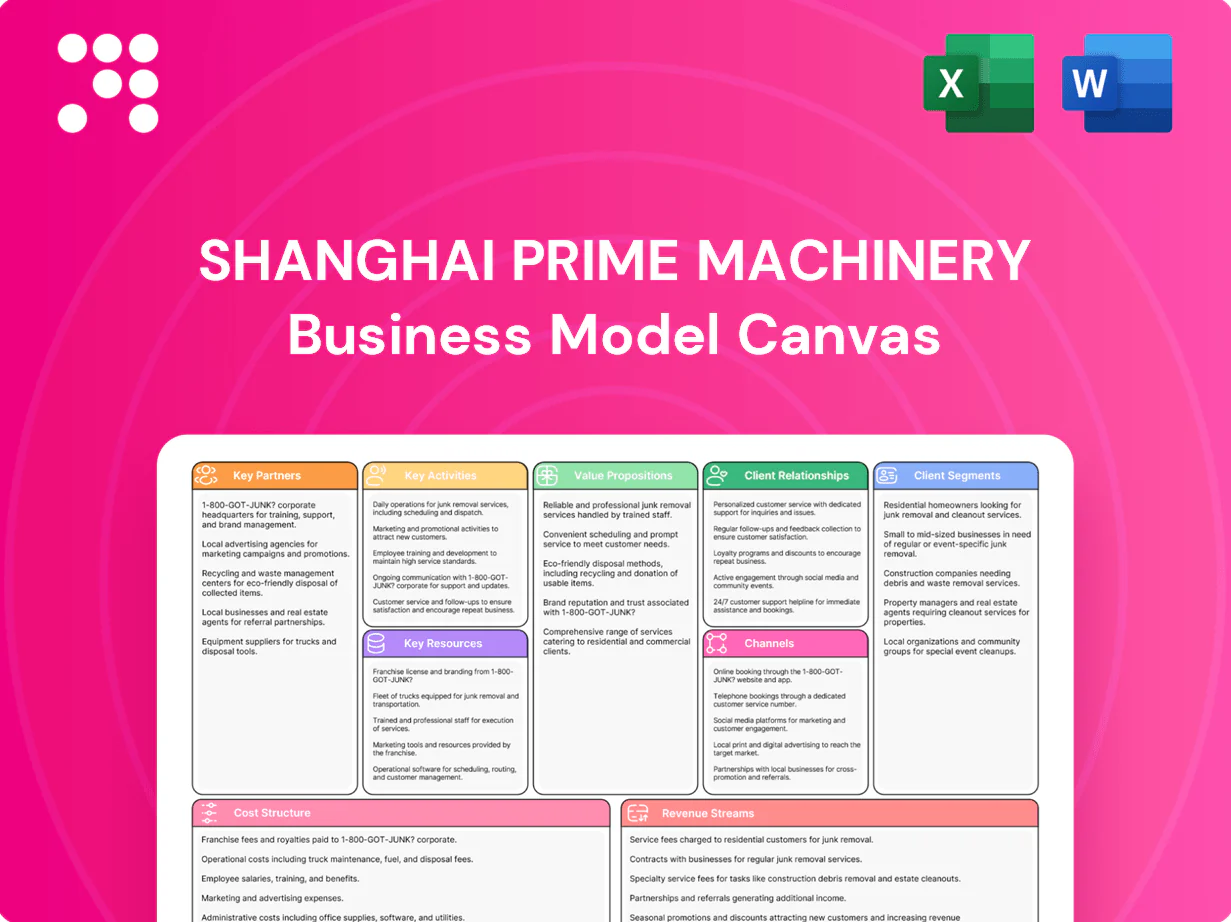
Shanghai Prime Machinery Business Model Canvas

Industrial Machinery Business Model Canvas: Value Chains, Customers & Revenue Levers
Discover how Shanghai Prime Machinery organizes value chains, customer segments, and revenue streams in a concise Business Model Canvas that reveals competitive advantages and scaling levers. This 3–5 sentence snapshot highlights partnerships, cost drivers, and monetization strategies—perfect for investors and strategists. Purchase the full Canvas to get the editable, section-by-section blueprint for benchmarking and decision-making.
Partnerships

Steel mills and alloy suppliers
Secure, high-grade steel and alloys are critical for fasteners, tools, and bearings; long-term purchase contracts lock pricing and ensure continuity, lowering input volatility. Co-development of special alloys enables higher-strength, corrosion-resistant products for heavy-duty markets. Supplier audits plus VMI programs cut inventory 20–30% and reduce stockouts 40–50%, freeing working capital.
OEMs and tier-1 integrators
Joint design with OEMs and tier-1 integrators aligns bearings, fasteners and forming equipment specs, enabling early supplier involvement that can shorten development cycles by up to 30% and ensure fit-for-purpose solutions. Volume commitments improve capacity planning and can cut unit costs ~10–15%, while aftermarket collaboration can contribute 20–25% of lifecycle sales.

Automation and tooling technology partners
Alliances with robotics, CNC and heat‑treatment partners raised machining accuracy to ±0.01 mm and, per 2024 pilot lines, cut first‑pass defects by 28%. Co‑investments in process innovation lifted throughput ~30% and improved consistency across batches. Integration support reduced ramp‑up time for new lines by ~40%, while shared IP frameworks accelerated product upgrade cycles by roughly 20%.

Distribution and logistics networks
Regional distributors extend Shanghai Prime Machinerys reach into fragmented industrial customers across China, where manufacturing accounts for about 30% of global output in 2024; 3PL partners optimize multi-modal shipping for heavy equipment and bulk components, lowering lead times and handling costs. Bonded warehouses near ports enable faster cross-border fulfillment and tariff deferral, while data-sharing with partners improves demand forecasting and inventory placement.
- regional distribution
- 3PL multi-modal shipping
- bonded warehousing
- data-driven forecasting
Universities and research institutes
Collaboration with universities and research institutes advances metallurgy, fatigue testing and surface treatments, providing peer-reviewed validation and technical know-how. Access to university labs and graduate talent accelerates prototyping and qualification cycles. Joint grants (national and municipal schemes in 2024) lower R&D cost risk and publications/certifications strengthen credibility with global customers.
- Metallurgy, fatigue testing, surface treatments
- Lab access and talent speed prototyping
- Joint 2024 grants reduce R&D risk
- Publications and certifications boost credibility
Alliances cut inventory 20–30%, stockouts 40–50%, dev −30%
Strategic suppliers and long‑term alloy contracts cut input volatility and VMI programs lower inventory 20–30% while reducing stockouts 40–50%. OEM and aftermarket alliances shorten development cycles up to 30% and add 20–25% lifecycle sales. Tech partners and universities improved first‑pass yield −28%, throughput +30% and ramp‑up time −40% in 2024.
| Metric | Value | Partner |
|---|---|---|
| Inventory reduction | 20–30% | Suppliers/VMI |
| Stockout reduction | 40–50% | Suppliers |
| Dev cycle | −30% | OEMs |
| Aftermarket sales | 20–25% | OEMs/Distributors |
| First‑pass defects | −28% | Tech partners |
| Throughput | +30% | Co‑investments |
| Ramp‑up time | −40% | Integrators |
What is included in the product
 Detailed Word Document
A comprehensive Business Model Canvas for Shanghai Prime Machinery detailing customer segments, value propositions, channels, revenue streams and 9 classic BMC blocks, with competitive advantage analysis, linked SWOT, real-world operational insights and a polished format for presentations, funding and strategic validation.

 Customizable Excel Spreadsheet
One-page Business Model Canvas for Shanghai Prime Machinery that quickly identifies core components and relieves fragmented planning, saving hours of formatting while enabling shareable, boardroom-ready strategy and collaborative adaptation.
Activities

Precision manufacturing and forging
Operate cold/hot forging, precision machining, grinding and heat-treatment lines with tight SPC control delivering 98% dimensional accuracy and 1.2% scrap rate. Continuous improvement programs cut cycle time 12% YoY and boost throughput. Proactive tooling maintenance sustains 96% uptime, lowering unplanned stops and service costs.
Product design and engineering
Product design and engineering develop fastener geometries, bearing assemblies and forming machinery layouts, using finite element and fatigue simulations to de-risk designs. Application engineering tailors solutions to automotive, aerospace and construction sector loads in 2024. Standardization frameworks balance customization with scale, reducing time-to-market and unit-cost variance.

Quality assurance and certification
Implement APQP, PPAP, and SPC across plants to standardize launch and control processes, aligning with IATF 16949 and ISO 9001 certifications for global market acceptance. Batch-level traceability and serialized tracking ensure regulatory and customer compliance across supply chains. Accredited lab testing validates component performance under extreme conditions from -40°C to +150°C. Continuous certification audits maintain export credentials to major markets.

Supply chain and inventory management
Plan raw material procurement synchronized to demand using rolling 12-week forecasts and JIT replenishment; VMI and safety stocks for critical SKUs have been shown to lower inventory levels 10–25% (industry studies) and Shanghai Prime targets an 18% reduction in critical SKU days-of-stock. Optimize the supply network to balance lead time and cost, shrinking average inbound lead time while monitoring supplier performance and resilience with quarterly scorecards and dual-sourcing for top 30% spend.
- Demand-synced procurement
- VMI + safety stock (target: −18% critical SKU DOS)
- Network optimization for lead time vs cost
- Supplier KPIs, quarterly resilience reviews
After-sales service and retrofits
Shanghai Prime provides installation, commissioning and operator training for forming equipment, supports maintenance, spare parts and upgrades (after-sales parts accounted for 20-30% of OEM revenue in 2024), and deploys field engineers for 24–48 hour response to troubleshoot and minimize downtime (predictive maintenance can cut downtime up to 50%). Feedback loops from service incidents feed R&D for product improvements and retrofit roadmaps.
- installation & training
- maintenance, spare parts & upgrades
- field engineers: 24–48h response
- predictive maintenance: up to 50% less downtime
- after-sales: 20–30% of OEM revenue (2024)
Manufacturing: 98% accuracy, 96% uptime, 12% YoY cycle-time reduction
Operate forging, machining, grinding and heat‑treat lines (98% dimensional accuracy; 1.2% scrap) with 96% uptime and 12% YoY cycle-time reduction. Design/engineering use FEA, APQP/PPAP and IATF16949/ISO9001 to de-risk launches and certify parts. Demand-synced procurement targets −18% critical SKU DOS; after-sales (parts+service) 20–30% revenue with 24–48h field response.
| Metric | 2024 value |
|---|---|
| Dimensional accuracy | 98% |
| Scrap rate | 1.2% |
| Cycle-time YoY | −12% |
| Uptime | 96% |
| After-sales rev | 20–30% |
| Target SKU DOS | −18% |
| Field response | 24–48h |
What You See Is What You Get
Business Model Canvas
The Shanghai Prime Machinery Business Model Canvas you’re previewing is the actual deliverable, not a mockup or sample; it’s a direct excerpt from the final file you’ll receive after purchase. When you buy, you’ll get this same comprehensive Business Model Canvas—complete, editable, and formatted exactly as shown—for immediate download in Word and Excel-friendly formats. No placeholders, no surprises, ready to present or adapt to your needs.

Industrial Machinery Business Model Canvas: Value Chains, Customers & Revenue Levers
Discover how Shanghai Prime Machinery organizes value chains, customer segments, and revenue streams in a concise Business Model Canvas that reveals competitive advantages and scaling levers. This 3–5 sentence snapshot highlights partnerships, cost drivers, and monetization strategies—perfect for investors and strategists. Purchase the full Canvas to get the editable, section-by-section blueprint for benchmarking and decision-making.
Partnerships
Steel mills and alloy suppliers
Secure, high-grade steel and alloys are critical for fasteners, tools, and bearings; long-term purchase contracts lock pricing and ensure continuity, lowering input volatility. Co-development of special alloys enables higher-strength, corrosion-resistant products for heavy-duty markets. Supplier audits plus VMI programs cut inventory 20–30% and reduce stockouts 40–50%, freeing working capital.
OEMs and tier-1 integrators
Joint design with OEMs and tier-1 integrators aligns bearings, fasteners and forming equipment specs, enabling early supplier involvement that can shorten development cycles by up to 30% and ensure fit-for-purpose solutions. Volume commitments improve capacity planning and can cut unit costs ~10–15%, while aftermarket collaboration can contribute 20–25% of lifecycle sales.
Automation and tooling technology partners
Alliances with robotics, CNC and heat‑treatment partners raised machining accuracy to ±0.01 mm and, per 2024 pilot lines, cut first‑pass defects by 28%. Co‑investments in process innovation lifted throughput ~30% and improved consistency across batches. Integration support reduced ramp‑up time for new lines by ~40%, while shared IP frameworks accelerated product upgrade cycles by roughly 20%.
Distribution and logistics networks
Regional distributors extend Shanghai Prime Machinerys reach into fragmented industrial customers across China, where manufacturing accounts for about 30% of global output in 2024; 3PL partners optimize multi-modal shipping for heavy equipment and bulk components, lowering lead times and handling costs. Bonded warehouses near ports enable faster cross-border fulfillment and tariff deferral, while data-sharing with partners improves demand forecasting and inventory placement.
- regional distribution
- 3PL multi-modal shipping
- bonded warehousing
- data-driven forecasting
Universities and research institutes
Collaboration with universities and research institutes advances metallurgy, fatigue testing and surface treatments, providing peer-reviewed validation and technical know-how. Access to university labs and graduate talent accelerates prototyping and qualification cycles. Joint grants (national and municipal schemes in 2024) lower R&D cost risk and publications/certifications strengthen credibility with global customers.
- Metallurgy, fatigue testing, surface treatments
- Lab access and talent speed prototyping
- Joint 2024 grants reduce R&D risk
- Publications and certifications boost credibility
Alliances cut inventory 20–30%, stockouts 40–50%, dev −30%
Strategic suppliers and long‑term alloy contracts cut input volatility and VMI programs lower inventory 20–30% while reducing stockouts 40–50%. OEM and aftermarket alliances shorten development cycles up to 30% and add 20–25% lifecycle sales. Tech partners and universities improved first‑pass yield −28%, throughput +30% and ramp‑up time −40% in 2024.
| Metric | Value | Partner |
|---|---|---|
| Inventory reduction | 20–30% | Suppliers/VMI |
| Stockout reduction | 40–50% | Suppliers |
| Dev cycle | −30% | OEMs |
| Aftermarket sales | 20–25% | OEMs/Distributors |
| First‑pass defects | −28% | Tech partners |
| Throughput | +30% | Co‑investments |
| Ramp‑up time | −40% | Integrators |
What is included in the product
Detailed Word Document
A comprehensive Business Model Canvas for Shanghai Prime Machinery detailing customer segments, value propositions, channels, revenue streams and 9 classic BMC blocks, with competitive advantage analysis, linked SWOT, real-world operational insights and a polished format for presentations, funding and strategic validation.
Customizable Excel Spreadsheet
One-page Business Model Canvas for Shanghai Prime Machinery that quickly identifies core components and relieves fragmented planning, saving hours of formatting while enabling shareable, boardroom-ready strategy and collaborative adaptation.
Activities
Precision manufacturing and forging
Operate cold/hot forging, precision machining, grinding and heat-treatment lines with tight SPC control delivering 98% dimensional accuracy and 1.2% scrap rate. Continuous improvement programs cut cycle time 12% YoY and boost throughput. Proactive tooling maintenance sustains 96% uptime, lowering unplanned stops and service costs.
Product design and engineering
Product design and engineering develop fastener geometries, bearing assemblies and forming machinery layouts, using finite element and fatigue simulations to de-risk designs. Application engineering tailors solutions to automotive, aerospace and construction sector loads in 2024. Standardization frameworks balance customization with scale, reducing time-to-market and unit-cost variance.
Quality assurance and certification
Implement APQP, PPAP, and SPC across plants to standardize launch and control processes, aligning with IATF 16949 and ISO 9001 certifications for global market acceptance. Batch-level traceability and serialized tracking ensure regulatory and customer compliance across supply chains. Accredited lab testing validates component performance under extreme conditions from -40°C to +150°C. Continuous certification audits maintain export credentials to major markets.
Supply chain and inventory management
Plan raw material procurement synchronized to demand using rolling 12-week forecasts and JIT replenishment; VMI and safety stocks for critical SKUs have been shown to lower inventory levels 10–25% (industry studies) and Shanghai Prime targets an 18% reduction in critical SKU days-of-stock. Optimize the supply network to balance lead time and cost, shrinking average inbound lead time while monitoring supplier performance and resilience with quarterly scorecards and dual-sourcing for top 30% spend.
- Demand-synced procurement
- VMI + safety stock (target: −18% critical SKU DOS)
- Network optimization for lead time vs cost
- Supplier KPIs, quarterly resilience reviews
After-sales service and retrofits
Shanghai Prime provides installation, commissioning and operator training for forming equipment, supports maintenance, spare parts and upgrades (after-sales parts accounted for 20-30% of OEM revenue in 2024), and deploys field engineers for 24–48 hour response to troubleshoot and minimize downtime (predictive maintenance can cut downtime up to 50%). Feedback loops from service incidents feed R&D for product improvements and retrofit roadmaps.
- installation & training
- maintenance, spare parts & upgrades
- field engineers: 24–48h response
- predictive maintenance: up to 50% less downtime
- after-sales: 20–30% of OEM revenue (2024)
Manufacturing: 98% accuracy, 96% uptime, 12% YoY cycle-time reduction
Operate forging, machining, grinding and heat‑treat lines (98% dimensional accuracy; 1.2% scrap) with 96% uptime and 12% YoY cycle-time reduction. Design/engineering use FEA, APQP/PPAP and IATF16949/ISO9001 to de-risk launches and certify parts. Demand-synced procurement targets −18% critical SKU DOS; after-sales (parts+service) 20–30% revenue with 24–48h field response.
| Metric | 2024 value |
|---|---|
| Dimensional accuracy | 98% |
| Scrap rate | 1.2% |
| Cycle-time YoY | −12% |
| Uptime | 96% |
| After-sales rev | 20–30% |
| Target SKU DOS | −18% |
| Field response | 24–48h |
What You See Is What You Get
Business Model Canvas
The Shanghai Prime Machinery Business Model Canvas you’re previewing is the actual deliverable, not a mockup or sample; it’s a direct excerpt from the final file you’ll receive after purchase. When you buy, you’ll get this same comprehensive Business Model Canvas—complete, editable, and formatted exactly as shown—for immediate download in Word and Excel-friendly formats. No placeholders, no surprises, ready to present or adapt to your needs.
Original: $10.00
-65%$10.00
$3.50Description
Industrial Machinery Business Model Canvas: Value Chains, Customers & Revenue Levers
Discover how Shanghai Prime Machinery organizes value chains, customer segments, and revenue streams in a concise Business Model Canvas that reveals competitive advantages and scaling levers. This 3–5 sentence snapshot highlights partnerships, cost drivers, and monetization strategies—perfect for investors and strategists. Purchase the full Canvas to get the editable, section-by-section blueprint for benchmarking and decision-making.
Partnerships
Steel mills and alloy suppliers
Secure, high-grade steel and alloys are critical for fasteners, tools, and bearings; long-term purchase contracts lock pricing and ensure continuity, lowering input volatility. Co-development of special alloys enables higher-strength, corrosion-resistant products for heavy-duty markets. Supplier audits plus VMI programs cut inventory 20–30% and reduce stockouts 40–50%, freeing working capital.
OEMs and tier-1 integrators
Joint design with OEMs and tier-1 integrators aligns bearings, fasteners and forming equipment specs, enabling early supplier involvement that can shorten development cycles by up to 30% and ensure fit-for-purpose solutions. Volume commitments improve capacity planning and can cut unit costs ~10–15%, while aftermarket collaboration can contribute 20–25% of lifecycle sales.
Automation and tooling technology partners
Alliances with robotics, CNC and heat‑treatment partners raised machining accuracy to ±0.01 mm and, per 2024 pilot lines, cut first‑pass defects by 28%. Co‑investments in process innovation lifted throughput ~30% and improved consistency across batches. Integration support reduced ramp‑up time for new lines by ~40%, while shared IP frameworks accelerated product upgrade cycles by roughly 20%.
Distribution and logistics networks
Regional distributors extend Shanghai Prime Machinerys reach into fragmented industrial customers across China, where manufacturing accounts for about 30% of global output in 2024; 3PL partners optimize multi-modal shipping for heavy equipment and bulk components, lowering lead times and handling costs. Bonded warehouses near ports enable faster cross-border fulfillment and tariff deferral, while data-sharing with partners improves demand forecasting and inventory placement.
- regional distribution
- 3PL multi-modal shipping
- bonded warehousing
- data-driven forecasting
Universities and research institutes
Collaboration with universities and research institutes advances metallurgy, fatigue testing and surface treatments, providing peer-reviewed validation and technical know-how. Access to university labs and graduate talent accelerates prototyping and qualification cycles. Joint grants (national and municipal schemes in 2024) lower R&D cost risk and publications/certifications strengthen credibility with global customers.
- Metallurgy, fatigue testing, surface treatments
- Lab access and talent speed prototyping
- Joint 2024 grants reduce R&D risk
- Publications and certifications boost credibility
Alliances cut inventory 20–30%, stockouts 40–50%, dev −30%
Strategic suppliers and long‑term alloy contracts cut input volatility and VMI programs lower inventory 20–30% while reducing stockouts 40–50%. OEM and aftermarket alliances shorten development cycles up to 30% and add 20–25% lifecycle sales. Tech partners and universities improved first‑pass yield −28%, throughput +30% and ramp‑up time −40% in 2024.
| Metric | Value | Partner |
|---|---|---|
| Inventory reduction | 20–30% | Suppliers/VMI |
| Stockout reduction | 40–50% | Suppliers |
| Dev cycle | −30% | OEMs |
| Aftermarket sales | 20–25% | OEMs/Distributors |
| First‑pass defects | −28% | Tech partners |
| Throughput | +30% | Co‑investments |
| Ramp‑up time | −40% | Integrators |
What is included in the product
Detailed Word Document
A comprehensive Business Model Canvas for Shanghai Prime Machinery detailing customer segments, value propositions, channels, revenue streams and 9 classic BMC blocks, with competitive advantage analysis, linked SWOT, real-world operational insights and a polished format for presentations, funding and strategic validation.
Customizable Excel Spreadsheet
One-page Business Model Canvas for Shanghai Prime Machinery that quickly identifies core components and relieves fragmented planning, saving hours of formatting while enabling shareable, boardroom-ready strategy and collaborative adaptation.
Activities
Precision manufacturing and forging
Operate cold/hot forging, precision machining, grinding and heat-treatment lines with tight SPC control delivering 98% dimensional accuracy and 1.2% scrap rate. Continuous improvement programs cut cycle time 12% YoY and boost throughput. Proactive tooling maintenance sustains 96% uptime, lowering unplanned stops and service costs.
Product design and engineering
Product design and engineering develop fastener geometries, bearing assemblies and forming machinery layouts, using finite element and fatigue simulations to de-risk designs. Application engineering tailors solutions to automotive, aerospace and construction sector loads in 2024. Standardization frameworks balance customization with scale, reducing time-to-market and unit-cost variance.
Quality assurance and certification
Implement APQP, PPAP, and SPC across plants to standardize launch and control processes, aligning with IATF 16949 and ISO 9001 certifications for global market acceptance. Batch-level traceability and serialized tracking ensure regulatory and customer compliance across supply chains. Accredited lab testing validates component performance under extreme conditions from -40°C to +150°C. Continuous certification audits maintain export credentials to major markets.
Supply chain and inventory management
Plan raw material procurement synchronized to demand using rolling 12-week forecasts and JIT replenishment; VMI and safety stocks for critical SKUs have been shown to lower inventory levels 10–25% (industry studies) and Shanghai Prime targets an 18% reduction in critical SKU days-of-stock. Optimize the supply network to balance lead time and cost, shrinking average inbound lead time while monitoring supplier performance and resilience with quarterly scorecards and dual-sourcing for top 30% spend.
- Demand-synced procurement
- VMI + safety stock (target: −18% critical SKU DOS)
- Network optimization for lead time vs cost
- Supplier KPIs, quarterly resilience reviews
After-sales service and retrofits
Shanghai Prime provides installation, commissioning and operator training for forming equipment, supports maintenance, spare parts and upgrades (after-sales parts accounted for 20-30% of OEM revenue in 2024), and deploys field engineers for 24–48 hour response to troubleshoot and minimize downtime (predictive maintenance can cut downtime up to 50%). Feedback loops from service incidents feed R&D for product improvements and retrofit roadmaps.
- installation & training
- maintenance, spare parts & upgrades
- field engineers: 24–48h response
- predictive maintenance: up to 50% less downtime
- after-sales: 20–30% of OEM revenue (2024)
Manufacturing: 98% accuracy, 96% uptime, 12% YoY cycle-time reduction
Operate forging, machining, grinding and heat‑treat lines (98% dimensional accuracy; 1.2% scrap) with 96% uptime and 12% YoY cycle-time reduction. Design/engineering use FEA, APQP/PPAP and IATF16949/ISO9001 to de-risk launches and certify parts. Demand-synced procurement targets −18% critical SKU DOS; after-sales (parts+service) 20–30% revenue with 24–48h field response.
| Metric | 2024 value |
|---|---|
| Dimensional accuracy | 98% |
| Scrap rate | 1.2% |
| Cycle-time YoY | −12% |
| Uptime | 96% |
| After-sales rev | 20–30% |
| Target SKU DOS | −18% |
| Field response | 24–48h |
What You See Is What You Get
Business Model Canvas
The Shanghai Prime Machinery Business Model Canvas you’re previewing is the actual deliverable, not a mockup or sample; it’s a direct excerpt from the final file you’ll receive after purchase. When you buy, you’ll get this same comprehensive Business Model Canvas—complete, editable, and formatted exactly as shown—for immediate download in Word and Excel-friendly formats. No placeholders, no surprises, ready to present or adapt to your needs.











