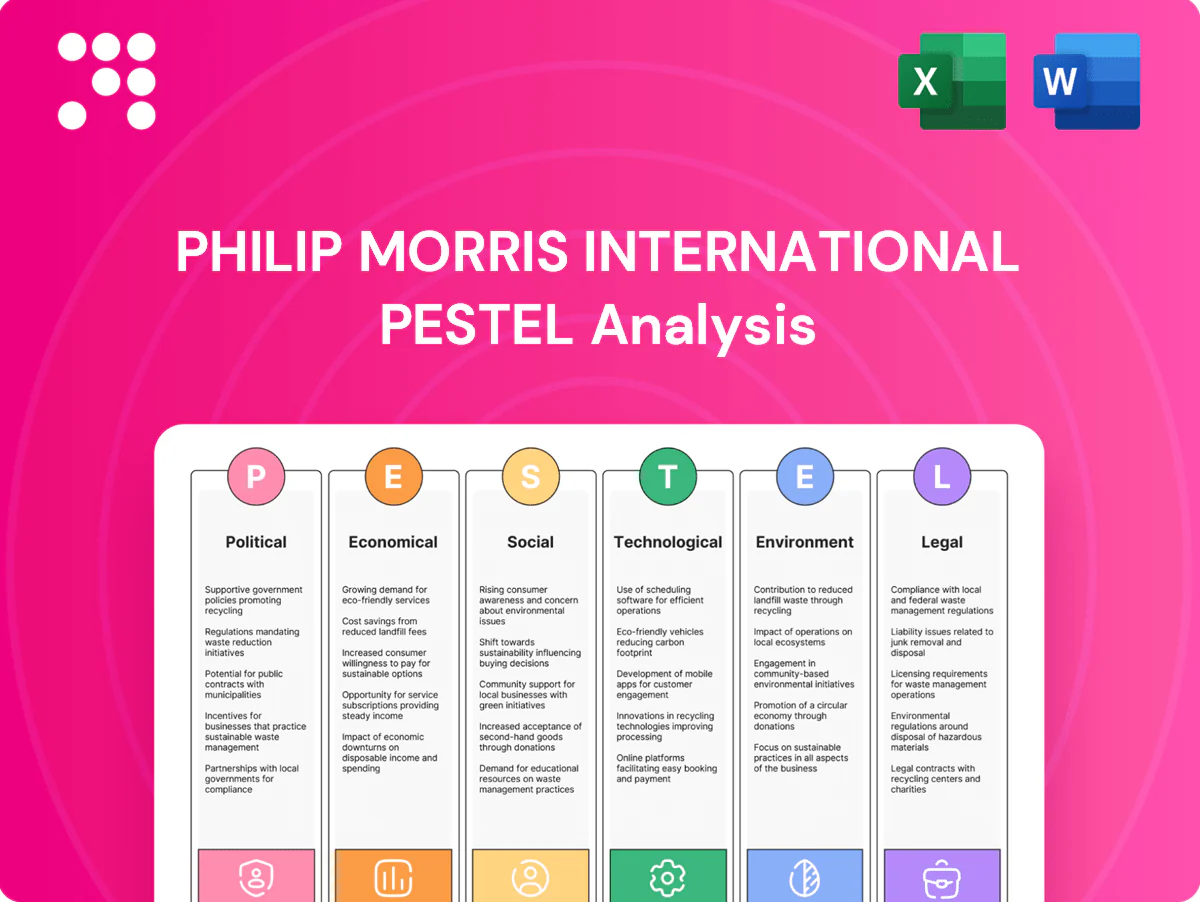
Philip Morris International PESTLE Analysis

Your Competitive Advantage Starts with This Report
Philip Morris International faces complex political, regulatory, and health-driven headwinds while pursuing growth through heated product innovation and global market diversification; our PESTLE distills these forces into strategic implications and risk factors. Whether evaluating regulatory exposure, social trends, or technological shifts, this concise overview highlights critical decision points. Purchase the full PESTLE for a complete, actionable breakdown ready for investment or strategy use.
Political factors

Excise tax and fiscal policy
Excise taxes on tobacco are politically driven and directly shape pricing, demand, and the mix between cigarettes and smoke-free products; frequent tax hikes compress volumes while supporting premium pricing where affordability remains. Differential tax regimes for heated tobacco versus combustibles can accelerate switching or stall it, so PMI must forecast fiscal cycles and advocate for risk-proportionate taxation to protect public health and shareholder value.
Regulatory stance on harm reduction
Governments differ widely on smoke-free alternatives: as of 2024 WHO estimates 1.3 billion tobacco users globally and dozens of countries maintain restrictive or outright bans on e-cigarettes and heated tobacco. Favorable regulatory frameworks permit scientific claims, commercialization and adult-smoker switching, while restrictive policies limit marketing, device distribution and consumer education. PMI’s strategy depends on aligning with policymakers and public-health goals to expand market access.

Plain packaging and marketing curbs
Political appetite to denormalize tobacco has delivered plain packaging and display bans in 20+ countries (Australia 2012, UK 2016/17), eroding cigarette brand equity and prompting regulators to extend rules to smoke-free products. Reduced on-shelf visibility raises acquisition costs and shifts consumers toward age-gated digital channels. PMI must pivot to tightly regulated direct-to-adult communications within strict guardrails.

Illicit trade enforcement
Weak enforcement and porous borders expand illicit cigarettes, undermining tax revenue and compliant players; WHO estimates annual global tax losses of about 40–50 billion USD from illicit tobacco. Robust crackdowns favor legal, traceable products and can improve PMI’s product mix; track-and-trace mandates add implementation costs but help protect market share. PMI benefits from collaboration with customs and tax authorities.
- Illicit trade expands with weak enforcement
- WHO: ~40–50 bn USD annual tax loss
- Track-and-trace raises costs but secures market share
- PMI gains from customs/tax collaboration
Trade policy and geopolitics
Tariffs, sanctions and regional instability disrupt supply chains and market access; PMI sells in more than 180 markets and operates over 30 manufacturing sites. Cross-border device components face customs frictions and certification delays adding weeks to shipments. Localization rules in several jurisdictions force in‑market production or sourcing, so PMI must diversify plants and routes to mitigate shocks.
- Markets: >180
- Manufacturing: >30 sites
- Shipment delays: weeks
- Mitigation: diversify plants/routes
Excise hikes, smokefree bans squeeze market; 1.3bn users
Political factors: excise-tax hikes, differential tax treatment and smoke-free product bans shape pricing, switching and market access; WHO: 1.3bn users (2024). Plain-pack/display bans in 20+ countries erode branding and restrict marketing. Illicit trade causes ~40–50 bn USD tax loss; PMI sells in >180 markets and operates >30 manufacturing sites.
| Factor | Key data |
|---|---|
| Global users (WHO) | 1.3 bn (2024) |
| Illicit tax loss | 40–50 bn USD/yr |
| Markets | >180 |
| Manufacturing sites | >30 |
What is included in the product
 Detailed Word Document
Explores how macro-environmental factors uniquely affect Philip Morris International across Political, Economic, Social, Technological, Environmental, and Legal dimensions, with data-driven insights and trend analysis tailored to the tobacco and nicotine alternatives market and relevant regional dynamics. Designed for executives and investors to identify risks, opportunities, and support proactive strategy and scenario planning.

 Customizable Excel Spreadsheet
A concise, visually segmented PESTLE summary of Philip Morris International that can be dropped into presentations or planning sessions, easily shared across teams, and edited with region- or business-specific notes to support discussions on external risks and market positioning.
Economic factors

Macroeconomic cycles and income
Recessions drive downtrading to value segments while recoveries lift premium share; IMF projected 2024 global growth ~3.1% which correlated with shifting premium volumes. Price elasticities differ: cigarettes ~-0.3 to -0.6, smoke-free devices/consumables ~-0.8 to -1.2. Affordability varies widely — pack cost can be <1% of daily wage in high-income vs >20% in some low-income markets. PMI tunes multi-tier pricing ladders to sustain revenue per user and expand smoke-free share ~mid-30s percent.
Inflation and cost pressures
Commodity, energy and freight inflation have lifted PMI’s COGS for both sticks and heated tobacco units, and PMI noted in 2024 that input-cost pressure remained a key margin headwind. Pricing power can offset these costs but risks accelerating illicit trade in several markets. Long-dated supply contracts and manufacturing efficiency are critical hedges. PMI balances price/mix with retention of adult smokers in the franchise.

Foreign exchange volatility
Multi-currency exposure across more than 180 markets creates translation and transaction risks for Philip Morris International, with foreign-exchange headwinds cutting reported net revenues by roughly 5 percentage points in 2024.
Depreciating local currencies erode reported revenue and margins, particularly in emerging markets where price increases are constrained.
Natural hedges and financial instruments only partially offset volatility, so active geographic mix management remains a key lever for earnings stability.

Emerging market growth
Rising adult populations in emerging markets—UN projects Africa to grow from ~1.4bn in 2023 toward ~2.5bn by 2050—plus World Bank 2024 EM GDP growth near 4% sustain regional volume pools for PMI.
Fragmented retail and weak infrastructure slow smoke-free device rollouts; payment access and device affordability determine adoption curves.
PMI deploys tailored financing, starter kits and local channel partnerships to accelerate penetration and lower upfront cost barriers.
- Demographics: UN Africa projection to ~2.5bn by 2050
- Growth: World Bank ~4% EM GDP 2024
- Adoption drivers: payment access, device cost
- PMI actions: financing, starter kits, channel partnerships
Capital allocation and R&D ROI
Shift from combustibles to science-based products forces sustained R&D and capex; returns depend on scale, regulatory approvals and consumer conversion rates, so PMI must prioritize programs that accelerate adoption while de‑risking approvals.
- R&D focus: prioritize high-conversion SKUs and regulatory pathways
- Capital sequencing: balance growth capex with buybacks/dividends
- Financial discipline: preserve credit metrics while funding scale
Excise hikes, smokefree bans squeeze market; 1.3bn users
Global growth ~3.1% (IMF 2024) and EM GDP ~4% sustain volume pools, while FX headwinds cut reported PMI revenue by ~5pp in 2024. Commodity, energy and freight inflation remained a key margin headwind in 2024; pricing offsets risk illicit trade. Affordability and device cost drive adoption; Africa population to ~2.5bn by 2050 expands long‑run addressable market.
| Metric | 2024 |
|---|---|
| Global GDP | ~3.1% |
| EM GDP | ~4% |
| FX headwind on revenue | -5 pp |
| Input-cost pressure | High |
| Africa population | 1.4bn → ~2.5bn (2050) |
Full Version Awaits
Philip Morris International PESTLE Analysis
The preview shown here is the exact Philip Morris International PESTLE Analysis you’ll receive after purchase—fully formatted and ready to use. It contains the complete political, economic, social, technological, legal and environmental assessment with actionable insights and citations. No placeholders or teasers—download the final, professionally structured file immediately after checkout.

Your Competitive Advantage Starts with This Report
Philip Morris International faces complex political, regulatory, and health-driven headwinds while pursuing growth through heated product innovation and global market diversification; our PESTLE distills these forces into strategic implications and risk factors. Whether evaluating regulatory exposure, social trends, or technological shifts, this concise overview highlights critical decision points. Purchase the full PESTLE for a complete, actionable breakdown ready for investment or strategy use.
Political factors
Excise tax and fiscal policy
Excise taxes on tobacco are politically driven and directly shape pricing, demand, and the mix between cigarettes and smoke-free products; frequent tax hikes compress volumes while supporting premium pricing where affordability remains. Differential tax regimes for heated tobacco versus combustibles can accelerate switching or stall it, so PMI must forecast fiscal cycles and advocate for risk-proportionate taxation to protect public health and shareholder value.
Regulatory stance on harm reduction
Governments differ widely on smoke-free alternatives: as of 2024 WHO estimates 1.3 billion tobacco users globally and dozens of countries maintain restrictive or outright bans on e-cigarettes and heated tobacco. Favorable regulatory frameworks permit scientific claims, commercialization and adult-smoker switching, while restrictive policies limit marketing, device distribution and consumer education. PMI’s strategy depends on aligning with policymakers and public-health goals to expand market access.
Plain packaging and marketing curbs
Political appetite to denormalize tobacco has delivered plain packaging and display bans in 20+ countries (Australia 2012, UK 2016/17), eroding cigarette brand equity and prompting regulators to extend rules to smoke-free products. Reduced on-shelf visibility raises acquisition costs and shifts consumers toward age-gated digital channels. PMI must pivot to tightly regulated direct-to-adult communications within strict guardrails.
Illicit trade enforcement
Weak enforcement and porous borders expand illicit cigarettes, undermining tax revenue and compliant players; WHO estimates annual global tax losses of about 40–50 billion USD from illicit tobacco. Robust crackdowns favor legal, traceable products and can improve PMI’s product mix; track-and-trace mandates add implementation costs but help protect market share. PMI benefits from collaboration with customs and tax authorities.
- Illicit trade expands with weak enforcement
- WHO: ~40–50 bn USD annual tax loss
- Track-and-trace raises costs but secures market share
- PMI gains from customs/tax collaboration
Trade policy and geopolitics
Tariffs, sanctions and regional instability disrupt supply chains and market access; PMI sells in more than 180 markets and operates over 30 manufacturing sites. Cross-border device components face customs frictions and certification delays adding weeks to shipments. Localization rules in several jurisdictions force in‑market production or sourcing, so PMI must diversify plants and routes to mitigate shocks.
- Markets: >180
- Manufacturing: >30 sites
- Shipment delays: weeks
- Mitigation: diversify plants/routes
Excise hikes, smokefree bans squeeze market; 1.3bn users
Political factors: excise-tax hikes, differential tax treatment and smoke-free product bans shape pricing, switching and market access; WHO: 1.3bn users (2024). Plain-pack/display bans in 20+ countries erode branding and restrict marketing. Illicit trade causes ~40–50 bn USD tax loss; PMI sells in >180 markets and operates >30 manufacturing sites.
| Factor | Key data |
|---|---|
| Global users (WHO) | 1.3 bn (2024) |
| Illicit tax loss | 40–50 bn USD/yr |
| Markets | >180 |
| Manufacturing sites | >30 |
What is included in the product
Detailed Word Document
Explores how macro-environmental factors uniquely affect Philip Morris International across Political, Economic, Social, Technological, Environmental, and Legal dimensions, with data-driven insights and trend analysis tailored to the tobacco and nicotine alternatives market and relevant regional dynamics. Designed for executives and investors to identify risks, opportunities, and support proactive strategy and scenario planning.
Customizable Excel Spreadsheet
A concise, visually segmented PESTLE summary of Philip Morris International that can be dropped into presentations or planning sessions, easily shared across teams, and edited with region- or business-specific notes to support discussions on external risks and market positioning.
Economic factors
Macroeconomic cycles and income
Recessions drive downtrading to value segments while recoveries lift premium share; IMF projected 2024 global growth ~3.1% which correlated with shifting premium volumes. Price elasticities differ: cigarettes ~-0.3 to -0.6, smoke-free devices/consumables ~-0.8 to -1.2. Affordability varies widely — pack cost can be <1% of daily wage in high-income vs >20% in some low-income markets. PMI tunes multi-tier pricing ladders to sustain revenue per user and expand smoke-free share ~mid-30s percent.
Inflation and cost pressures
Commodity, energy and freight inflation have lifted PMI’s COGS for both sticks and heated tobacco units, and PMI noted in 2024 that input-cost pressure remained a key margin headwind. Pricing power can offset these costs but risks accelerating illicit trade in several markets. Long-dated supply contracts and manufacturing efficiency are critical hedges. PMI balances price/mix with retention of adult smokers in the franchise.
Foreign exchange volatility
Multi-currency exposure across more than 180 markets creates translation and transaction risks for Philip Morris International, with foreign-exchange headwinds cutting reported net revenues by roughly 5 percentage points in 2024.
Depreciating local currencies erode reported revenue and margins, particularly in emerging markets where price increases are constrained.
Natural hedges and financial instruments only partially offset volatility, so active geographic mix management remains a key lever for earnings stability.
Emerging market growth
Rising adult populations in emerging markets—UN projects Africa to grow from ~1.4bn in 2023 toward ~2.5bn by 2050—plus World Bank 2024 EM GDP growth near 4% sustain regional volume pools for PMI.
Fragmented retail and weak infrastructure slow smoke-free device rollouts; payment access and device affordability determine adoption curves.
PMI deploys tailored financing, starter kits and local channel partnerships to accelerate penetration and lower upfront cost barriers.
- Demographics: UN Africa projection to ~2.5bn by 2050
- Growth: World Bank ~4% EM GDP 2024
- Adoption drivers: payment access, device cost
- PMI actions: financing, starter kits, channel partnerships
Capital allocation and R&D ROI
Shift from combustibles to science-based products forces sustained R&D and capex; returns depend on scale, regulatory approvals and consumer conversion rates, so PMI must prioritize programs that accelerate adoption while de‑risking approvals.
- R&D focus: prioritize high-conversion SKUs and regulatory pathways
- Capital sequencing: balance growth capex with buybacks/dividends
- Financial discipline: preserve credit metrics while funding scale
Excise hikes, smokefree bans squeeze market; 1.3bn users
Global growth ~3.1% (IMF 2024) and EM GDP ~4% sustain volume pools, while FX headwinds cut reported PMI revenue by ~5pp in 2024. Commodity, energy and freight inflation remained a key margin headwind in 2024; pricing offsets risk illicit trade. Affordability and device cost drive adoption; Africa population to ~2.5bn by 2050 expands long‑run addressable market.
| Metric | 2024 |
|---|---|
| Global GDP | ~3.1% |
| EM GDP | ~4% |
| FX headwind on revenue | -5 pp |
| Input-cost pressure | High |
| Africa population | 1.4bn → ~2.5bn (2050) |
Full Version Awaits
Philip Morris International PESTLE Analysis
The preview shown here is the exact Philip Morris International PESTLE Analysis you’ll receive after purchase—fully formatted and ready to use. It contains the complete political, economic, social, technological, legal and environmental assessment with actionable insights and citations. No placeholders or teasers—download the final, professionally structured file immediately after checkout.
Original: $10.00
-65%$10.00
$3.50Description
Your Competitive Advantage Starts with This Report
Philip Morris International faces complex political, regulatory, and health-driven headwinds while pursuing growth through heated product innovation and global market diversification; our PESTLE distills these forces into strategic implications and risk factors. Whether evaluating regulatory exposure, social trends, or technological shifts, this concise overview highlights critical decision points. Purchase the full PESTLE for a complete, actionable breakdown ready for investment or strategy use.
Political factors
Excise tax and fiscal policy
Excise taxes on tobacco are politically driven and directly shape pricing, demand, and the mix between cigarettes and smoke-free products; frequent tax hikes compress volumes while supporting premium pricing where affordability remains. Differential tax regimes for heated tobacco versus combustibles can accelerate switching or stall it, so PMI must forecast fiscal cycles and advocate for risk-proportionate taxation to protect public health and shareholder value.
Regulatory stance on harm reduction
Governments differ widely on smoke-free alternatives: as of 2024 WHO estimates 1.3 billion tobacco users globally and dozens of countries maintain restrictive or outright bans on e-cigarettes and heated tobacco. Favorable regulatory frameworks permit scientific claims, commercialization and adult-smoker switching, while restrictive policies limit marketing, device distribution and consumer education. PMI’s strategy depends on aligning with policymakers and public-health goals to expand market access.
Plain packaging and marketing curbs
Political appetite to denormalize tobacco has delivered plain packaging and display bans in 20+ countries (Australia 2012, UK 2016/17), eroding cigarette brand equity and prompting regulators to extend rules to smoke-free products. Reduced on-shelf visibility raises acquisition costs and shifts consumers toward age-gated digital channels. PMI must pivot to tightly regulated direct-to-adult communications within strict guardrails.
Illicit trade enforcement
Weak enforcement and porous borders expand illicit cigarettes, undermining tax revenue and compliant players; WHO estimates annual global tax losses of about 40–50 billion USD from illicit tobacco. Robust crackdowns favor legal, traceable products and can improve PMI’s product mix; track-and-trace mandates add implementation costs but help protect market share. PMI benefits from collaboration with customs and tax authorities.
- Illicit trade expands with weak enforcement
- WHO: ~40–50 bn USD annual tax loss
- Track-and-trace raises costs but secures market share
- PMI gains from customs/tax collaboration
Trade policy and geopolitics
Tariffs, sanctions and regional instability disrupt supply chains and market access; PMI sells in more than 180 markets and operates over 30 manufacturing sites. Cross-border device components face customs frictions and certification delays adding weeks to shipments. Localization rules in several jurisdictions force in‑market production or sourcing, so PMI must diversify plants and routes to mitigate shocks.
- Markets: >180
- Manufacturing: >30 sites
- Shipment delays: weeks
- Mitigation: diversify plants/routes
Excise hikes, smokefree bans squeeze market; 1.3bn users
Political factors: excise-tax hikes, differential tax treatment and smoke-free product bans shape pricing, switching and market access; WHO: 1.3bn users (2024). Plain-pack/display bans in 20+ countries erode branding and restrict marketing. Illicit trade causes ~40–50 bn USD tax loss; PMI sells in >180 markets and operates >30 manufacturing sites.
| Factor | Key data |
|---|---|
| Global users (WHO) | 1.3 bn (2024) |
| Illicit tax loss | 40–50 bn USD/yr |
| Markets | >180 |
| Manufacturing sites | >30 |
What is included in the product
Detailed Word Document
Explores how macro-environmental factors uniquely affect Philip Morris International across Political, Economic, Social, Technological, Environmental, and Legal dimensions, with data-driven insights and trend analysis tailored to the tobacco and nicotine alternatives market and relevant regional dynamics. Designed for executives and investors to identify risks, opportunities, and support proactive strategy and scenario planning.
Customizable Excel Spreadsheet
A concise, visually segmented PESTLE summary of Philip Morris International that can be dropped into presentations or planning sessions, easily shared across teams, and edited with region- or business-specific notes to support discussions on external risks and market positioning.
Economic factors
Macroeconomic cycles and income
Recessions drive downtrading to value segments while recoveries lift premium share; IMF projected 2024 global growth ~3.1% which correlated with shifting premium volumes. Price elasticities differ: cigarettes ~-0.3 to -0.6, smoke-free devices/consumables ~-0.8 to -1.2. Affordability varies widely — pack cost can be <1% of daily wage in high-income vs >20% in some low-income markets. PMI tunes multi-tier pricing ladders to sustain revenue per user and expand smoke-free share ~mid-30s percent.
Inflation and cost pressures
Commodity, energy and freight inflation have lifted PMI’s COGS for both sticks and heated tobacco units, and PMI noted in 2024 that input-cost pressure remained a key margin headwind. Pricing power can offset these costs but risks accelerating illicit trade in several markets. Long-dated supply contracts and manufacturing efficiency are critical hedges. PMI balances price/mix with retention of adult smokers in the franchise.
Foreign exchange volatility
Multi-currency exposure across more than 180 markets creates translation and transaction risks for Philip Morris International, with foreign-exchange headwinds cutting reported net revenues by roughly 5 percentage points in 2024.
Depreciating local currencies erode reported revenue and margins, particularly in emerging markets where price increases are constrained.
Natural hedges and financial instruments only partially offset volatility, so active geographic mix management remains a key lever for earnings stability.
Emerging market growth
Rising adult populations in emerging markets—UN projects Africa to grow from ~1.4bn in 2023 toward ~2.5bn by 2050—plus World Bank 2024 EM GDP growth near 4% sustain regional volume pools for PMI.
Fragmented retail and weak infrastructure slow smoke-free device rollouts; payment access and device affordability determine adoption curves.
PMI deploys tailored financing, starter kits and local channel partnerships to accelerate penetration and lower upfront cost barriers.
- Demographics: UN Africa projection to ~2.5bn by 2050
- Growth: World Bank ~4% EM GDP 2024
- Adoption drivers: payment access, device cost
- PMI actions: financing, starter kits, channel partnerships
Capital allocation and R&D ROI
Shift from combustibles to science-based products forces sustained R&D and capex; returns depend on scale, regulatory approvals and consumer conversion rates, so PMI must prioritize programs that accelerate adoption while de‑risking approvals.
- R&D focus: prioritize high-conversion SKUs and regulatory pathways
- Capital sequencing: balance growth capex with buybacks/dividends
- Financial discipline: preserve credit metrics while funding scale
Excise hikes, smokefree bans squeeze market; 1.3bn users
Global growth ~3.1% (IMF 2024) and EM GDP ~4% sustain volume pools, while FX headwinds cut reported PMI revenue by ~5pp in 2024. Commodity, energy and freight inflation remained a key margin headwind in 2024; pricing offsets risk illicit trade. Affordability and device cost drive adoption; Africa population to ~2.5bn by 2050 expands long‑run addressable market.
| Metric | 2024 |
|---|---|
| Global GDP | ~3.1% |
| EM GDP | ~4% |
| FX headwind on revenue | -5 pp |
| Input-cost pressure | High |
| Africa population | 1.4bn → ~2.5bn (2050) |
Full Version Awaits
Philip Morris International PESTLE Analysis
The preview shown here is the exact Philip Morris International PESTLE Analysis you’ll receive after purchase—fully formatted and ready to use. It contains the complete political, economic, social, technological, legal and environmental assessment with actionable insights and citations. No placeholders or teasers—download the final, professionally structured file immediately after checkout.











