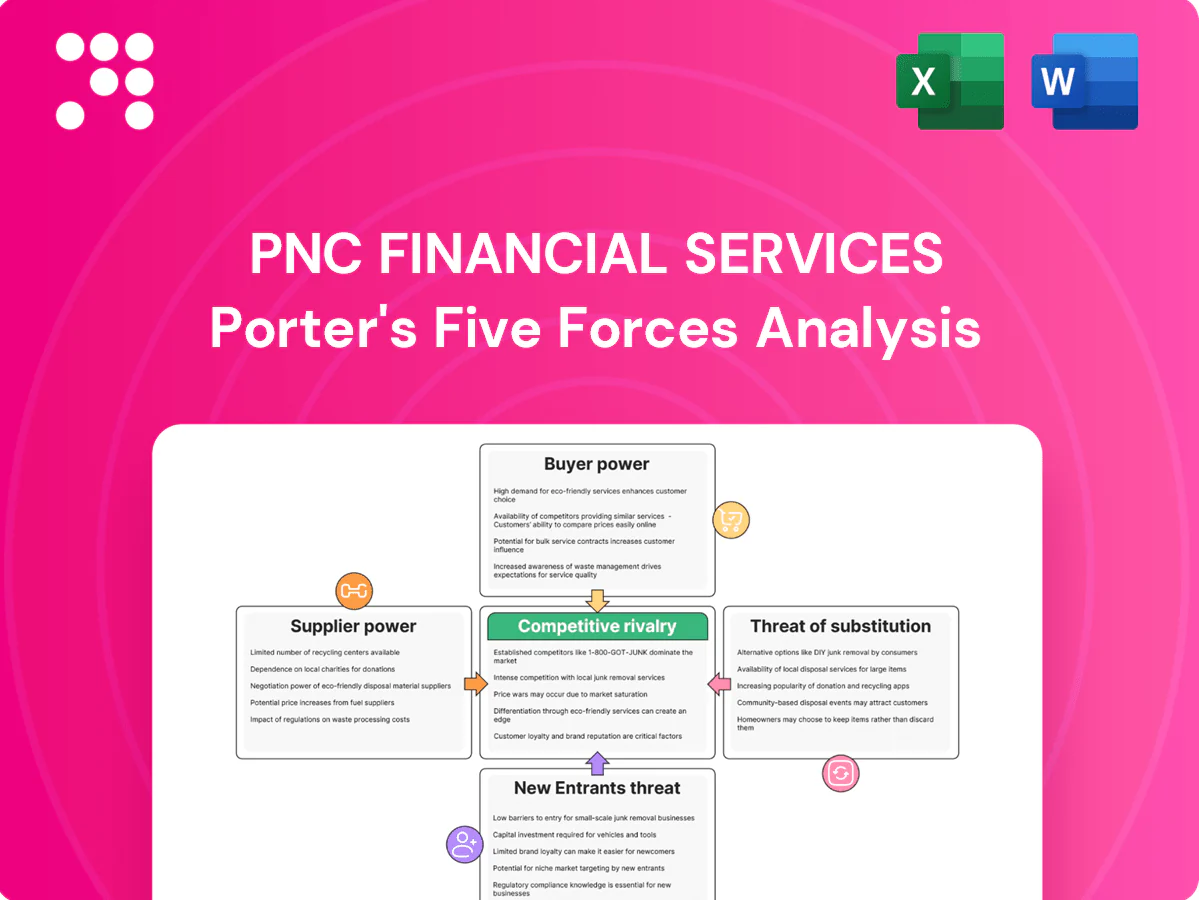
PNC Financial Services Porter's Five Forces Analysis

Go Beyond the Preview—Access the Full Strategic Report
PNC Financial Services faces moderate competitive rivalry, high regulatory scrutiny, and evolving customer power driven by digital banking trends. Supplier and buyer pressures are balanced by scale advantages and diversified service lines, while the threat of new entrants remains low but substitutes (fintechs) are rising. This brief snapshot only scratches the surface. Unlock the full Porter's Five Forces Analysis to explore PNC Financial Services’s competitive dynamics, market pressures, and strategic advantages in detail.
Suppliers Bargaining Power

Concentrated core tech vendors
PNC depends on a concentrated set of core banking, payments and cloud providers (eg FIS/Fiserv and hyperscalers), raising switching costs and vendor leverage. Core replacements typically run 18–36 months, limiting multi-sourcing. Gartner 2024 shows AWS 32% and Microsoft 22% cloud share, underscoring vendor influence on pricing, roadmaps and service levels; renegotiations carry meaningful operational risk.
Wholesale and brokered funding
Reliance on FHLB lines, brokered CDs and wholesale markets during tight 2023–24 liquidity pushed funding costs higher as market rates rose to about 5.25–5.50%; system FHLB advances were roughly $1.1 trillion in 2024. Lenders could reprice quickly, squeezing NIMs, while eligibility rules and collateral haircuts tightened capacity. Diversification mitigates risk, but pricing power often rests with capital market counterparties.

Payment networks and rails
Card networks and ACH/RTPS providers, led by Visa and Mastercard with over 80% of U.S. card volume (2024), set interchange and network rules that PNC must accept to remain ubiquitous; typical card interchange runs about 1.5–2.5%, creating material fee exposure. Limited substitutes for these rails give networks bargaining leverage, and rule changes drive compliance and tech costs. Scale rebates partially offset fees but do not remove structural dependency.

Data, credit bureaus, and analytics
Access to consumer and business credit data is vital for PNC underwriting and compliance, with three major bureaus holding 200+ million U.S. consumer files, making this input indispensable. Major bureaus and KYC/AML providers are few and standardized, limiting negotiating room. Pricing and per-use terms materially affect unit economics at scale. Vendor outages or data-quality lapses can directly impair credit and risk decisions.
- Few dominant suppliers: three major credit bureaus
- 200+ million consumer files underpin underwriting
- Pricing/usage terms affect per-loan margins
- Outages/data errors raise default and compliance risk
Skilled labor and specialized talent
Skilled technology, risk, compliance and quantitative talent remain scarce and mobile in 2024, increasing suppliers’ bargaining power as banks like PNC compete to attract experts for model risk, cyber and regulatory programs.
Wage inflation and richer retention packages have materially raised operating expenses, while growing regulatory complexity heightens reliance on seasoned practitioners with proven compliance track records.
Remote work in 2024 widened the candidate pool and intensified competition across financial hubs, pressuring PNC to match market compensation and total rewards to avoid attrition.
- 2024: elevated hiring/retention spend
- Regulatory complexity → higher reliance on experienced hires
- Remote work expands competitor talent reach
Vendor power, funding squeeze & data limits hit bank margins; $1.1T FHLB
PNC faces high supplier bargaining power from concentrated core processors, cloud hyperscalers and card rails, raising switching costs and vendor leverage. FHLB/wholesale funding and brokered CDs amplified pricing pressure in 2023–24 as rates rose to ~5.25–5.50% and system FHLB advances hit ~$1.1T in 2024. Three credit bureaus and 200+M consumer files constrain data sourcing; talent scarcity and wage inflation in 2024 add payroll pressure.
| Supplier | Concentration | 2024 Metric |
|---|---|---|
| Cloud | High | AWS 32% MSFT 22% |
| Card rails | High | Visa/Mastercard >80% vol |
| Funding | Moderate | FHLB advances ~$1.1T |
What is included in the product
 Detailed Word Document
Analyzes competitive rivalry, buyer and supplier power, threat of new entrants and substitutes, plus regulatory and technological disruptors shaping PNC Financial Services’ profitability and strategic positioning.

 Customizable Excel Spreadsheet
A concise, one-sheet Porter's Five Forces for PNC—instantly reveals competitive pressure points and clear strategic levers to relieve risk, ready to paste into decks or update with your own data.
Customers Bargaining Power

Rate-sensitive deposits
Consumers and SMBs can move balances quickly for higher yields, driving deposit betas commonly in the 20–40% range and raising funding volatility for PNC. Digital channels lower friction and make rate comparisons immediate, increasing sensitivity to market moves. This compresses NIM when competition intensifies, forcing promotional pricing and short-term rate hikes to defend balances.
Corporate and institutional bargaining
Large corporates commonly use multi-bank relationships to negotiate fees across treasury, credit and capital markets, leveraging RFPs and volume-based pricing to extract lower spreads and service fees.
These sophisticated clients shift bargaining power toward themselves by consolidating flows and demanding integrated pricing; PNC must offer concessions on rates, fees or service levels to retain mandates.
Relationship bundling helps lock in cross-sell revenue but often requires pricing trade-offs, and losing a single corporate mandate can erode multiple fee streams tied to deposits, treasury and capital markets work.

Low switching costs via digital
Account opening, payments, and aggregation tools lower switching friction for PNC customers, with 82% of US adults using mobile banking in 2024, enabling rapid onboarding and transfers. Fintechs set expectations for sub-minute onboarding and slick UX, pressuring incumbents on speed and design. Customers cherry-pick best-in-class products across lenders, payments, and wealth platforms. Loyalty now hinges on clear value, convenience, and integrated ecosystems.

Product commoditization
Many lending and deposit products have become price-comparable across providers, and online comparison tools and marketplaces in 2024 further heighten transparency, compressing spreads and fee differentials. Differentiation for PNC relies on service quality, product bundling and digital capabilities such as enhanced mobile features and integrated cash-management. Buyers increasingly push for lower fees and improved terms, forcing continuous pricing and service adjustments.
- Price transparency — increased competition
- Digital differentiation — mobile/CMS features
- Bundling & service — retention lever
- Fee pressure — customers demand better terms
Public sector and nonprofit procurement
Public sector and nonprofit procurement runs formal RFPs with strict requirements, and in 2024 US federal contract spending exceeded $700 billion, intensifying competition for banks like PNC. Price, compliance track record, and local presence are heavily weighted, amplifying buyer power and compressing margins; contract terms commonly span 3–5 years but are competitively won.
- Strict RFPs
- Price + compliance prioritized
- Local presence matters
- Contracts 3–5 years
- Buyer power compresses margins
Buyer power: 20–40% betas, 82% mobile, >$700B federal
Customers wield strong bargaining power: deposit betas of 20–40% raise funding volatility and compress NIM, while corporates use multi-bank RFPs to push fees and spreads lower. Digital adoption (82% mobile banking in 2024) and fintech UX lower switching costs and heighten rate sensitivity. Public procurement (US federal contracts >$700B in 2024) further concentrates buyer leverage.
| Metric | Value | Note |
|---|---|---|
| Deposit beta | 20–40% | Funding volatility |
| Mobile banking | 82% (2024) | Lower switching friction |
| Federal spend | >$700B (2024) | Competitive RFPs |
Same Document Delivered
PNC Financial Services Porter's Five Forces Analysis
This Porter’s Five Forces analysis of PNC Financial Services examines competitive rivalry, buyer and supplier power, threat of new entrants and substitutes, and industry dynamics to assess profitability and strategic positioning. The document you see is the same professionally written analysis you'll receive instantly after purchase—fully formatted and ready to use.

Go Beyond the Preview—Access the Full Strategic Report
PNC Financial Services faces moderate competitive rivalry, high regulatory scrutiny, and evolving customer power driven by digital banking trends. Supplier and buyer pressures are balanced by scale advantages and diversified service lines, while the threat of new entrants remains low but substitutes (fintechs) are rising. This brief snapshot only scratches the surface. Unlock the full Porter's Five Forces Analysis to explore PNC Financial Services’s competitive dynamics, market pressures, and strategic advantages in detail.
Suppliers Bargaining Power
Concentrated core tech vendors
PNC depends on a concentrated set of core banking, payments and cloud providers (eg FIS/Fiserv and hyperscalers), raising switching costs and vendor leverage. Core replacements typically run 18–36 months, limiting multi-sourcing. Gartner 2024 shows AWS 32% and Microsoft 22% cloud share, underscoring vendor influence on pricing, roadmaps and service levels; renegotiations carry meaningful operational risk.
Wholesale and brokered funding
Reliance on FHLB lines, brokered CDs and wholesale markets during tight 2023–24 liquidity pushed funding costs higher as market rates rose to about 5.25–5.50%; system FHLB advances were roughly $1.1 trillion in 2024. Lenders could reprice quickly, squeezing NIMs, while eligibility rules and collateral haircuts tightened capacity. Diversification mitigates risk, but pricing power often rests with capital market counterparties.
Payment networks and rails
Card networks and ACH/RTPS providers, led by Visa and Mastercard with over 80% of U.S. card volume (2024), set interchange and network rules that PNC must accept to remain ubiquitous; typical card interchange runs about 1.5–2.5%, creating material fee exposure. Limited substitutes for these rails give networks bargaining leverage, and rule changes drive compliance and tech costs. Scale rebates partially offset fees but do not remove structural dependency.
Data, credit bureaus, and analytics
Access to consumer and business credit data is vital for PNC underwriting and compliance, with three major bureaus holding 200+ million U.S. consumer files, making this input indispensable. Major bureaus and KYC/AML providers are few and standardized, limiting negotiating room. Pricing and per-use terms materially affect unit economics at scale. Vendor outages or data-quality lapses can directly impair credit and risk decisions.
- Few dominant suppliers: three major credit bureaus
- 200+ million consumer files underpin underwriting
- Pricing/usage terms affect per-loan margins
- Outages/data errors raise default and compliance risk
Skilled labor and specialized talent
Skilled technology, risk, compliance and quantitative talent remain scarce and mobile in 2024, increasing suppliers’ bargaining power as banks like PNC compete to attract experts for model risk, cyber and regulatory programs.
Wage inflation and richer retention packages have materially raised operating expenses, while growing regulatory complexity heightens reliance on seasoned practitioners with proven compliance track records.
Remote work in 2024 widened the candidate pool and intensified competition across financial hubs, pressuring PNC to match market compensation and total rewards to avoid attrition.
- 2024: elevated hiring/retention spend
- Regulatory complexity → higher reliance on experienced hires
- Remote work expands competitor talent reach
Vendor power, funding squeeze & data limits hit bank margins; $1.1T FHLB
PNC faces high supplier bargaining power from concentrated core processors, cloud hyperscalers and card rails, raising switching costs and vendor leverage. FHLB/wholesale funding and brokered CDs amplified pricing pressure in 2023–24 as rates rose to ~5.25–5.50% and system FHLB advances hit ~$1.1T in 2024. Three credit bureaus and 200+M consumer files constrain data sourcing; talent scarcity and wage inflation in 2024 add payroll pressure.
| Supplier | Concentration | 2024 Metric |
|---|---|---|
| Cloud | High | AWS 32% MSFT 22% |
| Card rails | High | Visa/Mastercard >80% vol |
| Funding | Moderate | FHLB advances ~$1.1T |
What is included in the product
Detailed Word Document
Analyzes competitive rivalry, buyer and supplier power, threat of new entrants and substitutes, plus regulatory and technological disruptors shaping PNC Financial Services’ profitability and strategic positioning.
Customizable Excel Spreadsheet
A concise, one-sheet Porter's Five Forces for PNC—instantly reveals competitive pressure points and clear strategic levers to relieve risk, ready to paste into decks or update with your own data.
Customers Bargaining Power
Rate-sensitive deposits
Consumers and SMBs can move balances quickly for higher yields, driving deposit betas commonly in the 20–40% range and raising funding volatility for PNC. Digital channels lower friction and make rate comparisons immediate, increasing sensitivity to market moves. This compresses NIM when competition intensifies, forcing promotional pricing and short-term rate hikes to defend balances.
Corporate and institutional bargaining
Large corporates commonly use multi-bank relationships to negotiate fees across treasury, credit and capital markets, leveraging RFPs and volume-based pricing to extract lower spreads and service fees.
These sophisticated clients shift bargaining power toward themselves by consolidating flows and demanding integrated pricing; PNC must offer concessions on rates, fees or service levels to retain mandates.
Relationship bundling helps lock in cross-sell revenue but often requires pricing trade-offs, and losing a single corporate mandate can erode multiple fee streams tied to deposits, treasury and capital markets work.
Low switching costs via digital
Account opening, payments, and aggregation tools lower switching friction for PNC customers, with 82% of US adults using mobile banking in 2024, enabling rapid onboarding and transfers. Fintechs set expectations for sub-minute onboarding and slick UX, pressuring incumbents on speed and design. Customers cherry-pick best-in-class products across lenders, payments, and wealth platforms. Loyalty now hinges on clear value, convenience, and integrated ecosystems.
Product commoditization
Many lending and deposit products have become price-comparable across providers, and online comparison tools and marketplaces in 2024 further heighten transparency, compressing spreads and fee differentials. Differentiation for PNC relies on service quality, product bundling and digital capabilities such as enhanced mobile features and integrated cash-management. Buyers increasingly push for lower fees and improved terms, forcing continuous pricing and service adjustments.
- Price transparency — increased competition
- Digital differentiation — mobile/CMS features
- Bundling & service — retention lever
- Fee pressure — customers demand better terms
Public sector and nonprofit procurement
Public sector and nonprofit procurement runs formal RFPs with strict requirements, and in 2024 US federal contract spending exceeded $700 billion, intensifying competition for banks like PNC. Price, compliance track record, and local presence are heavily weighted, amplifying buyer power and compressing margins; contract terms commonly span 3–5 years but are competitively won.
- Strict RFPs
- Price + compliance prioritized
- Local presence matters
- Contracts 3–5 years
- Buyer power compresses margins
Buyer power: 20–40% betas, 82% mobile, >$700B federal
Customers wield strong bargaining power: deposit betas of 20–40% raise funding volatility and compress NIM, while corporates use multi-bank RFPs to push fees and spreads lower. Digital adoption (82% mobile banking in 2024) and fintech UX lower switching costs and heighten rate sensitivity. Public procurement (US federal contracts >$700B in 2024) further concentrates buyer leverage.
| Metric | Value | Note |
|---|---|---|
| Deposit beta | 20–40% | Funding volatility |
| Mobile banking | 82% (2024) | Lower switching friction |
| Federal spend | >$700B (2024) | Competitive RFPs |
Same Document Delivered
PNC Financial Services Porter's Five Forces Analysis
This Porter’s Five Forces analysis of PNC Financial Services examines competitive rivalry, buyer and supplier power, threat of new entrants and substitutes, and industry dynamics to assess profitability and strategic positioning. The document you see is the same professionally written analysis you'll receive instantly after purchase—fully formatted and ready to use.
Description
Go Beyond the Preview—Access the Full Strategic Report
PNC Financial Services faces moderate competitive rivalry, high regulatory scrutiny, and evolving customer power driven by digital banking trends. Supplier and buyer pressures are balanced by scale advantages and diversified service lines, while the threat of new entrants remains low but substitutes (fintechs) are rising. This brief snapshot only scratches the surface. Unlock the full Porter's Five Forces Analysis to explore PNC Financial Services’s competitive dynamics, market pressures, and strategic advantages in detail.
Suppliers Bargaining Power
Concentrated core tech vendors
PNC depends on a concentrated set of core banking, payments and cloud providers (eg FIS/Fiserv and hyperscalers), raising switching costs and vendor leverage. Core replacements typically run 18–36 months, limiting multi-sourcing. Gartner 2024 shows AWS 32% and Microsoft 22% cloud share, underscoring vendor influence on pricing, roadmaps and service levels; renegotiations carry meaningful operational risk.
Wholesale and brokered funding
Reliance on FHLB lines, brokered CDs and wholesale markets during tight 2023–24 liquidity pushed funding costs higher as market rates rose to about 5.25–5.50%; system FHLB advances were roughly $1.1 trillion in 2024. Lenders could reprice quickly, squeezing NIMs, while eligibility rules and collateral haircuts tightened capacity. Diversification mitigates risk, but pricing power often rests with capital market counterparties.
Payment networks and rails
Card networks and ACH/RTPS providers, led by Visa and Mastercard with over 80% of U.S. card volume (2024), set interchange and network rules that PNC must accept to remain ubiquitous; typical card interchange runs about 1.5–2.5%, creating material fee exposure. Limited substitutes for these rails give networks bargaining leverage, and rule changes drive compliance and tech costs. Scale rebates partially offset fees but do not remove structural dependency.
Data, credit bureaus, and analytics
Access to consumer and business credit data is vital for PNC underwriting and compliance, with three major bureaus holding 200+ million U.S. consumer files, making this input indispensable. Major bureaus and KYC/AML providers are few and standardized, limiting negotiating room. Pricing and per-use terms materially affect unit economics at scale. Vendor outages or data-quality lapses can directly impair credit and risk decisions.
- Few dominant suppliers: three major credit bureaus
- 200+ million consumer files underpin underwriting
- Pricing/usage terms affect per-loan margins
- Outages/data errors raise default and compliance risk
Skilled labor and specialized talent
Skilled technology, risk, compliance and quantitative talent remain scarce and mobile in 2024, increasing suppliers’ bargaining power as banks like PNC compete to attract experts for model risk, cyber and regulatory programs.
Wage inflation and richer retention packages have materially raised operating expenses, while growing regulatory complexity heightens reliance on seasoned practitioners with proven compliance track records.
Remote work in 2024 widened the candidate pool and intensified competition across financial hubs, pressuring PNC to match market compensation and total rewards to avoid attrition.
- 2024: elevated hiring/retention spend
- Regulatory complexity → higher reliance on experienced hires
- Remote work expands competitor talent reach
Vendor power, funding squeeze & data limits hit bank margins; $1.1T FHLB
PNC faces high supplier bargaining power from concentrated core processors, cloud hyperscalers and card rails, raising switching costs and vendor leverage. FHLB/wholesale funding and brokered CDs amplified pricing pressure in 2023–24 as rates rose to ~5.25–5.50% and system FHLB advances hit ~$1.1T in 2024. Three credit bureaus and 200+M consumer files constrain data sourcing; talent scarcity and wage inflation in 2024 add payroll pressure.
| Supplier | Concentration | 2024 Metric |
|---|---|---|
| Cloud | High | AWS 32% MSFT 22% |
| Card rails | High | Visa/Mastercard >80% vol |
| Funding | Moderate | FHLB advances ~$1.1T |
What is included in the product
Detailed Word Document
Analyzes competitive rivalry, buyer and supplier power, threat of new entrants and substitutes, plus regulatory and technological disruptors shaping PNC Financial Services’ profitability and strategic positioning.
Customizable Excel Spreadsheet
A concise, one-sheet Porter's Five Forces for PNC—instantly reveals competitive pressure points and clear strategic levers to relieve risk, ready to paste into decks or update with your own data.
Customers Bargaining Power
Rate-sensitive deposits
Consumers and SMBs can move balances quickly for higher yields, driving deposit betas commonly in the 20–40% range and raising funding volatility for PNC. Digital channels lower friction and make rate comparisons immediate, increasing sensitivity to market moves. This compresses NIM when competition intensifies, forcing promotional pricing and short-term rate hikes to defend balances.
Corporate and institutional bargaining
Large corporates commonly use multi-bank relationships to negotiate fees across treasury, credit and capital markets, leveraging RFPs and volume-based pricing to extract lower spreads and service fees.
These sophisticated clients shift bargaining power toward themselves by consolidating flows and demanding integrated pricing; PNC must offer concessions on rates, fees or service levels to retain mandates.
Relationship bundling helps lock in cross-sell revenue but often requires pricing trade-offs, and losing a single corporate mandate can erode multiple fee streams tied to deposits, treasury and capital markets work.
Low switching costs via digital
Account opening, payments, and aggregation tools lower switching friction for PNC customers, with 82% of US adults using mobile banking in 2024, enabling rapid onboarding and transfers. Fintechs set expectations for sub-minute onboarding and slick UX, pressuring incumbents on speed and design. Customers cherry-pick best-in-class products across lenders, payments, and wealth platforms. Loyalty now hinges on clear value, convenience, and integrated ecosystems.
Product commoditization
Many lending and deposit products have become price-comparable across providers, and online comparison tools and marketplaces in 2024 further heighten transparency, compressing spreads and fee differentials. Differentiation for PNC relies on service quality, product bundling and digital capabilities such as enhanced mobile features and integrated cash-management. Buyers increasingly push for lower fees and improved terms, forcing continuous pricing and service adjustments.
- Price transparency — increased competition
- Digital differentiation — mobile/CMS features
- Bundling & service — retention lever
- Fee pressure — customers demand better terms
Public sector and nonprofit procurement
Public sector and nonprofit procurement runs formal RFPs with strict requirements, and in 2024 US federal contract spending exceeded $700 billion, intensifying competition for banks like PNC. Price, compliance track record, and local presence are heavily weighted, amplifying buyer power and compressing margins; contract terms commonly span 3–5 years but are competitively won.
- Strict RFPs
- Price + compliance prioritized
- Local presence matters
- Contracts 3–5 years
- Buyer power compresses margins
Buyer power: 20–40% betas, 82% mobile, >$700B federal
Customers wield strong bargaining power: deposit betas of 20–40% raise funding volatility and compress NIM, while corporates use multi-bank RFPs to push fees and spreads lower. Digital adoption (82% mobile banking in 2024) and fintech UX lower switching costs and heighten rate sensitivity. Public procurement (US federal contracts >$700B in 2024) further concentrates buyer leverage.
| Metric | Value | Note |
|---|---|---|
| Deposit beta | 20–40% | Funding volatility |
| Mobile banking | 82% (2024) | Lower switching friction |
| Federal spend | >$700B (2024) | Competitive RFPs |
Same Document Delivered
PNC Financial Services Porter's Five Forces Analysis
This Porter’s Five Forces analysis of PNC Financial Services examines competitive rivalry, buyer and supplier power, threat of new entrants and substitutes, and industry dynamics to assess profitability and strategic positioning. The document you see is the same professionally written analysis you'll receive instantly after purchase—fully formatted and ready to use.











