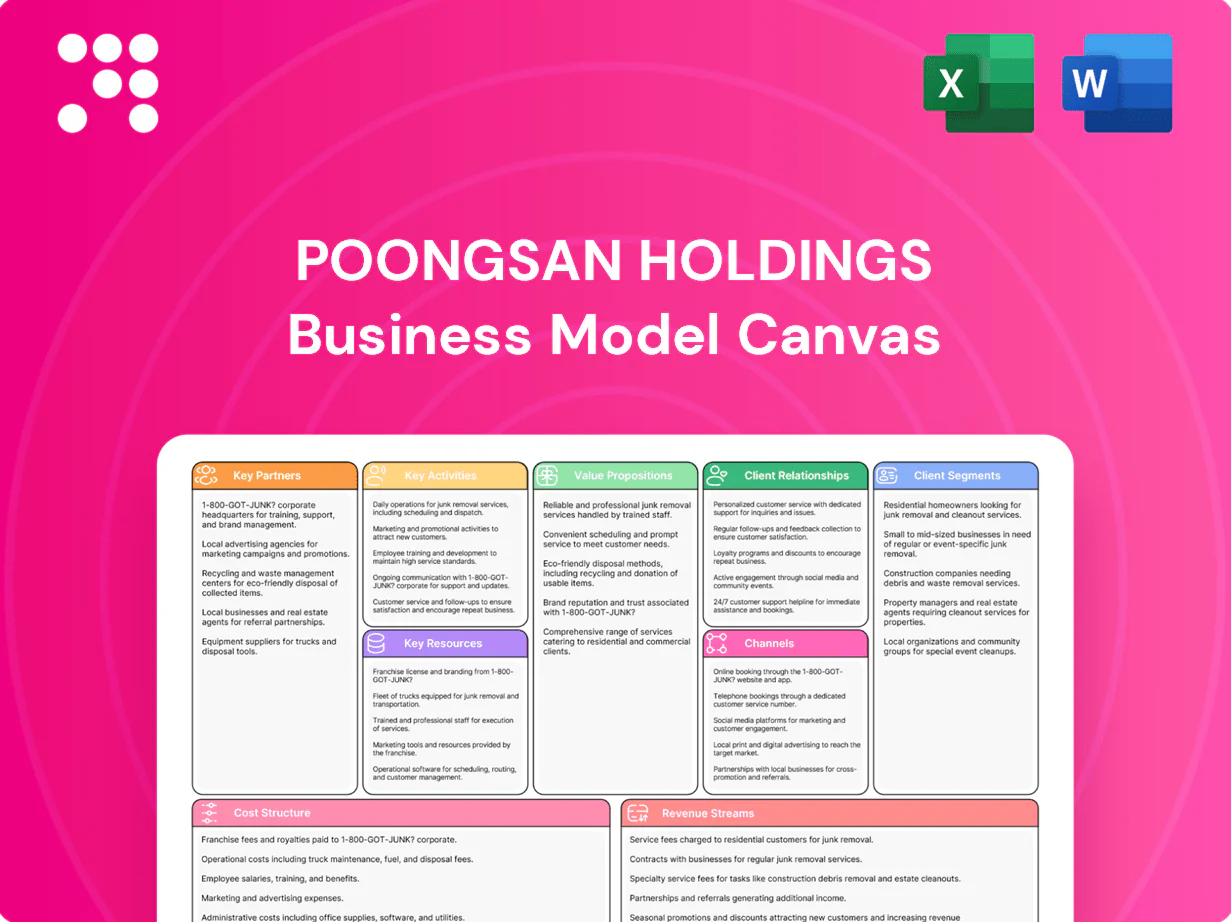
Poongsan Holdings Business Model Canvas

Unlock the strategic Business Model Canvas: value creation, revenue, partners, risks
Unlock the full strategic blueprint behind Poongsan Holdings’s business model and discover how it creates value, captures market share, and mitigates risk. This in-depth Business Model Canvas maps value propositions, revenue streams, key partners and cost structure—perfect for investors, consultants and founders. Download the editable Word and Excel canvas to benchmark, plan and act.
Partnerships

Mining and Metal Suppliers
Secure, diversified sources of copper, zinc and alloy inputs underpin Poongsan Holdings’ cost control and product quality by reducing single-supplier risk.
Long-term offtake agreements, commonly spanning multiple years, stabilize pricing and ensure continuity of supply for manufacturing cycles.
Collaboration on scrap-return programs boosts circularity and margins through higher metal recovery rates.
Joint quality programs maintain tight metallurgical specs demanded by industrial clients.
Defense Ministries and Prime Contractors
Strategic relationships with defense ministries and Tier-1 primes secure multi-year ammunition programs (typically 3–7 years) that anchor Poongsan Holdings’ order book. Compliance with procurement protocols and security regimes such as FMS/ITAR is mandatory for contract access and continuity. Co-development with primes aligns munitions performance to evolving mission needs, while rolling forecast sharing (12–36 month windows) improves capacity planning and delivery reliability.

Equipment and Technology Providers
Partnerships for rolling mills, extrusion lines and precision tooling lift throughput and yield by ~20–30%, supporting Poongsan’s capacity targets. Automation, NDT and digital quality systems cut defects and downtime by ~30%, per 2024 industry benchmarks. Joint trials accelerate advanced alloy and coating adoption by roughly 40%, shortening qualification cycles. Long-term service agreements deliver 99.5% uptime SLAs and predictable maintenance costs.

Logistics and Warehousing Providers
Specialized handling for heavy coils, tubes and hazardous defense goods is essential for Poongsan to meet industrial and military specs; with South Korea’s 2024 defense budget at about 61.9 trillion KRW, demand for secure logistics rises. Regional hubs compress lead times to key customers, track-and-trace improves OTIF by ~10–15%, and consolidation can cut freight costs and CO2 by ~10–25%.
- Specialized handling: heavy/heavy-gauge metals, hazardous munitions
- Regional hubs: shorter lead times to industrial & defense clients
- Digital track-and-trace: +10–15% OTIF, auditability
- Consolidation: -10–25% freight cost & carbon
R&D Institutes and Universities
Co-research with R&D institutes accelerates alloy innovation and ballistic performance, cutting prototype time-to-market by about 30% in 2024 industry studies; shared labs and testing validate material properties and standards compliance to MIL/KS specs; talent pipelines supply metallurgy, ballistics, and process engineers; IP-sharing frameworks balance protection and rapid commercialization.
- Co-research: -30% TTM (2024)
- Shared labs: MIL/KS validation
- Talent: metallurgy, ballistics, process eng.
- IP frameworks: protect & enable speed
Secure inputs, scrap-return boost yield 20–30% and uptime.
Secure, diversified copper/zinc inputs and long-term offtakes reduce supplier risk and stabilize costs; scrap-return programs raise recovery and margins.
Joint investments in rolling mills, automation and NDT lift yield ~20–30% and cut defects/downtime ~30%; SLAs deliver 99.5% uptime (2024).
Defense partnerships (S Korea 2024 budget 61.9T KRW) and co-research shorten TTM ~30% and improve OTIF +10–15% via regional hubs.
| Metric | Value | Year |
|---|---|---|
| Uptime SLA | 99.5% | 2024 |
| Yield lift | 20–30% | 2024 |
| TTM reduction | ~30% | 2024 |
| OTIF gain | +10–15% | 2024 |
What is included in the product
 Detailed Word Document
A comprehensive Business Model Canvas for Poongsan Holdings detailing customer segments, value propositions, channels, revenue streams and key resources across the 9 BMC blocks, with competitive analysis, SWOT-linked insights and investor-ready narratives for strategic presentations.

 Customizable Excel Spreadsheet
Condenses Poongsan Holdings’ strategy into a digestible one-page Business Model Canvas, saving hours on structuring and enabling quick comparisons, board-ready summaries, and collaborative edits for rapid decision-making.
Activities

Casting, Rolling, and Extrusion
Casting, rolling, and extrusion produce sheets, strips, tubes, and rods through core metal transformation processes, with Poongsan reporting 2024 product mix adjustments to meet defense and industrial demand. Tight process control holds dimensional tolerances to sub-millimeter levels and preserves surface integrity, supporting premium end-markets. Continuous improvement programs raised yields by about 4% in 2024 and cut scrap roughly 12%, while capacity balancing shifts monthly output to match demand cycles.
Ammunition Design and Manufacture
End-to-end ammunition production covers brass case forming, propellant loading, primer seating and ballistic testing. Strict QA with ISO 9001 and NATO STANAG-aligned lot traceability meets military acceptance criteria. Product variants span small arms (5.56mm) through large-caliber artillery (155mm). In 2024 lifecycle support includes refurbishment and demilitarization per international protocols.

Quality Assurance and Certification
ISO 9001, AS9100 and NATO AQAP certifications underpin Poongsan Holdings access to defense and industrial markets, supporting bids into a sector with global military spending of $2.24 trillion in 2023 (SIPRI). In-line ultrasonic and XRF inspection plus accredited lab testing (ASTM/ISO methods) verify composition and mechanical properties. Systematic root-cause analysis reduces recurring defects and warranty risk, while detailed compliance documentation (traceability, test reports) supports tenders and audits.

Supply Chain and Scrap Recycling
Dynamic sourcing and hedging protect margins against metal price swings (LME copper averaged about 9,500 USD/tonne in 2024), while closed-loop scrap recovery lowers feedstock costs and raises sustainability metrics for Poongsan.
- Hedging: stabilizes margins
- Closed-loop: reduces costs, cuts emissions
- Inventory opt.: lowers working capital
- VMI: ensures steady flow to key customers
Business Development and Contracting
Strategic bidding for defense tenders drives long-term revenue visibility, leveraging South Korea’s 2024 defense budget of about 61.5 trillion KRW to capture multi-year contracts.
Key account management deepens industrial relationships; export market development—targeting ASEAN and Europe—diversifies demand and reduced domestic concentration risk.
Pricing, hedging, and service bundling improve margins and lifecycle revenue for munitions and metal components.
- Defense budget: 61.5 trillion KRW (2024)
- Focus: strategic bids, key accounts, exports
- Margin levers: pricing, hedging, service bundles
Defense metals: +4% yield, -12% scrap; export push to ASEAN/EU
Casting, rolling, extrusion and ammunition production deliver metal products and munitions with ISO/AS/NATO QA; 2024 yield +4% and scrap -12%. Dynamic sourcing and hedging (LME Cu ~9,500 USD/tonne in 2024) plus closed-loop recycling cut costs. Strategic bids capture Korea 2024 defense budget ~61.5 trillion KRW and export push to ASEAN/EU.
| Metric | 2024 |
|---|---|
| Yield improvement | +4% |
| Scrap reduction | -12% |
| LME Cu | ~9,500 USD/t |
| Korea defense budget | 61.5T KRW |
Delivered as Displayed
Business Model Canvas
The preview you see is the actual Poongsan Holdings Business Model Canvas, not a mockup—what’s visible here is a direct excerpt from the final file you’ll receive after purchase. Once you complete your order, you’ll get the exact same document, fully formatted and ready to edit, present, or share in Word and Excel.

Unlock the strategic Business Model Canvas: value creation, revenue, partners, risks
Unlock the full strategic blueprint behind Poongsan Holdings’s business model and discover how it creates value, captures market share, and mitigates risk. This in-depth Business Model Canvas maps value propositions, revenue streams, key partners and cost structure—perfect for investors, consultants and founders. Download the editable Word and Excel canvas to benchmark, plan and act.
Partnerships
Mining and Metal Suppliers
Secure, diversified sources of copper, zinc and alloy inputs underpin Poongsan Holdings’ cost control and product quality by reducing single-supplier risk.
Long-term offtake agreements, commonly spanning multiple years, stabilize pricing and ensure continuity of supply for manufacturing cycles.
Collaboration on scrap-return programs boosts circularity and margins through higher metal recovery rates.
Joint quality programs maintain tight metallurgical specs demanded by industrial clients.
Defense Ministries and Prime Contractors
Strategic relationships with defense ministries and Tier-1 primes secure multi-year ammunition programs (typically 3–7 years) that anchor Poongsan Holdings’ order book. Compliance with procurement protocols and security regimes such as FMS/ITAR is mandatory for contract access and continuity. Co-development with primes aligns munitions performance to evolving mission needs, while rolling forecast sharing (12–36 month windows) improves capacity planning and delivery reliability.
Equipment and Technology Providers
Partnerships for rolling mills, extrusion lines and precision tooling lift throughput and yield by ~20–30%, supporting Poongsan’s capacity targets. Automation, NDT and digital quality systems cut defects and downtime by ~30%, per 2024 industry benchmarks. Joint trials accelerate advanced alloy and coating adoption by roughly 40%, shortening qualification cycles. Long-term service agreements deliver 99.5% uptime SLAs and predictable maintenance costs.
Logistics and Warehousing Providers
Specialized handling for heavy coils, tubes and hazardous defense goods is essential for Poongsan to meet industrial and military specs; with South Korea’s 2024 defense budget at about 61.9 trillion KRW, demand for secure logistics rises. Regional hubs compress lead times to key customers, track-and-trace improves OTIF by ~10–15%, and consolidation can cut freight costs and CO2 by ~10–25%.
- Specialized handling: heavy/heavy-gauge metals, hazardous munitions
- Regional hubs: shorter lead times to industrial & defense clients
- Digital track-and-trace: +10–15% OTIF, auditability
- Consolidation: -10–25% freight cost & carbon
R&D Institutes and Universities
Co-research with R&D institutes accelerates alloy innovation and ballistic performance, cutting prototype time-to-market by about 30% in 2024 industry studies; shared labs and testing validate material properties and standards compliance to MIL/KS specs; talent pipelines supply metallurgy, ballistics, and process engineers; IP-sharing frameworks balance protection and rapid commercialization.
- Co-research: -30% TTM (2024)
- Shared labs: MIL/KS validation
- Talent: metallurgy, ballistics, process eng.
- IP frameworks: protect & enable speed
Secure inputs, scrap-return boost yield 20–30% and uptime.
Secure, diversified copper/zinc inputs and long-term offtakes reduce supplier risk and stabilize costs; scrap-return programs raise recovery and margins.
Joint investments in rolling mills, automation and NDT lift yield ~20–30% and cut defects/downtime ~30%; SLAs deliver 99.5% uptime (2024).
Defense partnerships (S Korea 2024 budget 61.9T KRW) and co-research shorten TTM ~30% and improve OTIF +10–15% via regional hubs.
| Metric | Value | Year |
|---|---|---|
| Uptime SLA | 99.5% | 2024 |
| Yield lift | 20–30% | 2024 |
| TTM reduction | ~30% | 2024 |
| OTIF gain | +10–15% | 2024 |
What is included in the product
Detailed Word Document
A comprehensive Business Model Canvas for Poongsan Holdings detailing customer segments, value propositions, channels, revenue streams and key resources across the 9 BMC blocks, with competitive analysis, SWOT-linked insights and investor-ready narratives for strategic presentations.
Customizable Excel Spreadsheet
Condenses Poongsan Holdings’ strategy into a digestible one-page Business Model Canvas, saving hours on structuring and enabling quick comparisons, board-ready summaries, and collaborative edits for rapid decision-making.
Activities
Casting, Rolling, and Extrusion
Casting, rolling, and extrusion produce sheets, strips, tubes, and rods through core metal transformation processes, with Poongsan reporting 2024 product mix adjustments to meet defense and industrial demand. Tight process control holds dimensional tolerances to sub-millimeter levels and preserves surface integrity, supporting premium end-markets. Continuous improvement programs raised yields by about 4% in 2024 and cut scrap roughly 12%, while capacity balancing shifts monthly output to match demand cycles.
Ammunition Design and Manufacture
End-to-end ammunition production covers brass case forming, propellant loading, primer seating and ballistic testing. Strict QA with ISO 9001 and NATO STANAG-aligned lot traceability meets military acceptance criteria. Product variants span small arms (5.56mm) through large-caliber artillery (155mm). In 2024 lifecycle support includes refurbishment and demilitarization per international protocols.
Quality Assurance and Certification
ISO 9001, AS9100 and NATO AQAP certifications underpin Poongsan Holdings access to defense and industrial markets, supporting bids into a sector with global military spending of $2.24 trillion in 2023 (SIPRI). In-line ultrasonic and XRF inspection plus accredited lab testing (ASTM/ISO methods) verify composition and mechanical properties. Systematic root-cause analysis reduces recurring defects and warranty risk, while detailed compliance documentation (traceability, test reports) supports tenders and audits.
Supply Chain and Scrap Recycling
Dynamic sourcing and hedging protect margins against metal price swings (LME copper averaged about 9,500 USD/tonne in 2024), while closed-loop scrap recovery lowers feedstock costs and raises sustainability metrics for Poongsan.
- Hedging: stabilizes margins
- Closed-loop: reduces costs, cuts emissions
- Inventory opt.: lowers working capital
- VMI: ensures steady flow to key customers
Business Development and Contracting
Strategic bidding for defense tenders drives long-term revenue visibility, leveraging South Korea’s 2024 defense budget of about 61.5 trillion KRW to capture multi-year contracts.
Key account management deepens industrial relationships; export market development—targeting ASEAN and Europe—diversifies demand and reduced domestic concentration risk.
Pricing, hedging, and service bundling improve margins and lifecycle revenue for munitions and metal components.
- Defense budget: 61.5 trillion KRW (2024)
- Focus: strategic bids, key accounts, exports
- Margin levers: pricing, hedging, service bundles
Defense metals: +4% yield, -12% scrap; export push to ASEAN/EU
Casting, rolling, extrusion and ammunition production deliver metal products and munitions with ISO/AS/NATO QA; 2024 yield +4% and scrap -12%. Dynamic sourcing and hedging (LME Cu ~9,500 USD/tonne in 2024) plus closed-loop recycling cut costs. Strategic bids capture Korea 2024 defense budget ~61.5 trillion KRW and export push to ASEAN/EU.
| Metric | 2024 |
|---|---|
| Yield improvement | +4% |
| Scrap reduction | -12% |
| LME Cu | ~9,500 USD/t |
| Korea defense budget | 61.5T KRW |
Delivered as Displayed
Business Model Canvas
The preview you see is the actual Poongsan Holdings Business Model Canvas, not a mockup—what’s visible here is a direct excerpt from the final file you’ll receive after purchase. Once you complete your order, you’ll get the exact same document, fully formatted and ready to edit, present, or share in Word and Excel.
Original: $10.00
-65%$10.00
$3.50Description
Unlock the strategic Business Model Canvas: value creation, revenue, partners, risks
Unlock the full strategic blueprint behind Poongsan Holdings’s business model and discover how it creates value, captures market share, and mitigates risk. This in-depth Business Model Canvas maps value propositions, revenue streams, key partners and cost structure—perfect for investors, consultants and founders. Download the editable Word and Excel canvas to benchmark, plan and act.
Partnerships
Mining and Metal Suppliers
Secure, diversified sources of copper, zinc and alloy inputs underpin Poongsan Holdings’ cost control and product quality by reducing single-supplier risk.
Long-term offtake agreements, commonly spanning multiple years, stabilize pricing and ensure continuity of supply for manufacturing cycles.
Collaboration on scrap-return programs boosts circularity and margins through higher metal recovery rates.
Joint quality programs maintain tight metallurgical specs demanded by industrial clients.
Defense Ministries and Prime Contractors
Strategic relationships with defense ministries and Tier-1 primes secure multi-year ammunition programs (typically 3–7 years) that anchor Poongsan Holdings’ order book. Compliance with procurement protocols and security regimes such as FMS/ITAR is mandatory for contract access and continuity. Co-development with primes aligns munitions performance to evolving mission needs, while rolling forecast sharing (12–36 month windows) improves capacity planning and delivery reliability.
Equipment and Technology Providers
Partnerships for rolling mills, extrusion lines and precision tooling lift throughput and yield by ~20–30%, supporting Poongsan’s capacity targets. Automation, NDT and digital quality systems cut defects and downtime by ~30%, per 2024 industry benchmarks. Joint trials accelerate advanced alloy and coating adoption by roughly 40%, shortening qualification cycles. Long-term service agreements deliver 99.5% uptime SLAs and predictable maintenance costs.
Logistics and Warehousing Providers
Specialized handling for heavy coils, tubes and hazardous defense goods is essential for Poongsan to meet industrial and military specs; with South Korea’s 2024 defense budget at about 61.9 trillion KRW, demand for secure logistics rises. Regional hubs compress lead times to key customers, track-and-trace improves OTIF by ~10–15%, and consolidation can cut freight costs and CO2 by ~10–25%.
- Specialized handling: heavy/heavy-gauge metals, hazardous munitions
- Regional hubs: shorter lead times to industrial & defense clients
- Digital track-and-trace: +10–15% OTIF, auditability
- Consolidation: -10–25% freight cost & carbon
R&D Institutes and Universities
Co-research with R&D institutes accelerates alloy innovation and ballistic performance, cutting prototype time-to-market by about 30% in 2024 industry studies; shared labs and testing validate material properties and standards compliance to MIL/KS specs; talent pipelines supply metallurgy, ballistics, and process engineers; IP-sharing frameworks balance protection and rapid commercialization.
- Co-research: -30% TTM (2024)
- Shared labs: MIL/KS validation
- Talent: metallurgy, ballistics, process eng.
- IP frameworks: protect & enable speed
Secure inputs, scrap-return boost yield 20–30% and uptime.
Secure, diversified copper/zinc inputs and long-term offtakes reduce supplier risk and stabilize costs; scrap-return programs raise recovery and margins.
Joint investments in rolling mills, automation and NDT lift yield ~20–30% and cut defects/downtime ~30%; SLAs deliver 99.5% uptime (2024).
Defense partnerships (S Korea 2024 budget 61.9T KRW) and co-research shorten TTM ~30% and improve OTIF +10–15% via regional hubs.
| Metric | Value | Year |
|---|---|---|
| Uptime SLA | 99.5% | 2024 |
| Yield lift | 20–30% | 2024 |
| TTM reduction | ~30% | 2024 |
| OTIF gain | +10–15% | 2024 |
What is included in the product
Detailed Word Document
A comprehensive Business Model Canvas for Poongsan Holdings detailing customer segments, value propositions, channels, revenue streams and key resources across the 9 BMC blocks, with competitive analysis, SWOT-linked insights and investor-ready narratives for strategic presentations.
Customizable Excel Spreadsheet
Condenses Poongsan Holdings’ strategy into a digestible one-page Business Model Canvas, saving hours on structuring and enabling quick comparisons, board-ready summaries, and collaborative edits for rapid decision-making.
Activities
Casting, Rolling, and Extrusion
Casting, rolling, and extrusion produce sheets, strips, tubes, and rods through core metal transformation processes, with Poongsan reporting 2024 product mix adjustments to meet defense and industrial demand. Tight process control holds dimensional tolerances to sub-millimeter levels and preserves surface integrity, supporting premium end-markets. Continuous improvement programs raised yields by about 4% in 2024 and cut scrap roughly 12%, while capacity balancing shifts monthly output to match demand cycles.
Ammunition Design and Manufacture
End-to-end ammunition production covers brass case forming, propellant loading, primer seating and ballistic testing. Strict QA with ISO 9001 and NATO STANAG-aligned lot traceability meets military acceptance criteria. Product variants span small arms (5.56mm) through large-caliber artillery (155mm). In 2024 lifecycle support includes refurbishment and demilitarization per international protocols.
Quality Assurance and Certification
ISO 9001, AS9100 and NATO AQAP certifications underpin Poongsan Holdings access to defense and industrial markets, supporting bids into a sector with global military spending of $2.24 trillion in 2023 (SIPRI). In-line ultrasonic and XRF inspection plus accredited lab testing (ASTM/ISO methods) verify composition and mechanical properties. Systematic root-cause analysis reduces recurring defects and warranty risk, while detailed compliance documentation (traceability, test reports) supports tenders and audits.
Supply Chain and Scrap Recycling
Dynamic sourcing and hedging protect margins against metal price swings (LME copper averaged about 9,500 USD/tonne in 2024), while closed-loop scrap recovery lowers feedstock costs and raises sustainability metrics for Poongsan.
- Hedging: stabilizes margins
- Closed-loop: reduces costs, cuts emissions
- Inventory opt.: lowers working capital
- VMI: ensures steady flow to key customers
Business Development and Contracting
Strategic bidding for defense tenders drives long-term revenue visibility, leveraging South Korea’s 2024 defense budget of about 61.5 trillion KRW to capture multi-year contracts.
Key account management deepens industrial relationships; export market development—targeting ASEAN and Europe—diversifies demand and reduced domestic concentration risk.
Pricing, hedging, and service bundling improve margins and lifecycle revenue for munitions and metal components.
- Defense budget: 61.5 trillion KRW (2024)
- Focus: strategic bids, key accounts, exports
- Margin levers: pricing, hedging, service bundles
Defense metals: +4% yield, -12% scrap; export push to ASEAN/EU
Casting, rolling, extrusion and ammunition production deliver metal products and munitions with ISO/AS/NATO QA; 2024 yield +4% and scrap -12%. Dynamic sourcing and hedging (LME Cu ~9,500 USD/tonne in 2024) plus closed-loop recycling cut costs. Strategic bids capture Korea 2024 defense budget ~61.5 trillion KRW and export push to ASEAN/EU.
| Metric | 2024 |
|---|---|
| Yield improvement | +4% |
| Scrap reduction | -12% |
| LME Cu | ~9,500 USD/t |
| Korea defense budget | 61.5T KRW |
Delivered as Displayed
Business Model Canvas
The preview you see is the actual Poongsan Holdings Business Model Canvas, not a mockup—what’s visible here is a direct excerpt from the final file you’ll receive after purchase. Once you complete your order, you’ll get the exact same document, fully formatted and ready to edit, present, or share in Word and Excel.











