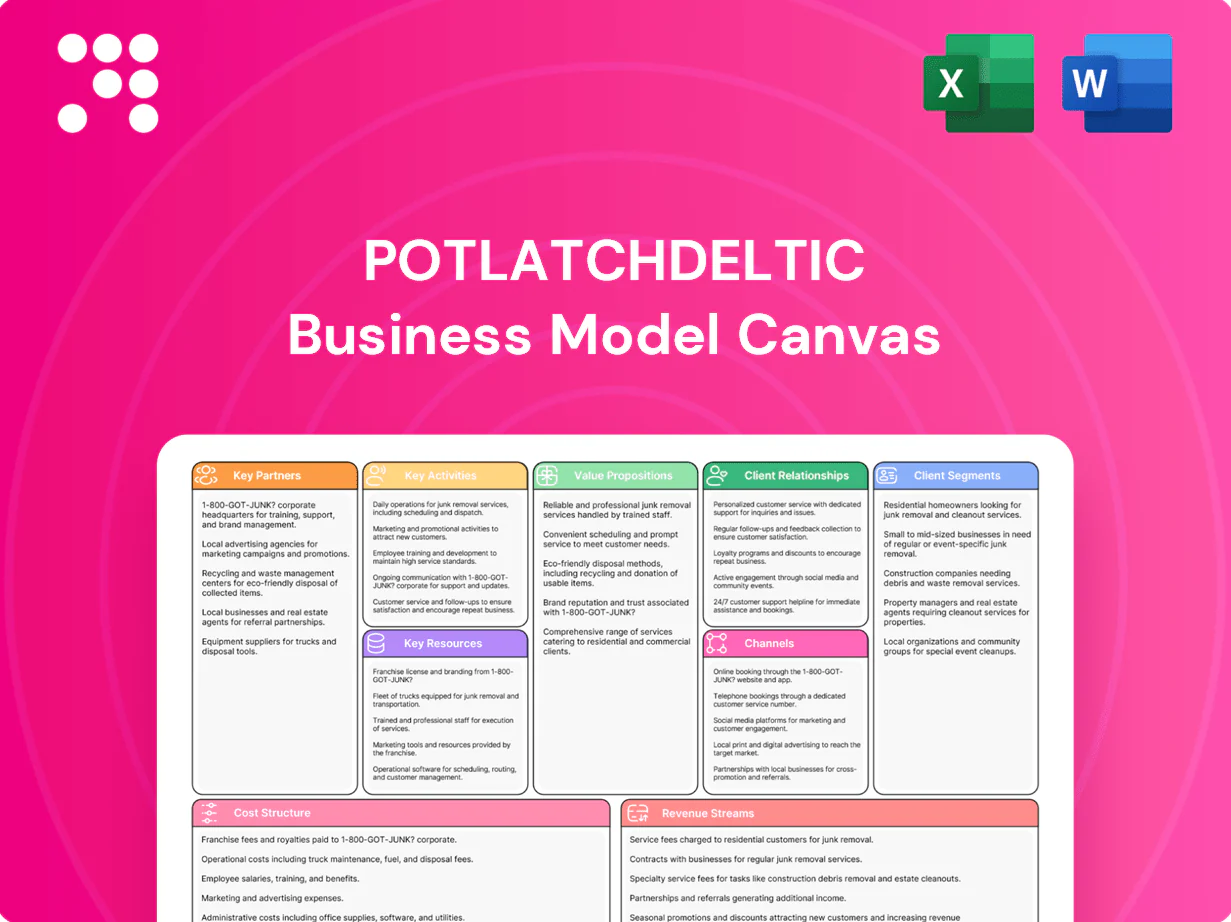
PotlatchDeltic Business Model Canvas

Unlock the Business Model Canvas: editable Word & Excel for investors and strategists
Unlock the full strategic blueprint behind PotlatchDeltic with our Business Model Canvas — a concise, actionable map of value propositions, channels, partnerships, and revenue drivers. Ideal for investors, strategists, and founders seeking competitive insight; download the editable Word & Excel files to apply these lessons directly to your analysis.
Partnerships

Timber supply chain partners
Logging contractors, silviculture firms and nurseries underpin PotlatchDeltic’s forest ops across about 1.9 million acres (2024), supplying planting stock, thinning and harvest services that meet sustainability standards. Strong vendor ties stabilize per-acre costs and improve harvest scheduling; joint planning reduces downtime and raises yield consistency over multi-decade rotations.
Certification and conservation bodies
Partnerships with SFI/FSC auditors and conservation NGOs validate PotlatchDeltic’s sustainable practices across its roughly 1.8 million acres of timberland, enhancing market access and pricing power for certified wood products. Conservation groups assist with easements and habitat projects that monetize non-timber values, while these alliances strengthen ESG credentials and reduce regulatory friction.

Transportation and logistics
In 2024 PotlatchDeltic leverages rail carriers, dedicated trucking fleets, and transload facilities to move logs, lumber, and plywood to customers efficiently, cutting delivered costs and cycle times. Reliable logistics partnerships reduce demurrage and inventory holding through coordinated scheduling across supply nodes. Proximity contracts with regional carriers improve service levels during peak demand and shorten lead times.

Real estate developers and brokers
Local developers, planners, and land brokers entitle, market, and sell rural and commercial parcels, accelerating absorption and maximizing highest-and-best-use value; PotlatchDeltic reported about $180 million of real estate sales in 2024, reflecting active parcel monetization and price realization.
- Market intel guides pricing & product mix
- Partners speed absorption, lift NOI
- Co-investment structures de-risk large phases
Industrial and utility offtakers
Long-term offtakers such as homebuilders, retail chains and panel manufacturers secure steady volume for PotlatchDeltic’s lumber and OSB, while biomass users and utilities provide outlets for harvest residues and low-grade fiber; formal offtake agreements improve mill throughput and margin visibility and strategic customers co-develop specs and just-in-time delivery programs to reduce inventory and logistics costs.
- Offtake partners: homebuilders, retail, panel makers, utilities
- Benefits: stabilized throughput, margin visibility, JIT delivery
- Residue outlets: biomass and utility contracts
Vendors sustain ~1.9M acres; certs cover ~1.8M; sales $180M
Logging/silviculture vendors support forest ops across ~1.9 million acres (2024), stabilizing per-acre costs and harvest cadence. SFI/FSC and NGOs validate sustainable management across ~1.8 million certified acres, enhancing pricing and easement revenues. Rail/truck logistics and long-term offtakes secure mill throughput; real estate partners enabled ~$180 million in 2024 parcel sales.
| Partner | Scope/2024 | Key metric |
|---|---|---|
| Vendors | Harvest/planting | ~1.9M acres |
| Certifiers/NGOs | Sustainability | ~1.8M certified acres |
| Real estate partners | Parcel sales | $180M |
What is included in the product
 Detailed Word Document
A comprehensive, pre-written Business Model Canvas tailored to PotlatchDeltic, covering customer segments, channels, value propositions and all nine BMC blocks with real-company data and polished design. Includes block-level competitive advantages, linked SWOT analysis and actionable insights—ideal for presentations, investor discussions and strategic decision-making.

 Customizable Excel Spreadsheet
High-level view of PotlatchDeltic’s business model with editable cells to quickly relieve pain points in strategy alignment and operational planning.
Activities

Sustainable forest management
Planning, planting, thinning and harvesting on PotlatchDeltic's ~1.9 million acres (2024) optimize growth and long-term yield through rotation and silviculture schedules. Compliance with SFI and FSC standards ensures regeneration and biodiversity across managed tracts. LiDAR-driven inventory and growth modeling set sustainable harvest levels, while targeted fire, pest and disease management protect asset value.
Wood products manufacturing
Sawmilling and plywood production at PotlatchDeltic convert logs from its approximately 1.95 million acres of timberland into higher‑value lumber and panels. Continuous improvement initiatives reported industrywide lift recovery rates by 2–4%, reducing waste and raising yield. Rigorous quality control and grading sustain premium pricing on specialty grades. Proactive maintenance and uptime programs target double‑digit throughput gains and lower unplanned downtime.

Real estate development and sales
PotlatchDeltic leverages zoning, entitlements, and subdivision to convert portions of its ~1.9 million-acre 2024 portfolio into marketable parcels, increasing liquidity and buyer pool. Targeted marketing and brokerage channels accelerate rural land and commercial parcel sales across the Midwest and West. Strategic site infrastructure investments—roads, utilities—raise achievable pricing per acre. Phased development sequences limit capital outlay and reduce market timing risk.

Market and price risk management
PotlatchDeltic uses hedging and multi-year fiber and lumber contracts to mitigate price volatility, while flexible mill run-mixes let mills shift toward higher-margin lumber or high-yield chips as demand changes; its ~2.0 million acres of timberland (2024) provide geographic diversification to smooth regional cycles and strategic inventory timing stabilizes revenue.
- Hedging & long-term contracts
- Flexible mill run-mix
- Geographic diversification (≈2.0M acres, 2024)
- Inventory timing to smooth revenue
ESG compliance and stakeholder engagement
Monitoring environmental impact and transparent reporting strengthen PotlatchDeltic’s license to operate, supporting compliance across its ~2.0 million acres (2024) and reducing regulatory risk. Active community engagement secures workforce support and smooths project approvals, while robust safety programs cut incidents and downtime. Focused water, soil, and wildlife stewardship preserves long-term timber productivity and asset value.
- ESG reporting: strengthens license to operate
- Community engagement: workforce & approvals
- Safety programs: fewer incidents, less downtime
- Stewardship: protects long-term productivity
Managing ~1.95M acres: integrated forestry, mills, land sales, hedging & ESG
Planning, silviculture and harvest on ~1.95M acres (2024) sustain yields and fiber supply. Milling, plywood and land sales convert timber to higher-margin products and parcels. Hedging, contracts, ESG reporting and community engagement stabilize revenue and reduce operational/regulatory risk.
| Metric | 2024 |
|---|---|
| Acres | ~1.95M |
| Primary revenue | Timber, mill products, land |
Preview Before You Purchase
Business Model Canvas
The PotlatchDeltic Business Model Canvas you’re previewing is the actual deliverable, not a mockup. Upon purchase you’ll receive this exact document—complete, editable, and formatted as shown. No placeholders, no surprises—ready to download, present, and customize.

Unlock the Business Model Canvas: editable Word & Excel for investors and strategists
Unlock the full strategic blueprint behind PotlatchDeltic with our Business Model Canvas — a concise, actionable map of value propositions, channels, partnerships, and revenue drivers. Ideal for investors, strategists, and founders seeking competitive insight; download the editable Word & Excel files to apply these lessons directly to your analysis.
Partnerships
Timber supply chain partners
Logging contractors, silviculture firms and nurseries underpin PotlatchDeltic’s forest ops across about 1.9 million acres (2024), supplying planting stock, thinning and harvest services that meet sustainability standards. Strong vendor ties stabilize per-acre costs and improve harvest scheduling; joint planning reduces downtime and raises yield consistency over multi-decade rotations.
Certification and conservation bodies
Partnerships with SFI/FSC auditors and conservation NGOs validate PotlatchDeltic’s sustainable practices across its roughly 1.8 million acres of timberland, enhancing market access and pricing power for certified wood products. Conservation groups assist with easements and habitat projects that monetize non-timber values, while these alliances strengthen ESG credentials and reduce regulatory friction.
Transportation and logistics
In 2024 PotlatchDeltic leverages rail carriers, dedicated trucking fleets, and transload facilities to move logs, lumber, and plywood to customers efficiently, cutting delivered costs and cycle times. Reliable logistics partnerships reduce demurrage and inventory holding through coordinated scheduling across supply nodes. Proximity contracts with regional carriers improve service levels during peak demand and shorten lead times.
Real estate developers and brokers
Local developers, planners, and land brokers entitle, market, and sell rural and commercial parcels, accelerating absorption and maximizing highest-and-best-use value; PotlatchDeltic reported about $180 million of real estate sales in 2024, reflecting active parcel monetization and price realization.
- Market intel guides pricing & product mix
- Partners speed absorption, lift NOI
- Co-investment structures de-risk large phases
Industrial and utility offtakers
Long-term offtakers such as homebuilders, retail chains and panel manufacturers secure steady volume for PotlatchDeltic’s lumber and OSB, while biomass users and utilities provide outlets for harvest residues and low-grade fiber; formal offtake agreements improve mill throughput and margin visibility and strategic customers co-develop specs and just-in-time delivery programs to reduce inventory and logistics costs.
- Offtake partners: homebuilders, retail, panel makers, utilities
- Benefits: stabilized throughput, margin visibility, JIT delivery
- Residue outlets: biomass and utility contracts
Vendors sustain ~1.9M acres; certs cover ~1.8M; sales $180M
Logging/silviculture vendors support forest ops across ~1.9 million acres (2024), stabilizing per-acre costs and harvest cadence. SFI/FSC and NGOs validate sustainable management across ~1.8 million certified acres, enhancing pricing and easement revenues. Rail/truck logistics and long-term offtakes secure mill throughput; real estate partners enabled ~$180 million in 2024 parcel sales.
| Partner | Scope/2024 | Key metric |
|---|---|---|
| Vendors | Harvest/planting | ~1.9M acres |
| Certifiers/NGOs | Sustainability | ~1.8M certified acres |
| Real estate partners | Parcel sales | $180M |
What is included in the product
Detailed Word Document
A comprehensive, pre-written Business Model Canvas tailored to PotlatchDeltic, covering customer segments, channels, value propositions and all nine BMC blocks with real-company data and polished design. Includes block-level competitive advantages, linked SWOT analysis and actionable insights—ideal for presentations, investor discussions and strategic decision-making.
Customizable Excel Spreadsheet
High-level view of PotlatchDeltic’s business model with editable cells to quickly relieve pain points in strategy alignment and operational planning.
Activities
Sustainable forest management
Planning, planting, thinning and harvesting on PotlatchDeltic's ~1.9 million acres (2024) optimize growth and long-term yield through rotation and silviculture schedules. Compliance with SFI and FSC standards ensures regeneration and biodiversity across managed tracts. LiDAR-driven inventory and growth modeling set sustainable harvest levels, while targeted fire, pest and disease management protect asset value.
Wood products manufacturing
Sawmilling and plywood production at PotlatchDeltic convert logs from its approximately 1.95 million acres of timberland into higher‑value lumber and panels. Continuous improvement initiatives reported industrywide lift recovery rates by 2–4%, reducing waste and raising yield. Rigorous quality control and grading sustain premium pricing on specialty grades. Proactive maintenance and uptime programs target double‑digit throughput gains and lower unplanned downtime.
Real estate development and sales
PotlatchDeltic leverages zoning, entitlements, and subdivision to convert portions of its ~1.9 million-acre 2024 portfolio into marketable parcels, increasing liquidity and buyer pool. Targeted marketing and brokerage channels accelerate rural land and commercial parcel sales across the Midwest and West. Strategic site infrastructure investments—roads, utilities—raise achievable pricing per acre. Phased development sequences limit capital outlay and reduce market timing risk.
Market and price risk management
PotlatchDeltic uses hedging and multi-year fiber and lumber contracts to mitigate price volatility, while flexible mill run-mixes let mills shift toward higher-margin lumber or high-yield chips as demand changes; its ~2.0 million acres of timberland (2024) provide geographic diversification to smooth regional cycles and strategic inventory timing stabilizes revenue.
- Hedging & long-term contracts
- Flexible mill run-mix
- Geographic diversification (≈2.0M acres, 2024)
- Inventory timing to smooth revenue
ESG compliance and stakeholder engagement
Monitoring environmental impact and transparent reporting strengthen PotlatchDeltic’s license to operate, supporting compliance across its ~2.0 million acres (2024) and reducing regulatory risk. Active community engagement secures workforce support and smooths project approvals, while robust safety programs cut incidents and downtime. Focused water, soil, and wildlife stewardship preserves long-term timber productivity and asset value.
- ESG reporting: strengthens license to operate
- Community engagement: workforce & approvals
- Safety programs: fewer incidents, less downtime
- Stewardship: protects long-term productivity
Managing ~1.95M acres: integrated forestry, mills, land sales, hedging & ESG
Planning, silviculture and harvest on ~1.95M acres (2024) sustain yields and fiber supply. Milling, plywood and land sales convert timber to higher-margin products and parcels. Hedging, contracts, ESG reporting and community engagement stabilize revenue and reduce operational/regulatory risk.
| Metric | 2024 |
|---|---|
| Acres | ~1.95M |
| Primary revenue | Timber, mill products, land |
Preview Before You Purchase
Business Model Canvas
The PotlatchDeltic Business Model Canvas you’re previewing is the actual deliverable, not a mockup. Upon purchase you’ll receive this exact document—complete, editable, and formatted as shown. No placeholders, no surprises—ready to download, present, and customize.
Description
Unlock the Business Model Canvas: editable Word & Excel for investors and strategists
Unlock the full strategic blueprint behind PotlatchDeltic with our Business Model Canvas — a concise, actionable map of value propositions, channels, partnerships, and revenue drivers. Ideal for investors, strategists, and founders seeking competitive insight; download the editable Word & Excel files to apply these lessons directly to your analysis.
Partnerships
Timber supply chain partners
Logging contractors, silviculture firms and nurseries underpin PotlatchDeltic’s forest ops across about 1.9 million acres (2024), supplying planting stock, thinning and harvest services that meet sustainability standards. Strong vendor ties stabilize per-acre costs and improve harvest scheduling; joint planning reduces downtime and raises yield consistency over multi-decade rotations.
Certification and conservation bodies
Partnerships with SFI/FSC auditors and conservation NGOs validate PotlatchDeltic’s sustainable practices across its roughly 1.8 million acres of timberland, enhancing market access and pricing power for certified wood products. Conservation groups assist with easements and habitat projects that monetize non-timber values, while these alliances strengthen ESG credentials and reduce regulatory friction.
Transportation and logistics
In 2024 PotlatchDeltic leverages rail carriers, dedicated trucking fleets, and transload facilities to move logs, lumber, and plywood to customers efficiently, cutting delivered costs and cycle times. Reliable logistics partnerships reduce demurrage and inventory holding through coordinated scheduling across supply nodes. Proximity contracts with regional carriers improve service levels during peak demand and shorten lead times.
Real estate developers and brokers
Local developers, planners, and land brokers entitle, market, and sell rural and commercial parcels, accelerating absorption and maximizing highest-and-best-use value; PotlatchDeltic reported about $180 million of real estate sales in 2024, reflecting active parcel monetization and price realization.
- Market intel guides pricing & product mix
- Partners speed absorption, lift NOI
- Co-investment structures de-risk large phases
Industrial and utility offtakers
Long-term offtakers such as homebuilders, retail chains and panel manufacturers secure steady volume for PotlatchDeltic’s lumber and OSB, while biomass users and utilities provide outlets for harvest residues and low-grade fiber; formal offtake agreements improve mill throughput and margin visibility and strategic customers co-develop specs and just-in-time delivery programs to reduce inventory and logistics costs.
- Offtake partners: homebuilders, retail, panel makers, utilities
- Benefits: stabilized throughput, margin visibility, JIT delivery
- Residue outlets: biomass and utility contracts
Vendors sustain ~1.9M acres; certs cover ~1.8M; sales $180M
Logging/silviculture vendors support forest ops across ~1.9 million acres (2024), stabilizing per-acre costs and harvest cadence. SFI/FSC and NGOs validate sustainable management across ~1.8 million certified acres, enhancing pricing and easement revenues. Rail/truck logistics and long-term offtakes secure mill throughput; real estate partners enabled ~$180 million in 2024 parcel sales.
| Partner | Scope/2024 | Key metric |
|---|---|---|
| Vendors | Harvest/planting | ~1.9M acres |
| Certifiers/NGOs | Sustainability | ~1.8M certified acres |
| Real estate partners | Parcel sales | $180M |
What is included in the product
Detailed Word Document
A comprehensive, pre-written Business Model Canvas tailored to PotlatchDeltic, covering customer segments, channels, value propositions and all nine BMC blocks with real-company data and polished design. Includes block-level competitive advantages, linked SWOT analysis and actionable insights—ideal for presentations, investor discussions and strategic decision-making.
Customizable Excel Spreadsheet
High-level view of PotlatchDeltic’s business model with editable cells to quickly relieve pain points in strategy alignment and operational planning.
Activities
Sustainable forest management
Planning, planting, thinning and harvesting on PotlatchDeltic's ~1.9 million acres (2024) optimize growth and long-term yield through rotation and silviculture schedules. Compliance with SFI and FSC standards ensures regeneration and biodiversity across managed tracts. LiDAR-driven inventory and growth modeling set sustainable harvest levels, while targeted fire, pest and disease management protect asset value.
Wood products manufacturing
Sawmilling and plywood production at PotlatchDeltic convert logs from its approximately 1.95 million acres of timberland into higher‑value lumber and panels. Continuous improvement initiatives reported industrywide lift recovery rates by 2–4%, reducing waste and raising yield. Rigorous quality control and grading sustain premium pricing on specialty grades. Proactive maintenance and uptime programs target double‑digit throughput gains and lower unplanned downtime.
Real estate development and sales
PotlatchDeltic leverages zoning, entitlements, and subdivision to convert portions of its ~1.9 million-acre 2024 portfolio into marketable parcels, increasing liquidity and buyer pool. Targeted marketing and brokerage channels accelerate rural land and commercial parcel sales across the Midwest and West. Strategic site infrastructure investments—roads, utilities—raise achievable pricing per acre. Phased development sequences limit capital outlay and reduce market timing risk.
Market and price risk management
PotlatchDeltic uses hedging and multi-year fiber and lumber contracts to mitigate price volatility, while flexible mill run-mixes let mills shift toward higher-margin lumber or high-yield chips as demand changes; its ~2.0 million acres of timberland (2024) provide geographic diversification to smooth regional cycles and strategic inventory timing stabilizes revenue.
- Hedging & long-term contracts
- Flexible mill run-mix
- Geographic diversification (≈2.0M acres, 2024)
- Inventory timing to smooth revenue
ESG compliance and stakeholder engagement
Monitoring environmental impact and transparent reporting strengthen PotlatchDeltic’s license to operate, supporting compliance across its ~2.0 million acres (2024) and reducing regulatory risk. Active community engagement secures workforce support and smooths project approvals, while robust safety programs cut incidents and downtime. Focused water, soil, and wildlife stewardship preserves long-term timber productivity and asset value.
- ESG reporting: strengthens license to operate
- Community engagement: workforce & approvals
- Safety programs: fewer incidents, less downtime
- Stewardship: protects long-term productivity
Managing ~1.95M acres: integrated forestry, mills, land sales, hedging & ESG
Planning, silviculture and harvest on ~1.95M acres (2024) sustain yields and fiber supply. Milling, plywood and land sales convert timber to higher-margin products and parcels. Hedging, contracts, ESG reporting and community engagement stabilize revenue and reduce operational/regulatory risk.
| Metric | 2024 |
|---|---|
| Acres | ~1.95M |
| Primary revenue | Timber, mill products, land |
Preview Before You Purchase
Business Model Canvas
The PotlatchDeltic Business Model Canvas you’re previewing is the actual deliverable, not a mockup. Upon purchase you’ll receive this exact document—complete, editable, and formatted as shown. No placeholders, no surprises—ready to download, present, and customize.











