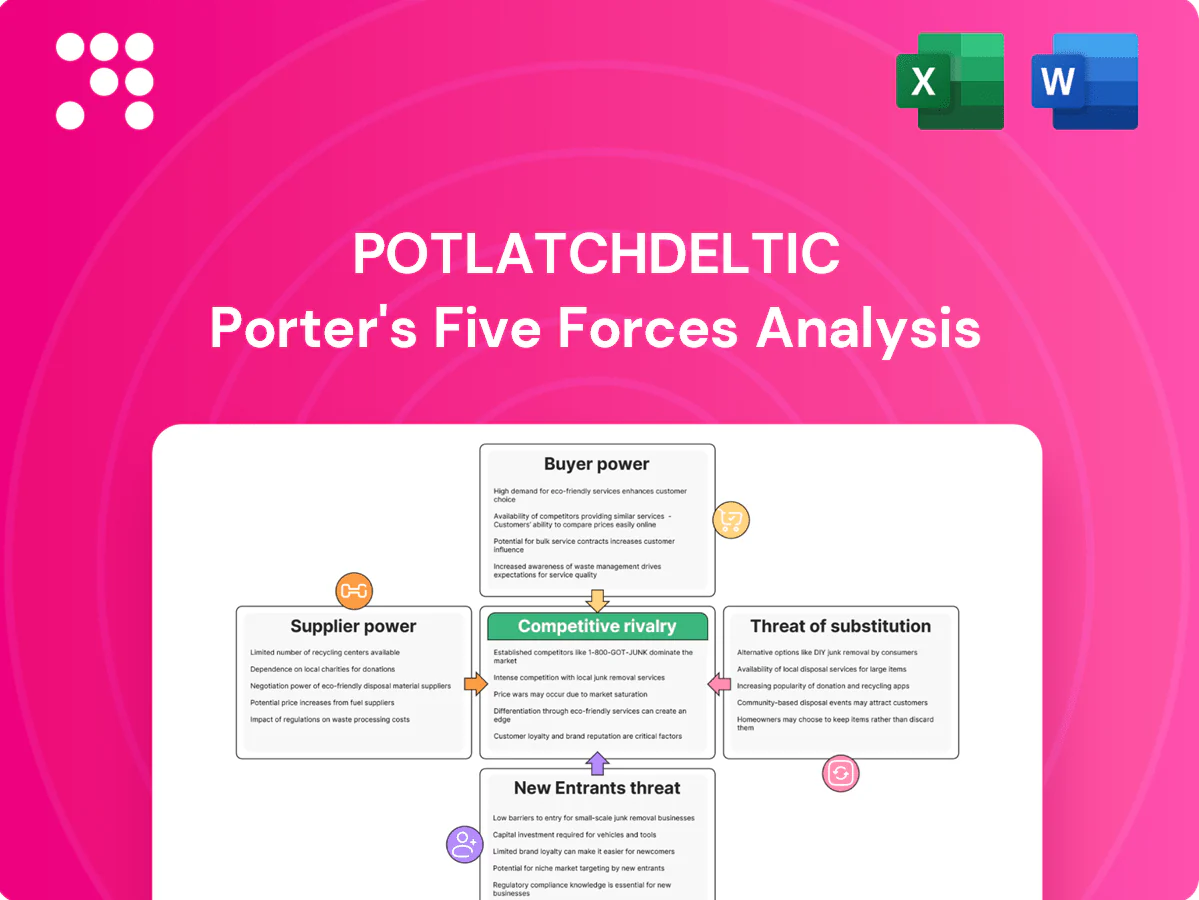
PotlatchDeltic Porter's Five Forces Analysis

Go Beyond the Preview—Access the Full Strategic Report
PotlatchDeltic faces moderate supplier power, steady buyer demand, and notable rivalry from timber REITs and integrated forest product firms, while substitutes and new entrants pose limited but evolving threats. This brief snapshot only scratches the surface. Unlock the full Porter's Five Forces Analysis to explore PotlatchDeltic’s competitive dynamics in detail.
Suppliers Bargaining Power

Owned timberbase limits supplier leverage
PotlatchDeltic owns approximately 1.9 million acres of timberland, reducing dependence on stumpage sellers and lowering raw wood supplier power. The firm still purchases third-party logs in some regions, but core fiber is internally sourced, buffering against price spikes and availability shocks. Supplier influence is therefore concentrated in non-fiber inputs such as fuel, chemicals and equipment maintenance.
Contract logging and trucking concentration
Harvesting and haul for PotlatchDeltic rely on regional contractors with limited capacity, giving them bargaining clout in peak seasons. The American Trucking Associations estimated an 80,000 driver shortfall in 2023 and BLS reports ~1.7M heavy and tractor-trailer drivers in 2023, tightening labor markets and pushing rates. Switching costs arise from safety, quality and terrain familiarity, though long-term contracts and multi-vendor rosters temper supplier power.

Energy, resin, and chemical inputs volatility
Lumber/plywood mills consume electricity (US industrial ~11¢/kWh in 2024), natural gas (Henry Hub ~3 $/MMBtu in 2024), resins and chemicals whose costs track hydrocarbons, so feedstock swings materially affect input costs. Remote mill locations limit alternative suppliers, increasing supplier pricing power during tight markets. Hedging and efficiency cap volatility, but imperfect cost pass-through in down cycles gives suppliers moderate influence on mill margins.

Equipment OEMs and maintenance dependencies
- Major OEM concentration: Valmet/Andritz/Metso
- Priority support increases downtime-cost exposure
- Multi-year contracts reduce short-term leverage
- Upgrades/regulatory needs drive long-term lock-in
Railcar and port access constraints
Outbound lumber depends heavily on constrained rail and port capacity, where carrier leverage from bottlenecks can push congestion surcharges and demurrage that erode PotlatchDeltic margins and delay shipments.
Diversified lanes, transload facilities and inland terminals provide partial relief by reducing reliance on single gateways, while geographic dispersion of timberlands and mills helps balance logistics power pockets.
- Logistics leverage: congestion drives surcharges
- Mitigation: transloading and diversified lanes
- Advantage: dispersed asset footprint balances risk
Timberland reduces stumpage power; driver shortage and OEM bottlenecks squeeze suppliers
PotlatchDeltic owns ~1.9M acres, lowering stumpage supplier power. It still purchases regional logs; non-fiber inputs (fuel, chemicals, parts) exert moderate influence. Contractor haul and trucking tightness (ATA 80,000 driver shortfall 2023; BLS ~1.7M drivers 2023) boost seasonal bargaining. OEM concentration (Valmet, Andritz, Metso) and rail/port bottlenecks raise supplier leverage.
| Input | 2024/2023 stat | Impact |
|---|---|---|
| Timberland | 1.9M acres | Low |
| Electricity | ~11¢/kWh (2024) | Medium |
| Drivers | 80,000 shortfall (2023) | High |
What is included in the product
 Detailed Word Document
Tailored Porter's Five Forces analysis revealing key drivers of competition, buyer and supplier power, substitutes, new-entrants risk, and rivalry shaping PotlatchDeltic's timberland and wood-products profitability. Fully editable for inclusion in investor materials, strategic plans, or academic reports.

 Customizable Excel Spreadsheet
Clear, one-sheet Porter’s Five Forces for PotlatchDeltic—distills competitive pressures and timberland risks into a single view for fast, confident decisions. Clean layout and editable inputs make it easy to drop into decks or reports and update as market conditions shift.
Customers Bargaining Power

Commodity pricing and high transparency
Lumber and plywood prices are widely quoted via Random Lengths and CME futures, with the Random Lengths 2x4 index averaging about $400/MBF in 2024, giving buyers clear market benchmarks. Low product differentiation drives buyers toward spot or index-linked contracts and forces sellers to offer discounts, rebates, or quick-ship terms as negotiation levers. These tactics amplify buyer power, particularly when inventories rise and markets are oversupplied.
Concentrated large buyers
Big-box retailers and pro dealers (Home Depot, Lowe's and national pro channels) concentrate purchasing power, with big-boxes capturing over 50% of US home improvement sales in 2024, enabling intense price and contract leverage over suppliers like PotlatchDeltic.
Their scale supports multi-sourcing and competitive bidding, raising the cost of lost volume as top accounts can represent 40–60% of a regional mill's logged demand.
Losing a major account hits mill utilization and realized prices; maintaining service levels, fill rates above industry benchmarks and EDI integration are critical to defend share.

Cyclical demand tied to housing
When U.S. housing slowed in 2024, buyers gained leverage as mills sought volume to cover fixed costs, pressuring prices and allocations; U.S. housing starts averaged roughly 1.5 million annualized in 2024, tightening mill margins. In upcycles allocations tighten and bargaining shifts back to producers as demand outstrips supply. PotlatchDeltic’s integrated timber base—about 1.85 million acres in 2024—softens cycle impacts but does not eliminate buyer clout. Real estate buyers became more selective in downturns, favoring price and delivery certainty.

Low switching costs across mills
Buyers can shift orders among regional producers with minimal technical hurdles; freight differentials matter but alternatives usually exist within each basin, keeping leverage with buyers. Certifications such as SFI and FSC (widely adopted by 2024) only slightly raise switching costs, so negotiation pressure on PotlatchDeltic remains persistent; PotlatchDeltic held about 2.0 million acres of timberland in 2024.
- Low switching costs: regional mills interchangeable
- Freight matters: basin differentials but alternatives exist
- Certifications: SFI/FSC temper switching slightly
- 2024 fact: ~2.0 million acres timberland
Land and real estate buyer heterogeneity
Rural land buyers for PotlatchDeltic range from institutional investors to recreational purchasers, diluting singular buyer power, though large-scale transactions or complex entitlement needs can give specific buyers leverage. Regional comparable supply and recent lot absorption rates shape deal terms, while PotlatchDeltic’s ~2.0 million acres of timberland (2024) and master-planned, value-add offerings reduce buyer bargaining strength.
Lumber market favors buyers — $400/MBF, big-box > 50% share
Lumber pricing transparency (Random Lengths 2x4 ~$400/MBF avg 2024) and low product differentiation strengthen buyer bargaining, especially big-boxes (Home Depot/Lowe's >50% US DIY sales 2024). Large accounts can represent 40–60% of regional mill demand; PotlatchDeltic’s ~2.0M acres (2024) mitigates but does not remove buyer leverage. Freight and certifications only modestly raise switching costs.
| Metric | 2024 value |
|---|---|
| Random Lengths 2x4 | $400/MBF |
| Big-box share | >50% US DIY sales |
| Housing starts | ~1.5M annualized |
| Timberland | ~2.0M acres |
| Major account demand | 40–60% |
Preview the Actual Deliverable
PotlatchDeltic Porter's Five Forces Analysis
This PotlatchDeltic Porter's Five Forces Analysis preview is the exact document you'll receive upon purchase—fully formatted, complete and ready for use. No placeholders or samples are included; the file you see is the file you'll download instantly after payment. It provides a comprehensive evaluation of competitive forces affecting PotlatchDeltic for immediate application.

Go Beyond the Preview—Access the Full Strategic Report
PotlatchDeltic faces moderate supplier power, steady buyer demand, and notable rivalry from timber REITs and integrated forest product firms, while substitutes and new entrants pose limited but evolving threats. This brief snapshot only scratches the surface. Unlock the full Porter's Five Forces Analysis to explore PotlatchDeltic’s competitive dynamics in detail.
Suppliers Bargaining Power
Owned timberbase limits supplier leverage
PotlatchDeltic owns approximately 1.9 million acres of timberland, reducing dependence on stumpage sellers and lowering raw wood supplier power. The firm still purchases third-party logs in some regions, but core fiber is internally sourced, buffering against price spikes and availability shocks. Supplier influence is therefore concentrated in non-fiber inputs such as fuel, chemicals and equipment maintenance.
Contract logging and trucking concentration
Harvesting and haul for PotlatchDeltic rely on regional contractors with limited capacity, giving them bargaining clout in peak seasons. The American Trucking Associations estimated an 80,000 driver shortfall in 2023 and BLS reports ~1.7M heavy and tractor-trailer drivers in 2023, tightening labor markets and pushing rates. Switching costs arise from safety, quality and terrain familiarity, though long-term contracts and multi-vendor rosters temper supplier power.
Energy, resin, and chemical inputs volatility
Lumber/plywood mills consume electricity (US industrial ~11¢/kWh in 2024), natural gas (Henry Hub ~3 $/MMBtu in 2024), resins and chemicals whose costs track hydrocarbons, so feedstock swings materially affect input costs. Remote mill locations limit alternative suppliers, increasing supplier pricing power during tight markets. Hedging and efficiency cap volatility, but imperfect cost pass-through in down cycles gives suppliers moderate influence on mill margins.
Equipment OEMs and maintenance dependencies
- Major OEM concentration: Valmet/Andritz/Metso
- Priority support increases downtime-cost exposure
- Multi-year contracts reduce short-term leverage
- Upgrades/regulatory needs drive long-term lock-in
Railcar and port access constraints
Outbound lumber depends heavily on constrained rail and port capacity, where carrier leverage from bottlenecks can push congestion surcharges and demurrage that erode PotlatchDeltic margins and delay shipments.
Diversified lanes, transload facilities and inland terminals provide partial relief by reducing reliance on single gateways, while geographic dispersion of timberlands and mills helps balance logistics power pockets.
- Logistics leverage: congestion drives surcharges
- Mitigation: transloading and diversified lanes
- Advantage: dispersed asset footprint balances risk
Timberland reduces stumpage power; driver shortage and OEM bottlenecks squeeze suppliers
PotlatchDeltic owns ~1.9M acres, lowering stumpage supplier power. It still purchases regional logs; non-fiber inputs (fuel, chemicals, parts) exert moderate influence. Contractor haul and trucking tightness (ATA 80,000 driver shortfall 2023; BLS ~1.7M drivers 2023) boost seasonal bargaining. OEM concentration (Valmet, Andritz, Metso) and rail/port bottlenecks raise supplier leverage.
| Input | 2024/2023 stat | Impact |
|---|---|---|
| Timberland | 1.9M acres | Low |
| Electricity | ~11¢/kWh (2024) | Medium |
| Drivers | 80,000 shortfall (2023) | High |
What is included in the product
Detailed Word Document
Tailored Porter's Five Forces analysis revealing key drivers of competition, buyer and supplier power, substitutes, new-entrants risk, and rivalry shaping PotlatchDeltic's timberland and wood-products profitability. Fully editable for inclusion in investor materials, strategic plans, or academic reports.
Customizable Excel Spreadsheet
Clear, one-sheet Porter’s Five Forces for PotlatchDeltic—distills competitive pressures and timberland risks into a single view for fast, confident decisions. Clean layout and editable inputs make it easy to drop into decks or reports and update as market conditions shift.
Customers Bargaining Power
Commodity pricing and high transparency
Lumber and plywood prices are widely quoted via Random Lengths and CME futures, with the Random Lengths 2x4 index averaging about $400/MBF in 2024, giving buyers clear market benchmarks. Low product differentiation drives buyers toward spot or index-linked contracts and forces sellers to offer discounts, rebates, or quick-ship terms as negotiation levers. These tactics amplify buyer power, particularly when inventories rise and markets are oversupplied.
Concentrated large buyers
Big-box retailers and pro dealers (Home Depot, Lowe's and national pro channels) concentrate purchasing power, with big-boxes capturing over 50% of US home improvement sales in 2024, enabling intense price and contract leverage over suppliers like PotlatchDeltic.
Their scale supports multi-sourcing and competitive bidding, raising the cost of lost volume as top accounts can represent 40–60% of a regional mill's logged demand.
Losing a major account hits mill utilization and realized prices; maintaining service levels, fill rates above industry benchmarks and EDI integration are critical to defend share.
Cyclical demand tied to housing
When U.S. housing slowed in 2024, buyers gained leverage as mills sought volume to cover fixed costs, pressuring prices and allocations; U.S. housing starts averaged roughly 1.5 million annualized in 2024, tightening mill margins. In upcycles allocations tighten and bargaining shifts back to producers as demand outstrips supply. PotlatchDeltic’s integrated timber base—about 1.85 million acres in 2024—softens cycle impacts but does not eliminate buyer clout. Real estate buyers became more selective in downturns, favoring price and delivery certainty.
Low switching costs across mills
Buyers can shift orders among regional producers with minimal technical hurdles; freight differentials matter but alternatives usually exist within each basin, keeping leverage with buyers. Certifications such as SFI and FSC (widely adopted by 2024) only slightly raise switching costs, so negotiation pressure on PotlatchDeltic remains persistent; PotlatchDeltic held about 2.0 million acres of timberland in 2024.
- Low switching costs: regional mills interchangeable
- Freight matters: basin differentials but alternatives exist
- Certifications: SFI/FSC temper switching slightly
- 2024 fact: ~2.0 million acres timberland
Land and real estate buyer heterogeneity
Rural land buyers for PotlatchDeltic range from institutional investors to recreational purchasers, diluting singular buyer power, though large-scale transactions or complex entitlement needs can give specific buyers leverage. Regional comparable supply and recent lot absorption rates shape deal terms, while PotlatchDeltic’s ~2.0 million acres of timberland (2024) and master-planned, value-add offerings reduce buyer bargaining strength.
Lumber market favors buyers — $400/MBF, big-box > 50% share
Lumber pricing transparency (Random Lengths 2x4 ~$400/MBF avg 2024) and low product differentiation strengthen buyer bargaining, especially big-boxes (Home Depot/Lowe's >50% US DIY sales 2024). Large accounts can represent 40–60% of regional mill demand; PotlatchDeltic’s ~2.0M acres (2024) mitigates but does not remove buyer leverage. Freight and certifications only modestly raise switching costs.
| Metric | 2024 value |
|---|---|
| Random Lengths 2x4 | $400/MBF |
| Big-box share | >50% US DIY sales |
| Housing starts | ~1.5M annualized |
| Timberland | ~2.0M acres |
| Major account demand | 40–60% |
Preview the Actual Deliverable
PotlatchDeltic Porter's Five Forces Analysis
This PotlatchDeltic Porter's Five Forces Analysis preview is the exact document you'll receive upon purchase—fully formatted, complete and ready for use. No placeholders or samples are included; the file you see is the file you'll download instantly after payment. It provides a comprehensive evaluation of competitive forces affecting PotlatchDeltic for immediate application.
Description
Go Beyond the Preview—Access the Full Strategic Report
PotlatchDeltic faces moderate supplier power, steady buyer demand, and notable rivalry from timber REITs and integrated forest product firms, while substitutes and new entrants pose limited but evolving threats. This brief snapshot only scratches the surface. Unlock the full Porter's Five Forces Analysis to explore PotlatchDeltic’s competitive dynamics in detail.
Suppliers Bargaining Power
Owned timberbase limits supplier leverage
PotlatchDeltic owns approximately 1.9 million acres of timberland, reducing dependence on stumpage sellers and lowering raw wood supplier power. The firm still purchases third-party logs in some regions, but core fiber is internally sourced, buffering against price spikes and availability shocks. Supplier influence is therefore concentrated in non-fiber inputs such as fuel, chemicals and equipment maintenance.
Contract logging and trucking concentration
Harvesting and haul for PotlatchDeltic rely on regional contractors with limited capacity, giving them bargaining clout in peak seasons. The American Trucking Associations estimated an 80,000 driver shortfall in 2023 and BLS reports ~1.7M heavy and tractor-trailer drivers in 2023, tightening labor markets and pushing rates. Switching costs arise from safety, quality and terrain familiarity, though long-term contracts and multi-vendor rosters temper supplier power.
Energy, resin, and chemical inputs volatility
Lumber/plywood mills consume electricity (US industrial ~11¢/kWh in 2024), natural gas (Henry Hub ~3 $/MMBtu in 2024), resins and chemicals whose costs track hydrocarbons, so feedstock swings materially affect input costs. Remote mill locations limit alternative suppliers, increasing supplier pricing power during tight markets. Hedging and efficiency cap volatility, but imperfect cost pass-through in down cycles gives suppliers moderate influence on mill margins.
Equipment OEMs and maintenance dependencies
- Major OEM concentration: Valmet/Andritz/Metso
- Priority support increases downtime-cost exposure
- Multi-year contracts reduce short-term leverage
- Upgrades/regulatory needs drive long-term lock-in
Railcar and port access constraints
Outbound lumber depends heavily on constrained rail and port capacity, where carrier leverage from bottlenecks can push congestion surcharges and demurrage that erode PotlatchDeltic margins and delay shipments.
Diversified lanes, transload facilities and inland terminals provide partial relief by reducing reliance on single gateways, while geographic dispersion of timberlands and mills helps balance logistics power pockets.
- Logistics leverage: congestion drives surcharges
- Mitigation: transloading and diversified lanes
- Advantage: dispersed asset footprint balances risk
Timberland reduces stumpage power; driver shortage and OEM bottlenecks squeeze suppliers
PotlatchDeltic owns ~1.9M acres, lowering stumpage supplier power. It still purchases regional logs; non-fiber inputs (fuel, chemicals, parts) exert moderate influence. Contractor haul and trucking tightness (ATA 80,000 driver shortfall 2023; BLS ~1.7M drivers 2023) boost seasonal bargaining. OEM concentration (Valmet, Andritz, Metso) and rail/port bottlenecks raise supplier leverage.
| Input | 2024/2023 stat | Impact |
|---|---|---|
| Timberland | 1.9M acres | Low |
| Electricity | ~11¢/kWh (2024) | Medium |
| Drivers | 80,000 shortfall (2023) | High |
What is included in the product
Detailed Word Document
Tailored Porter's Five Forces analysis revealing key drivers of competition, buyer and supplier power, substitutes, new-entrants risk, and rivalry shaping PotlatchDeltic's timberland and wood-products profitability. Fully editable for inclusion in investor materials, strategic plans, or academic reports.
Customizable Excel Spreadsheet
Clear, one-sheet Porter’s Five Forces for PotlatchDeltic—distills competitive pressures and timberland risks into a single view for fast, confident decisions. Clean layout and editable inputs make it easy to drop into decks or reports and update as market conditions shift.
Customers Bargaining Power
Commodity pricing and high transparency
Lumber and plywood prices are widely quoted via Random Lengths and CME futures, with the Random Lengths 2x4 index averaging about $400/MBF in 2024, giving buyers clear market benchmarks. Low product differentiation drives buyers toward spot or index-linked contracts and forces sellers to offer discounts, rebates, or quick-ship terms as negotiation levers. These tactics amplify buyer power, particularly when inventories rise and markets are oversupplied.
Concentrated large buyers
Big-box retailers and pro dealers (Home Depot, Lowe's and national pro channels) concentrate purchasing power, with big-boxes capturing over 50% of US home improvement sales in 2024, enabling intense price and contract leverage over suppliers like PotlatchDeltic.
Their scale supports multi-sourcing and competitive bidding, raising the cost of lost volume as top accounts can represent 40–60% of a regional mill's logged demand.
Losing a major account hits mill utilization and realized prices; maintaining service levels, fill rates above industry benchmarks and EDI integration are critical to defend share.
Cyclical demand tied to housing
When U.S. housing slowed in 2024, buyers gained leverage as mills sought volume to cover fixed costs, pressuring prices and allocations; U.S. housing starts averaged roughly 1.5 million annualized in 2024, tightening mill margins. In upcycles allocations tighten and bargaining shifts back to producers as demand outstrips supply. PotlatchDeltic’s integrated timber base—about 1.85 million acres in 2024—softens cycle impacts but does not eliminate buyer clout. Real estate buyers became more selective in downturns, favoring price and delivery certainty.
Low switching costs across mills
Buyers can shift orders among regional producers with minimal technical hurdles; freight differentials matter but alternatives usually exist within each basin, keeping leverage with buyers. Certifications such as SFI and FSC (widely adopted by 2024) only slightly raise switching costs, so negotiation pressure on PotlatchDeltic remains persistent; PotlatchDeltic held about 2.0 million acres of timberland in 2024.
- Low switching costs: regional mills interchangeable
- Freight matters: basin differentials but alternatives exist
- Certifications: SFI/FSC temper switching slightly
- 2024 fact: ~2.0 million acres timberland
Land and real estate buyer heterogeneity
Rural land buyers for PotlatchDeltic range from institutional investors to recreational purchasers, diluting singular buyer power, though large-scale transactions or complex entitlement needs can give specific buyers leverage. Regional comparable supply and recent lot absorption rates shape deal terms, while PotlatchDeltic’s ~2.0 million acres of timberland (2024) and master-planned, value-add offerings reduce buyer bargaining strength.
Lumber market favors buyers — $400/MBF, big-box > 50% share
Lumber pricing transparency (Random Lengths 2x4 ~$400/MBF avg 2024) and low product differentiation strengthen buyer bargaining, especially big-boxes (Home Depot/Lowe's >50% US DIY sales 2024). Large accounts can represent 40–60% of regional mill demand; PotlatchDeltic’s ~2.0M acres (2024) mitigates but does not remove buyer leverage. Freight and certifications only modestly raise switching costs.
| Metric | 2024 value |
|---|---|
| Random Lengths 2x4 | $400/MBF |
| Big-box share | >50% US DIY sales |
| Housing starts | ~1.5M annualized |
| Timberland | ~2.0M acres |
| Major account demand | 40–60% |
Preview the Actual Deliverable
PotlatchDeltic Porter's Five Forces Analysis
This PotlatchDeltic Porter's Five Forces Analysis preview is the exact document you'll receive upon purchase—fully formatted, complete and ready for use. No placeholders or samples are included; the file you see is the file you'll download instantly after payment. It provides a comprehensive evaluation of competitive forces affecting PotlatchDeltic for immediate application.











