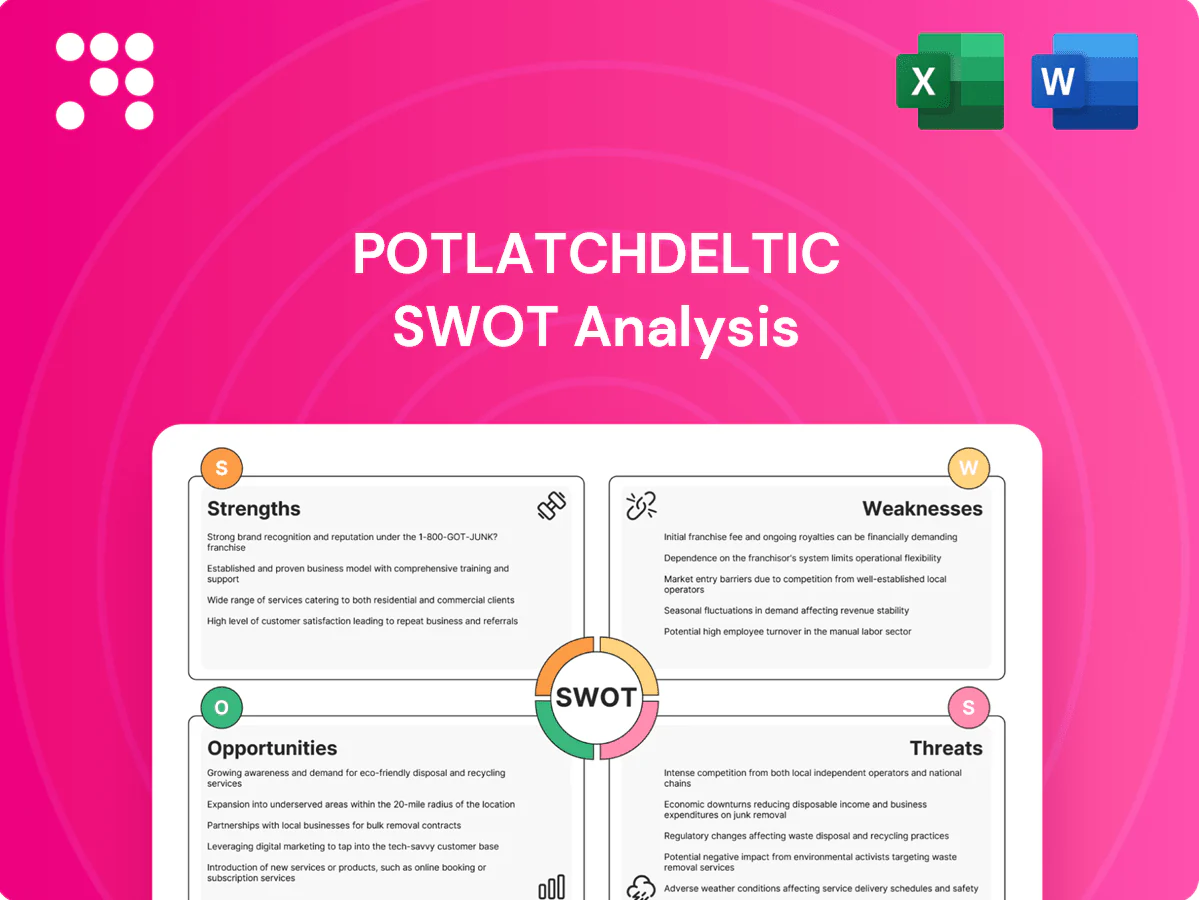
PotlatchDeltic SWOT Analysis

Go Beyond the Preview—Access the Full Strategic Report
Our PotlatchDeltic SWOT snapshot highlights timberland scale, cash-flow resilience, and ESG momentum while flagging commodity exposure and regulatory risks. Want the full strategic picture with financial context and growth scenarios? Purchase the complete SWOT for a research-backed, editable Word report plus Excel deliverables to plan, pitch, and invest with confidence.
Strengths

Integrated timberland-to-products model
Owning roughly 1.9 million acres alongside operating mills lets PotlatchDeltic capture margin across the timber-to-products chain, keeping more value in-house. Internal log supply stabilizes mill input costs and boosts utilization, while the ability to pivot between stumpage sales and internal conversion provides market-driven optionality. That integration amplifies operating leverage in up-cycles.
REIT structure and cash-return discipline
REIT status affords tax efficiency when distributing income, supporting competitive dividends; pass-through treatment avoids corporate tax on qualifying income and REITs must distribute at least 90% of taxable income. This clear capital-return framework attracts income-focused investors. It encourages portfolio optimization to maximize distributable cash flow for PotlatchDeltic (ticker PCH).

High-quality, sustainably managed timber base
PotlatchDeltic manages about 1.9 million acres of high-quality timberland, with roughly 99% of holdings third-party certified, enabling access to premium markets and smoother regulatory interactions. Biological growth functions as a compounding asset, replenishing inventory and supporting recurring harvests. Long-lived stands have historically driven stumpage appreciation, providing inflation hedge while sustainability credentials strengthen customer and stakeholder relationships.

Geographic and product diversification
Real estate monetization capabilities
PotlatchDeltic leverages experience in rural land sales and highest-and-best-use development to unlock hidden land value across its ~1.9 million-acre timberland portfolio, generating supplemental real estate revenue alongside timber. Parcelization, entitlements and joint ventures have historically lifted per-acre realizations, and timing dispositions to market windows improved returns; real estate sales contributed about $154 million in 2024, smoothing cash flow versus volatile harvest income.
- Parcelization boosts per-acre realizations
- Entitlements and JVs unlock HBU upside
- Timing sales enhances IRR
- 2024 real estate sales ~ $154M
Integrated timber REIT with ~1.9M acres, mills and REIT dividends
Owning ~1.9M acres and integrated mills secures internal log supply, boosts mill utilization and preserves margin across timber-to-products conversion. REIT status (90% distribution) supports tax-efficient dividends and income-focused capital. 99% third-party certified timber and 2024 real estate sales of ~$154M diversify revenue and enhance long-term asset value.
| Metric | 2024 |
|---|---|
| Timberland acreage | ~1.9M acres |
| Certification | ~99% |
| Real estate sales | $154M |
| REIT distribution rule | ≥90% |
What is included in the product
 Detailed Word Document
Provides a concise SWOT analysis of PotlatchDeltic, highlighting its extensive timberland ownership and integrated forest-products operations as strengths, capital intensity and commodity/cycle exposure as weaknesses, carbon markets, biomass demand and land-use optimization as opportunities, and regulatory, climate, and timber-price risks as threats.

 Customizable Excel Spreadsheet
Delivers a concise, visual SWOT for PotlatchDeltic to quickly align forestry and timberland strategy and relieve decision bottlenecks.
Weaknesses

High commodity price sensitivity
Earnings are tightly linked to lumber and panel prices, so PotlatchDeltic’s margins swing with commodity cycles; housing starts fell about 3.0% in 2024, stressing demand and compressing margins in downturns. Hedging programs lack depth and long-duration protection, leaving exposure to price shocks. This cyclical volatility can strain quarterly dividends and compress valuation multiples during weak lumber cycles.
Capital intensity and long growth cycles
Timber maturation cycles of 25–35 years slow capital recycling, and PotlatchDeltic’s roughly 1.9 million acres of timberland tie up capital for long periods. Mills demand continuous maintenance and periodic upgrades, increasing fixed costs and capex variability. Large silviculture or mill projects carry execution risk and uncertain payback horizons. These factors limit agility versus asset-light peers.

Concentration in U.S. markets
PotlatchDeltic's operations are concentrated almost entirely in the U.S., with roughly 2.1 million acres of timberland, exposing results to U.S. macro and housing cycles. Regional weather, logistics or state-level policy shifts can disproportionately affect earnings and harvest volumes. Lower export optionality versus coastal peers limits diversification in global downturns.

REIT distribution constraints
As a REIT PotlatchDeltic must distribute at least 90% of taxable income, which constrains retained cash for reinvestment; growth therefore often depends on external financing or asset recycling. With the federal funds rate near 5.25–5.50% in 2024–25, rising rates make equity issuance and debt more expensive, slowing organic expansion and delaying M&A timing.
- 90% REIT payout requirement
- Reliance on external financing/asset sales
- Higher rates (5.25–5.50%) reduce equity appeal
Operational exposure to outages and logistics
Mills are vulnerable to downtime from maintenance or supply disruptions, creating sudden throughput losses; transportation bottlenecks delay shipments and raise haul costs; labor tightness compresses productivity and heightens safety incidents, all of which can erode margins during peak demand.
- Operational outages: increased downtime risk
- Logistics: shipment delays and higher costs
- Labor: tight market hurts output and safety
Lumber-driven cyclicality, housing -3.0% and 90% REIT payout pressure
Earnings highly cyclical tied to lumber prices; housing starts fell about 3.0% in 2024, compressing margins. Large capital tie-up: ~2.1 million acres slow capital recycling and limit agility. REIT payout 90% plus Fed funds ~5.25–5.50% raise financing costs and constrain reinvestment.
| Metric | Value |
|---|---|
| Timberland | ~2.1M acres |
| Housing starts 2024 | -3.0% |
| REIT payout | 90% |
| Fed funds (2024–25) | 5.25–5.50% |
Preview the Actual Deliverable
PotlatchDeltic SWOT Analysis
This is the actual PotlatchDeltic SWOT analysis document you’ll receive upon purchase—no surprises, just professional quality. The preview below is taken directly from the full report; purchase unlocks the complete, editable version.

Go Beyond the Preview—Access the Full Strategic Report
Our PotlatchDeltic SWOT snapshot highlights timberland scale, cash-flow resilience, and ESG momentum while flagging commodity exposure and regulatory risks. Want the full strategic picture with financial context and growth scenarios? Purchase the complete SWOT for a research-backed, editable Word report plus Excel deliverables to plan, pitch, and invest with confidence.
Strengths
Integrated timberland-to-products model
Owning roughly 1.9 million acres alongside operating mills lets PotlatchDeltic capture margin across the timber-to-products chain, keeping more value in-house. Internal log supply stabilizes mill input costs and boosts utilization, while the ability to pivot between stumpage sales and internal conversion provides market-driven optionality. That integration amplifies operating leverage in up-cycles.
REIT structure and cash-return discipline
REIT status affords tax efficiency when distributing income, supporting competitive dividends; pass-through treatment avoids corporate tax on qualifying income and REITs must distribute at least 90% of taxable income. This clear capital-return framework attracts income-focused investors. It encourages portfolio optimization to maximize distributable cash flow for PotlatchDeltic (ticker PCH).
High-quality, sustainably managed timber base
PotlatchDeltic manages about 1.9 million acres of high-quality timberland, with roughly 99% of holdings third-party certified, enabling access to premium markets and smoother regulatory interactions. Biological growth functions as a compounding asset, replenishing inventory and supporting recurring harvests. Long-lived stands have historically driven stumpage appreciation, providing inflation hedge while sustainability credentials strengthen customer and stakeholder relationships.
Geographic and product diversification
Real estate monetization capabilities
PotlatchDeltic leverages experience in rural land sales and highest-and-best-use development to unlock hidden land value across its ~1.9 million-acre timberland portfolio, generating supplemental real estate revenue alongside timber. Parcelization, entitlements and joint ventures have historically lifted per-acre realizations, and timing dispositions to market windows improved returns; real estate sales contributed about $154 million in 2024, smoothing cash flow versus volatile harvest income.
- Parcelization boosts per-acre realizations
- Entitlements and JVs unlock HBU upside
- Timing sales enhances IRR
- 2024 real estate sales ~ $154M
Integrated timber REIT with ~1.9M acres, mills and REIT dividends
Owning ~1.9M acres and integrated mills secures internal log supply, boosts mill utilization and preserves margin across timber-to-products conversion. REIT status (90% distribution) supports tax-efficient dividends and income-focused capital. 99% third-party certified timber and 2024 real estate sales of ~$154M diversify revenue and enhance long-term asset value.
| Metric | 2024 |
|---|---|
| Timberland acreage | ~1.9M acres |
| Certification | ~99% |
| Real estate sales | $154M |
| REIT distribution rule | ≥90% |
What is included in the product
Detailed Word Document
Provides a concise SWOT analysis of PotlatchDeltic, highlighting its extensive timberland ownership and integrated forest-products operations as strengths, capital intensity and commodity/cycle exposure as weaknesses, carbon markets, biomass demand and land-use optimization as opportunities, and regulatory, climate, and timber-price risks as threats.
Customizable Excel Spreadsheet
Delivers a concise, visual SWOT for PotlatchDeltic to quickly align forestry and timberland strategy and relieve decision bottlenecks.
Weaknesses
High commodity price sensitivity
Earnings are tightly linked to lumber and panel prices, so PotlatchDeltic’s margins swing with commodity cycles; housing starts fell about 3.0% in 2024, stressing demand and compressing margins in downturns. Hedging programs lack depth and long-duration protection, leaving exposure to price shocks. This cyclical volatility can strain quarterly dividends and compress valuation multiples during weak lumber cycles.
Capital intensity and long growth cycles
Timber maturation cycles of 25–35 years slow capital recycling, and PotlatchDeltic’s roughly 1.9 million acres of timberland tie up capital for long periods. Mills demand continuous maintenance and periodic upgrades, increasing fixed costs and capex variability. Large silviculture or mill projects carry execution risk and uncertain payback horizons. These factors limit agility versus asset-light peers.
Concentration in U.S. markets
PotlatchDeltic's operations are concentrated almost entirely in the U.S., with roughly 2.1 million acres of timberland, exposing results to U.S. macro and housing cycles. Regional weather, logistics or state-level policy shifts can disproportionately affect earnings and harvest volumes. Lower export optionality versus coastal peers limits diversification in global downturns.
REIT distribution constraints
As a REIT PotlatchDeltic must distribute at least 90% of taxable income, which constrains retained cash for reinvestment; growth therefore often depends on external financing or asset recycling. With the federal funds rate near 5.25–5.50% in 2024–25, rising rates make equity issuance and debt more expensive, slowing organic expansion and delaying M&A timing.
- 90% REIT payout requirement
- Reliance on external financing/asset sales
- Higher rates (5.25–5.50%) reduce equity appeal
Operational exposure to outages and logistics
Mills are vulnerable to downtime from maintenance or supply disruptions, creating sudden throughput losses; transportation bottlenecks delay shipments and raise haul costs; labor tightness compresses productivity and heightens safety incidents, all of which can erode margins during peak demand.
- Operational outages: increased downtime risk
- Logistics: shipment delays and higher costs
- Labor: tight market hurts output and safety
Lumber-driven cyclicality, housing -3.0% and 90% REIT payout pressure
Earnings highly cyclical tied to lumber prices; housing starts fell about 3.0% in 2024, compressing margins. Large capital tie-up: ~2.1 million acres slow capital recycling and limit agility. REIT payout 90% plus Fed funds ~5.25–5.50% raise financing costs and constrain reinvestment.
| Metric | Value |
|---|---|
| Timberland | ~2.1M acres |
| Housing starts 2024 | -3.0% |
| REIT payout | 90% |
| Fed funds (2024–25) | 5.25–5.50% |
Preview the Actual Deliverable
PotlatchDeltic SWOT Analysis
This is the actual PotlatchDeltic SWOT analysis document you’ll receive upon purchase—no surprises, just professional quality. The preview below is taken directly from the full report; purchase unlocks the complete, editable version.
Description
Go Beyond the Preview—Access the Full Strategic Report
Our PotlatchDeltic SWOT snapshot highlights timberland scale, cash-flow resilience, and ESG momentum while flagging commodity exposure and regulatory risks. Want the full strategic picture with financial context and growth scenarios? Purchase the complete SWOT for a research-backed, editable Word report plus Excel deliverables to plan, pitch, and invest with confidence.
Strengths
Integrated timberland-to-products model
Owning roughly 1.9 million acres alongside operating mills lets PotlatchDeltic capture margin across the timber-to-products chain, keeping more value in-house. Internal log supply stabilizes mill input costs and boosts utilization, while the ability to pivot between stumpage sales and internal conversion provides market-driven optionality. That integration amplifies operating leverage in up-cycles.
REIT structure and cash-return discipline
REIT status affords tax efficiency when distributing income, supporting competitive dividends; pass-through treatment avoids corporate tax on qualifying income and REITs must distribute at least 90% of taxable income. This clear capital-return framework attracts income-focused investors. It encourages portfolio optimization to maximize distributable cash flow for PotlatchDeltic (ticker PCH).
High-quality, sustainably managed timber base
PotlatchDeltic manages about 1.9 million acres of high-quality timberland, with roughly 99% of holdings third-party certified, enabling access to premium markets and smoother regulatory interactions. Biological growth functions as a compounding asset, replenishing inventory and supporting recurring harvests. Long-lived stands have historically driven stumpage appreciation, providing inflation hedge while sustainability credentials strengthen customer and stakeholder relationships.
Geographic and product diversification
Real estate monetization capabilities
PotlatchDeltic leverages experience in rural land sales and highest-and-best-use development to unlock hidden land value across its ~1.9 million-acre timberland portfolio, generating supplemental real estate revenue alongside timber. Parcelization, entitlements and joint ventures have historically lifted per-acre realizations, and timing dispositions to market windows improved returns; real estate sales contributed about $154 million in 2024, smoothing cash flow versus volatile harvest income.
- Parcelization boosts per-acre realizations
- Entitlements and JVs unlock HBU upside
- Timing sales enhances IRR
- 2024 real estate sales ~ $154M
Integrated timber REIT with ~1.9M acres, mills and REIT dividends
Owning ~1.9M acres and integrated mills secures internal log supply, boosts mill utilization and preserves margin across timber-to-products conversion. REIT status (90% distribution) supports tax-efficient dividends and income-focused capital. 99% third-party certified timber and 2024 real estate sales of ~$154M diversify revenue and enhance long-term asset value.
| Metric | 2024 |
|---|---|
| Timberland acreage | ~1.9M acres |
| Certification | ~99% |
| Real estate sales | $154M |
| REIT distribution rule | ≥90% |
What is included in the product
Detailed Word Document
Provides a concise SWOT analysis of PotlatchDeltic, highlighting its extensive timberland ownership and integrated forest-products operations as strengths, capital intensity and commodity/cycle exposure as weaknesses, carbon markets, biomass demand and land-use optimization as opportunities, and regulatory, climate, and timber-price risks as threats.
Customizable Excel Spreadsheet
Delivers a concise, visual SWOT for PotlatchDeltic to quickly align forestry and timberland strategy and relieve decision bottlenecks.
Weaknesses
High commodity price sensitivity
Earnings are tightly linked to lumber and panel prices, so PotlatchDeltic’s margins swing with commodity cycles; housing starts fell about 3.0% in 2024, stressing demand and compressing margins in downturns. Hedging programs lack depth and long-duration protection, leaving exposure to price shocks. This cyclical volatility can strain quarterly dividends and compress valuation multiples during weak lumber cycles.
Capital intensity and long growth cycles
Timber maturation cycles of 25–35 years slow capital recycling, and PotlatchDeltic’s roughly 1.9 million acres of timberland tie up capital for long periods. Mills demand continuous maintenance and periodic upgrades, increasing fixed costs and capex variability. Large silviculture or mill projects carry execution risk and uncertain payback horizons. These factors limit agility versus asset-light peers.
Concentration in U.S. markets
PotlatchDeltic's operations are concentrated almost entirely in the U.S., with roughly 2.1 million acres of timberland, exposing results to U.S. macro and housing cycles. Regional weather, logistics or state-level policy shifts can disproportionately affect earnings and harvest volumes. Lower export optionality versus coastal peers limits diversification in global downturns.
REIT distribution constraints
As a REIT PotlatchDeltic must distribute at least 90% of taxable income, which constrains retained cash for reinvestment; growth therefore often depends on external financing or asset recycling. With the federal funds rate near 5.25–5.50% in 2024–25, rising rates make equity issuance and debt more expensive, slowing organic expansion and delaying M&A timing.
- 90% REIT payout requirement
- Reliance on external financing/asset sales
- Higher rates (5.25–5.50%) reduce equity appeal
Operational exposure to outages and logistics
Mills are vulnerable to downtime from maintenance or supply disruptions, creating sudden throughput losses; transportation bottlenecks delay shipments and raise haul costs; labor tightness compresses productivity and heightens safety incidents, all of which can erode margins during peak demand.
- Operational outages: increased downtime risk
- Logistics: shipment delays and higher costs
- Labor: tight market hurts output and safety
Lumber-driven cyclicality, housing -3.0% and 90% REIT payout pressure
Earnings highly cyclical tied to lumber prices; housing starts fell about 3.0% in 2024, compressing margins. Large capital tie-up: ~2.1 million acres slow capital recycling and limit agility. REIT payout 90% plus Fed funds ~5.25–5.50% raise financing costs and constrain reinvestment.
| Metric | Value |
|---|---|
| Timberland | ~2.1M acres |
| Housing starts 2024 | -3.0% |
| REIT payout | 90% |
| Fed funds (2024–25) | 5.25–5.50% |
Preview the Actual Deliverable
PotlatchDeltic SWOT Analysis
This is the actual PotlatchDeltic SWOT analysis document you’ll receive upon purchase—no surprises, just professional quality. The preview below is taken directly from the full report; purchase unlocks the complete, editable version.











