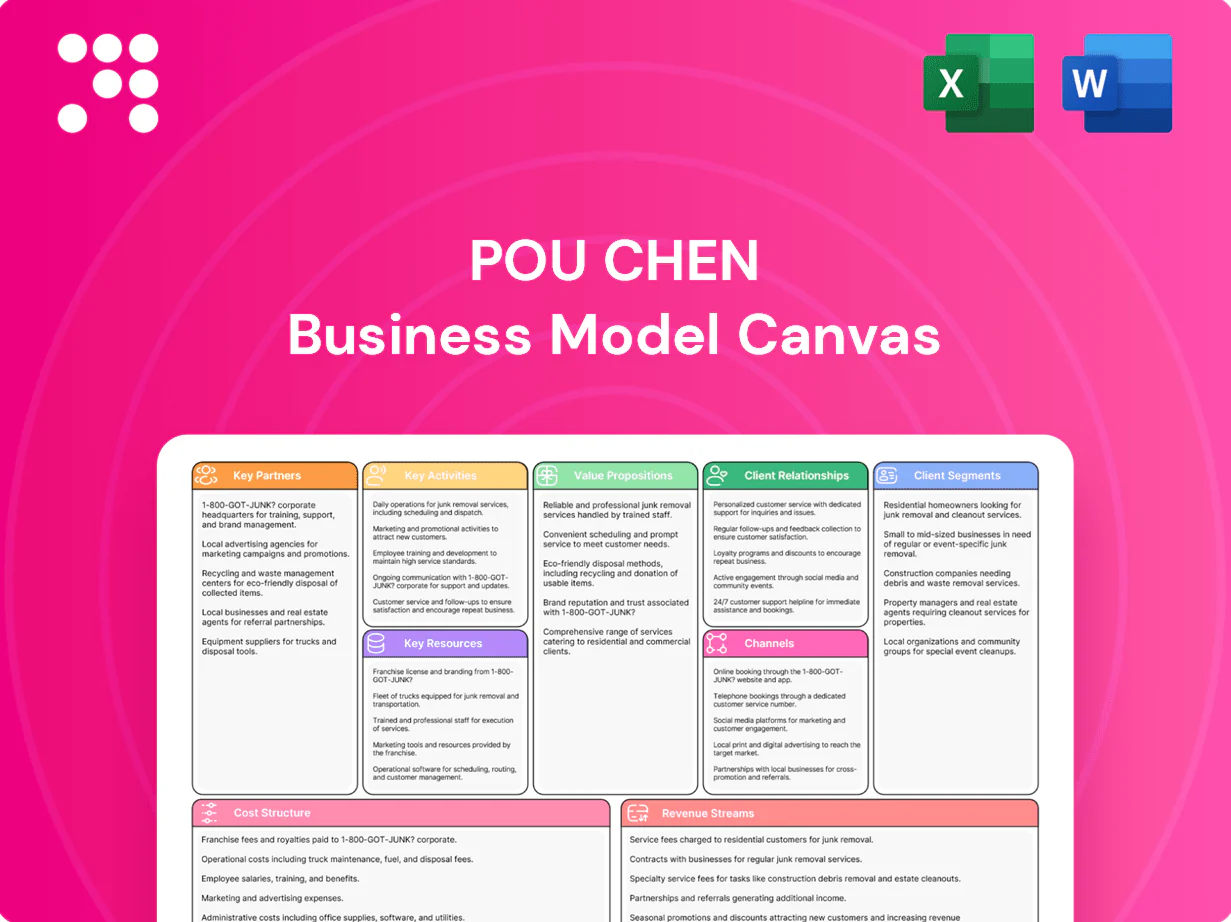
Pou Chen Business Model Canvas

Unlock a leading footwear maker's Business Model Canvas and action-ready strategic playbook
Unlock Pou Chen’s strategic playbook with our concise Business Model Canvas: three to five sentences that map customer segments, value propositions, partnerships, and revenue drivers—plus clear action points. Download the full Word/Excel canvas for a complete, editable blueprint ideal for investors, consultants, and entrepreneurs seeking rapid, practical insights.
Partnerships

Global sports and fashion brand clients
Strategic OEM/ODM ties with global brands (Nike, adidas, Puma) anchor demand and drive scale, supporting Pou Chen's manufacture of over 200 million pairs annually; multi-year frameworks align production forecasts, innovation roadmaps, and compliance standards across facilities. Close collaboration reduces volatility and enables synchronized global product launches, improving on-time delivery and margin stability.
Advanced material and component suppliers
Tier-1 suppliers for leather, synthetics, foams, textiles and soles supply the majority of critical inputs, covering roughly 70% of material spend to ensure quality and availability. Co-development of new compounds and sustainable materials boosts product performance and ESG credentials, with industry targets often aiming for 30–50% recycled content by 2030. Long-term supply agreements, typically 3–5 years, secure capacity and cost stability across cycles. Supplier audits and KPIs drive compliance and yield improvements.

Logistics, 3PL, and freight partners
Integrated logistics and 3PL partnerships enable Pou Chen, the world’s largest branded athletic footwear manufacturer, to optimize inbound materials and outbound finished-goods flows, leveraging a global 3PL market valued at about US$1.1 trillion in 2024. Multi-modal routing across sea, air and rail shortens lead times and spreads regional risk. Data-driven planning boosts on-time delivery and can raise inventory turns by double-digit percentages for brand partners.

Technology and machinery providers
Alliances with automation, molding, and digital-manufacturing vendors lift productivity and precision across Pou Chen’s global operations; the company, founded in 1969 (55 years in 2024), leverages supplier partnerships to meet OEM quality standards. Collaborative pilots expedite 3D design, digital twins, and smart-factory rollouts, while continuous equipment upgrades preserve cost competitiveness and consistent product output.
- Automation partnerships: higher precision, lower variability
- Digital pilots: faster 3D/design → production cycles
- Ongoing upgrades: sustain cost position and quality consistency
Retail and distribution alliances
- Retail reach: multi-brand expansion
- Partners: franchisees, landlords, marketplaces
- Impact: promotions, data-driven assortment
OEM/ODM anchor demand—200M+ pairs; tier-1 ~70% spend; 3PL US$1.1T
OEM/ODM ties with Nike, adidas and Puma anchor demand (over 200 million pairs/year); tier-1 suppliers account for ~70% of material spend; global 3PL market valued at US$1.1 trillion in 2024 supports logistics; automation and digital vendors drive productivity and ESG material co-development.
| Metric | Value (2024) |
|---|---|
| Annual output | 200M+ pairs |
| Material spend from tier-1 | ~70% |
| 3PL market | US$1.1T |
| Pou Chen age | 55 years |
What is included in the product
 Detailed Word Document
A comprehensive Pou Chen Business Model Canvas detailing customer segments, channels, value propositions, key activities, partners, resources, cost structure and revenue streams across 9 blocks, with linked SWOT and competitive advantages—designed for presentations, investor discussions and strategic decision-making.

 Customizable Excel Spreadsheet
High-level view of Pou Chen’s business model with editable cells to quickly identify core components and relieve strategic blind spots.
Activities

Footwear and apparel design & development
ODM teams at Pou Chen translate brand briefs into manufacturable, performance-ready footwear and apparel, leveraging the companys position as the world’s largest shoemaker with over 60 factories to scale designs into production. Rapid prototyping, fit testing, and material selection compress development cycles and enable faster time-to-market. Tooling and iterative samples align cost, quality, and aesthetics before ramp-up, reducing launch risk for global brands.
High-volume, multi-country manufacturing
Standardized processes and flexible lines across Pou Chen’s 70 plants in 10 countries enable scale across categories, supporting roughly 150 million pairs annually; lean manufacturing, automation and rigorous QA cut defect rates below 1% and raise throughput per line by 20% year-on-year (2024). Capacity balancing across sites mitigates geopolitical and supply risks, with cross-site shiftable capacity of ~25% of output.

End-to-end supply chain orchestration
Forecasting, procurement and production scheduling align tightly with brand calendars to meet seasonal peaks for major clients such as Nike and Adidas; Pou Chen is listed on the Taiwan Stock Exchange (TWSE: 9933). Vendor-managed inventory and JIT practices reduce working capital needs and inventory days on hand across contract manufacturing operations. Integrated data flows and ERP integrations enhance end-to-end visibility from raw materials to retail delivery, enabling quicker response to demand shifts.

Quality, compliance, and sustainability management
Comprehensive audits uphold labor, safety, and environmental standards across Pou Chen’s global factories, ensuring compliance with major brand codes of conduct and local regulations.
Traceability systems and material testing verify supply-chain integrity and product durability, enabling rapid recalls and supplier corrective actions when needed.
Continuous ESG improvements align operations with evolving brand expectations and regulatory frameworks through measurable targets and periodic public reporting.
- audits: labor, safety, environment
- traceability: materials to finished goods
- testing: durability and safety checks
- ESG: iterative improvements, regulatory alignment
Retail operations and merchandising
Retail operations and merchandising at Pou Chen focus on store network management, assortment planning, and dynamic pricing to drive traffic and protect margins; omnichannel integration enables click-and-collect, ship-from-store, and streamlined returns to improve fulfilment speed and customer experience. Data analytics continuously refines category mix, promotional effectiveness, and inventory allocation across channels.
- Store network optimization
- Assortment and price elasticity
- Omnichannel fulfilment
- Data-driven inventory allocation
ODM scale: ~150M pairs/yr, under 1% defects
Pou Chen converts global brand briefs into scalable ODM production across ~70 plants, delivering ~150 million pairs annually (2024) with defect rates under 1% and ~25% shiftable cross-site capacity. Lean manufacturing, rapid prototyping and ERP-integrated planning compress lead times and align with brand calendars. Robust audits, traceability and ESG targets ensure compliance and supply integrity.
| Metric | 2024 |
|---|---|
| Plants | ~70 |
| Output | ~150M pairs |
| Defect rate | <1% |
| Shiftable capacity | ~25% |
| Listing | TWSE: 9933 |
What You See Is What You Get
Business Model Canvas
This preview of the Pou Chen Business Model Canvas is the actual deliverable, not a mockup. When you purchase, you’ll receive this same document in full, formatted and ready to edit. The complete file includes all sections shown here and is provided in Word and Excel formats.

Unlock a leading footwear maker's Business Model Canvas and action-ready strategic playbook
Unlock Pou Chen’s strategic playbook with our concise Business Model Canvas: three to five sentences that map customer segments, value propositions, partnerships, and revenue drivers—plus clear action points. Download the full Word/Excel canvas for a complete, editable blueprint ideal for investors, consultants, and entrepreneurs seeking rapid, practical insights.
Partnerships
Global sports and fashion brand clients
Strategic OEM/ODM ties with global brands (Nike, adidas, Puma) anchor demand and drive scale, supporting Pou Chen's manufacture of over 200 million pairs annually; multi-year frameworks align production forecasts, innovation roadmaps, and compliance standards across facilities. Close collaboration reduces volatility and enables synchronized global product launches, improving on-time delivery and margin stability.
Advanced material and component suppliers
Tier-1 suppliers for leather, synthetics, foams, textiles and soles supply the majority of critical inputs, covering roughly 70% of material spend to ensure quality and availability. Co-development of new compounds and sustainable materials boosts product performance and ESG credentials, with industry targets often aiming for 30–50% recycled content by 2030. Long-term supply agreements, typically 3–5 years, secure capacity and cost stability across cycles. Supplier audits and KPIs drive compliance and yield improvements.
Logistics, 3PL, and freight partners
Integrated logistics and 3PL partnerships enable Pou Chen, the world’s largest branded athletic footwear manufacturer, to optimize inbound materials and outbound finished-goods flows, leveraging a global 3PL market valued at about US$1.1 trillion in 2024. Multi-modal routing across sea, air and rail shortens lead times and spreads regional risk. Data-driven planning boosts on-time delivery and can raise inventory turns by double-digit percentages for brand partners.
Technology and machinery providers
Alliances with automation, molding, and digital-manufacturing vendors lift productivity and precision across Pou Chen’s global operations; the company, founded in 1969 (55 years in 2024), leverages supplier partnerships to meet OEM quality standards. Collaborative pilots expedite 3D design, digital twins, and smart-factory rollouts, while continuous equipment upgrades preserve cost competitiveness and consistent product output.
- Automation partnerships: higher precision, lower variability
- Digital pilots: faster 3D/design → production cycles
- Ongoing upgrades: sustain cost position and quality consistency
Retail and distribution alliances
- Retail reach: multi-brand expansion
- Partners: franchisees, landlords, marketplaces
- Impact: promotions, data-driven assortment
OEM/ODM anchor demand—200M+ pairs; tier-1 ~70% spend; 3PL US$1.1T
OEM/ODM ties with Nike, adidas and Puma anchor demand (over 200 million pairs/year); tier-1 suppliers account for ~70% of material spend; global 3PL market valued at US$1.1 trillion in 2024 supports logistics; automation and digital vendors drive productivity and ESG material co-development.
| Metric | Value (2024) |
|---|---|
| Annual output | 200M+ pairs |
| Material spend from tier-1 | ~70% |
| 3PL market | US$1.1T |
| Pou Chen age | 55 years |
What is included in the product
Detailed Word Document
A comprehensive Pou Chen Business Model Canvas detailing customer segments, channels, value propositions, key activities, partners, resources, cost structure and revenue streams across 9 blocks, with linked SWOT and competitive advantages—designed for presentations, investor discussions and strategic decision-making.
Customizable Excel Spreadsheet
High-level view of Pou Chen’s business model with editable cells to quickly identify core components and relieve strategic blind spots.
Activities
Footwear and apparel design & development
ODM teams at Pou Chen translate brand briefs into manufacturable, performance-ready footwear and apparel, leveraging the companys position as the world’s largest shoemaker with over 60 factories to scale designs into production. Rapid prototyping, fit testing, and material selection compress development cycles and enable faster time-to-market. Tooling and iterative samples align cost, quality, and aesthetics before ramp-up, reducing launch risk for global brands.
High-volume, multi-country manufacturing
Standardized processes and flexible lines across Pou Chen’s 70 plants in 10 countries enable scale across categories, supporting roughly 150 million pairs annually; lean manufacturing, automation and rigorous QA cut defect rates below 1% and raise throughput per line by 20% year-on-year (2024). Capacity balancing across sites mitigates geopolitical and supply risks, with cross-site shiftable capacity of ~25% of output.
End-to-end supply chain orchestration
Forecasting, procurement and production scheduling align tightly with brand calendars to meet seasonal peaks for major clients such as Nike and Adidas; Pou Chen is listed on the Taiwan Stock Exchange (TWSE: 9933). Vendor-managed inventory and JIT practices reduce working capital needs and inventory days on hand across contract manufacturing operations. Integrated data flows and ERP integrations enhance end-to-end visibility from raw materials to retail delivery, enabling quicker response to demand shifts.
Quality, compliance, and sustainability management
Comprehensive audits uphold labor, safety, and environmental standards across Pou Chen’s global factories, ensuring compliance with major brand codes of conduct and local regulations.
Traceability systems and material testing verify supply-chain integrity and product durability, enabling rapid recalls and supplier corrective actions when needed.
Continuous ESG improvements align operations with evolving brand expectations and regulatory frameworks through measurable targets and periodic public reporting.
- audits: labor, safety, environment
- traceability: materials to finished goods
- testing: durability and safety checks
- ESG: iterative improvements, regulatory alignment
Retail operations and merchandising
Retail operations and merchandising at Pou Chen focus on store network management, assortment planning, and dynamic pricing to drive traffic and protect margins; omnichannel integration enables click-and-collect, ship-from-store, and streamlined returns to improve fulfilment speed and customer experience. Data analytics continuously refines category mix, promotional effectiveness, and inventory allocation across channels.
- Store network optimization
- Assortment and price elasticity
- Omnichannel fulfilment
- Data-driven inventory allocation
ODM scale: ~150M pairs/yr, under 1% defects
Pou Chen converts global brand briefs into scalable ODM production across ~70 plants, delivering ~150 million pairs annually (2024) with defect rates under 1% and ~25% shiftable cross-site capacity. Lean manufacturing, rapid prototyping and ERP-integrated planning compress lead times and align with brand calendars. Robust audits, traceability and ESG targets ensure compliance and supply integrity.
| Metric | 2024 |
|---|---|
| Plants | ~70 |
| Output | ~150M pairs |
| Defect rate | <1% |
| Shiftable capacity | ~25% |
| Listing | TWSE: 9933 |
What You See Is What You Get
Business Model Canvas
This preview of the Pou Chen Business Model Canvas is the actual deliverable, not a mockup. When you purchase, you’ll receive this same document in full, formatted and ready to edit. The complete file includes all sections shown here and is provided in Word and Excel formats.
Description
Unlock a leading footwear maker's Business Model Canvas and action-ready strategic playbook
Unlock Pou Chen’s strategic playbook with our concise Business Model Canvas: three to five sentences that map customer segments, value propositions, partnerships, and revenue drivers—plus clear action points. Download the full Word/Excel canvas for a complete, editable blueprint ideal for investors, consultants, and entrepreneurs seeking rapid, practical insights.
Partnerships
Global sports and fashion brand clients
Strategic OEM/ODM ties with global brands (Nike, adidas, Puma) anchor demand and drive scale, supporting Pou Chen's manufacture of over 200 million pairs annually; multi-year frameworks align production forecasts, innovation roadmaps, and compliance standards across facilities. Close collaboration reduces volatility and enables synchronized global product launches, improving on-time delivery and margin stability.
Advanced material and component suppliers
Tier-1 suppliers for leather, synthetics, foams, textiles and soles supply the majority of critical inputs, covering roughly 70% of material spend to ensure quality and availability. Co-development of new compounds and sustainable materials boosts product performance and ESG credentials, with industry targets often aiming for 30–50% recycled content by 2030. Long-term supply agreements, typically 3–5 years, secure capacity and cost stability across cycles. Supplier audits and KPIs drive compliance and yield improvements.
Logistics, 3PL, and freight partners
Integrated logistics and 3PL partnerships enable Pou Chen, the world’s largest branded athletic footwear manufacturer, to optimize inbound materials and outbound finished-goods flows, leveraging a global 3PL market valued at about US$1.1 trillion in 2024. Multi-modal routing across sea, air and rail shortens lead times and spreads regional risk. Data-driven planning boosts on-time delivery and can raise inventory turns by double-digit percentages for brand partners.
Technology and machinery providers
Alliances with automation, molding, and digital-manufacturing vendors lift productivity and precision across Pou Chen’s global operations; the company, founded in 1969 (55 years in 2024), leverages supplier partnerships to meet OEM quality standards. Collaborative pilots expedite 3D design, digital twins, and smart-factory rollouts, while continuous equipment upgrades preserve cost competitiveness and consistent product output.
- Automation partnerships: higher precision, lower variability
- Digital pilots: faster 3D/design → production cycles
- Ongoing upgrades: sustain cost position and quality consistency
Retail and distribution alliances
- Retail reach: multi-brand expansion
- Partners: franchisees, landlords, marketplaces
- Impact: promotions, data-driven assortment
OEM/ODM anchor demand—200M+ pairs; tier-1 ~70% spend; 3PL US$1.1T
OEM/ODM ties with Nike, adidas and Puma anchor demand (over 200 million pairs/year); tier-1 suppliers account for ~70% of material spend; global 3PL market valued at US$1.1 trillion in 2024 supports logistics; automation and digital vendors drive productivity and ESG material co-development.
| Metric | Value (2024) |
|---|---|
| Annual output | 200M+ pairs |
| Material spend from tier-1 | ~70% |
| 3PL market | US$1.1T |
| Pou Chen age | 55 years |
What is included in the product
Detailed Word Document
A comprehensive Pou Chen Business Model Canvas detailing customer segments, channels, value propositions, key activities, partners, resources, cost structure and revenue streams across 9 blocks, with linked SWOT and competitive advantages—designed for presentations, investor discussions and strategic decision-making.
Customizable Excel Spreadsheet
High-level view of Pou Chen’s business model with editable cells to quickly identify core components and relieve strategic blind spots.
Activities
Footwear and apparel design & development
ODM teams at Pou Chen translate brand briefs into manufacturable, performance-ready footwear and apparel, leveraging the companys position as the world’s largest shoemaker with over 60 factories to scale designs into production. Rapid prototyping, fit testing, and material selection compress development cycles and enable faster time-to-market. Tooling and iterative samples align cost, quality, and aesthetics before ramp-up, reducing launch risk for global brands.
High-volume, multi-country manufacturing
Standardized processes and flexible lines across Pou Chen’s 70 plants in 10 countries enable scale across categories, supporting roughly 150 million pairs annually; lean manufacturing, automation and rigorous QA cut defect rates below 1% and raise throughput per line by 20% year-on-year (2024). Capacity balancing across sites mitigates geopolitical and supply risks, with cross-site shiftable capacity of ~25% of output.
End-to-end supply chain orchestration
Forecasting, procurement and production scheduling align tightly with brand calendars to meet seasonal peaks for major clients such as Nike and Adidas; Pou Chen is listed on the Taiwan Stock Exchange (TWSE: 9933). Vendor-managed inventory and JIT practices reduce working capital needs and inventory days on hand across contract manufacturing operations. Integrated data flows and ERP integrations enhance end-to-end visibility from raw materials to retail delivery, enabling quicker response to demand shifts.
Quality, compliance, and sustainability management
Comprehensive audits uphold labor, safety, and environmental standards across Pou Chen’s global factories, ensuring compliance with major brand codes of conduct and local regulations.
Traceability systems and material testing verify supply-chain integrity and product durability, enabling rapid recalls and supplier corrective actions when needed.
Continuous ESG improvements align operations with evolving brand expectations and regulatory frameworks through measurable targets and periodic public reporting.
- audits: labor, safety, environment
- traceability: materials to finished goods
- testing: durability and safety checks
- ESG: iterative improvements, regulatory alignment
Retail operations and merchandising
Retail operations and merchandising at Pou Chen focus on store network management, assortment planning, and dynamic pricing to drive traffic and protect margins; omnichannel integration enables click-and-collect, ship-from-store, and streamlined returns to improve fulfilment speed and customer experience. Data analytics continuously refines category mix, promotional effectiveness, and inventory allocation across channels.
- Store network optimization
- Assortment and price elasticity
- Omnichannel fulfilment
- Data-driven inventory allocation
ODM scale: ~150M pairs/yr, under 1% defects
Pou Chen converts global brand briefs into scalable ODM production across ~70 plants, delivering ~150 million pairs annually (2024) with defect rates under 1% and ~25% shiftable cross-site capacity. Lean manufacturing, rapid prototyping and ERP-integrated planning compress lead times and align with brand calendars. Robust audits, traceability and ESG targets ensure compliance and supply integrity.
| Metric | 2024 |
|---|---|
| Plants | ~70 |
| Output | ~150M pairs |
| Defect rate | <1% |
| Shiftable capacity | ~25% |
| Listing | TWSE: 9933 |
What You See Is What You Get
Business Model Canvas
This preview of the Pou Chen Business Model Canvas is the actual deliverable, not a mockup. When you purchase, you’ll receive this same document in full, formatted and ready to edit. The complete file includes all sections shown here and is provided in Word and Excel formats.











