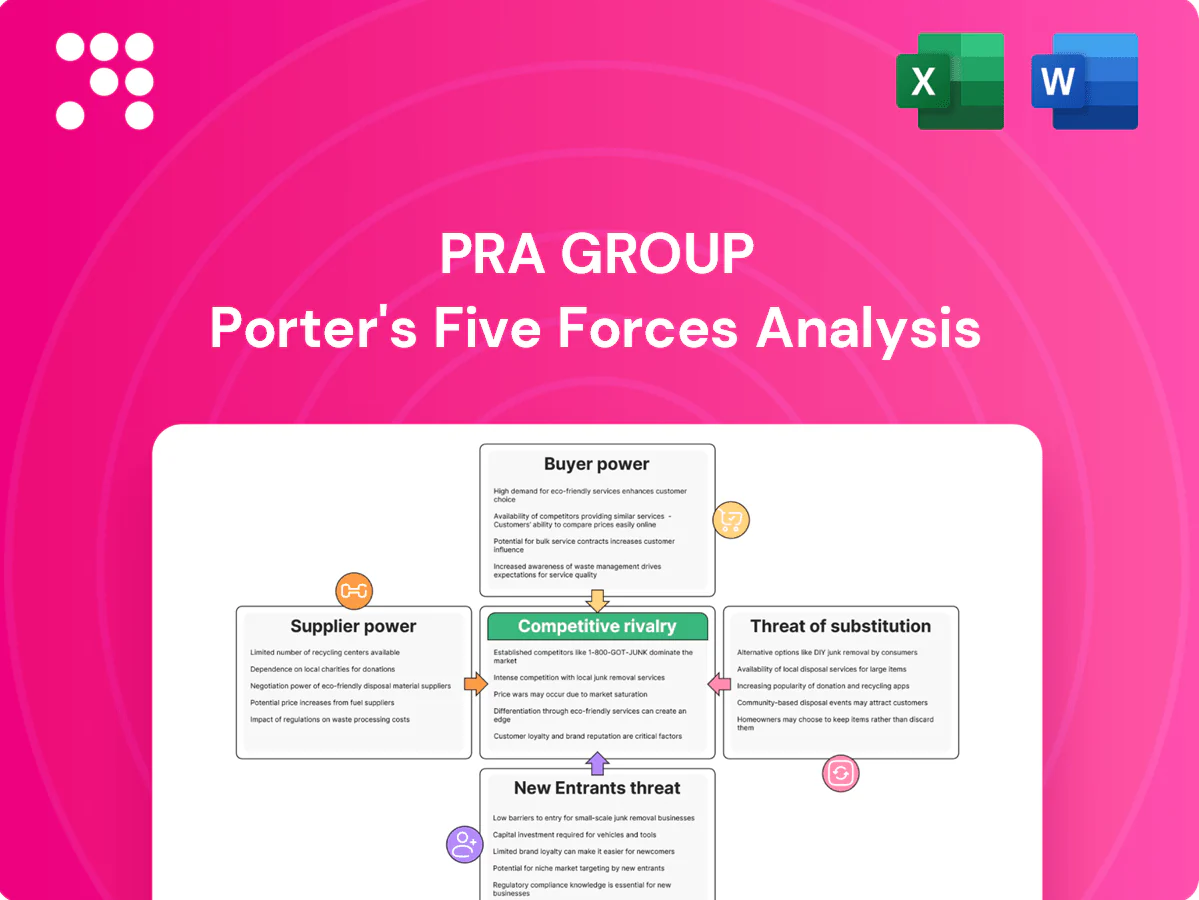
PRA Group Porter's Five Forces Analysis

Go Beyond the Preview—Access the Full Strategic Report
PRA Group faces moderate buyer power, concentrated regulatory and compliance pressures, differentiated supplier influence, low threat of direct substitutes, and variable threat of new entrants driven by capital and data barriers. This snapshot highlights competitive intensity and strategic vulnerabilities. Unlock the full Porter's Five Forces Analysis to explore force-by-force ratings, visuals, and actionable insights for investment or strategy.
Suppliers Bargaining Power

Concentrated bank sellers
Major banks, credit unions, and fintech lenders control the bulk of charged-off portfolios, concentrating supply among a short list of large originators who can coordinate auction timing and terms. This concentration elevates seller leverage over price, reps and warranties, and the depth of required data packages. PRA Group must sustain strong origination relationships to secure consistent deal flow and favorable access to inventory.
Portfolio auction dynamics
Competitive sealed-bid and forward-flow auctions give sellers leverage: they set reserve prices, tighten bidder eligibility, and bundle assets to boost proceeds, reducing buyer margin flexibility. Limited transparency into rival bids further strengthens seller power and pressures PRA on bid discipline. PRA must balance defending margins with meeting volume targets to sustain portfolio supply.

Data quality and reps
Sellers materially influence asset value through file completeness, documentation quality, and warranty scope, with strong data rooms and tight post-sale put-back limits shifting risk toward buyers.
Negotiating stronger reps typically requires paying up, as buyers compensate for residual legal and operational exposure.
PRA’s analytics materially mitigate mispricing from imperfect inputs but cannot fully offset poor-quality data and missing documentation.

Regulatory constraints on supply
Compliance expectations in 2024—stricter account documentation and consent standards—have narrowed which portfolios are saleable, prompting several sellers to pause sales after regulatory events and temporarily reduce market supply. When supply constricts, seller pricing power rises and PRA faces scarcity premiums on purchasable assets. This dynamic elevates acquisition costs and widens bid-ask spreads.
- Regulatory pauses tighten supply
- Documentation/consent limit saleability
- Scarcity drives premiums for PRA
Macroeconomic cycle timing
Charge-off waves drive supply surges or droughts, shifting seller pricing power; droughts strengthen seller leverage while surges give buyers more negotiating room. With the federal funds rate at 5.25–5.50% in 2024, interest rates and credit growth materially shift portfolio mix and yields, so PRA must adapt underwriting and purchase criteria across cycles.
- Supply: charge-off waves
- Pricing: droughts favor sellers
- Negotiation: surges favor buyers
- Rates: 2024 Fed funds 5.25–5.50%
- Action: dynamic underwriting
Seller-driven auctions and concentrated originators force buyers to flex underwriting
Concentrated originators and auction formats give sellers strong leverage over price, warranties, and data requirements, forcing PRA to maintain deep origination ties and disciplined bidding. Documentation, consent and post-sale put-back limits shift risk to buyers despite PRA’s analytics. Regulatory pauses and higher rates tighten saleable supply and raise acquisition premiums; PRA must flex underwriting across cycles.
| Metric | 2024 Value | Impact |
|---|---|---|
| Federal funds rate | 5.25–5.50% | Raises yields, narrows saleable pools, boosts seller pricing power |
What is included in the product
 Detailed Word Document
Porter’s Five Forces analysis for PRA Group uncovers competitive intensity, buyer and supplier bargaining power, substitution risks, and barriers to entry specific to debt recovery and receivables management, identifying disruptive threats, regulatory sensitivities, and strategic levers to protect margins and market share.

 Customizable Excel Spreadsheet
One-sheet Porter's Five Forces for PRA Group that instantly visualizes competitive pressure with a customizable spider chart—ready to drop into decks, tweak for regulatory or market shifts, and integrate into Excel dashboards without macros.
Customers Bargaining Power

Debtor ability to pay
End-consumers face limited disposable income and asymmetric information; ability to pay in 2024 tracked macro drivers—US unemployment ~4.0% and CPI inflation ~3.4%—while household debt-to-GDP hovered near 74%, constraining cashflows. Low repayment capacity weakens buyer negotiation power but also lowers recoveries for PRA. PRA must calibrate settlement offers to measurable affordability to protect yields.
Legal protections and rights
Consumers benefit from stringent collections rules and dispute rights; federal FDCPA validation rights require a debt collector to respond to disputes within 30 days. Statutes of limitations on many consumer debts typically run three to six years, limiting enforcement. These protections let consumers contest or delay payments, so PRA must remain fully compliant to avoid regulatory and reputational risk.

Settlement and hardship options
Debtors can negotiate discounts, payment plans, or pauses, with industry settlement concessions commonly in the 20–40% range; PRA Group reported roughly $1.09bn revenue in 2023, reflecting tradeoffs between rate and volume. Access to debt counseling and hardship programs increases borrower leverage, while alternatives like bankruptcy and formal debt management limit recoveries. PRA balances higher settlement rates against speed and regulatory compliance to protect margins.

Digital channel leverage
Self-service portals and comparison tools give buyers clearer option sets; 2024 studies show about 70% of consumers use digital self-service, increasing transparency into typical discounts and hardening negotiating stances. Digitalization lowers servicing costs but raises buyer expectations; PRA must deploy adaptive offers and frictionless UX to convert digital leads into recoveries.
- Digital transparency increases buyer leverage
- 70% self-service adoption in 2024
- Adaptive pricing + UX required for conversion
Reputation sensitivity
Reputation sensitivity increases customer bargaining power because public complaints and social media scrutiny force collectors to be flexible; CFPB recorded over 100,000 debt collection complaints across 2023–24, raising the stakes for remediation. Consumers can escalate issues to regulators or media, which drives remediation and legal costs upward and pressures concessions beyond pure economics. PRA’s brand strength and conduct directly shape outcomes and settlement leverage.
- reputational risk: high public scrutiny
- regulatory pressure: >100,000 complaints 2023–24
- financial impact: remediation and legal costs drive concessions
- brand leverage: PRA conduct determines bargaining outcomes
Moderate customer leverage pressures recoveries amid rising disputes, self-service use
Customer bargaining power is moderate: constrained affordability (US unemployment ~4.0%, CPI ~3.4%, household debt/GDP ~74%) limits ability to pay but lowers recoveries; consumers use dispute rights and bankruptcy to extract concessions; digital self-service (~70% adoption) and >100,000 CFPB complaints (2023–24) amplify leverage, forcing PRA to balance settlement rates, speed and compliance to protect margins.
| Metric | Value |
|---|---|
| PRA revenue (2023) | $1.09bn |
| US unemployment (2024) | ~4.0% |
| CPI (2024) | ~3.4% |
| Household debt/GDP | ~74% |
| Self-service adoption (2024) | ~70% |
| CFPB complaints (2023–24) | >100,000 |
Preview the Actual Deliverable
PRA Group Porter's Five Forces Analysis
This preview is the exact, fully formatted Porter’s Five Forces analysis for PRA Group you’ll receive upon purchase—no mockups or placeholders. It delivers a comprehensive assessment of competitive rivalry, supplier and buyer power, threats of entry and substitution, and strategic implications. Downloadable and ready to use instantly after payment.

Go Beyond the Preview—Access the Full Strategic Report
PRA Group faces moderate buyer power, concentrated regulatory and compliance pressures, differentiated supplier influence, low threat of direct substitutes, and variable threat of new entrants driven by capital and data barriers. This snapshot highlights competitive intensity and strategic vulnerabilities. Unlock the full Porter's Five Forces Analysis to explore force-by-force ratings, visuals, and actionable insights for investment or strategy.
Suppliers Bargaining Power
Concentrated bank sellers
Major banks, credit unions, and fintech lenders control the bulk of charged-off portfolios, concentrating supply among a short list of large originators who can coordinate auction timing and terms. This concentration elevates seller leverage over price, reps and warranties, and the depth of required data packages. PRA Group must sustain strong origination relationships to secure consistent deal flow and favorable access to inventory.
Portfolio auction dynamics
Competitive sealed-bid and forward-flow auctions give sellers leverage: they set reserve prices, tighten bidder eligibility, and bundle assets to boost proceeds, reducing buyer margin flexibility. Limited transparency into rival bids further strengthens seller power and pressures PRA on bid discipline. PRA must balance defending margins with meeting volume targets to sustain portfolio supply.
Data quality and reps
Sellers materially influence asset value through file completeness, documentation quality, and warranty scope, with strong data rooms and tight post-sale put-back limits shifting risk toward buyers.
Negotiating stronger reps typically requires paying up, as buyers compensate for residual legal and operational exposure.
PRA’s analytics materially mitigate mispricing from imperfect inputs but cannot fully offset poor-quality data and missing documentation.
Regulatory constraints on supply
Compliance expectations in 2024—stricter account documentation and consent standards—have narrowed which portfolios are saleable, prompting several sellers to pause sales after regulatory events and temporarily reduce market supply. When supply constricts, seller pricing power rises and PRA faces scarcity premiums on purchasable assets. This dynamic elevates acquisition costs and widens bid-ask spreads.
- Regulatory pauses tighten supply
- Documentation/consent limit saleability
- Scarcity drives premiums for PRA
Macroeconomic cycle timing
Charge-off waves drive supply surges or droughts, shifting seller pricing power; droughts strengthen seller leverage while surges give buyers more negotiating room. With the federal funds rate at 5.25–5.50% in 2024, interest rates and credit growth materially shift portfolio mix and yields, so PRA must adapt underwriting and purchase criteria across cycles.
- Supply: charge-off waves
- Pricing: droughts favor sellers
- Negotiation: surges favor buyers
- Rates: 2024 Fed funds 5.25–5.50%
- Action: dynamic underwriting
Seller-driven auctions and concentrated originators force buyers to flex underwriting
Concentrated originators and auction formats give sellers strong leverage over price, warranties, and data requirements, forcing PRA to maintain deep origination ties and disciplined bidding. Documentation, consent and post-sale put-back limits shift risk to buyers despite PRA’s analytics. Regulatory pauses and higher rates tighten saleable supply and raise acquisition premiums; PRA must flex underwriting across cycles.
| Metric | 2024 Value | Impact |
|---|---|---|
| Federal funds rate | 5.25–5.50% | Raises yields, narrows saleable pools, boosts seller pricing power |
What is included in the product
Detailed Word Document
Porter’s Five Forces analysis for PRA Group uncovers competitive intensity, buyer and supplier bargaining power, substitution risks, and barriers to entry specific to debt recovery and receivables management, identifying disruptive threats, regulatory sensitivities, and strategic levers to protect margins and market share.
Customizable Excel Spreadsheet
One-sheet Porter's Five Forces for PRA Group that instantly visualizes competitive pressure with a customizable spider chart—ready to drop into decks, tweak for regulatory or market shifts, and integrate into Excel dashboards without macros.
Customers Bargaining Power
Debtor ability to pay
End-consumers face limited disposable income and asymmetric information; ability to pay in 2024 tracked macro drivers—US unemployment ~4.0% and CPI inflation ~3.4%—while household debt-to-GDP hovered near 74%, constraining cashflows. Low repayment capacity weakens buyer negotiation power but also lowers recoveries for PRA. PRA must calibrate settlement offers to measurable affordability to protect yields.
Legal protections and rights
Consumers benefit from stringent collections rules and dispute rights; federal FDCPA validation rights require a debt collector to respond to disputes within 30 days. Statutes of limitations on many consumer debts typically run three to six years, limiting enforcement. These protections let consumers contest or delay payments, so PRA must remain fully compliant to avoid regulatory and reputational risk.
Settlement and hardship options
Debtors can negotiate discounts, payment plans, or pauses, with industry settlement concessions commonly in the 20–40% range; PRA Group reported roughly $1.09bn revenue in 2023, reflecting tradeoffs between rate and volume. Access to debt counseling and hardship programs increases borrower leverage, while alternatives like bankruptcy and formal debt management limit recoveries. PRA balances higher settlement rates against speed and regulatory compliance to protect margins.
Digital channel leverage
Self-service portals and comparison tools give buyers clearer option sets; 2024 studies show about 70% of consumers use digital self-service, increasing transparency into typical discounts and hardening negotiating stances. Digitalization lowers servicing costs but raises buyer expectations; PRA must deploy adaptive offers and frictionless UX to convert digital leads into recoveries.
- Digital transparency increases buyer leverage
- 70% self-service adoption in 2024
- Adaptive pricing + UX required for conversion
Reputation sensitivity
Reputation sensitivity increases customer bargaining power because public complaints and social media scrutiny force collectors to be flexible; CFPB recorded over 100,000 debt collection complaints across 2023–24, raising the stakes for remediation. Consumers can escalate issues to regulators or media, which drives remediation and legal costs upward and pressures concessions beyond pure economics. PRA’s brand strength and conduct directly shape outcomes and settlement leverage.
- reputational risk: high public scrutiny
- regulatory pressure: >100,000 complaints 2023–24
- financial impact: remediation and legal costs drive concessions
- brand leverage: PRA conduct determines bargaining outcomes
Moderate customer leverage pressures recoveries amid rising disputes, self-service use
Customer bargaining power is moderate: constrained affordability (US unemployment ~4.0%, CPI ~3.4%, household debt/GDP ~74%) limits ability to pay but lowers recoveries; consumers use dispute rights and bankruptcy to extract concessions; digital self-service (~70% adoption) and >100,000 CFPB complaints (2023–24) amplify leverage, forcing PRA to balance settlement rates, speed and compliance to protect margins.
| Metric | Value |
|---|---|
| PRA revenue (2023) | $1.09bn |
| US unemployment (2024) | ~4.0% |
| CPI (2024) | ~3.4% |
| Household debt/GDP | ~74% |
| Self-service adoption (2024) | ~70% |
| CFPB complaints (2023–24) | >100,000 |
Preview the Actual Deliverable
PRA Group Porter's Five Forces Analysis
This preview is the exact, fully formatted Porter’s Five Forces analysis for PRA Group you’ll receive upon purchase—no mockups or placeholders. It delivers a comprehensive assessment of competitive rivalry, supplier and buyer power, threats of entry and substitution, and strategic implications. Downloadable and ready to use instantly after payment.
Original: $10.00
-65%$10.00
$3.50Description
Go Beyond the Preview—Access the Full Strategic Report
PRA Group faces moderate buyer power, concentrated regulatory and compliance pressures, differentiated supplier influence, low threat of direct substitutes, and variable threat of new entrants driven by capital and data barriers. This snapshot highlights competitive intensity and strategic vulnerabilities. Unlock the full Porter's Five Forces Analysis to explore force-by-force ratings, visuals, and actionable insights for investment or strategy.
Suppliers Bargaining Power
Concentrated bank sellers
Major banks, credit unions, and fintech lenders control the bulk of charged-off portfolios, concentrating supply among a short list of large originators who can coordinate auction timing and terms. This concentration elevates seller leverage over price, reps and warranties, and the depth of required data packages. PRA Group must sustain strong origination relationships to secure consistent deal flow and favorable access to inventory.
Portfolio auction dynamics
Competitive sealed-bid and forward-flow auctions give sellers leverage: they set reserve prices, tighten bidder eligibility, and bundle assets to boost proceeds, reducing buyer margin flexibility. Limited transparency into rival bids further strengthens seller power and pressures PRA on bid discipline. PRA must balance defending margins with meeting volume targets to sustain portfolio supply.
Data quality and reps
Sellers materially influence asset value through file completeness, documentation quality, and warranty scope, with strong data rooms and tight post-sale put-back limits shifting risk toward buyers.
Negotiating stronger reps typically requires paying up, as buyers compensate for residual legal and operational exposure.
PRA’s analytics materially mitigate mispricing from imperfect inputs but cannot fully offset poor-quality data and missing documentation.
Regulatory constraints on supply
Compliance expectations in 2024—stricter account documentation and consent standards—have narrowed which portfolios are saleable, prompting several sellers to pause sales after regulatory events and temporarily reduce market supply. When supply constricts, seller pricing power rises and PRA faces scarcity premiums on purchasable assets. This dynamic elevates acquisition costs and widens bid-ask spreads.
- Regulatory pauses tighten supply
- Documentation/consent limit saleability
- Scarcity drives premiums for PRA
Macroeconomic cycle timing
Charge-off waves drive supply surges or droughts, shifting seller pricing power; droughts strengthen seller leverage while surges give buyers more negotiating room. With the federal funds rate at 5.25–5.50% in 2024, interest rates and credit growth materially shift portfolio mix and yields, so PRA must adapt underwriting and purchase criteria across cycles.
- Supply: charge-off waves
- Pricing: droughts favor sellers
- Negotiation: surges favor buyers
- Rates: 2024 Fed funds 5.25–5.50%
- Action: dynamic underwriting
Seller-driven auctions and concentrated originators force buyers to flex underwriting
Concentrated originators and auction formats give sellers strong leverage over price, warranties, and data requirements, forcing PRA to maintain deep origination ties and disciplined bidding. Documentation, consent and post-sale put-back limits shift risk to buyers despite PRA’s analytics. Regulatory pauses and higher rates tighten saleable supply and raise acquisition premiums; PRA must flex underwriting across cycles.
| Metric | 2024 Value | Impact |
|---|---|---|
| Federal funds rate | 5.25–5.50% | Raises yields, narrows saleable pools, boosts seller pricing power |
What is included in the product
Detailed Word Document
Porter’s Five Forces analysis for PRA Group uncovers competitive intensity, buyer and supplier bargaining power, substitution risks, and barriers to entry specific to debt recovery and receivables management, identifying disruptive threats, regulatory sensitivities, and strategic levers to protect margins and market share.
Customizable Excel Spreadsheet
One-sheet Porter's Five Forces for PRA Group that instantly visualizes competitive pressure with a customizable spider chart—ready to drop into decks, tweak for regulatory or market shifts, and integrate into Excel dashboards without macros.
Customers Bargaining Power
Debtor ability to pay
End-consumers face limited disposable income and asymmetric information; ability to pay in 2024 tracked macro drivers—US unemployment ~4.0% and CPI inflation ~3.4%—while household debt-to-GDP hovered near 74%, constraining cashflows. Low repayment capacity weakens buyer negotiation power but also lowers recoveries for PRA. PRA must calibrate settlement offers to measurable affordability to protect yields.
Legal protections and rights
Consumers benefit from stringent collections rules and dispute rights; federal FDCPA validation rights require a debt collector to respond to disputes within 30 days. Statutes of limitations on many consumer debts typically run three to six years, limiting enforcement. These protections let consumers contest or delay payments, so PRA must remain fully compliant to avoid regulatory and reputational risk.
Settlement and hardship options
Debtors can negotiate discounts, payment plans, or pauses, with industry settlement concessions commonly in the 20–40% range; PRA Group reported roughly $1.09bn revenue in 2023, reflecting tradeoffs between rate and volume. Access to debt counseling and hardship programs increases borrower leverage, while alternatives like bankruptcy and formal debt management limit recoveries. PRA balances higher settlement rates against speed and regulatory compliance to protect margins.
Digital channel leverage
Self-service portals and comparison tools give buyers clearer option sets; 2024 studies show about 70% of consumers use digital self-service, increasing transparency into typical discounts and hardening negotiating stances. Digitalization lowers servicing costs but raises buyer expectations; PRA must deploy adaptive offers and frictionless UX to convert digital leads into recoveries.
- Digital transparency increases buyer leverage
- 70% self-service adoption in 2024
- Adaptive pricing + UX required for conversion
Reputation sensitivity
Reputation sensitivity increases customer bargaining power because public complaints and social media scrutiny force collectors to be flexible; CFPB recorded over 100,000 debt collection complaints across 2023–24, raising the stakes for remediation. Consumers can escalate issues to regulators or media, which drives remediation and legal costs upward and pressures concessions beyond pure economics. PRA’s brand strength and conduct directly shape outcomes and settlement leverage.
- reputational risk: high public scrutiny
- regulatory pressure: >100,000 complaints 2023–24
- financial impact: remediation and legal costs drive concessions
- brand leverage: PRA conduct determines bargaining outcomes
Moderate customer leverage pressures recoveries amid rising disputes, self-service use
Customer bargaining power is moderate: constrained affordability (US unemployment ~4.0%, CPI ~3.4%, household debt/GDP ~74%) limits ability to pay but lowers recoveries; consumers use dispute rights and bankruptcy to extract concessions; digital self-service (~70% adoption) and >100,000 CFPB complaints (2023–24) amplify leverage, forcing PRA to balance settlement rates, speed and compliance to protect margins.
| Metric | Value |
|---|---|
| PRA revenue (2023) | $1.09bn |
| US unemployment (2024) | ~4.0% |
| CPI (2024) | ~3.4% |
| Household debt/GDP | ~74% |
| Self-service adoption (2024) | ~70% |
| CFPB complaints (2023–24) | >100,000 |
Preview the Actual Deliverable
PRA Group Porter's Five Forces Analysis
This preview is the exact, fully formatted Porter’s Five Forces analysis for PRA Group you’ll receive upon purchase—no mockups or placeholders. It delivers a comprehensive assessment of competitive rivalry, supplier and buyer power, threats of entry and substitution, and strategic implications. Downloadable and ready to use instantly after payment.











