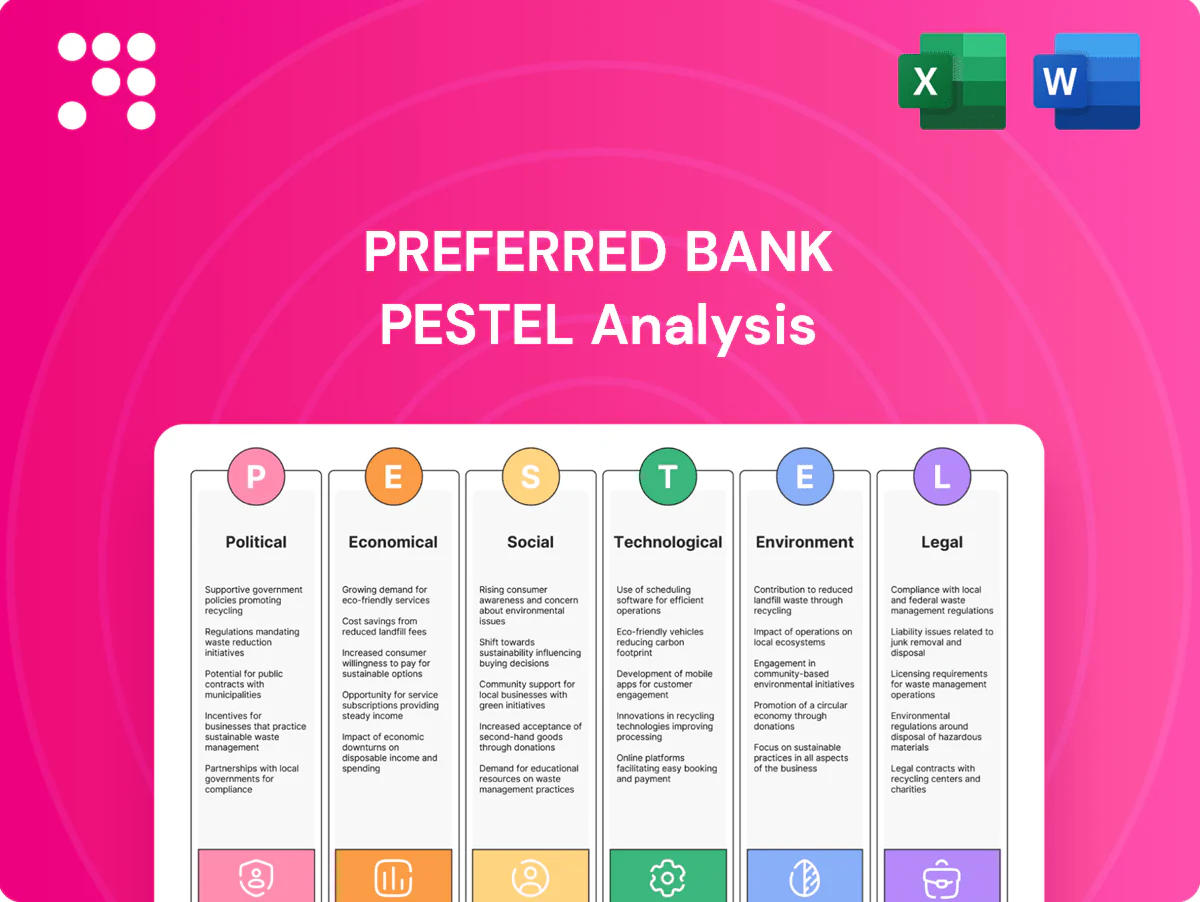
Preferred Bank PESTLE Analysis

Skip the Research. Get the Strategy.
Navigate the complex external landscape impacting Preferred Bank with our comprehensive PESTLE analysis. Understand how political stability, economic fluctuations, and evolving social trends are shaping the banking sector. Unlock actionable intelligence to inform your strategic decisions and gain a competitive advantage. Download the full PESTLE analysis now for a deeper understanding.
Political factors

Regulatory Environment Shifts
The U.S. banking sector faces a shifting regulatory environment heading into 2025, influenced by potential changes in presidential administration and congressional makeup. A new administration might pursue deregulation, though significant shifts in financial supervision often occur gradually.
Banks need to focus on strong governance, risk management, and compliance to effectively manage this evolving and uncertain regulatory landscape.
Government Fiscal and Monetary Policies
Government fiscal and monetary policies remain a critical influence on Preferred Bank. The Federal Reserve's interest rate decisions, for instance, directly shape the banking environment. While projections suggest a gradual reduction in rates by mid-2025, the likelihood of significant cuts has diminished, potentially constraining net interest margins and moderating loan growth.
Furthermore, shifts in federal spending could have ripple effects across the state economies where Preferred Bank has a presence. A potential slowdown in government expenditures might impact local economic activity and, consequently, state revenues, requiring Preferred Bank to closely monitor these trends and adapt its strategies accordingly.

Trade Policies and Geopolitical Tensions
Changing trade policies, including tariffs, present both risks and opportunities for businesses, especially in Texas, a state heavily reliant on international trade. For instance, in 2024, the US continued to navigate complex trade relationships, impacting sectors from manufacturing to agriculture, which are significant for Texas's economy.
Geopolitical tensions are anticipated to remain a significant factor throughout 2025, directly increasing operational risks for financial institutions. These ongoing global uncertainties can disrupt supply chains and affect the financial health of businesses, including Preferred Bank's middle-market clientele.
Financial institutions like Preferred Bank must proactively analyze how trade disputes and evolving international relations could impact their clients and the broader economic landscape. For example, changes in trade agreements could alter the cost of goods for businesses or affect their access to international markets, necessitating careful risk assessment.

State-Level Legislative and Budgetary Pressures
State-level legislative and budgetary conditions, particularly in major markets like California and New York, present distinct political pressures for Preferred Bank. California's projected budget deficits for fiscal years 2024-2025 and 2025-2026, estimated to be in the tens of billions of dollars, could lead to reduced state spending and a dampened economic climate.
These regional fiscal challenges directly influence the business environment, potentially affecting demand for commercial banking services. For example, shifts in state tax policies or increased regulatory scrutiny stemming from budget shortfalls can impact corporate clients' financial strategies and their need for banking solutions.
- California's Fiscal Outlook: The state anticipates a budget gap of approximately $28 billion for fiscal year 2024-2025, with further challenges projected for 2025-2026.
- Impact on Business: State budget pressures can translate to changes in business incentives, infrastructure spending, and overall economic growth, all of which affect banking demand.
- Regulatory Environment: Legislative actions in response to budget constraints could introduce new compliance requirements or alter existing financial regulations impacting Preferred Bank's operations.
Political Stability and Business Confidence
Political stability is a cornerstone for business confidence, directly impacting commercial banks that cater to entrepreneurs and mid-market companies. When there's a clear and consistent policy landscape, businesses feel more secure making investments and expanding operations. For instance, Texas has consistently fostered a business-friendly environment, which has contributed to its robust economic growth, attracting significant business investment and expansion in recent years. This predictability allows banks to better assess risk and offer more stable financing solutions.
Conversely, even the prospect of deregulation can create hesitation if the transition is uncertain. Businesses might adopt a wait-and-see approach, slowing down investment and economic activity. This cautious sentiment can affect loan demand and the overall health of the banking sector. A stable political climate, therefore, translates into a more predictable and robust market for financial institutions.
Key indicators of political stability impacting business confidence include:
- Government Effectiveness: Measured by the quality of public services, policy implementation, and the credibility of the government’s commitment to its policies.
- Regulatory Quality: Reflects the government’s ability to formulate and implement sound policies and regulations that promote private sector development.
- Rule of Law: Encompasses the extent to which agents have confidence in and abide by the rules of society, particularly contract enforcement and property rights.
- Control of Corruption: Measures the extent to which public power is exercised for private gain, including various forms of corruption as well as the capture of the state by elites and private interests.
Government Policies and Political Stability Shape Banking Outlook
Government fiscal and monetary policies significantly influence Preferred Bank's operating environment. The Federal Reserve's interest rate decisions, for example, impact net interest margins and loan growth. As of mid-2025, projections indicate a gradual reduction in rates, though substantial cuts appear less likely, moderating growth prospects.
Shifts in federal spending can also affect state economies where Preferred Bank operates. Reduced government expenditures might dampen local economic activity and state revenues, necessitating close monitoring by the bank.
Political stability is crucial for business confidence, directly affecting commercial banks. A predictable policy landscape encourages investment and expansion, as seen in Texas's business-friendly environment, which has driven significant economic growth and investment in recent years.
Conversely, regulatory uncertainty can lead businesses to adopt a cautious approach, slowing investment and impacting loan demand. Key indicators of political stability include government effectiveness, regulatory quality, rule of law, and control of corruption, all of which shape the business climate and banking sector health.
What is included in the product
 Detailed Word Document
This PESTLE analysis meticulously examines the Political, Economic, Social, Technological, Environmental, and Legal forces impacting Preferred Bank, offering a comprehensive overview of its external operating landscape.

 Customizable Excel Spreadsheet
This PESTLE analysis for Preferred Bank offers a clear, summarized version of the full analysis, simplifying complex external factors into easily digestible points for quick referencing during meetings or presentations, thereby alleviating the pain of information overload.
Economic factors

Interest Rate Trajectory and Net Interest Margins
Interest rates remain a key focus for bankers heading into 2025. The Federal Reserve is expected to implement modest rate cuts, which will directly impact how much banks pay for deposits and, consequently, their net interest margins. These cuts, while potentially offering some breathing room for institutions like community banks, may not lead to rapid profit acceleration due to persistent short-term rates and attractive yields on other investments.
For Preferred Bank, navigating this evolving rate landscape requires astute management of both its lending and deposit activities. The bank must carefully balance its loan pricing and deposit costs to ensure its net interest margin remains healthy and profitable. For instance, if the Fed's cuts are slower than anticipated, or if deposit competition remains fierce, Preferred Bank might see its funding costs stay elevated, squeezing its profitability.
Inflationary Pressures and Cost Management
Inflationary pressures remain a significant concern for Preferred Bank. While forecasts suggest moderation, inflation could still hover above 4% in the latter half of 2025, especially with potential tariff impacts on supply chains. This persistent inflation erodes purchasing power for both businesses and consumers, directly affecting loan demand and increasing the bank's own operational expenses.
Effective cost management strategies are therefore crucial for Preferred Bank to navigate this economic landscape. The bank's ability to control its operating costs amidst rising prices will be a key determinant of its financial resilience and its capacity for strategic growth and planning throughout 2024 and into 2025.

Regional Economic Growth and Market Conditions
The economic landscape for Preferred Bank is a patchwork of varying growth trajectories. California's economic outlook for 2025 suggests a more subdued expansion, potentially impacting loan demand and deposit growth in that key market. In contrast, Texas is poised for robust economic activity, with forecasts indicating it will outpace the national average, presenting opportunities for increased lending and business development.
New York's economy is anticipated to exhibit moderate growth in 2025, accompanied by an expected rise in personal income. This suggests a stable environment for consumer spending and potential for growth in retail banking services. Preferred Bank needs to strategically allocate resources, capitalizing on the dynamism in Texas while navigating the more tempered growth expected in California and New York.

Real Estate Market Dynamics
Real estate market trends, especially in commercial properties which are central to Preferred Bank's lending, are a significant economic consideration. California's housing market is expected to see a recovery with slower price growth, while Texas faces a downturn in new home building, largely due to elevated mortgage rates and housing costs.
These differing regional trends are crucial for evaluating the bank's loan portfolio risks and spotting potential new lending avenues. For instance, the National Association of Realtors projected a 4.7% increase in existing-home sales nationally for 2024, indicating a general market improvement, though regional variations persist.
- California Housing Market: Projected moderating price increases signal a stabilizing environment.
- Texas Residential Construction: Anticipated decline due to high mortgage rates and home prices impacts construction lending.
- National Trends: A modest rebound in overall home sales suggests broader economic recovery influences.
- Commercial Real Estate: Core lending area for Preferred Bank, directly affected by business expansion and investment sentiment.
Unemployment Rates and Labor Market Health
Unemployment rates are a key indicator of labor market health, directly impacting consumer spending and business investment. For Preferred Bank, understanding these trends is crucial for assessing credit risk and economic outlook.
Current projections suggest a dynamic labor market landscape for 2025-2026. California may experience an uptick in unemployment in the latter half of 2025 and into 2026, potentially signaling a slowdown in its robust economy. Conversely, states like Texas and New York are anticipated to maintain relatively stable unemployment figures, indicating continued economic resilience.
A cooling labor market, characterized by rising unemployment, can dampen personal income growth and consequently reduce consumer spending. This directly affects the financial capacity of Preferred Bank's clients, potentially leading to increased loan defaults and reduced demand for financial services. For instance, if California's unemployment rate were to climb from its current low, it could impact the bank's exposure to sectors heavily reliant on consumer discretionary spending in that state.
Key labor market indicators to monitor for Preferred Bank include:
- National Unemployment Rate: As of early 2024, the U.S. unemployment rate hovered around 3.9%. Projections for late 2025 anticipate slight fluctuations, which will influence overall economic sentiment.
- State-Specific Unemployment Data: Tracking California's unemployment rate, which has historically been lower than the national average but is projected to rise, and comparing it to Texas and New York's steadier rates provides regional economic insights.
- Wage Growth: Stagnant or declining wage growth, often correlated with a weaker labor market, directly impacts a bank's client base's ability to service debt.
- Job Creation/Loss Trends: Analyzing the net change in jobs across key sectors and regions helps forecast the economic vitality that underpins banking operations.
2025 Economic Outlook: Rates, Inflation, and Regional Dynamics for Banking
Economic factors significantly shape Preferred Bank's operational environment heading into 2025, with interest rate adjustments and inflation remaining central concerns. Modest Federal Reserve rate cuts are anticipated, impacting net interest margins, while inflation, potentially exceeding 4% in late 2025, could squeeze profitability and loan demand. Regional economic disparities, with Texas showing robust growth and California a more subdued outlook, necessitate strategic resource allocation for Preferred Bank.
The real estate market presents a mixed picture, with California housing prices expected to rise moderately and Texas facing a slowdown in new home construction. Unemployment rates are also a key consideration; while Texas and New York project stable figures, California's unemployment may tick up, influencing consumer spending and credit risk for Preferred Bank.
| Economic Factor | 2024/2025 Projection | Impact on Preferred Bank |
|---|---|---|
| Interest Rates | Modest Fed cuts anticipated; short-term rates remain elevated. | Affects net interest margins, deposit costs, and loan pricing strategy. |
| Inflation | Potentially above 4% in late 2025. | Erodes purchasing power, impacting loan demand and increasing operational expenses. |
| Regional Growth | Texas: Robust; California: Subdued; New York: Moderate. | Influences loan demand, deposit growth, and strategic market focus. |
| Unemployment Rate | California: Potential uptick; Texas/New York: Stable. | Impacts consumer spending, wage growth, and credit risk assessment. |
Full Version Awaits
Preferred Bank PESTLE Analysis
The Preferred Bank PESTLE Analysis preview you see here is the exact document you’ll receive after purchase—fully formatted and ready to use. This comprehensive report details the Political, Economic, Social, Technological, Legal, and Environmental factors impacting Preferred Bank. Gain valuable insights into the strategic landscape and make informed decisions with this complete analysis.

Skip the Research. Get the Strategy.
Navigate the complex external landscape impacting Preferred Bank with our comprehensive PESTLE analysis. Understand how political stability, economic fluctuations, and evolving social trends are shaping the banking sector. Unlock actionable intelligence to inform your strategic decisions and gain a competitive advantage. Download the full PESTLE analysis now for a deeper understanding.
Political factors
Regulatory Environment Shifts
The U.S. banking sector faces a shifting regulatory environment heading into 2025, influenced by potential changes in presidential administration and congressional makeup. A new administration might pursue deregulation, though significant shifts in financial supervision often occur gradually.
Banks need to focus on strong governance, risk management, and compliance to effectively manage this evolving and uncertain regulatory landscape.
Government Fiscal and Monetary Policies
Government fiscal and monetary policies remain a critical influence on Preferred Bank. The Federal Reserve's interest rate decisions, for instance, directly shape the banking environment. While projections suggest a gradual reduction in rates by mid-2025, the likelihood of significant cuts has diminished, potentially constraining net interest margins and moderating loan growth.
Furthermore, shifts in federal spending could have ripple effects across the state economies where Preferred Bank has a presence. A potential slowdown in government expenditures might impact local economic activity and, consequently, state revenues, requiring Preferred Bank to closely monitor these trends and adapt its strategies accordingly.
Trade Policies and Geopolitical Tensions
Changing trade policies, including tariffs, present both risks and opportunities for businesses, especially in Texas, a state heavily reliant on international trade. For instance, in 2024, the US continued to navigate complex trade relationships, impacting sectors from manufacturing to agriculture, which are significant for Texas's economy.
Geopolitical tensions are anticipated to remain a significant factor throughout 2025, directly increasing operational risks for financial institutions. These ongoing global uncertainties can disrupt supply chains and affect the financial health of businesses, including Preferred Bank's middle-market clientele.
Financial institutions like Preferred Bank must proactively analyze how trade disputes and evolving international relations could impact their clients and the broader economic landscape. For example, changes in trade agreements could alter the cost of goods for businesses or affect their access to international markets, necessitating careful risk assessment.
State-Level Legislative and Budgetary Pressures
State-level legislative and budgetary conditions, particularly in major markets like California and New York, present distinct political pressures for Preferred Bank. California's projected budget deficits for fiscal years 2024-2025 and 2025-2026, estimated to be in the tens of billions of dollars, could lead to reduced state spending and a dampened economic climate.
These regional fiscal challenges directly influence the business environment, potentially affecting demand for commercial banking services. For example, shifts in state tax policies or increased regulatory scrutiny stemming from budget shortfalls can impact corporate clients' financial strategies and their need for banking solutions.
- California's Fiscal Outlook: The state anticipates a budget gap of approximately $28 billion for fiscal year 2024-2025, with further challenges projected for 2025-2026.
- Impact on Business: State budget pressures can translate to changes in business incentives, infrastructure spending, and overall economic growth, all of which affect banking demand.
- Regulatory Environment: Legislative actions in response to budget constraints could introduce new compliance requirements or alter existing financial regulations impacting Preferred Bank's operations.
Political Stability and Business Confidence
Political stability is a cornerstone for business confidence, directly impacting commercial banks that cater to entrepreneurs and mid-market companies. When there's a clear and consistent policy landscape, businesses feel more secure making investments and expanding operations. For instance, Texas has consistently fostered a business-friendly environment, which has contributed to its robust economic growth, attracting significant business investment and expansion in recent years. This predictability allows banks to better assess risk and offer more stable financing solutions.
Conversely, even the prospect of deregulation can create hesitation if the transition is uncertain. Businesses might adopt a wait-and-see approach, slowing down investment and economic activity. This cautious sentiment can affect loan demand and the overall health of the banking sector. A stable political climate, therefore, translates into a more predictable and robust market for financial institutions.
Key indicators of political stability impacting business confidence include:
- Government Effectiveness: Measured by the quality of public services, policy implementation, and the credibility of the government’s commitment to its policies.
- Regulatory Quality: Reflects the government’s ability to formulate and implement sound policies and regulations that promote private sector development.
- Rule of Law: Encompasses the extent to which agents have confidence in and abide by the rules of society, particularly contract enforcement and property rights.
- Control of Corruption: Measures the extent to which public power is exercised for private gain, including various forms of corruption as well as the capture of the state by elites and private interests.
Government Policies and Political Stability Shape Banking Outlook
Government fiscal and monetary policies significantly influence Preferred Bank's operating environment. The Federal Reserve's interest rate decisions, for example, impact net interest margins and loan growth. As of mid-2025, projections indicate a gradual reduction in rates, though substantial cuts appear less likely, moderating growth prospects.
Shifts in federal spending can also affect state economies where Preferred Bank operates. Reduced government expenditures might dampen local economic activity and state revenues, necessitating close monitoring by the bank.
Political stability is crucial for business confidence, directly affecting commercial banks. A predictable policy landscape encourages investment and expansion, as seen in Texas's business-friendly environment, which has driven significant economic growth and investment in recent years.
Conversely, regulatory uncertainty can lead businesses to adopt a cautious approach, slowing investment and impacting loan demand. Key indicators of political stability include government effectiveness, regulatory quality, rule of law, and control of corruption, all of which shape the business climate and banking sector health.
What is included in the product
Detailed Word Document
This PESTLE analysis meticulously examines the Political, Economic, Social, Technological, Environmental, and Legal forces impacting Preferred Bank, offering a comprehensive overview of its external operating landscape.
Customizable Excel Spreadsheet
This PESTLE analysis for Preferred Bank offers a clear, summarized version of the full analysis, simplifying complex external factors into easily digestible points for quick referencing during meetings or presentations, thereby alleviating the pain of information overload.
Economic factors
Interest Rate Trajectory and Net Interest Margins
Interest rates remain a key focus for bankers heading into 2025. The Federal Reserve is expected to implement modest rate cuts, which will directly impact how much banks pay for deposits and, consequently, their net interest margins. These cuts, while potentially offering some breathing room for institutions like community banks, may not lead to rapid profit acceleration due to persistent short-term rates and attractive yields on other investments.
For Preferred Bank, navigating this evolving rate landscape requires astute management of both its lending and deposit activities. The bank must carefully balance its loan pricing and deposit costs to ensure its net interest margin remains healthy and profitable. For instance, if the Fed's cuts are slower than anticipated, or if deposit competition remains fierce, Preferred Bank might see its funding costs stay elevated, squeezing its profitability.
Inflationary Pressures and Cost Management
Inflationary pressures remain a significant concern for Preferred Bank. While forecasts suggest moderation, inflation could still hover above 4% in the latter half of 2025, especially with potential tariff impacts on supply chains. This persistent inflation erodes purchasing power for both businesses and consumers, directly affecting loan demand and increasing the bank's own operational expenses.
Effective cost management strategies are therefore crucial for Preferred Bank to navigate this economic landscape. The bank's ability to control its operating costs amidst rising prices will be a key determinant of its financial resilience and its capacity for strategic growth and planning throughout 2024 and into 2025.
Regional Economic Growth and Market Conditions
The economic landscape for Preferred Bank is a patchwork of varying growth trajectories. California's economic outlook for 2025 suggests a more subdued expansion, potentially impacting loan demand and deposit growth in that key market. In contrast, Texas is poised for robust economic activity, with forecasts indicating it will outpace the national average, presenting opportunities for increased lending and business development.
New York's economy is anticipated to exhibit moderate growth in 2025, accompanied by an expected rise in personal income. This suggests a stable environment for consumer spending and potential for growth in retail banking services. Preferred Bank needs to strategically allocate resources, capitalizing on the dynamism in Texas while navigating the more tempered growth expected in California and New York.
Real Estate Market Dynamics
Real estate market trends, especially in commercial properties which are central to Preferred Bank's lending, are a significant economic consideration. California's housing market is expected to see a recovery with slower price growth, while Texas faces a downturn in new home building, largely due to elevated mortgage rates and housing costs.
These differing regional trends are crucial for evaluating the bank's loan portfolio risks and spotting potential new lending avenues. For instance, the National Association of Realtors projected a 4.7% increase in existing-home sales nationally for 2024, indicating a general market improvement, though regional variations persist.
- California Housing Market: Projected moderating price increases signal a stabilizing environment.
- Texas Residential Construction: Anticipated decline due to high mortgage rates and home prices impacts construction lending.
- National Trends: A modest rebound in overall home sales suggests broader economic recovery influences.
- Commercial Real Estate: Core lending area for Preferred Bank, directly affected by business expansion and investment sentiment.
Unemployment Rates and Labor Market Health
Unemployment rates are a key indicator of labor market health, directly impacting consumer spending and business investment. For Preferred Bank, understanding these trends is crucial for assessing credit risk and economic outlook.
Current projections suggest a dynamic labor market landscape for 2025-2026. California may experience an uptick in unemployment in the latter half of 2025 and into 2026, potentially signaling a slowdown in its robust economy. Conversely, states like Texas and New York are anticipated to maintain relatively stable unemployment figures, indicating continued economic resilience.
A cooling labor market, characterized by rising unemployment, can dampen personal income growth and consequently reduce consumer spending. This directly affects the financial capacity of Preferred Bank's clients, potentially leading to increased loan defaults and reduced demand for financial services. For instance, if California's unemployment rate were to climb from its current low, it could impact the bank's exposure to sectors heavily reliant on consumer discretionary spending in that state.
Key labor market indicators to monitor for Preferred Bank include:
- National Unemployment Rate: As of early 2024, the U.S. unemployment rate hovered around 3.9%. Projections for late 2025 anticipate slight fluctuations, which will influence overall economic sentiment.
- State-Specific Unemployment Data: Tracking California's unemployment rate, which has historically been lower than the national average but is projected to rise, and comparing it to Texas and New York's steadier rates provides regional economic insights.
- Wage Growth: Stagnant or declining wage growth, often correlated with a weaker labor market, directly impacts a bank's client base's ability to service debt.
- Job Creation/Loss Trends: Analyzing the net change in jobs across key sectors and regions helps forecast the economic vitality that underpins banking operations.
2025 Economic Outlook: Rates, Inflation, and Regional Dynamics for Banking
Economic factors significantly shape Preferred Bank's operational environment heading into 2025, with interest rate adjustments and inflation remaining central concerns. Modest Federal Reserve rate cuts are anticipated, impacting net interest margins, while inflation, potentially exceeding 4% in late 2025, could squeeze profitability and loan demand. Regional economic disparities, with Texas showing robust growth and California a more subdued outlook, necessitate strategic resource allocation for Preferred Bank.
The real estate market presents a mixed picture, with California housing prices expected to rise moderately and Texas facing a slowdown in new home construction. Unemployment rates are also a key consideration; while Texas and New York project stable figures, California's unemployment may tick up, influencing consumer spending and credit risk for Preferred Bank.
| Economic Factor | 2024/2025 Projection | Impact on Preferred Bank |
|---|---|---|
| Interest Rates | Modest Fed cuts anticipated; short-term rates remain elevated. | Affects net interest margins, deposit costs, and loan pricing strategy. |
| Inflation | Potentially above 4% in late 2025. | Erodes purchasing power, impacting loan demand and increasing operational expenses. |
| Regional Growth | Texas: Robust; California: Subdued; New York: Moderate. | Influences loan demand, deposit growth, and strategic market focus. |
| Unemployment Rate | California: Potential uptick; Texas/New York: Stable. | Impacts consumer spending, wage growth, and credit risk assessment. |
Full Version Awaits
Preferred Bank PESTLE Analysis
The Preferred Bank PESTLE Analysis preview you see here is the exact document you’ll receive after purchase—fully formatted and ready to use. This comprehensive report details the Political, Economic, Social, Technological, Legal, and Environmental factors impacting Preferred Bank. Gain valuable insights into the strategic landscape and make informed decisions with this complete analysis.
Original: $10.00
-65%$10.00
$3.50Description
Skip the Research. Get the Strategy.
Navigate the complex external landscape impacting Preferred Bank with our comprehensive PESTLE analysis. Understand how political stability, economic fluctuations, and evolving social trends are shaping the banking sector. Unlock actionable intelligence to inform your strategic decisions and gain a competitive advantage. Download the full PESTLE analysis now for a deeper understanding.
Political factors
Regulatory Environment Shifts
The U.S. banking sector faces a shifting regulatory environment heading into 2025, influenced by potential changes in presidential administration and congressional makeup. A new administration might pursue deregulation, though significant shifts in financial supervision often occur gradually.
Banks need to focus on strong governance, risk management, and compliance to effectively manage this evolving and uncertain regulatory landscape.
Government Fiscal and Monetary Policies
Government fiscal and monetary policies remain a critical influence on Preferred Bank. The Federal Reserve's interest rate decisions, for instance, directly shape the banking environment. While projections suggest a gradual reduction in rates by mid-2025, the likelihood of significant cuts has diminished, potentially constraining net interest margins and moderating loan growth.
Furthermore, shifts in federal spending could have ripple effects across the state economies where Preferred Bank has a presence. A potential slowdown in government expenditures might impact local economic activity and, consequently, state revenues, requiring Preferred Bank to closely monitor these trends and adapt its strategies accordingly.
Trade Policies and Geopolitical Tensions
Changing trade policies, including tariffs, present both risks and opportunities for businesses, especially in Texas, a state heavily reliant on international trade. For instance, in 2024, the US continued to navigate complex trade relationships, impacting sectors from manufacturing to agriculture, which are significant for Texas's economy.
Geopolitical tensions are anticipated to remain a significant factor throughout 2025, directly increasing operational risks for financial institutions. These ongoing global uncertainties can disrupt supply chains and affect the financial health of businesses, including Preferred Bank's middle-market clientele.
Financial institutions like Preferred Bank must proactively analyze how trade disputes and evolving international relations could impact their clients and the broader economic landscape. For example, changes in trade agreements could alter the cost of goods for businesses or affect their access to international markets, necessitating careful risk assessment.
State-Level Legislative and Budgetary Pressures
State-level legislative and budgetary conditions, particularly in major markets like California and New York, present distinct political pressures for Preferred Bank. California's projected budget deficits for fiscal years 2024-2025 and 2025-2026, estimated to be in the tens of billions of dollars, could lead to reduced state spending and a dampened economic climate.
These regional fiscal challenges directly influence the business environment, potentially affecting demand for commercial banking services. For example, shifts in state tax policies or increased regulatory scrutiny stemming from budget shortfalls can impact corporate clients' financial strategies and their need for banking solutions.
- California's Fiscal Outlook: The state anticipates a budget gap of approximately $28 billion for fiscal year 2024-2025, with further challenges projected for 2025-2026.
- Impact on Business: State budget pressures can translate to changes in business incentives, infrastructure spending, and overall economic growth, all of which affect banking demand.
- Regulatory Environment: Legislative actions in response to budget constraints could introduce new compliance requirements or alter existing financial regulations impacting Preferred Bank's operations.
Political Stability and Business Confidence
Political stability is a cornerstone for business confidence, directly impacting commercial banks that cater to entrepreneurs and mid-market companies. When there's a clear and consistent policy landscape, businesses feel more secure making investments and expanding operations. For instance, Texas has consistently fostered a business-friendly environment, which has contributed to its robust economic growth, attracting significant business investment and expansion in recent years. This predictability allows banks to better assess risk and offer more stable financing solutions.
Conversely, even the prospect of deregulation can create hesitation if the transition is uncertain. Businesses might adopt a wait-and-see approach, slowing down investment and economic activity. This cautious sentiment can affect loan demand and the overall health of the banking sector. A stable political climate, therefore, translates into a more predictable and robust market for financial institutions.
Key indicators of political stability impacting business confidence include:
- Government Effectiveness: Measured by the quality of public services, policy implementation, and the credibility of the government’s commitment to its policies.
- Regulatory Quality: Reflects the government’s ability to formulate and implement sound policies and regulations that promote private sector development.
- Rule of Law: Encompasses the extent to which agents have confidence in and abide by the rules of society, particularly contract enforcement and property rights.
- Control of Corruption: Measures the extent to which public power is exercised for private gain, including various forms of corruption as well as the capture of the state by elites and private interests.
Government Policies and Political Stability Shape Banking Outlook
Government fiscal and monetary policies significantly influence Preferred Bank's operating environment. The Federal Reserve's interest rate decisions, for example, impact net interest margins and loan growth. As of mid-2025, projections indicate a gradual reduction in rates, though substantial cuts appear less likely, moderating growth prospects.
Shifts in federal spending can also affect state economies where Preferred Bank operates. Reduced government expenditures might dampen local economic activity and state revenues, necessitating close monitoring by the bank.
Political stability is crucial for business confidence, directly affecting commercial banks. A predictable policy landscape encourages investment and expansion, as seen in Texas's business-friendly environment, which has driven significant economic growth and investment in recent years.
Conversely, regulatory uncertainty can lead businesses to adopt a cautious approach, slowing investment and impacting loan demand. Key indicators of political stability include government effectiveness, regulatory quality, rule of law, and control of corruption, all of which shape the business climate and banking sector health.
What is included in the product
Detailed Word Document
This PESTLE analysis meticulously examines the Political, Economic, Social, Technological, Environmental, and Legal forces impacting Preferred Bank, offering a comprehensive overview of its external operating landscape.
Customizable Excel Spreadsheet
This PESTLE analysis for Preferred Bank offers a clear, summarized version of the full analysis, simplifying complex external factors into easily digestible points for quick referencing during meetings or presentations, thereby alleviating the pain of information overload.
Economic factors
Interest Rate Trajectory and Net Interest Margins
Interest rates remain a key focus for bankers heading into 2025. The Federal Reserve is expected to implement modest rate cuts, which will directly impact how much banks pay for deposits and, consequently, their net interest margins. These cuts, while potentially offering some breathing room for institutions like community banks, may not lead to rapid profit acceleration due to persistent short-term rates and attractive yields on other investments.
For Preferred Bank, navigating this evolving rate landscape requires astute management of both its lending and deposit activities. The bank must carefully balance its loan pricing and deposit costs to ensure its net interest margin remains healthy and profitable. For instance, if the Fed's cuts are slower than anticipated, or if deposit competition remains fierce, Preferred Bank might see its funding costs stay elevated, squeezing its profitability.
Inflationary Pressures and Cost Management
Inflationary pressures remain a significant concern for Preferred Bank. While forecasts suggest moderation, inflation could still hover above 4% in the latter half of 2025, especially with potential tariff impacts on supply chains. This persistent inflation erodes purchasing power for both businesses and consumers, directly affecting loan demand and increasing the bank's own operational expenses.
Effective cost management strategies are therefore crucial for Preferred Bank to navigate this economic landscape. The bank's ability to control its operating costs amidst rising prices will be a key determinant of its financial resilience and its capacity for strategic growth and planning throughout 2024 and into 2025.
Regional Economic Growth and Market Conditions
The economic landscape for Preferred Bank is a patchwork of varying growth trajectories. California's economic outlook for 2025 suggests a more subdued expansion, potentially impacting loan demand and deposit growth in that key market. In contrast, Texas is poised for robust economic activity, with forecasts indicating it will outpace the national average, presenting opportunities for increased lending and business development.
New York's economy is anticipated to exhibit moderate growth in 2025, accompanied by an expected rise in personal income. This suggests a stable environment for consumer spending and potential for growth in retail banking services. Preferred Bank needs to strategically allocate resources, capitalizing on the dynamism in Texas while navigating the more tempered growth expected in California and New York.
Real Estate Market Dynamics
Real estate market trends, especially in commercial properties which are central to Preferred Bank's lending, are a significant economic consideration. California's housing market is expected to see a recovery with slower price growth, while Texas faces a downturn in new home building, largely due to elevated mortgage rates and housing costs.
These differing regional trends are crucial for evaluating the bank's loan portfolio risks and spotting potential new lending avenues. For instance, the National Association of Realtors projected a 4.7% increase in existing-home sales nationally for 2024, indicating a general market improvement, though regional variations persist.
- California Housing Market: Projected moderating price increases signal a stabilizing environment.
- Texas Residential Construction: Anticipated decline due to high mortgage rates and home prices impacts construction lending.
- National Trends: A modest rebound in overall home sales suggests broader economic recovery influences.
- Commercial Real Estate: Core lending area for Preferred Bank, directly affected by business expansion and investment sentiment.
Unemployment Rates and Labor Market Health
Unemployment rates are a key indicator of labor market health, directly impacting consumer spending and business investment. For Preferred Bank, understanding these trends is crucial for assessing credit risk and economic outlook.
Current projections suggest a dynamic labor market landscape for 2025-2026. California may experience an uptick in unemployment in the latter half of 2025 and into 2026, potentially signaling a slowdown in its robust economy. Conversely, states like Texas and New York are anticipated to maintain relatively stable unemployment figures, indicating continued economic resilience.
A cooling labor market, characterized by rising unemployment, can dampen personal income growth and consequently reduce consumer spending. This directly affects the financial capacity of Preferred Bank's clients, potentially leading to increased loan defaults and reduced demand for financial services. For instance, if California's unemployment rate were to climb from its current low, it could impact the bank's exposure to sectors heavily reliant on consumer discretionary spending in that state.
Key labor market indicators to monitor for Preferred Bank include:
- National Unemployment Rate: As of early 2024, the U.S. unemployment rate hovered around 3.9%. Projections for late 2025 anticipate slight fluctuations, which will influence overall economic sentiment.
- State-Specific Unemployment Data: Tracking California's unemployment rate, which has historically been lower than the national average but is projected to rise, and comparing it to Texas and New York's steadier rates provides regional economic insights.
- Wage Growth: Stagnant or declining wage growth, often correlated with a weaker labor market, directly impacts a bank's client base's ability to service debt.
- Job Creation/Loss Trends: Analyzing the net change in jobs across key sectors and regions helps forecast the economic vitality that underpins banking operations.
2025 Economic Outlook: Rates, Inflation, and Regional Dynamics for Banking
Economic factors significantly shape Preferred Bank's operational environment heading into 2025, with interest rate adjustments and inflation remaining central concerns. Modest Federal Reserve rate cuts are anticipated, impacting net interest margins, while inflation, potentially exceeding 4% in late 2025, could squeeze profitability and loan demand. Regional economic disparities, with Texas showing robust growth and California a more subdued outlook, necessitate strategic resource allocation for Preferred Bank.
The real estate market presents a mixed picture, with California housing prices expected to rise moderately and Texas facing a slowdown in new home construction. Unemployment rates are also a key consideration; while Texas and New York project stable figures, California's unemployment may tick up, influencing consumer spending and credit risk for Preferred Bank.
| Economic Factor | 2024/2025 Projection | Impact on Preferred Bank |
|---|---|---|
| Interest Rates | Modest Fed cuts anticipated; short-term rates remain elevated. | Affects net interest margins, deposit costs, and loan pricing strategy. |
| Inflation | Potentially above 4% in late 2025. | Erodes purchasing power, impacting loan demand and increasing operational expenses. |
| Regional Growth | Texas: Robust; California: Subdued; New York: Moderate. | Influences loan demand, deposit growth, and strategic market focus. |
| Unemployment Rate | California: Potential uptick; Texas/New York: Stable. | Impacts consumer spending, wage growth, and credit risk assessment. |
Full Version Awaits
Preferred Bank PESTLE Analysis
The Preferred Bank PESTLE Analysis preview you see here is the exact document you’ll receive after purchase—fully formatted and ready to use. This comprehensive report details the Political, Economic, Social, Technological, Legal, and Environmental factors impacting Preferred Bank. Gain valuable insights into the strategic landscape and make informed decisions with this complete analysis.











