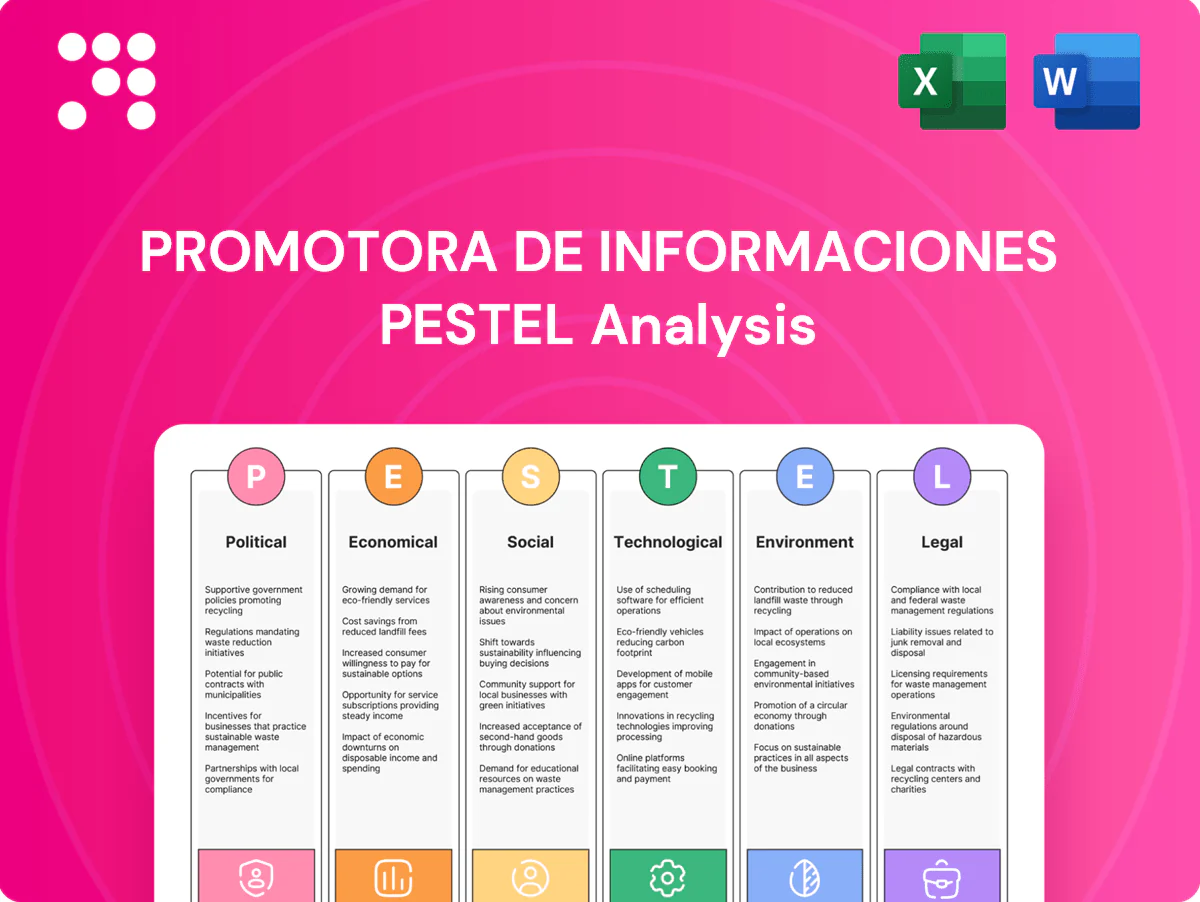
Promotora de Informaciones PESTLE Analysis

Skip the Research. Get the Strategy.
Unlock how political shifts, economic trends, social changes, and regulatory pressures shape Promotora de Informaciones’s strategic outlook with our concise PESTLE snapshot. Ideal for investors and planners, it highlights immediate risks and opportunities. Purchase the full PESTLE for a comprehensive, actionable breakdown ready for decision-making.
Political factors

EU and Spanish media policy shifts
EU rules such as the Audiovisual Media Services Directive (which mandates at least 30% European works for VOD) and Spain’s 2022 Ley General de Comunicación Audiovisual reshape licensing, spectrum and content quotas that affect PRISA’s radio and news units. Public service priorities, election cycles and allocation of government advertising can rapidly alter competitive dynamics and revenue flows. Monitoring Madrid and Brussels regulatory agendas, including the Digital Services Act/DMA framework rolled out 2022–2024, helps anticipate compliance costs and openings. Proactive engagement reduces abrupt policy risk across news, radio and education segments.
Press freedom and political polarization
Political polarization across Spain and Latin America undermines audience trust, raises threats to reporter safety and pressures editorial independence, reflected in Spain’s 2024 RSF press freedom rank of 32/180. Changes in government affect access, public advertising and legal scrutiny, impacting PRISA (Promotora de Informaciones) revenue sensitivity — group revenues near 1.1 billion euros (2024). Rigorous editorial standards sustain El País and Cadena SER brand equity, while crisis protocols are essential to counter election disinformation spikes.

Latin American country risk
Operations across 33 Latin American countries face policy volatility, FX controls in Argentina and Venezuela and shifting subsidy regimes that disrupt content distribution and cash flows. Changes in education policy affect Santillana’s approvals and public procurement timing. Media ownership and foreign investment limits in several LATAM markets can constrain partnerships or expansion. Diversifying footprint and hedging political exposure helps stabilize revenues.

Digital platform regulation (DSA/DMA)
EU Digital Services Act (in force Aug 2023) and Digital Markets Act (gatekeeper rules applied 2023) reshape distribution, moderation and bargaining with ~22 designated gatekeepers; DSA fines up to 6% of global turnover and DMA up to 10% (20% for repeated breaches). Greater transparency aids publishers but adds compliance on content flows; PRISA can press platform obligations to boost visibility and monetization while legal readiness cuts takedown risk and fines.
- DSA: fines up to 6% turnover
- DMA: fines up to 10% (20% repeat)
- ~22 gatekeepers designated (2023)
- Opportunity: improved visibility/monetization for PRISA
Public education spending priorities
Government K-12 and secondary budgets drive curriculum adoptions and demand for textbooks and digital content; Spain spent about 4% of GDP on education in OECD 2023 data, shaping national tenders that affect PRISA/Santillana adoptions. Electoral cycles and fiscal constraints can delay multi-year tenders or accelerate shifts from print to digital; Santillana must align with evolving standards and engage in proactive policy dialogue to secure stable programs.
- Budget drivers: national K-12 allocations shape demand
- Timing risk: electoral cycles can delay tenders
- Format shift: rising digital adoption pressures print margins
- Strategy: align to standards and pursue policy dialogue
AVMSD & DSA/DMA reshape media: platforms face 6% and 10–20% fines
EU AVMSD, DSA/DMA and Spain’s 2022 media law reshape quotas, licensing and platform fines (DSA 6%, DMA 10/20%). Polarization and RSF 32/180 (2024) heighten editorial risk; PRISA rev ~€1.1bn (2024). LATAM FX controls and ownership limits across ~33 countries affect Santillana; Spain education spend ~4% GDP (2023).
| Metric | Value |
|---|---|
| PRISA rev | €1.1bn (2024) |
| RSF rank | 32/180 (2024) |
| LATAM footprint | ~33 countries |
| Spain edu spend | ~4% GDP (2023) |
What is included in the product
 Detailed Word Document
Explores how Political, Economic, Social, Technological, Environmental and Legal forces uniquely affect Promotora de Informaciones, with data-backed, region-specific insights and forward-looking implications to aid executives, investors and strategists.

 Customizable Excel Spreadsheet
A concise, visually segmented PESTLE summary for Promotora de Informaciones that’s easy to drop into presentations or share across teams, supporting quick alignment on external risks, market positioning, and strategic planning.
Economic factors

Advertising cycle sensitivity
Macroeconomic slowdowns quickly reduce ad spend on news, radio and audio, pressuring Promotora de Informaciones margins as spot and brand buys are pulled. Recovery phases favor digital formats—programmatic now accounts for over 70% of global digital display spend—boosting yield and branded content mixes. Diversification into subscriptions and events (publishers report these channels can contribute double‑digit revenue shares) dampens cyclicality. Flexible cost structures preserve EBITDA during downturns.
FX and inflation in LATAM
Revenue and costs in Argentine pesos and Brazilian reais create material EUR translation risk as EUR/BRL traded near 5.0 in 2024 and Argentina faced inflation above 100% in 2024 while Brazil's IPCA was around 4%–5%, amplifying margin volatility. Active hedging and local pricing strategies are essential to protect cash flow and working capital against FX swings. Inflation raises paper, distribution and talent costs, and indexation clauses in contracts help preserve real revenues.

Digital subscription scalability
Growth in paid digital news and audio memberships—Reuters Institute reports paid news subscriptions rose ~16% y/y to about 220 million in 2024—can smooth PRISA revenue seasonality by adding recurring cash flow. Pricing power will hinge on unique El País journalism, LOS40 brand bundling and churn control. Data-driven upsells across El País, LOS40 and podcasts boost ARPU, while a robust paywall and CRM stack raise customer lifetime value.

Interest rates and leverage
- ECB rate 4.00% (2024)
- Net financial debt ~€1.36bn (FY2023)
- Focus: high-ROI digital capex
- Mitigation: tenor extension, interest swaps
Education market cycles
Santillana faces adoption calendars and multi-year curriculum reforms that create revenue lumpiness across years; transitions from print to digital subscriptions shift cash conversion cycles, raising working-capital needs and often compressing gross margins. Public procurement timing and school-cycle purchases cause quarter-to-quarter volatility, while diversified private-sector sales help smooth peaks and troughs.
- Adoption cycles: cause lumpiness
- Print→digital: higher WC, margin pressure
- Public procurement: quarterly swings
- Private sales: smoothing effect
AVMSD & DSA/DMA reshape media: platforms face 6% and 10–20% fines
Macroeconomic slowdowns cut ad spend, pressuring margins while recoveries favor programmatic (>$70% global digital display) and subscriptions (~220m paid news subs, +16% y/y). FX (EUR/BRL ~5.0 in 2024; AR inflation >100% in 2024) and ECB rates (~4.0% 2024) amplify financing and input-cost volatility; active hedging and liability management are critical.
| Metric | Value (2024/2023) |
|---|---|
| EUR/BRL | ~5.0 (2024) |
| Argentina inflation | >100% (2024) |
| ECB rate | ~4.0% (2024) |
| Net debt | €1.36bn (FY2023) |
Same Document Delivered
Promotora de Informaciones PESTLE Analysis
The preview shown here is the exact Promotora de Informaciones PESTLE Analysis you’ll receive after purchase—fully formatted and ready to use. The layout, content, and structure visible are the final file delivered immediately after payment. No placeholders or surprises—this is the real, professional document.

Skip the Research. Get the Strategy.
Unlock how political shifts, economic trends, social changes, and regulatory pressures shape Promotora de Informaciones’s strategic outlook with our concise PESTLE snapshot. Ideal for investors and planners, it highlights immediate risks and opportunities. Purchase the full PESTLE for a comprehensive, actionable breakdown ready for decision-making.
Political factors
EU and Spanish media policy shifts
EU rules such as the Audiovisual Media Services Directive (which mandates at least 30% European works for VOD) and Spain’s 2022 Ley General de Comunicación Audiovisual reshape licensing, spectrum and content quotas that affect PRISA’s radio and news units. Public service priorities, election cycles and allocation of government advertising can rapidly alter competitive dynamics and revenue flows. Monitoring Madrid and Brussels regulatory agendas, including the Digital Services Act/DMA framework rolled out 2022–2024, helps anticipate compliance costs and openings. Proactive engagement reduces abrupt policy risk across news, radio and education segments.
Press freedom and political polarization
Political polarization across Spain and Latin America undermines audience trust, raises threats to reporter safety and pressures editorial independence, reflected in Spain’s 2024 RSF press freedom rank of 32/180. Changes in government affect access, public advertising and legal scrutiny, impacting PRISA (Promotora de Informaciones) revenue sensitivity — group revenues near 1.1 billion euros (2024). Rigorous editorial standards sustain El País and Cadena SER brand equity, while crisis protocols are essential to counter election disinformation spikes.
Latin American country risk
Operations across 33 Latin American countries face policy volatility, FX controls in Argentina and Venezuela and shifting subsidy regimes that disrupt content distribution and cash flows. Changes in education policy affect Santillana’s approvals and public procurement timing. Media ownership and foreign investment limits in several LATAM markets can constrain partnerships or expansion. Diversifying footprint and hedging political exposure helps stabilize revenues.
Digital platform regulation (DSA/DMA)
EU Digital Services Act (in force Aug 2023) and Digital Markets Act (gatekeeper rules applied 2023) reshape distribution, moderation and bargaining with ~22 designated gatekeepers; DSA fines up to 6% of global turnover and DMA up to 10% (20% for repeated breaches). Greater transparency aids publishers but adds compliance on content flows; PRISA can press platform obligations to boost visibility and monetization while legal readiness cuts takedown risk and fines.
- DSA: fines up to 6% turnover
- DMA: fines up to 10% (20% repeat)
- ~22 gatekeepers designated (2023)
- Opportunity: improved visibility/monetization for PRISA
Public education spending priorities
Government K-12 and secondary budgets drive curriculum adoptions and demand for textbooks and digital content; Spain spent about 4% of GDP on education in OECD 2023 data, shaping national tenders that affect PRISA/Santillana adoptions. Electoral cycles and fiscal constraints can delay multi-year tenders or accelerate shifts from print to digital; Santillana must align with evolving standards and engage in proactive policy dialogue to secure stable programs.
- Budget drivers: national K-12 allocations shape demand
- Timing risk: electoral cycles can delay tenders
- Format shift: rising digital adoption pressures print margins
- Strategy: align to standards and pursue policy dialogue
AVMSD & DSA/DMA reshape media: platforms face 6% and 10–20% fines
EU AVMSD, DSA/DMA and Spain’s 2022 media law reshape quotas, licensing and platform fines (DSA 6%, DMA 10/20%). Polarization and RSF 32/180 (2024) heighten editorial risk; PRISA rev ~€1.1bn (2024). LATAM FX controls and ownership limits across ~33 countries affect Santillana; Spain education spend ~4% GDP (2023).
| Metric | Value |
|---|---|
| PRISA rev | €1.1bn (2024) |
| RSF rank | 32/180 (2024) |
| LATAM footprint | ~33 countries |
| Spain edu spend | ~4% GDP (2023) |
What is included in the product
Detailed Word Document
Explores how Political, Economic, Social, Technological, Environmental and Legal forces uniquely affect Promotora de Informaciones, with data-backed, region-specific insights and forward-looking implications to aid executives, investors and strategists.
Customizable Excel Spreadsheet
A concise, visually segmented PESTLE summary for Promotora de Informaciones that’s easy to drop into presentations or share across teams, supporting quick alignment on external risks, market positioning, and strategic planning.
Economic factors
Advertising cycle sensitivity
Macroeconomic slowdowns quickly reduce ad spend on news, radio and audio, pressuring Promotora de Informaciones margins as spot and brand buys are pulled. Recovery phases favor digital formats—programmatic now accounts for over 70% of global digital display spend—boosting yield and branded content mixes. Diversification into subscriptions and events (publishers report these channels can contribute double‑digit revenue shares) dampens cyclicality. Flexible cost structures preserve EBITDA during downturns.
FX and inflation in LATAM
Revenue and costs in Argentine pesos and Brazilian reais create material EUR translation risk as EUR/BRL traded near 5.0 in 2024 and Argentina faced inflation above 100% in 2024 while Brazil's IPCA was around 4%–5%, amplifying margin volatility. Active hedging and local pricing strategies are essential to protect cash flow and working capital against FX swings. Inflation raises paper, distribution and talent costs, and indexation clauses in contracts help preserve real revenues.
Digital subscription scalability
Growth in paid digital news and audio memberships—Reuters Institute reports paid news subscriptions rose ~16% y/y to about 220 million in 2024—can smooth PRISA revenue seasonality by adding recurring cash flow. Pricing power will hinge on unique El País journalism, LOS40 brand bundling and churn control. Data-driven upsells across El País, LOS40 and podcasts boost ARPU, while a robust paywall and CRM stack raise customer lifetime value.
Interest rates and leverage
- ECB rate 4.00% (2024)
- Net financial debt ~€1.36bn (FY2023)
- Focus: high-ROI digital capex
- Mitigation: tenor extension, interest swaps
Education market cycles
Santillana faces adoption calendars and multi-year curriculum reforms that create revenue lumpiness across years; transitions from print to digital subscriptions shift cash conversion cycles, raising working-capital needs and often compressing gross margins. Public procurement timing and school-cycle purchases cause quarter-to-quarter volatility, while diversified private-sector sales help smooth peaks and troughs.
- Adoption cycles: cause lumpiness
- Print→digital: higher WC, margin pressure
- Public procurement: quarterly swings
- Private sales: smoothing effect
AVMSD & DSA/DMA reshape media: platforms face 6% and 10–20% fines
Macroeconomic slowdowns cut ad spend, pressuring margins while recoveries favor programmatic (>$70% global digital display) and subscriptions (~220m paid news subs, +16% y/y). FX (EUR/BRL ~5.0 in 2024; AR inflation >100% in 2024) and ECB rates (~4.0% 2024) amplify financing and input-cost volatility; active hedging and liability management are critical.
| Metric | Value (2024/2023) |
|---|---|
| EUR/BRL | ~5.0 (2024) |
| Argentina inflation | >100% (2024) |
| ECB rate | ~4.0% (2024) |
| Net debt | €1.36bn (FY2023) |
Same Document Delivered
Promotora de Informaciones PESTLE Analysis
The preview shown here is the exact Promotora de Informaciones PESTLE Analysis you’ll receive after purchase—fully formatted and ready to use. The layout, content, and structure visible are the final file delivered immediately after payment. No placeholders or surprises—this is the real, professional document.
Original: $10.00
-65%$10.00
$3.50Description
Skip the Research. Get the Strategy.
Unlock how political shifts, economic trends, social changes, and regulatory pressures shape Promotora de Informaciones’s strategic outlook with our concise PESTLE snapshot. Ideal for investors and planners, it highlights immediate risks and opportunities. Purchase the full PESTLE for a comprehensive, actionable breakdown ready for decision-making.
Political factors
EU and Spanish media policy shifts
EU rules such as the Audiovisual Media Services Directive (which mandates at least 30% European works for VOD) and Spain’s 2022 Ley General de Comunicación Audiovisual reshape licensing, spectrum and content quotas that affect PRISA’s radio and news units. Public service priorities, election cycles and allocation of government advertising can rapidly alter competitive dynamics and revenue flows. Monitoring Madrid and Brussels regulatory agendas, including the Digital Services Act/DMA framework rolled out 2022–2024, helps anticipate compliance costs and openings. Proactive engagement reduces abrupt policy risk across news, radio and education segments.
Press freedom and political polarization
Political polarization across Spain and Latin America undermines audience trust, raises threats to reporter safety and pressures editorial independence, reflected in Spain’s 2024 RSF press freedom rank of 32/180. Changes in government affect access, public advertising and legal scrutiny, impacting PRISA (Promotora de Informaciones) revenue sensitivity — group revenues near 1.1 billion euros (2024). Rigorous editorial standards sustain El País and Cadena SER brand equity, while crisis protocols are essential to counter election disinformation spikes.
Latin American country risk
Operations across 33 Latin American countries face policy volatility, FX controls in Argentina and Venezuela and shifting subsidy regimes that disrupt content distribution and cash flows. Changes in education policy affect Santillana’s approvals and public procurement timing. Media ownership and foreign investment limits in several LATAM markets can constrain partnerships or expansion. Diversifying footprint and hedging political exposure helps stabilize revenues.
Digital platform regulation (DSA/DMA)
EU Digital Services Act (in force Aug 2023) and Digital Markets Act (gatekeeper rules applied 2023) reshape distribution, moderation and bargaining with ~22 designated gatekeepers; DSA fines up to 6% of global turnover and DMA up to 10% (20% for repeated breaches). Greater transparency aids publishers but adds compliance on content flows; PRISA can press platform obligations to boost visibility and monetization while legal readiness cuts takedown risk and fines.
- DSA: fines up to 6% turnover
- DMA: fines up to 10% (20% repeat)
- ~22 gatekeepers designated (2023)
- Opportunity: improved visibility/monetization for PRISA
Public education spending priorities
Government K-12 and secondary budgets drive curriculum adoptions and demand for textbooks and digital content; Spain spent about 4% of GDP on education in OECD 2023 data, shaping national tenders that affect PRISA/Santillana adoptions. Electoral cycles and fiscal constraints can delay multi-year tenders or accelerate shifts from print to digital; Santillana must align with evolving standards and engage in proactive policy dialogue to secure stable programs.
- Budget drivers: national K-12 allocations shape demand
- Timing risk: electoral cycles can delay tenders
- Format shift: rising digital adoption pressures print margins
- Strategy: align to standards and pursue policy dialogue
AVMSD & DSA/DMA reshape media: platforms face 6% and 10–20% fines
EU AVMSD, DSA/DMA and Spain’s 2022 media law reshape quotas, licensing and platform fines (DSA 6%, DMA 10/20%). Polarization and RSF 32/180 (2024) heighten editorial risk; PRISA rev ~€1.1bn (2024). LATAM FX controls and ownership limits across ~33 countries affect Santillana; Spain education spend ~4% GDP (2023).
| Metric | Value |
|---|---|
| PRISA rev | €1.1bn (2024) |
| RSF rank | 32/180 (2024) |
| LATAM footprint | ~33 countries |
| Spain edu spend | ~4% GDP (2023) |
What is included in the product
Detailed Word Document
Explores how Political, Economic, Social, Technological, Environmental and Legal forces uniquely affect Promotora de Informaciones, with data-backed, region-specific insights and forward-looking implications to aid executives, investors and strategists.
Customizable Excel Spreadsheet
A concise, visually segmented PESTLE summary for Promotora de Informaciones that’s easy to drop into presentations or share across teams, supporting quick alignment on external risks, market positioning, and strategic planning.
Economic factors
Advertising cycle sensitivity
Macroeconomic slowdowns quickly reduce ad spend on news, radio and audio, pressuring Promotora de Informaciones margins as spot and brand buys are pulled. Recovery phases favor digital formats—programmatic now accounts for over 70% of global digital display spend—boosting yield and branded content mixes. Diversification into subscriptions and events (publishers report these channels can contribute double‑digit revenue shares) dampens cyclicality. Flexible cost structures preserve EBITDA during downturns.
FX and inflation in LATAM
Revenue and costs in Argentine pesos and Brazilian reais create material EUR translation risk as EUR/BRL traded near 5.0 in 2024 and Argentina faced inflation above 100% in 2024 while Brazil's IPCA was around 4%–5%, amplifying margin volatility. Active hedging and local pricing strategies are essential to protect cash flow and working capital against FX swings. Inflation raises paper, distribution and talent costs, and indexation clauses in contracts help preserve real revenues.
Digital subscription scalability
Growth in paid digital news and audio memberships—Reuters Institute reports paid news subscriptions rose ~16% y/y to about 220 million in 2024—can smooth PRISA revenue seasonality by adding recurring cash flow. Pricing power will hinge on unique El País journalism, LOS40 brand bundling and churn control. Data-driven upsells across El País, LOS40 and podcasts boost ARPU, while a robust paywall and CRM stack raise customer lifetime value.
Interest rates and leverage
- ECB rate 4.00% (2024)
- Net financial debt ~€1.36bn (FY2023)
- Focus: high-ROI digital capex
- Mitigation: tenor extension, interest swaps
Education market cycles
Santillana faces adoption calendars and multi-year curriculum reforms that create revenue lumpiness across years; transitions from print to digital subscriptions shift cash conversion cycles, raising working-capital needs and often compressing gross margins. Public procurement timing and school-cycle purchases cause quarter-to-quarter volatility, while diversified private-sector sales help smooth peaks and troughs.
- Adoption cycles: cause lumpiness
- Print→digital: higher WC, margin pressure
- Public procurement: quarterly swings
- Private sales: smoothing effect
AVMSD & DSA/DMA reshape media: platforms face 6% and 10–20% fines
Macroeconomic slowdowns cut ad spend, pressuring margins while recoveries favor programmatic (>$70% global digital display) and subscriptions (~220m paid news subs, +16% y/y). FX (EUR/BRL ~5.0 in 2024; AR inflation >100% in 2024) and ECB rates (~4.0% 2024) amplify financing and input-cost volatility; active hedging and liability management are critical.
| Metric | Value (2024/2023) |
|---|---|
| EUR/BRL | ~5.0 (2024) |
| Argentina inflation | >100% (2024) |
| ECB rate | ~4.0% (2024) |
| Net debt | €1.36bn (FY2023) |
Same Document Delivered
Promotora de Informaciones PESTLE Analysis
The preview shown here is the exact Promotora de Informaciones PESTLE Analysis you’ll receive after purchase—fully formatted and ready to use. The layout, content, and structure visible are the final file delivered immediately after payment. No placeholders or surprises—this is the real, professional document.











