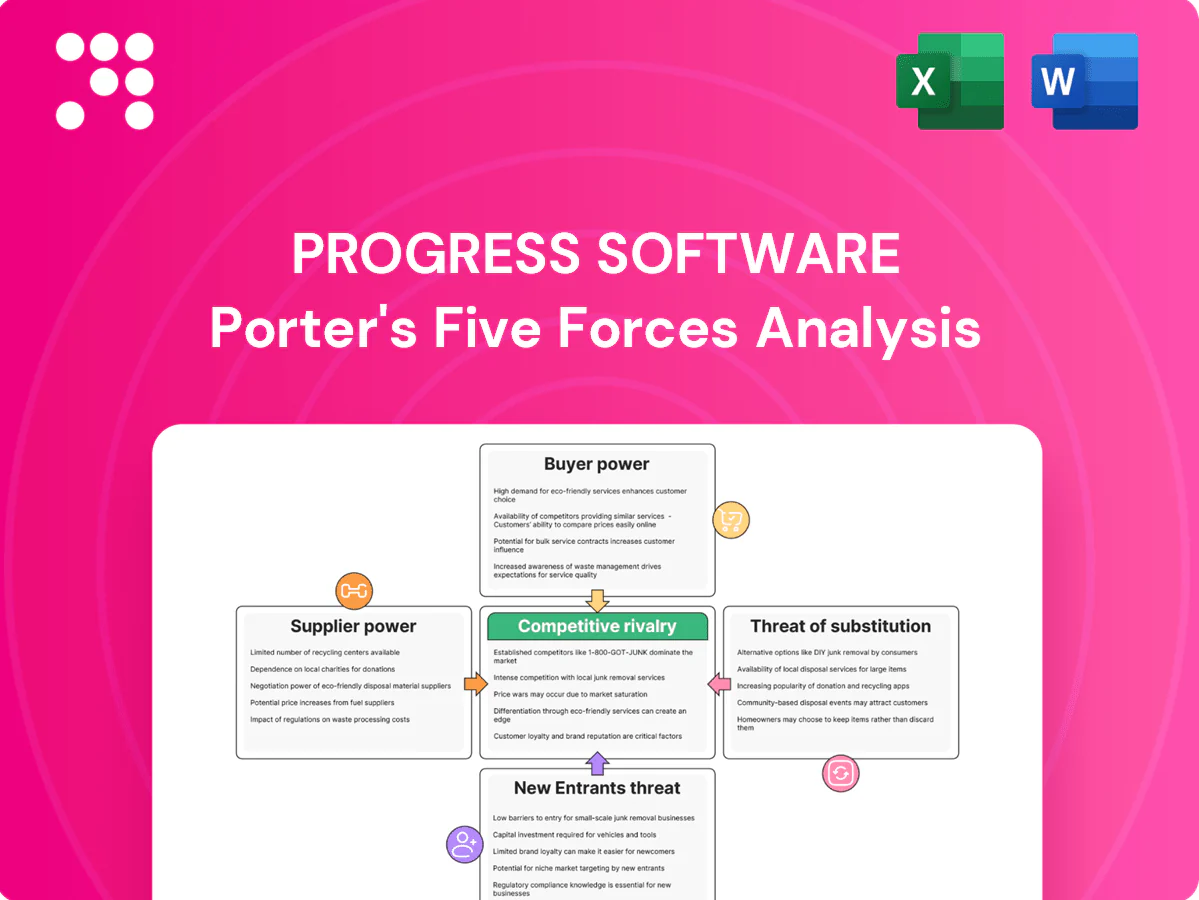
Progress Software Porter's Five Forces Analysis

A Must-Have Tool for Decision-Makers
Progress Software faces moderate supplier power, intense rivalry in application development platforms, and rising substitute threats as cloud-native alternatives proliferate. Buyer bargaining and switching costs will shape adoption and margins. This brief snapshot only scratches the surface. Unlock the full Porter's Five Forces Analysis to explore Progress Software’s competitive dynamics, market pressures, and strategic advantages in detail.
Suppliers Bargaining Power

Concentrated cloud infrastructure
Progress depends on major IaaS/PaaS providers—AWS (~31% global market share in 2024), Azure (~23%) and GCP (~11%)—giving suppliers pricing and policy leverage that can squeeze margins and alter roadmap timing. Changes in fees or partner terms can raise hosting costs or integration complexity. Multi-cloud support and containerization reduce exposure but provider migration remains costly and operationally complex. Preferential partner status can lower supplier power but demands sustained volume and co-selling alignment.
Critical open-source components
Many Progress dev and data products embed open-source libraries used in 99% of modern codebases (Synopsys OSSRA 2024); while licensing fees are low, security patches, roadmap shifts or community fragmentation create dependency risk. Progress must invest in curation, vulnerability management and paid long-term support to stabilize inputs and comply with SLAs. Forking or replacing core components drives significant engineering effort and cost, reducing supplier bargaining leverage.

Specialized software vendors/OEMs
Connectivity drivers, database vendors (Oracle and MySQL rank top two in DB-Engines as of 2024) and niche SDK providers can be hard to replace, giving suppliers pricing leverage when few equivalents exist. Co-innovation and certification programs often rebalance power by locking in joint roadmaps and services. Building in-house alternatives cuts dependency but typically adds months to time-to-market and increases upfront costs.

Skilled engineering talent
Data/licensing and compliance inputs
Data/licensing and compliance inputs tie Progress to recurring supplier costs via compliance tooling, security certificates and embedded IP (codecs, fonts); price hikes or audits can materially raise costs relative to 2024 fiscal pressures (Progress reported ~1.03B revenue in FY2024). Diversifying vendors and multi-year contracts reduce exposure; building proprietary substitutes is feasible but rarely economical across all asset classes.
- Compliance tooling: recurring fees
- Certificates/IP: audit risk
- Mitigation: vendor diversification
- Tradeoff: costly proprietary build
IaaS/PaaS lead (AWS 31% Azure 23% GCP 11) and 99% OSS raise migration, talent costs
Progress depends on IaaS/PaaS (AWS 31% 2024; Azure 23%; GCP 11%) and ubiquitous OSS (99% of codebases), giving pricing, security and roadmap leverage. Migration, DB/SDK replacement and talent (27.7M devs; US median wage $110,140) are costly; multi-cloud, certifications and vendor diversification mitigate.
| Metric | Value |
|---|---|
| AWS share 2024 | 31% |
| Azure | 23% |
| GCP | 11% |
| Progress FY2024 rev | $1.03B |
What is included in the product
 Detailed Word Document
Tailored Porter’s Five Forces analysis for Progress Software examining competitive rivalry, buyer/supplier power, threat of new entrants and substitutes, plus emerging disruptive forces and strategic protections for market share.

 Customizable Excel Spreadsheet
Clear, one-sheet Porter's Five Forces for Progress Software—instantly visualize competitive pressure with a spider chart, customize inputs for evolving threats and integrate into decks without macros for fast decision-making.
Customers Bargaining Power

Large enterprise procurement clout
Progress sells primarily to midsize and large enterprises with formal procurement teams; RFPs, volume commitments and competitive bidding in 2024 intensify buyer leverage over price and commercial terms. Referenceability and documented ROI from case studies help defend value and limit concessions. Multi-year contracts commonly trade 10–15% discounts for higher retention and predictable ARR.
Moderate-to-high switching costs
Integration footprints, developer training, and app dependencies create moderate-to-high switching costs that blunt day-one buyer leverage while still allowing buyers to solicit competitive quotes at renewal. Interoperability and adherence to open standards reduce perceived risk without fully removing vendor stickiness. Robust migration tooling both attracts new customers and fortifies incumbent accounts during renewal negotiations.

Abundant alternatives across categories
Customers can pit Progress against hyperscalers, pure-plays and open-source options, with AWS+Azure+GCP controlling about 67% of the IaaS/PaaS market in 2024. Feature parity in core areas elevates price sensitivity, compressing willingness to pay. Bundled suites from larger vendors frequently undercut standalone pricing by double-digit margins. Differentiation in TCO, time-to-value and premium support cuts buyer leverage.

Outcome-focused, ROI-driven deals
Buyers push for outcome-focused, ROI-driven deals emphasizing faster dev cycles, broad data connectivity and 99.95%+ reliability; clear metrics — deployment time, throughput, SLAs — drive negotiation leverage and downgrades in perceived value. Packaging by usage, seats and connectors captures upsell; misaligned pricing raises churn risk by ~20% (2024 industry averages).
- Metric-driven negotiations
- Target SLAs 99.95%+
- Package by usage/connectors
- Mispricing ≈ +20% churn (2024)
Demand for interoperability and openness
Enterprises in 2024 demand seamless integration across databases, clouds, and apps, punishing vendors that enforce lock-in with procurement pushback and discount pressure; open APIs, standards support, and broad connector libraries are now table stakes, and strong ecosystem partnerships convert buyer demands into co-selling opportunities.
- Open APIs and connectors required; ecosystem partnerships drive sales alignment
RFP leverage powers enterprises; top-3 cloud ~67%
Large-enterprise buyers wield high price leverage via RFPs and multi-vendor sourcing; 2024 IaaS/PaaS concentration (AWS+Azure+GCP ~67%) intensifies alternatives.
Integration and migration tooling raise switching costs, but typical renewals trade 10–15% discounts for multi-year ARR.
Metric-driven SLAs (target 99.95%), ROI proof and connectors limit concessions; mispricing linked to ~20% higher churn in 2024.
| Metric | 2024 |
|---|---|
| IaaS/PaaS share (Top3) | ~67% |
| Renewal discount | 10–15% |
| Target SLA | 99.95%+ |
| Churn impact (mispricing) | ~+20% |
Same Document Delivered
Progress Software Porter's Five Forces Analysis
This preview shows the exact Progress Software Porter's Five Forces analysis you'll receive immediately after purchase—no placeholders or mockups. The document is fully formatted and ready for download and use upon payment. It's the final deliverable, complete and professionally written.

A Must-Have Tool for Decision-Makers
Progress Software faces moderate supplier power, intense rivalry in application development platforms, and rising substitute threats as cloud-native alternatives proliferate. Buyer bargaining and switching costs will shape adoption and margins. This brief snapshot only scratches the surface. Unlock the full Porter's Five Forces Analysis to explore Progress Software’s competitive dynamics, market pressures, and strategic advantages in detail.
Suppliers Bargaining Power
Concentrated cloud infrastructure
Progress depends on major IaaS/PaaS providers—AWS (~31% global market share in 2024), Azure (~23%) and GCP (~11%)—giving suppliers pricing and policy leverage that can squeeze margins and alter roadmap timing. Changes in fees or partner terms can raise hosting costs or integration complexity. Multi-cloud support and containerization reduce exposure but provider migration remains costly and operationally complex. Preferential partner status can lower supplier power but demands sustained volume and co-selling alignment.
Critical open-source components
Many Progress dev and data products embed open-source libraries used in 99% of modern codebases (Synopsys OSSRA 2024); while licensing fees are low, security patches, roadmap shifts or community fragmentation create dependency risk. Progress must invest in curation, vulnerability management and paid long-term support to stabilize inputs and comply with SLAs. Forking or replacing core components drives significant engineering effort and cost, reducing supplier bargaining leverage.
Specialized software vendors/OEMs
Connectivity drivers, database vendors (Oracle and MySQL rank top two in DB-Engines as of 2024) and niche SDK providers can be hard to replace, giving suppliers pricing leverage when few equivalents exist. Co-innovation and certification programs often rebalance power by locking in joint roadmaps and services. Building in-house alternatives cuts dependency but typically adds months to time-to-market and increases upfront costs.
Skilled engineering talent
Data/licensing and compliance inputs
Data/licensing and compliance inputs tie Progress to recurring supplier costs via compliance tooling, security certificates and embedded IP (codecs, fonts); price hikes or audits can materially raise costs relative to 2024 fiscal pressures (Progress reported ~1.03B revenue in FY2024). Diversifying vendors and multi-year contracts reduce exposure; building proprietary substitutes is feasible but rarely economical across all asset classes.
- Compliance tooling: recurring fees
- Certificates/IP: audit risk
- Mitigation: vendor diversification
- Tradeoff: costly proprietary build
IaaS/PaaS lead (AWS 31% Azure 23% GCP 11) and 99% OSS raise migration, talent costs
Progress depends on IaaS/PaaS (AWS 31% 2024; Azure 23%; GCP 11%) and ubiquitous OSS (99% of codebases), giving pricing, security and roadmap leverage. Migration, DB/SDK replacement and talent (27.7M devs; US median wage $110,140) are costly; multi-cloud, certifications and vendor diversification mitigate.
| Metric | Value |
|---|---|
| AWS share 2024 | 31% |
| Azure | 23% |
| GCP | 11% |
| Progress FY2024 rev | $1.03B |
What is included in the product
Detailed Word Document
Tailored Porter’s Five Forces analysis for Progress Software examining competitive rivalry, buyer/supplier power, threat of new entrants and substitutes, plus emerging disruptive forces and strategic protections for market share.
Customizable Excel Spreadsheet
Clear, one-sheet Porter's Five Forces for Progress Software—instantly visualize competitive pressure with a spider chart, customize inputs for evolving threats and integrate into decks without macros for fast decision-making.
Customers Bargaining Power
Large enterprise procurement clout
Progress sells primarily to midsize and large enterprises with formal procurement teams; RFPs, volume commitments and competitive bidding in 2024 intensify buyer leverage over price and commercial terms. Referenceability and documented ROI from case studies help defend value and limit concessions. Multi-year contracts commonly trade 10–15% discounts for higher retention and predictable ARR.
Moderate-to-high switching costs
Integration footprints, developer training, and app dependencies create moderate-to-high switching costs that blunt day-one buyer leverage while still allowing buyers to solicit competitive quotes at renewal. Interoperability and adherence to open standards reduce perceived risk without fully removing vendor stickiness. Robust migration tooling both attracts new customers and fortifies incumbent accounts during renewal negotiations.
Abundant alternatives across categories
Customers can pit Progress against hyperscalers, pure-plays and open-source options, with AWS+Azure+GCP controlling about 67% of the IaaS/PaaS market in 2024. Feature parity in core areas elevates price sensitivity, compressing willingness to pay. Bundled suites from larger vendors frequently undercut standalone pricing by double-digit margins. Differentiation in TCO, time-to-value and premium support cuts buyer leverage.
Outcome-focused, ROI-driven deals
Buyers push for outcome-focused, ROI-driven deals emphasizing faster dev cycles, broad data connectivity and 99.95%+ reliability; clear metrics — deployment time, throughput, SLAs — drive negotiation leverage and downgrades in perceived value. Packaging by usage, seats and connectors captures upsell; misaligned pricing raises churn risk by ~20% (2024 industry averages).
- Metric-driven negotiations
- Target SLAs 99.95%+
- Package by usage/connectors
- Mispricing ≈ +20% churn (2024)
Demand for interoperability and openness
Enterprises in 2024 demand seamless integration across databases, clouds, and apps, punishing vendors that enforce lock-in with procurement pushback and discount pressure; open APIs, standards support, and broad connector libraries are now table stakes, and strong ecosystem partnerships convert buyer demands into co-selling opportunities.
- Open APIs and connectors required; ecosystem partnerships drive sales alignment
RFP leverage powers enterprises; top-3 cloud ~67%
Large-enterprise buyers wield high price leverage via RFPs and multi-vendor sourcing; 2024 IaaS/PaaS concentration (AWS+Azure+GCP ~67%) intensifies alternatives.
Integration and migration tooling raise switching costs, but typical renewals trade 10–15% discounts for multi-year ARR.
Metric-driven SLAs (target 99.95%), ROI proof and connectors limit concessions; mispricing linked to ~20% higher churn in 2024.
| Metric | 2024 |
|---|---|
| IaaS/PaaS share (Top3) | ~67% |
| Renewal discount | 10–15% |
| Target SLA | 99.95%+ |
| Churn impact (mispricing) | ~+20% |
Same Document Delivered
Progress Software Porter's Five Forces Analysis
This preview shows the exact Progress Software Porter's Five Forces analysis you'll receive immediately after purchase—no placeholders or mockups. The document is fully formatted and ready for download and use upon payment. It's the final deliverable, complete and professionally written.
Description
A Must-Have Tool for Decision-Makers
Progress Software faces moderate supplier power, intense rivalry in application development platforms, and rising substitute threats as cloud-native alternatives proliferate. Buyer bargaining and switching costs will shape adoption and margins. This brief snapshot only scratches the surface. Unlock the full Porter's Five Forces Analysis to explore Progress Software’s competitive dynamics, market pressures, and strategic advantages in detail.
Suppliers Bargaining Power
Concentrated cloud infrastructure
Progress depends on major IaaS/PaaS providers—AWS (~31% global market share in 2024), Azure (~23%) and GCP (~11%)—giving suppliers pricing and policy leverage that can squeeze margins and alter roadmap timing. Changes in fees or partner terms can raise hosting costs or integration complexity. Multi-cloud support and containerization reduce exposure but provider migration remains costly and operationally complex. Preferential partner status can lower supplier power but demands sustained volume and co-selling alignment.
Critical open-source components
Many Progress dev and data products embed open-source libraries used in 99% of modern codebases (Synopsys OSSRA 2024); while licensing fees are low, security patches, roadmap shifts or community fragmentation create dependency risk. Progress must invest in curation, vulnerability management and paid long-term support to stabilize inputs and comply with SLAs. Forking or replacing core components drives significant engineering effort and cost, reducing supplier bargaining leverage.
Specialized software vendors/OEMs
Connectivity drivers, database vendors (Oracle and MySQL rank top two in DB-Engines as of 2024) and niche SDK providers can be hard to replace, giving suppliers pricing leverage when few equivalents exist. Co-innovation and certification programs often rebalance power by locking in joint roadmaps and services. Building in-house alternatives cuts dependency but typically adds months to time-to-market and increases upfront costs.
Skilled engineering talent
Data/licensing and compliance inputs
Data/licensing and compliance inputs tie Progress to recurring supplier costs via compliance tooling, security certificates and embedded IP (codecs, fonts); price hikes or audits can materially raise costs relative to 2024 fiscal pressures (Progress reported ~1.03B revenue in FY2024). Diversifying vendors and multi-year contracts reduce exposure; building proprietary substitutes is feasible but rarely economical across all asset classes.
- Compliance tooling: recurring fees
- Certificates/IP: audit risk
- Mitigation: vendor diversification
- Tradeoff: costly proprietary build
IaaS/PaaS lead (AWS 31% Azure 23% GCP 11) and 99% OSS raise migration, talent costs
Progress depends on IaaS/PaaS (AWS 31% 2024; Azure 23%; GCP 11%) and ubiquitous OSS (99% of codebases), giving pricing, security and roadmap leverage. Migration, DB/SDK replacement and talent (27.7M devs; US median wage $110,140) are costly; multi-cloud, certifications and vendor diversification mitigate.
| Metric | Value |
|---|---|
| AWS share 2024 | 31% |
| Azure | 23% |
| GCP | 11% |
| Progress FY2024 rev | $1.03B |
What is included in the product
Detailed Word Document
Tailored Porter’s Five Forces analysis for Progress Software examining competitive rivalry, buyer/supplier power, threat of new entrants and substitutes, plus emerging disruptive forces and strategic protections for market share.
Customizable Excel Spreadsheet
Clear, one-sheet Porter's Five Forces for Progress Software—instantly visualize competitive pressure with a spider chart, customize inputs for evolving threats and integrate into decks without macros for fast decision-making.
Customers Bargaining Power
Large enterprise procurement clout
Progress sells primarily to midsize and large enterprises with formal procurement teams; RFPs, volume commitments and competitive bidding in 2024 intensify buyer leverage over price and commercial terms. Referenceability and documented ROI from case studies help defend value and limit concessions. Multi-year contracts commonly trade 10–15% discounts for higher retention and predictable ARR.
Moderate-to-high switching costs
Integration footprints, developer training, and app dependencies create moderate-to-high switching costs that blunt day-one buyer leverage while still allowing buyers to solicit competitive quotes at renewal. Interoperability and adherence to open standards reduce perceived risk without fully removing vendor stickiness. Robust migration tooling both attracts new customers and fortifies incumbent accounts during renewal negotiations.
Abundant alternatives across categories
Customers can pit Progress against hyperscalers, pure-plays and open-source options, with AWS+Azure+GCP controlling about 67% of the IaaS/PaaS market in 2024. Feature parity in core areas elevates price sensitivity, compressing willingness to pay. Bundled suites from larger vendors frequently undercut standalone pricing by double-digit margins. Differentiation in TCO, time-to-value and premium support cuts buyer leverage.
Outcome-focused, ROI-driven deals
Buyers push for outcome-focused, ROI-driven deals emphasizing faster dev cycles, broad data connectivity and 99.95%+ reliability; clear metrics — deployment time, throughput, SLAs — drive negotiation leverage and downgrades in perceived value. Packaging by usage, seats and connectors captures upsell; misaligned pricing raises churn risk by ~20% (2024 industry averages).
- Metric-driven negotiations
- Target SLAs 99.95%+
- Package by usage/connectors
- Mispricing ≈ +20% churn (2024)
Demand for interoperability and openness
Enterprises in 2024 demand seamless integration across databases, clouds, and apps, punishing vendors that enforce lock-in with procurement pushback and discount pressure; open APIs, standards support, and broad connector libraries are now table stakes, and strong ecosystem partnerships convert buyer demands into co-selling opportunities.
- Open APIs and connectors required; ecosystem partnerships drive sales alignment
RFP leverage powers enterprises; top-3 cloud ~67%
Large-enterprise buyers wield high price leverage via RFPs and multi-vendor sourcing; 2024 IaaS/PaaS concentration (AWS+Azure+GCP ~67%) intensifies alternatives.
Integration and migration tooling raise switching costs, but typical renewals trade 10–15% discounts for multi-year ARR.
Metric-driven SLAs (target 99.95%), ROI proof and connectors limit concessions; mispricing linked to ~20% higher churn in 2024.
| Metric | 2024 |
|---|---|
| IaaS/PaaS share (Top3) | ~67% |
| Renewal discount | 10–15% |
| Target SLA | 99.95%+ |
| Churn impact (mispricing) | ~+20% |
Same Document Delivered
Progress Software Porter's Five Forces Analysis
This preview shows the exact Progress Software Porter's Five Forces analysis you'll receive immediately after purchase—no placeholders or mockups. The document is fully formatted and ready for download and use upon payment. It's the final deliverable, complete and professionally written.











