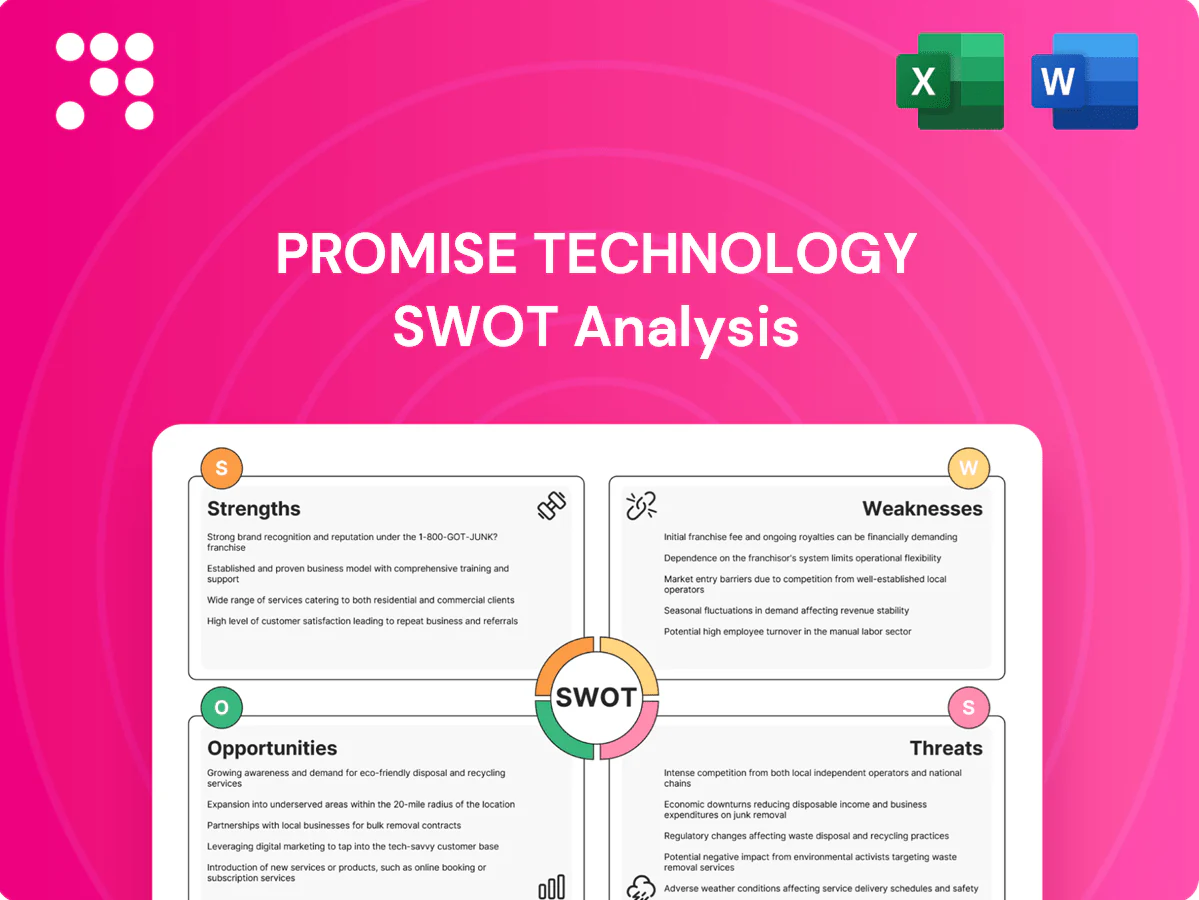
Promise Technology SWOT Analysis

Dive Deeper Into the Company’s Strategic Blueprint
Promise Technology’s SWOT snapshot highlights its storage innovation, channel partnerships, and niche enterprise focus, alongside competitive pressure and execution risks; it’s a must-read for tech investors and strategists. Want the full picture—detailed strengths, risks, market drivers, and financial context? Purchase the complete SWOT analysis to receive a professionally written, editable Word report plus an Excel matrix. Unlock research-backed insights to plan, pitch, or invest with confidence.
Strengths

Diversified storage portfolio
Promise Technology offers RAID, flash, and NAS systems across performance and capacity tiers, enabling tailored fits for data center, surveillance, and rich media workloads. This breadth lowers dependence on any single product category and supports cross-selling between flash and NAS lines. Standardized management across deployments simplifies operations and accelerates enterprise adoption.
Performance and reliability focus
Promise Technology emphasizes high IOPS and throughput with data-integrity features tailored for demanding workflows, supported by enterprise-grade components and proven RAID architectures that enhance uptime. Reliability is a clear differentiator in surveillance and production environments, and tightly aligned SLAs have driven measurable customer retention and repeat business.

Scalability across use cases
Promise Technology enables scalable deployments from edge to core, supporting capacity expansion and mixed protocol needs for surveillance and media workflows. Modular growth reduces upfront CAPEX while accommodating future data growth, critical for multi-day video retention and media asset archives. IDC forecasts the global datasphere will hit 175 ZB by 2025, underscoring why flexible scaling lowers TCO over the lifecycle.

Vertical market specialization
Targeting surveillance and rich-media workloads lets Promise tune performance and obtain certifications for high-throughput video capture; unstructured data accounts for about 80% of enterprise data (IDC), driving specialized needs. Verticalized reference architectures shorten time-to-value with prevalidated designs. Industry firmware and integrations raise reliability and allow premium positioning versus generic storage.
- Focus: surveillance & rich media
- Benefit: faster deployments, prevalidated stacks
- Outcome: higher reliability, premium pricing
Channel and OEM readiness
Promise Technologys hardware-forward portfolio, anchored by Vess storage and Pegasus RAIDs, aligns with reseller, systems integrator and OEM motions, offering clear SKUs and established support models that reduce integration friction. Partner enablement programs expand reach into regional markets and specialized niches, lowering direct sales overhead and accelerating deployment in verticals like media and surveillance.
- Vess and Pegasus product lines
- Clear SKUs and support models
- OEM and SI-friendly architecture
- Faster regional and vertical penetration
RAID+flash NAS for surveillance — 80% unstructured, 175 ZB
Promise Technology combines RAID, flash and NAS breadth with Vess and Pegasus SKUs to serve surveillance and rich-media needs. High IOPS, enterprise RAID and SLAs drive uptime and customer retention. Edge-to-core scalability reduces CAPEX as unstructured data hits ~80% of enterprise data and the global datasphere targets 175 ZB by 2025 (IDC).
| Strength | Metric |
|---|---|
| Unstructured data focus | ~80% (IDC) |
| Datasphere | 175 ZB by 2025 (IDC) |
What is included in the product
 Detailed Word Document
Provides a concise SWOT overview of Promise Technology’s internal capabilities and external market conditions, highlighting strengths, weaknesses, growth opportunities, and potential threats to its competitive position.

 Customizable Excel Spreadsheet
Delivers a concise SWOT matrix for Promise Technology that quickly highlights strengths, weaknesses, opportunities and threats, enabling fast alignment and actionable strategy adjustments across teams.
Weaknesses

Brand visibility versus tier-1 vendors
Against Dell (FY2024 revenue $102.3B), HPE (FY2024 revenue ~$27.8B), NetApp (FY2024 revenue ~$6.9B) and Pure (FY2024 revenue ~$2.5B), Promise Technology’s brand awareness can lag, causing enterprise buyers to default to familiar incumbents. This shortlisting tendency lengthens sales cycles and raises proof-of-concept demands, increasing customer acquisition cost. Marketing spend must be disproportionately higher to win mindshare and shorten time-to-deal.
Exposure to hardware commoditization
Storage hardware faces ongoing price erosion as components standardize: NAND flash contract prices fell about 30% in 2023 (TrendForce), and enterprise external storage revenue slipped mid-single digits YoY (IDC), increasing margin pressure in down cycles. Promise must shift differentiation into software, services and integrations to protect margins. Competing on price alone is unsustainable without higher‑margin software and services.

Limited cloud-native software ecosystem
Customers now expect rich APIs, orchestration, and cloud-native data services; CNCF 2024 found Kubernetes use in production exceeded 90%, raising baseline expectations. If Promise lags behind market leaders (AWS 32% and Microsoft 23% IaaS share in 2024), customer stickiness can decline. Gaps in multi-cloud mobility and object services hinder wins in cloud-first enterprises and constrain growth in the expanding cloud storage market.

Supply chain and component dependency
Reliance on HDDs, SSDs, third-party controllers and firmware vendors concentrates supply risk; lead times reaching up to 20 weeks have delayed deployments and inflated costs. 2024 surveillance rollouts reported component shortages that pushed timelines and warranty exposure. Maintaining buffer inventory and multi-sourcing reduces stockouts but raises procurement complexity and working capital.
- Dependency: HDD/SSD/controller vendors
- Lead time: up to 20 weeks
- Impact: delayed surveillance rollouts in 2024
- Mitigation cost: higher inventory and sourcing complexity
Concentration in select verticals
Concentration in surveillance and media gives Promise Technology strong product-market fit but limits diversification, making the company sensitive to sector slowdowns and budget reallocation by major customers; this over-reliance can drive pronounced quarterly revenue volatility. Expanding deeper into enterprise storage and cloud-native deployments is needed to stabilize pipeline and capture recurring, higher-margin contracts.
- Risk: customer budget shifts → tighter pipeline
- Need: broader enterprise and cloud penetration
- Impact: higher quarterly volatility from concentrated verticals
Brand lag, NAND deflation, cloud-native gaps and 20-week leads raise CAC and execution risk
Brand awareness lags vs incumbents (Dell $102.3B, HPE $27.8B, NetApp $6.9B, Pure $2.5B FY2024), lengthening sales cycles and raising CAC. Flash price deflation (NAND ~‑30% in 2023) and external storage revenue softness compress margins unless software/services growth accelerates. Gaps in cloud-native features (Kubernetes >90% prod, AWS 32%/Azure 23% IaaS 2024) and supply lead times up to 20 weeks heighten execution risk.
| Metric | Value |
|---|---|
| Top competitor rev (FY2024) | Dell $102.3B |
| NAND price change 2023 | ~‑30% |
| Max component lead time | 20 weeks |
Same Document Delivered
Promise Technology SWOT Analysis
This is the actual Promise Technology SWOT analysis document you’ll receive upon purchase—no surprises, just professional quality. The preview below is taken directly from the full report and highlights key strengths, weaknesses, opportunities, and threats specific to Promise Technology’s storage and data management business. Purchase unlocks the complete, editable version ready for use in strategy and valuation work.

Dive Deeper Into the Company’s Strategic Blueprint
Promise Technology’s SWOT snapshot highlights its storage innovation, channel partnerships, and niche enterprise focus, alongside competitive pressure and execution risks; it’s a must-read for tech investors and strategists. Want the full picture—detailed strengths, risks, market drivers, and financial context? Purchase the complete SWOT analysis to receive a professionally written, editable Word report plus an Excel matrix. Unlock research-backed insights to plan, pitch, or invest with confidence.
Strengths
Diversified storage portfolio
Promise Technology offers RAID, flash, and NAS systems across performance and capacity tiers, enabling tailored fits for data center, surveillance, and rich media workloads. This breadth lowers dependence on any single product category and supports cross-selling between flash and NAS lines. Standardized management across deployments simplifies operations and accelerates enterprise adoption.
Performance and reliability focus
Promise Technology emphasizes high IOPS and throughput with data-integrity features tailored for demanding workflows, supported by enterprise-grade components and proven RAID architectures that enhance uptime. Reliability is a clear differentiator in surveillance and production environments, and tightly aligned SLAs have driven measurable customer retention and repeat business.
Scalability across use cases
Promise Technology enables scalable deployments from edge to core, supporting capacity expansion and mixed protocol needs for surveillance and media workflows. Modular growth reduces upfront CAPEX while accommodating future data growth, critical for multi-day video retention and media asset archives. IDC forecasts the global datasphere will hit 175 ZB by 2025, underscoring why flexible scaling lowers TCO over the lifecycle.
Vertical market specialization
Targeting surveillance and rich-media workloads lets Promise tune performance and obtain certifications for high-throughput video capture; unstructured data accounts for about 80% of enterprise data (IDC), driving specialized needs. Verticalized reference architectures shorten time-to-value with prevalidated designs. Industry firmware and integrations raise reliability and allow premium positioning versus generic storage.
- Focus: surveillance & rich media
- Benefit: faster deployments, prevalidated stacks
- Outcome: higher reliability, premium pricing
Channel and OEM readiness
Promise Technologys hardware-forward portfolio, anchored by Vess storage and Pegasus RAIDs, aligns with reseller, systems integrator and OEM motions, offering clear SKUs and established support models that reduce integration friction. Partner enablement programs expand reach into regional markets and specialized niches, lowering direct sales overhead and accelerating deployment in verticals like media and surveillance.
- Vess and Pegasus product lines
- Clear SKUs and support models
- OEM and SI-friendly architecture
- Faster regional and vertical penetration
RAID+flash NAS for surveillance — 80% unstructured, 175 ZB
Promise Technology combines RAID, flash and NAS breadth with Vess and Pegasus SKUs to serve surveillance and rich-media needs. High IOPS, enterprise RAID and SLAs drive uptime and customer retention. Edge-to-core scalability reduces CAPEX as unstructured data hits ~80% of enterprise data and the global datasphere targets 175 ZB by 2025 (IDC).
| Strength | Metric |
|---|---|
| Unstructured data focus | ~80% (IDC) |
| Datasphere | 175 ZB by 2025 (IDC) |
What is included in the product
Detailed Word Document
Provides a concise SWOT overview of Promise Technology’s internal capabilities and external market conditions, highlighting strengths, weaknesses, growth opportunities, and potential threats to its competitive position.
Customizable Excel Spreadsheet
Delivers a concise SWOT matrix for Promise Technology that quickly highlights strengths, weaknesses, opportunities and threats, enabling fast alignment and actionable strategy adjustments across teams.
Weaknesses
Brand visibility versus tier-1 vendors
Against Dell (FY2024 revenue $102.3B), HPE (FY2024 revenue ~$27.8B), NetApp (FY2024 revenue ~$6.9B) and Pure (FY2024 revenue ~$2.5B), Promise Technology’s brand awareness can lag, causing enterprise buyers to default to familiar incumbents. This shortlisting tendency lengthens sales cycles and raises proof-of-concept demands, increasing customer acquisition cost. Marketing spend must be disproportionately higher to win mindshare and shorten time-to-deal.
Exposure to hardware commoditization
Storage hardware faces ongoing price erosion as components standardize: NAND flash contract prices fell about 30% in 2023 (TrendForce), and enterprise external storage revenue slipped mid-single digits YoY (IDC), increasing margin pressure in down cycles. Promise must shift differentiation into software, services and integrations to protect margins. Competing on price alone is unsustainable without higher‑margin software and services.
Limited cloud-native software ecosystem
Customers now expect rich APIs, orchestration, and cloud-native data services; CNCF 2024 found Kubernetes use in production exceeded 90%, raising baseline expectations. If Promise lags behind market leaders (AWS 32% and Microsoft 23% IaaS share in 2024), customer stickiness can decline. Gaps in multi-cloud mobility and object services hinder wins in cloud-first enterprises and constrain growth in the expanding cloud storage market.
Supply chain and component dependency
Reliance on HDDs, SSDs, third-party controllers and firmware vendors concentrates supply risk; lead times reaching up to 20 weeks have delayed deployments and inflated costs. 2024 surveillance rollouts reported component shortages that pushed timelines and warranty exposure. Maintaining buffer inventory and multi-sourcing reduces stockouts but raises procurement complexity and working capital.
- Dependency: HDD/SSD/controller vendors
- Lead time: up to 20 weeks
- Impact: delayed surveillance rollouts in 2024
- Mitigation cost: higher inventory and sourcing complexity
Concentration in select verticals
Concentration in surveillance and media gives Promise Technology strong product-market fit but limits diversification, making the company sensitive to sector slowdowns and budget reallocation by major customers; this over-reliance can drive pronounced quarterly revenue volatility. Expanding deeper into enterprise storage and cloud-native deployments is needed to stabilize pipeline and capture recurring, higher-margin contracts.
- Risk: customer budget shifts → tighter pipeline
- Need: broader enterprise and cloud penetration
- Impact: higher quarterly volatility from concentrated verticals
Brand lag, NAND deflation, cloud-native gaps and 20-week leads raise CAC and execution risk
Brand awareness lags vs incumbents (Dell $102.3B, HPE $27.8B, NetApp $6.9B, Pure $2.5B FY2024), lengthening sales cycles and raising CAC. Flash price deflation (NAND ~‑30% in 2023) and external storage revenue softness compress margins unless software/services growth accelerates. Gaps in cloud-native features (Kubernetes >90% prod, AWS 32%/Azure 23% IaaS 2024) and supply lead times up to 20 weeks heighten execution risk.
| Metric | Value |
|---|---|
| Top competitor rev (FY2024) | Dell $102.3B |
| NAND price change 2023 | ~‑30% |
| Max component lead time | 20 weeks |
Same Document Delivered
Promise Technology SWOT Analysis
This is the actual Promise Technology SWOT analysis document you’ll receive upon purchase—no surprises, just professional quality. The preview below is taken directly from the full report and highlights key strengths, weaknesses, opportunities, and threats specific to Promise Technology’s storage and data management business. Purchase unlocks the complete, editable version ready for use in strategy and valuation work.
Description
Dive Deeper Into the Company’s Strategic Blueprint
Promise Technology’s SWOT snapshot highlights its storage innovation, channel partnerships, and niche enterprise focus, alongside competitive pressure and execution risks; it’s a must-read for tech investors and strategists. Want the full picture—detailed strengths, risks, market drivers, and financial context? Purchase the complete SWOT analysis to receive a professionally written, editable Word report plus an Excel matrix. Unlock research-backed insights to plan, pitch, or invest with confidence.
Strengths
Diversified storage portfolio
Promise Technology offers RAID, flash, and NAS systems across performance and capacity tiers, enabling tailored fits for data center, surveillance, and rich media workloads. This breadth lowers dependence on any single product category and supports cross-selling between flash and NAS lines. Standardized management across deployments simplifies operations and accelerates enterprise adoption.
Performance and reliability focus
Promise Technology emphasizes high IOPS and throughput with data-integrity features tailored for demanding workflows, supported by enterprise-grade components and proven RAID architectures that enhance uptime. Reliability is a clear differentiator in surveillance and production environments, and tightly aligned SLAs have driven measurable customer retention and repeat business.
Scalability across use cases
Promise Technology enables scalable deployments from edge to core, supporting capacity expansion and mixed protocol needs for surveillance and media workflows. Modular growth reduces upfront CAPEX while accommodating future data growth, critical for multi-day video retention and media asset archives. IDC forecasts the global datasphere will hit 175 ZB by 2025, underscoring why flexible scaling lowers TCO over the lifecycle.
Vertical market specialization
Targeting surveillance and rich-media workloads lets Promise tune performance and obtain certifications for high-throughput video capture; unstructured data accounts for about 80% of enterprise data (IDC), driving specialized needs. Verticalized reference architectures shorten time-to-value with prevalidated designs. Industry firmware and integrations raise reliability and allow premium positioning versus generic storage.
- Focus: surveillance & rich media
- Benefit: faster deployments, prevalidated stacks
- Outcome: higher reliability, premium pricing
Channel and OEM readiness
Promise Technologys hardware-forward portfolio, anchored by Vess storage and Pegasus RAIDs, aligns with reseller, systems integrator and OEM motions, offering clear SKUs and established support models that reduce integration friction. Partner enablement programs expand reach into regional markets and specialized niches, lowering direct sales overhead and accelerating deployment in verticals like media and surveillance.
- Vess and Pegasus product lines
- Clear SKUs and support models
- OEM and SI-friendly architecture
- Faster regional and vertical penetration
RAID+flash NAS for surveillance — 80% unstructured, 175 ZB
Promise Technology combines RAID, flash and NAS breadth with Vess and Pegasus SKUs to serve surveillance and rich-media needs. High IOPS, enterprise RAID and SLAs drive uptime and customer retention. Edge-to-core scalability reduces CAPEX as unstructured data hits ~80% of enterprise data and the global datasphere targets 175 ZB by 2025 (IDC).
| Strength | Metric |
|---|---|
| Unstructured data focus | ~80% (IDC) |
| Datasphere | 175 ZB by 2025 (IDC) |
What is included in the product
Detailed Word Document
Provides a concise SWOT overview of Promise Technology’s internal capabilities and external market conditions, highlighting strengths, weaknesses, growth opportunities, and potential threats to its competitive position.
Customizable Excel Spreadsheet
Delivers a concise SWOT matrix for Promise Technology that quickly highlights strengths, weaknesses, opportunities and threats, enabling fast alignment and actionable strategy adjustments across teams.
Weaknesses
Brand visibility versus tier-1 vendors
Against Dell (FY2024 revenue $102.3B), HPE (FY2024 revenue ~$27.8B), NetApp (FY2024 revenue ~$6.9B) and Pure (FY2024 revenue ~$2.5B), Promise Technology’s brand awareness can lag, causing enterprise buyers to default to familiar incumbents. This shortlisting tendency lengthens sales cycles and raises proof-of-concept demands, increasing customer acquisition cost. Marketing spend must be disproportionately higher to win mindshare and shorten time-to-deal.
Exposure to hardware commoditization
Storage hardware faces ongoing price erosion as components standardize: NAND flash contract prices fell about 30% in 2023 (TrendForce), and enterprise external storage revenue slipped mid-single digits YoY (IDC), increasing margin pressure in down cycles. Promise must shift differentiation into software, services and integrations to protect margins. Competing on price alone is unsustainable without higher‑margin software and services.
Limited cloud-native software ecosystem
Customers now expect rich APIs, orchestration, and cloud-native data services; CNCF 2024 found Kubernetes use in production exceeded 90%, raising baseline expectations. If Promise lags behind market leaders (AWS 32% and Microsoft 23% IaaS share in 2024), customer stickiness can decline. Gaps in multi-cloud mobility and object services hinder wins in cloud-first enterprises and constrain growth in the expanding cloud storage market.
Supply chain and component dependency
Reliance on HDDs, SSDs, third-party controllers and firmware vendors concentrates supply risk; lead times reaching up to 20 weeks have delayed deployments and inflated costs. 2024 surveillance rollouts reported component shortages that pushed timelines and warranty exposure. Maintaining buffer inventory and multi-sourcing reduces stockouts but raises procurement complexity and working capital.
- Dependency: HDD/SSD/controller vendors
- Lead time: up to 20 weeks
- Impact: delayed surveillance rollouts in 2024
- Mitigation cost: higher inventory and sourcing complexity
Concentration in select verticals
Concentration in surveillance and media gives Promise Technology strong product-market fit but limits diversification, making the company sensitive to sector slowdowns and budget reallocation by major customers; this over-reliance can drive pronounced quarterly revenue volatility. Expanding deeper into enterprise storage and cloud-native deployments is needed to stabilize pipeline and capture recurring, higher-margin contracts.
- Risk: customer budget shifts → tighter pipeline
- Need: broader enterprise and cloud penetration
- Impact: higher quarterly volatility from concentrated verticals
Brand lag, NAND deflation, cloud-native gaps and 20-week leads raise CAC and execution risk
Brand awareness lags vs incumbents (Dell $102.3B, HPE $27.8B, NetApp $6.9B, Pure $2.5B FY2024), lengthening sales cycles and raising CAC. Flash price deflation (NAND ~‑30% in 2023) and external storage revenue softness compress margins unless software/services growth accelerates. Gaps in cloud-native features (Kubernetes >90% prod, AWS 32%/Azure 23% IaaS 2024) and supply lead times up to 20 weeks heighten execution risk.
| Metric | Value |
|---|---|
| Top competitor rev (FY2024) | Dell $102.3B |
| NAND price change 2023 | ~‑30% |
| Max component lead time | 20 weeks |
Same Document Delivered
Promise Technology SWOT Analysis
This is the actual Promise Technology SWOT analysis document you’ll receive upon purchase—no surprises, just professional quality. The preview below is taken directly from the full report and highlights key strengths, weaknesses, opportunities, and threats specific to Promise Technology’s storage and data management business. Purchase unlocks the complete, editable version ready for use in strategy and valuation work.











