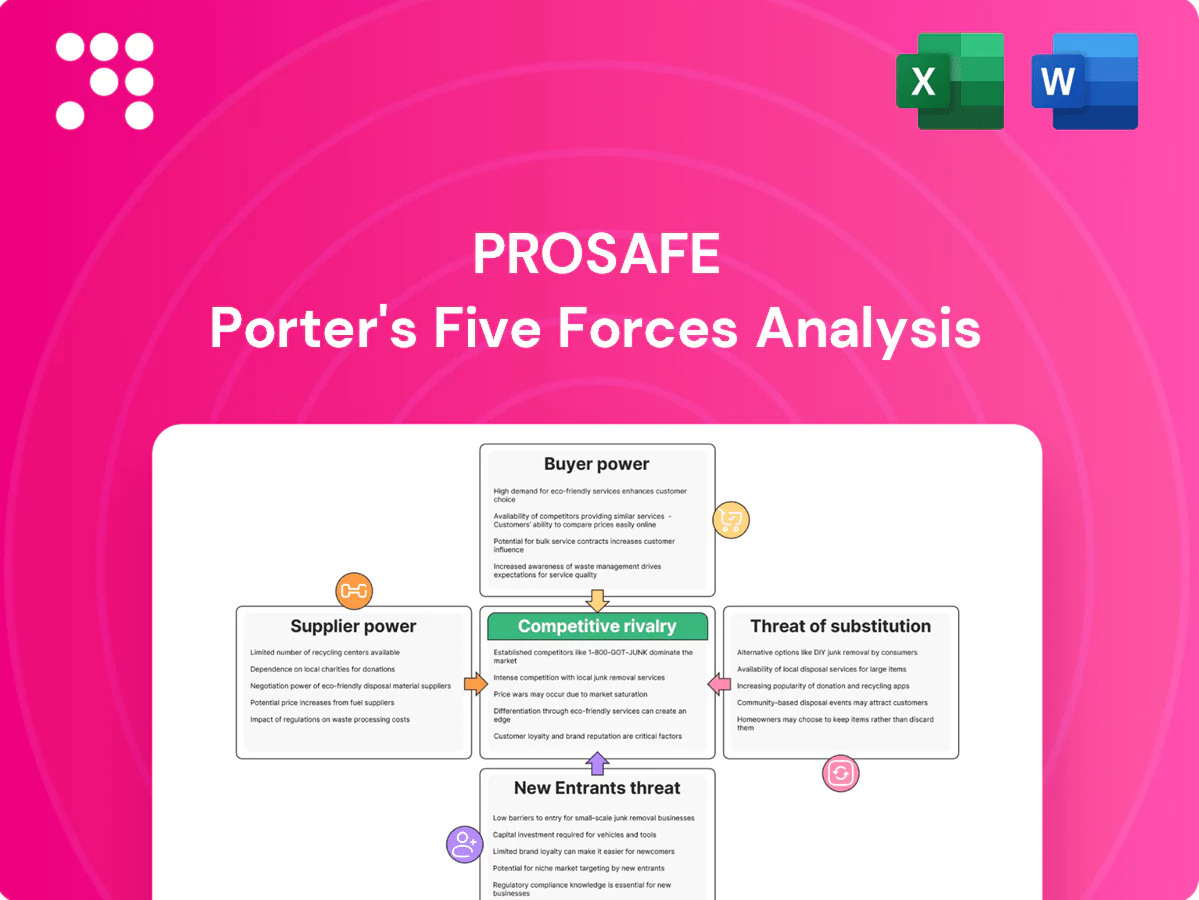
Prosafe Porter's Five Forces Analysis

A Must-Have Tool for Decision-Makers
Prosafe faces concentrated buyer power, high capital barriers for entrants, and evolving substitute threats as offshore service demand shifts; supplier leverage and industry rivalry further shape margins. This brief snapshot only scratches the surface—unlock the full Porter's Five Forces Analysis to explore Prosafe’s competitive dynamics and strategic opportunities in detail.
Suppliers Bargaining Power

Concentrated shipyard and OEM base
High-spec semi-sub builds and life-extension work depend on a small set of capable shipyards and OEMs (e.g., VARD, COSCO, Keppel), concentrating supplier leverage. Limited yard slots and typical lead times of 18–36 months let suppliers push pricing and terms, especially in upcycles when orderbooks extend beyond a year. Prosafe uses framework agreements and dual-sourcing where feasible, but technology lock-in (DP systems, cranes, thrusters) sustains supplier power.
Specialized crewing and certification
Experienced offshore crews with niche certifications are scarce, driving wage pressure—industry reports showed offshore crew pay rising roughly 10–15% in 2023–24. Maritime unions and regional labor rules constrain flexibility and can add recruitment costs; Prosafe’s fleet scale (six units) limits rapid redeployment. Training pipelines average about 12 months, limiting quick capacity additions. Prosafe’s strong safety record improves retention but cannot remove the structural scarcity.

Dry-dock and critical maintenance capacity
Heavy maintenance and class surveys follow fixed intervals (annual, intermediate, special surveys typically every 5 years) and need specific yards or floating docks, creating bottlenecks when local dock capacity is constrained. Scheduling conflicts at peak demand give yards pricing power and can push turnarounds beyond planned windows. Deferred maintenance risks class non-compliance and charter penalties. Multi-year maintenance contracts (commonly 3–5 years) and advance planning partially offset supplier leverage.

Fuel, consumables, and logistics
Bunker price volatility partially passes through under many Prosafe contracts, leaving residual cost exposure; Brent crude averaged about $86/bbl in 2024, sustaining fuel cost pressure. Remote operations heighten reliance on logistics for spares and consumables, while a few consolidated marine logistics providers can enforce tight service and pricing terms. Hedging and on-board inventory cut but do not eliminate this risk.
- Partial fuel pass-through
- 2024 Brent ~$86/bbl
- Higher logistics dependence
- Consolidated suppliers set terms
- Hedging/inventory mitigate, not remove exposure
Regulatory and class compliance vendors
Class societies and inspection bodies impose mandatory standards that create non-negotiable costs; compliance retrofits in 2024 commonly run from several hundred thousand to a few million USD per vessel. Many upgrades (emissions abatement, ballast/waste, safety systems) require vendor-specific solutions and approvals, and approval timing—often weeks—reduces vessel availability and can cut dayrates materially. Early engagement aids scheduling but leaves vendors with negotiating leverage.
- Major certifiers: DNV, ABS, LR, BV dominate fleet certification
- Retrofit costs: hundreds k to low millions USD
- Approval delays: typically weeks, impacting availability/dayrates
High supplier power: yards 18-36 months, fleet 6, crew pay +10-15%
Supplier power is high: yard lead times 18–36 months and specialist OEMs (VARD, COSCO, Keppel) constrain pricing; Prosafe fleet size six limits bargaining. Crew scarcity pushed pay ~10–15% in 2023–24; Brent averaged ~$86/bbl in 2024, keeping fuel exposure. Class retrofits cost hundreds k–low millions and approval delays (weeks) tighten supplier leverage.
| Factor | Metric | 2024/2023–24 |
|---|---|---|
| Fleet scale | Units | 6 |
| Yard lead time | Range | 18–36 months |
| Crew pay | Increase | 10–15% |
| Fuel | Brent | $86/bbl |
| Retrofit cost | Per vessel | hundreds k–low M USD |
What is included in the product
 Detailed Word Document
Concise Porter's Five Forces assessment tailored for Prosafe, detailing competitive rivalry, supplier and buyer power, entry barriers and substitutes, plus emerging threats and strategic implications for its offshore accommodation market.

 Customizable Excel Spreadsheet
A clear, one-sheet summary of Prosafe's five forces—perfect for quick decision-making on offshore accommodation risks and opportunities.
Customers Bargaining Power

Few large oil and gas clients
IOC/NOC and major contractors dominate demand for Prosafe services, representing roughly 70% of floater and accommodation contract awards in 2024, concentrating bargaining power with a small buyer set. They run rigorous tenders with tight technical specs and pricing pressure, shrinking margins. Vendor lists and prequalification restrict spot opportunities, and although long relationships support retention, buyers keep the leverage.
Tendering and long-term charters
Competitive tenders standardize offerings and compress margins, forcing Prosafe to match market terms in 2024. Multi-month to multi-year charters (commonly 3–36 months) deliver volume but require deep discounts and strict performance KPIs. Downtime penalties shift operational risk to the operator, while extensions are strategically valuable yet routinely priced aggressively by buyers.

Project cyclicality and timing
Project cyclicality drives customer bargaining: utilization swings with maintenance, MMOD and decommissioning cycles create soft windows where buyers can delay work and press for lower dayrates, a dynamic seen through 2024 market pauses.
In downturn phases of 2024 buyers exerted pressure to defer projects and secure concessions, while in tight pockets during the year scarce high-POB tonnage shifted leverage back to owners.
Prosafe must actively manage fleet positioning and contract timing in 2024 to capture peak rates and minimize exposure to troughs.

Switching costs and standardization
Operational switching costs for Prosafe are moderate because vessel specifications are similar across competitors; Prosafe operates six accommodation vessels in 2024 which eases comparability. Familiarity with a provider’s safety systems and procedures creates customer stickiness, while standardized contracts at renewal simplify switching. Strong HSE performance and high uptime remain key levers to reduce buyer power.
- Moderate switching costs due to similar specs
- Stickiness from safety system familiarity
- Standardized renewal contracts enable switching
- HSE and uptime differentiation lowers buyer power
ESG and regulatory requirements
Buyers increasingly demand lower emissions and superior HSE; mandatory IMO measures such as EEXI and CII (in force since 2023–24) and EU CSRD from 2024 force compliance or risk exclusion and pricing penalties. Meeting evolving standards raises owner capex and supports ESG-linked financing (ESG-linked loan market surpassed about 2 trillion USD by 2024). Early adopters gain charter preference but do not capture full pricing control.
Buyer power concentrated: ~70% of floater awards; HSE, uptime and ESG reduce buyer leverage
IOC/NOC and major contractors account for ~70% of floater/accommodation awards in 2024, concentrating buyer power. Competitive tenders, 3–36 month charters and tight KPIs compress margins; downtime penalties shift risk to owners. Prosafe operates six accommodation vessels in 2024; strong HSE, uptime and early ESG compliance (EEXI/CII/CSRD) reduce buyer leverage.
| Metric | 2024 Value |
|---|---|
| Buyer concentration | ~70% |
| Fleet (accommodation) | 6 vessels |
| Typical charter | 3–36 months |
| ESG-linked financing | >2 trillion USD |
Full Version Awaits
Prosafe Porter's Five Forces Analysis
This preview shows the exact Prosafe Porter's Five Forces Analysis you'll receive immediately after purchase—no surprises or placeholders. The document is professionally written and fully formatted, ready for download and immediate use. You're viewing the final deliverable in full.

A Must-Have Tool for Decision-Makers
Prosafe faces concentrated buyer power, high capital barriers for entrants, and evolving substitute threats as offshore service demand shifts; supplier leverage and industry rivalry further shape margins. This brief snapshot only scratches the surface—unlock the full Porter's Five Forces Analysis to explore Prosafe’s competitive dynamics and strategic opportunities in detail.
Suppliers Bargaining Power
Concentrated shipyard and OEM base
High-spec semi-sub builds and life-extension work depend on a small set of capable shipyards and OEMs (e.g., VARD, COSCO, Keppel), concentrating supplier leverage. Limited yard slots and typical lead times of 18–36 months let suppliers push pricing and terms, especially in upcycles when orderbooks extend beyond a year. Prosafe uses framework agreements and dual-sourcing where feasible, but technology lock-in (DP systems, cranes, thrusters) sustains supplier power.
Specialized crewing and certification
Experienced offshore crews with niche certifications are scarce, driving wage pressure—industry reports showed offshore crew pay rising roughly 10–15% in 2023–24. Maritime unions and regional labor rules constrain flexibility and can add recruitment costs; Prosafe’s fleet scale (six units) limits rapid redeployment. Training pipelines average about 12 months, limiting quick capacity additions. Prosafe’s strong safety record improves retention but cannot remove the structural scarcity.
Dry-dock and critical maintenance capacity
Heavy maintenance and class surveys follow fixed intervals (annual, intermediate, special surveys typically every 5 years) and need specific yards or floating docks, creating bottlenecks when local dock capacity is constrained. Scheduling conflicts at peak demand give yards pricing power and can push turnarounds beyond planned windows. Deferred maintenance risks class non-compliance and charter penalties. Multi-year maintenance contracts (commonly 3–5 years) and advance planning partially offset supplier leverage.
Fuel, consumables, and logistics
Bunker price volatility partially passes through under many Prosafe contracts, leaving residual cost exposure; Brent crude averaged about $86/bbl in 2024, sustaining fuel cost pressure. Remote operations heighten reliance on logistics for spares and consumables, while a few consolidated marine logistics providers can enforce tight service and pricing terms. Hedging and on-board inventory cut but do not eliminate this risk.
- Partial fuel pass-through
- 2024 Brent ~$86/bbl
- Higher logistics dependence
- Consolidated suppliers set terms
- Hedging/inventory mitigate, not remove exposure
Regulatory and class compliance vendors
Class societies and inspection bodies impose mandatory standards that create non-negotiable costs; compliance retrofits in 2024 commonly run from several hundred thousand to a few million USD per vessel. Many upgrades (emissions abatement, ballast/waste, safety systems) require vendor-specific solutions and approvals, and approval timing—often weeks—reduces vessel availability and can cut dayrates materially. Early engagement aids scheduling but leaves vendors with negotiating leverage.
- Major certifiers: DNV, ABS, LR, BV dominate fleet certification
- Retrofit costs: hundreds k to low millions USD
- Approval delays: typically weeks, impacting availability/dayrates
High supplier power: yards 18-36 months, fleet 6, crew pay +10-15%
Supplier power is high: yard lead times 18–36 months and specialist OEMs (VARD, COSCO, Keppel) constrain pricing; Prosafe fleet size six limits bargaining. Crew scarcity pushed pay ~10–15% in 2023–24; Brent averaged ~$86/bbl in 2024, keeping fuel exposure. Class retrofits cost hundreds k–low millions and approval delays (weeks) tighten supplier leverage.
| Factor | Metric | 2024/2023–24 |
|---|---|---|
| Fleet scale | Units | 6 |
| Yard lead time | Range | 18–36 months |
| Crew pay | Increase | 10–15% |
| Fuel | Brent | $86/bbl |
| Retrofit cost | Per vessel | hundreds k–low M USD |
What is included in the product
Detailed Word Document
Concise Porter's Five Forces assessment tailored for Prosafe, detailing competitive rivalry, supplier and buyer power, entry barriers and substitutes, plus emerging threats and strategic implications for its offshore accommodation market.
Customizable Excel Spreadsheet
A clear, one-sheet summary of Prosafe's five forces—perfect for quick decision-making on offshore accommodation risks and opportunities.
Customers Bargaining Power
Few large oil and gas clients
IOC/NOC and major contractors dominate demand for Prosafe services, representing roughly 70% of floater and accommodation contract awards in 2024, concentrating bargaining power with a small buyer set. They run rigorous tenders with tight technical specs and pricing pressure, shrinking margins. Vendor lists and prequalification restrict spot opportunities, and although long relationships support retention, buyers keep the leverage.
Tendering and long-term charters
Competitive tenders standardize offerings and compress margins, forcing Prosafe to match market terms in 2024. Multi-month to multi-year charters (commonly 3–36 months) deliver volume but require deep discounts and strict performance KPIs. Downtime penalties shift operational risk to the operator, while extensions are strategically valuable yet routinely priced aggressively by buyers.
Project cyclicality and timing
Project cyclicality drives customer bargaining: utilization swings with maintenance, MMOD and decommissioning cycles create soft windows where buyers can delay work and press for lower dayrates, a dynamic seen through 2024 market pauses.
In downturn phases of 2024 buyers exerted pressure to defer projects and secure concessions, while in tight pockets during the year scarce high-POB tonnage shifted leverage back to owners.
Prosafe must actively manage fleet positioning and contract timing in 2024 to capture peak rates and minimize exposure to troughs.
Switching costs and standardization
Operational switching costs for Prosafe are moderate because vessel specifications are similar across competitors; Prosafe operates six accommodation vessels in 2024 which eases comparability. Familiarity with a provider’s safety systems and procedures creates customer stickiness, while standardized contracts at renewal simplify switching. Strong HSE performance and high uptime remain key levers to reduce buyer power.
- Moderate switching costs due to similar specs
- Stickiness from safety system familiarity
- Standardized renewal contracts enable switching
- HSE and uptime differentiation lowers buyer power
ESG and regulatory requirements
Buyers increasingly demand lower emissions and superior HSE; mandatory IMO measures such as EEXI and CII (in force since 2023–24) and EU CSRD from 2024 force compliance or risk exclusion and pricing penalties. Meeting evolving standards raises owner capex and supports ESG-linked financing (ESG-linked loan market surpassed about 2 trillion USD by 2024). Early adopters gain charter preference but do not capture full pricing control.
Buyer power concentrated: ~70% of floater awards; HSE, uptime and ESG reduce buyer leverage
IOC/NOC and major contractors account for ~70% of floater/accommodation awards in 2024, concentrating buyer power. Competitive tenders, 3–36 month charters and tight KPIs compress margins; downtime penalties shift risk to owners. Prosafe operates six accommodation vessels in 2024; strong HSE, uptime and early ESG compliance (EEXI/CII/CSRD) reduce buyer leverage.
| Metric | 2024 Value |
|---|---|
| Buyer concentration | ~70% |
| Fleet (accommodation) | 6 vessels |
| Typical charter | 3–36 months |
| ESG-linked financing | >2 trillion USD |
Full Version Awaits
Prosafe Porter's Five Forces Analysis
This preview shows the exact Prosafe Porter's Five Forces Analysis you'll receive immediately after purchase—no surprises or placeholders. The document is professionally written and fully formatted, ready for download and immediate use. You're viewing the final deliverable in full.
Original: $10.00
-65%$10.00
$3.50Description
A Must-Have Tool for Decision-Makers
Prosafe faces concentrated buyer power, high capital barriers for entrants, and evolving substitute threats as offshore service demand shifts; supplier leverage and industry rivalry further shape margins. This brief snapshot only scratches the surface—unlock the full Porter's Five Forces Analysis to explore Prosafe’s competitive dynamics and strategic opportunities in detail.
Suppliers Bargaining Power
Concentrated shipyard and OEM base
High-spec semi-sub builds and life-extension work depend on a small set of capable shipyards and OEMs (e.g., VARD, COSCO, Keppel), concentrating supplier leverage. Limited yard slots and typical lead times of 18–36 months let suppliers push pricing and terms, especially in upcycles when orderbooks extend beyond a year. Prosafe uses framework agreements and dual-sourcing where feasible, but technology lock-in (DP systems, cranes, thrusters) sustains supplier power.
Specialized crewing and certification
Experienced offshore crews with niche certifications are scarce, driving wage pressure—industry reports showed offshore crew pay rising roughly 10–15% in 2023–24. Maritime unions and regional labor rules constrain flexibility and can add recruitment costs; Prosafe’s fleet scale (six units) limits rapid redeployment. Training pipelines average about 12 months, limiting quick capacity additions. Prosafe’s strong safety record improves retention but cannot remove the structural scarcity.
Dry-dock and critical maintenance capacity
Heavy maintenance and class surveys follow fixed intervals (annual, intermediate, special surveys typically every 5 years) and need specific yards or floating docks, creating bottlenecks when local dock capacity is constrained. Scheduling conflicts at peak demand give yards pricing power and can push turnarounds beyond planned windows. Deferred maintenance risks class non-compliance and charter penalties. Multi-year maintenance contracts (commonly 3–5 years) and advance planning partially offset supplier leverage.
Fuel, consumables, and logistics
Bunker price volatility partially passes through under many Prosafe contracts, leaving residual cost exposure; Brent crude averaged about $86/bbl in 2024, sustaining fuel cost pressure. Remote operations heighten reliance on logistics for spares and consumables, while a few consolidated marine logistics providers can enforce tight service and pricing terms. Hedging and on-board inventory cut but do not eliminate this risk.
- Partial fuel pass-through
- 2024 Brent ~$86/bbl
- Higher logistics dependence
- Consolidated suppliers set terms
- Hedging/inventory mitigate, not remove exposure
Regulatory and class compliance vendors
Class societies and inspection bodies impose mandatory standards that create non-negotiable costs; compliance retrofits in 2024 commonly run from several hundred thousand to a few million USD per vessel. Many upgrades (emissions abatement, ballast/waste, safety systems) require vendor-specific solutions and approvals, and approval timing—often weeks—reduces vessel availability and can cut dayrates materially. Early engagement aids scheduling but leaves vendors with negotiating leverage.
- Major certifiers: DNV, ABS, LR, BV dominate fleet certification
- Retrofit costs: hundreds k to low millions USD
- Approval delays: typically weeks, impacting availability/dayrates
High supplier power: yards 18-36 months, fleet 6, crew pay +10-15%
Supplier power is high: yard lead times 18–36 months and specialist OEMs (VARD, COSCO, Keppel) constrain pricing; Prosafe fleet size six limits bargaining. Crew scarcity pushed pay ~10–15% in 2023–24; Brent averaged ~$86/bbl in 2024, keeping fuel exposure. Class retrofits cost hundreds k–low millions and approval delays (weeks) tighten supplier leverage.
| Factor | Metric | 2024/2023–24 |
|---|---|---|
| Fleet scale | Units | 6 |
| Yard lead time | Range | 18–36 months |
| Crew pay | Increase | 10–15% |
| Fuel | Brent | $86/bbl |
| Retrofit cost | Per vessel | hundreds k–low M USD |
What is included in the product
Detailed Word Document
Concise Porter's Five Forces assessment tailored for Prosafe, detailing competitive rivalry, supplier and buyer power, entry barriers and substitutes, plus emerging threats and strategic implications for its offshore accommodation market.
Customizable Excel Spreadsheet
A clear, one-sheet summary of Prosafe's five forces—perfect for quick decision-making on offshore accommodation risks and opportunities.
Customers Bargaining Power
Few large oil and gas clients
IOC/NOC and major contractors dominate demand for Prosafe services, representing roughly 70% of floater and accommodation contract awards in 2024, concentrating bargaining power with a small buyer set. They run rigorous tenders with tight technical specs and pricing pressure, shrinking margins. Vendor lists and prequalification restrict spot opportunities, and although long relationships support retention, buyers keep the leverage.
Tendering and long-term charters
Competitive tenders standardize offerings and compress margins, forcing Prosafe to match market terms in 2024. Multi-month to multi-year charters (commonly 3–36 months) deliver volume but require deep discounts and strict performance KPIs. Downtime penalties shift operational risk to the operator, while extensions are strategically valuable yet routinely priced aggressively by buyers.
Project cyclicality and timing
Project cyclicality drives customer bargaining: utilization swings with maintenance, MMOD and decommissioning cycles create soft windows where buyers can delay work and press for lower dayrates, a dynamic seen through 2024 market pauses.
In downturn phases of 2024 buyers exerted pressure to defer projects and secure concessions, while in tight pockets during the year scarce high-POB tonnage shifted leverage back to owners.
Prosafe must actively manage fleet positioning and contract timing in 2024 to capture peak rates and minimize exposure to troughs.
Switching costs and standardization
Operational switching costs for Prosafe are moderate because vessel specifications are similar across competitors; Prosafe operates six accommodation vessels in 2024 which eases comparability. Familiarity with a provider’s safety systems and procedures creates customer stickiness, while standardized contracts at renewal simplify switching. Strong HSE performance and high uptime remain key levers to reduce buyer power.
- Moderate switching costs due to similar specs
- Stickiness from safety system familiarity
- Standardized renewal contracts enable switching
- HSE and uptime differentiation lowers buyer power
ESG and regulatory requirements
Buyers increasingly demand lower emissions and superior HSE; mandatory IMO measures such as EEXI and CII (in force since 2023–24) and EU CSRD from 2024 force compliance or risk exclusion and pricing penalties. Meeting evolving standards raises owner capex and supports ESG-linked financing (ESG-linked loan market surpassed about 2 trillion USD by 2024). Early adopters gain charter preference but do not capture full pricing control.
Buyer power concentrated: ~70% of floater awards; HSE, uptime and ESG reduce buyer leverage
IOC/NOC and major contractors account for ~70% of floater/accommodation awards in 2024, concentrating buyer power. Competitive tenders, 3–36 month charters and tight KPIs compress margins; downtime penalties shift risk to owners. Prosafe operates six accommodation vessels in 2024; strong HSE, uptime and early ESG compliance (EEXI/CII/CSRD) reduce buyer leverage.
| Metric | 2024 Value |
|---|---|
| Buyer concentration | ~70% |
| Fleet (accommodation) | 6 vessels |
| Typical charter | 3–36 months |
| ESG-linked financing | >2 trillion USD |
Full Version Awaits
Prosafe Porter's Five Forces Analysis
This preview shows the exact Prosafe Porter's Five Forces Analysis you'll receive immediately after purchase—no surprises or placeholders. The document is professionally written and fully formatted, ready for download and immediate use. You're viewing the final deliverable in full.











