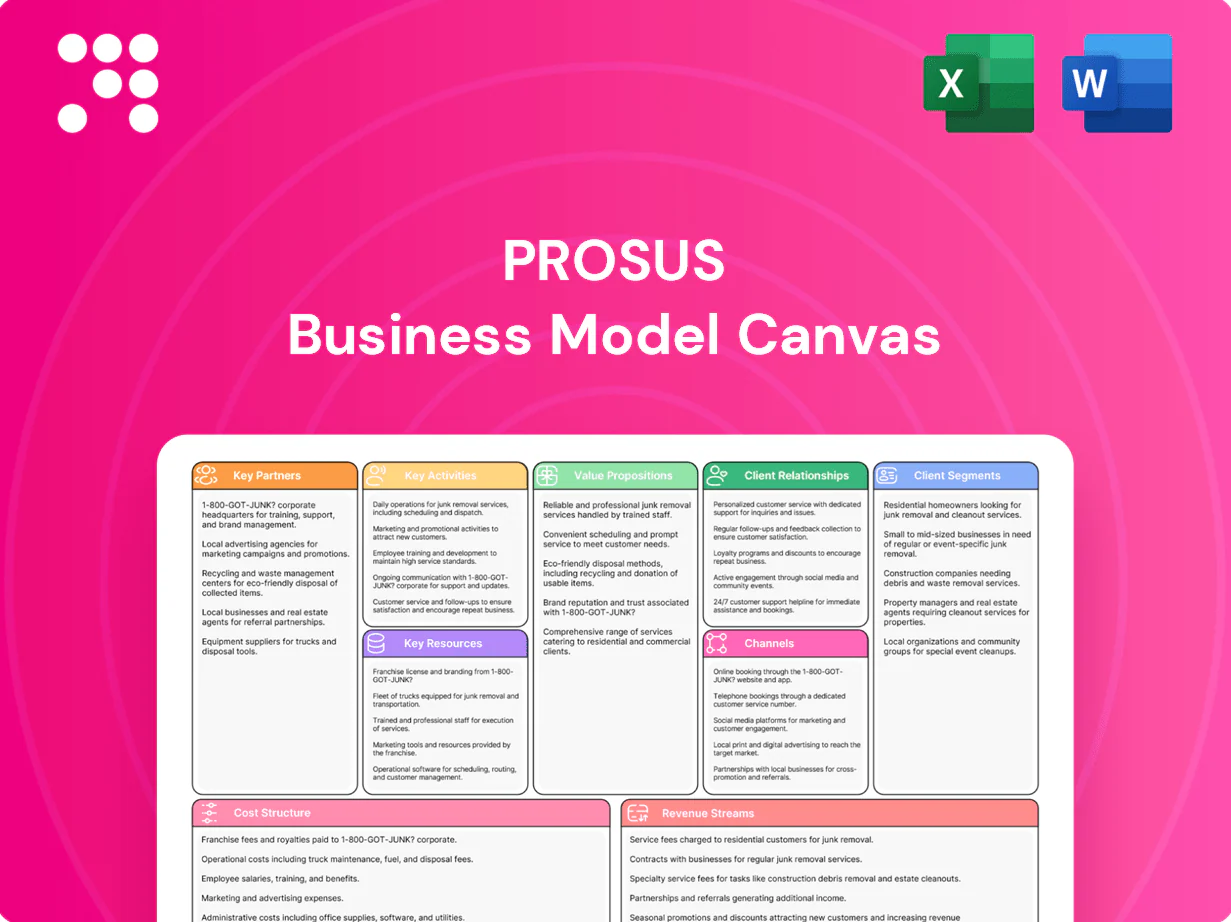
Prosus Business Model Canvas

Unlock the strategic blueprint behind Prosus with our concise Business Model Canvas—three core strengths, customer segments, and revenue levers revealed in a single snapshot. This short preview shows how Prosus scales marketplaces, monetizes digital services, and leverages global partnerships to sustain growth. Purchase the full, editable Canvas for a section-by-section breakdown, financial implications, and ready-to-use templates for analysis or presentations.
Partnerships

Founders and co-investors
Prosus partners with visionary founders and top-tier VCs to source, syndicate and scale deals, leveraging its presence across over 90 markets (2024). These partnerships provide privileged access to deal pipelines and coordinated follow-on capital, while Prosus contributes operating expertise and growth resources. Co-investors de-risk rounds and validate valuations; alignment on governance and long-term growth underpins the model.
Strategic tech and cloud vendors
Strategic partnerships with cloud providers, data infrastructure firms and cybersecurity vendors underpin Prosus scalability, tapping a public cloud market exceeding 600 billion USD in 2024 per Gartner and hyperscaler share trends (Synergy Research 2024: AWS ~31%, Microsoft ~22%, Google ~10%). Preferential pricing and co-innovation speed product rollouts and analytics. Joint go-to-market programs extend reach across emerging markets. Certified architectures ensure reliability and regulatory compliance.

Local regulators and ecosystem bodies
Active engagement with financial, marketplace and food-delivery regulators builds trust and supported Prosus’ fintech and platform operations across markets; Prosus, which held roughly 27.3% of Tencent in 2024, leverages regulatory dialogue to protect large investments. Policy engagement advances fintech licences, KYC/AML frameworks and platform safety rules. Industry associations shape standards for responsible growth and multi-market compliance enables cross-border expansion and capital flows.

Logistics, payments, and fulfillment partners
Third-party couriers, dark-store operators and payment gateways improve unit economics by lowering last-mile and storage costs; industry studies in 2024 show external logistics can cut last-mile cost 10-15% and speed up delivery windows.
Service-level agreements secure speed, reliability and geographic coverage while integrated settlement and reconciliation reduce leakage and disputes, improving cash conversion.
Flexible partnerships scale capacity during peak demand (Black Friday/Cyber Week spikes of 2x+ volume) while preserving customer experience.
- logistics: 10-15% lower last-mile cost (2024 industry studies)
- sla: ensures speed, reliability, coverage
- payments: integrated settlement reduces disputes and leakage
- flex-capacity: handles 2x+ peak volume
Universities and edtech content providers
Content syndication and credential partnerships expand Prosus' catalog and credibility within the $315 billion global e-learning market in 2024; joint programs have driven completion in credential tracks to ~50% versus typical MOOC rates of 10–15%, improving outcomes and monetization. Data-sharing enables adaptive learning and continuous course optimization, while localized curricula target market-specific employability needs.
- Catalog breadth: syndicated content increases offerings and trust
- Completion lift: credential programs ≈50% completion
- Adaptive learning: data-driven course optimization
- Local employability: curricula tailored per market
Partner network in 90+ markets taps $600B+ cloud and $315B e-learning
Prosus partners with founders and top VCs across 90+ markets (2024) to source deals, provide follow-on capital and operating support. Cloud and infra partners tap a >$600B public cloud (2024) with hyperscalers AWS ~31% MSFT ~22% GCP ~10%; logistics, payments and flex-capacity cut last-mile costs 10–15% and handle 2x+ peaks. Content partners grow e-learning into a $315B market, lifting credential completion to ~50%.
| Metric | 2024 |
|---|---|
| Markets | 90+ |
| Tencent stake | 27.3% |
| Public cloud | >$600B |
| E‑learning market | $315B |
| Completion rate | ~50% |
What is included in the product
 Detailed Word Document
A comprehensive Business Model Canvas for Prosus that maps its nine blocks—customer segments, value propositions, channels, customer relationships, revenue streams, key resources, key activities, key partners, and cost structure—reflecting its global internet-investment strategy across classifieds, fintech, edtech and food delivery. Ideal for investors and analysts, it includes competitive advantages, SWOT-linked insights and practical validation using real company data.

 Customizable Excel Spreadsheet
High-level, editable Business Model Canvas for Prosus that condenses complex portfolio strategy into a one-page snapshot, saving hours of structuring and making it easy to compare investments, brief boards, or align teams. Perfect for fast deliverables, collaborative iteration, and adapting the structure as new data or strategic insights emerge.
Activities

Venture investing and capital allocation
Sourcing, diligencing and structuring investments across seed to late-growth stages underpins Prosus’s venture investing and capital allocation, with a portfolio anchored by its largest holding in Tencent and major stakes in OLX, iFood and Swiggy. Portfolio construction balances sector exposure and risk-return across markets in Asia, Europe and Latin America. Follow-on funding concentrates on compounding winners, while capital recycling via strategic exits and IPOs optimizes NAV and IRR.
Operational scaling and platform building
Prosus scales by codifying growth, monetization and retention playbooks deployed across its 80+ markets (2024), with shared services in data, growth marketing and compliance accelerating rollouts and reducing duplication. Continuous experimentation and localization deepen product-market fit, while pricing, incentive levers and cost leverage lift unit economics across portfolio companies.

M&A and portfolio optimization
Bolt-ons and mergers consolidate category leadership and reduce competition, leveraging Prosus's scale and its 28.9% stake in Tencent (2024). Secondary sales and buybacks manage exposure and liquidity via targeted disposals and repurchases. Strategic divestments sharpen focus on core theses, while governance upgrades and board stewardship drive performance.

Technology enablement and data science
Centralized data platforms power fraud prevention, personalization and ad targeting across Prosus assets; Prosus retains an approximate 28.9% stake in Tencent and PayU operates in over 50 markets, anchoring scale and data flow.
ML models drive logistics routing, CAC/LTV optimization and credit-risk scoring while privacy-by-design and security hardening sustain regulator and user trust; shared tooling cuts duplication across portfolio companies.
- Data platforms: cross-asset fraud, personalization, ads
- ML: logistics, CAC/LTV, credit risk
- Security: privacy-by-design, hardening
- Efficiency: shared tooling reduces duplication
Market expansion and localization
Market expansion and localization: Prosus adapts entry strategies to local cultures, price points and regulation, leveraging product tweaks and compliance frameworks to scale across over 80 markets. Partnerships with local operators accelerate ramp-up and reduce distribution friction. Hiring local leadership improves execution and resilience while go-to-market aligns brand, channels and incentives across regions.
- Entry: product + regs
- Partners: local operators
- Talent: local leadership
- GTM: unified brand & incentives
Portfolio led by 28.9% Tencent stake across 80+ markets
Prosus sources and diligences deals from seed to late growth, anchoring a portfolio led by a 28.9% Tencent stake (2024) and major positions in OLX, iFood and Swiggy. It scales product, monetization and retention playbooks across 80+ markets (2024) with PayU in 50+ markets. Centralized data platforms and ML optimize logistics, CAC/LTV and credit risk while follow-ons and strategic exits drive NAV and IRR.
| Metric | 2024 |
|---|---|
| Tencent stake | 28.9% |
| Markets (Prosus portfolio) | 80+ |
| PayU markets | 50+ |
Preview Before You Purchase
Business Model Canvas
The document previewed is the exact Prosus Business Model Canvas you'll receive—no mockups or samples. On purchase you'll instantly download this same complete, editable file, formatted for Word and Excel. It's ready to present, adapt, and use immediately with all content and sections included.

Unlock the strategic blueprint behind Prosus with our concise Business Model Canvas—three core strengths, customer segments, and revenue levers revealed in a single snapshot. This short preview shows how Prosus scales marketplaces, monetizes digital services, and leverages global partnerships to sustain growth. Purchase the full, editable Canvas for a section-by-section breakdown, financial implications, and ready-to-use templates for analysis or presentations.
Partnerships
Founders and co-investors
Prosus partners with visionary founders and top-tier VCs to source, syndicate and scale deals, leveraging its presence across over 90 markets (2024). These partnerships provide privileged access to deal pipelines and coordinated follow-on capital, while Prosus contributes operating expertise and growth resources. Co-investors de-risk rounds and validate valuations; alignment on governance and long-term growth underpins the model.
Strategic tech and cloud vendors
Strategic partnerships with cloud providers, data infrastructure firms and cybersecurity vendors underpin Prosus scalability, tapping a public cloud market exceeding 600 billion USD in 2024 per Gartner and hyperscaler share trends (Synergy Research 2024: AWS ~31%, Microsoft ~22%, Google ~10%). Preferential pricing and co-innovation speed product rollouts and analytics. Joint go-to-market programs extend reach across emerging markets. Certified architectures ensure reliability and regulatory compliance.
Local regulators and ecosystem bodies
Active engagement with financial, marketplace and food-delivery regulators builds trust and supported Prosus’ fintech and platform operations across markets; Prosus, which held roughly 27.3% of Tencent in 2024, leverages regulatory dialogue to protect large investments. Policy engagement advances fintech licences, KYC/AML frameworks and platform safety rules. Industry associations shape standards for responsible growth and multi-market compliance enables cross-border expansion and capital flows.
Logistics, payments, and fulfillment partners
Third-party couriers, dark-store operators and payment gateways improve unit economics by lowering last-mile and storage costs; industry studies in 2024 show external logistics can cut last-mile cost 10-15% and speed up delivery windows.
Service-level agreements secure speed, reliability and geographic coverage while integrated settlement and reconciliation reduce leakage and disputes, improving cash conversion.
Flexible partnerships scale capacity during peak demand (Black Friday/Cyber Week spikes of 2x+ volume) while preserving customer experience.
- logistics: 10-15% lower last-mile cost (2024 industry studies)
- sla: ensures speed, reliability, coverage
- payments: integrated settlement reduces disputes and leakage
- flex-capacity: handles 2x+ peak volume
Universities and edtech content providers
Content syndication and credential partnerships expand Prosus' catalog and credibility within the $315 billion global e-learning market in 2024; joint programs have driven completion in credential tracks to ~50% versus typical MOOC rates of 10–15%, improving outcomes and monetization. Data-sharing enables adaptive learning and continuous course optimization, while localized curricula target market-specific employability needs.
- Catalog breadth: syndicated content increases offerings and trust
- Completion lift: credential programs ≈50% completion
- Adaptive learning: data-driven course optimization
- Local employability: curricula tailored per market
Partner network in 90+ markets taps $600B+ cloud and $315B e-learning
Prosus partners with founders and top VCs across 90+ markets (2024) to source deals, provide follow-on capital and operating support. Cloud and infra partners tap a >$600B public cloud (2024) with hyperscalers AWS ~31% MSFT ~22% GCP ~10%; logistics, payments and flex-capacity cut last-mile costs 10–15% and handle 2x+ peaks. Content partners grow e-learning into a $315B market, lifting credential completion to ~50%.
| Metric | 2024 |
|---|---|
| Markets | 90+ |
| Tencent stake | 27.3% |
| Public cloud | >$600B |
| E‑learning market | $315B |
| Completion rate | ~50% |
What is included in the product
Detailed Word Document
A comprehensive Business Model Canvas for Prosus that maps its nine blocks—customer segments, value propositions, channels, customer relationships, revenue streams, key resources, key activities, key partners, and cost structure—reflecting its global internet-investment strategy across classifieds, fintech, edtech and food delivery. Ideal for investors and analysts, it includes competitive advantages, SWOT-linked insights and practical validation using real company data.
Customizable Excel Spreadsheet
High-level, editable Business Model Canvas for Prosus that condenses complex portfolio strategy into a one-page snapshot, saving hours of structuring and making it easy to compare investments, brief boards, or align teams. Perfect for fast deliverables, collaborative iteration, and adapting the structure as new data or strategic insights emerge.
Activities
Venture investing and capital allocation
Sourcing, diligencing and structuring investments across seed to late-growth stages underpins Prosus’s venture investing and capital allocation, with a portfolio anchored by its largest holding in Tencent and major stakes in OLX, iFood and Swiggy. Portfolio construction balances sector exposure and risk-return across markets in Asia, Europe and Latin America. Follow-on funding concentrates on compounding winners, while capital recycling via strategic exits and IPOs optimizes NAV and IRR.
Operational scaling and platform building
Prosus scales by codifying growth, monetization and retention playbooks deployed across its 80+ markets (2024), with shared services in data, growth marketing and compliance accelerating rollouts and reducing duplication. Continuous experimentation and localization deepen product-market fit, while pricing, incentive levers and cost leverage lift unit economics across portfolio companies.
M&A and portfolio optimization
Bolt-ons and mergers consolidate category leadership and reduce competition, leveraging Prosus's scale and its 28.9% stake in Tencent (2024). Secondary sales and buybacks manage exposure and liquidity via targeted disposals and repurchases. Strategic divestments sharpen focus on core theses, while governance upgrades and board stewardship drive performance.
Technology enablement and data science
Centralized data platforms power fraud prevention, personalization and ad targeting across Prosus assets; Prosus retains an approximate 28.9% stake in Tencent and PayU operates in over 50 markets, anchoring scale and data flow.
ML models drive logistics routing, CAC/LTV optimization and credit-risk scoring while privacy-by-design and security hardening sustain regulator and user trust; shared tooling cuts duplication across portfolio companies.
- Data platforms: cross-asset fraud, personalization, ads
- ML: logistics, CAC/LTV, credit risk
- Security: privacy-by-design, hardening
- Efficiency: shared tooling reduces duplication
Market expansion and localization
Market expansion and localization: Prosus adapts entry strategies to local cultures, price points and regulation, leveraging product tweaks and compliance frameworks to scale across over 80 markets. Partnerships with local operators accelerate ramp-up and reduce distribution friction. Hiring local leadership improves execution and resilience while go-to-market aligns brand, channels and incentives across regions.
- Entry: product + regs
- Partners: local operators
- Talent: local leadership
- GTM: unified brand & incentives
Portfolio led by 28.9% Tencent stake across 80+ markets
Prosus sources and diligences deals from seed to late growth, anchoring a portfolio led by a 28.9% Tencent stake (2024) and major positions in OLX, iFood and Swiggy. It scales product, monetization and retention playbooks across 80+ markets (2024) with PayU in 50+ markets. Centralized data platforms and ML optimize logistics, CAC/LTV and credit risk while follow-ons and strategic exits drive NAV and IRR.
| Metric | 2024 |
|---|---|
| Tencent stake | 28.9% |
| Markets (Prosus portfolio) | 80+ |
| PayU markets | 50+ |
Preview Before You Purchase
Business Model Canvas
The document previewed is the exact Prosus Business Model Canvas you'll receive—no mockups or samples. On purchase you'll instantly download this same complete, editable file, formatted for Word and Excel. It's ready to present, adapt, and use immediately with all content and sections included.
Original: $10.00
-65%$10.00
$3.50Description
Unlock the strategic blueprint behind Prosus with our concise Business Model Canvas—three core strengths, customer segments, and revenue levers revealed in a single snapshot. This short preview shows how Prosus scales marketplaces, monetizes digital services, and leverages global partnerships to sustain growth. Purchase the full, editable Canvas for a section-by-section breakdown, financial implications, and ready-to-use templates for analysis or presentations.
Partnerships
Founders and co-investors
Prosus partners with visionary founders and top-tier VCs to source, syndicate and scale deals, leveraging its presence across over 90 markets (2024). These partnerships provide privileged access to deal pipelines and coordinated follow-on capital, while Prosus contributes operating expertise and growth resources. Co-investors de-risk rounds and validate valuations; alignment on governance and long-term growth underpins the model.
Strategic tech and cloud vendors
Strategic partnerships with cloud providers, data infrastructure firms and cybersecurity vendors underpin Prosus scalability, tapping a public cloud market exceeding 600 billion USD in 2024 per Gartner and hyperscaler share trends (Synergy Research 2024: AWS ~31%, Microsoft ~22%, Google ~10%). Preferential pricing and co-innovation speed product rollouts and analytics. Joint go-to-market programs extend reach across emerging markets. Certified architectures ensure reliability and regulatory compliance.
Local regulators and ecosystem bodies
Active engagement with financial, marketplace and food-delivery regulators builds trust and supported Prosus’ fintech and platform operations across markets; Prosus, which held roughly 27.3% of Tencent in 2024, leverages regulatory dialogue to protect large investments. Policy engagement advances fintech licences, KYC/AML frameworks and platform safety rules. Industry associations shape standards for responsible growth and multi-market compliance enables cross-border expansion and capital flows.
Logistics, payments, and fulfillment partners
Third-party couriers, dark-store operators and payment gateways improve unit economics by lowering last-mile and storage costs; industry studies in 2024 show external logistics can cut last-mile cost 10-15% and speed up delivery windows.
Service-level agreements secure speed, reliability and geographic coverage while integrated settlement and reconciliation reduce leakage and disputes, improving cash conversion.
Flexible partnerships scale capacity during peak demand (Black Friday/Cyber Week spikes of 2x+ volume) while preserving customer experience.
- logistics: 10-15% lower last-mile cost (2024 industry studies)
- sla: ensures speed, reliability, coverage
- payments: integrated settlement reduces disputes and leakage
- flex-capacity: handles 2x+ peak volume
Universities and edtech content providers
Content syndication and credential partnerships expand Prosus' catalog and credibility within the $315 billion global e-learning market in 2024; joint programs have driven completion in credential tracks to ~50% versus typical MOOC rates of 10–15%, improving outcomes and monetization. Data-sharing enables adaptive learning and continuous course optimization, while localized curricula target market-specific employability needs.
- Catalog breadth: syndicated content increases offerings and trust
- Completion lift: credential programs ≈50% completion
- Adaptive learning: data-driven course optimization
- Local employability: curricula tailored per market
Partner network in 90+ markets taps $600B+ cloud and $315B e-learning
Prosus partners with founders and top VCs across 90+ markets (2024) to source deals, provide follow-on capital and operating support. Cloud and infra partners tap a >$600B public cloud (2024) with hyperscalers AWS ~31% MSFT ~22% GCP ~10%; logistics, payments and flex-capacity cut last-mile costs 10–15% and handle 2x+ peaks. Content partners grow e-learning into a $315B market, lifting credential completion to ~50%.
| Metric | 2024 |
|---|---|
| Markets | 90+ |
| Tencent stake | 27.3% |
| Public cloud | >$600B |
| E‑learning market | $315B |
| Completion rate | ~50% |
What is included in the product
Detailed Word Document
A comprehensive Business Model Canvas for Prosus that maps its nine blocks—customer segments, value propositions, channels, customer relationships, revenue streams, key resources, key activities, key partners, and cost structure—reflecting its global internet-investment strategy across classifieds, fintech, edtech and food delivery. Ideal for investors and analysts, it includes competitive advantages, SWOT-linked insights and practical validation using real company data.
Customizable Excel Spreadsheet
High-level, editable Business Model Canvas for Prosus that condenses complex portfolio strategy into a one-page snapshot, saving hours of structuring and making it easy to compare investments, brief boards, or align teams. Perfect for fast deliverables, collaborative iteration, and adapting the structure as new data or strategic insights emerge.
Activities
Venture investing and capital allocation
Sourcing, diligencing and structuring investments across seed to late-growth stages underpins Prosus’s venture investing and capital allocation, with a portfolio anchored by its largest holding in Tencent and major stakes in OLX, iFood and Swiggy. Portfolio construction balances sector exposure and risk-return across markets in Asia, Europe and Latin America. Follow-on funding concentrates on compounding winners, while capital recycling via strategic exits and IPOs optimizes NAV and IRR.
Operational scaling and platform building
Prosus scales by codifying growth, monetization and retention playbooks deployed across its 80+ markets (2024), with shared services in data, growth marketing and compliance accelerating rollouts and reducing duplication. Continuous experimentation and localization deepen product-market fit, while pricing, incentive levers and cost leverage lift unit economics across portfolio companies.
M&A and portfolio optimization
Bolt-ons and mergers consolidate category leadership and reduce competition, leveraging Prosus's scale and its 28.9% stake in Tencent (2024). Secondary sales and buybacks manage exposure and liquidity via targeted disposals and repurchases. Strategic divestments sharpen focus on core theses, while governance upgrades and board stewardship drive performance.
Technology enablement and data science
Centralized data platforms power fraud prevention, personalization and ad targeting across Prosus assets; Prosus retains an approximate 28.9% stake in Tencent and PayU operates in over 50 markets, anchoring scale and data flow.
ML models drive logistics routing, CAC/LTV optimization and credit-risk scoring while privacy-by-design and security hardening sustain regulator and user trust; shared tooling cuts duplication across portfolio companies.
- Data platforms: cross-asset fraud, personalization, ads
- ML: logistics, CAC/LTV, credit risk
- Security: privacy-by-design, hardening
- Efficiency: shared tooling reduces duplication
Market expansion and localization
Market expansion and localization: Prosus adapts entry strategies to local cultures, price points and regulation, leveraging product tweaks and compliance frameworks to scale across over 80 markets. Partnerships with local operators accelerate ramp-up and reduce distribution friction. Hiring local leadership improves execution and resilience while go-to-market aligns brand, channels and incentives across regions.
- Entry: product + regs
- Partners: local operators
- Talent: local leadership
- GTM: unified brand & incentives
Portfolio led by 28.9% Tencent stake across 80+ markets
Prosus sources and diligences deals from seed to late growth, anchoring a portfolio led by a 28.9% Tencent stake (2024) and major positions in OLX, iFood and Swiggy. It scales product, monetization and retention playbooks across 80+ markets (2024) with PayU in 50+ markets. Centralized data platforms and ML optimize logistics, CAC/LTV and credit risk while follow-ons and strategic exits drive NAV and IRR.
| Metric | 2024 |
|---|---|
| Tencent stake | 28.9% |
| Markets (Prosus portfolio) | 80+ |
| PayU markets | 50+ |
Preview Before You Purchase
Business Model Canvas
The document previewed is the exact Prosus Business Model Canvas you'll receive—no mockups or samples. On purchase you'll instantly download this same complete, editable file, formatted for Word and Excel. It's ready to present, adapt, and use immediately with all content and sections included.











