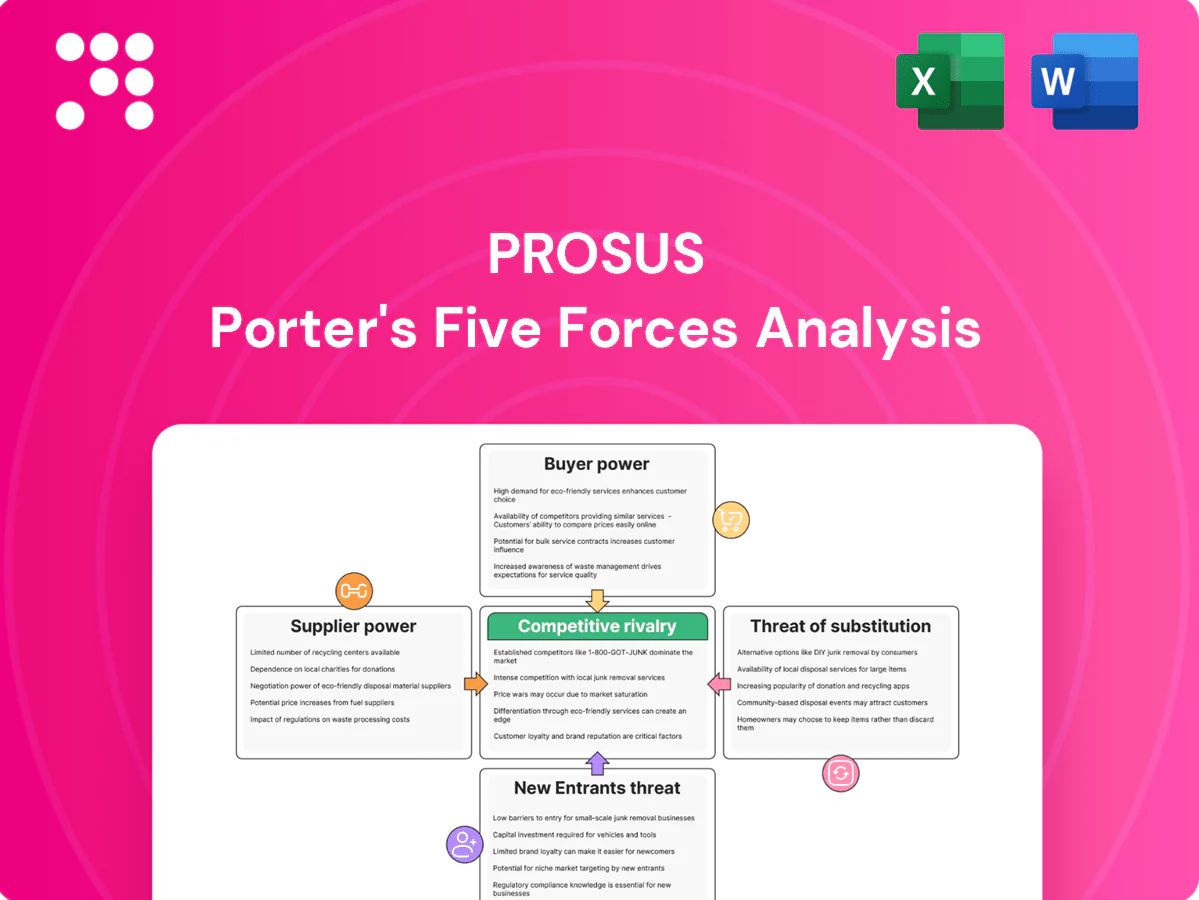
Prosus Porter's Five Forces Analysis

A Must-Have Tool for Decision-Makers
Prosus faces a dynamic mix of strong buyer power, fierce digital-platform rivalry, and constant threat from agile entrants and substitutes, while supplier leverage varies across its global portfolio. Our snapshot highlights key pressures on margins, growth levers, and strategic vulnerabilities. This brief only scratches the surface—unlock the full Porter's Five Forces Analysis for force-by-force ratings, visuals, and actionable recommendations tailored to Prosus.
Suppliers Bargaining Power

Platform dependencies
Prosus depends on app stores, cloud providers and mapping APIs where Apple/Google app commissions remain 15–30% in 2024 and top cloud vendors hold dominant share (AWS ~31%, Azure ~24%, GCP ~11% in 2024), so fee or policy shifts can compress margins or disrupt acquisition. Long-term contracts and multi-cloud reduce single-vendor risk but raise ops complexity and costs. Scale and diversified traffic improve negotiating leverage.
Restaurant and logistics partners
Restaurant and logistics partners hold meaningful leverage for food delivery platforms: industry commission rates commonly range from 10 to 30% for restaurants and courier incentives can meaningfully increase platform costs. Higher partner commission demands or surge courier incentives compress take rates and gross margins, especially in tight labor markets. Exclusive restaurant tie-ups and courier loyalty programs, plus denser urban coverage (which can lower last-mile costs by roughly 20–40%), mitigate dependency on any single provider.

Payment rails and banks
Payments and fintech ops depend on card networks, issuers and local banks—Visa and Mastercard account for roughly 80% of card volume globally in 2024, concentrating supplier power. Interchange, scheme fees and settlement terms (EU interchange caps 0.20% debit/0.30% credit; settlement typically 1–3 days) materially affect unit economics and cash cycles. Direct licensing and alternative rails cut exposure but demand CAPEX and compliance; multi-rail orchestration can restore bargaining leverage.

Talent and tech vendors
- AI/ML engineers: total comp 200,000+ USD (2024)
- Cybersecurity/product talent: 120,000–180,000 USD (2024)
- Vendor lock-in: six- to seven-figure migration costs
- Mitigation: in-house + open-source; portfolio procurement improves terms
Regulatory and data sources
Supplier concentration threatens margins: app store fees, cloud dominance, card rails, talent costs
Prosus faces concentrated supplier power: app store fees (Apple/Google 15–30% in 2024), cloud share (AWS 31%, Azure 24%, GCP 11% 2024), card networks (Visa+MC ~80% 2024) and high talent costs (AI hires 200,000+ USD 2024); fee or policy shifts and wage inflation can compress margins. Multi-cloud, in-house builds and partnerships mitigate but raise costs and complexity.
| Supplier | 2024 metric | Impact | Mitigation |
|---|---|---|---|
| App stores | 15–30% fees | Margin pressure | Web/paywalls |
| Cloud | AWS31%/AZ24%/GCP11% | Service risk | Multi-cloud |
| Cards | ~80% share | Costs/liquidity | Alternative rails |
What is included in the product
 Detailed Word Document
Tailored Porter's Five Forces analysis for Prosus, uncovering competitive drivers, buyer/supplier power, threat of substitutes and new entrants, and strategic barriers protecting its market position; highlights disruptive forces, monetization pressures, and regulatory risks to inform investor and corporate strategy.

 Customizable Excel Spreadsheet
One-sheet Porter's Five Forces for Prosus—visual radar chart and editable scores remove analysis paralysis, letting teams quickly assess competitive pressure, test scenarios, and drop straight into decks without coding or heavy setup.
Customers Bargaining Power

Multi-homing consumers
Multi-homing is widespread: 2024 surveys show over 50% of delivery/marketplace users actively compare apps, boosting customer bargaining power and enabling promotions/free delivery that compress take rates into low-double-digit or sub-10% ranges in many markets. Aggressive discounts accelerate switching and margin pressure. Loyalty programs, subscriptions and superior UX can raise switching costs, while network effects only defend pricing when selection and reliability are clearly superior and durable.
Price-sensitive merchants
SMBs and enterprise sellers commonly negotiate commissions (typically 5–15% in 2024), ad fees and payment MDRs (1–3%), using multichannel selling—around 60% of merchants—to gain leverage. Access to value-added services that lift conversion by up to 20–30% justifies higher take rates and reduces churn. Volume discounts and proprietary data insights further increase retention for high-volume sellers.

Advertisers and take-rates
Advertisers can reallocate budgets to search, social or fast-growing retail media, with global digital ad spend topping $600bn in 2024, increasing pressure on Prosus to defend yields via clear ROI attribution and competitive take-rates. Format innovation and closed-loop measurement (at-scale conversion tracking) blunt buyer bargaining power. Category exclusives and premium placements create scarcity, supporting higher take-rates and ad yields.

Churn in delivery
Food delivery users churn rapidly without continual incentives; 2024 industry reports show annual churn often exceeding 20% for non-member cohorts, increasing buyer leverage over pricing and ETAs.
High elasticity to fees and delivery time amplifies this power, while operational excellence and reliability reduce sensitivity by raising perceived value.
Membership programs that bundle free delivery, discounts and faster ETAs have proven to stabilize demand and reduce churn among core users.
- churn >20% annually (non-members)
- high fee/ETA elasticity increases leverage
- ops reliability lowers price sensitivity
- memberships stabilize demand
Enterprise fintech clients
Enterprise fintech clients negotiate aggressively on MDR (discounts up to 30–40%) and FX margins (often compressed below 1%), demand 99.99% uptime SLAs, performance guarantees and unified coverage across 50+ markets; bundled services and deep ERP/platform integrations raise switching costs, while regulatory expertise and local licenses (presence in 20+ jurisdictions) create clear differentiation and pricing power.
- Revenue share: enterprises often represent 20–40% of fintech ARR
- MDR pressure: discounts up to 30–40%
- FX margins: frequently <1%
- Uptime SLA: 99.99%
- Global reach: 50+ markets; licenses in 20+ jurisdictions
Customers wield pricing power: multi-homing >50% and churn >20% compress take rates
Customers hold strong bargaining power: multi-homing >50% (2024) and food-delivery churn >20% (non-members) compress take rates to low-double-digit/sub-10% levels. SMBs negotiate 5–15% commissions; enterprises demand MDR cuts up to 30–40% and <1% FX margins, while memberships and superior UX raise switching costs.
| Metric | 2024 | Impact |
|---|---|---|
| Multi-homing | >50% | Higher promo pressure |
| Churn (non-members) | >20% pa | Price leverage |
| SMB commission | 5–15% | Negotiation |
| Enterprise MDR cuts | 30–40% | Margin squeeze |
What You See Is What You Get
Prosus Porter's Five Forces Analysis
This preview shows the exact Prosus Porter’s Five Forces analysis you will receive after purchase—comprehensive, professionally formatted, and ready to use. It contains the full assessment of competitive rivalry, buyer and supplier power, threat of new entrants and substitutes, and strategic implications. Once you buy, you get instant access to this identical file with no placeholders or samples.

A Must-Have Tool for Decision-Makers
Prosus faces a dynamic mix of strong buyer power, fierce digital-platform rivalry, and constant threat from agile entrants and substitutes, while supplier leverage varies across its global portfolio. Our snapshot highlights key pressures on margins, growth levers, and strategic vulnerabilities. This brief only scratches the surface—unlock the full Porter's Five Forces Analysis for force-by-force ratings, visuals, and actionable recommendations tailored to Prosus.
Suppliers Bargaining Power
Platform dependencies
Prosus depends on app stores, cloud providers and mapping APIs where Apple/Google app commissions remain 15–30% in 2024 and top cloud vendors hold dominant share (AWS ~31%, Azure ~24%, GCP ~11% in 2024), so fee or policy shifts can compress margins or disrupt acquisition. Long-term contracts and multi-cloud reduce single-vendor risk but raise ops complexity and costs. Scale and diversified traffic improve negotiating leverage.
Restaurant and logistics partners
Restaurant and logistics partners hold meaningful leverage for food delivery platforms: industry commission rates commonly range from 10 to 30% for restaurants and courier incentives can meaningfully increase platform costs. Higher partner commission demands or surge courier incentives compress take rates and gross margins, especially in tight labor markets. Exclusive restaurant tie-ups and courier loyalty programs, plus denser urban coverage (which can lower last-mile costs by roughly 20–40%), mitigate dependency on any single provider.
Payment rails and banks
Payments and fintech ops depend on card networks, issuers and local banks—Visa and Mastercard account for roughly 80% of card volume globally in 2024, concentrating supplier power. Interchange, scheme fees and settlement terms (EU interchange caps 0.20% debit/0.30% credit; settlement typically 1–3 days) materially affect unit economics and cash cycles. Direct licensing and alternative rails cut exposure but demand CAPEX and compliance; multi-rail orchestration can restore bargaining leverage.
Talent and tech vendors
- AI/ML engineers: total comp 200,000+ USD (2024)
- Cybersecurity/product talent: 120,000–180,000 USD (2024)
- Vendor lock-in: six- to seven-figure migration costs
- Mitigation: in-house + open-source; portfolio procurement improves terms
Regulatory and data sources
Supplier concentration threatens margins: app store fees, cloud dominance, card rails, talent costs
Prosus faces concentrated supplier power: app store fees (Apple/Google 15–30% in 2024), cloud share (AWS 31%, Azure 24%, GCP 11% 2024), card networks (Visa+MC ~80% 2024) and high talent costs (AI hires 200,000+ USD 2024); fee or policy shifts and wage inflation can compress margins. Multi-cloud, in-house builds and partnerships mitigate but raise costs and complexity.
| Supplier | 2024 metric | Impact | Mitigation |
|---|---|---|---|
| App stores | 15–30% fees | Margin pressure | Web/paywalls |
| Cloud | AWS31%/AZ24%/GCP11% | Service risk | Multi-cloud |
| Cards | ~80% share | Costs/liquidity | Alternative rails |
What is included in the product
Detailed Word Document
Tailored Porter's Five Forces analysis for Prosus, uncovering competitive drivers, buyer/supplier power, threat of substitutes and new entrants, and strategic barriers protecting its market position; highlights disruptive forces, monetization pressures, and regulatory risks to inform investor and corporate strategy.
Customizable Excel Spreadsheet
One-sheet Porter's Five Forces for Prosus—visual radar chart and editable scores remove analysis paralysis, letting teams quickly assess competitive pressure, test scenarios, and drop straight into decks without coding or heavy setup.
Customers Bargaining Power
Multi-homing consumers
Multi-homing is widespread: 2024 surveys show over 50% of delivery/marketplace users actively compare apps, boosting customer bargaining power and enabling promotions/free delivery that compress take rates into low-double-digit or sub-10% ranges in many markets. Aggressive discounts accelerate switching and margin pressure. Loyalty programs, subscriptions and superior UX can raise switching costs, while network effects only defend pricing when selection and reliability are clearly superior and durable.
Price-sensitive merchants
SMBs and enterprise sellers commonly negotiate commissions (typically 5–15% in 2024), ad fees and payment MDRs (1–3%), using multichannel selling—around 60% of merchants—to gain leverage. Access to value-added services that lift conversion by up to 20–30% justifies higher take rates and reduces churn. Volume discounts and proprietary data insights further increase retention for high-volume sellers.
Advertisers and take-rates
Advertisers can reallocate budgets to search, social or fast-growing retail media, with global digital ad spend topping $600bn in 2024, increasing pressure on Prosus to defend yields via clear ROI attribution and competitive take-rates. Format innovation and closed-loop measurement (at-scale conversion tracking) blunt buyer bargaining power. Category exclusives and premium placements create scarcity, supporting higher take-rates and ad yields.
Churn in delivery
Food delivery users churn rapidly without continual incentives; 2024 industry reports show annual churn often exceeding 20% for non-member cohorts, increasing buyer leverage over pricing and ETAs.
High elasticity to fees and delivery time amplifies this power, while operational excellence and reliability reduce sensitivity by raising perceived value.
Membership programs that bundle free delivery, discounts and faster ETAs have proven to stabilize demand and reduce churn among core users.
- churn >20% annually (non-members)
- high fee/ETA elasticity increases leverage
- ops reliability lowers price sensitivity
- memberships stabilize demand
Enterprise fintech clients
Enterprise fintech clients negotiate aggressively on MDR (discounts up to 30–40%) and FX margins (often compressed below 1%), demand 99.99% uptime SLAs, performance guarantees and unified coverage across 50+ markets; bundled services and deep ERP/platform integrations raise switching costs, while regulatory expertise and local licenses (presence in 20+ jurisdictions) create clear differentiation and pricing power.
- Revenue share: enterprises often represent 20–40% of fintech ARR
- MDR pressure: discounts up to 30–40%
- FX margins: frequently <1%
- Uptime SLA: 99.99%
- Global reach: 50+ markets; licenses in 20+ jurisdictions
Customers wield pricing power: multi-homing >50% and churn >20% compress take rates
Customers hold strong bargaining power: multi-homing >50% (2024) and food-delivery churn >20% (non-members) compress take rates to low-double-digit/sub-10% levels. SMBs negotiate 5–15% commissions; enterprises demand MDR cuts up to 30–40% and <1% FX margins, while memberships and superior UX raise switching costs.
| Metric | 2024 | Impact |
|---|---|---|
| Multi-homing | >50% | Higher promo pressure |
| Churn (non-members) | >20% pa | Price leverage |
| SMB commission | 5–15% | Negotiation |
| Enterprise MDR cuts | 30–40% | Margin squeeze |
What You See Is What You Get
Prosus Porter's Five Forces Analysis
This preview shows the exact Prosus Porter’s Five Forces analysis you will receive after purchase—comprehensive, professionally formatted, and ready to use. It contains the full assessment of competitive rivalry, buyer and supplier power, threat of new entrants and substitutes, and strategic implications. Once you buy, you get instant access to this identical file with no placeholders or samples.
Description
A Must-Have Tool for Decision-Makers
Prosus faces a dynamic mix of strong buyer power, fierce digital-platform rivalry, and constant threat from agile entrants and substitutes, while supplier leverage varies across its global portfolio. Our snapshot highlights key pressures on margins, growth levers, and strategic vulnerabilities. This brief only scratches the surface—unlock the full Porter's Five Forces Analysis for force-by-force ratings, visuals, and actionable recommendations tailored to Prosus.
Suppliers Bargaining Power
Platform dependencies
Prosus depends on app stores, cloud providers and mapping APIs where Apple/Google app commissions remain 15–30% in 2024 and top cloud vendors hold dominant share (AWS ~31%, Azure ~24%, GCP ~11% in 2024), so fee or policy shifts can compress margins or disrupt acquisition. Long-term contracts and multi-cloud reduce single-vendor risk but raise ops complexity and costs. Scale and diversified traffic improve negotiating leverage.
Restaurant and logistics partners
Restaurant and logistics partners hold meaningful leverage for food delivery platforms: industry commission rates commonly range from 10 to 30% for restaurants and courier incentives can meaningfully increase platform costs. Higher partner commission demands or surge courier incentives compress take rates and gross margins, especially in tight labor markets. Exclusive restaurant tie-ups and courier loyalty programs, plus denser urban coverage (which can lower last-mile costs by roughly 20–40%), mitigate dependency on any single provider.
Payment rails and banks
Payments and fintech ops depend on card networks, issuers and local banks—Visa and Mastercard account for roughly 80% of card volume globally in 2024, concentrating supplier power. Interchange, scheme fees and settlement terms (EU interchange caps 0.20% debit/0.30% credit; settlement typically 1–3 days) materially affect unit economics and cash cycles. Direct licensing and alternative rails cut exposure but demand CAPEX and compliance; multi-rail orchestration can restore bargaining leverage.
Talent and tech vendors
- AI/ML engineers: total comp 200,000+ USD (2024)
- Cybersecurity/product talent: 120,000–180,000 USD (2024)
- Vendor lock-in: six- to seven-figure migration costs
- Mitigation: in-house + open-source; portfolio procurement improves terms
Regulatory and data sources
Supplier concentration threatens margins: app store fees, cloud dominance, card rails, talent costs
Prosus faces concentrated supplier power: app store fees (Apple/Google 15–30% in 2024), cloud share (AWS 31%, Azure 24%, GCP 11% 2024), card networks (Visa+MC ~80% 2024) and high talent costs (AI hires 200,000+ USD 2024); fee or policy shifts and wage inflation can compress margins. Multi-cloud, in-house builds and partnerships mitigate but raise costs and complexity.
| Supplier | 2024 metric | Impact | Mitigation |
|---|---|---|---|
| App stores | 15–30% fees | Margin pressure | Web/paywalls |
| Cloud | AWS31%/AZ24%/GCP11% | Service risk | Multi-cloud |
| Cards | ~80% share | Costs/liquidity | Alternative rails |
What is included in the product
Detailed Word Document
Tailored Porter's Five Forces analysis for Prosus, uncovering competitive drivers, buyer/supplier power, threat of substitutes and new entrants, and strategic barriers protecting its market position; highlights disruptive forces, monetization pressures, and regulatory risks to inform investor and corporate strategy.
Customizable Excel Spreadsheet
One-sheet Porter's Five Forces for Prosus—visual radar chart and editable scores remove analysis paralysis, letting teams quickly assess competitive pressure, test scenarios, and drop straight into decks without coding or heavy setup.
Customers Bargaining Power
Multi-homing consumers
Multi-homing is widespread: 2024 surveys show over 50% of delivery/marketplace users actively compare apps, boosting customer bargaining power and enabling promotions/free delivery that compress take rates into low-double-digit or sub-10% ranges in many markets. Aggressive discounts accelerate switching and margin pressure. Loyalty programs, subscriptions and superior UX can raise switching costs, while network effects only defend pricing when selection and reliability are clearly superior and durable.
Price-sensitive merchants
SMBs and enterprise sellers commonly negotiate commissions (typically 5–15% in 2024), ad fees and payment MDRs (1–3%), using multichannel selling—around 60% of merchants—to gain leverage. Access to value-added services that lift conversion by up to 20–30% justifies higher take rates and reduces churn. Volume discounts and proprietary data insights further increase retention for high-volume sellers.
Advertisers and take-rates
Advertisers can reallocate budgets to search, social or fast-growing retail media, with global digital ad spend topping $600bn in 2024, increasing pressure on Prosus to defend yields via clear ROI attribution and competitive take-rates. Format innovation and closed-loop measurement (at-scale conversion tracking) blunt buyer bargaining power. Category exclusives and premium placements create scarcity, supporting higher take-rates and ad yields.
Churn in delivery
Food delivery users churn rapidly without continual incentives; 2024 industry reports show annual churn often exceeding 20% for non-member cohorts, increasing buyer leverage over pricing and ETAs.
High elasticity to fees and delivery time amplifies this power, while operational excellence and reliability reduce sensitivity by raising perceived value.
Membership programs that bundle free delivery, discounts and faster ETAs have proven to stabilize demand and reduce churn among core users.
- churn >20% annually (non-members)
- high fee/ETA elasticity increases leverage
- ops reliability lowers price sensitivity
- memberships stabilize demand
Enterprise fintech clients
Enterprise fintech clients negotiate aggressively on MDR (discounts up to 30–40%) and FX margins (often compressed below 1%), demand 99.99% uptime SLAs, performance guarantees and unified coverage across 50+ markets; bundled services and deep ERP/platform integrations raise switching costs, while regulatory expertise and local licenses (presence in 20+ jurisdictions) create clear differentiation and pricing power.
- Revenue share: enterprises often represent 20–40% of fintech ARR
- MDR pressure: discounts up to 30–40%
- FX margins: frequently <1%
- Uptime SLA: 99.99%
- Global reach: 50+ markets; licenses in 20+ jurisdictions
Customers wield pricing power: multi-homing >50% and churn >20% compress take rates
Customers hold strong bargaining power: multi-homing >50% (2024) and food-delivery churn >20% (non-members) compress take rates to low-double-digit/sub-10% levels. SMBs negotiate 5–15% commissions; enterprises demand MDR cuts up to 30–40% and <1% FX margins, while memberships and superior UX raise switching costs.
| Metric | 2024 | Impact |
|---|---|---|
| Multi-homing | >50% | Higher promo pressure |
| Churn (non-members) | >20% pa | Price leverage |
| SMB commission | 5–15% | Negotiation |
| Enterprise MDR cuts | 30–40% | Margin squeeze |
What You See Is What You Get
Prosus Porter's Five Forces Analysis
This preview shows the exact Prosus Porter’s Five Forces analysis you will receive after purchase—comprehensive, professionally formatted, and ready to use. It contains the full assessment of competitive rivalry, buyer and supplier power, threat of new entrants and substitutes, and strategic implications. Once you buy, you get instant access to this identical file with no placeholders or samples.











