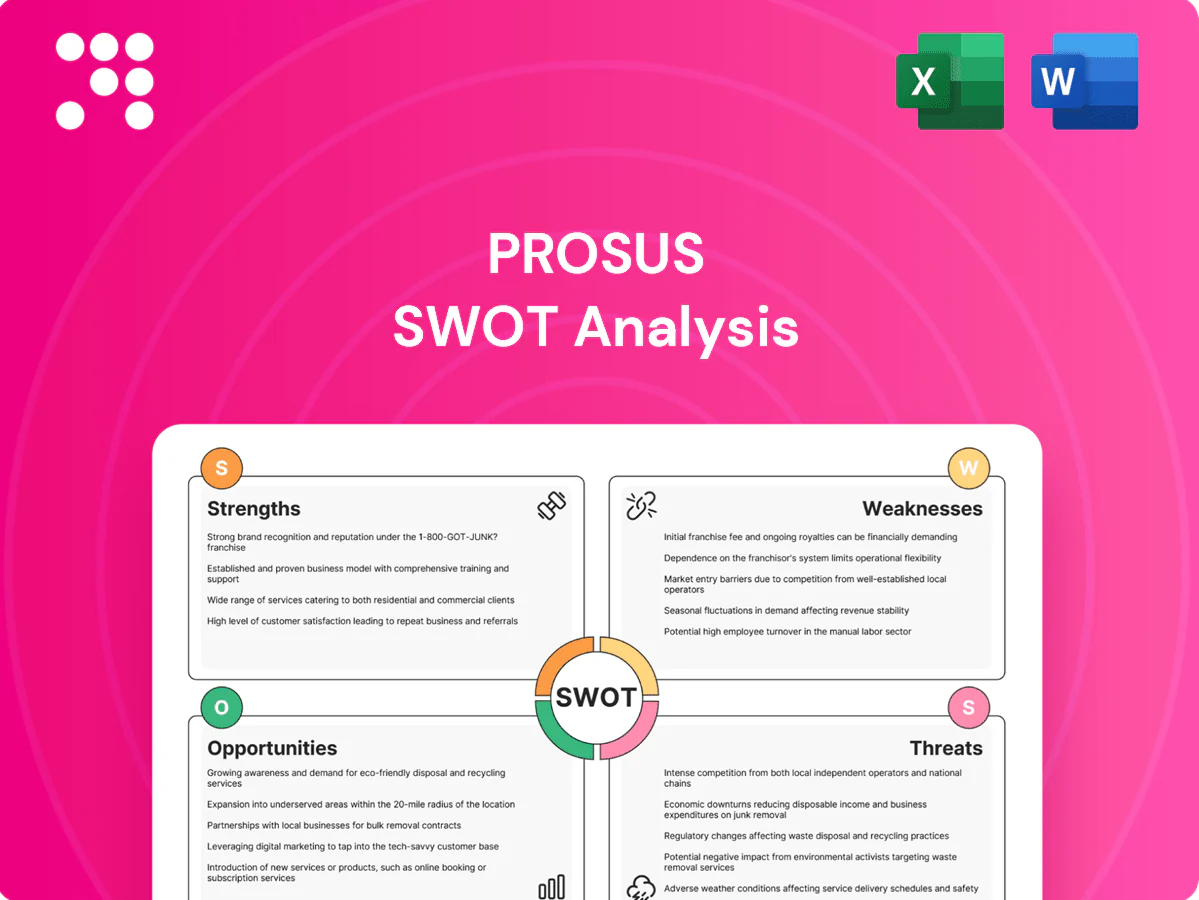
Prosus SWOT Analysis

Make Insightful Decisions Backed by Expert Research
Prosus combines strong global tech investments and deep cash reserves with exposure to fast-growing emerging markets, but faces regulatory scrutiny, market concentration and valuation risk; its growth hinges on portfolio execution and M&A. Purchase the full SWOT analysis for a detailed, editable Word + Excel report to inform investment and strategy decisions.
Strengths

Scale in high-growth internet
Prosus aggregates leading positions across marketplaces, fintech, food delivery and edtech in fast-growing regions (India, Brazil, Southeast Asia, Africa), with a cornerstone ~28.9% stake in Tencent powering scale. Scale accelerates network effects, lowers customer acquisition costs and strengthens bargaining power with partners. iFood commands roughly 75% share in Brazil, illustrating market dominance. A broad footprint diversifies revenue and creates capital reallocation optionality.
Proven investment track record
Prosus has built a proven investment track record over more than 20 years, consistently sourcing, backing and scaling category leaders through disciplined, long-term investing.
It applies deep diligence and repeatable operating playbooks to improve unit economics across portfolio companies, enabling margin expansion and faster path to profitability.
Repeatable exits and partial monetizations fuel capital recycling and the group’s credibility attracts co-investors and top-tier entrepreneurs.

Strategic stakes in global leaders
Prosus holds a marquee ~27% stake in Tencent (2024), a position that historically represented roughly half of group NAV, anchoring valuation and providing liquid optionality.
These strategic stakes deliver secular internet growth exposure without full operating risk while supplying data, partnership flow and market insight across iFood, OLX and PayU.
Dividends or selective sell-downs of such holdings can unlock cash to fund new investments and buyouts.

Operational expertise and synergies
Centralized product, data and growth-marketing teams allow Prosus to scale best practices across its portfolio, accelerating time-to-market and boosting LTV through shared analytics and playbooks. Unified procurement, governance and risk frameworks lower operating costs and strengthen compliance, while structured knowledge transfer speeds execution in new markets. Cross-portfolio collaboration increases retention and monetization via bundled offerings and shared user insights.
- Shared product/data/growth
- Procurement & governance
- Faster market execution
- Improved retention & monetization
Strong balance sheet and capital flexibility
Prosus maintains strong liquidity and diversified funding sources that enhance resilience, enabling counter-cyclical investments and opportunistic buybacks when valuation discounts widen. The group uses structured deals and partial stake disposals to raise capital with limited dilution, while financial flexibility supports scaling high-growth winners and pruning underperformers.
- Liquidity and funding diversity
- Counter-cyclical investing and buybacks
- Structured deals limit dilution
- Flexibility to scale winners/prune losers
Scale network effects via a ~27% stake and ~75% Brazil share
Prosus leverages a ~27% Tencent stake (2024) and market-leading positions in India, Brazil, SEA and Africa to scale network effects and lower CAC. iFood holds ~75% share in Brazil, while repeatable exits and partial monetisations fund new investments. Centralised product, data and procurement teams drive faster market execution and margin expansion.
| Metric | Value |
|---|---|
| Tencent stake | ~27% (2024) |
| iFood Brazil share | ~75% |
| Historic NAV from Tencent | ~50% |
What is included in the product
 Detailed Word Document
Analyzes Prosus’s competitive position through its market strengths, operational weaknesses, strategic growth opportunities, and external threats shaping future performance.

 Customizable Excel Spreadsheet
Provides a concise, visual SWOT summary of Prosus to quickly surface core strengths, weaknesses, opportunities and threats—ideal for fast strategic alignment and decision-making across teams.
Weaknesses

Holding company discount
Prosus’s complex holding structure and multiple minority stakes regularly trade below sum-of-the-parts valuation, with the holding-company discount reported in market commentary typically ranging between 20–40% in recent years. Investors apply a governance and liquidity penalty that can obscure underlying asset value and compress observable multiples across the group. This persistent discount effectively raises the implied cost of equity for new initiatives, making capital raising and deal valuation more expensive.
Concentration in key assets
Concentration in key assets—notably the group’s large Tencent exposure—means performance often moves with a handful of names, amplifying NAV swings and investor sentiment shifts. Volatility in those stakes can cause sharp headline-driven mark-to-market moves. Strategic flexibility may be limited by lock-ups, holding structures and cross-border regulatory constraints. Claimed diversification can evaporate when correlations spike across tech and growth equities.

Exposure to loss-making verticals
Prosus faces exposure to loss-making verticals as its food-delivery and fintech units have required multi-year investment and remain EBITDA-negative in several markets, creating sustained cash burn that constrains capital allocation.

Regulatory complexity across markets
Operating across emerging and developed markets exposes Prosus to heterogeneous rules that raise compliance costs and can delay launches by months; sudden policy shifts in key jurisdictions have previously constrained monetization and asset use, while evolving data-privacy and payments laws create recurring overhead for product teams and legal functions.
- Heterogeneous rules across jurisdictions
- Compliance costs and licensing delays
- Policy shifts can impair assets
- Data privacy and payments add recurring overhead
FX and macro sensitivity
FX and macro sensitivity: Prosus revenues and NAV are exposed to currency swings across high-beta markets (notably India and Brazil) while its largest asset remains the Tencent stake (~27% of group value), amplifying exchange-rate and valuation volatility.
Inflation and rate hikes raise discount rates, pressuring tech multiples and consumer demand in downturns which can reduce take rates; hedging programs only partially mitigate these swings.
- High FX exposure — emerging markets (India, Brazil)
- Major Tencent holding (~27% of value) amplifies FX/NAV moves
- Rate-driven multiple compression hurts tech valuations
- Hedging provides partial, not full, protection
Holding: 20-40% discount; ~27% Tencent raises NAV/FX risk
Prosus suffers a 20–40% holding-company discount, raising its implied cost of equity and compressing multiples. Heavy concentration in Tencent (~27% of group value) amplifies NAV and FX volatility across India/Brazil exposure. Ongoing cash burn from EBITDA-negative food-delivery and fintech units constrains capital deployment. Regulatory fragmentation raises compliance costs and can delay monetization.
| Metric | Value |
|---|---|
| Holding-company discount | 20–40% |
| Tencent share of group value | ~27% |
| Key FX markets | India, Brazil |
Same Document Delivered
Prosus SWOT Analysis
This is the actual Prosus SWOT analysis document you’ll receive upon purchase—no surprises, just professional quality. The preview below is taken directly from the full report you'll get and is fully editable. Purchase unlocks the complete, detailed version immediately after checkout.

Make Insightful Decisions Backed by Expert Research
Prosus combines strong global tech investments and deep cash reserves with exposure to fast-growing emerging markets, but faces regulatory scrutiny, market concentration and valuation risk; its growth hinges on portfolio execution and M&A. Purchase the full SWOT analysis for a detailed, editable Word + Excel report to inform investment and strategy decisions.
Strengths
Scale in high-growth internet
Prosus aggregates leading positions across marketplaces, fintech, food delivery and edtech in fast-growing regions (India, Brazil, Southeast Asia, Africa), with a cornerstone ~28.9% stake in Tencent powering scale. Scale accelerates network effects, lowers customer acquisition costs and strengthens bargaining power with partners. iFood commands roughly 75% share in Brazil, illustrating market dominance. A broad footprint diversifies revenue and creates capital reallocation optionality.
Proven investment track record
Prosus has built a proven investment track record over more than 20 years, consistently sourcing, backing and scaling category leaders through disciplined, long-term investing.
It applies deep diligence and repeatable operating playbooks to improve unit economics across portfolio companies, enabling margin expansion and faster path to profitability.
Repeatable exits and partial monetizations fuel capital recycling and the group’s credibility attracts co-investors and top-tier entrepreneurs.
Strategic stakes in global leaders
Prosus holds a marquee ~27% stake in Tencent (2024), a position that historically represented roughly half of group NAV, anchoring valuation and providing liquid optionality.
These strategic stakes deliver secular internet growth exposure without full operating risk while supplying data, partnership flow and market insight across iFood, OLX and PayU.
Dividends or selective sell-downs of such holdings can unlock cash to fund new investments and buyouts.
Operational expertise and synergies
Centralized product, data and growth-marketing teams allow Prosus to scale best practices across its portfolio, accelerating time-to-market and boosting LTV through shared analytics and playbooks. Unified procurement, governance and risk frameworks lower operating costs and strengthen compliance, while structured knowledge transfer speeds execution in new markets. Cross-portfolio collaboration increases retention and monetization via bundled offerings and shared user insights.
- Shared product/data/growth
- Procurement & governance
- Faster market execution
- Improved retention & monetization
Strong balance sheet and capital flexibility
Prosus maintains strong liquidity and diversified funding sources that enhance resilience, enabling counter-cyclical investments and opportunistic buybacks when valuation discounts widen. The group uses structured deals and partial stake disposals to raise capital with limited dilution, while financial flexibility supports scaling high-growth winners and pruning underperformers.
- Liquidity and funding diversity
- Counter-cyclical investing and buybacks
- Structured deals limit dilution
- Flexibility to scale winners/prune losers
Scale network effects via a ~27% stake and ~75% Brazil share
Prosus leverages a ~27% Tencent stake (2024) and market-leading positions in India, Brazil, SEA and Africa to scale network effects and lower CAC. iFood holds ~75% share in Brazil, while repeatable exits and partial monetisations fund new investments. Centralised product, data and procurement teams drive faster market execution and margin expansion.
| Metric | Value |
|---|---|
| Tencent stake | ~27% (2024) |
| iFood Brazil share | ~75% |
| Historic NAV from Tencent | ~50% |
What is included in the product
Detailed Word Document
Analyzes Prosus’s competitive position through its market strengths, operational weaknesses, strategic growth opportunities, and external threats shaping future performance.
Customizable Excel Spreadsheet
Provides a concise, visual SWOT summary of Prosus to quickly surface core strengths, weaknesses, opportunities and threats—ideal for fast strategic alignment and decision-making across teams.
Weaknesses
Holding company discount
Prosus’s complex holding structure and multiple minority stakes regularly trade below sum-of-the-parts valuation, with the holding-company discount reported in market commentary typically ranging between 20–40% in recent years. Investors apply a governance and liquidity penalty that can obscure underlying asset value and compress observable multiples across the group. This persistent discount effectively raises the implied cost of equity for new initiatives, making capital raising and deal valuation more expensive.
Concentration in key assets
Concentration in key assets—notably the group’s large Tencent exposure—means performance often moves with a handful of names, amplifying NAV swings and investor sentiment shifts. Volatility in those stakes can cause sharp headline-driven mark-to-market moves. Strategic flexibility may be limited by lock-ups, holding structures and cross-border regulatory constraints. Claimed diversification can evaporate when correlations spike across tech and growth equities.
Exposure to loss-making verticals
Prosus faces exposure to loss-making verticals as its food-delivery and fintech units have required multi-year investment and remain EBITDA-negative in several markets, creating sustained cash burn that constrains capital allocation.
Regulatory complexity across markets
Operating across emerging and developed markets exposes Prosus to heterogeneous rules that raise compliance costs and can delay launches by months; sudden policy shifts in key jurisdictions have previously constrained monetization and asset use, while evolving data-privacy and payments laws create recurring overhead for product teams and legal functions.
- Heterogeneous rules across jurisdictions
- Compliance costs and licensing delays
- Policy shifts can impair assets
- Data privacy and payments add recurring overhead
FX and macro sensitivity
FX and macro sensitivity: Prosus revenues and NAV are exposed to currency swings across high-beta markets (notably India and Brazil) while its largest asset remains the Tencent stake (~27% of group value), amplifying exchange-rate and valuation volatility.
Inflation and rate hikes raise discount rates, pressuring tech multiples and consumer demand in downturns which can reduce take rates; hedging programs only partially mitigate these swings.
- High FX exposure — emerging markets (India, Brazil)
- Major Tencent holding (~27% of value) amplifies FX/NAV moves
- Rate-driven multiple compression hurts tech valuations
- Hedging provides partial, not full, protection
Holding: 20-40% discount; ~27% Tencent raises NAV/FX risk
Prosus suffers a 20–40% holding-company discount, raising its implied cost of equity and compressing multiples. Heavy concentration in Tencent (~27% of group value) amplifies NAV and FX volatility across India/Brazil exposure. Ongoing cash burn from EBITDA-negative food-delivery and fintech units constrains capital deployment. Regulatory fragmentation raises compliance costs and can delay monetization.
| Metric | Value |
|---|---|
| Holding-company discount | 20–40% |
| Tencent share of group value | ~27% |
| Key FX markets | India, Brazil |
Same Document Delivered
Prosus SWOT Analysis
This is the actual Prosus SWOT analysis document you’ll receive upon purchase—no surprises, just professional quality. The preview below is taken directly from the full report you'll get and is fully editable. Purchase unlocks the complete, detailed version immediately after checkout.
Original: $10.00
-65%$10.00
$3.50Description
Make Insightful Decisions Backed by Expert Research
Prosus combines strong global tech investments and deep cash reserves with exposure to fast-growing emerging markets, but faces regulatory scrutiny, market concentration and valuation risk; its growth hinges on portfolio execution and M&A. Purchase the full SWOT analysis for a detailed, editable Word + Excel report to inform investment and strategy decisions.
Strengths
Scale in high-growth internet
Prosus aggregates leading positions across marketplaces, fintech, food delivery and edtech in fast-growing regions (India, Brazil, Southeast Asia, Africa), with a cornerstone ~28.9% stake in Tencent powering scale. Scale accelerates network effects, lowers customer acquisition costs and strengthens bargaining power with partners. iFood commands roughly 75% share in Brazil, illustrating market dominance. A broad footprint diversifies revenue and creates capital reallocation optionality.
Proven investment track record
Prosus has built a proven investment track record over more than 20 years, consistently sourcing, backing and scaling category leaders through disciplined, long-term investing.
It applies deep diligence and repeatable operating playbooks to improve unit economics across portfolio companies, enabling margin expansion and faster path to profitability.
Repeatable exits and partial monetizations fuel capital recycling and the group’s credibility attracts co-investors and top-tier entrepreneurs.
Strategic stakes in global leaders
Prosus holds a marquee ~27% stake in Tencent (2024), a position that historically represented roughly half of group NAV, anchoring valuation and providing liquid optionality.
These strategic stakes deliver secular internet growth exposure without full operating risk while supplying data, partnership flow and market insight across iFood, OLX and PayU.
Dividends or selective sell-downs of such holdings can unlock cash to fund new investments and buyouts.
Operational expertise and synergies
Centralized product, data and growth-marketing teams allow Prosus to scale best practices across its portfolio, accelerating time-to-market and boosting LTV through shared analytics and playbooks. Unified procurement, governance and risk frameworks lower operating costs and strengthen compliance, while structured knowledge transfer speeds execution in new markets. Cross-portfolio collaboration increases retention and monetization via bundled offerings and shared user insights.
- Shared product/data/growth
- Procurement & governance
- Faster market execution
- Improved retention & monetization
Strong balance sheet and capital flexibility
Prosus maintains strong liquidity and diversified funding sources that enhance resilience, enabling counter-cyclical investments and opportunistic buybacks when valuation discounts widen. The group uses structured deals and partial stake disposals to raise capital with limited dilution, while financial flexibility supports scaling high-growth winners and pruning underperformers.
- Liquidity and funding diversity
- Counter-cyclical investing and buybacks
- Structured deals limit dilution
- Flexibility to scale winners/prune losers
Scale network effects via a ~27% stake and ~75% Brazil share
Prosus leverages a ~27% Tencent stake (2024) and market-leading positions in India, Brazil, SEA and Africa to scale network effects and lower CAC. iFood holds ~75% share in Brazil, while repeatable exits and partial monetisations fund new investments. Centralised product, data and procurement teams drive faster market execution and margin expansion.
| Metric | Value |
|---|---|
| Tencent stake | ~27% (2024) |
| iFood Brazil share | ~75% |
| Historic NAV from Tencent | ~50% |
What is included in the product
Detailed Word Document
Analyzes Prosus’s competitive position through its market strengths, operational weaknesses, strategic growth opportunities, and external threats shaping future performance.
Customizable Excel Spreadsheet
Provides a concise, visual SWOT summary of Prosus to quickly surface core strengths, weaknesses, opportunities and threats—ideal for fast strategic alignment and decision-making across teams.
Weaknesses
Holding company discount
Prosus’s complex holding structure and multiple minority stakes regularly trade below sum-of-the-parts valuation, with the holding-company discount reported in market commentary typically ranging between 20–40% in recent years. Investors apply a governance and liquidity penalty that can obscure underlying asset value and compress observable multiples across the group. This persistent discount effectively raises the implied cost of equity for new initiatives, making capital raising and deal valuation more expensive.
Concentration in key assets
Concentration in key assets—notably the group’s large Tencent exposure—means performance often moves with a handful of names, amplifying NAV swings and investor sentiment shifts. Volatility in those stakes can cause sharp headline-driven mark-to-market moves. Strategic flexibility may be limited by lock-ups, holding structures and cross-border regulatory constraints. Claimed diversification can evaporate when correlations spike across tech and growth equities.
Exposure to loss-making verticals
Prosus faces exposure to loss-making verticals as its food-delivery and fintech units have required multi-year investment and remain EBITDA-negative in several markets, creating sustained cash burn that constrains capital allocation.
Regulatory complexity across markets
Operating across emerging and developed markets exposes Prosus to heterogeneous rules that raise compliance costs and can delay launches by months; sudden policy shifts in key jurisdictions have previously constrained monetization and asset use, while evolving data-privacy and payments laws create recurring overhead for product teams and legal functions.
- Heterogeneous rules across jurisdictions
- Compliance costs and licensing delays
- Policy shifts can impair assets
- Data privacy and payments add recurring overhead
FX and macro sensitivity
FX and macro sensitivity: Prosus revenues and NAV are exposed to currency swings across high-beta markets (notably India and Brazil) while its largest asset remains the Tencent stake (~27% of group value), amplifying exchange-rate and valuation volatility.
Inflation and rate hikes raise discount rates, pressuring tech multiples and consumer demand in downturns which can reduce take rates; hedging programs only partially mitigate these swings.
- High FX exposure — emerging markets (India, Brazil)
- Major Tencent holding (~27% of value) amplifies FX/NAV moves
- Rate-driven multiple compression hurts tech valuations
- Hedging provides partial, not full, protection
Holding: 20-40% discount; ~27% Tencent raises NAV/FX risk
Prosus suffers a 20–40% holding-company discount, raising its implied cost of equity and compressing multiples. Heavy concentration in Tencent (~27% of group value) amplifies NAV and FX volatility across India/Brazil exposure. Ongoing cash burn from EBITDA-negative food-delivery and fintech units constrains capital deployment. Regulatory fragmentation raises compliance costs and can delay monetization.
| Metric | Value |
|---|---|
| Holding-company discount | 20–40% |
| Tencent share of group value | ~27% |
| Key FX markets | India, Brazil |
Same Document Delivered
Prosus SWOT Analysis
This is the actual Prosus SWOT analysis document you’ll receive upon purchase—no surprises, just professional quality. The preview below is taken directly from the full report you'll get and is fully editable. Purchase unlocks the complete, detailed version immediately after checkout.











